
ICPOES Instrumental Analysis of Beryllium Particulates Whitney Coffey
ICP-OES Instrumental Analysis of Beryllium Particulates Whitney Coffey
ICP-OES…? Inductively Coupled Plasma-Optical Emission Spectroscopy
Overview Properties of beryllium Industrial uses of beryllium Health risks Sampling methods Instrumental analysis (ICP-OES)
Physical Characteristics of Beryllium: Atomic Number: 4 Atomic Weight: 9. 012 Solid at room temperature Period Number: 2 Group Name: Alkaline Earth Metals Good thermal conductor Good electrical conductor Non-magnetic metal Melting Point: 1560 K Boiling Point: 2744 K Density: 1. 85 g/cm 3 Extremely lightweight, yet very stiff Sources of Beryllium: Found in approximately 30 mineral species; the most significant sources are beryl and bertrandite Aquamarine and emerald are precious forms of beryl
Beryllium has many industrial uses. These include: Aerospace Space shuttle components Structural material for high-speed aircraft and missiles Atomic Energy Nuclear weapons components Nuclear reactor components Ceramics Crucibles Ignition modules Jet engine blades Semi-conductor chips Electronics Computer parts Telecommunication parts Transistors Metallurgy Aluminum-, copper-, magnesium-, and nickel-beryllium alloys

So why analyze for beryllium particulates? Beryllium-related health issues
Beryllium Related Health Risks Beryllium is safe in natural state and in finished products Beryllium dust or fumes are unsafe, and can cause illness: Lungs primarily affected Other organs may also be affected 1 related condition: Beryllium Sensitization 2 beryllium-related illnesses: Chronic Beryllium Disease Acute Beryllium Disease
Beryllium Sensitization Immune response: After an individual inhales beryllium dust or fumes, the immune system may see the element as a foreign invader Cells accumulate in the bloodstream, prepared to mount an attack against any beryllium particles encountered No outward symptoms Diagnosis: Be. LPT test (beryllium lymphocyte proliferation test): Blood test to identify immune response to beryllium Highly specific – beryllium only cause of immune response Normal result: rules out beryllium sensitization as well as CBD
Chronic Beryllium Disease (CBD) Scarring of the lungs that results from immune system attacking foreign beryllium particles Symptoms: Shortness of breath during activity Persistent dry cough Fatigue Chest and joint pain Increasing loss of appetite *Symptoms can take a decade or more to develop Diagnosis: Abnormal Be. LPT test Further testing, including: Chest x-ray Pulmonary function testing Blood work Exercise tolerance testing Bronchoscopy with possible biopsy
Acute Beryllium Disease (ABD) Caused by high dose exposure to dust or fumes Common symptoms: nausea fatigue night sweats cough breathing difficulties Onset of symptoms is usually immediate, occasionally delayed a few days following exposure Cases of acute beryllium disease have become quite rare, thanks to improved safety procedures in the workplace
Beryllium sampling methods Two general sampling methods are currently in use: Air sampling Wipe sampling Air Sampling A measured volume of air is drawn through a filter - inhalable dust sampler Filter and any collected sample then digested and prepared for instrumental analysis Air sampling rates are typically identified in liters per hour Wipe Sampling Method for sampling smooth surfaces Analyst can choose appropriate size for the sampling area per wipe cm 2 is a suitable frame of measurement Two methods: Dry wipe sampling Wet wipe sampling
Dry Wipe Sampling May be required for some surfaces that: Can be damaged or compromised by moisture Can be damaged by specific compounds used to moisten the wipes *Cautionary note: Dry wipes remove only a fraction of the residue from a surface as wetted wipes do - if wetted wipes can be used without compromising the sampling surface, they are the preferred choice. Wet Wipe Sampling Moistened wipes remove greater percentage of residues than dry wipes Wipes typically moistened with: Distilled water Methanol methanol-wetted wipes have proven most efficient * In any of the above methods, the collected samples are subjected to an acid digestion, resulting in a liquid sample that can be analyzed via ICP-OES*
ICP-OES Brief definition Instrument components and functions Particulate Analysis Spectral interferences MSF: correction software for spectral interferences
What is ICP-OES? ICP-OES, or inductively coupled plasma optical emission spectroscopy, is a multielement technique featuring: Moderately low detection limits (~0. 2 -100 ppb) Variety of sampling options for organic or liquid matrices Ability to run up to 60 samples in a single run time of <1 min Few chemical interferences Some spectral interferences that can be corrected via software ICP source for more complete dissociation of samples Basic function of ICP-OES: Atoms of the sample in the ICP plasma emit photons Photons of each element have characteristic wavelength Photon emission recorded by optical spectrometer Photons emission calibrated against standard emissions Provides quantitative results of sample
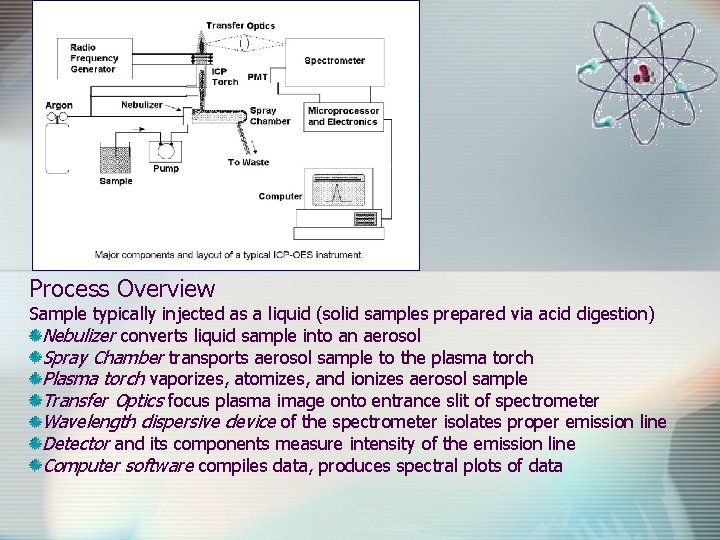
Process Overview Sample typically injected as a liquid (solid samples prepared via acid digestion) Nebulizer converts liquid sample into an aerosol Spray Chamber transports aerosol sample to the plasma torch Plasma torch vaporizes, atomizes, and ionizes aerosol sample Transfer Optics focus plasma image onto entrance slit of spectrometer Wavelength dispersive device of the spectrometer isolates proper emission line Detector and its components measure intensity of the emission line Computer software compiles data, produces spectral plots of data
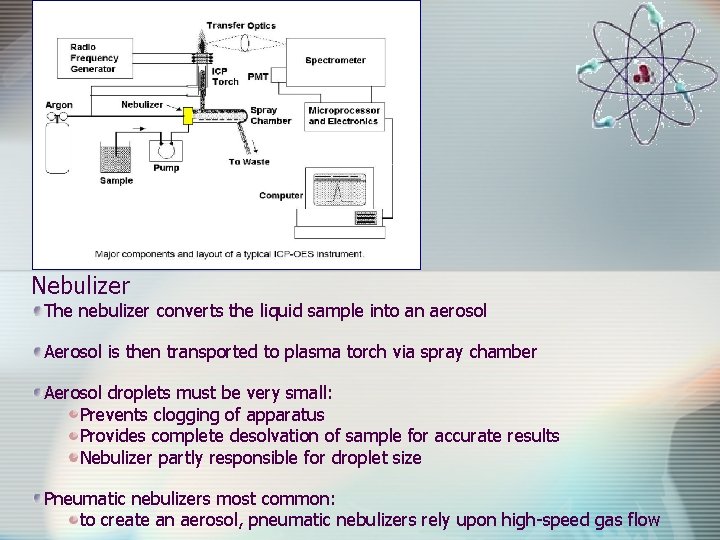
Nebulizer The nebulizer converts the liquid sample into an aerosol Aerosol is then transported to plasma torch via spray chamber Aerosol droplets must be very small: Prevents clogging of apparatus Provides complete desolvation of sample for accurate results Nebulizer partly responsible for droplet size Pneumatic nebulizers most common: to create an aerosol, pneumatic nebulizers rely upon high-speed gas flow
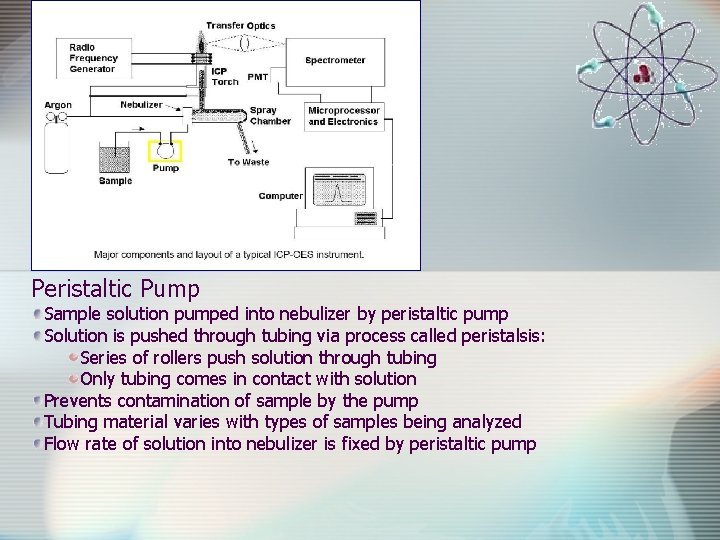
Peristaltic Pump Sample solution pumped into nebulizer by peristaltic pump Solution is pushed through tubing via process called peristalsis: Series of rollers push solution through tubing Only tubing comes in contact with solution Prevents contamination of sample by the pump Tubing material varies with types of samples being analyzed Flow rate of solution into nebulizer is fixed by peristaltic pump
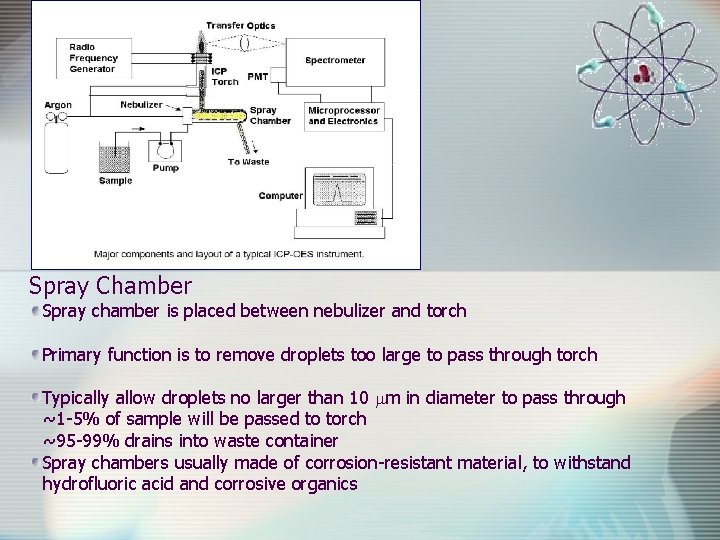
Spray Chamber Spray chamber is placed between nebulizer and torch Primary function is to remove droplets too large to pass through torch Typically allow droplets no larger than 10 m in diameter to pass through ~1 -5% of sample will be passed to torch ~95 -99% drains into waste container Spray chambers usually made of corrosion-resistant material, to withstand hydrofluoric acid and corrosive organics
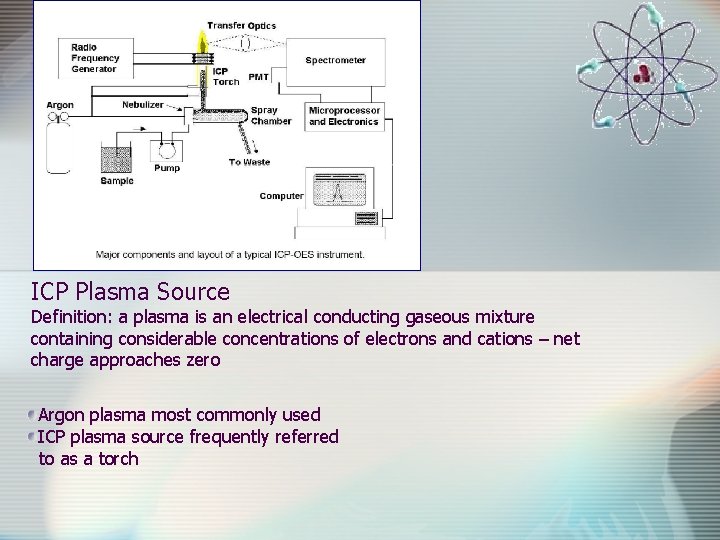
ICP Plasma Source Definition: a plasma is an electrical conducting gaseous mixture containing considerable concentrations of electrons and cations – net charge approaches zero Argon plasma most commonly used ICP plasma source frequently referred to as a torch
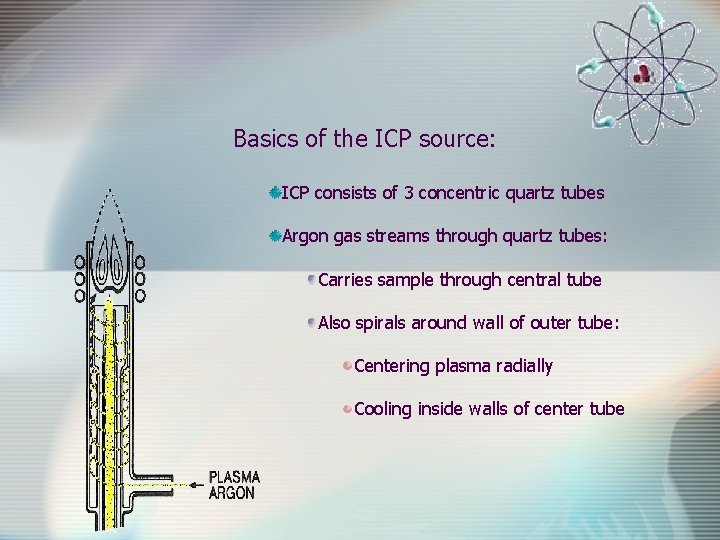
Basics of the ICP source: ICP consists of 3 concentric quartz tubes Argon gas streams through quartz tubes: Carries sample through central tube Also spirals around wall of outer tube: Centering plasma radially Cooling inside walls of center tube
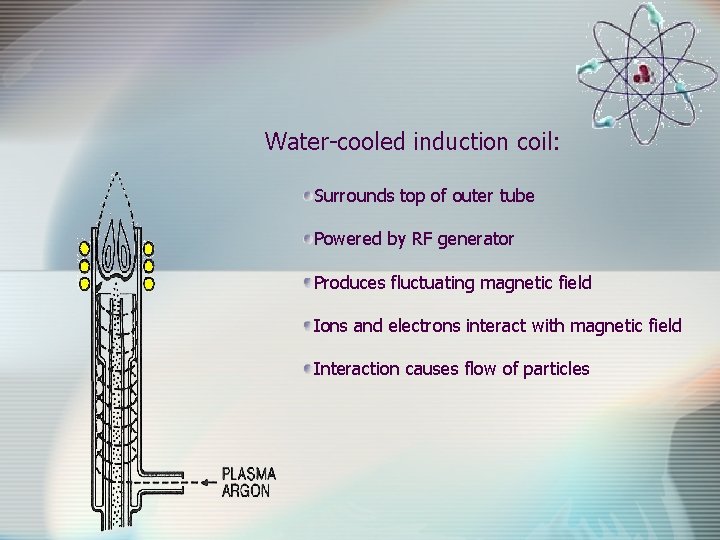
Water-cooled induction coil: Surrounds top of outer tube Powered by RF generator Produces fluctuating magnetic field Ions and electrons interact with magnetic field Interaction causes flow of particles
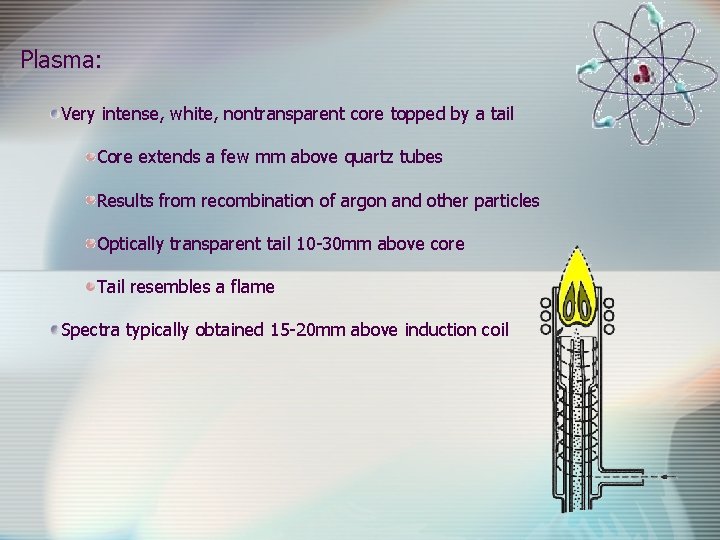
Plasma: Very intense, white, nontransparent core topped by a tail Core extends a few mm above quartz tubes Results from recombination of argon and other particles Optically transparent tail 10 -30 mm above core Tail resembles a flame Spectra typically obtained 15 -20 mm above induction coil
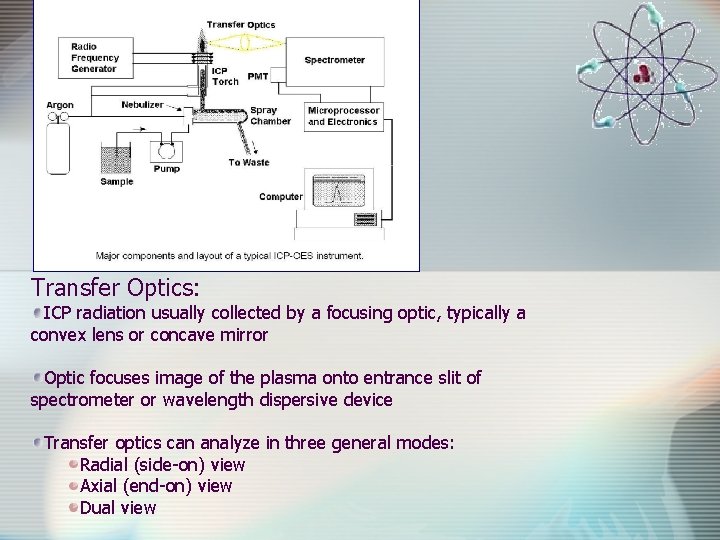
Transfer Optics: ICP radiation usually collected by a focusing optic, typically a convex lens or concave mirror Optic focuses image of the plasma onto entrance slit of spectrometer or wavelength dispersive device Transfer optics can analyze in three general modes: Radial (side-on) view Axial (end-on) view Dual view
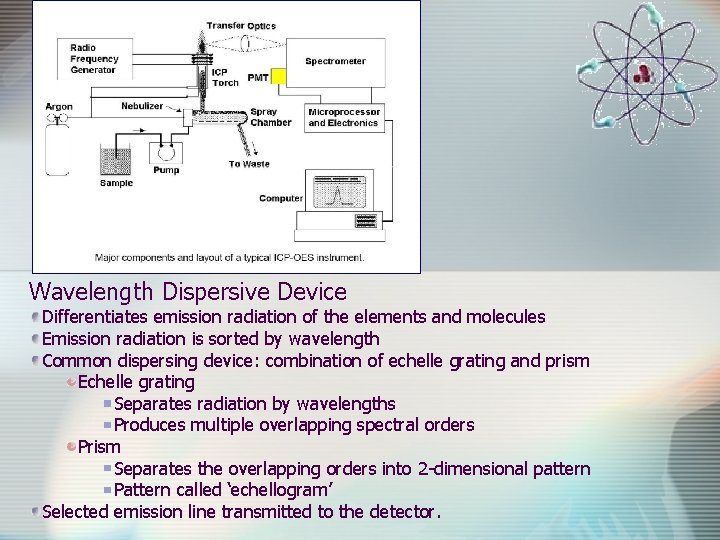
Wavelength Dispersive Device Differentiates emission radiation of the elements and molecules Emission radiation is sorted by wavelength Common dispersing device: combination of echelle grating and prism Echelle grating Separates radiation by wavelengths Produces multiple overlapping spectral orders Prism Separates the overlapping orders into 2 -dimensional pattern Pattern called ‘echellogram’ Selected emission line transmitted to the detector.
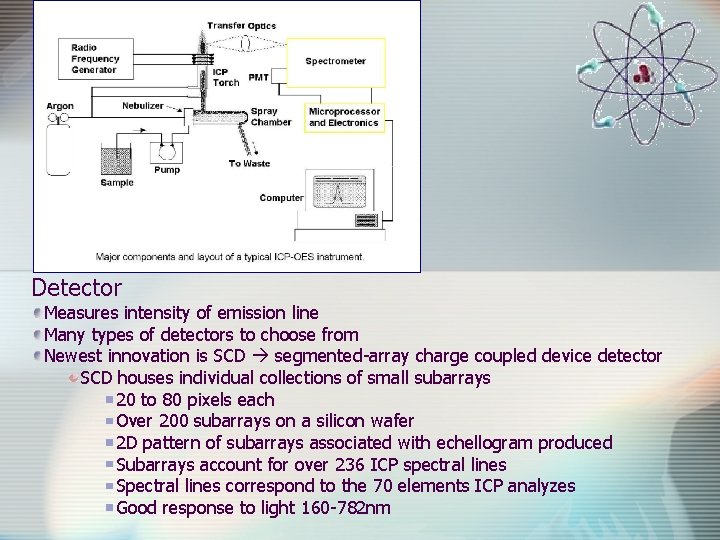
Detector Measures intensity of emission line Many types of detectors to choose from Newest innovation is SCD segmented-array charge coupled device detector SCD houses individual collections of small subarrays 20 to 80 pixels each Over 200 subarrays on a silicon wafer 2 D pattern of subarrays associated with echellogram produced Subarrays account for over 236 ICP spectral lines Spectral lines correspond to the 70 elements ICP analyzes Good response to light 160 -782 nm
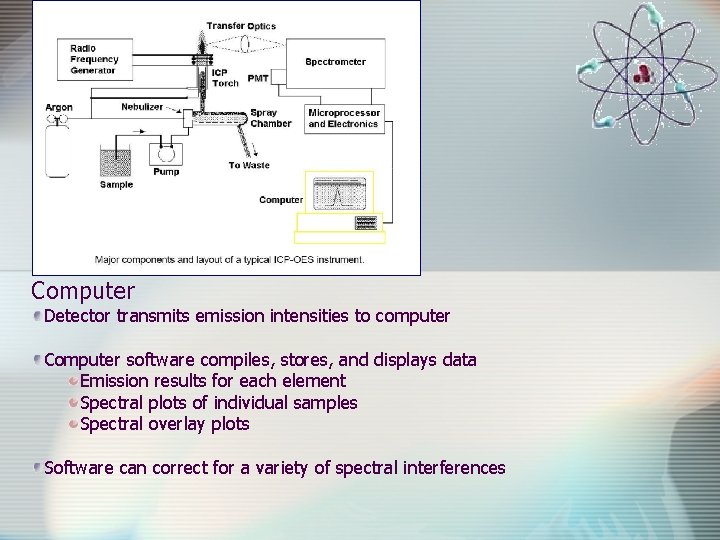
Computer Detector transmits emission intensities to computer Computer software compiles, stores, and displays data Emission results for each element Spectral plots of individual samples Spectral overlay plots Software can correct for a variety of spectral interferences
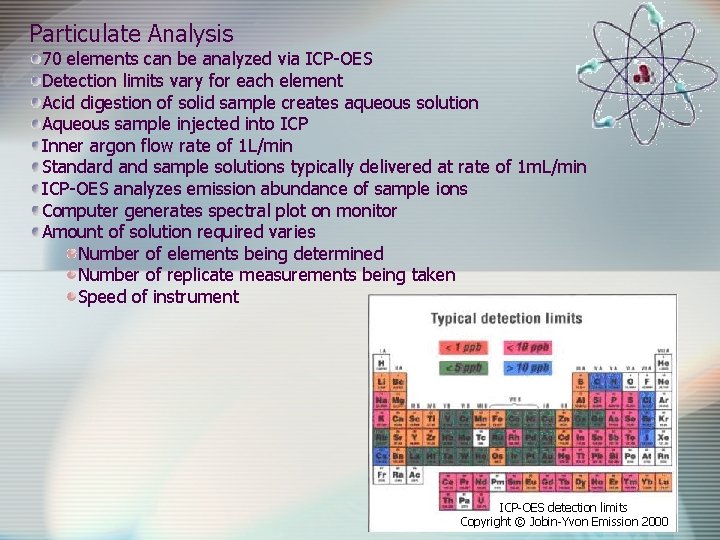
Particulate Analysis 70 elements can be analyzed via ICP-OES Detection limits vary for each element Acid digestion of solid sample creates aqueous solution Aqueous sample injected into ICP Inner argon flow rate of 1 L/min Standard and sample solutions typically delivered at rate of 1 m. L/min ICP-OES analyzes emission abundance of sample ions Computer generates spectral plot on monitor Amount of solution required varies Number of elements being determined Number of replicate measurements being taken Speed of instrument ICP-OES detection limits Copyright © Jobin-Yvon Emission 2000
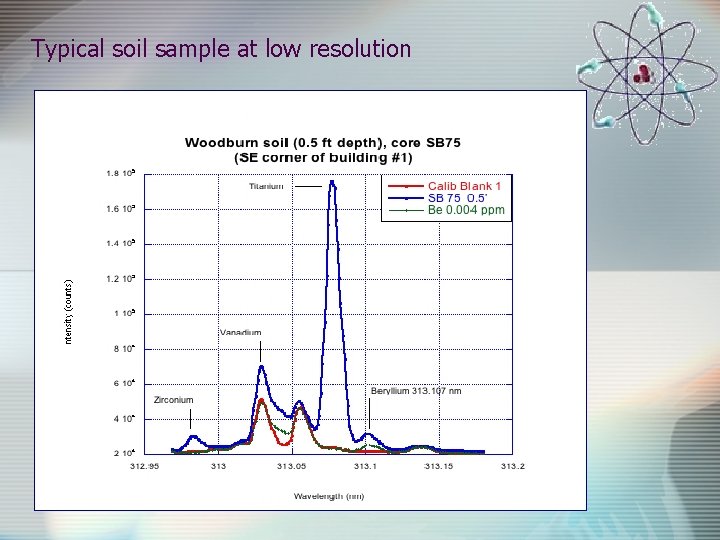
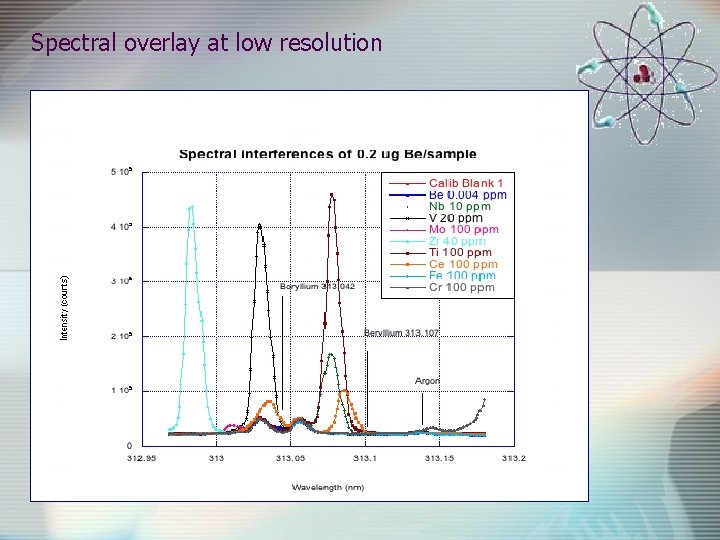
Beryllium Particulates ICP-OES LOD for beryllium < 1 ppb DOE sets beryllium baseline at 0. 004 ppm for analyses Beryllium crustal abundance 1. 6 ppm: above this considered “hit” Wavelengths for beryllium analysis: Be 313. 042 Be 313. 107 Subarray used for beryllium analysis: 312. 968 – 313. 180 Computer plots spectrum of emission abundance for beryllium ions in subarray Calibration blank run with sample In specified subarray: 2 hydroxyl peaks 1 argon peak 2 beryllium peaks
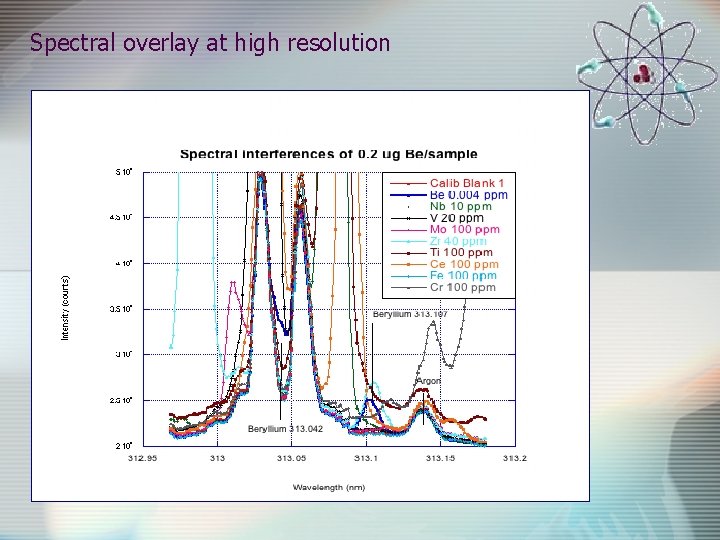
Spectral Interferences Several elements cause spectral interference in designated subarray: Zirconium Vanadium Cerium Titanium Niobium Molybdenum Chromium Emission from these elements can hide emission abundance of beryllium, producing false positives or false negatives Standards of known concentration analyzed along with sample MSF applied
Spectral Correction – MSF Multi-component spectral fitting Algebra-based software program: Single-element spectra obtained for each interfering element Concentration of analyte calculated using scaling factors Scaling factors calculated using interfering single-element spectra Spectral interferences mathematically eliminated For accurate results, MSF software requires that data be collected in highresolution mode peaks must be resolved at every 0. 001 nm
Typical soil sample at low resolution
Spectral overlay at low resolution
Spectral overlay at high resolution
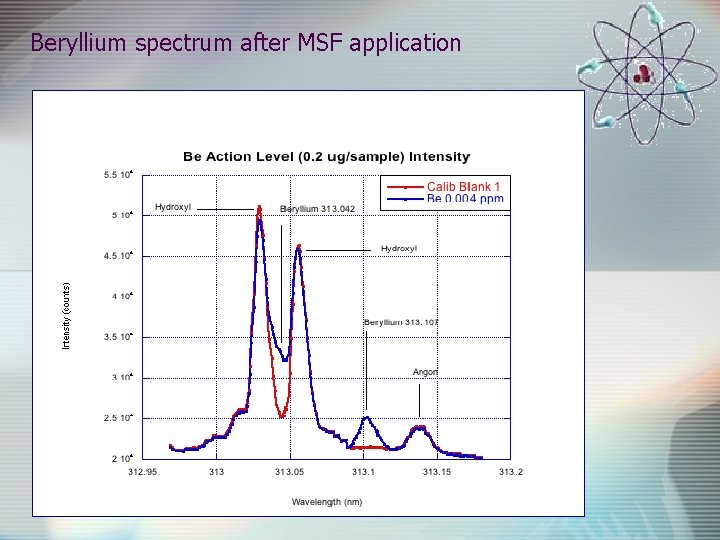
Beryllium spectrum after MSF application
What have we learned? Strong + lightweight + corrosion resistant = good for industry! Fumes + dust = bad for lungs! Conclusion? Find dust and remove it. But how do we find it? Some instruments = poor LOD’s Some instruments = too $$$$ ICP-OES = competitive LOD’s, reasonable cost
Sources National Jewish Medical and Research Center: www. njc. org Optima 5000 DV Series ICP-OES. www. perkinelmer. com Boss, Charles B; Fredeen, Kenneth J. Concepts, Instrumentation, and Techniques in Inductively Coupled Plasma Optical Emission Spectrometry, 2 nd Edition. Perkin-Elmer. 1997. Kriebel D, et al. The pulmonary toxicity of beryllium. Am Rev Respir Dis 1988; 137: 464473. Kreiss K, et al. Risks of beryllium disease related to work processes at a metal, alloy, and oxide production plant. Occup Environ Med 1997; 54: 605 -612. Nolte, Joachim. ICP Emission Spectrometry – A Practical Guide. Chapter 4; Method Development. www. wiley-vch. de Septon, Jerry; Abel, Ray; Simmons, Michael: Metal and Metalloid Particulates in Workplace Atmospheres (ICP Analysis). OSHA Technical Center, www. osha. gov. Sept 2002. Chris’ instrumental book

- Slides: 37