
ICorr YEP Case Study Onshore Titanium Pipe Corrosion
- Slides: 25
ICorr YEP Case Study: Onshore Titanium Pipe Corrosion Failure Team 6 Ross Houston (Mc. Dermott), Joshua Owen (University of Leeds), Sam Shea (KBR) and Josie Watson (Metec) Mentor: Rob Doggett
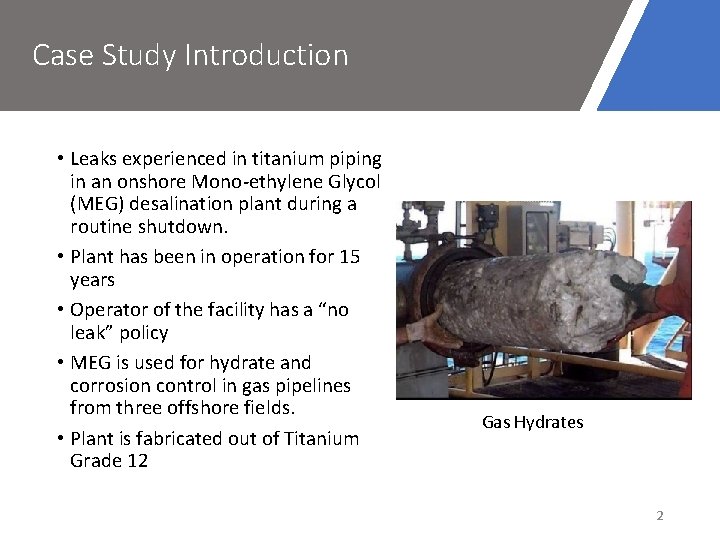
Case Study Introduction • Leaks experienced in titanium piping in an onshore Mono-ethylene Glycol (MEG) desalination plant during a routine shutdown. • Plant has been in operation for 15 years • Operator of the facility has a “no leak” policy • MEG is used for hydrate and corrosion control in gas pipelines from three offshore fields. • Plant is fabricated out of Titanium Grade 12 Gas Hydrates 2
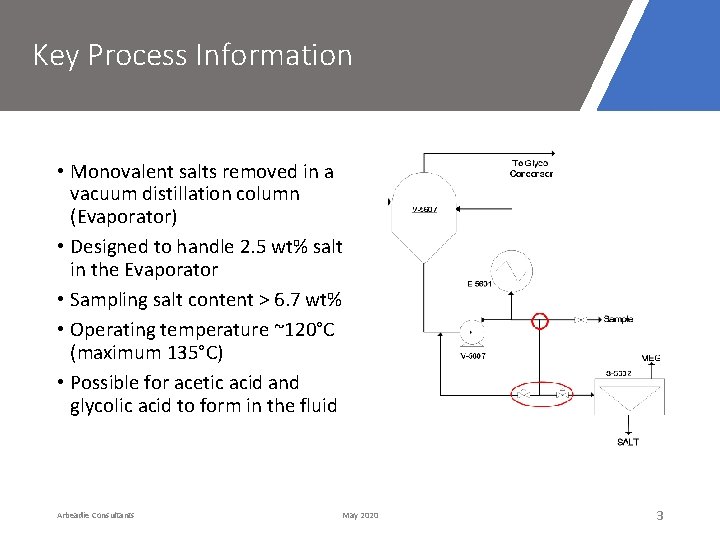
Key Process Information • Monovalent salts removed in a vacuum distillation column (Evaporator) • Designed to handle 2. 5 wt% salt in the Evaporator • Sampling salt content > 6. 7 wt% • Operating temperature ~120°C (maximum 135°C) • Possible for acetic acid and glycolic acid to form in the fluid Arbeadie Consultants May 2020 3
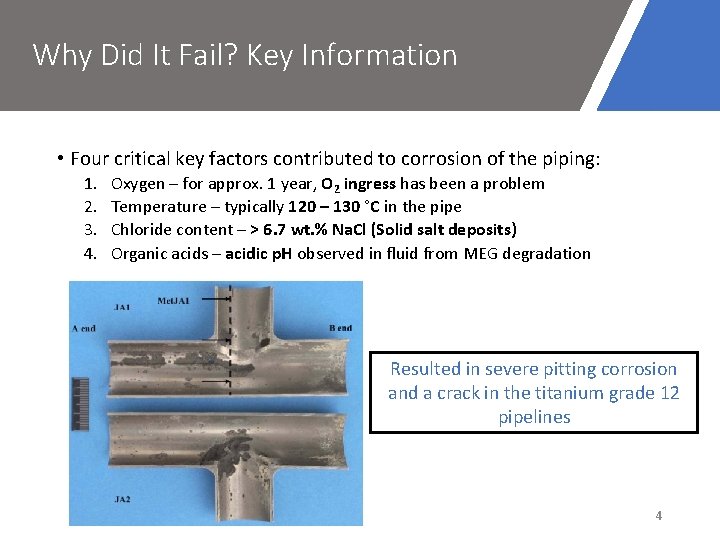
Why Did It Fail? Key Information • Four critical key factors contributed to corrosion of the piping: 1. 2. 3. 4. Oxygen – for approx. 1 year, O 2 ingress has been a problem Temperature – typically 120 – 130 °C in the pipe Chloride content – > 6. 7 wt. % Na. Cl (Solid salt deposits) Organic acids – acidic p. H observed in fluid from MEG degradation Resulted in severe pitting corrosion and a crack in the titanium grade 12 pipelines 4
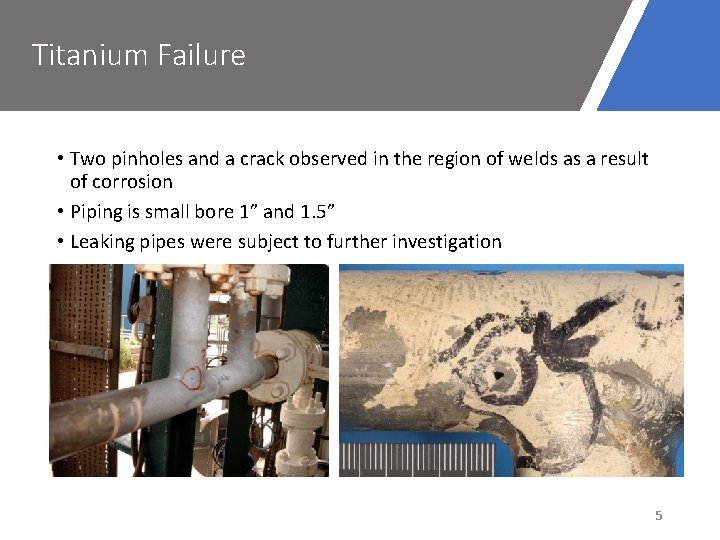
Titanium Failure • Two pinholes and a crack observed in the region of welds as a result of corrosion • Piping is small bore 1” and 1. 5” • Leaking pipes were subject to further investigation 5
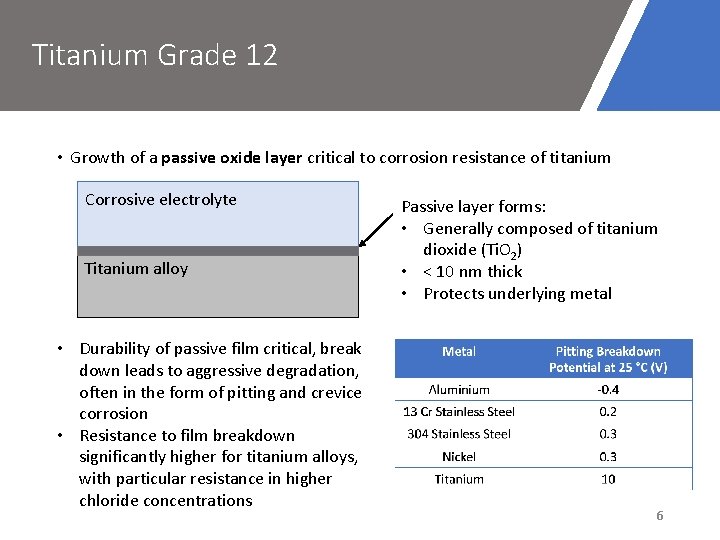
Titanium Grade 12 • Growth of a passive oxide layer critical to corrosion resistance of titanium Corrosive electrolyte Titanium alloy • Durability of passive film critical, break down leads to aggressive degradation, often in the form of pitting and crevice corrosion • Resistance to film breakdown significantly higher for titanium alloys, with particular resistance in higher chloride concentrations Passive layer forms: • Generally composed of titanium dioxide (Ti. O 2) • < 10 nm thick • Protects underlying metal 6
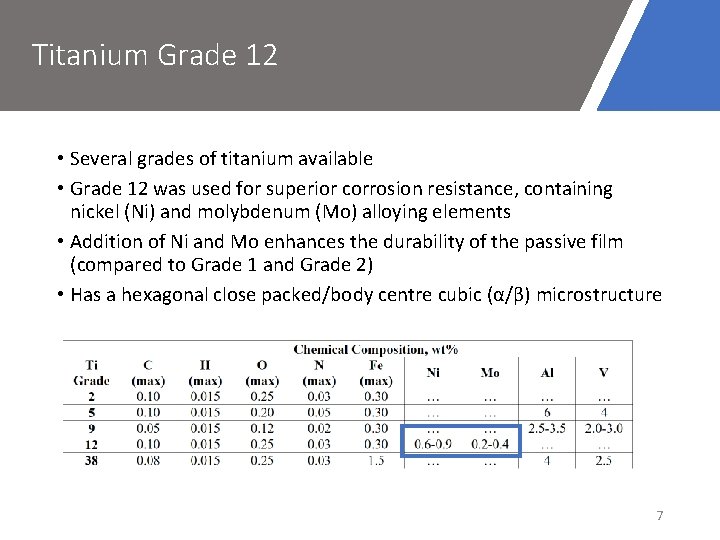
Titanium Grade 12 • Several grades of titanium available • Grade 12 was used for superior corrosion resistance, containing nickel (Ni) and molybdenum (Mo) alloying elements • Addition of Ni and Mo enhances the durability of the passive film (compared to Grade 1 and Grade 2) • Has a hexagonal close packed/body centre cubic (α/β) microstructure 7
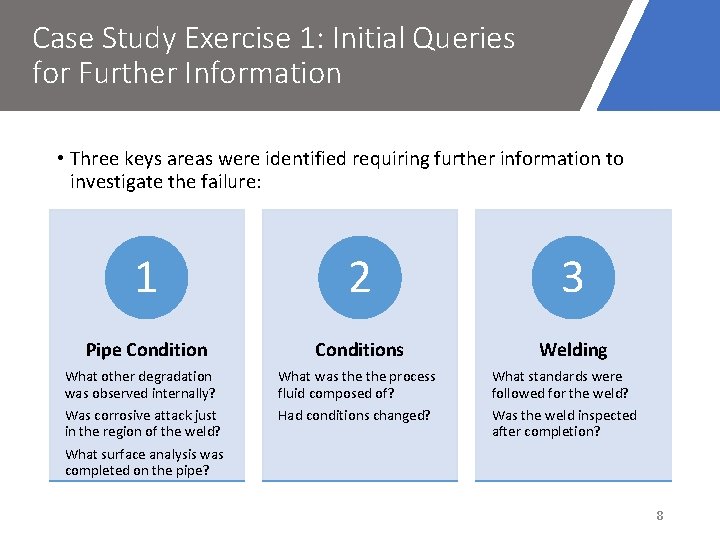
Case Study Exercise 1: Initial Queries for Further Information • Three keys areas were identified requiring further information to investigate the failure: 1 2 3 Pipe Conditions Welding What other degradation was observed internally? Was corrosive attack just in the region of the weld? What was the process fluid composed of? Had conditions changed? What standards were followed for the weld? Was the weld inspected after completion? What surface analysis was completed on the pipe? 8
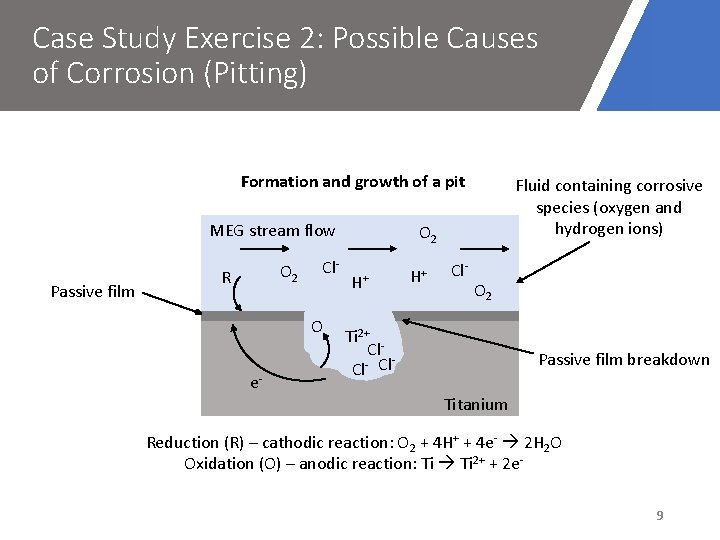
Case Study Exercise 2: Possible Causes of Corrosion (Pitting) Formation and growth of a pit MEG stream flow Passive film O 2 R Cl. O e- Fluid containing corrosive species (oxygen and hydrogen ions) O 2 H+ H+ Cl- O 2 Ti 2+ Cl Cl- Cl Passive film breakdown Titanium Reduction (R) – cathodic reaction: O 2 + 4 H+ + 4 e- 2 H 2 O Oxidation (O) – anodic reaction: Ti 2+ + 2 e 9
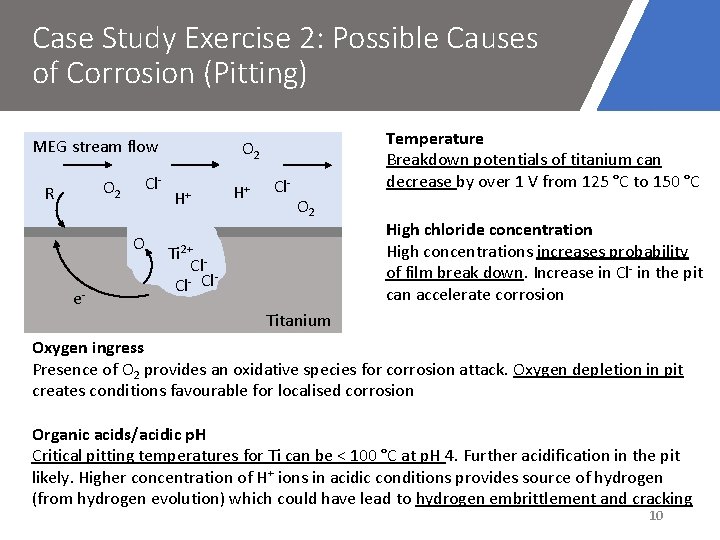
Case Study Exercise 2: Possible Causes of Corrosion (Pitting) MEG stream flow O 2 R Cl. O e- Temperature Breakdown potentials of titanium can decrease by over 1 V from 125 °C to 150 °C O 2 H+ H+ Cl- O 2 Ti 2+ Cl Cl- Cl High chloride concentration High concentrations increases probability of film break down. Increase in Cl- in the pit can accelerate corrosion Titanium Oxygen ingress Presence of O 2 provides an oxidative species for corrosion attack. Oxygen depletion in pit creates conditions favourable for localised corrosion Organic acids/acidic p. H Critical pitting temperatures for Ti can be < 100 °C at p. H 4. Further acidification in the pit likely. Higher concentration of H+ ions in acidic conditions provides source of hydrogen (from hydrogen evolution) which could have lead to hydrogen embrittlement and cracking 10
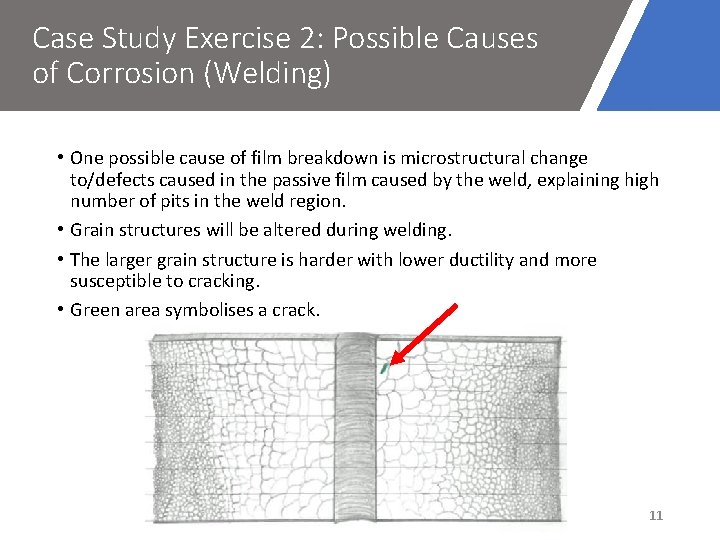
Case Study Exercise 2: Possible Causes of Corrosion (Welding) • One possible cause of film breakdown is microstructural change to/defects caused in the passive film caused by the weld, explaining high number of pits in the weld region. • Grain structures will be altered during welding. • The larger grain structure is harder with lower ductility and more susceptible to cracking. • Green area symbolises a crack. 11
Case Study Exercise 2: Possible Causes of Corrosion (Welding) • Cleanliness is key when welding titanium as it only has a tolerance of 0. 3% oxygen, 0. 15% Nitrogen and 150 parts/million of hydrogen. • A sufficient gas shield should be used. • The room should be atmospherically controlled. • Air velocity should be low enough to not cause any disturbances to the shielding gas. • All tools and workspaces should be cleaned. • Heat input should be low/high enough for the thickness of the material. 12
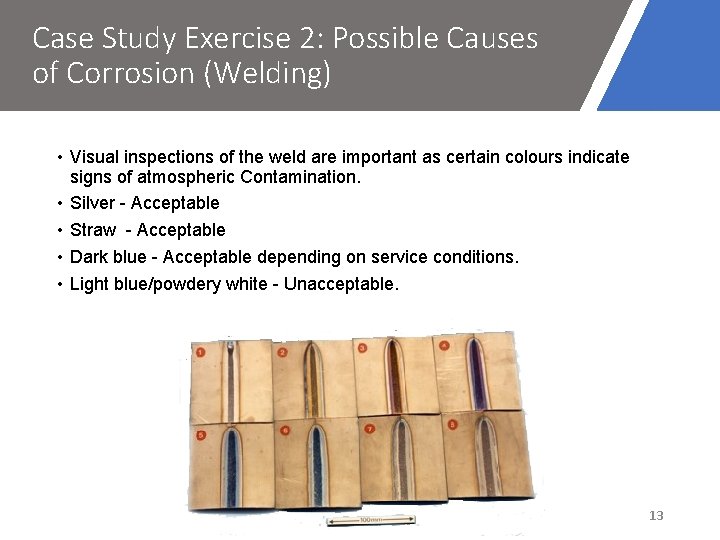
Case Study Exercise 2: Possible Causes of Corrosion (Welding) • Visual inspections of the weld are important as certain colours indicate signs of atmospheric Contamination. • Silver - Acceptable • Straw - Acceptable • Dark blue - Acceptable depending on service conditions. • Light blue/powdery white - Unacceptable. 13
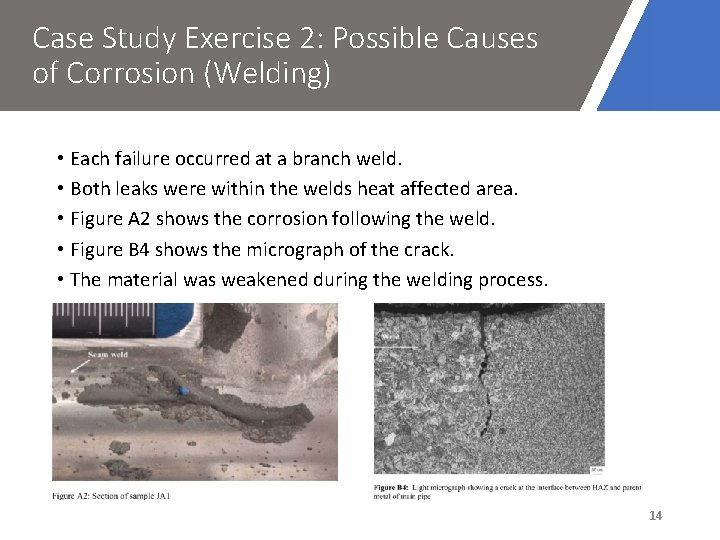
Case Study Exercise 2: Possible Causes of Corrosion (Welding) • Each failure occurred at a branch weld. • Both leaks were within the welds heat affected area. • Figure A 2 shows the corrosion following the weld. • Figure B 4 shows the micrograph of the crack. • The material was weakened during the welding process. 14
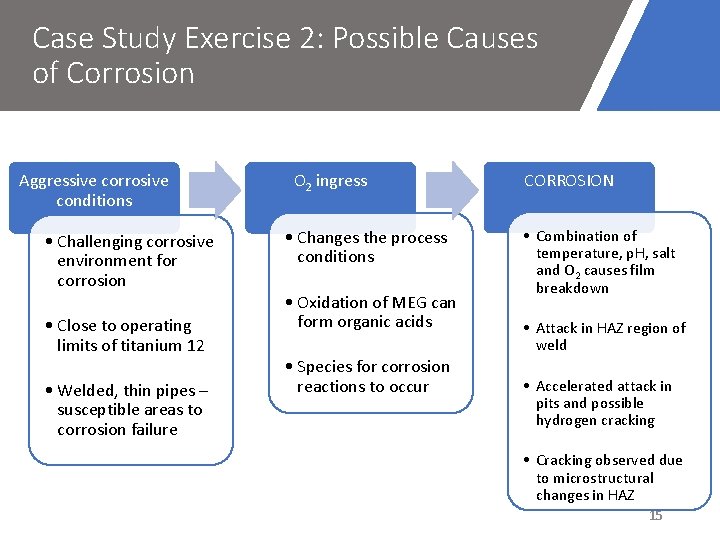
Case Study Exercise 2: Possible Causes of Corrosion Aggressive corrosive conditions • Challenging corrosive environment for corrosion • Close to operating limits of titanium 12 • Welded, thin pipes – susceptible areas to corrosion failure O 2 ingress • Changes the process conditions • Oxidation of MEG can form organic acids • Species for corrosion reactions to occur CORROSION • Combination of temperature, p. H, salt and O 2 causes film breakdown • Attack in HAZ region of weld • Accelerated attack in pits and possible hydrogen cracking • Cracking observed due to microstructural changes in HAZ 15
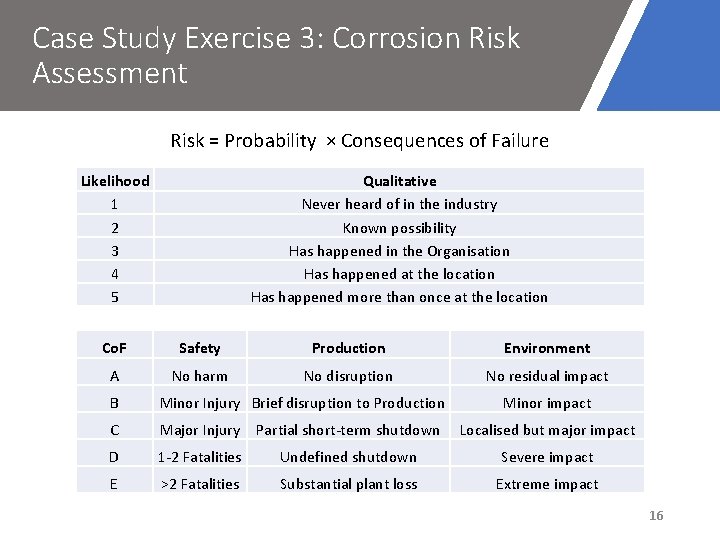
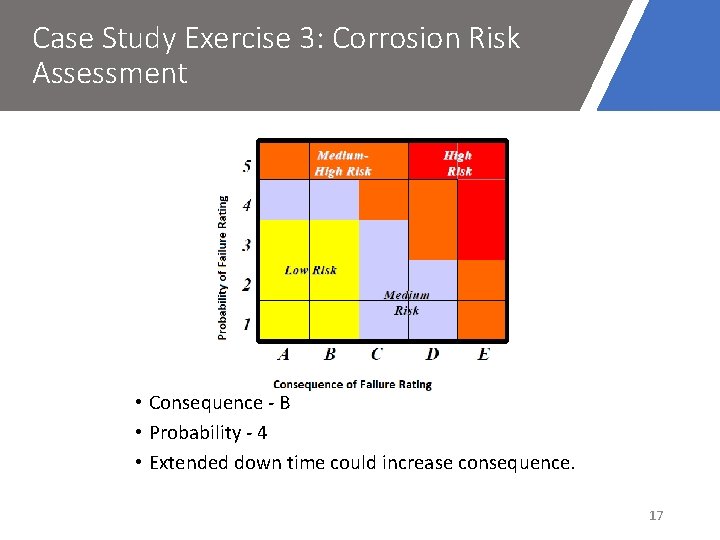
Case Study Exercise 3: Corrosion Risk Assessment Risk = Probability × Consequences of Failure Likelihood 1 2 3 4 5 Qualitative Never heard of in the industry Known possibility Has happened in the Organisation Has happened at the location Has happened more than once at the location Co. F Safety Production Environment A No harm No disruption No residual impact B Minor Injury Brief disruption to Production Minor impact C Major Injury Partial short-term shutdown Localised but major impact D 1 -2 Fatalities Undefined shutdown Severe impact E >2 Fatalities Substantial plant loss Extreme impact 16
Case Study Exercise 3: Corrosion Risk Assessment • Consequence - B • Probability - 4 • Extended down time could increase consequence. 17
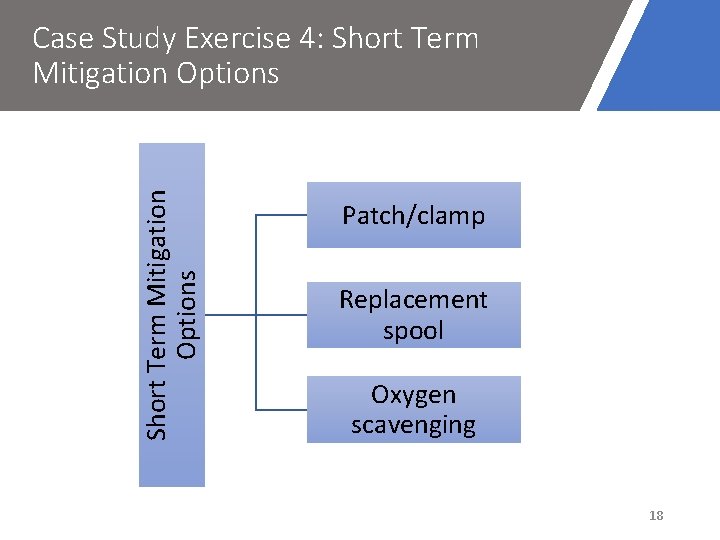
Short Term Mitigation Options Case Study Exercise 4: Short Term Mitigation Options Patch/clamp Replacement spool Oxygen scavenging 18
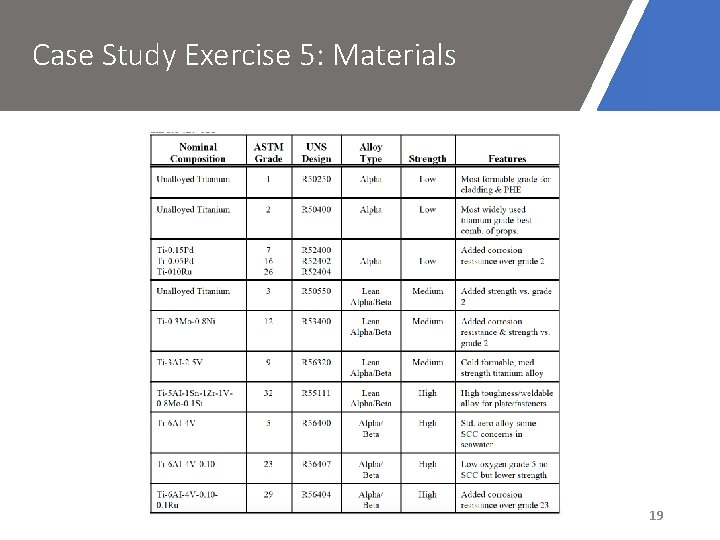
Case Study Exercise 5: Materials 19
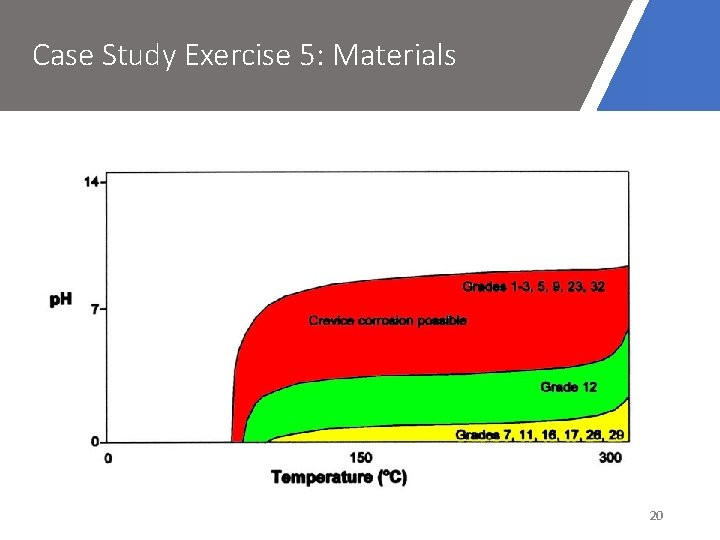
Case Study Exercise 5: Materials 20
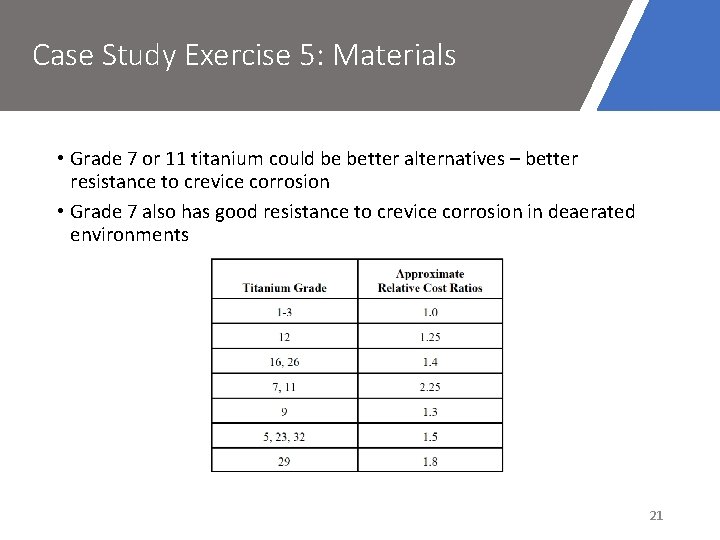
Case Study Exercise 5: Materials • Grade 7 or 11 titanium could be better alternatives – better resistance to crevice corrosion • Grade 7 also has good resistance to crevice corrosion in deaerated environments 21
Case Study Exercise 5: Materials • GRP (or GRP-lined) pipe possible alternatives • Removes galvanic corrosion chemistry • Cost ~1. 9 x carbon steel • Would be good option for new plant – offers reduced OPEX • Less financially beneficial for brownfield 22
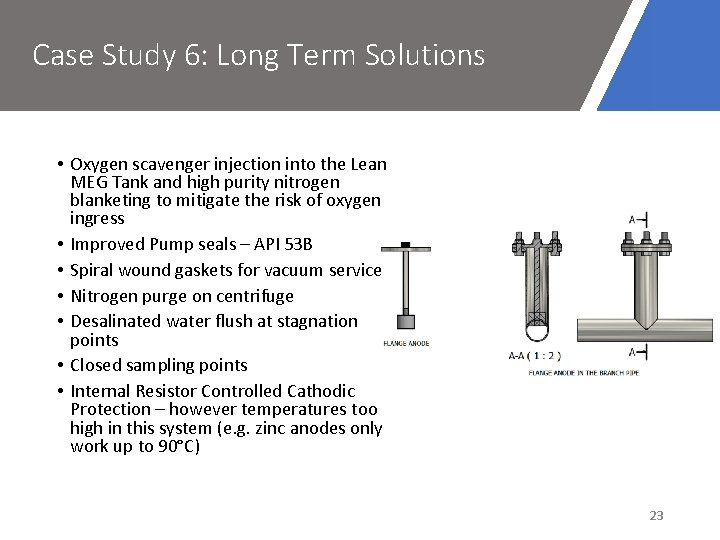
Case Study 6: Long Term Solutions • Oxygen scavenger injection into the Lean MEG Tank and high purity nitrogen blanketing to mitigate the risk of oxygen ingress • Improved Pump seals – API 53 B • Spiral wound gaskets for vacuum service • Nitrogen purge on centrifuge • Desalinated water flush at stagnation points • Closed sampling points • Internal Resistor Controlled Cathodic Protection – however temperatures too high in this system (e. g. zinc anodes only work up to 90°C) 23
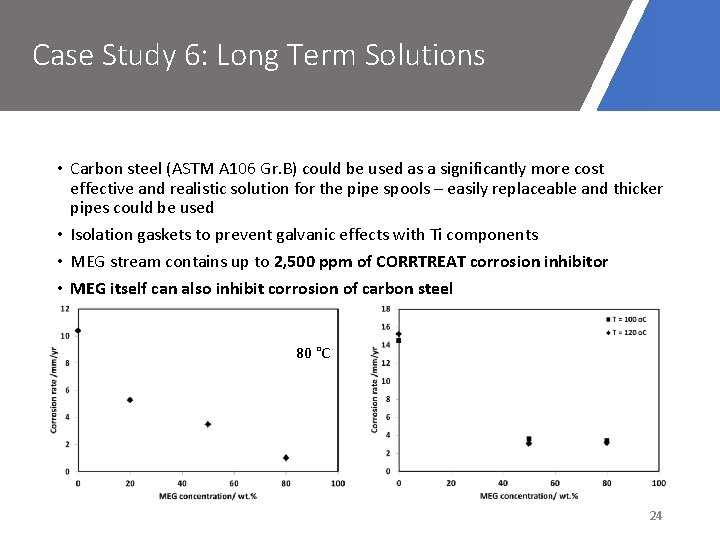
Case Study 6: Long Term Solutions • Carbon steel (ASTM A 106 Gr. B) could be used as a significantly more cost effective and realistic solution for the pipe spools – easily replaceable and thicker pipes could be used • Isolation gaskets to prevent galvanic effects with Ti components • MEG stream contains up to 2, 500 ppm of CORRTREAT corrosion inhibitor • MEG itself can also inhibit corrosion of carbon steel 80 °C 24
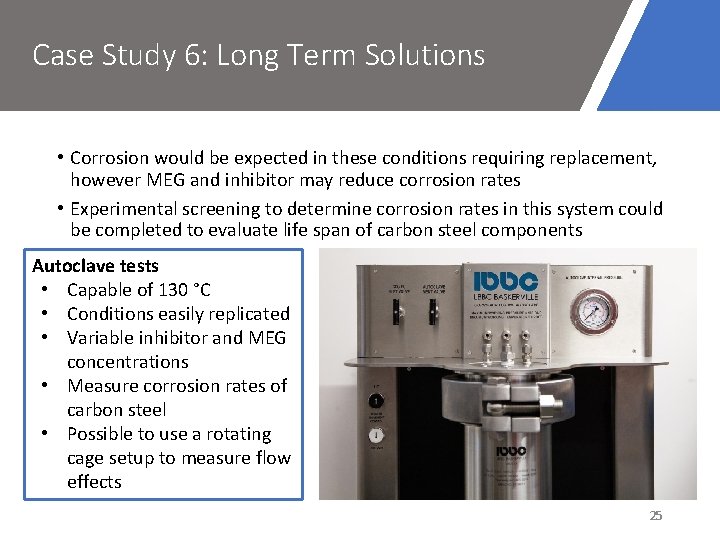
Case Study 6: Long Term Solutions • Corrosion would be expected in these conditions requiring replacement, however MEG and inhibitor may reduce corrosion rates • Experimental screening to determine corrosion rates in this system could be completed to evaluate life span of carbon steel components Autoclave tests • Capable of 130 °C • Conditions easily replicated • Variable inhibitor and MEG concentrations • Measure corrosion rates of carbon steel • Possible to use a rotating cage setup to measure flow effects 25