
ICMA Mi FID II conference Amsterdam 10 November

ICMA Mi. FID II conference Amsterdam, 10 November 2015 Level 2 for bonds: a view from the AFM Hans Wolters Pagina 1 10 November 2015
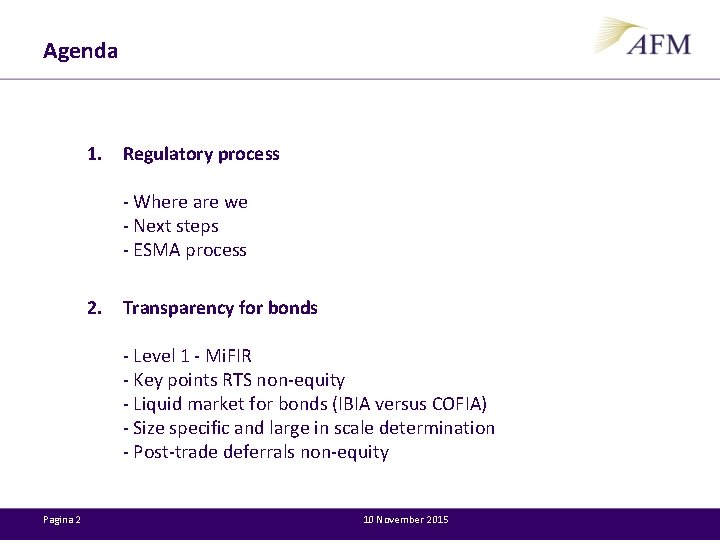
Agenda 1. Regulatory process - Where are we - Next steps - ESMA process 2. Transparency for bonds - Level 1 - Mi. FIR - Key points RTS non-equity - Liquid market for bonds (IBIA versus COFIA) - Size specific and large in scale determination - Post-trade deferrals non-equity Pagina 2 10 November 2015
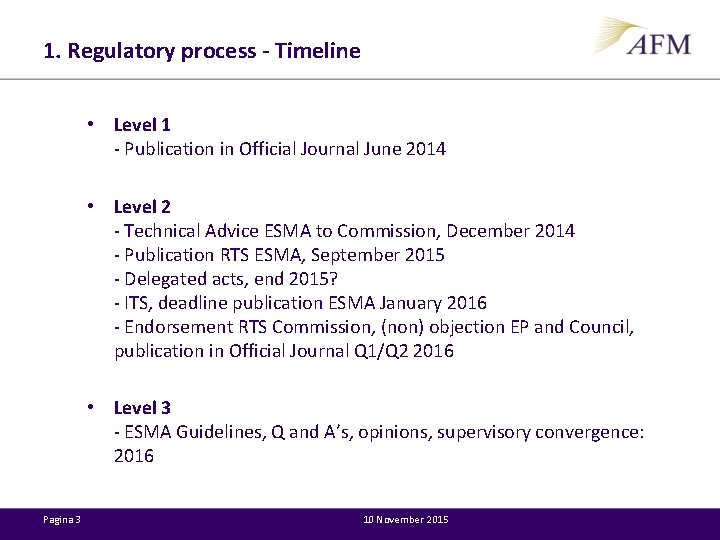
1. Regulatory process - Timeline • Level 1 - Publication in Official Journal June 2014 • Level 2 - Technical Advice ESMA to Commission, December 2014 - Publication RTS ESMA, September 2015 - Delegated acts, end 2015? - ITS, deadline publication ESMA January 2016 - Endorsement RTS Commission, (non) objection EP and Council, publication in Official Journal Q 1/Q 2 2016 • Level 3 - ESMA Guidelines, Q and A’s, opinions, supervisory convergence: 2016 Pagina 3 10 November 2015
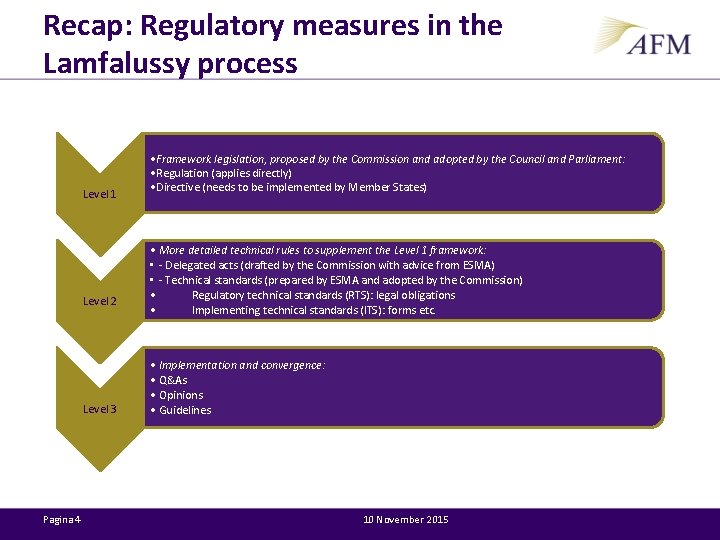
Recap: Regulatory measures in the Lamfalussy process Level 1 Level 2 Level 3 Pagina 4 • Framework legislation, proposed by the Commission and adopted by the Council and Parliament: • Regulation (applies directly) • Directive (needs to be implemented by Member States) • More detailed technical rules to supplement the Level 1 framework: • - Delegated acts (drafted by the Commission with advice from ESMA) • - Technical standards (prepared by ESMA and adopted by the Commission) • Regulatory technical standards (RTS): legal obligations • Implementing technical standards (ITS): forms etc. • Implementation and convergence: • Q&As • Opinions • Guidelines 10 November 2015
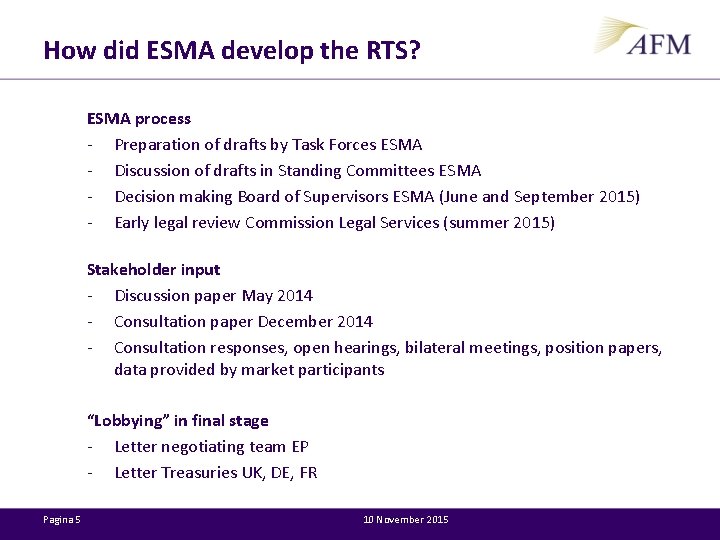
How did ESMA develop the RTS? ESMA process - Preparation of drafts by Task Forces ESMA - Discussion of drafts in Standing Committees ESMA - Decision making Board of Supervisors ESMA (June and September 2015) - Early legal review Commission Legal Services (summer 2015) Stakeholder input - Discussion paper May 2014 - Consultation paper December 2014 - Consultation responses, open hearings, bilateral meetings, position papers, data provided by market participants “Lobbying” in final stage - Letter negotiating team EP - Letter Treasuries UK, DE, FR Pagina 5 10 November 2015
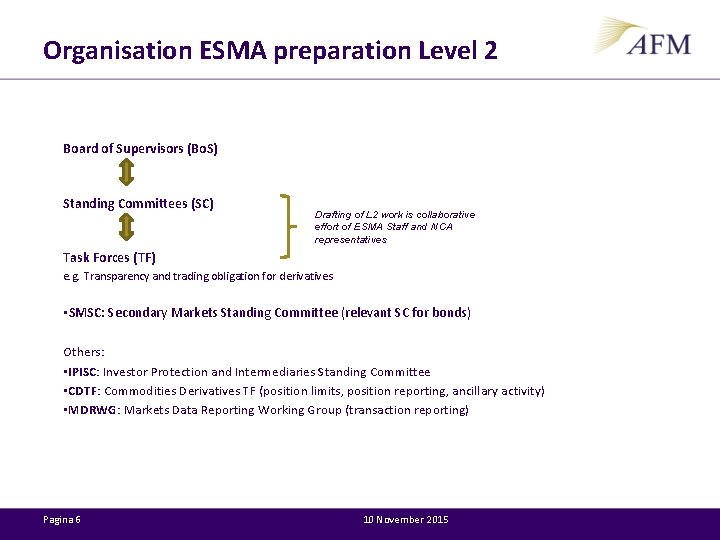
Organisation ESMA preparation Level 2 Board of Supervisors (Bo. S) Standing Committees (SC) Drafting of L 2 work is collaborative effort of ESMA Staff and NCA representatives Task Forces (TF) e. g. Transparency and trading obligation for derivatives • SMSC: Secondary Markets Standing Committee (relevant SC for bonds) Others: • IPISC: Investor Protection and Intermediaries Standing Committee • CDTF: Commodities Derivatives TF (position limits, position reporting, ancillary activity) • MDRWG: Markets Data Reporting Working Group (transaction reporting) Pagina 6 10 November 2015
2. TRANSPARENCY FOR BONDS Pagina 7 10 November 2015
Transparency: recap key points level 1 • Policy objective: to increase transparency • Extension of scope: from shares to equity-like and non-equity • Four waivers pre-trade (equity) have remained, ESMA to provide further detail at Level 2 • Introduction double volume cap for dark pool trading equity, max 4% per venue, 8% for all venues, 6 months suspension if breached • Introduction trading obligation for derivatives and shares Pagina 8 10 November 2015
Key articles Mi. FIR: pre-trade bonds • Art. 8 Mi. FIR pre-trade transparency requirements for trading venues in respect of bonds, structured finance products, emission allowances and derivatives - make public current bid and offer prices and the depth of trading interests, also applies to actionable indications of interest - make public on a continuous basis during normal trading hours - calibration for different types of trading systems • Art. 9 waivers pre-trade for non-equity - large in scale and orders held in an order management facility - actionable indications of interest in RFQ and voice trading systems that are above a size specific to the financial instrument - derivatives not subject to the trading obligation and other (nonequity) financial instruments for which there is not a liquid market • Art. 18 obligation for systematic internalisers to make public firm quotes non-equity Pagina 9 10 November 2015
Key articles Mi. FIR: post-trade bonds • Art. 10 post-trade transparency requirements for trading venues nonequity - make public price, volume and time - as close to real time as technically possible • Art. 11 authorisation of deferred publication - large in scale - not a liquid market - above a size specific • Art. 21 post-trade disclosure by investment firms including SI’s nonequity: price, volume and time through an APA • P. M. Art. 28 trading obligation (RM, MTF or OTF) for derivatives Pagina 10 10 November 2015
Overview RTS non-equity (RTS 2) • Pre-trade transparency for trading venues • Post-trade for trading venues and investment firms trading outside a trading venue • Provisions common to pre- and post-trade transparency - art. 13: methodology to perform the transparency calculations, e. g. determination of liquid market, size of orders large in scale compared with normal market size, size specific to the instrument • Annexes with details of content pre- and post-trade, liquidity assessment, LIS and SSTI-thresholds Pagina 11 10 November 2015
Liquid market: IBIA or COFIA for bonds (1) Definition liquid market in art. 2 Mi. FIR (17) Liquid market means: …. . a market for a financial instrument or a class of financial instruments, where there are ready and willing buyers and sellers on a continuous basis, and where the market is assessed in accordance with the following criteria…. : (i) the average frequency and size of transactions…. . (ii) the number and type of market participants. … (iii) the average size of spreads, where available. Pagina 12 10 November 2015
Liquid market: IBIA or COFIA for bonds (2) • Non-equity instruments for which there is not a liquid market: pre-trade transparency may be waived, post-trade publication may be deferred • Liquidity assessment for individual financial instruments (IBIA) or classes (COFIA). ESMA CP proposal: to use COFIA for bonds • Empirical exercise shows a clear relation between liquidity and issuance size. ESMA designed the classes of bonds optimising the issuance size (e. g. 2 bln. for sovereign debt) • Reasons CP preference COFIA: stability and predictability, much less complex, less of an administrative burden for industry and authorities, easier and straightforward for newly issued financial instruments • Methodology implies there will be some bonds belonging to a liquid class that are illiquid in reality (false positives, i. e. they do not meet the liquidity criteria) and vice versa (false negatives) Pagina 13 10 November 2015
IBIA/COFIA - Decision making process ESMA - Discussion Paper (May 2014): explanation issue and two options - Consultation Paper (December 2014): ESMA preference for COFIA - Intensive lobby market participants, buy-side and trading venues generally in favor of COFIA, sell-side prefers IBIA - EP: preliminary preference for IBIA, also Treasuries UK, DE, FR - Publication RTS (September 2015): ESMA opts for IBIA, assessment on a quarterly basis Pagina 14 10 November 2015
Liquid market for bonds in RTS 2 - Liquidity criteria: each individual financial instrument shall be determined not to have a liquid market… if it does not meet one or all of the following thresholds of the quantitative liquidity criteria on a cumulative basis: - Average daily notional amount: EUR 100, 000 - Average daily number of trades: 2 - Percentage of days traded over the period considered: 80% New issues (bonds admitted to trading or first traded during the quarter): specific combination of bond type and issuance size, e. g. threshold sovereign bond 1 bln. , corporate bond 500 mln. Pagina 15 10 November 2015
Size specific and large in scale thresholds Percentiles to be applied for the calculation of the pre-trade and post-trade SSTI and LIS thresholds for each bond type: - SSTI pre-trade percentile: 60 (covered bonds 40) - LIS pre-trade: 70 - SSTI post-trade: 80 - LIS post-trade: 90 Pagina 16 10 November 2015
Post-trade deferrals non-equity • Without deferral - publication as close to real time as is technically possible and in any case - within 15 minutes after the execution of the transaction - within 5 minutes from January 2020 • Deferred publication possible (NCA may authorise) - 19. 00 local time on the second working day after the date of the transaction - thereafter, all details of the transaction on an individual basis shall be published unless extended time period of deferral is granted • Extended deferral regime at the discretion of the NCA - 4 weeks extended time period of deferral (e. g. for volume omission or weekly publication of several transactions in an aggregated form) - publication of all details of the transactions on an individual basis after 4 weeks (except sovereign debt, NCAs may allow weekly publication in aggregate form for an indefinite period) 10 November 2015 Pagina 17
Questions? mifid 2@afm. nl Pagina 18 10 November 2015
- Slides: 18