
ICF and DISABILITY Learning Material PART A Brainstorming
ICF and DISABILITY Learning Material PART A
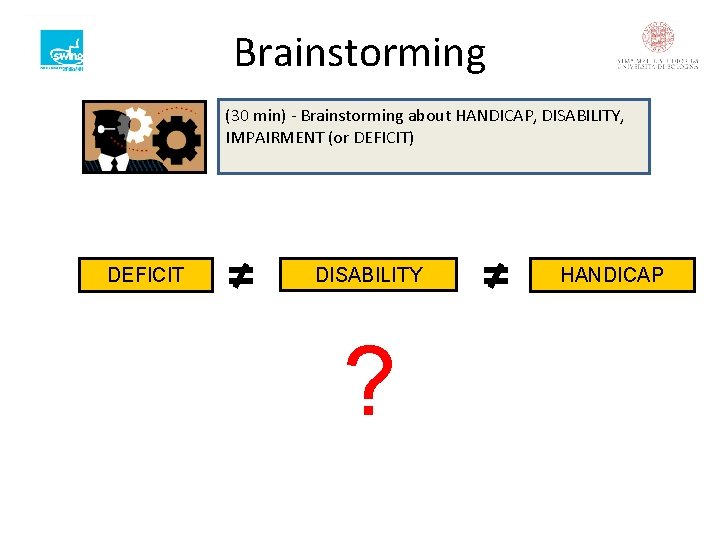
Brainstorming (30 min) - Brainstorming about HANDICAP, DISABILITY, IMPAIRMENT (or DEFICIT) DEFICIT DISABILITY ? HANDICAP
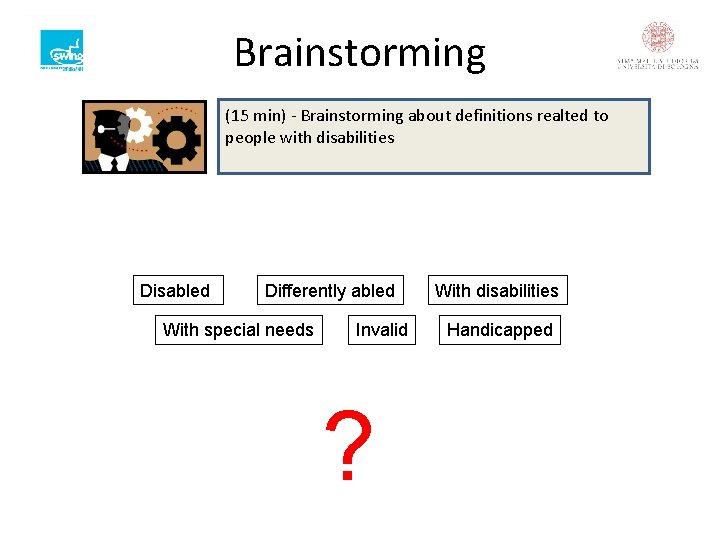
Brainstorming (15 min) - Brainstorming about definitions realted to people with disabilities Disabled Differently abled With special needs Invalid ? With disabilities Handicapped

WHO World Health Organization Classifications 1893 – Classification of causes of Death 1946 – ICD / Classification of Diseases 1980 – ICIDH / Classification of Impairment, Disabilities and Handicap 2001 – ICF / Classification of Human Functioning

ICIDH (1980) LINK International Classification of Impairments, Disabilities and Handicaps IMPAIRMENT (Deficit) any loss or abnormality of psychological, physiological or anatomical structure or function BODY DISABILITY HANDICAP any restriction or lack (resulting from an impairment) of ability to perform an activity in the manner or within the range considered normal for a human being. a disadvantage for a given individual that limits or prevents the fulfillment of a role that is normal ACTIVITY SOCIETY

Deficit, Disability, Handicap (30 min) – Find and discuss case examples about differences between Impairments, Disabilites and Handicaps as showed in the examples DEFICIT Cerebral Palsy - inability to move the legs - inability to bear weight on the feet -Inability to move hands properly Aids: orthotics and surgery Severe dyslexia - inability to associate sounds with symbols DISABILITY -inability to walk. - inability to use a keyboard HANDICAP - Social exclusion (architectural barriers, lack of AT, etc) -Difficulty in using public transport Aids: Walkers, braces, special keyboard - inability to read -Learning difficulties (lack of AT, alternative Reading strategies, visual Learning, etc)
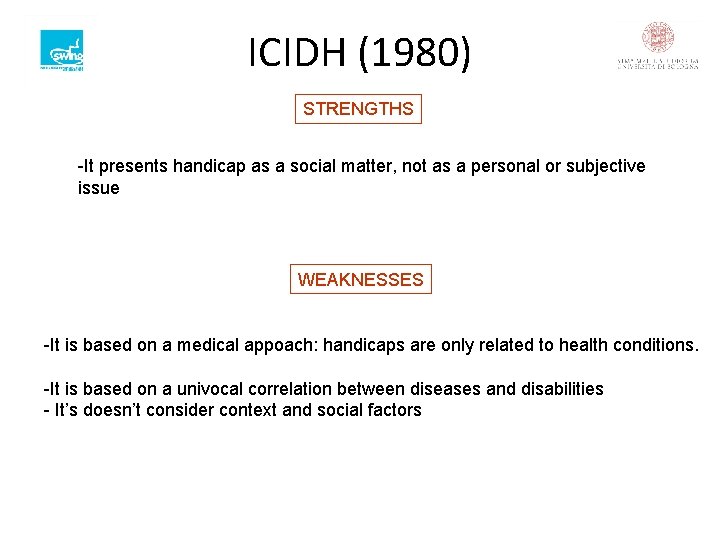
ICIDH (1980) STRENGTHS -It presents handicap as a social matter, not as a personal or subjective issue WEAKNESSES -It is based on a medical appoach: handicaps are only related to health conditions. -It is based on a univocal correlation between diseases and disabilities - It’s doesn’t consider context and social factors
ICF (2001) Offers a clear map of the basic concepts of a person’s health and functioning. Its overall aim is to provide a unified and standard language and framework for the description of health and health-related states. The ICF is structured around the following broad components: - Body functions and structure - Activities (related to tasks and actions by an individual) and participation (involvement in a life situation) - Additional information on severity and environmental factors Functioning and disability are viewed as a complex interaction between the health condition of the individual and the contextual factors of the environment as well as personal factors.
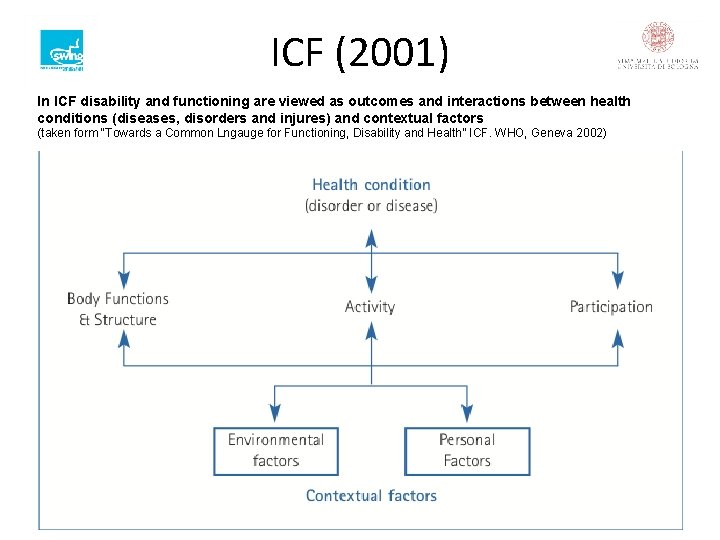
ICF (2001) In ICF disability and functioning are viewed as outcomes and interactions between health conditions (diseases, disorders and injures) and contextual factors (taken form “Towards a Common Lngauge for Functioning, Disability and Health” ICF. WHO, Geneva 2002)
ICF (2001) One of the major innovations in ICF is the presence of an environmental factor classification that makes it possible for the identification of environmental barriers and facilitators (e. g. ICT, AT)for both capacity and performance of actions and tasks in daily living. Performance describes what an individual does in his or her current environment. Since the current environment always includes the overall societal context, performance can also be understood as "involvement in a life situation" or "the lived experience" of people in their actual context. Capacity qualifier describes an individual’s ability to execute a task or an action. This construct indicates the highest probable level of functioning of a person in a given domain at a given moment.

ICF (2001) CAPACITY environmental barriers (-) and facilitators (+) PERFORMANCE CAPACITY FACILITATOR PERFORMANCE Speech Impairment Symbols Communication Tablet (Technology) Complete Communication Performance CAPACITY BARRIER PERFORMANCE Complete Speech Capacity Social anxiety around strangers Communication Performance Difficulty Complete difficulty No difficulty

ICF (2001) CAPACITY environmental barriers (-) and facilitators (+) PERFORMANCE CAPACITY FACILITATOR PERFORMANCE Visual Impairment Screen Reader (e. g. JAWS) Braille Knowledge Complete Reading Performance CAPACITY BARRIER PERFORMANCE Dislexya Complete Visual Capacity Lack of digital texts Reading Performance limited Complete difficulty No difficulty
ICF (2001) (30 min) – Find and discuss case examples about differences between Capacity, Performance, Facilitator, Barrier CAPACITY FACILITATOR PERFORMANCE CAPACITY BARRIER PERFORMANCE
Personas (15 min) – Read the follow personas and find deficit and possible handicaps, barriers and facilitators (included ICT). Then you will find in the next slide possible solutions related only to AT Description: - Name: Nikolaos Souflakos - Age: 25 - Location: Nicosia, Cyprus - Marital status: Single - Job: Unemployed - Impairment: Traumatic brain injury Nikolaos (31) lives in Nicosia, Cyprus, and was involved in a severe car accident when he was 19 years old. He was in a coma for 5 months and experienceed permanent neurobiological damage. He was able to fully recover from his back injury he sustained during the same accident. Nikolaos has difficulty speaking and being understood (expressive aphasia) while also experiencing blurred vision.
Personas Nikolaos Souflakos Possible AT solutions: To communicate with his peers, Nikolaos uses software on his PC that allows him to communicate using symbols which are transferred to sound. In addition, he also uses text to speech software despite the fact that his linguistic skills were severely affected by his brain injury. He therefore uses word prediction software. On his mobile, he also uses such word prediction software and a simplified interface based on symbols. He mainly uses Nokia phones because the menu structure is similar across all newer models. This persona was created for the ACCESSIBLE project which is financially supported by the European Commission (www. accessible-project. eu – Accessible Applications Design and Development). This persona is licensed under a Creative Commons Attribution-Share Alike 3. 0 License.
Personas (15 min) – Read the follow personas and find deficit and possible handicaps, barriers and facilitators (included ICT). Then you will find in the next slide possible solutions related only to AT Description: Marta Guglielmi was a severly dyslexic student who failed her first year of Medicine. As a result of This failure, her academic tutors advised her that she ought to seek advice from Dyslexia Support Services. Since the identification of her dyslexia, she received academic skills tuition from a specialist tutor. She was taught many strategies to enable her to cope with the rigorous demands of her chosen course of study. Her dyslexic profile is typical of the experiences related by dyslexic students who have not been identified until they reached HE: -Never seemed to obtain results that reflected time and effort - Reflective learner who lacked self-confidence in academic skills -Oral sentence structure lacked sequential fluency - Could not process different types of information simultaneously (multi-tasking)
Personas Marta Guglielmi Possible AT solutions: - Mind-mapping software: in a creative manner to support her individual cognitive style. - Text-to-speech software: to support her hesitant reading skills and to develop critical reading skills -Talking spelling checker and thesaurus: to by-pass her weak visual memory skills and to tap into her auditory strenght and ensure accuracy and efficiency. -Coloured acetates and individualised screen colour backgrounds: to reduce visual stress when reading This persona is coming from Riddick et al. , 1999; Mc. Loughlin, 2001
Personas (15 min) – Read the follow personas and find deficit and possible handicaps, barriers and facilitators (included ICT). Then you will find in the next slide possible solutions related only to AT Description: Name: Paulina Reyes - Age: 25 - Location: Murcia, Spain - Marital status: Single - Job: Unemployed - Impairment: Blind Paulina (25) was born blind, and lives in Murcia, Spain. Due to her visual impairment, Paulina was unable to find a job after finishing high school. The only job opportunities she had would have required her to move, which Paulina and her family did not want to do. She started taking guitar lessons and can now play it to a good standard It was not easy to learn in the beginning. She cannot read regular music scores so she has to use music Braille.
Personas Paulina Reyes Possible AT solutions – Part 1: Paulina uses her PC on a daily basis for the text editor to write letters for job applications and to visit Yahoo and check her emails using Internet Explorer. She tried Hotmail and later Gmail, but there just was too much information on the page. Yahoo email works well with her Jaws screenreader. She also uses OCR software, a Braille embosser, and Adobe reader speech output. The combination of all these technologies enables Paulina to use her PC to a satisfactory degree. However, the investments she and her family had to make to acquire this technology put some pressure on the family finances. The internet was also an enormous help in finding information, Braille music scores, and mp 3 music. Paulina bought herself a smartphone which she uses practically all the time. This persona was created for the ACCESSIBLE project which is financially supported by the European Commission (www. accessible-project. eu – Accessible Applications Design and Development). This persona is licensed under a Creative Commons Attribution-Share Alike 3. 0 License.
Personas Paulina Reyes Possible AT solutions – Part 2: Her choice of smartphone took into account its ease of use and came recommended by a friend who is also blind. The device has large enough keys that provide lots of tactile feedback when pressed. Paulina uses it to call friends and family and to text, maintain her calendar, and listen to audiobooks she downloads from the internet. She uses a VOCA to read her text messages but, unfortunately, the Spanish output often has a faulty pronunciation. This persona was created for the ACCESSIBLE project which is financially supported by the European Commission (www. accessible-project. eu – Accessible Applications Design and Development). This persona is licensed under a Creative Commons Attribution-Share Alike 3. 0 License.
Learning Outcome Core competence at this level - Basic knowledge about ICF, difference between Handicap and Deficit - Awareness of the importance of a biopsychosocial approach to disability - Awareness of the benefits that can be gained from AT in improving performace - Recognise sitatuations in which the presented approaches and tools might be of use
- Slides: 21