
ICESat2 Metadata and Status Jeffrey Lee ESIP July
- Slides: 24
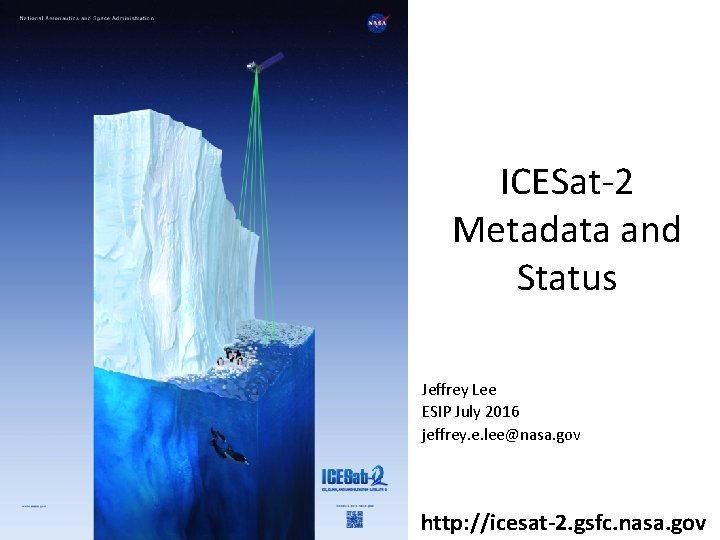
ICESat-2 Metadata and Status Jeffrey Lee ESIP July 2016 jeffrey. e. lee@nasa. gov http: //icesat-2. gsfc. nasa. gov
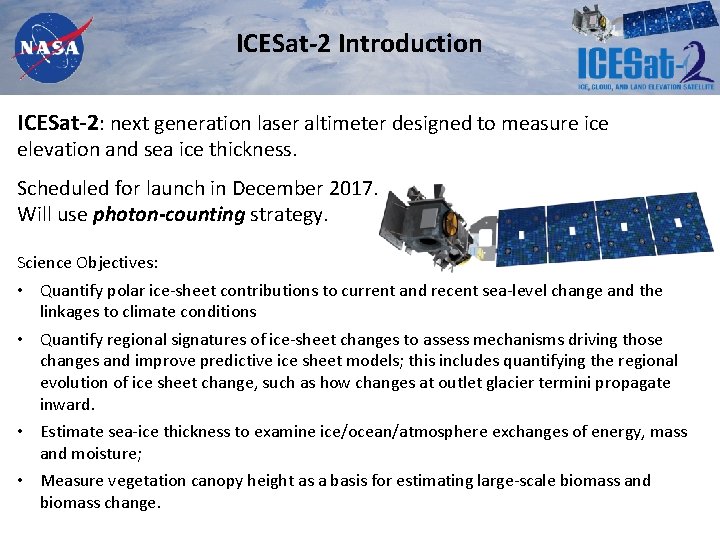
ICESat-2 Introduction ICESat-2: next generation laser altimeter designed to measure ice elevation and sea ice thickness. Scheduled for launch in December 2017. Will use photon-counting strategy. Science Objectives: • Quantify polar ice-sheet contributions to current and recent sea-level change and the linkages to climate conditions • Quantify regional signatures of ice-sheet changes to assess mechanisms driving those changes and improve predictive ice sheet models; this includes quantifying the regional evolution of ice sheet change, such as how changes at outlet glacier termini propagate inward. • Estimate sea-ice thickness to examine ice/ocean/atmosphere exchanges of energy, mass and moisture; • Measure vegetation canopy height as a basis for estimating large-scale biomass and biomass change.
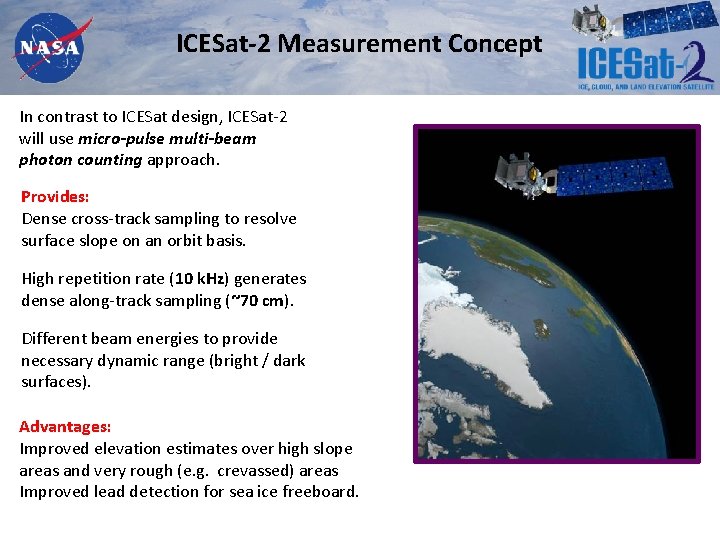
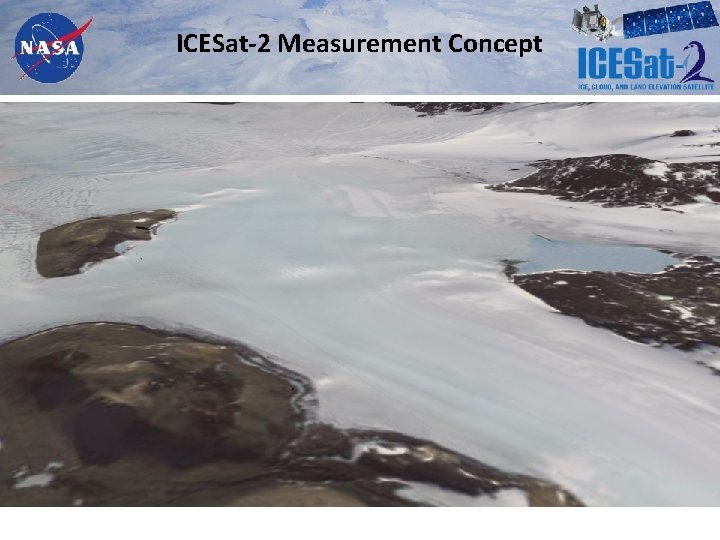
ICESat-2 Measurement Concept In contrast to ICESat design, ICESat-2 will use micro-pulse multi-beam photon counting approach. Provides: Dense cross-track sampling to resolve surface slope on an orbit basis. High repetition rate (10 k. Hz) generates dense along-track sampling (~70 cm). Different beam energies to provide necessary dynamic range (bright / dark surfaces). Advantages: Improved elevation estimates over high slope areas and very rough (e. g. crevassed) areas Improved lead detection for sea ice freeboard.
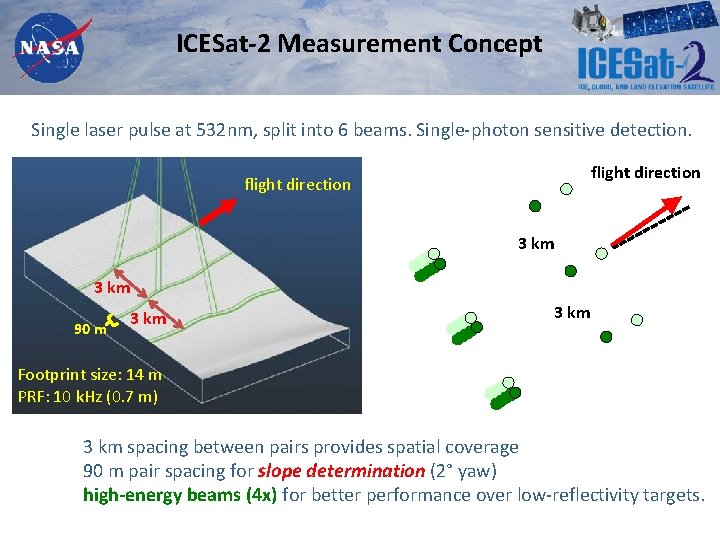
ICESat-2 Measurement Concept Single laser pulse at 532 nm, split into 6 beams. Single-photon sensitive detection. flight direction 3 km 90 m 3 km Footprint size: 14 m PRF: 10 k. Hz (0. 7 m) 3 km spacing between pairs provides spatial coverage 90 m pair spacing for slope determination (2° yaw) high-energy beams (4 x) for better performance over low-reflectivity targets.
ICESat-2 Measurement Concept
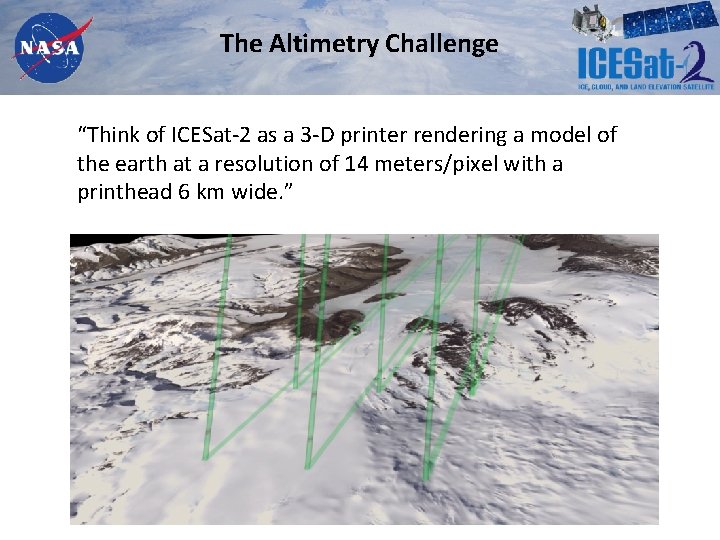
The Altimetry Challenge “Think of ICESat-2 as a 3 -D printer rendering a model of the earth at a resolution of 14 meters/pixel with a printhead 6 km wide. ”
Data Product Characterization – 80 GB L 0 data daily. – 1 TB of L 1 A-L 3 B data daily in HDF 5. – 3. 5 PB over 3 years. –Every photon geolocated to a precise lat/lon/hgt. –Discipline-specific products. • Land Ice, Sea Ice, Ocean, Land, Atmosphere. –Sparse, multi-rate along-track products (L 1 A-L 3 A). –Gridded products (L 3 B). –Over 3, 200 science parameters (and counting…) Only the L 3 B data fit within the imagery/gridded data model.
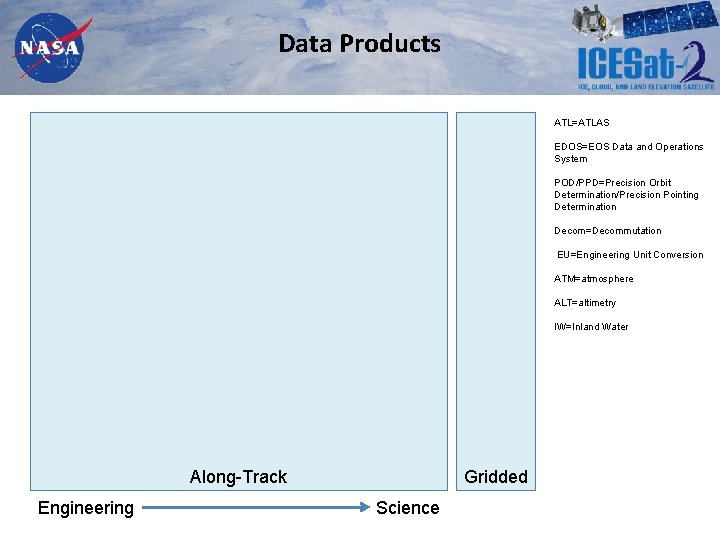
Data Products ATL=ATLAS EDOS=EOS Data and Operations System POD/PPD=Precision Orbit Determination/Precision Pointing Determination Decom=Decommutation EU=Engineering Unit Conversion ATM=atmosphere ALT=altimetry IW=Inland Water Along-Track Engineering Gridded Science
Science Software PGEs ASAS algorithms are compartmentalized in Product Generation Executives (PGEs) based on the ATBDs
Science Software Workflow – KEY: Isolates the metadata/browse/QA from the science code. – PGE creates a product with minimal metadata & QA. – Utility software combines metadata from multiple sources, reformats to ISO 19139 & embeds. – Utility software creates browse, reformats to PNG and embeds. – Utility software extracts QA and feeds into a trend database. – Utility software creates a data dictionary from product content
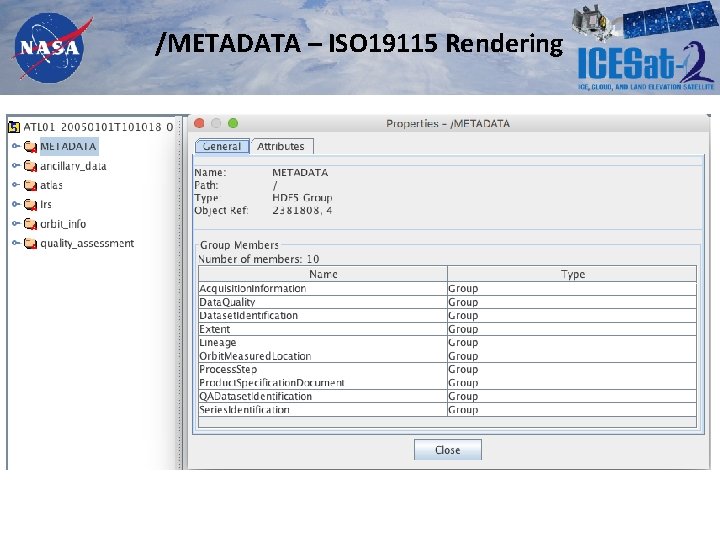
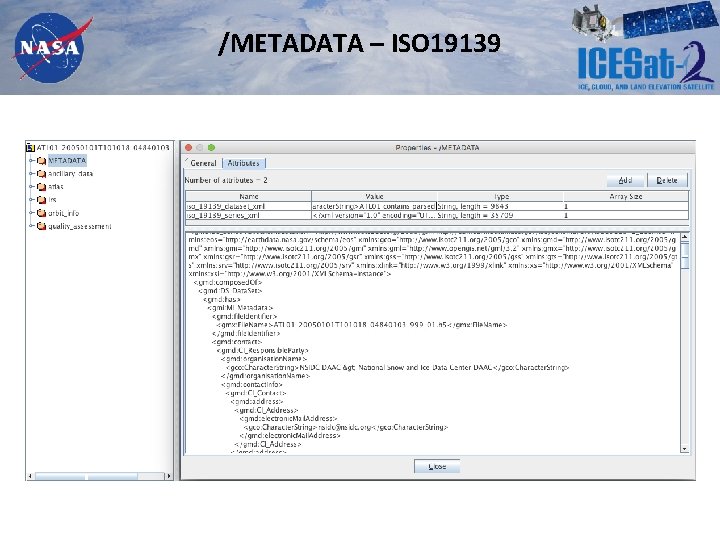
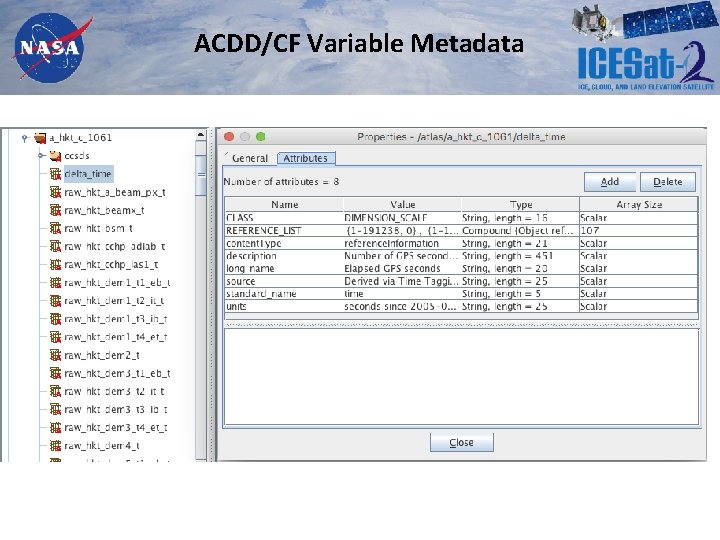
On-Product Metadata • ACDD-recommended global attributes • ACDD/CF-recommended variable attributes • /METADATA • ISO 19139 XML
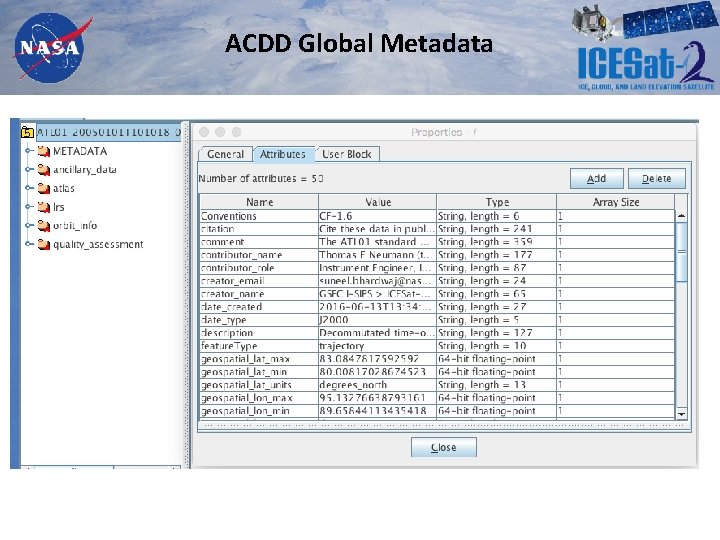
ACDD Global Metadata
/METADATA – ISO 19115 Rendering
/METADATA – ISO 19139
ACDD/CF Variable Metadata
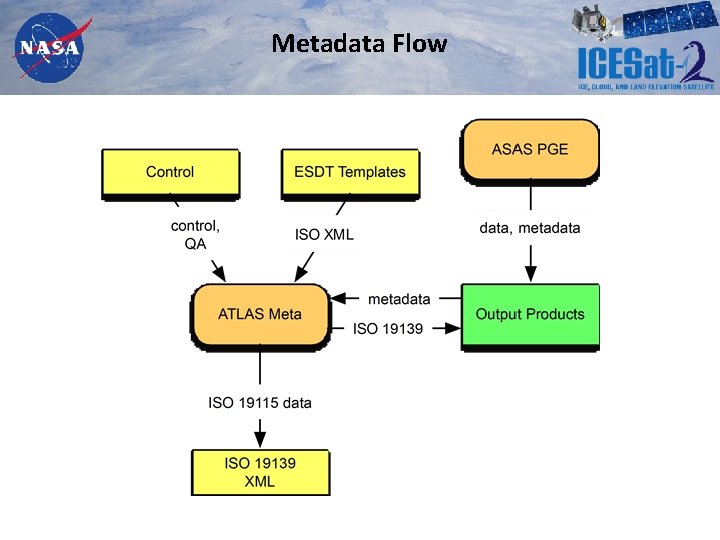
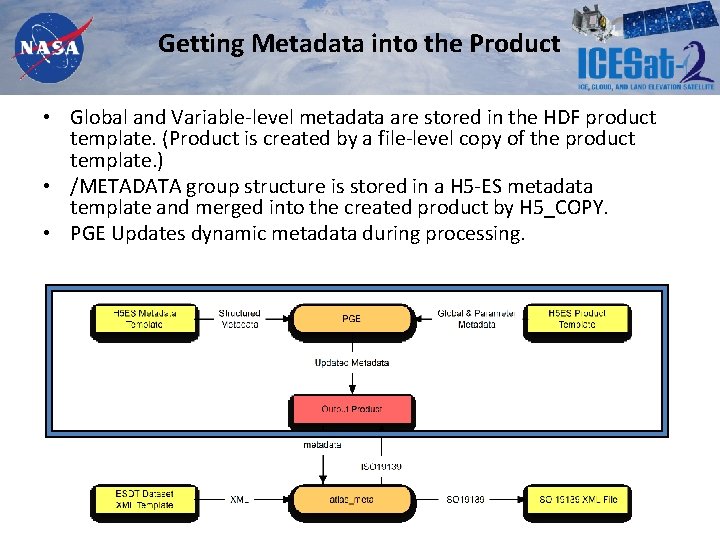
Metadata Flow
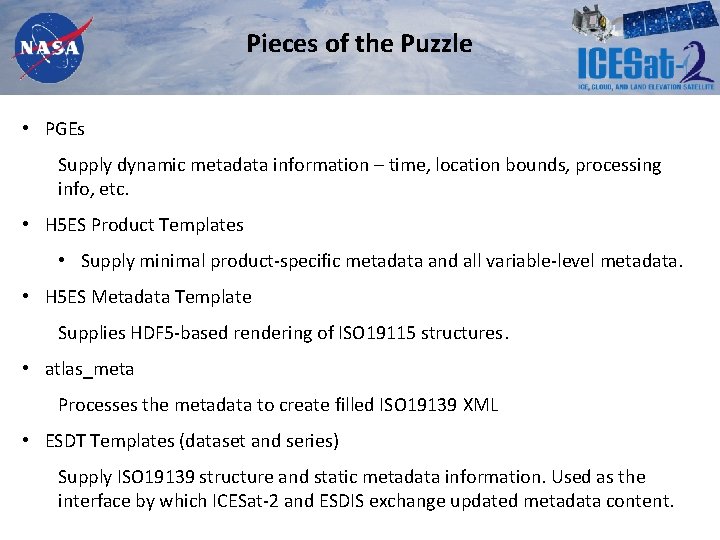
Pieces of the Puzzle • PGEs Supply dynamic metadata information – time, location bounds, processing info, etc. • H 5 ES Product Templates • Supply minimal product-specific metadata and all variable-level metadata. • H 5 ES Metadata Template Supplies HDF 5 -based rendering of ISO 19115 structures. • atlas_meta Processes the metadata to create filled ISO 19139 XML • ESDT Templates (dataset and series) Supply ISO 19139 structure and static metadata information. Used as the interface by which ICESat-2 and ESDIS exchange updated metadata content.
Getting Metadata into the Product • Global and Variable-level metadata are stored in the HDF product template. (Product is created by a file-level copy of the product template. ) • /METADATA group structure is stored in a H 5 -ES metadata template and merged into the created product by H 5_COPY. • PGE Updates dynamic metadata during processing.
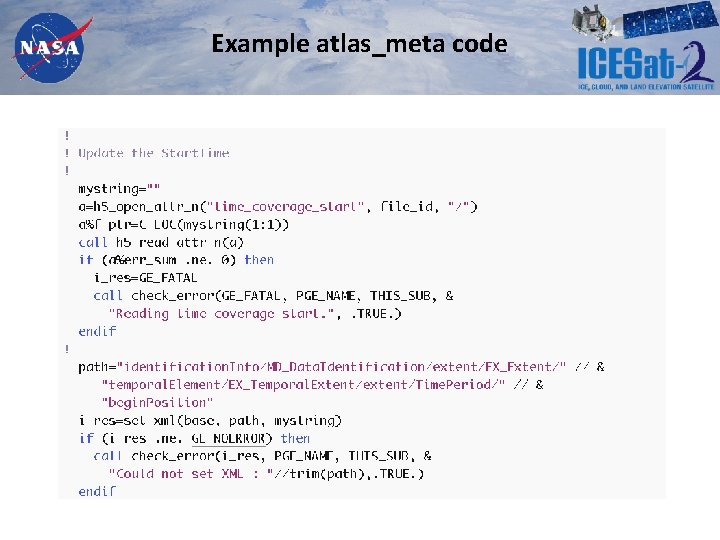
Updating Metadata on the Product • • • atlas_meta is a utility written in Fortran using the Fo. X XML library. Uses XML DOC model code to fill the ISO 19139 XML templates. Reads the XML ESDT templates and updates product static metadata. Reads dynamic metadata from products and updates ISO 19139 metadata. Writes an external ISO 19139 XML dataset file. Stores textual representations of the ISO 19139 XML series and dataset files back on the data product.
Example atlas_meta code
How This Shakes Out • Most static information (both dataset and series) is maintained within a single set of files (ESDT XMLs) that can be exchanged between ESDIS and ICESat-2. • Static information provided within the ESDT XMLs (including Release and Version information) can be used to update the Product metadata without changing software. • The /METADATA structure is a superset of the current ISO-19115 content, which allows for future extension of the ICESat-2 metadata model. • This allows us to focus initial development on the NSIDC-required ISO information but provides the ability to support increasingly richer metadata as we go along. (ie: lineage, QA) • The /METADATA information is somewhat easier to parse with human eyes than the ISO 19139 XML. • Although output metadata information is duplicated in several places, the source data is stored in a single place and software manages the duplication process.
Backup
Why HDF 5? • Quality • Completeness • Flexibility
The CRAZY Things I’ve Done with HDF 5 • Developed the first prototype of Product Designer. • Use HDF 5 “templates” as the basis for products and metadata. • Use H 5 copy to copy generic instances of groups/datasets into specific instances. • Use HDF 5 for big endian -> little endian conversion (L 1 A->L 1 B). • Virtualized a calibrations file/directory structure within a single HDF 5 file. • Embedded hundreds of GMTED 2010 tiles (geotiffs) within a single geographically - indexed HDF 5 file (same with EGM 2008 & GIMP). • Wrote independent columns of ragged 1 D data into a 2 D dataset. • Wrote software to recursively walk a generic HDF 5 file and compute statistics for every dataset it finds. • Wrote software to recursively walk a generic HDF 5 file and create a data dictionary describing all the groups and datasets. • DEEPLY exploited the HDF 5/Fortran 2003 interface.