
ICE5108084 Antenna Design Lecture 5 Antenna Mutual Coupling

- Slides: 29
ICE-5108084 Antenna Design Lecture 5: Antenna Mutual Coupling 4. 1 Dipole of Various Lengths 4. 2 Antenan Pattern Types 4. 3 Antenna Pattern Synthesis 4. 4 Antenna Mutual Coupling 1
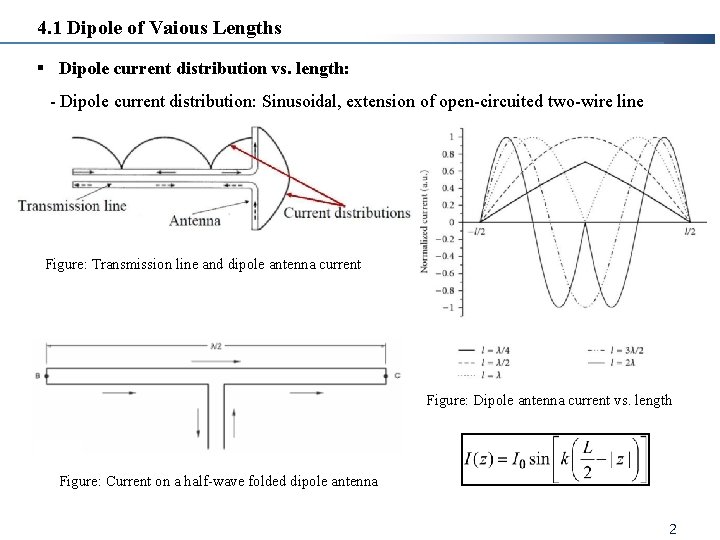
4. 1 Dipole of Vaious Lengths § Dipole current distribution vs. length: - Dipole current distribution: Sinusoidal, extension of open-circuited two-wire line Figure: Transmission line and dipole antenna current Figure: Dipole antenna current vs. length Figure: Current on a half-wave folded dipole antenna 2
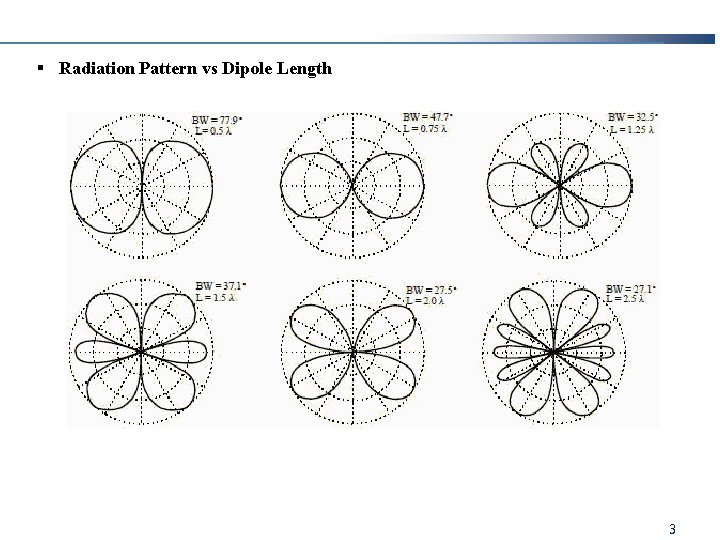
§ Radiation Pattern vs Dipole Length 3
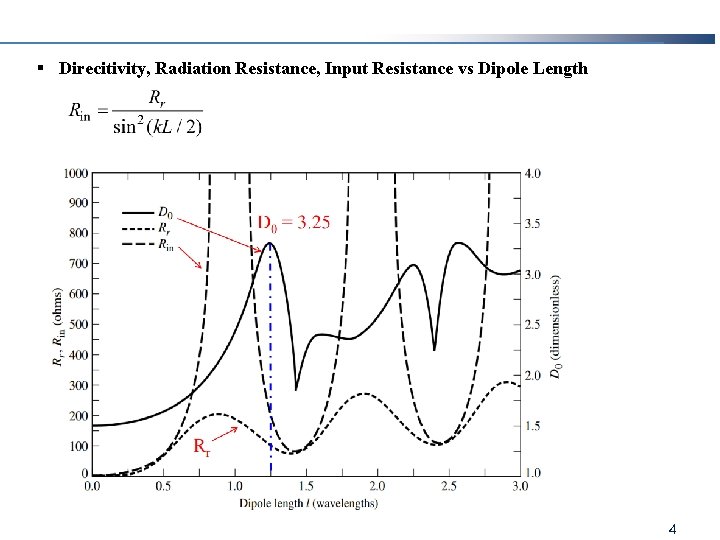
§ Direcitivity, Radiation Resistance, Input Resistance vs Dipole Length 4
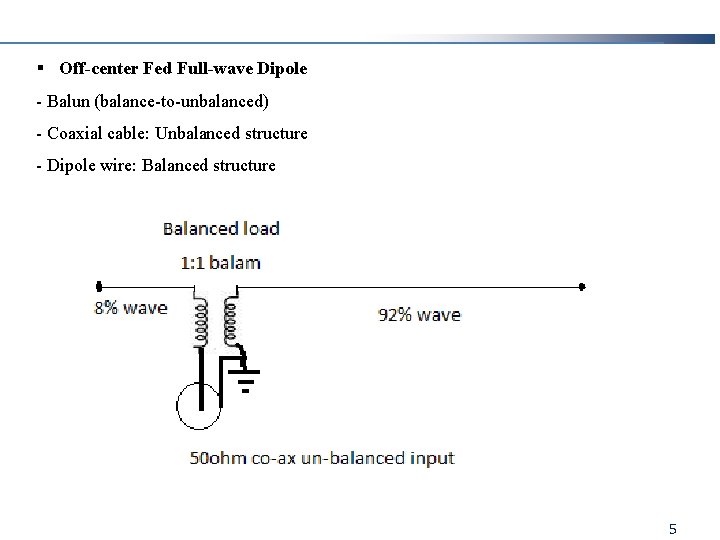
§ Off-center Fed Full-wave Dipole - Balun (balance-to-unbalanced) - Coaxial cable: Unbalanced structure - Dipole wire: Balanced structure 5
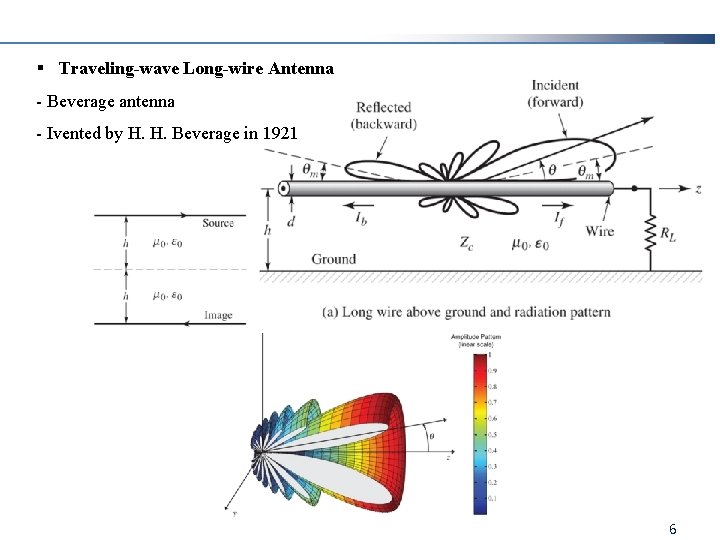
§ Traveling-wave Long-wire Antenna - Beverage antenna - Ivented by H. H. Beverage in 1921 6
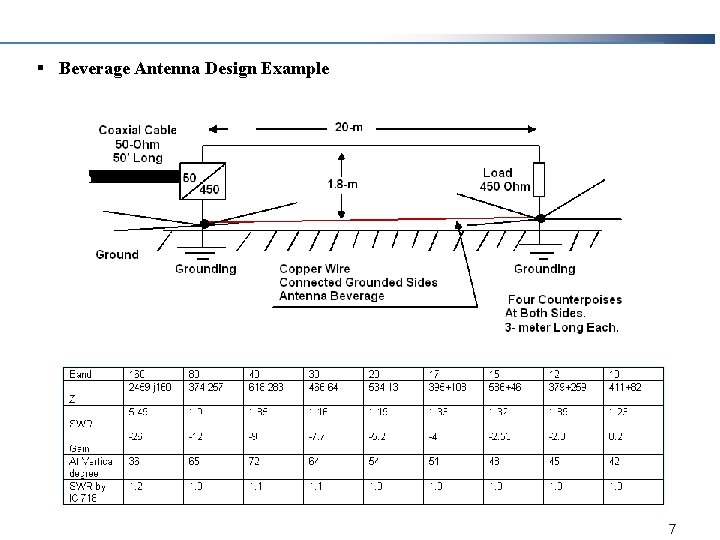
§ Beverage Antenna Design Example 7
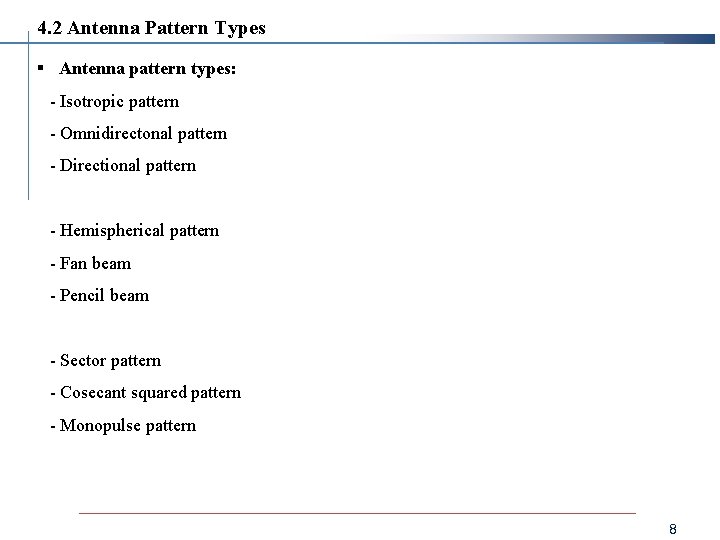
4. 2 Antenna Pattern Types § Antenna pattern types: - Isotropic pattern - Omnidirectonal pattern - Directional pattern - Hemispherical pattern - Fan beam - Pencil beam - Sector pattern - Cosecant squared pattern - Monopulse pattern 8
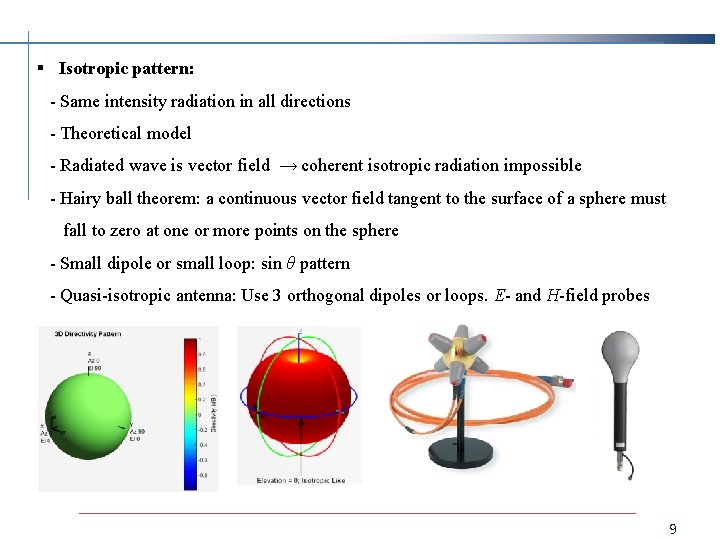
§ Isotropic pattern: - Same intensity radiation in all directions - Theoretical model - Radiated wave is vector field → coherent isotropic radiation impossible - Hairy ball theorem: a continuous vector field tangent to the surface of a sphere must fall to zero at one or more points on the sphere - Small dipole or small loop: sin θ pattern - Quasi-isotropic antenna: Use 3 orthogonal dipoles or loops. E- and H-field probes 9
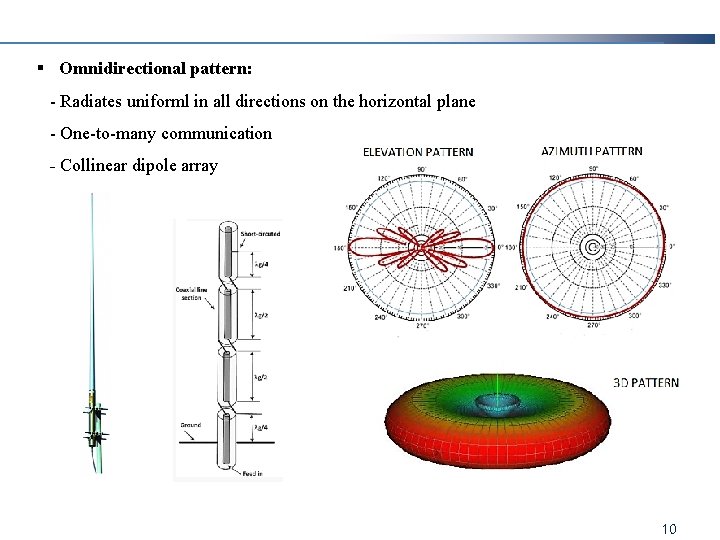
§ Omnidirectional pattern: - Radiates uniforml in all directions on the horizontal plane - One-to-many communication - Collinear dipole array 10
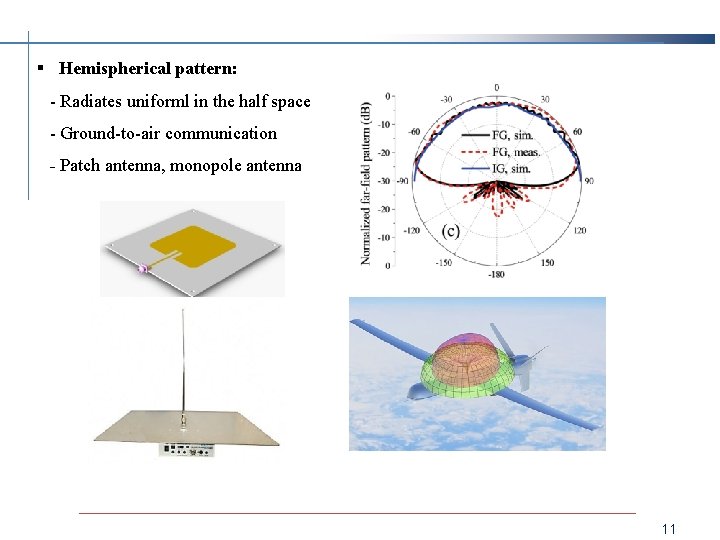
§ Hemispherical pattern: - Radiates uniforml in the half space - Ground-to-air communication - Patch antenna, monopole antenna 11
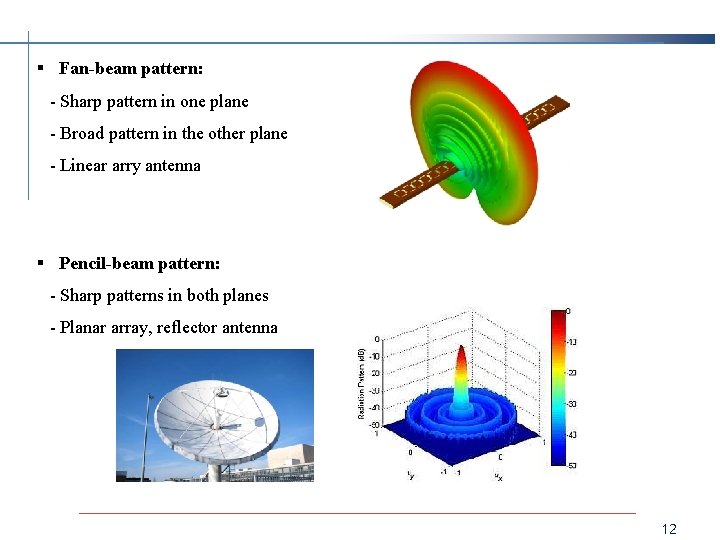
§ Fan-beam pattern: - Sharp pattern in one plane - Broad pattern in the other plane - Linear arry antenna § Pencil-beam pattern: - Sharp patterns in both planes - Planar array, reflector antenna 12
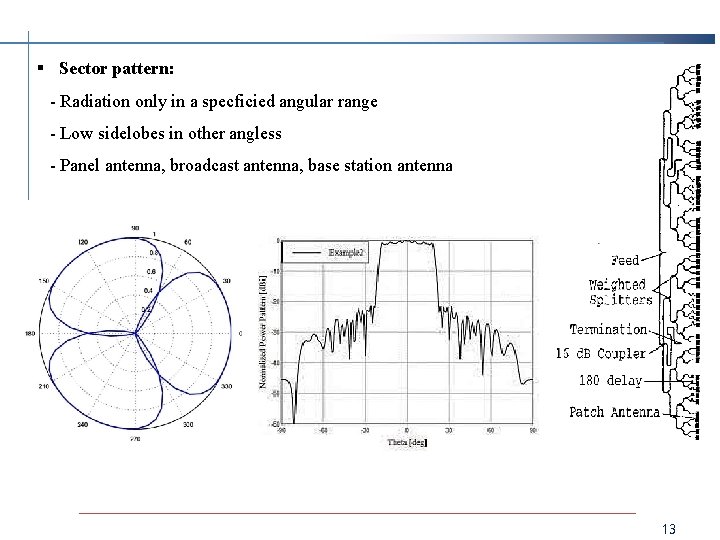
§ Sector pattern: - Radiation only in a specficied angular range - Low sidelobes in other angless - Panel antenna, broadcast antenna, base station antenna 13
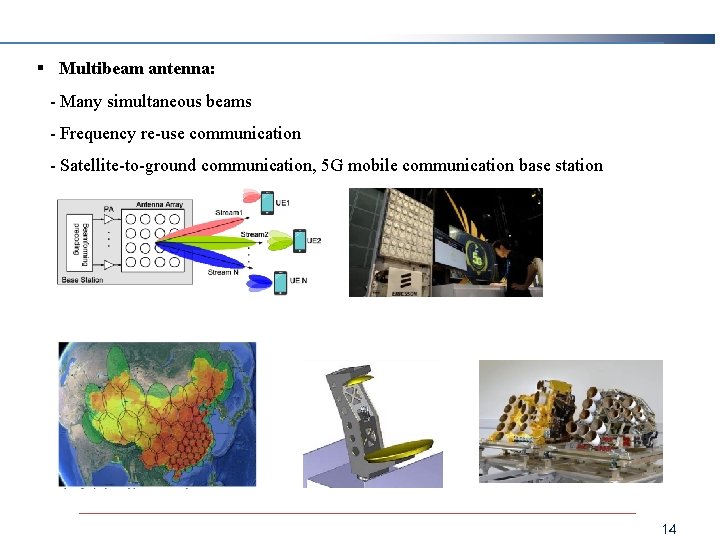
§ Multibeam antenna: - Many simultaneous beams - Frequency re-use communication - Satellite-to-ground communication, 5 G mobile communication base station 14
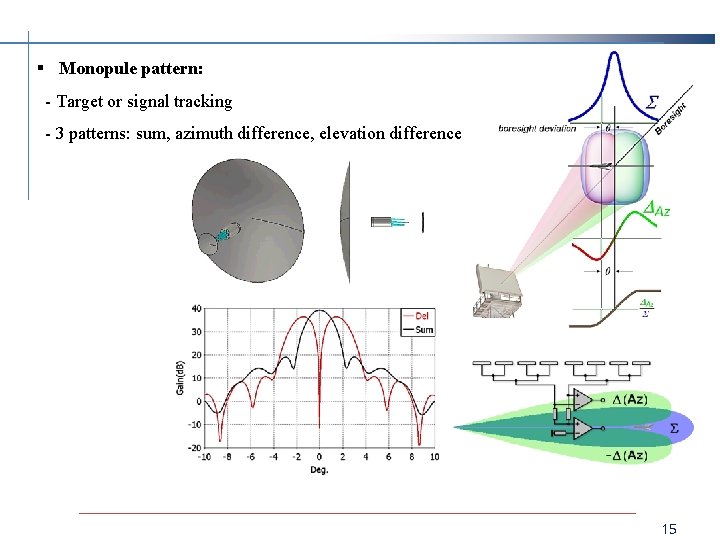
§ Monopule pattern: - Target or signal tracking - 3 patterns: sum, azimuth difference, elevation difference 15
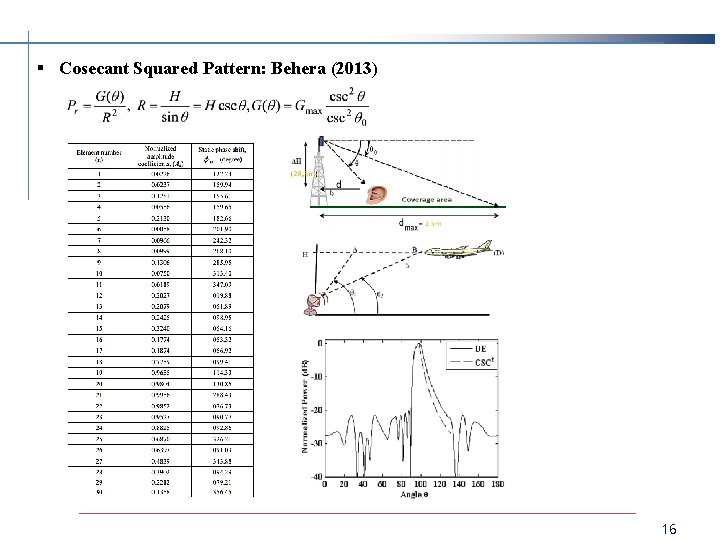
§ Cosecant Squared Pattern: Behera (2013) 16
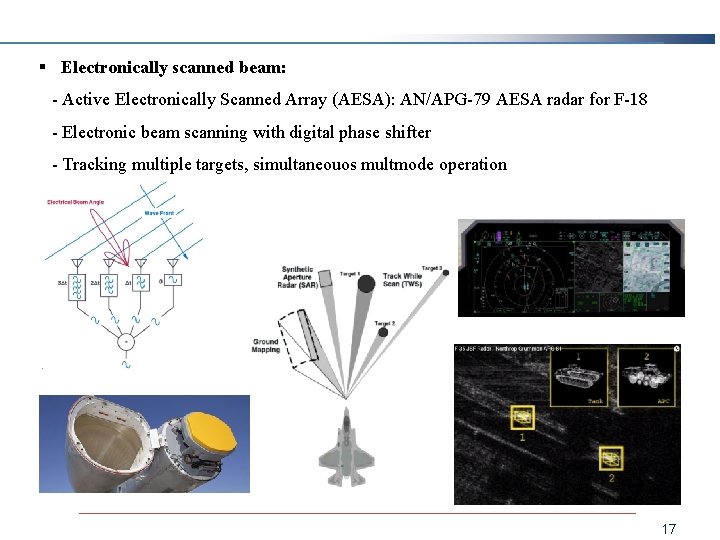
§ Electronically scanned beam: - Active Electronically Scanned Array (AESA): AN/APG-79 AESA radar for F-18 - Electronic beam scanning with digital phase shifter - Tracking multiple targets, simultaneouos multmode operation 17
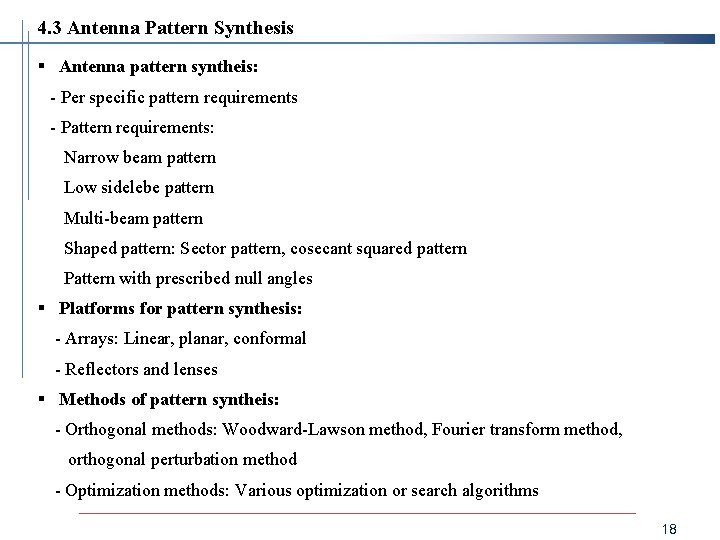
4. 3 Antenna Pattern Synthesis § Antenna pattern syntheis: - Per specific pattern requirements - Pattern requirements: Narrow beam pattern Low sidelebe pattern Multi-beam pattern Shaped pattern: Sector pattern, cosecant squared pattern Pattern with prescribed null angles § Platforms for pattern synthesis: - Arrays: Linear, planar, conformal - Reflectors and lenses § Methods of pattern syntheis: - Orthogonal methods: Woodward-Lawson method, Fourier transform method, orthogonal perturbation method - Optimization methods: Various optimization or search algorithms 18
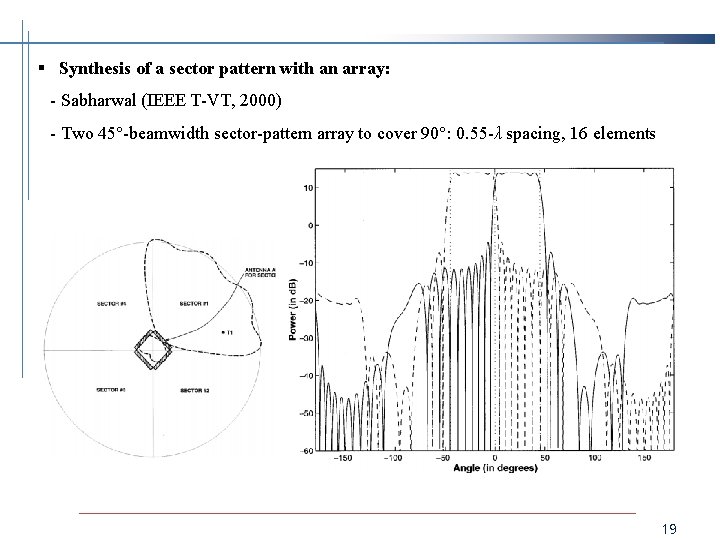
§ Synthesis of a sector pattern with an array: - Sabharwal (IEEE T-VT, 2000) - Two 45°-beamwidth sector-pattern array to cover 90°: 0. 55 -λ spacing, 16 elements 19
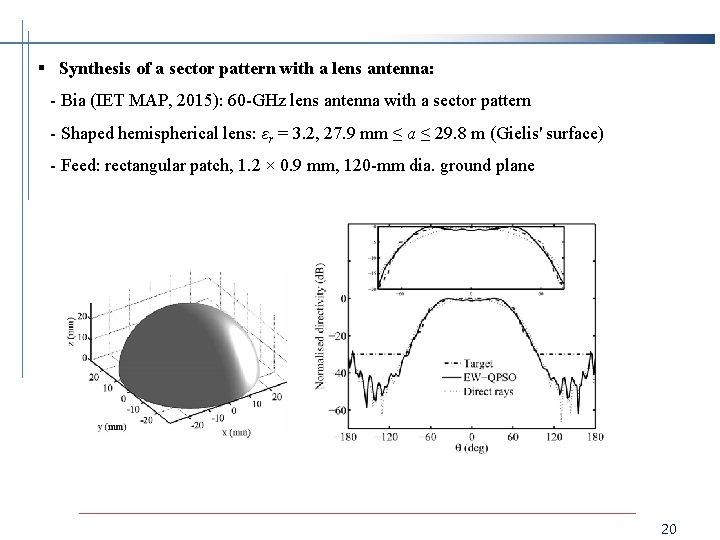
§ Synthesis of a sector pattern with a lens antenna: - Bia (IET MAP, 2015): 60 -GHz lens antenna with a sector pattern - Shaped hemispherical lens: εr = 3. 2, 27. 9 mm ≤ a ≤ 29. 8 m (Gielis' surface) - Feed: rectangular patch, 1. 2 × 0. 9 mm, 120 -mm dia. ground plane 20
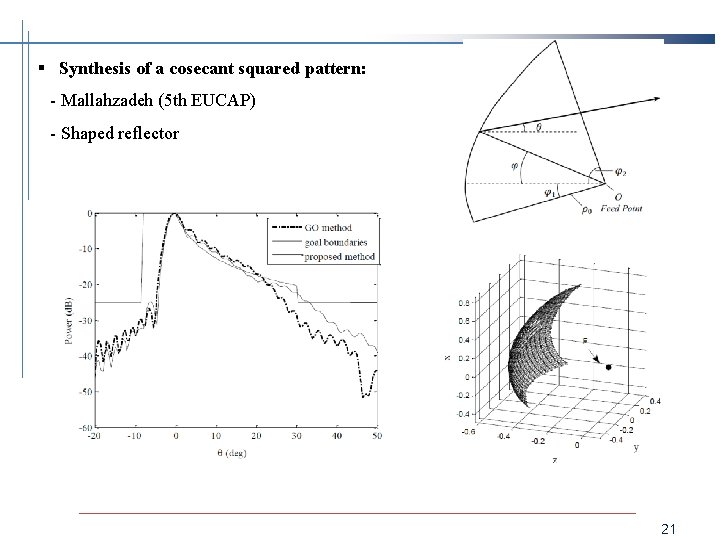
§ Synthesis of a cosecant squared pattern: - Mallahzadeh (5 th EUCAP) - Shaped reflector 21
4. 4 Antenna Mutual Coupling § Impedance Matrix Method - Impedance matrix - Self impedance: Znn - Mutual impedance: Zmn - Impedance calculation formula: - Antenna reciprocity: Zmn = Znm 22
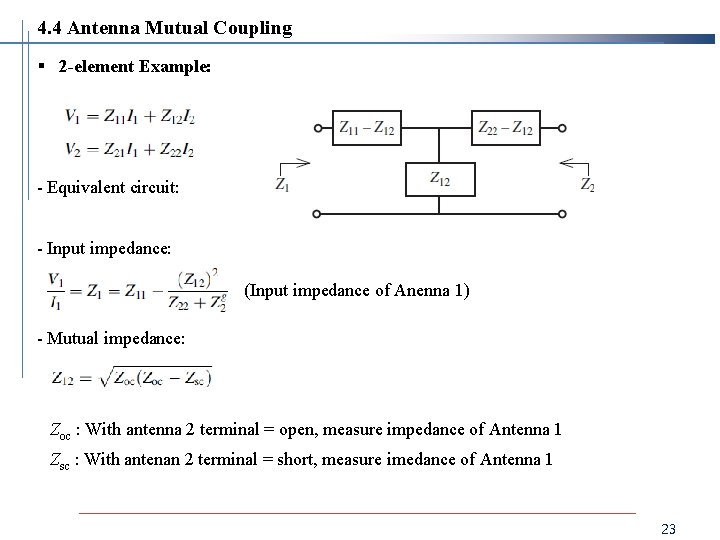
4. 4 Antenna Mutual Coupling § 2 -element Example: - Equivalent circuit: - Input impedance: (Input impedance of Anenna 1) - Mutual impedance: Zoc : With antenna 2 terminal = open, measure impedance of Antenna 1 Zsc : With antenan 2 terminal = short, measure imedance of Antenna 1 23
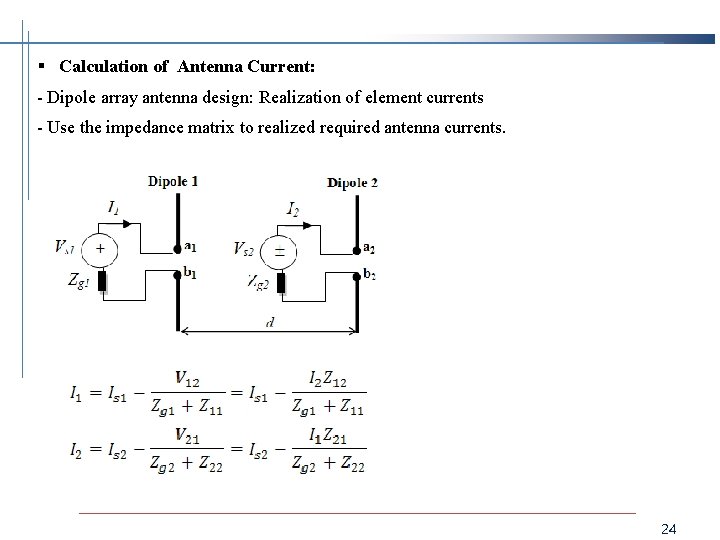
§ Calculation of Antenna Current: - Dipole array antenna design: Realization of element currents - Use the impedance matrix to realized required antenna currents. 24
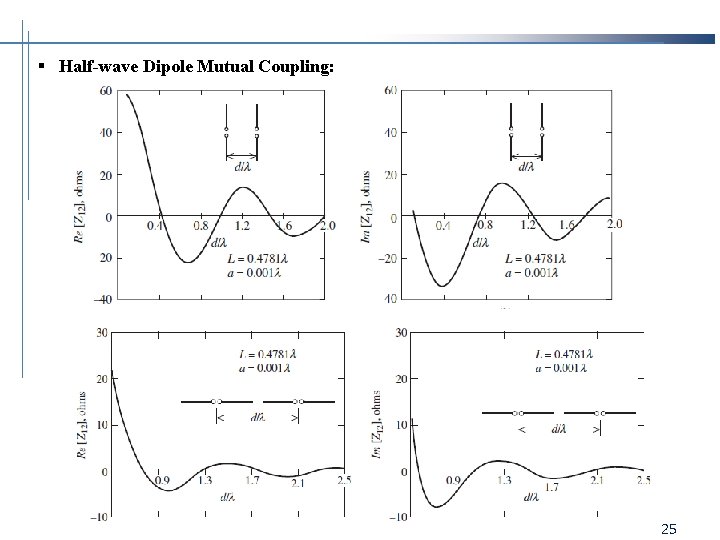
§ Half-wave Dipole Mutual Coupling: 25
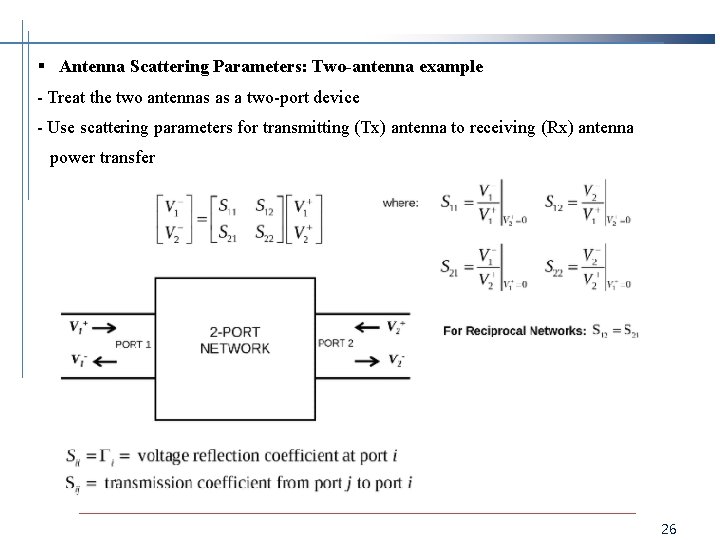
§ Antenna Scattering Parameters: Two-antenna example - Treat the two antennas as a two-port device - Use scattering parameters for transmitting (Tx) antenna to receiving (Rx) antenna power transfer 26
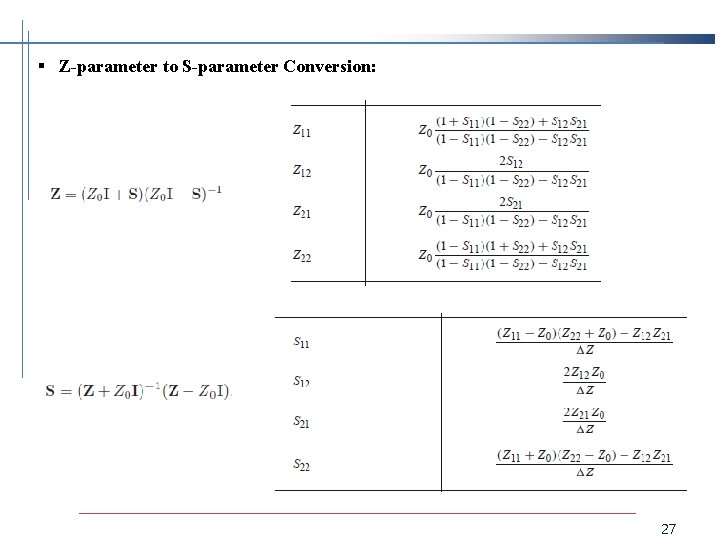
§ Z-parameter to S-parameter Conversion: 27
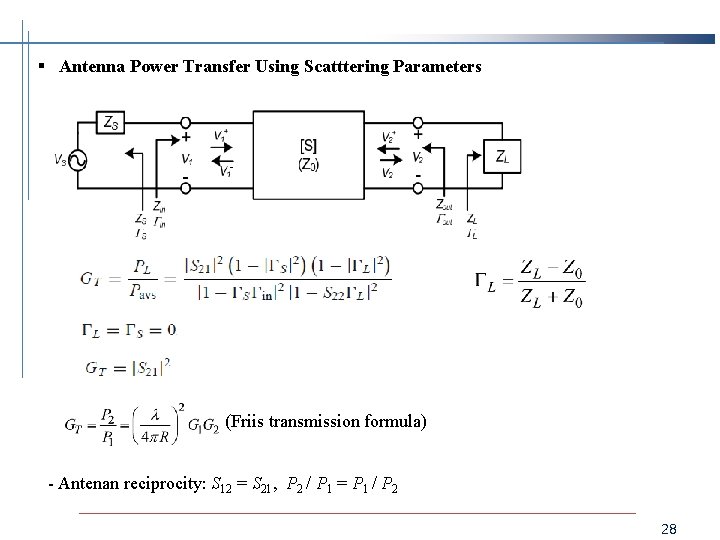
§ Antenna Power Transfer Using Scatttering Parameters (Friis transmission formula) - Antenan reciprocity: S 12 = S 21, P 2 / P 1 = P 1 / P 2 28
ICE-5108084 Antenna Design Lecture 5: Antenna Mutual Coupling 29