
ICD10 Ready My Vision Express presents An introduction





- Slides: 28
ICD-10 Ready? My Vision Express presents An introduction to the new coding system
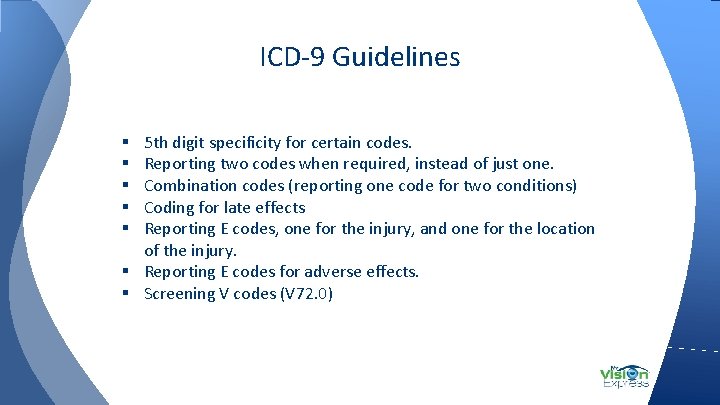
ICD-9 Guidelines 5 th digit specificity for certain codes. Reporting two codes when required, instead of just one. Combination codes (reporting one code for two conditions) Coding for late effects Reporting E codes, one for the injury, and one for the location of the injury. § Reporting E codes for adverse effects. § Screening V codes (V 72. 0) § § §
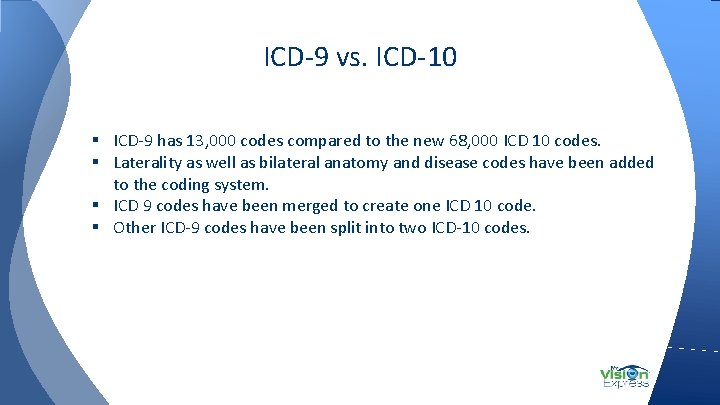
ICD-9 vs. ICD-10 § ICD-9 has 13, 000 codes compared to the new 68, 000 ICD 10 codes. § Laterality as well as bilateral anatomy and disease codes have been added to the coding system. § ICD 9 codes have been merged to create one ICD 10 code. § Other ICD-9 codes have been split into two ICD-10 codes.
ICD-10 Format and Organization § ICD-10 consists of 3 to 7 characters. The first character is an alpha character, the second is numeric, and the rest can either be alpha or numeric.
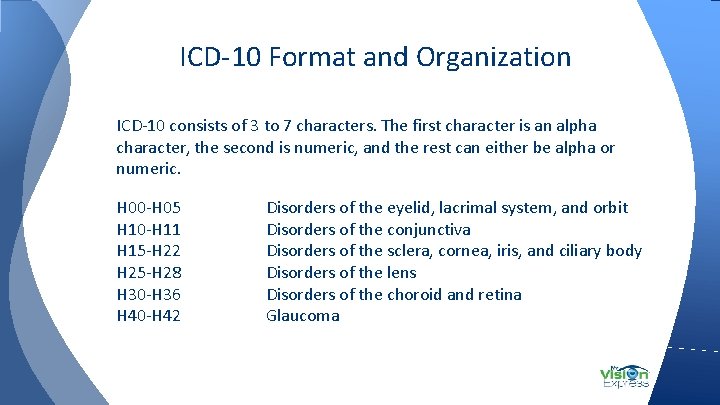
ICD-10 Format and Organization ICD-10 consists of 3 to 7 characters. The first character is an alpha character, the second is numeric, and the rest can either be alpha or numeric. H 00 -H 05 H 10 -H 11 H 15 -H 22 H 25 -H 28 H 30 -H 36 H 40 -H 42 Disorders of the eyelid, lacrimal system, and orbit Disorders of the conjunctiva Disorders of the sclera, cornea, iris, and ciliary body Disorders of the lens Disorders of the choroid and retina Glaucoma
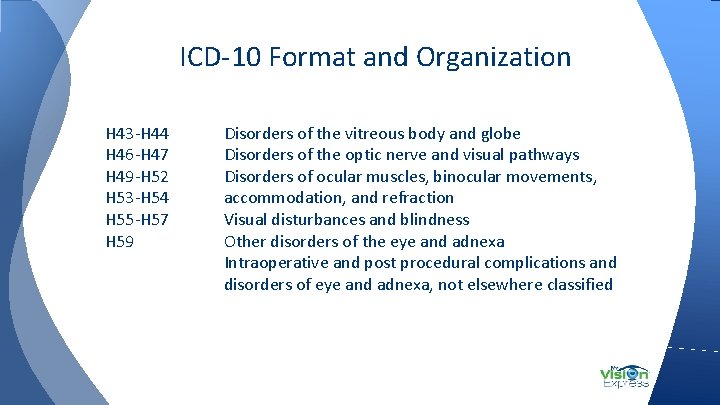
ICD-10 Format and Organization H 43 -H 44 H 46 -H 47 H 49 -H 52 H 53 -H 54 H 55 -H 57 H 59 Disorders of the vitreous body and globe Disorders of the optic nerve and visual pathways Disorders of ocular muscles, binocular movements, accommodation, and refraction Visual disturbances and blindness Other disorders of the eye and adnexa Intraoperative and post procedural complications and disorders of eye and adnexa, not elsewhere classified
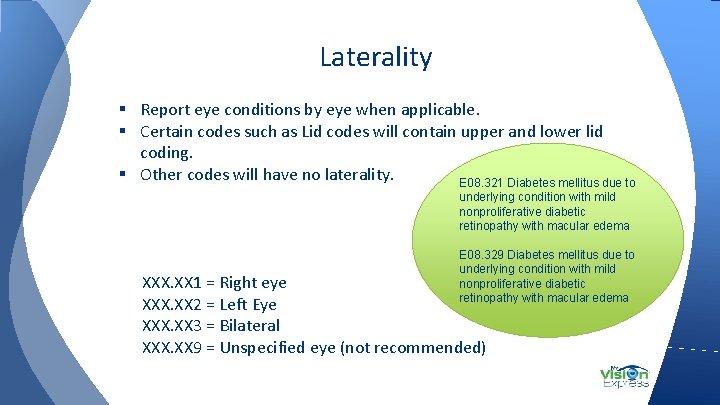
Laterality § Report eye conditions by eye when applicable. § Certain codes such as Lid codes will contain upper and lower lid coding. § Other codes will have no laterality. E 08. 321 Diabetes mellitus due to underlying condition with mild nonproliferative diabetic retinopathy with macular edema E 08. 329 Diabetes mellitus due to underlying condition with mild nonproliferative diabetic retinopathy with macular edema XXX. XX 1 = Right eye XXX. XX 2 = Left Eye XXX. XX 3 = Bilateral XXX. XX 9 = Unspecified eye (not recommended)
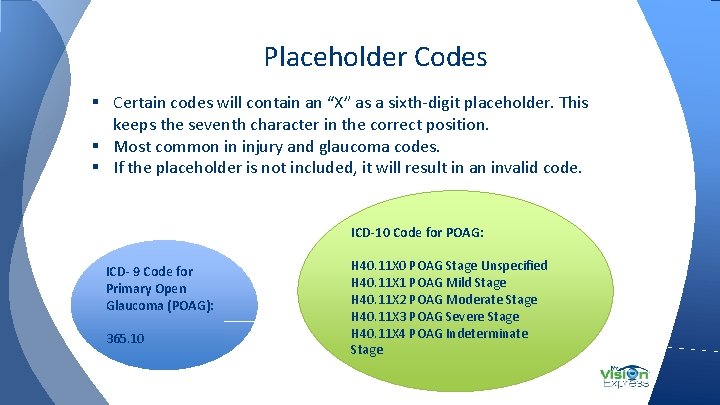
Placeholder Codes § Certain codes will contain an “X” as a sixth-digit placeholder. This keeps the seventh character in the correct position. § Most common in injury and glaucoma codes. § If the placeholder is not included, it will result in an invalid code. ICD-10 Code for POAG: ICD- 9 Code for Primary Open Glaucoma (POAG): 365. 10 H 40. 11 X 0 POAG Stage Unspecified H 40. 11 X 1 POAG Mild Stage H 40. 11 X 2 POAG Moderate Stage H 40. 11 X 3 POAG Severe Stage H 40. 11 X 4 POAG Indeterminate Stage
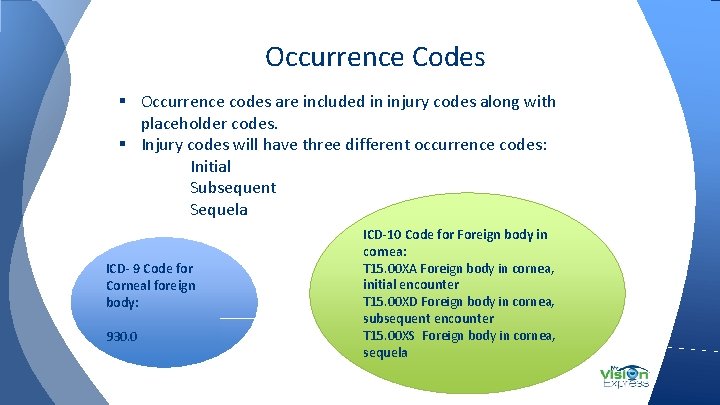
Occurrence Codes § Occurrence codes are included in injury codes along with placeholder codes. § Injury codes will have three different occurrence codes: Initial Subsequent Sequela ICD- 9 Code for Corneal foreign body: 930. 0 ICD-10 Code for Foreign body in cornea: T 15. 00 XA Foreign body in cornea, initial encounter T 15. 00 XD Foreign body in cornea, subsequent encounter T 15. 00 XS Foreign body in cornea, sequela
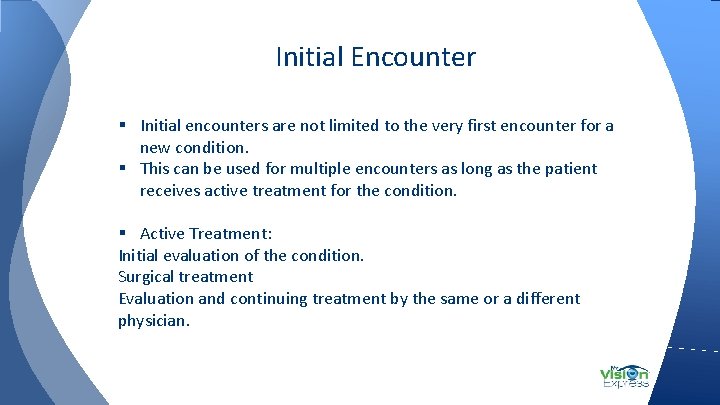
Initial Encounter § Initial encounters are not limited to the very first encounter for a new condition. § This can be used for multiple encounters as long as the patient receives active treatment for the condition. § Active Treatment: Initial evaluation of the condition. Surgical treatment Evaluation and continuing treatment by the same or a different physician.
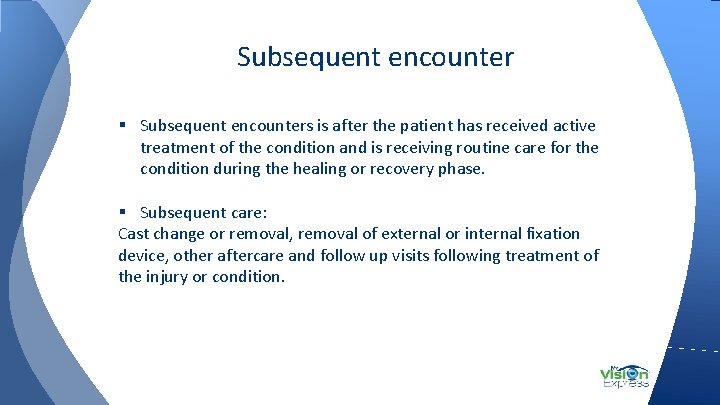
Subsequent encounter § Subsequent encounters is after the patient has received active treatment of the condition and is receiving routine care for the condition during the healing or recovery phase. § Subsequent care: Cast change or removal, removal of external or internal fixation device, other aftercare and follow up visits following treatment of the injury or condition.
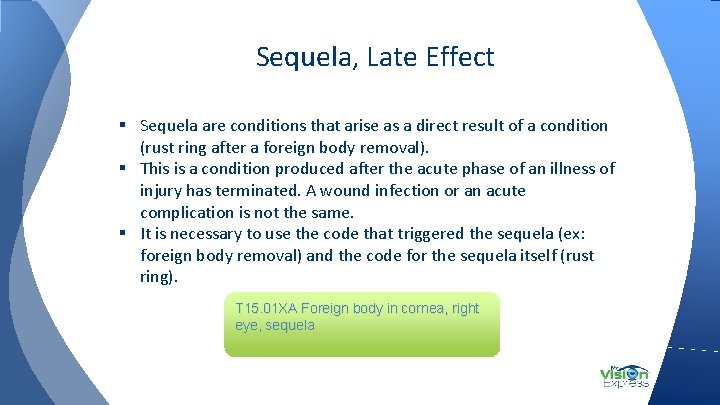
Sequela, Late Effect § Sequela are conditions that arise as a direct result of a condition (rust ring after a foreign body removal). § This is a condition produced after the acute phase of an illness of injury has terminated. A wound infection or an acute complication is not the same. § It is necessary to use the code that triggered the sequela (ex: foreign body removal) and the code for the sequela itself (rust ring). T 15. 01 XA Foreign body in cornea, right eye, sequela
Exclude 1 Notes § Excludes 1: Indicates that code identified in the note and code where the note appears cannot be reports together because the 2 conditions cannot occur together. H 40. 021 Open angle with borderline findings, high risk Type 1 Excludes: H 41. 51 - Absolute Glaucoma Q 15. 0 - Congenital Glaucoma P 15. 3 - Traumatic glaucoma due to birth injury
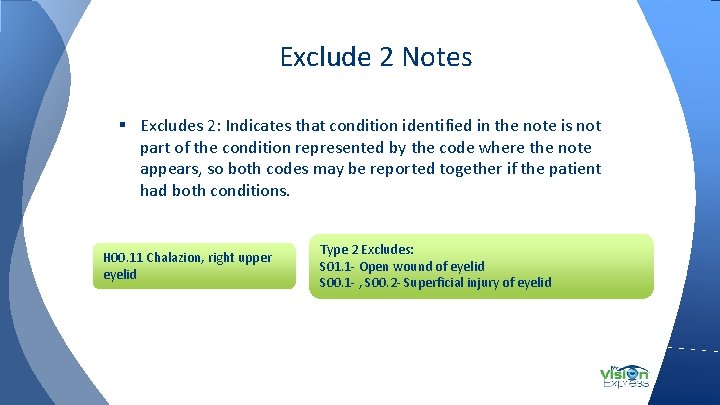
Exclude 2 Notes § Excludes 2: Indicates that condition identified in the note is not part of the condition represented by the code where the note appears, so both codes may be reported together if the patient had both conditions. H 00. 11 Chalazion, right upper eyelid Type 2 Excludes: S 01. 1 - Open wound of eyelid S 00. 1 - , S 00. 2 - Superficial injury of eyelid
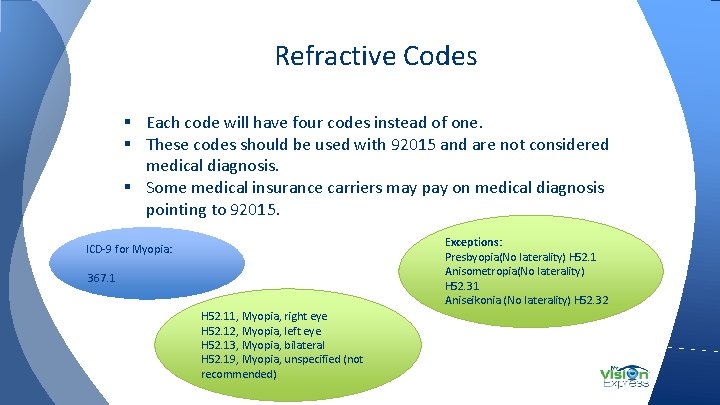
Refractive Codes § Each code will have four codes instead of one. § These codes should be used with 92015 and are not considered medical diagnosis. § Some medical insurance carriers may pay on medical diagnosis pointing to 92015. Exceptions: Presbyopia(No laterality) H 52. 1 Anisometropia(No laterality) H 52. 31 Aniseikonia (No laterality) H 52. 32 ICD-9 for Myopia: 367. 1 H 52. 11, Myopia, right eye H 52. 12, Myopia, left eye H 52. 13, Myopia, bilateral H 52. 19, Myopia, unspecified (not recommended)
Routine Eye Exam § V 72. 0, routine exam of eyes changes to two codes: § Z 01. 00 Encounter for examination of eyes and vision without abnormal findings. § Z 01. 01 Encounter for examination of eyes and vision with abnormal findings. § Individual carriers or vision plans may have different requirements. § Office visits should be linked to Z 01. 00 or Z 01. 01 when necessary.
Eyelid Codes § Seven codes are available for Eyelid codes. ICD-9 for Retained foreign body of eyelid is 374. 86 H 02. 811 Retained foreign body in right upper eyelid H 02. 812 Retained foreign body in right lower eyelid H 02. 813 Retained foreign body in right eye, unspecified eyelid (not recommended) H 02. 814 Retained foreign body in left upper eyelid H 02. 815 Retained foreign body in left lower eyelid H 02. 816 Retained foreign body in left eye, unspecified eyelid (not recommended)
Injury Codes § When documenting injuries, include: Episode of Care Injury site Etiology Place of Occurrence S 05. 51 XA Penetrating wound with foreign body of right eyeball, initial encounter S 05. 51 XD Penetrating wound with foreign body of right eyeball, subsequent encounter S 05. 51 XS Penetrating wound with foreign body of right eyeball, sequela
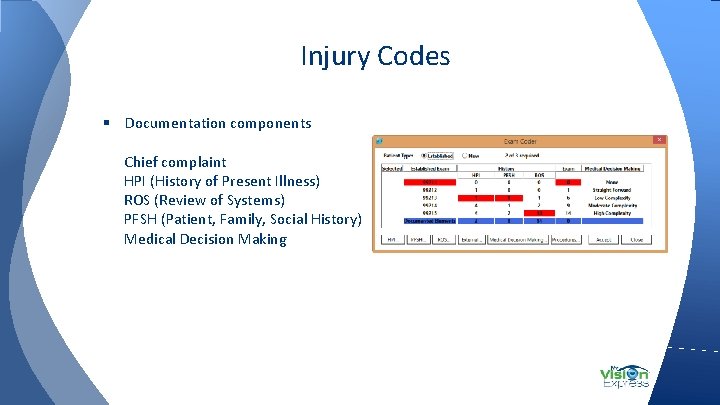
Injury Codes § Documentation components Chief complaint HPI (History of Present Illness) ROS (Review of Systems) PFSH (Patient, Family, Social History) Medical Decision Making
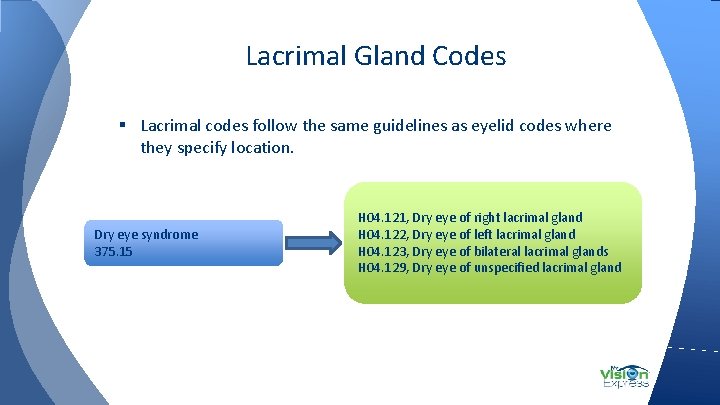
Lacrimal Gland Codes § Lacrimal codes follow the same guidelines as eyelid codes where they specify location. Dry eye syndrome 375. 15 H 04. 121, Dry eye of right lacrimal gland H 04. 122, Dry eye of left lacrimal gland H 04. 123, Dry eye of bilateral lacrimal glands H 04. 129, Dry eye of unspecified lacrimal gland
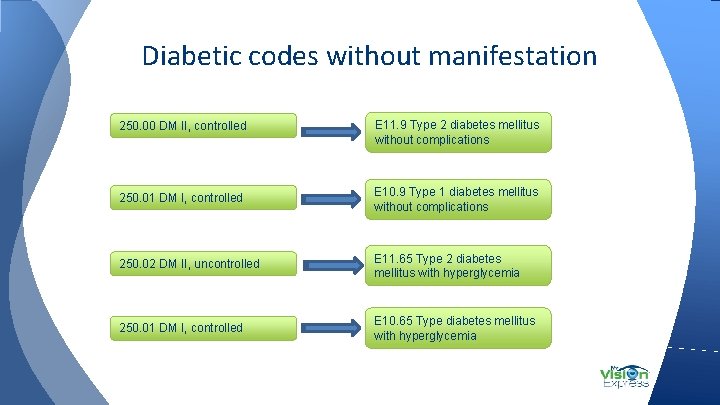
Diabetic codes without manifestation 250. 00 DM II, controlled E 11. 9 Type 2 diabetes mellitus without complications 250. 01 DM I, controlled E 10. 9 Type 1 diabetes mellitus without complications 250. 02 DM II, uncontrolled E 11. 65 Type 2 diabetes mellitus with hyperglycemia 250. 01 DM I, controlled E 10. 65 Type diabetes mellitus with hyperglycemia
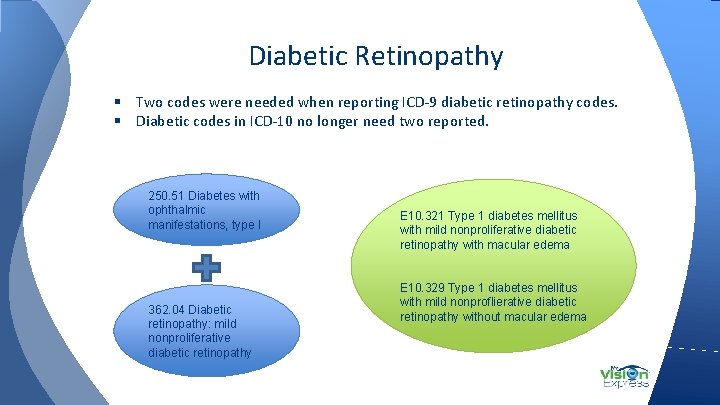
Diabetic Retinopathy § Two codes were needed when reporting ICD-9 diabetic retinopathy codes. § Diabetic codes in ICD-10 no longer need two reported. 250. 51 Diabetes with ophthalmic manifestations, type I 362. 04 Diabetic retinopathy: mild nonproliferative diabetic retinopathy E 10. 321 Type 1 diabetes mellitus with mild nonproliferative diabetic retinopathy with macular edema E 10. 329 Type 1 diabetes mellitus with mild nonproflierative diabetic retinopathy without macular edema
Claim Examples ICD 9 Example: Medical visit with Fundus Photos, Gonio, Pach, and Refraction.
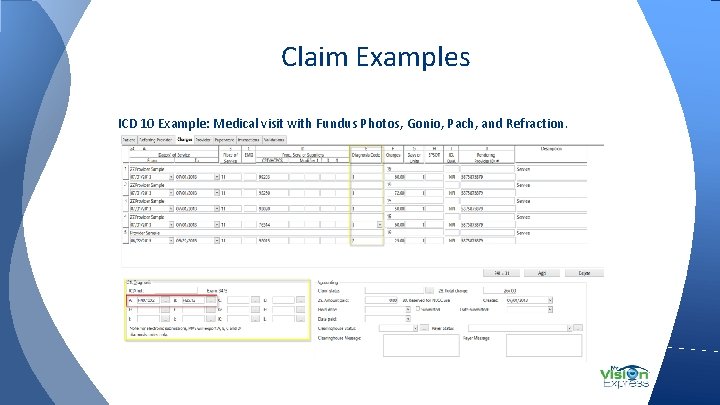
Claim Examples ICD 10 Example: Medical visit with Fundus Photos, Gonio, Pach, and Refraction.
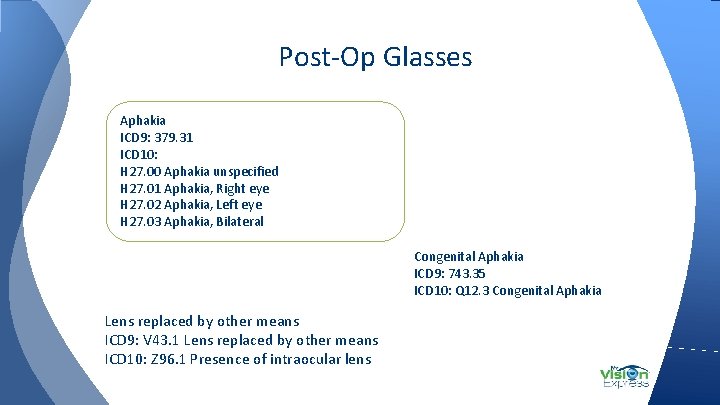
Post-Op Glasses Aphakia ICD 9: 379. 31 ICD 10: H 27. 00 Aphakia unspecified H 27. 01 Aphakia, Right eye H 27. 02 Aphakia, Left eye H 27. 03 Aphakia, Bilateral Congenital Aphakia ICD 9: 743. 35 ICD 10: Q 12. 3 Congenital Aphakia Lens replaced by other means ICD 9: V 43. 1 Lens replaced by other means ICD 10: Z 96. 1 Presence of intraocular lens
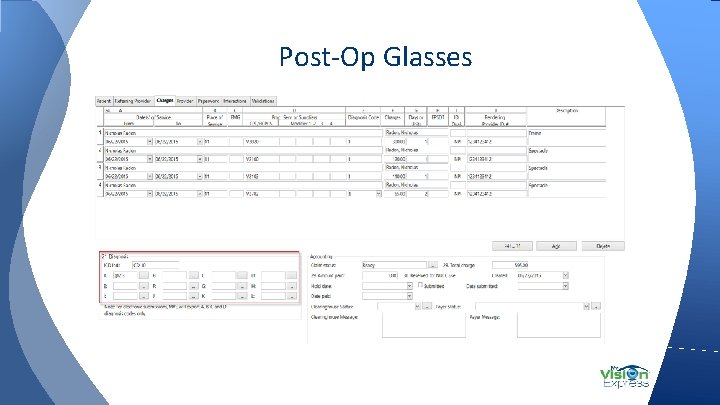
Post-Op Glasses
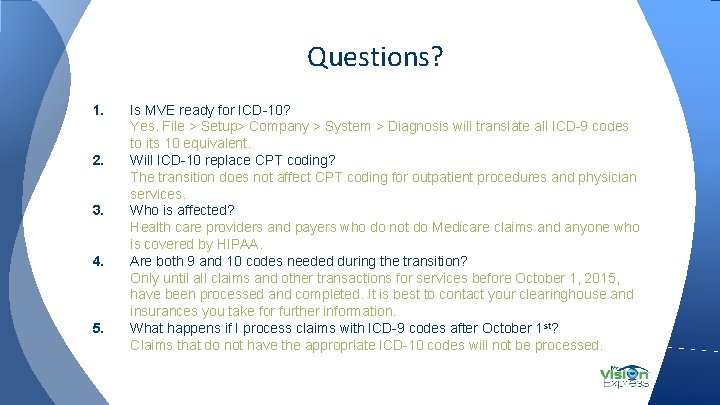
Questions? 1. 2. 3. 4. 5. Is MVE ready for ICD-10? Yes. File > Setup> Company > System > Diagnosis will translate all ICD-9 codes to its 10 equivalent. Will ICD-10 replace CPT coding? The transition does not affect CPT coding for outpatient procedures and physician services. Who is affected? Health care providers and payers who do not do Medicare claims and anyone who is covered by HIPAA. Are both 9 and 10 codes needed during the transition? Only until all claims and other transactions for services before October 1, 2015, have been processed and completed. It is best to contact your clearinghouse and insurances you take for further information. What happens if I process claims with ICD-9 codes after October 1 st? Claims that do not have the appropriate ICD-10 codes will not be processed.
Additional Knowledgebase Videos and Articles: www. support. myvisionexpress. com Contact: support@myvisionexpress. com 1 -800 -877 -7456 Ext. 3