
ICD10 Presentation 52115 TRACY PILA CMSS ADMINISTRATIVE DIRECTOR



- Slides: 46
ICD-10 Presentation 5/21/15 TRACY PILA, CMSS ADMINISTRATIVE DIRECTOR ARBOR CENTERS FOR EYECARE
Financial Interest I do not have any financial interest in any product, website, or photo mentioned in this presentation.
Introduction W 55. 39 CONTACT WITH GIRAFFE OR OTHER HOOF STOCK
Introduction �Why are we changing to ICD-10? The rest of the WORLD (yes, world) is currently using ICD-10. The United States is the only country not using ICD-10. � But the United States is the only country using ICD-10 for reimbursement. �Why does that matter? The World Health Organization (WHO) releases information about disease populations, etc. and our statistics don't get counted since our codes do not match. For example, WHO reports on the number of Ebola cases throughout the world. Even though the United States had a few reported cases, our current ICD-9 codes don't even include Ebola in them - so our statistics don't match and our coding isn't accurate.
Introduction �How is it different from ICD-9? The current set of ICD-9 codes we use are outdated and newer codes have not been added in years. ICD-10 is also much more specific than ICD-9. ICD-10 will now have codes for severity of diseases/problems and also for location. � In ICD-10, we will code H 25. 11 for a nuclear sclerotic cataract in the right eye, H 25. 12 for a nuclear sclerotic cataract in the left eye, and H 25. 13 for a nuclear sclerotic cataract in both eyes.
Is it really that scary? �For doctors, not really! While the change seems overwhelming, our EMR provider has made this transition relatively easy with their ICD-10 solution. Almost everything you need to code will be built into EMR, just like it is now. You will also have access to a user-specific favorites list in case you need to reference your most commonly used codes. � You will also be able to see other users’ lists as well.
ICD-10 Basics V 91. 07 XD: BURN DUE TO WATER-SKIS ON FIRE, SUBSEQUENT ENCOUNTER
ICD-10 Basics �Go-Live date is October 1, 2015 �Going from about 15, 000 codes to around 70, 000 codes �Combination of letters and numbers, up to 7 digits �Location and severity, and visit type (initial, subsequent, etc. ) now included �All insurance companies will be using ICD-10 EXCEPT for worker’s comp. and auto insurance
Coding Information R 46. 1: BIZARRE PERSONAL APPEARANCE
Coding Information �First character of all code sets will be a letter �H indicates an eye code �X indicates a place holder code �Unspecified codes may result in lower or non- payment �V codes are now Z codes
Coding, continued… � Modifiers will NOT go away! RT/LT codes still need to be attached to CPT codes for surgeries, lasers and diagnostic testing, even if the ICD-10 code specifies laterality. For example, when coding cataract surgery, you will still code 66984 -RT along with the lateral cataract diagnosis. � Trauma will need to be coded to the 7 th character and will usually require several codes. � Not every code specifies laterality… POAG is NOT coded per eye but by severity whereas OHTN IS coded per eye but NOT by severity. Glaucoma associated with inflammation codes using both. � Cannot add a lateral code if it is not needed. Cannot code per eye for POAG, even if stage is different per eye.
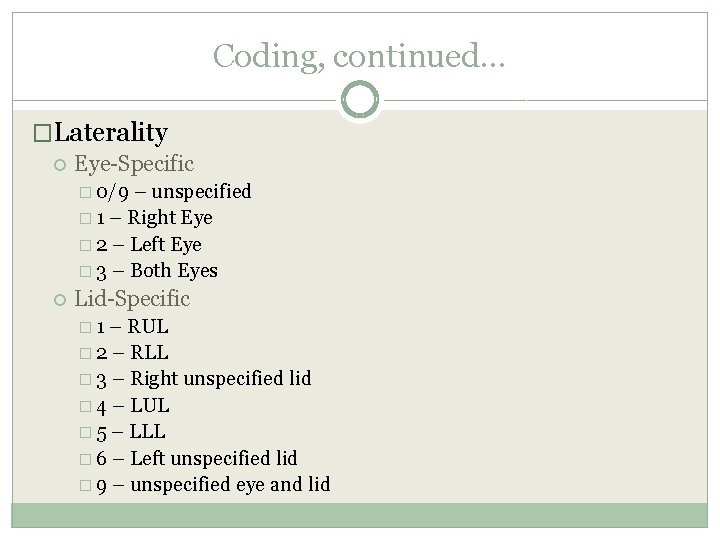
Coding, continued… �Laterality Eye-Specific � 0/9 – unspecified � 1 – Right Eye � 2 – Left Eye � 3 – Both Eyes Lid-Specific � 1 – RUL � 2 – RLL � 3 – Right unspecified lid � 4 – LUL � 5 – LLL � 6 – Left unspecified lid � 9 – unspecified eye and lid
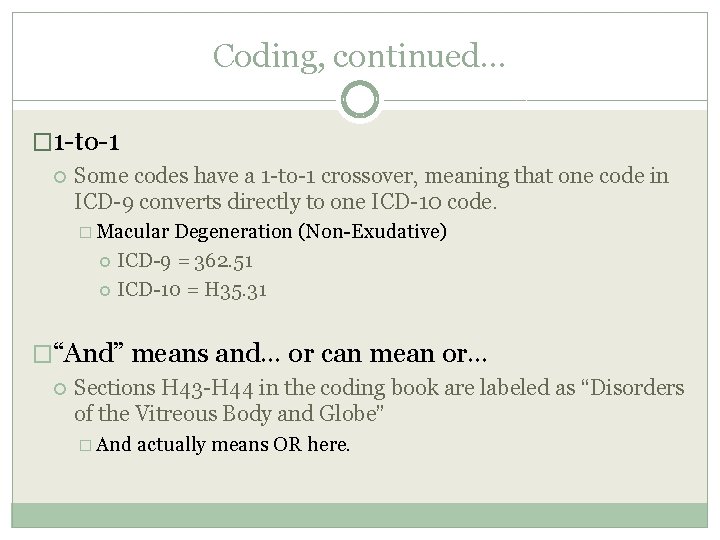
Coding, continued… � 1 -to-1 Some codes have a 1 -to-1 crossover, meaning that one code in ICD-9 converts directly to one ICD-10 code. � Macular Degeneration (Non-Exudative) ICD-9 = 362. 51 ICD-10 = H 35. 31 �“And” means and… or can mean or… Sections H 43 -H 44 in the coding book are labeled as “Disorders of the Vitreous Body and Globe” � And actually means OR here.
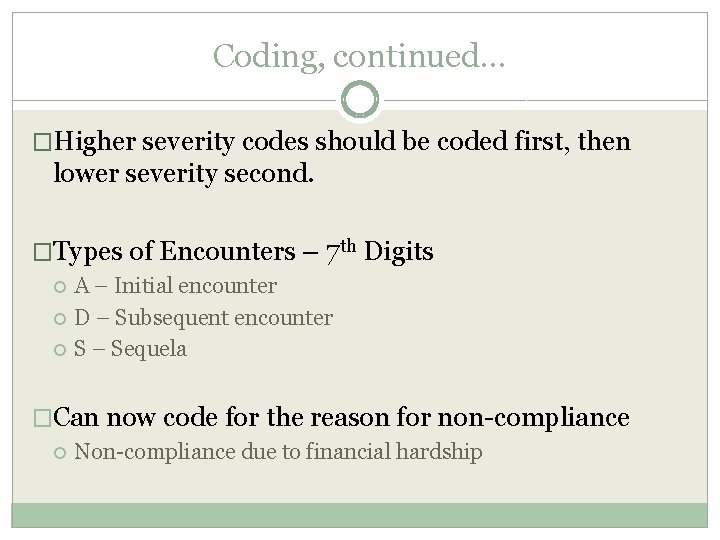
Coding, continued… �Higher severity codes should be coded first, then lower severity second. �Types of Encounters – 7 th Digits A – Initial encounter D – Subsequent encounter S – Sequela �Can now code for the reason for non-compliance Non-compliance due to financial hardship
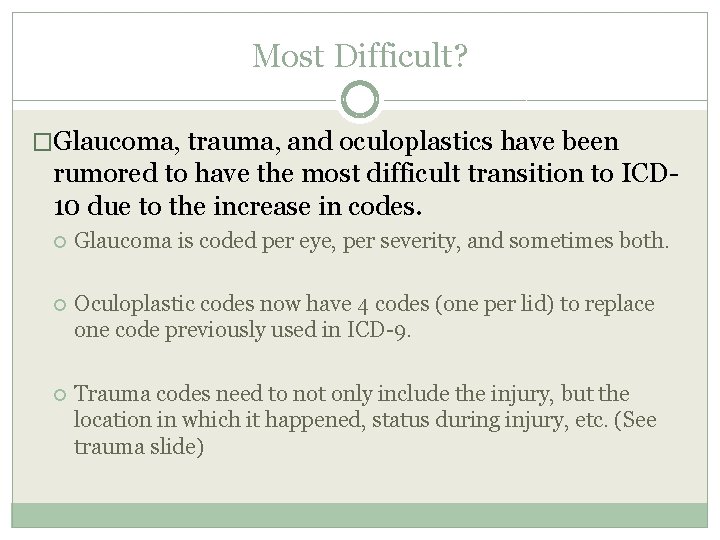
Most Difficult? �Glaucoma, trauma, and oculoplastics have been rumored to have the most difficult transition to ICD 10 due to the increase in codes. Glaucoma is coded per eye, per severity, and sometimes both. Oculoplastic codes now have 4 codes (one per lid) to replace one code previously used in ICD-9. Trauma codes need to not only include the injury, but the location in which it happened, status during injury, etc. (See trauma slide)
Using Unspecified Codes �Unspecified Coding Unspecified codes do NOT have 1 -to-1 crossover codes. Unspecified codes may be paid at a lower level or not at all in ICD-10.
Transition W 59. 22 XA STRUCK BY TURTLE
Coding Analysis (Each practice to determine best way to analyze this information. ) �How many codes are we actually talking about? Pulled reports for the last 2 years for each doctor individually. Sorted each report from most commonly used to least commonly used codes. Highlighted each doctor’s coding analysis by the following: � Top 80% used = green � Top 80%-90% = blue � Top 90% - Top 50 codes used = pink Most doctors had under 50 codes that were their “top used” codes. Gave us an idea of what each doctor uses so we are prepared for the transition.
EMR Changes �How has your EMR company transitioned to ICD-10? �Start the transition sooner rather than later so that the changes are easier once October 1 st is here. �Does the EMR company provide any training (webinars, handouts, on-site, etc. )? �How will your staff and doctors be aware of the changes?
Staff Training �Billing �Surgery Scheduling �Clinic Coordinators �Technicians �Scribes �Front Desk �Call Center
The Transition Plan �Weekly communication to all staff with announcements �In-person meetings to introduce all staff to ICD-10 �“Super-User” team consisting of technicians and scribes that will learn more and be the “go-to” staff members during the transition
Specialty-Specific W 56. 41 BITTEN BY SHARK
Cataracts H 25 – H 28 Codes �Coded per eye. �Changed wording from senile to mature. �Cause of cataract needs to be coded if secondary to drug or other disorder. �If coding traumatic cataract, need to list external cause of cataract as well (see trauma slide).
Cornea H 15 – H 22 Codes �Unspecified codes will now be replaced with specific disorder codes, per eye (in most cases). For example, Corneal Ulcer (unsp. ) – 370. 00 – will now be coded with specifics as to location (central), type (perforated), and eye. �Corneal problems caused by external causes will need codes specifying HOW the injury happened.
Diabetes E 11 Codes �Type II will need to be coded with insulin use. � 250. 00 has a 1 -to-1 match with E 11. 9 �Instead of coding 250. 50 with NPDR/CSME code(s), each of these combinations now has its own code Type II diabetes with moderate NPDR with macular edema (previously 3 separate codes) is now E 11. 321. Also need to code Z 79. 4 for Insulin use.
Eyelid, Lacrimal, Orbit H 00 – H 05 Codes �Codes are split up per eye and/or lid Lid-Specific � 1 – RUL � 2 – RLL � 3 – Right unspecified lid � 4 – LUL � 5 – LLL � 6 – Left unspecified lid � 9 – unspecified eye and lid
Glaucoma H 40 – H 42 Codes �Some glaucoma diagnoses are coded per eye, some are coded by severity, and some are coded using BOTH. Glaucoma associated with ocular inflammation is coded by eye AND severity, splitting this one code (365. 62) into 15 possible codes. �If severity is worse in one eye than the other, but there isn’t a lateral code, then two codes should be given, the most severe first. �Glaucoma caused by medication use will also need additional code for adverse effect to identify the drug.
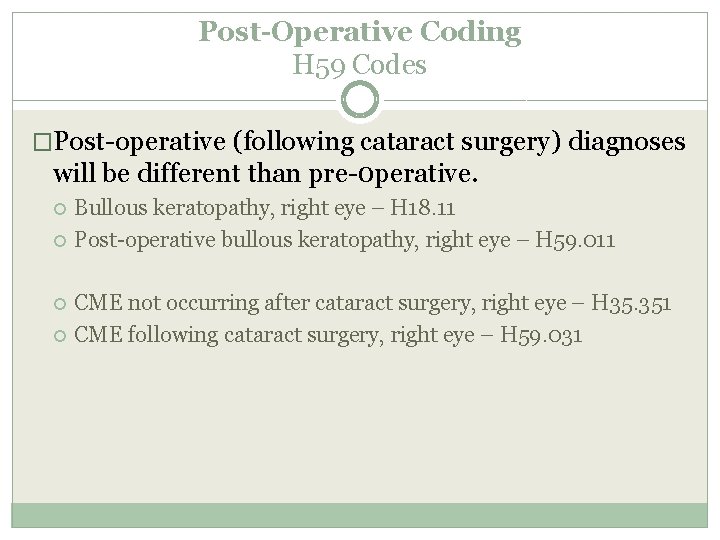
Post-Operative Coding H 59 Codes �Post-operative (following cataract surgery) diagnoses will be different than pre-0 perative. Bullous keratopathy, right eye – H 18. 11 Post-operative bullous keratopathy, right eye – H 59. 011 CME not occurring after cataract surgery, right eye – H 35. 351 CME following cataract surgery, right eye – H 59. 031
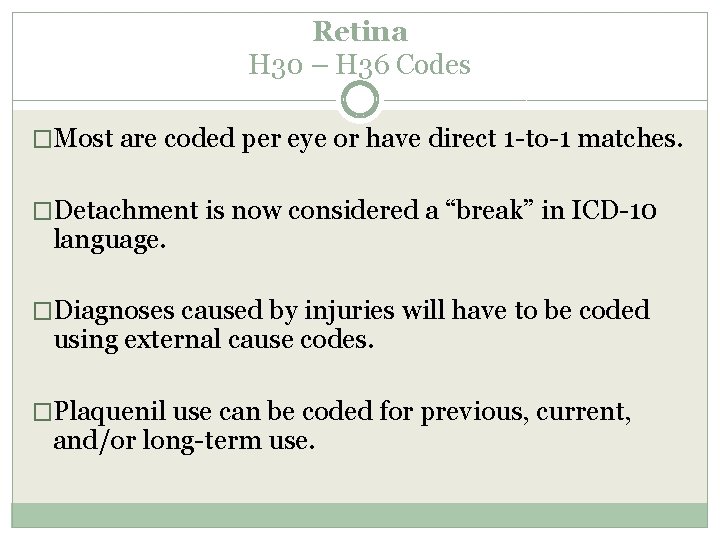
Retina H 30 – H 36 Codes �Most are coded per eye or have direct 1 -to-1 matches. �Detachment is now considered a “break” in ICD-10 language. �Diagnoses caused by injuries will have to be coded using external cause codes. �Plaquenil use can be coded for previous, current, and/or long-term use.
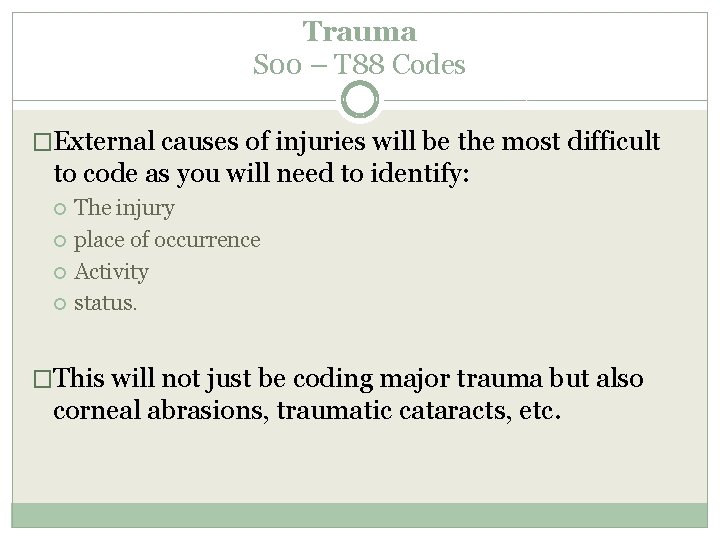
Trauma S 00 – T 88 Codes �External causes of injuries will be the most difficult to code as you will need to identify: The injury place of occurrence Activity status. �This will not just be coding major trauma but also corneal abrasions, traumatic cataracts, etc.
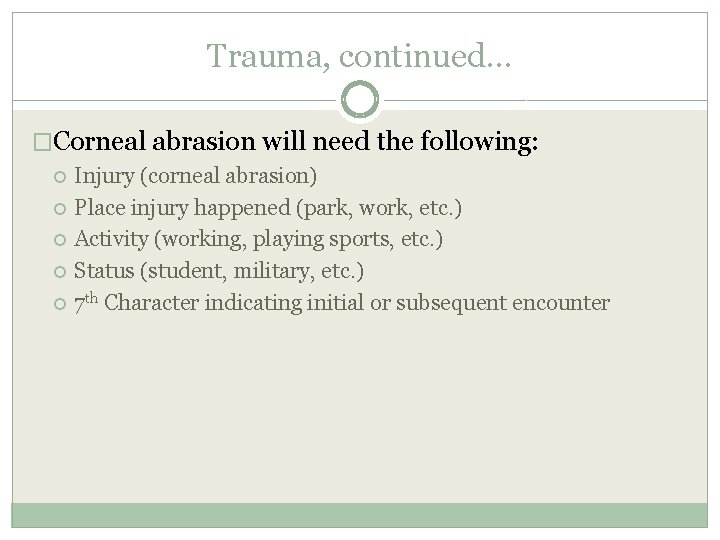
Trauma, continued… �Corneal abrasion will need the following: Injury (corneal abrasion) Place injury happened (park, work, etc. ) Activity (working, playing sports, etc. ) Status (student, military, etc. ) 7 th Character indicating initial or subsequent encounter
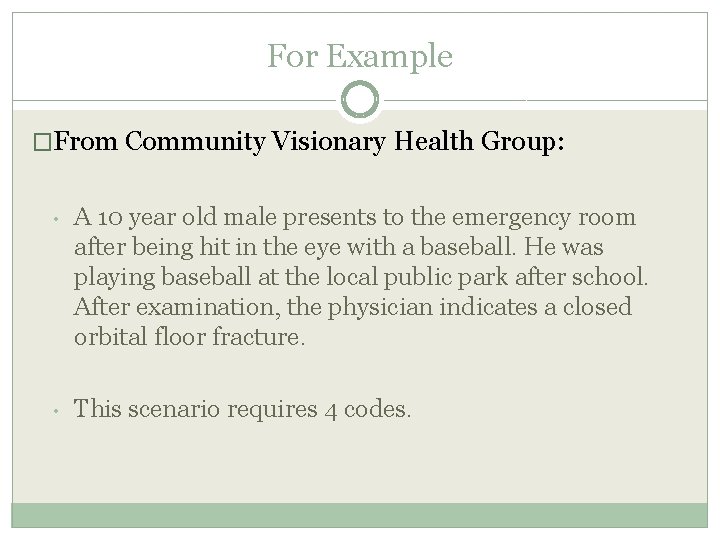
For Example �From Community Visionary Health Group: • A 10 year old male presents to the emergency room after being hit in the eye with a baseball. He was playing baseball at the local public park after school. After examination, the physician indicates a closed orbital floor fracture. • This scenario requires 4 codes.
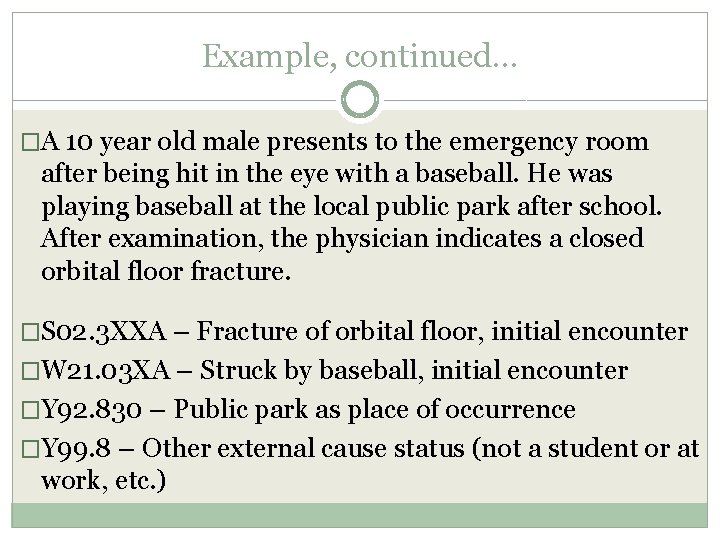
Example, continued… �A 10 year old male presents to the emergency room after being hit in the eye with a baseball. He was playing baseball at the local public park after school. After examination, the physician indicates a closed orbital floor fracture. �S 02. 3 XXA – Fracture of orbital floor, initial encounter �W 21. 03 XA – Struck by baseball, initial encounter �Y 92. 830 – Public park as place of occurrence �Y 99. 8 – Other external cause status (not a student or at work, etc. )
EMR Changes Z 73. 4 INADEQUATE SOCIAL SKILLS
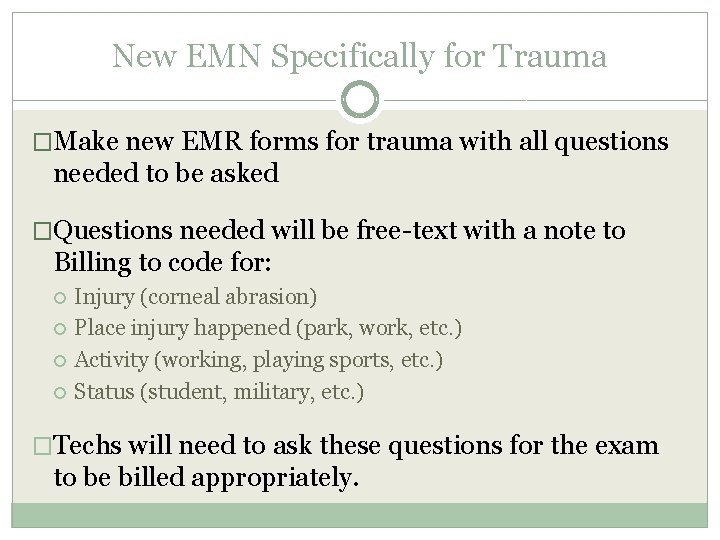
New EMN Specifically for Trauma �Make new EMR forms for trauma with all questions needed to be asked �Questions needed will be free-text with a note to Billing to code for: Injury (corneal abrasion) Place injury happened (park, work, etc. ) Activity (working, playing sports, etc. ) Status (student, military, etc. ) �Techs will need to ask these questions for the exam to be billed appropriately.
Diabetics �Will need to document medication use at every visit. �Make new diabetic history box in EMR that asks specific medication use and history. �Techs will need to ask these questions for the exam to be billed appropriately.
Surgical Billing �Option 1: Create new surgical billing sheets including ICD-10 codes. �Option 2: Start using Intraoperative Note in EMR for all surgical billing. � During or after surgery
Learning More R 06. 5 HABITUAL MOUTH BREATHING
More Information �Billing staff has ICD-10 coding books and the following: Fee sheets with ICD-10 codes AAO find a code online AAPC Top 50 Ophthalmology Codes cheat sheets AGS Quick coding tips
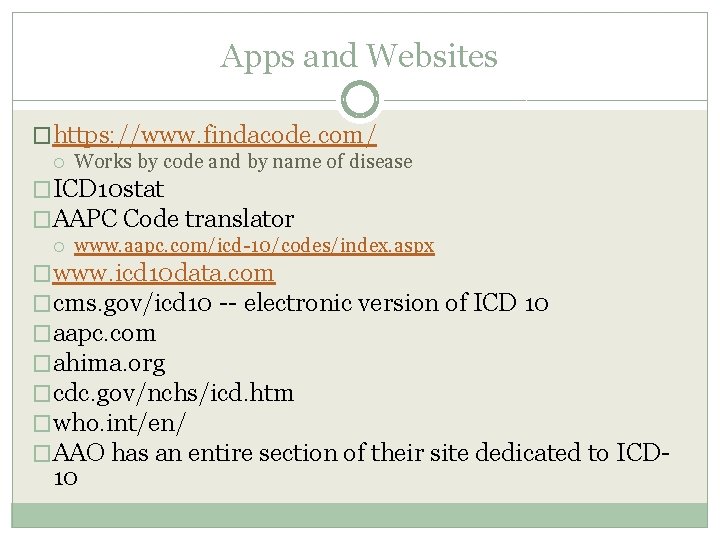
Apps and Websites �https: //www. findacode. com/ Works by code and by name of disease �ICD 10 stat �AAPC Code translator www. aapc. com/icd-10/codes/index. aspx �www. icd 10 data. com �cms. gov/icd 10 -- electronic version of ICD 10 �aapc. com �ahima. org �cdc. gov/nchs/icd. htm �who. int/en/ �AAO has an entire section of their site dedicated to ICD- 10
Next Steps S 05. 90 XA SHOT IN THE EYE WITH A BB GUN
What do we do next? �Who will help each doctor with the transition? (Tech, scribe) �Meet with doctors individually to go over unspecified codes for further details. �Think about the EMR changes and how to make the transition easy. �Think about your own training and transition plan – what can we do to help? What do you need? When can we do this?
Go-Live Week �End clinic early (or cut back a little). Gives doctors time at the end of the day to go back to anything they could not finish. �Make sure all coding is complete. �Have billers and super users available to help all week.
Weeks Following Go-Live �Monitor denials Track and report on them �Teach doctors and scribes what they are doing wrong �Make any necessary EMR changes
Thank You!
Picture References �Giraffe www. buzzfeed. com �Water Skis / Turtle / Shark / Darth Vader / Cow Bell http: //blog. himss. org/2014/09/18/10 -ways-to-relate-icd 10 nhitweek/ �Bizarre Personal Appearance / Social Skills http: //www. icd 10 illustrated. com/ �BB Gun (Christmas Story) www. pinterest. com