
ICD10 CM Training Nephrology ICD10 CM Compliance Dates











- Slides: 43
ICD-10 CM Training Nephrology
ICD-10 -CM Compliance Dates • ICD-10 -CM will be valid for dates of service on or after October 1, 2015 – Outpatient dates of service of October 1, 2015 and beyond. – Inpatient hospital service claims, is effective for dates of discharge after September 30, 2015
Covered and Non-Covered Entities • Covered Entities – Everyone covered by the Health Insurance Portability Accountability Act (HIPPA) • Non-Covered Entities – Worker’s Compensation – Auto Insurance – Non covered HIPAA entities are exempt but are encouraged to adapt the new code set
ICD-10 Code Structure • 21 Chapters • Alpha-numeric codes; not case-sensitive – Codes begin with Alpha letter, A-Z, excluding U – Common errors • I verses 1 • O verses 0 • “X” Placeholder • 3 to 7 characters – Decimal following 3 rd character
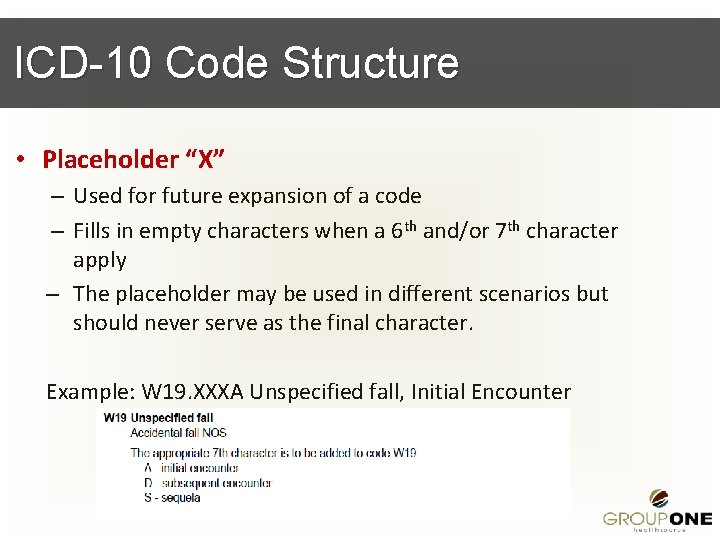
ICD-10 Code Structure • Placeholder “X” – Used for future expansion of a code – Fills in empty characters when a 6 th and/or 7 th character apply – The placeholder may be used in different scenarios but should never serve as the final character. Example: W 19. XXXA Unspecified fall, Initial Encounter
ICD-10 Code Structure • 7 th Character – Provides specified information regarding the clinical visit – Is required for certain categories and must be reported in the seventh position – May be alpha or numeric – Has different meanings depending on the coding category
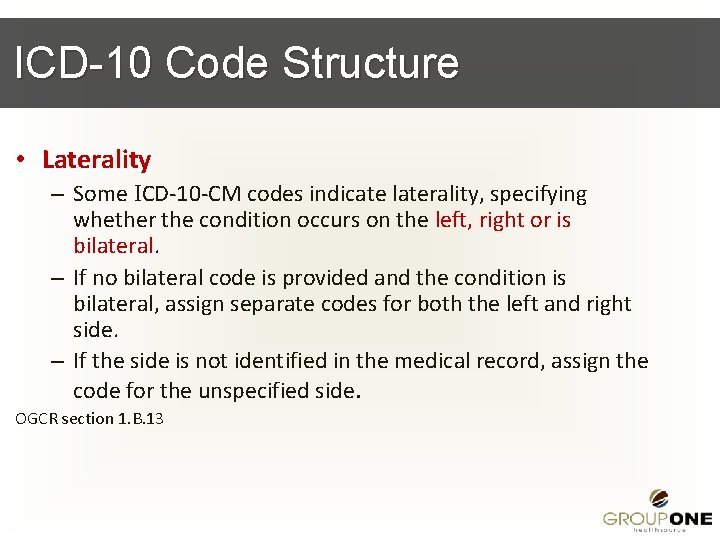
ICD-10 Code Structure • Laterality – Some ICD-10 -CM codes indicate laterality, specifying whether the condition occurs on the left, right or is bilateral. – If no bilateral code is provided and the condition is bilateral, assign separate codes for both the left and right side. – If the side is not identified in the medical record, assign the code for the unspecified side. OGCR section 1. B. 13
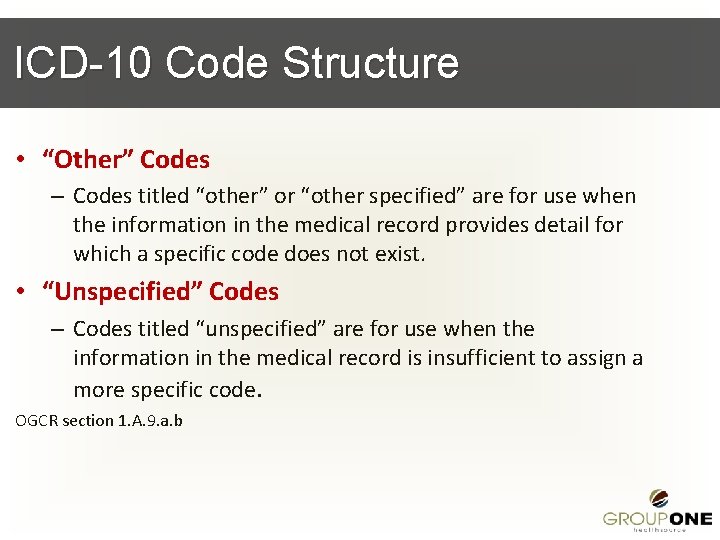
ICD-10 Code Structure • “Other” Codes – Codes titled “other” or “other specified” are for use when the information in the medical record provides detail for which a specific code does not exist. • “Unspecified” Codes – Codes titled “unspecified” are for use when the information in the medical record is insufficient to assign a more specific code. OGCR section 1. A. 9. a. b
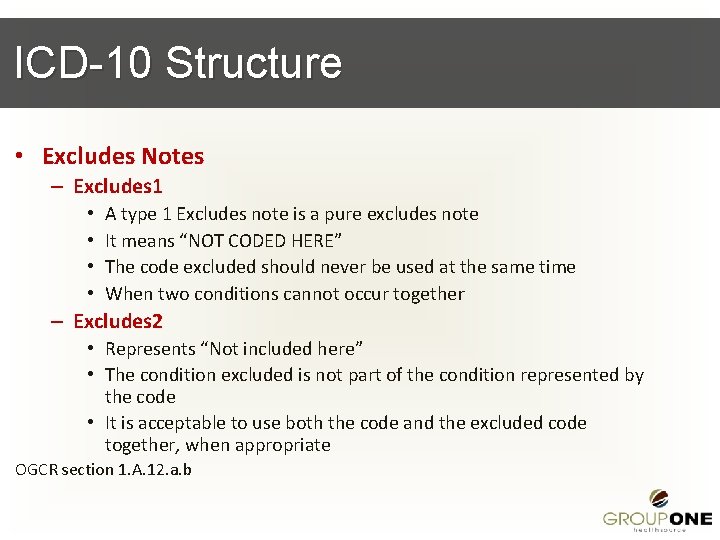
ICD-10 Structure • Excludes Notes – Excludes 1 • • A type 1 Excludes note is a pure excludes note It means “NOT CODED HERE” The code excluded should never be used at the same time When two conditions cannot occur together – Excludes 2 • Represents “Not included here” • The condition excluded is not part of the condition represented by the code • It is acceptable to use both the code and the excluded code together, when appropriate OGCR section 1. A. 12. a. b
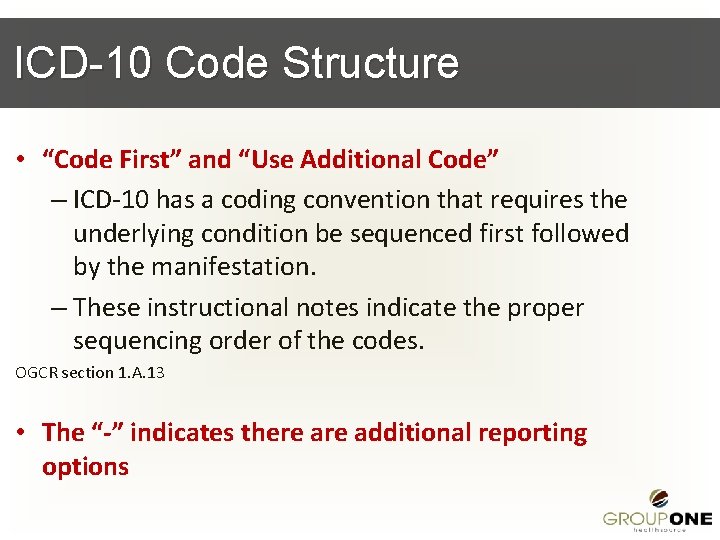
ICD-10 Code Structure • “Code First” and “Use Additional Code” – ICD-10 has a coding convention that requires the underlying condition be sequenced first followed by the manifestation. – These instructional notes indicate the proper sequencing order of the codes. OGCR section 1. A. 13 • The “-” indicates there additional reporting options
Most Common Diagnosis Codes
Hypertension ICD-9 Code ICD-10 Code Description Excludes 1 Excludes 2 401. 1 401. 9 401. 0 I 10 Essential (Primary) Hypertension Includes: high blood pressure, Hypertension (arterial) (benign) (essential) (malignant) (systemic) • Hypertensive disease complicating pregnancy, childbirth and the puerperium (O 10 -O 11, O 13 -O 16) • Neonatal hypertension (P 29. 2) • Primary pulmonary hypertension (I 127. 0) • Essential (primary) hypertension involving vessels of brain (I 60 -I 69) • Essential (primary) hypertension involving vessels of eye (H 35. 0 -) Hypertensive Diseases Categories (I 10 -I 15) Use additional code to identify: • Exposure to environmental tobacco smoke (Z 77. 22) • History of tobacco use (Z 87. 891) • Occupational exposure to environmental tobacco smoke (Z 57. 31) • Tobacco dependence (F 17. -) • Tobacco use (Z 72. 0) • Hypertensive disease complicating pregnancy, childbirth and the puerperium (O 10 -O 11. O 13 -O 16) • Neonatal hypertension (P 29. 2) • Primary Pulmonary hypertension (I 27. 0) The use additional codes and Excludes 1 codes apply for all categories.
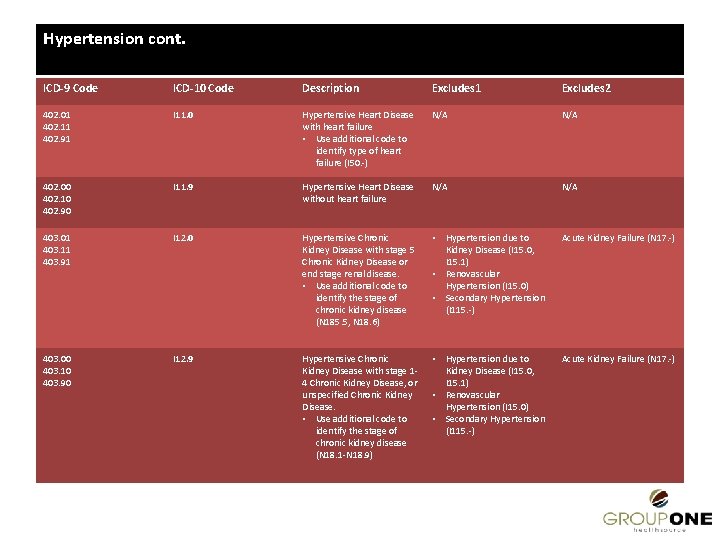
Hypertension cont. ICD-9 Code ICD-10 Code Description Excludes 1 Excludes 2 402. 01 402. 11 402. 91 I 11. 0 Hypertensive Heart Disease with heart failure • Use additional code to identify type of heart failure (I 50. -) N/A 402. 00 402. 10 402. 90 I 11. 9 Hypertensive Heart Disease without heart failure N/A 403. 01 403. 11 403. 91 I 12. 0 Hypertensive Chronic Kidney Disease with stage 5 Chronic Kidney Disease or end stage renal disease. • Use additional code to identify the stage of chronic kidney disease (N 185. 5, N 18. 6) • Hypertension due to Kidney Disease (I 15. 0, I 15. 1) • Renovascular Hypertension (I 15. 0) • Secondary Hypertension (I 115. -) Acute Kidney Failure (N 17. -) 403. 00 403. 10 403. 90 I 12. 9 Hypertensive Chronic Kidney Disease with stage 14 Chronic Kidney Disease, or unspecified Chronic Kidney Disease. • Use additional code to identify the stage of chronic kidney disease (N 18. 1 -N 18. 9) • Hypertension due to Kidney Disease (I 15. 0, I 15. 1) • Renovascular Hypertension (I 15. 0) • Secondary Hypertension (I 115. -) Acute Kidney Failure (N 17. -)
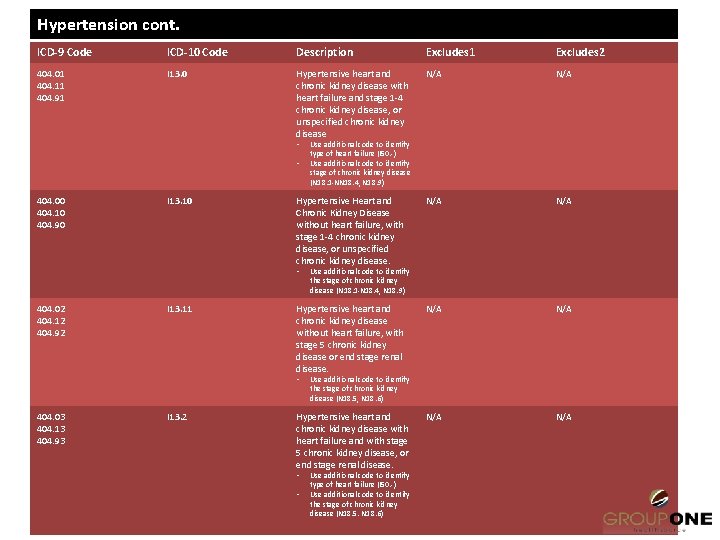
Hypertension cont. ICD-9 Code ICD-10 Code Description Excludes 1 Excludes 2 404. 01 404. 11 404. 91 I 13. 0 Hypertensive heart and chronic kidney disease with heart failure and stage 1 -4 chronic kidney disease, or unspecified chronic kidney disease N/A Hypertensive Heart and Chronic Kidney Disease without heart failure, with stage 1 -4 chronic kidney disease, or unspecified chronic kidney disease. N/A Hypertensive heart and chronic kidney disease without heart failure, with stage 5 chronic kidney disease or end stage renal disease. N/A Hypertensive heart and chronic kidney disease with heart failure and with stage 5 chronic kidney disease, or end stage renal disease. N/A • • 404. 00 404. 10 404. 90 I 13. 10 • 404. 02 404. 12 404. 92 I 13. 11 • 404. 03 404. 13 404. 93 I 13. 2 • • Use additional code to identify type of heart failure (I 50. -) Use additional code to identify stage of chronic kidney disease (N 18. 1 -NN 18. 4, N 18. 9) Use additional code to identify the stage of chronic kidney disease (N 18. 1 -N 18. 4, N 18. 9) Use additional code to identify the stage of chronic kidney disease (N 18. 5, N 18. 6) Use additional code to identify type of heart failure (I 50. -) Use additional code to identify the stage of chronic kidney disease (N 18. 5. N 18. 6)
Hypertension cont. ICD-9 Code ICD-10 Code Description Excludes 1 Excludes 2 405. 01 405. 11 405. 91 I 15. 0 Renovascular Hypertension • Code also underlying condition Postprocedural hypertension (I 97. 3) • Secondary hypertension involving vessels of brain (I 60 -I 69) • Secondary hypertension involving vessels of eye (H 35. 0 -) 405. 91 I 15. 1 Hypertension secondary to other renal disorders • Code also underlying condition Postprocedural hypertension (I 97. 3) • Secondary hypertension involving vessels of brain (I 60 -I 69) • Secondary hypertension involving vessels of eye (H 35. 0 -) 405. 99 I 15. 2 Hypertension secondary to endocrine disorders • Code also underlying condition Postprocedural hypertension (I 97. 3) • Secondary hypertension involving vessels of brain (I 60 -I 69) • Secondary hypertension involving vessels of eye (H 35. 0 -) 405. 09 405. 19 405. 99 I 15. 8 Other secondary hypertension • Code also underlying condition Postprocedural hypertension (I 97. 3) • Secondary hypertension involving vessels of brain (I 60 -I 69) • Secondary hypertension involving vessels of eye (H 35. 0 -) 405. 99 I 15. 9 Secondary hypertension, unspecified • Code also underlying condition Postprocedural hypertension (I 97. 3) • Secondary hypertension involving vessels of brain (I 60 -I 69) • Secondary hypertension involving vessels of eye (H 35. 0 -)
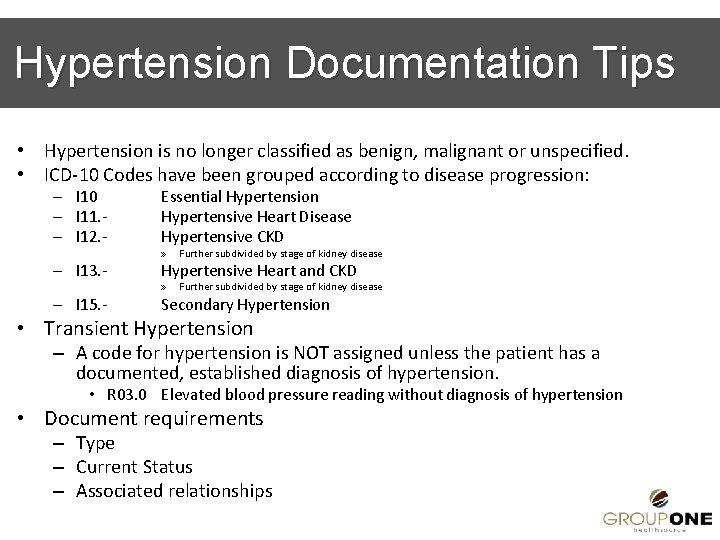
Hypertension Documentation Tips • Hypertension is no longer classified as benign, malignant or unspecified. • ICD-10 Codes have been grouped according to disease progression: – I 10 – I 11. – I 12. - Essential Hypertension Hypertensive Heart Disease Hypertensive CKD – I 13. - Hypertensive Heart and CKD – I 15. - Secondary Hypertension » » Further subdivided by stage of kidney disease • Transient Hypertension – A code for hypertension is NOT assigned unless the patient has a documented, established diagnosis of hypertension. • R 03. 0 Elevated blood pressure reading without diagnosis of hypertension • Document requirements – Type – Current Status – Associated relationships
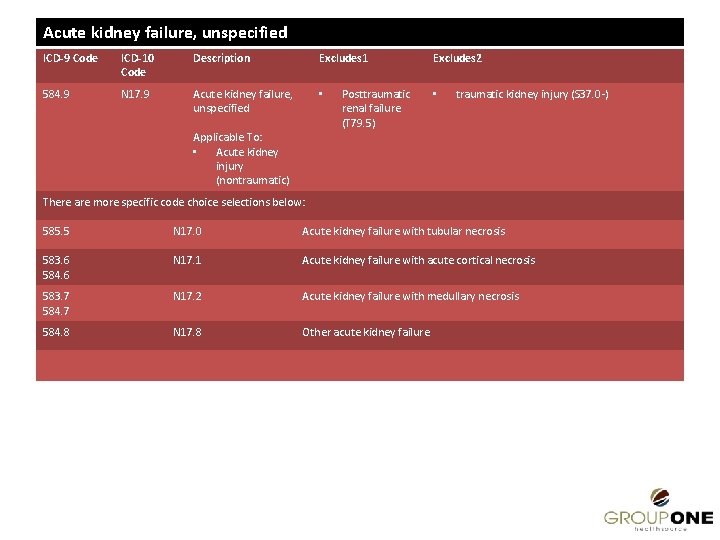
Acute kidney failure, unspecified ICD-9 Code ICD-10 Code Description Excludes 1 584. 9 N 17. 9 Acute kidney failure, unspecified • Applicable To: • Acute kidney injury (nontraumatic) Posttraumatic renal failure (T 79. 5) Excludes 2 • traumatic kidney injury (S 37. 0 -) There are more specific code choice selections below: 585. 5 N 17. 0 Acute kidney failure with tubular necrosis 583. 6 584. 6 N 17. 1 Acute kidney failure with acute cortical necrosis 583. 7 584. 7 N 17. 2 Acute kidney failure with medullary necrosis 584. 8 N 17. 8 Other acute kidney failure
Documentation Tips • Indicate any associated underlying condition • Indicate acute renal failure type
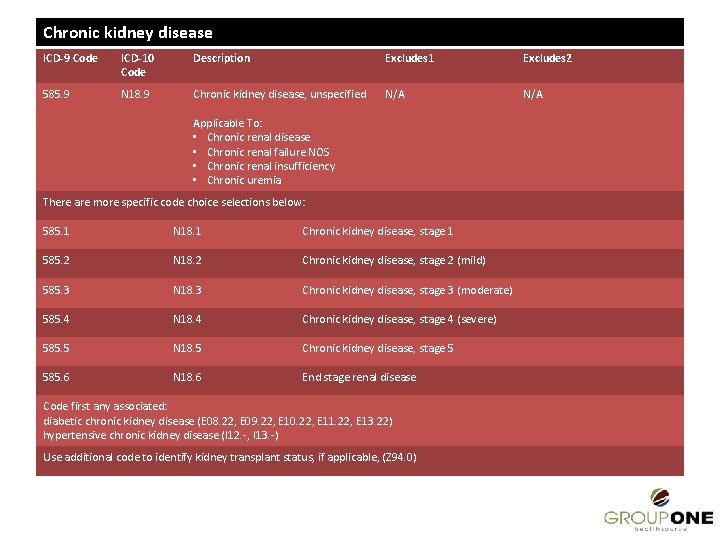
Chronic kidney disease ICD-9 Code ICD-10 Code Description Excludes 1 Excludes 2 585. 9 N 18. 9 Chronic kidney disease, unspecified N/A Applicable To: • Chronic renal disease • Chronic renal failure NOS • Chronic renal insufficiency • Chronic uremia There are more specific code choice selections below: 585. 1 N 18. 1 Chronic kidney disease, stage 1 585. 2 N 18. 2 Chronic kidney disease, stage 2 (mild) 585. 3 N 18. 3 Chronic kidney disease, stage 3 (moderate) 585. 4 N 18. 4 Chronic kidney disease, stage 4 (severe) 585. 5 N 18. 5 Chronic kidney disease, stage 5 585. 6 N 18. 6 End stage renal disease Code first any associated: diabetic chronic kidney disease (E 08. 22, E 09. 22, E 10. 22, E 11. 22, E 13. 22) hypertensive chronic kidney disease (I 12. -, I 13. -) Use additional code to identify kidney transplant status, if applicable, (Z 94. 0)
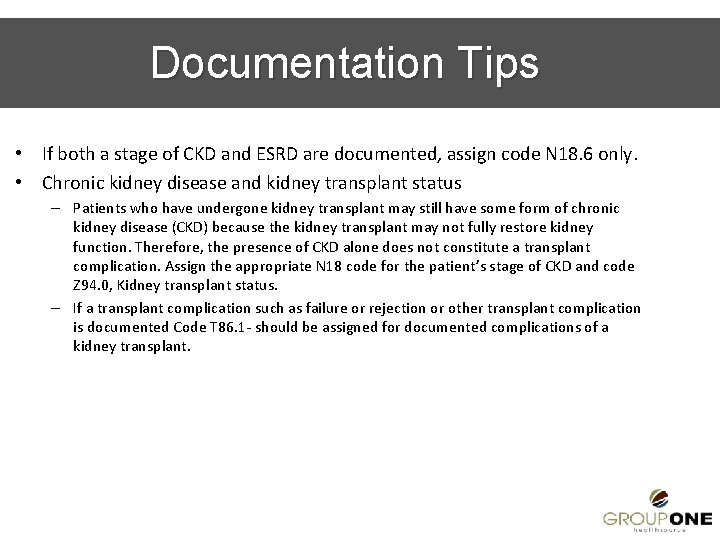
Documentation Tips • If both a stage of CKD and ESRD are documented, assign code N 18. 6 only. • Chronic kidney disease and kidney transplant status – Patients who have undergone kidney transplant may still have some form of chronic kidney disease (CKD) because the kidney transplant may not fully restore kidney function. Therefore, the presence of CKD alone does not constitute a transplant complication. Assign the appropriate N 18 code for the patient’s stage of CKD and code Z 94. 0, Kidney transplant status. – If a transplant complication such as failure or rejection or other transplant complication is documented Code T 86. 1 - should be assigned for documented complications of a kidney transplant.
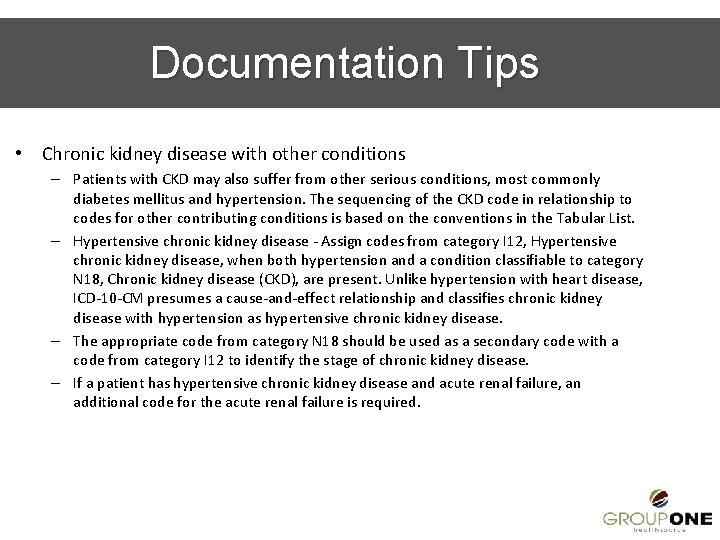
Documentation Tips • Chronic kidney disease with other conditions – Patients with CKD may also suffer from other serious conditions, most commonly diabetes mellitus and hypertension. The sequencing of the CKD code in relationship to codes for other contributing conditions is based on the conventions in the Tabular List. – Hypertensive chronic kidney disease - Assign codes from category I 12, Hypertensive chronic kidney disease, when both hypertension and a condition classifiable to category N 18, Chronic kidney disease (CKD), are present. Unlike hypertension with heart disease, ICD-10 -CM presumes a cause-and-effect relationship and classifies chronic kidney disease with hypertension as hypertensive chronic kidney disease. – The appropriate code from category N 18 should be used as a secondary code with a code from category I 12 to identify the stage of chronic kidney disease. – If a patient has hypertensive chronic kidney disease and acute renal failure, an additional code for the acute renal failure is required.
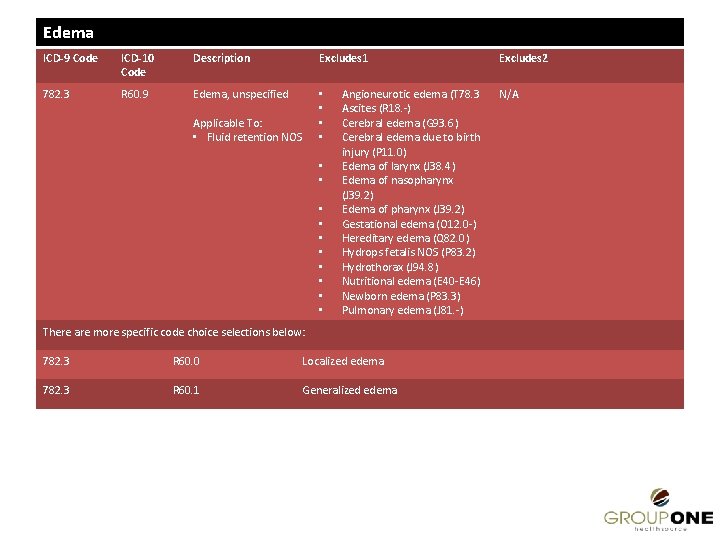
Edema ICD-9 Code ICD-10 Code Description Excludes 1 782. 3 R 60. 9 Edema, unspecified • • Applicable To: • Fluid retention NOS • • • Angioneurotic edema (T 78. 3 Ascites (R 18. -) Cerebral edema (G 93. 6) Cerebral edema due to birth injury (P 11. 0) Edema of larynx (J 38. 4) Edema of nasopharynx (J 39. 2) Edema of pharynx (J 39. 2) Gestational edema (O 12. 0 -) Hereditary edema (Q 82. 0) Hydrops fetalis NOS (P 83. 2) Hydrothorax (J 94. 8) Nutritional edema (E 40 -E 46) Newborn edema (P 83. 3) Pulmonary edema (J 81. -) There are more specific code choice selections below: 782. 3 R 60. 0 Localized edema 782. 3 R 60. 1 Generalized edema Excludes 2 N/A
Documentation Tips Identify: • Edema type • Malnutrition type • Trimester (Gestational)
Documentation Tips Use of symptom codes • Codes that describe symptoms and signs are acceptable for reporting purposes when a related definitive diagnosis has not been established (confirmed) by the provider. Use of a symptom code with a definitive diagnosis code • Codes for signs and symptoms may be reported in addition to a related definitive diagnosis when the sign or symptom is not routinely associated with that diagnosis, such as the various signs and symptoms associated with complex syndromes. The definitive diagnosis code should be sequenced before the symptom code. Signs or symptoms that are associated routinely with a disease process should not be assigned as additional codes, unless otherwise instructed by the classification. Combination codes that include symptoms • ICD-10 -CM contains a number of combination codes that identify both the definitive diagnosis and common symptoms of that diagnosis. When using one of these combination codes, an additional code should not be assigned for the symptom. )
Anemia in chronic diseases ICD-9 Code ICD-10 Code Description Excludes 1 285. 21 D 63. 1 Anemia in chronic kidney disease • Applicable to: Erythropoietin resistant anemia (EPO resistant anemia) • refractory anemia (D 46. -) refractory anemia with excess blasts in transformation [RAEB T] (C 92. 0 -) Code first underlying chronic kidney disease (CKD) (N 18. -) There are more specific code choice selections below: 285. 29 D 63. 8 Anemia in other chronic diseases classified elsewhere Code first underlying disease, such as: • diphyllobothriasis (B 70. 0) • hookworm disease (B 76. 0 -B 76. 9) • hypothyroidism (E 00. 0 -E 03. 9) • malaria (B 50. 0 -B 54) • symptomatic late syphilis (A 52. 79) • tuberculosis (A 18. 89) Excludes 2 N/A
Anemia, unspecified Documentation Tips • Identify: – – – Anemia type Nutritional Deficiency Anemia type Bone Marrow Failure Anemia type Hemolytic Anemia type Other causes of Anemia
Heart failure, unspecified ICD-9 Code ICD-10 Code Description Excludes 1 428. 0 I 50. 9 Heart failure, unspecified • Applicable To: • Biventricular (heart) failure NOS • Cardiac, heart or myocardial failure NOS • Congestive heart disease • Congestive heart failure NOS • Right ventricular failure (secondary to left heart failure) • • Cardia arrest (I 46. -) Neonatal cardiac failure (P 29. 0) fluid overload (E 87. 70) Code first: • Heart failure complicating abortion or ectopic or molar pregnancy (O 00 -O 07, O 08. 8) • Heart failure following surgery (I 97. 13 -) • Heart failure due to hypertension (I 11. 0) • Heart failure due to hypertension with chronic kidney disease (I 13. -) • Obstetrics surgery and procedures (O 75. 4) • Rheumatic heart failure (I 09. 81) Excludes 2 N/A
Heart failure, unspecified Documentation Tips 1) Hypertension with Heart Disease Heart conditions classified to I 50. - or I 51. 4 -I 51. 9, are assigned to a code from category I 11, Hypertensive heart disease, when a causal relationship is stated (due to hypertension) or implied (hypertensive). Use an additional code from category I 50, Heart failure, to identify the type of heart failure in those patients with heart failure.
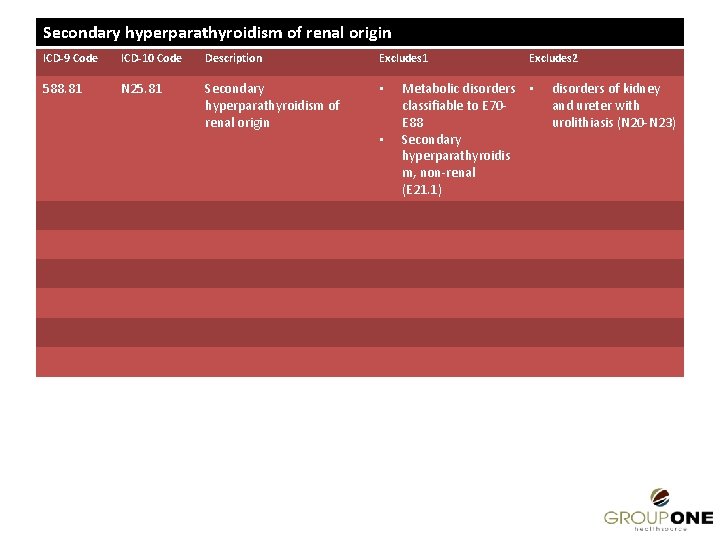
Secondary hyperparathyroidism of renal origin ICD-9 Code ICD-10 Code Description Excludes 1 588. 81 N 25. 81 Secondary hyperparathyroidism of renal origin • • Excludes 2 Metabolic disorders • classifiable to E 70 E 88 Secondary hyperparathyroidis m, non-renal (E 21. 1) disorders of kidney and ureter with urolithiasis (N 20 -N 23)
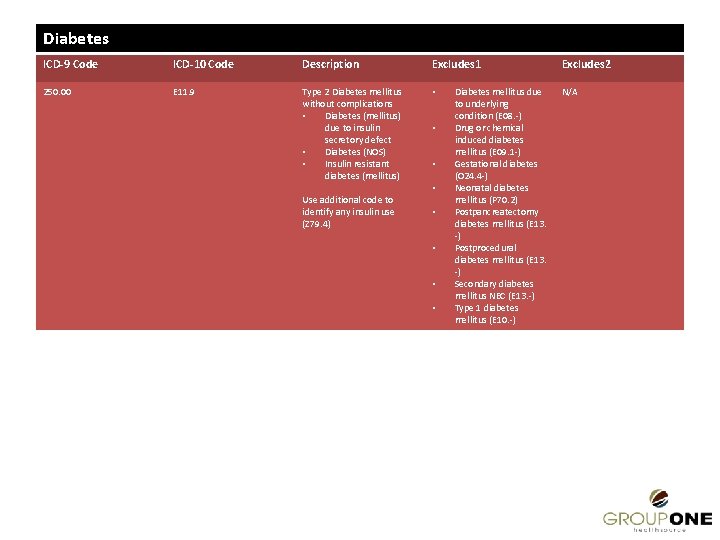
Diabetes ICD-9 Code ICD-10 Code Description Excludes 1 250. 00 E 11. 9 Type 2 Diabetes mellitus without complications • Diabetes (mellitus) due to insulin secretory defect • Diabetes (NOS) • Insulin resistant diabetes (mellitus) • Use additional code to identify any insulin use (Z 79. 4) • • Diabetes mellitus due to underlying condition (E 08. -) Drug or chemical induced diabetes mellitus (E 09. 1 -) Gestational diabetes (O 24. 4 -) Neonatal diabetes mellitus (P 70. 2) Postpancreatectomy diabetes mellitus (E 13. -) Postprocedural diabetes mellitus (E 13. -) Secondary diabetes mellitus NEC (E 13. -) Type 1 diabetes mellitus (E 10. -) Excludes 2 N/A
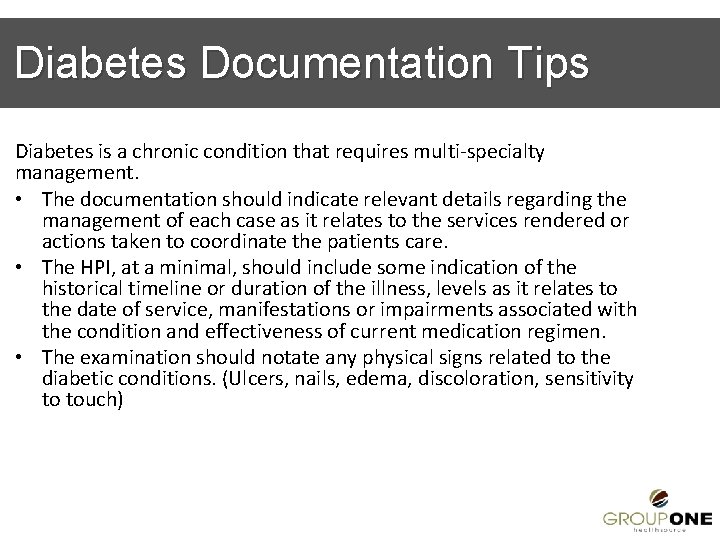
Diabetes Documentation Tips Diabetes is a chronic condition that requires multi-specialty management. • The documentation should indicate relevant details regarding the management of each case as it relates to the services rendered or actions taken to coordinate the patients care. • The HPI, at a minimal, should include some indication of the historical timeline or duration of the illness, levels as it relates to the date of service, manifestations or impairments associated with the condition and effectiveness of current medication regimen. • The examination should notate any physical signs related to the diabetic conditions. (Ulcers, nails, edema, discoloration, sensitivity to touch)
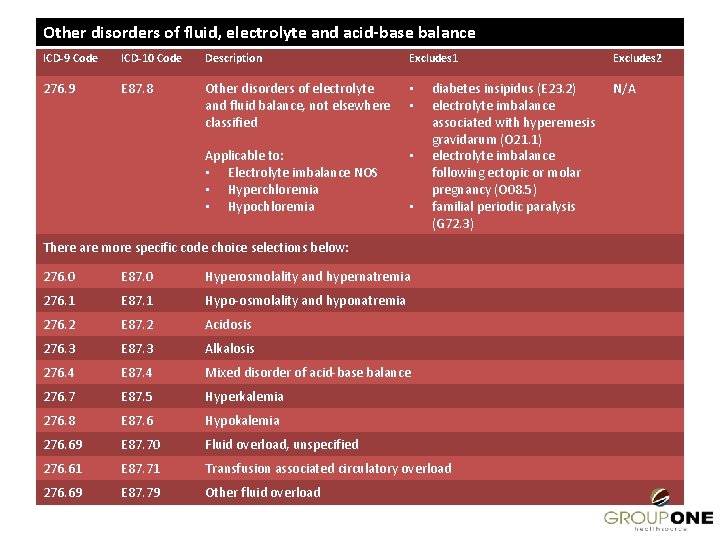
Other disorders of fluid, electrolyte and acid-base balance ICD-9 Code ICD-10 Code Description Excludes 1 276. 9 E 87. 8 Other disorders of electrolyte and fluid balance, not elsewhere classified • • Applicable to: • Electrolyte imbalance NOS • Hyperchloremia • Hypochloremia • • diabetes insipidus (E 23. 2) electrolyte imbalance associated with hyperemesis gravidarum (O 21. 1) electrolyte imbalance following ectopic or molar pregnancy (O 08. 5) familial periodic paralysis (G 72. 3) There are more specific code choice selections below: 276. 0 E 87. 0 Hyperosmolality and hypernatremia 276. 1 E 87. 1 Hypo-osmolality and hyponatremia 276. 2 E 87. 2 Acidosis 276. 3 E 87. 3 Alkalosis 276. 4 E 87. 4 Mixed disorder of acid-base balance 276. 7 E 87. 5 Hyperkalemia 276. 8 E 87. 6 Hypokalemia 276. 69 E 87. 70 Fluid overload, unspecified 276. 61 E 87. 71 Transfusion associated circulatory overload 276. 69 E 87. 79 Other fluid overload Excludes 2 N/A
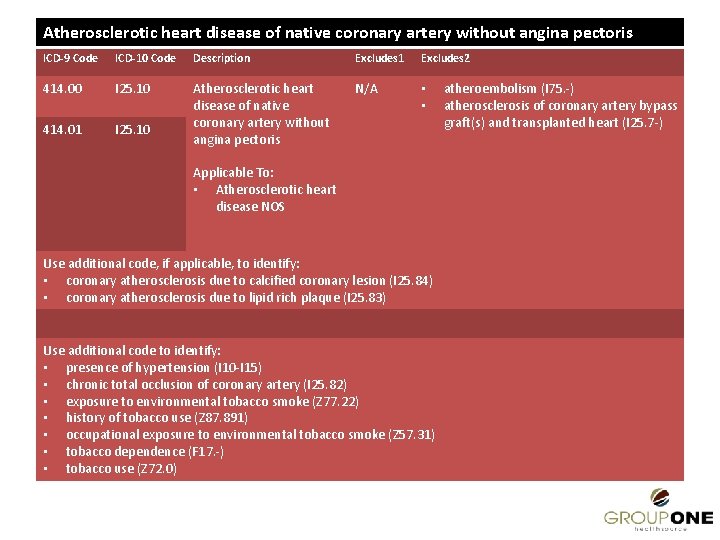
Atherosclerotic heart disease of native coronary artery without angina pectoris ICD-9 Code ICD-10 Code Description Excludes 1 Excludes 2 414. 00 I 25. 10 N/A • • 414. 01 I 25. 10 Atherosclerotic heart disease of native coronary artery without angina pectoris Applicable To: • Atherosclerotic heart disease NOS Use additional code, if applicable, to identify: • coronary atherosclerosis due to calcified coronary lesion (I 25. 84) • coronary atherosclerosis due to lipid rich plaque (I 25. 83) Use additional code to identify: • presence of hypertension (I 10 -I 15) • chronic total occlusion of coronary artery (I 25. 82) • exposure to environmental tobacco smoke (Z 77. 22) • history of tobacco use (Z 87. 891) • occupational exposure to environmental tobacco smoke (Z 57. 31) • tobacco dependence (F 17. -) • tobacco use (Z 72. 0) atheroembolism (I 75. -) atherosclerosis of coronary artery bypass graft(s) and transplanted heart (I 25. 7 -)
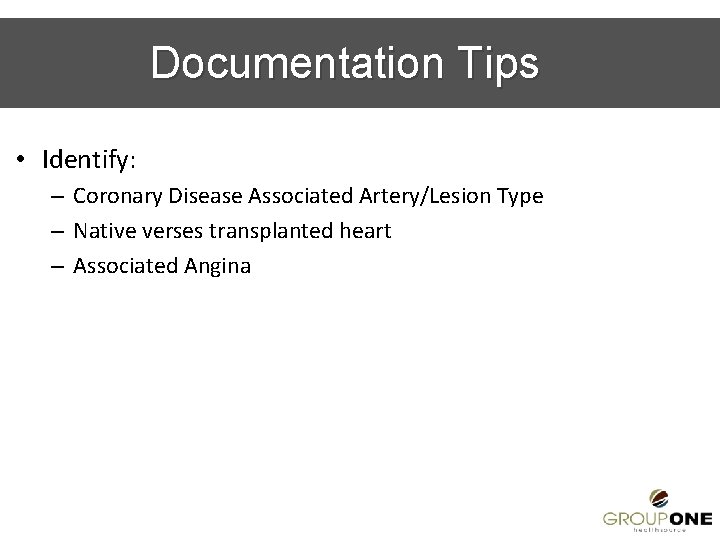
Documentation Tips • Identify: – Coronary Disease Associated Artery/Lesion Type – Native verses transplanted heart – Associated Angina
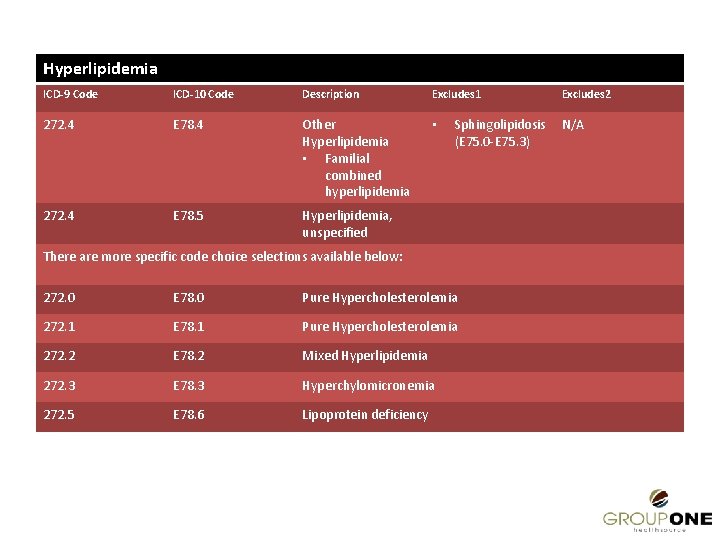
Hyperlipidemia ICD-9 Code ICD-10 Code Description Excludes 1 272. 4 E 78. 4 Other Hyperlipidemia • Familial combined hyperlipidemia • 272. 4 E 78. 5 Hyperlipidemia, unspecified Sphingolipidosis (E 75. 0 -E 75. 3) There are more specific code choice selections available below: 272. 0 E 78. 0 Pure Hypercholesterolemia 272. 1 E 78. 1 Pure Hypercholesterolemia 272. 2 E 78. 2 Mixed Hyperlipidemia 272. 3 E 78. 3 Hyperchylomicronemia 272. 5 E 78. 6 Lipoprotein deficiency Excludes 2 N/A
Hyperlipidemia Documentation Tips • Type – Mixed – Other – Unspecified
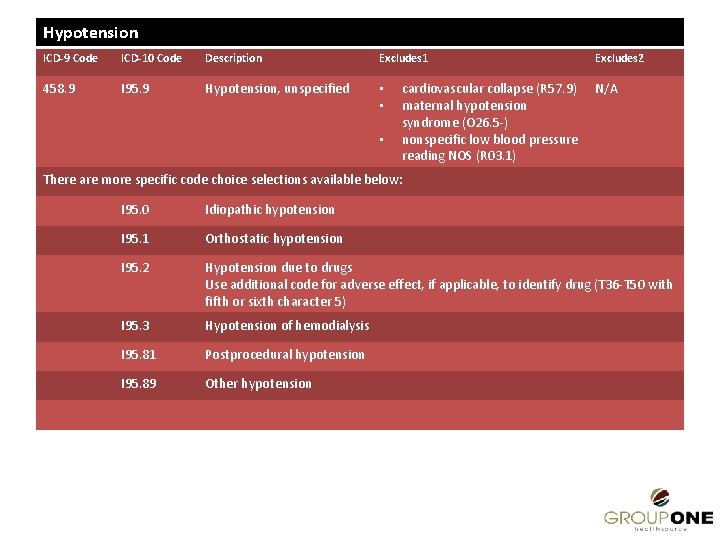
Hypotension ICD-9 Code ICD-10 Code Description Excludes 1 458. 9 I 95. 9 Hypotension, unspecified • • • cardiovascular collapse (R 57. 9) maternal hypotension syndrome (O 26. 5 -) nonspecific low blood pressure reading NOS (R 03. 1) Excludes 2 N/A There are more specific code choice selections available below: I 95. 0 Idiopathic hypotension I 95. 1 Orthostatic hypotension I 95. 2 Hypotension due to drugs Use additional code for adverse effect, if applicable, to identify drug (T 36 -T 50 with fifth or sixth character 5) I 95. 3 Hypotension of hemodialysis I 95. 81 Postprocedural hypotension I 95. 89 Other hypotension
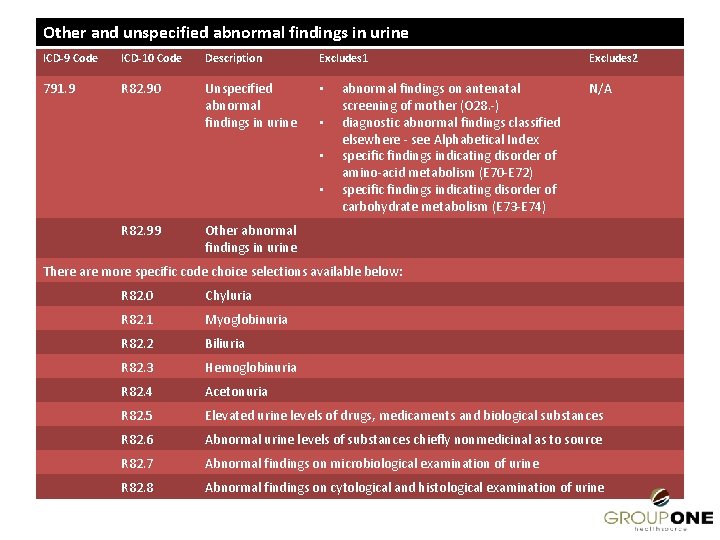
Other and unspecified abnormal findings in urine ICD-9 Code ICD-10 Code Description Excludes 1 791. 9 R 82. 90 Unspecified abnormal findings in urine • • R 82. 99 abnormal findings on antenatal screening of mother (O 28. -) diagnostic abnormal findings classified elsewhere - see Alphabetical Index specific findings indicating disorder of amino-acid metabolism (E 70 -E 72) specific findings indicating disorder of carbohydrate metabolism (E 73 -E 74) Excludes 2 N/A Other abnormal findings in urine There are more specific code choice selections available below: R 82. 0 Chyluria R 82. 1 Myoglobinuria R 82. 2 Biliuria R 82. 3 Hemoglobinuria R 82. 4 Acetonuria R 82. 5 Elevated urine levels of drugs, medicaments and biological substances R 82. 6 Abnormal urine levels of substances chiefly nonmedicinal as to source R 82. 7 Abnormal findings on microbiological examination of urine R 82. 8 Abnormal findings on cytological and histological examination of urine
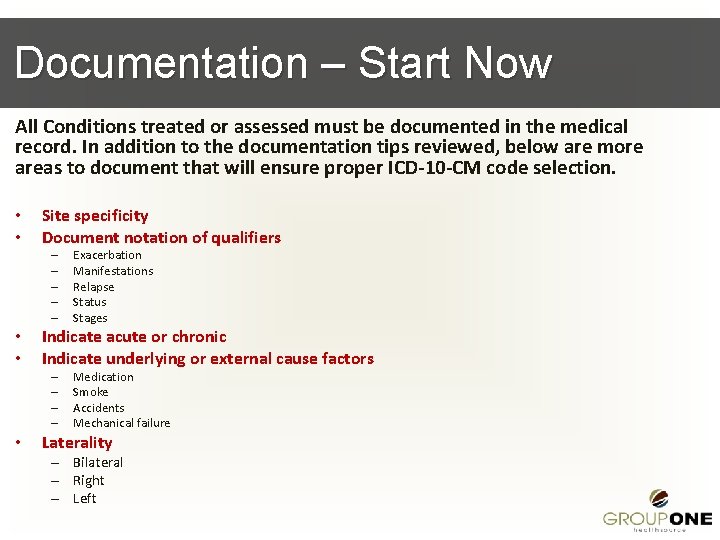
Documentation – Start Now All Conditions treated or assessed must be documented in the medical record. In addition to the documentation tips reviewed, below are more areas to document that will ensure proper ICD-10 -CM code selection. • • Site specificity Document notation of qualifiers – – – • • Indicate acute or chronic Indicate underlying or external cause factors – – • Exacerbation Manifestations Relapse Status Stages Medication Smoke Accidents Mechanical failure Laterality – Bilateral – Right – Left
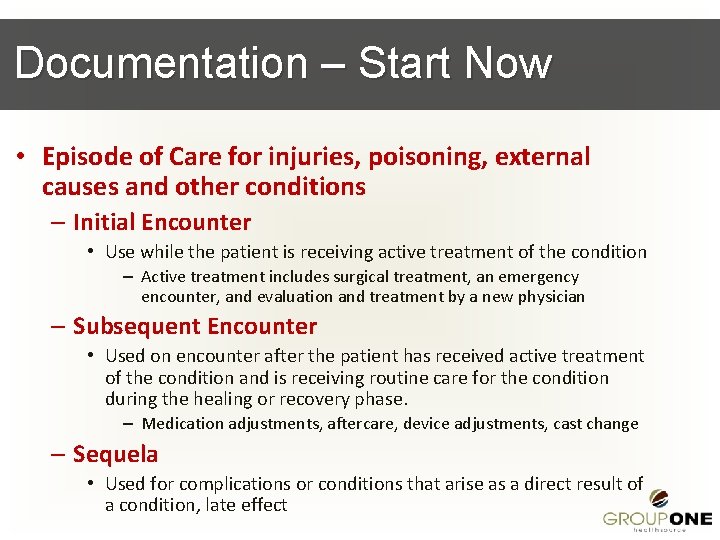
Documentation – Start Now • Episode of Care for injuries, poisoning, external causes and other conditions – Initial Encounter • Use while the patient is receiving active treatment of the condition – Active treatment includes surgical treatment, an emergency encounter, and evaluation and treatment by a new physician – Subsequent Encounter • Used on encounter after the patient has received active treatment of the condition and is receiving routine care for the condition during the healing or recovery phase. – Medication adjustments, aftercare, device adjustments, cast change – Sequela • Used for complications or conditions that arise as a direct result of a condition, late effect
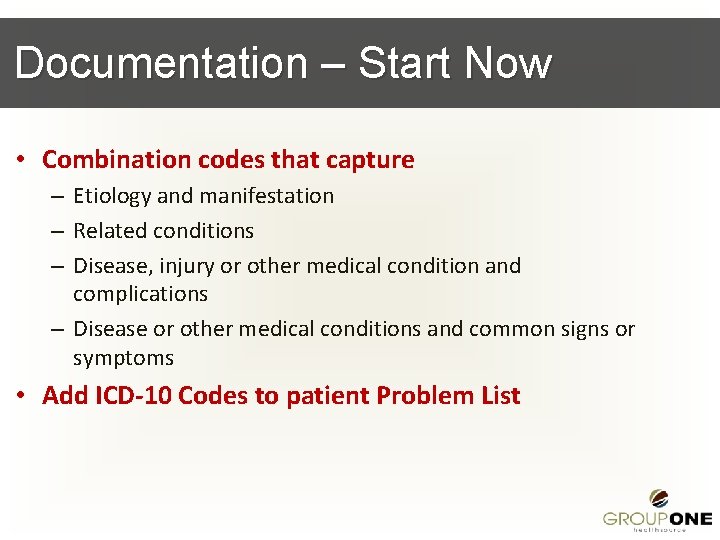
Documentation – Start Now • Combination codes that capture – Etiology and manifestation – Related conditions – Disease, injury or other medical condition and complications – Disease or other medical conditions and common signs or symptoms • Add ICD-10 Codes to patient Problem List
Official Guidelines for Coding and Reporting Underdosing refers to taking less of a medication than is prescribed by a provider or a manufacturer’s instruction. For underdosing, assign the code from categories T 36 -T 50 (fifth or sixth character “ 6”). Codes for underdosing should never be assigned as principal or first-listed codes. If a patient has a relapse or exacerbation of the medical condition for which the drug is prescribed because of the reduction in dose, then the medical condition itself should be coded. Noncompliance (Z 91. 12 -, Z 91. 13 -) or complication of care (Y 63. 6 -Y 63. 9) codes are to be used with an underdosing code to indicate intent, if known. OGCR Section 1. C. 19. e. 5. c
Questions codingresource@g 1 hs. com Centers for Disease Control and Prevention (ICD-10 -CM) http: //www. cdc. gov/nchs/icd 10 cm. htm