
ICARS International Centre for Antimicrobial Resistance Solutions BASED
ICARS International Centre for Antimicrobial Resistance Solutions BASED ON SLIDES PREPARED BY PROFESSORKÅRE MØLBAK VICE-PRESIDENT AND DIRECTOR OFDIVISION OF INFECTIOUS DISEASES PREPAREDNESS STATENS SERUM INSTITUT, DENMARK HEADING ICARS INTERIM STEERING COMMITTEE
This presentation What Why When, how & where JPIAMR ↔ ICARS
What is ICARS A Danish inter-ministerial initiative, suggested in 2017 by World Bank and CGIAR, on solutions for AMR mainly in LMIC. ICARS is under development in 2019 ICARS conduct, commission and participate in research to support the development of interventions to contain and mitigate AMR in LMICs Translational research transforms national action plans and policies into practice Bottom-up participatory research and complex intervention studies Top-down risk assessments and economic analyses to aid risk management, and setting of governmental priorities and intervention research Combination of top-down and bottom-up: ICARS as a policy interface Independent open resource to public and private bodies
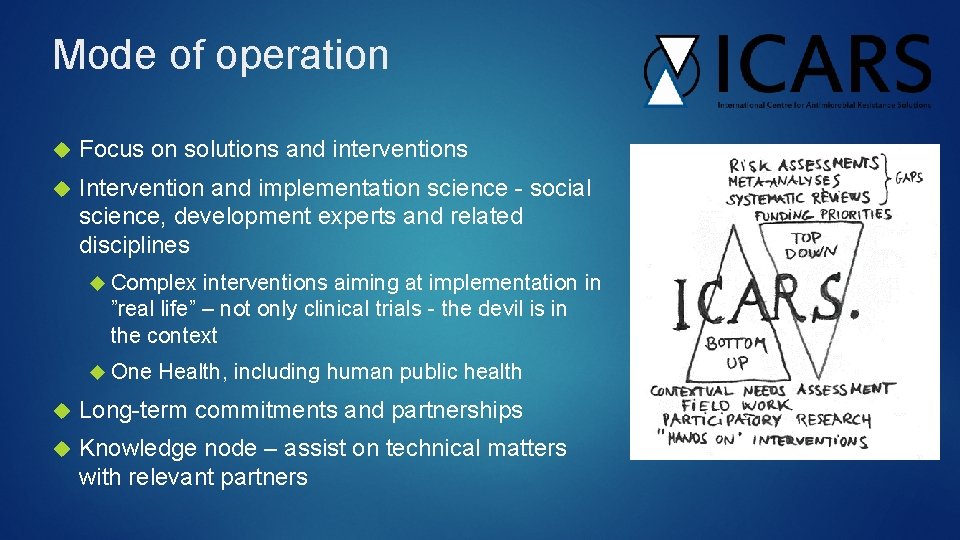
Mode of operation Focus on solutions and interventions Intervention and implementation science - social science, development experts and related disciplines Complex interventions aiming at implementation in ”real life” – not only clinical trials - the devil is in the context One Health, including human public health Long-term commitments and partnerships Knowledge node – assist on technical matters with relevant partners
Direct + indirect focus AMR specific and AMR sensitive interventions Too much emphasis on antimicrobial use ? Indirect drivers to be addressed: Environment – domestic and the public domain WASH (water, sanitation, hygiene) Better use of existing vaccines (a. o. flu for pregnant, childhood vaccines) Management practices in health care and in agriculture Infection control The ”AMR lens” on such interventions
Why ICARS: AMR is a ”wicked problem” Ø Difficult to clearly define – cannot first understand then solve Ø Multi-causal with many interdependencies Ø Unforeseen consequences of addressing them Ø Solutions are not right or wrong – they are better-worse; good enough-not good enough Ø Are socially complex, context matters making each one unique Ø Responsibility of multiple organizations Ø Solutions involve changes in behavior Ø Often characterized by chronic policy failure
Re-focus Bias in research towards presenting challenges rather than working on solutions and interventions When solutions are addressed, it is often addressed with a single or few disciplines Although there is a concensus on One Health, there is a lot of silo thinking and focus on antimicrobial use Focus on publishing rather than making a change
Why LMIC are home to 5 of the world’s 7 billion people and 73% of the world’s poor people. MICs also represent about one-third of global GDP and are major engines of global growth Need to be working with NGO’s, private partners and local governments
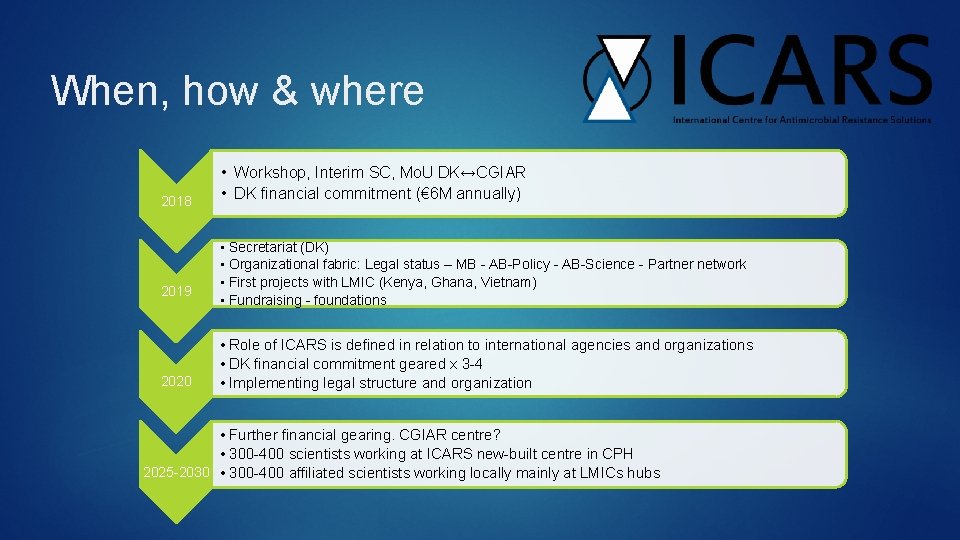
When, how & where 2018 2019 2020 • Workshop, Interim SC, Mo. U DK↔CGIAR • DK financial commitment (€ 6 M annually) • Secretariat (DK) • Organizational fabric: Legal status – MB - AB-Policy - AB-Science - Partner network • First projects with LMIC (Kenya, Ghana, Vietnam) • Fundraising - foundations • Role of ICARS is defined in relation to international agencies and organizations • DK financial commitment geared x 3 -4 • Implementing legal structure and organization • Further financial gearing. CGIAR centre? • 300 -400 scientists working at ICARS new-built centre in CPH 2025 -2030 • 300 -400 affiliated scientists working locally mainly at LMICs hubs
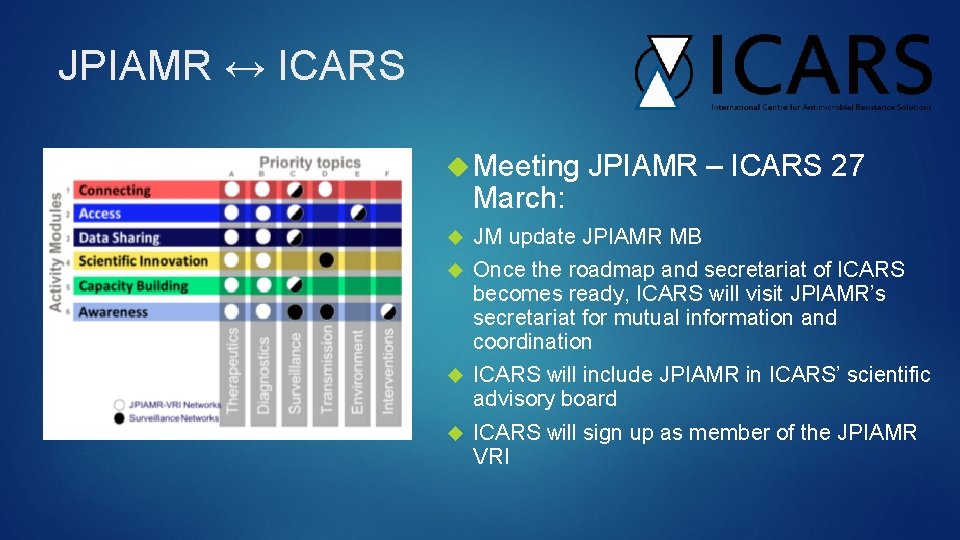
JPIAMR ↔ ICARS Meeting March: JPIAMR – ICARS 27 JM update JPIAMR MB Once the roadmap and secretariat of ICARS becomes ready, ICARS will visit JPIAMR’s secretariat for mutual information and coordination ICARS will include JPIAMR in ICARS’ scientific advisory board ICARS will sign up as member of the JPIAMR VRI
- Slides: 10