
ICAO UNIVERSAL SAFETY OVERSIGHT AUDIT PROGRAMME CONTINUOUS MONITORING
- Slides: 29
ICAO UNIVERSAL SAFETY OVERSIGHT AUDIT PROGRAMME – CONTINUOUS MONITORING APPROACH (USOAP – CMA) Tools used in safety oversight
Overview of CMA On-line Framework (OLF) A suite of web-integrated applications and centralized database systems used for: 1) Collection of safety-related information and documentation from different sources 2) Monitoring and reporting of safety oversight activities by ICAO and member states
Electronic Filing of Differences (EFOD) q States are required to comply with ICAO Standards without exception. However, States may at times not be able to comply as required or comply using alternative means. q States must provide this information through the Electronic Filing of Differences (EFOD) system on the CMA online framework q By completing the CCs through the EFOD system, States can use the EFOD as an alternative means for notifying ICAO of their compliance and differences.
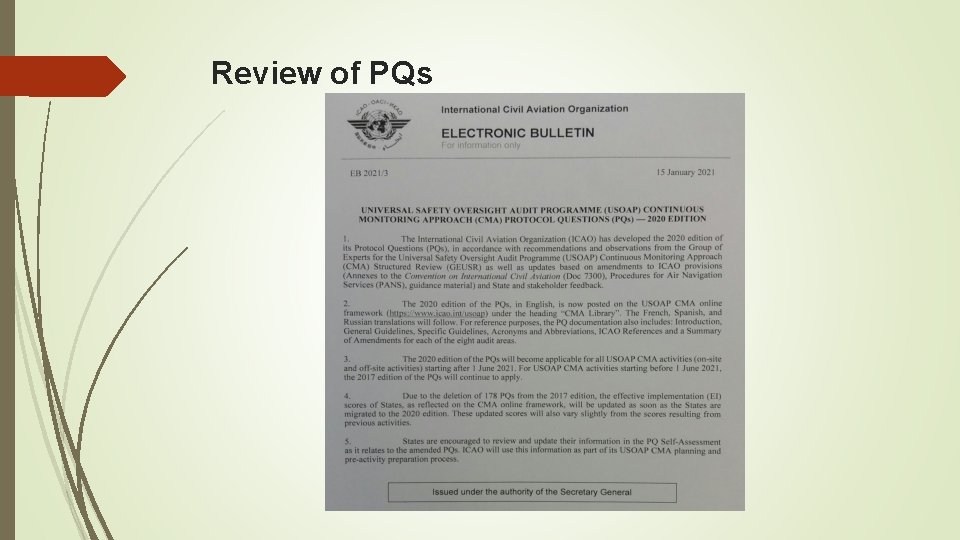
ICAO USOAP CMA Protocol Questions (PQs) are the primary tool for assessing the level of effective implementation of a State’s safety oversight system. PQs are based on ICAO SARPS, PANS, Documents and other Guidance material while considering CEs. PQs are organized by audit area. use of standardized PQs ensures transparency, quality, consistency, reliability and fairness in the conduct and implementation of USOAP CMA activities
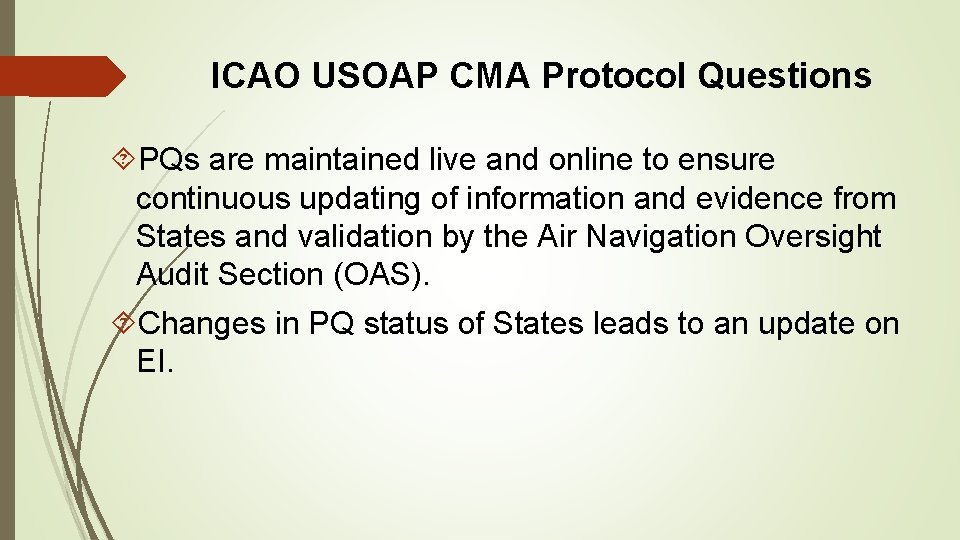
ICAO USOAP CMA Protocol Questions PQs are maintained live and online to ensure continuous updating of information and evidence from States and validation by the Air Navigation Oversight Audit Section (OAS). Changes in PQ status of States leads to an update on EI.
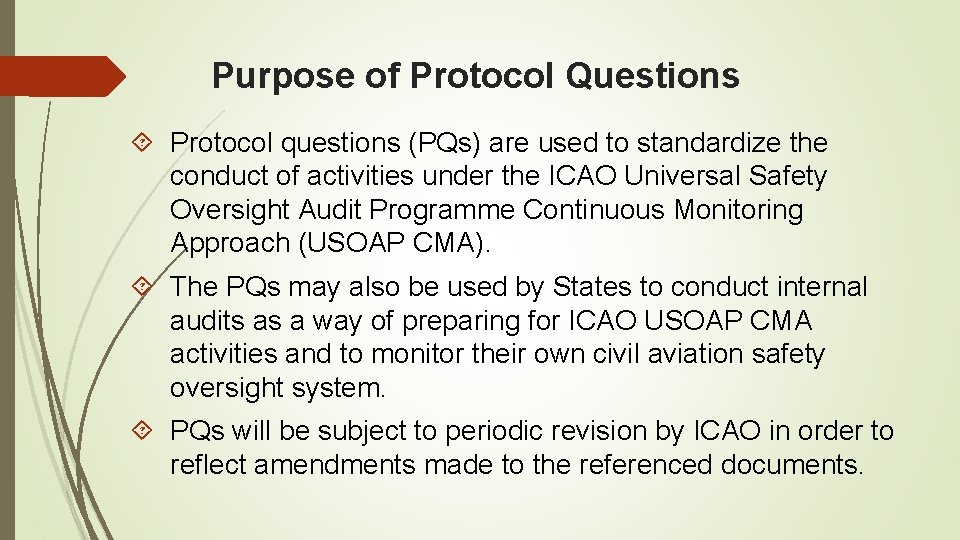
Purpose of Protocol Questions Protocol questions (PQs) are used to standardize the conduct of activities under the ICAO Universal Safety Oversight Audit Programme Continuous Monitoring Approach (USOAP CMA). The PQs may also be used by States to conduct internal audits as a way of preparing for ICAO USOAP CMA activities and to monitor their own civil aviation safety oversight system. PQs will be subject to periodic revision by ICAO in order to reflect amendments made to the referenced documents.
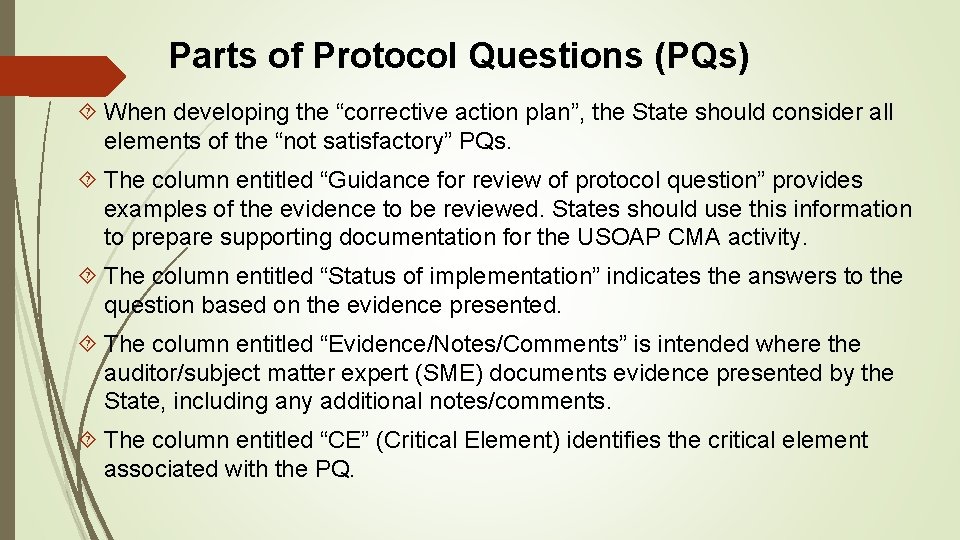
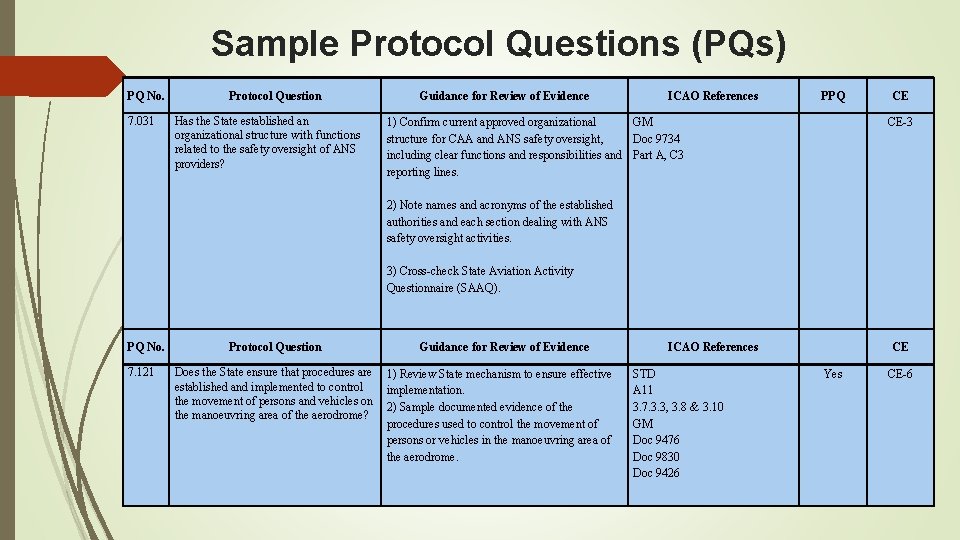
Parts of Protocol Questions (PQs) When developing the “corrective action plan”, the State should consider all elements of the “not satisfactory” PQs. The column entitled “Guidance for review of protocol question” provides examples of the evidence to be reviewed. States should use this information to prepare supporting documentation for the USOAP CMA activity. The column entitled “Status of implementation” indicates the answers to the question based on the evidence presented. The column entitled “Evidence/Notes/Comments” is intended where the auditor/subject matter expert (SME) documents evidence presented by the State, including any additional notes/comments. The column entitled “CE” (Critical Element) identifies the critical element associated with the PQ.
Sample Protocol Questions (PQs) PQ No. 7. 031 Protocol Question Has the State established an organizational structure with functions related to the safety oversight of ANS providers? Guidance for Review of Evidence ICAO References PPQ 1) Confirm current approved organizational GM structure for CAA and ANS safety oversight, Doc 9734 including clear functions and responsibilities and Part A, C 3 reporting lines. CE CE-3 2) Note names and acronyms of the established authorities and each section dealing with ANS safety oversight activities. 3) Cross-check State Aviation Activity Questionnaire (SAAQ). PQ No. 7. 121 Protocol Question Does the State ensure that procedures are established and implemented to control the movement of persons and vehicles on the manoeuvring area of the aerodrome? Guidance for Review of Evidence 1) Review State mechanism to ensure effective implementation. 2) Sample documented evidence of the procedures used to control the movement of persons or vehicles in the manoeuvring area of the aerodrome. ICAO References STD A 11 3. 7. 3. 3, 3. 8 & 3. 10 GM Doc 9476 Doc 9830 Doc 9426 CE Yes CE-6
Review of PQs
Sample New PQs in ATS
Sample New PQs in AIS
Sample New PQs in CNS
Sample New PQs in MET
Self-Assessment Checklist States are required to submit and regularly update the status of PQs, using the online framework. As a priority, States shall conduct a PQ self-assessment: a) on PQs that were deemed not satisfactory in a previous USOAP activity; b) on new PQs introduced through PQ amendments – these PQs will have an undetermined status until they are assessed through a USOAP CMA activity; c) on amended PQs, if the amendment impacts the status of the PQ; or d) in case of any changes in their aviation system, regulations and/or procedures to determine whether these changes impact the status of any PQs
Purpose of self-assessment The PQ self-assessment is an important tool for States to use in order to prepare for a USOAP CMA activity. Regular self-assessments using PQs are also a tool for States to actively monitor and report the health of their aviation system on a continuous basis.
PQ Finding A PQ finding is identified when ICAO cannot obtain evidence indicating compliance hence a deficiency identified. PQ findings issued when there is: a) lack of compliance of the State’s safety oversight system with the Convention; b) lack of implementation of ICAO SARPs and PANS; and/or c) lack of application of guidance material and relevant safety-related practices in general use in the aviation industry to support the implementation of the ICAO SARPs and PANS. A PQ finding changes the status of the associated PQ to unsatisfactory and decreases the State’s EI
Contents of a PQ Finding A PQ finding contains: a) the not satisfactory PQ; b) the applicable CE; and c) a description of the identified deficiencies. In order for ICAO to close a PQ finding, the State must address the associated PQ by resolving all the deficiencies detailed in the finding.
Mandatory Information Request (MIR) The Oversight Audit Section (OAS) may submit a mandatory information request (MIR) to a State to request information or documentation needed for USOAP CMA review and validation. If the State does not respond to the MIR with complete, clear and relevant information, or within the specified timeframe, ICAO can generate a PQ finding or even an SSC.
Mandatory Information Request (MIR) An MIR can be issued when: a) a State has not submitted and/or maintained its SAAQ, CCs and/or PQs complete and up to date; b) a State has not submitted and/or maintained its CAPs up to date; c) information in the SAAQ, CCs and/or PQs provided by the State contradicts information found in other documents or provided by other stakeholders; d) a significant change is observed in the organization responsible for a State’s aviation safety oversight; e) evidence indicates that a potential deficiency or significant safety concern may exist, and additional information is required to validate this — it gives the State the opportunity to clarify the issue; f) information is needed on an aircraft accident or incident; g) information is needed in addition to an ICAO RO visit; and h) information collected during a USOAP CMA activity is incomplete or insufficient
Corrective Action Plan (CAP) ICAO will issue a finding when the status of a PQ is not satisfactory as a result of a USOAP CMA activity and in response the State must develop an acceptable corrective action plan (CAP). The terms of the CMA MOU will be followed including submitting it through the USOAP CMA OLF The State must provide and implement CAPs that meet certain criteria. Proposed CAPs must fully address the associated PQ and all identified deficiencies.
Corrective Action Plan (CAP) Once OAS accepts the State’s CAPs, the State starts to implement the corrective actions. The OAS then monitors the State’s progress through the OLF until full implementation If a State does not submit a CAP within the required timeline, the OAS will coordinate with the RO and other relevant ICAO sections and report to DD/MO to determine further action, as appropriate.
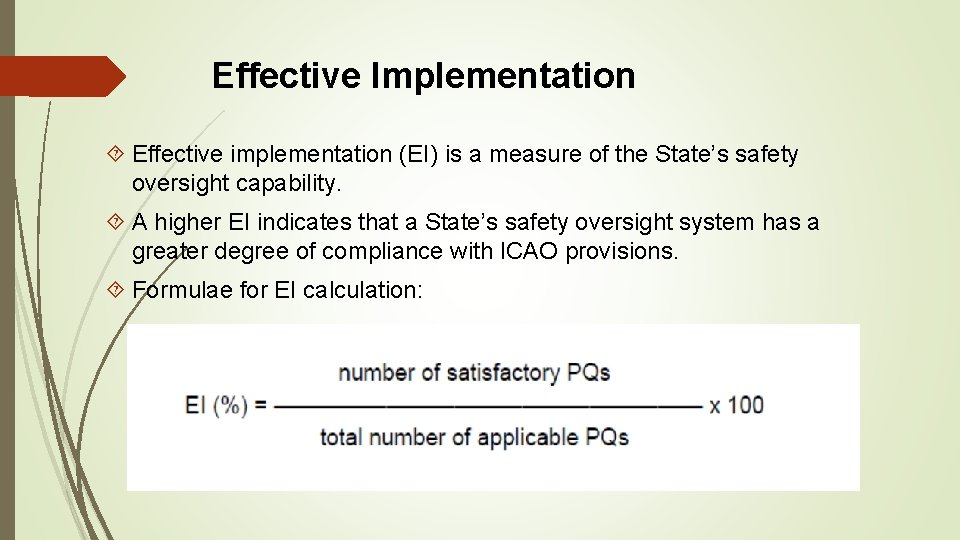
Effective Implementation Effective implementation (EI) is a measure of the State’s safety oversight capability. A higher EI indicates that a State’s safety oversight system has a greater degree of compliance with ICAO provisions. Formulae for EI calculation:
Effective Implementation EI can thus be calculated for each CE, each audit area and as an overall value. A lack of effective implementation (LEI) score is also calculated for certain analysis. LEI (%) = 100 – EI (%)
State Aviation Activity Questionnaire (SAAQ) Designed to collect comprehensive and specific information on each State’s aviation activities, including legislative, regulatory, organizational, operational, technical and administrative details. Each State shall complete and maintain its SAAQ up to date in order to assist the Monitoring and Oversight Office in monitoring the level of aviation activity in the State related to each audit area and in prioritizing and planning USOAP CMA activities. ICAO will revise the SAAQ periodically. States are required to update their SAAQs regularly.
Compliance Checklists (CCs)/EFOD States are required by the USOAP CMA Memorandum of Understanding to file their differences against standards and recommended practices by completing and maintaining up-to- date Compliance Checklists (CCs). These contain information regarding the implementation of the specific provisions of the relevant Annexes to the Convention. The completion of the CCs by Member States will provide an overview of the level of implementation of ICAO Standards to authorized users. States must provide this information through the Electronic Filing of Differences (EFOD) system on the CMA online framework.
The integrated Safety Trend Analysis and Reporting System (i. STARS) Launched in 2009 with the aim of combining safety related datasets such as accidents, traffic and USOAP results into a single web based system to allow integrated safety analysis. Currently operates as i. STARS version 3. 0 on the ICAO Secure Portal website can be accessed from: http: //portal. icao. int – group name SPACE and the CMA online framework are two different but connected and synchronized systems so as to show the exact same information at all times. SPACE is designed for all State aviation professional s while the online framework is designed primarily for NCMCs to provide ICAO with information related to USOAP.
The integrated Safety Trend Analysis and Reporting System (i. STARS) SPACE provides a set of applications related to USOAP which allow users to: a) find any State’s current implementation scores, i. e. the EI or LEI; b) explore any State’s current PQ status by viewing and drilling down to ‘not satisfactory’ PQs by critical element or audit area; c) compare any State’s implementation scores to regional and/or global averages, as well as to other State’s implementation scores;
The integrated Safety Trend Analysis and Reporting System (i. STARS) d) combine State implementation scores with other factors like accident statistics or traffic to perform risk analysis; e) generate tables, charts and maps using implementation scores to feed presentations, documents and reports; and f) run queries on individual PQs through groups of States and calculate implementation scores for each PQ.
End of Chapter Thank You