
ICAO Handbook on Radio Frequency Spectrum Requirements for
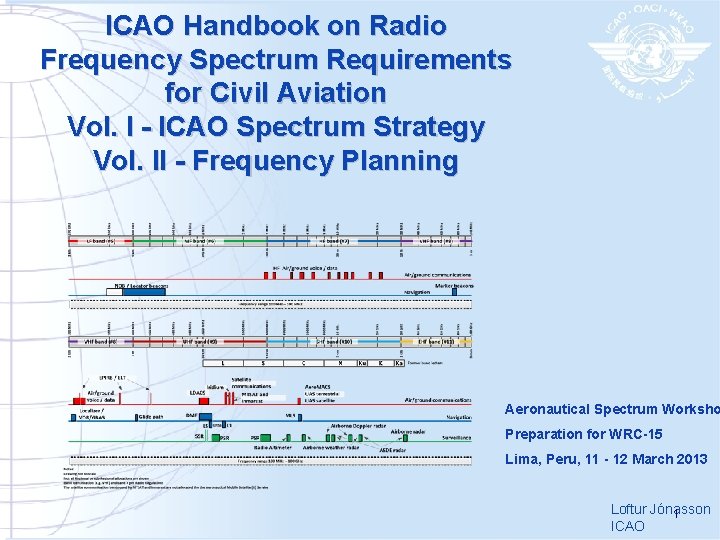
ICAO Handbook on Radio Frequency Spectrum Requirements for Civil Aviation Vol. I - ICAO Spectrum Strategy Vol. II - Frequency Planning Aeronautical Spectrum Worksho Preparation for WRC-15 Lima, Peru, 11 - 12 March 2013 Loftur Jónasson 1 ICAO

2
Overview Ø Volume I – ICAO Spectrum Strategy and Policies Ø Volume II – ICAO Frequency Assignment Planning 3
Handbook Volume I Spectrum Strategy and Policies Overall ICAO Spectrum Policy (approved by Council) Ø ICAO Spectrum Strategy ✓Long term spectrum use of current and future radio systems Ø ICAO Spectrum Policy Statements ✓Specific actions to assist in meeting the Strategic Objectives Ø ICAO Position for future WRC’s ✓Medium and long term availability of spectrum for aviation 4
Handbook Volume I Spectrum Strategy and Policies Background material in the Handbook, (Volume I) (1) Ø Role of ICAO ✓In ITU-R (Study Groups) and in Regional Telecommunication Organizations ✓At ITU World Radiocommunication Conferences ✓In frequency coordination and registration (also ITU) Ø Role of the ITU and Regional Telecommunication Organizations ✓Develop technical material (ITU-R Study Groups) ✓Amend Radio Regulations (at WRCs) 5
Handbook Volume I Spectrum Strategy and Policies Background material in the Handbook, (Volume I) (2) Ø Statement of frequency allocations and technical details (Chapter 7) ✓Frequency allocations and footnotes in ITU Radio Regulations ✓Aviation use ✓Commentary (specific comments on ITU and ICAO review In frequency coordination and registration (also ITU) Ø Interference protection considerations 6
Handbook Volume II Frequency assignment planning Purpose Ø Provide globally harmonized frequency assignment planning criteria and guidance material to support the application of SARPs in Annex 10, Vol. V Ø Developed in conjunction with the revisions to Annex 10, Vol. V Ø Developed by ACP Working Group F Ø Implementation through Regional Air Navigation Agreement by PIRG Ø To support the development of Global COM lists and the Global Air Navigation Plan 7
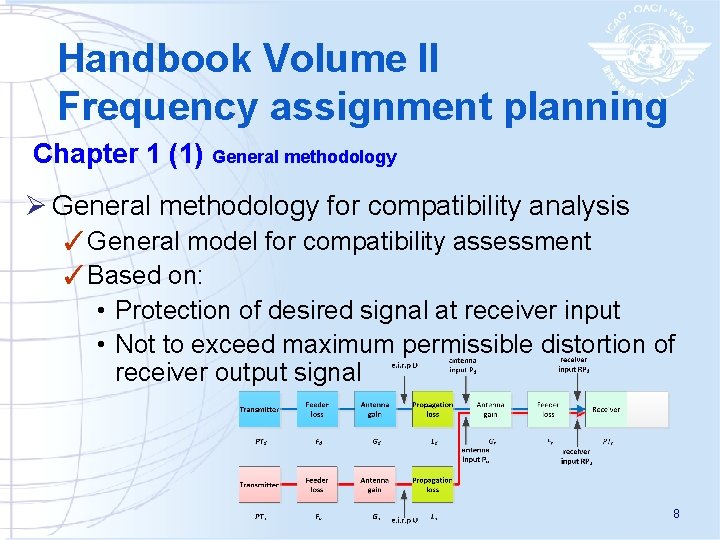
Handbook Volume II Frequency assignment planning Chapter 1 (1) General methodology Ø General methodology for compatibility analysis ✓General model for compatibility assessment ✓Based on: • Protection of desired signal at receiver input • Not to exceed maximum permissible distortion of receiver output signal 8
Handbook Volume II Frequency assignment planning Chapter 1 (2) General methodology Ø Propagation model ✓Based on free space propagation (Re. Recommendation ITU-R P. 525) Ø Propagation model does not accommodate certain phenomena which are difficult to predict such as ✓Changes in the refractive index of the atmosphere ✓Ducting Ø ITU has developed propagation curves for aeronautical communication and navigation systems (Recommendation ITU-R P. 528) 9
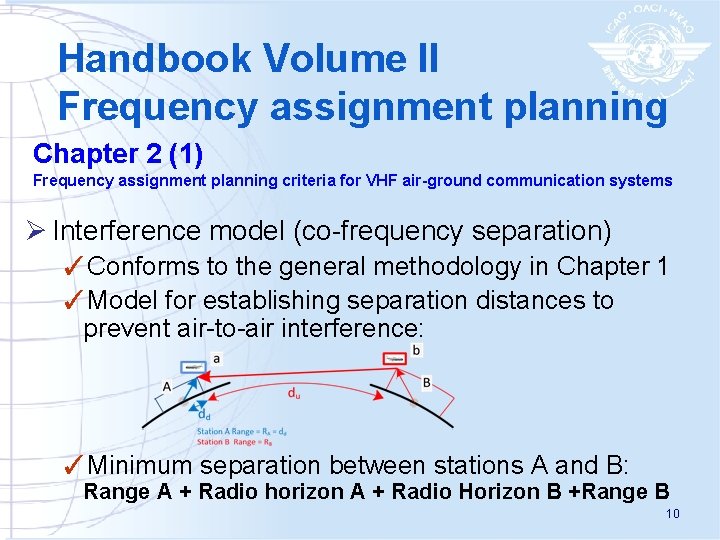
Handbook Volume II Frequency assignment planning Chapter 2 (1) Frequency assignment planning criteria for VHF air-ground communication systems Ø Interference model (co-frequency separation) ✓Conforms to the general methodology in Chapter 1 ✓Model for establishing separation distances to prevent air-to-air interference: ✓Minimum separation between stations A and B: Range A + Radio horizon A + Radio Horizon B +Range B 10
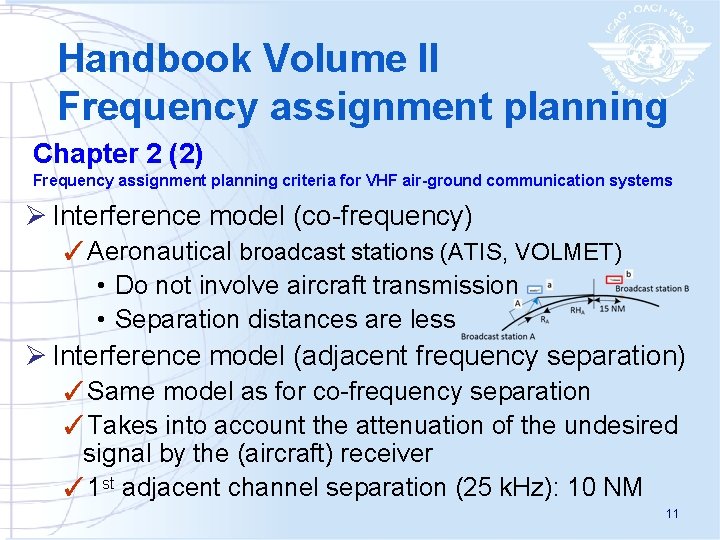
Handbook Volume II Frequency assignment planning Chapter 2 (2) Frequency assignment planning criteria for VHF air-ground communication systems Ø Interference model (co-frequency) ✓Aeronautical broadcast stations (ATIS, VOLMET) • Do not involve aircraft transmission • Separation distances are less Ø Interference model (adjacent frequency separation) ✓Same model as for co-frequency separation ✓Takes into account the attenuation of the undesired signal by the (aircraft) receiver ✓ 1 st adjacent channel separation (25 k. Hz): 10 NM 11
Handbook Volume II Frequency assignment planning Chapter 2 (3) Frequency assignment planning criteria for VHF air-ground communication systems Ø Frequency separation and channelling ✓ 25 k. Hz and 8. 33 k. Hz channel spacing. ✓Special consideration for mixed environment where both are applied Ø Designated Operational Coverage (DOC) ✓Table of uniform values for DOC ✓Complies with common values used in most Regions ✓Area services ACC-FIS – are in many cases not 12 specified
Handbook Volume II Frequency assignment planning Chapter 2 (4) Frequency assignment planning criteria for VHF air-ground communication systems Ø Calculation of separation distances. ✓Methodology for establishing separation distances ✓Air/ground communications ✓Aeronautical broadcast communications ✓Aerodrome surface communications For each of these types the Handbook clarifies the principles and method used when the separation distances were established. A summary of the 13 results (25 k. Hz channel spacing) is on the next slide
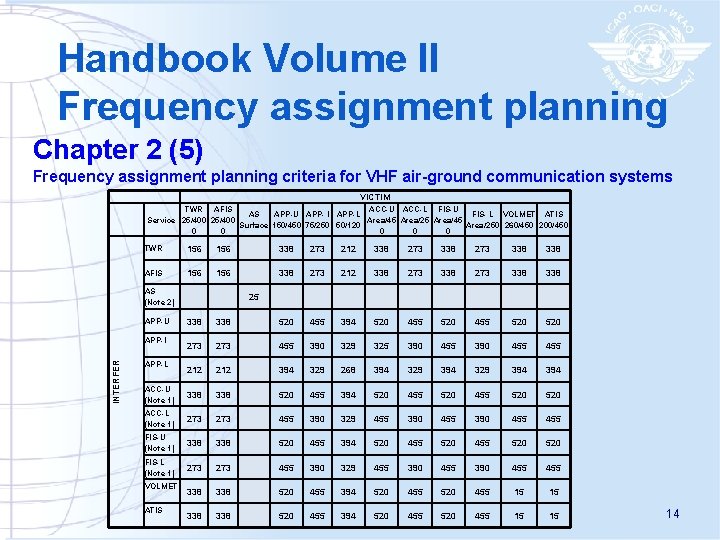
Handbook Volume II Frequency assignment planning Chapter 2 (5) Frequency assignment planning criteria for VHF air-ground communication systems VICTIM TWR AFIS ACC-U ACC-L FIS-U AS APP-U APP- I APP-L FIS- L VOLMET ATIS Service 25/400 Area/45 Area/25 Area/45 Surface 150/450 75/250 50/120 Area/250 260/450 200/450 0 0 TWR 156 338 273 212 338 273 338 AFIS 156 338 273 212 338 273 338 AS (Note 2) 338 520 455 394 520 455 520 273 455 390 329 325 390 455 455 212 394 329 268 394 329 394 ACC-U (Note 1) 338 520 455 394 520 455 520 ACC-L (Note 1) 273 455 390 329 455 390 455 FIS-U (Note 1) 338 520 455 394 520 455 520 FIS-L (Note 1) 273 455 390 329 455 390 455 338 338 520 455 394 520 455 15 15 APP-U APP-I INTERFER 25 APP-L VOLMET ATIS 14
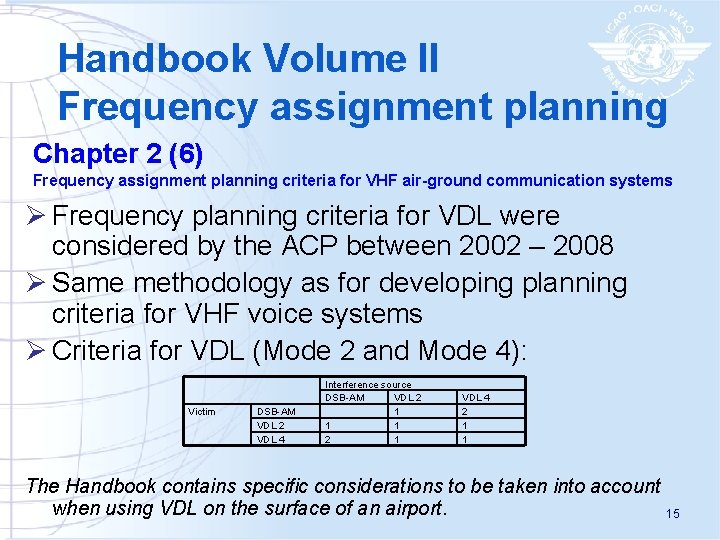
Handbook Volume II Frequency assignment planning Chapter 2 (6) Frequency assignment planning criteria for VHF air-ground communication systems Ø Frequency planning criteria for VDL were considered by the ACP between 2002 – 2008 Ø Same methodology as for developing planning criteria for VHF voice systems Ø Criteria for VDL (Mode 2 and Mode 4): Victim DSB-AM VDL 2 VDL 4 Interference source DSB-AM VDL 2 1 1 1 2 1 VDL 4 2 1 1 The Handbook contains specific considerations to be taken into account when using VDL on the surface of an airport. 15
Handbook Volume II Frequency assignment planning Future work Ø Future work will concentrate on developing harmonized and updated planning criteria for aeronautical radionavigation systems Ø The Handbook and other relevant material can be downloaded from the ACP website (Repository section) at http: //legacy. icao. int/anb/panels/acp/repository. cfm 16
- Slides: 16