
ICAO Annex 10 and Doc 8071 current status
- Slides: 24
ICAO Annex 10 and Doc 8071: current status and planned developments Alessandro Capretti Technical Officer, CNS ICAO 16 th International Flight Inspection Symposium Oklahoma City, 23 – 27 June 2008
Presentation overview Q Introduction to ICAO Q ICAO SARPs and guidance material Ø Definitions Ø Development process Q Navigation systems SARPs and GM Q The ICAO Navigation Systems Panel (NSP) Q Current SARPs developments in NSP Q Doc 8071 evolution 16 th International Flight Inspection Symposium Oklahoma City, 23 – 27 June 2008
Introduction - ICAO Q Convention (Chicago, 1944) and Annexes Q UN Specialized Agency Q 190 Contracting States Q Assembly (ordinarily every 3 years) Q Council – 36 States Q Air Navigation Commission – 19 members Q Secretariat (Secretary General) Q Standards and Recommended Practices (SARPs) 16 th International Flight Inspection Symposium Oklahoma City, 23 – 27 June 2008
Standards and Recommended Practices (SARPs) Q Contained in the Annexes to the ICAO Convention Q Standard: Any specification […] the uniform application of which is recognized as necessary for the safety or regularity of international air navigation and to which Contracting States will conform in accordance with the Convention; in the event of impossibility of compliance, notification to the Council is compulsory Q Recommended Practice: Similar to Standard, but application is “desirable” rather than “necessary” and notification of non-compliance is not compulsory 16 th International Flight Inspection Symposium Oklahoma City, 23 – 27 June 2008
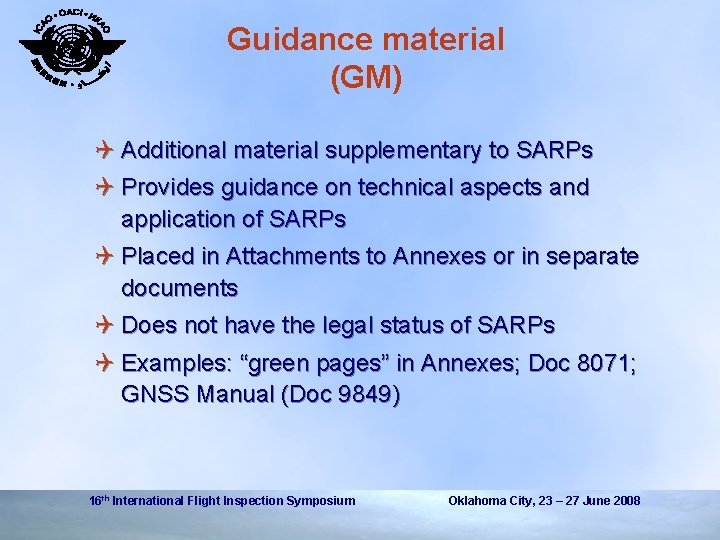
Guidance material (GM) Q Additional material supplementary to SARPs Q Provides guidance on technical aspects and application of SARPs Q Placed in Attachments to Annexes or in separate documents Q Does not have the legal status of SARPs Q Examples: “green pages” in Annexes; Doc 8071; GNSS Manual (Doc 9849) 16 th International Flight Inspection Symposium Oklahoma City, 23 – 27 June 2008
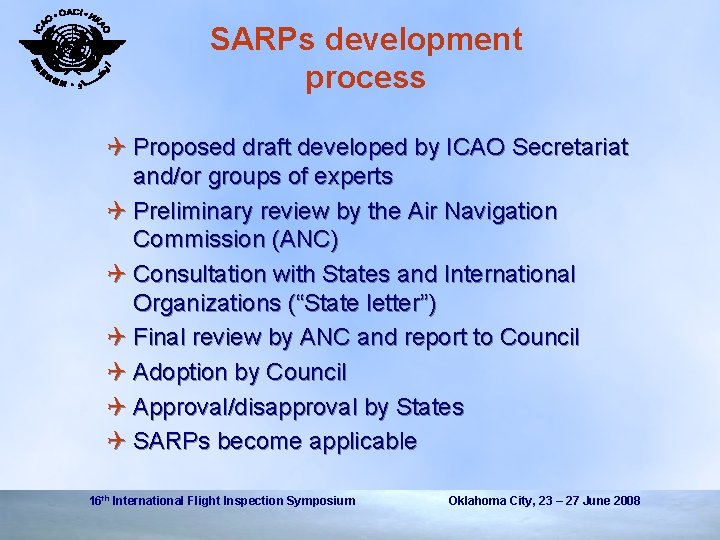
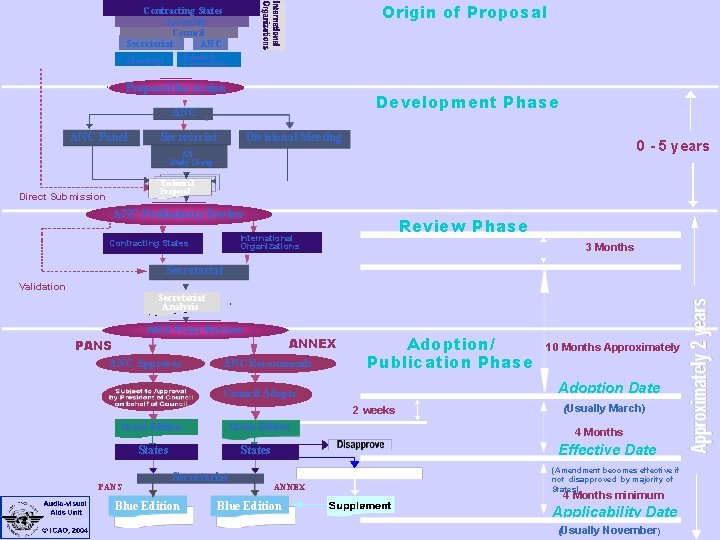
SARPs development process Q Proposed draft developed by ICAO Secretariat and/or groups of experts Q Preliminary review by the Air Navigation Commission (ANC) Q Consultation with States and International Organizations (“State letter”) Q Final review by ANC and report to Council Q Adoption by Council Q Approval/disapproval by States Q SARPs become applicable 16 th International Flight Inspection Symposium Oklahoma City, 23 – 27 June 2008
Origin of Proposal Contracting States Assembly Council Secretariat ANC Panels & Committees Meetings Proposal for Action Development Phase ANC Panel Secretariat Divisional Meeting 0 - 5 years AN Study Group Technical Proposal Direct Submission ANC Preliminary Review Phase International Organizations Contracting States 3 Months Secretariat Validation Secretariat Analysis ANC Final Review ANC Approves Adoption/ Publication Phase ANNEX PANS ANC Recommends Adoption Date Council Adopts 2 weeks Green Edition States PANS 16 th Effective Date Notification of Differences ANNEX International Inspection Blue Edition Flight. Blue Edition Symposium Applicability Date (Usually March) 4 Months States Secretariat 10 Months Approximately Applicability Date (Amendment becomes effective if not disapproved by majority of States) Months minimum Oklahoma City, 23 – 427 June 2008 Applicability Date (Usually November)
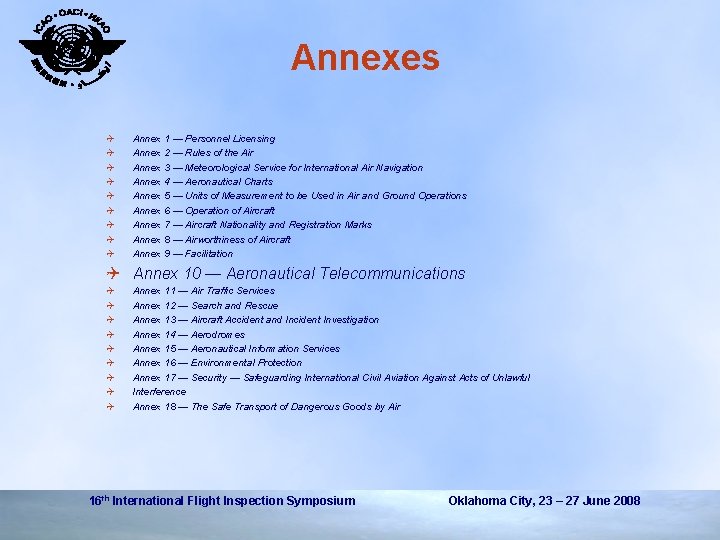
Annexes Q Q Q Q Q Annex 1 — Personnel Licensing Annex 2 — Rules of the Air Annex 3 — Meteorological Service for International Air Navigation Annex 4 — Aeronautical Charts Annex 5 — Units of Measurement to be Used in Air and Ground Operations Annex 6 — Operation of Aircraft Annex 7 — Aircraft Nationality and Registration Marks Annex 8 — Airworthiness of Aircraft Annex 9 — Facilitation Q Annex 10 — Aeronautical Telecommunications Q Q Q Q Q Annex 11 — Air Traffic Services Annex 12 — Search and Rescue Annex 13 — Aircraft Accident and Incident Investigation Annex 14 — Aerodromes Annex 15 — Aeronautical Information Services Annex 16 — Environmental Protection Annex 17 — Security — Safeguarding International Civil Aviation Against Acts of Unlawful Interference Annex 18 — The Safe Transport of Dangerous Goods by Air 16 th International Flight Inspection Symposium Oklahoma City, 23 – 27 June 2008
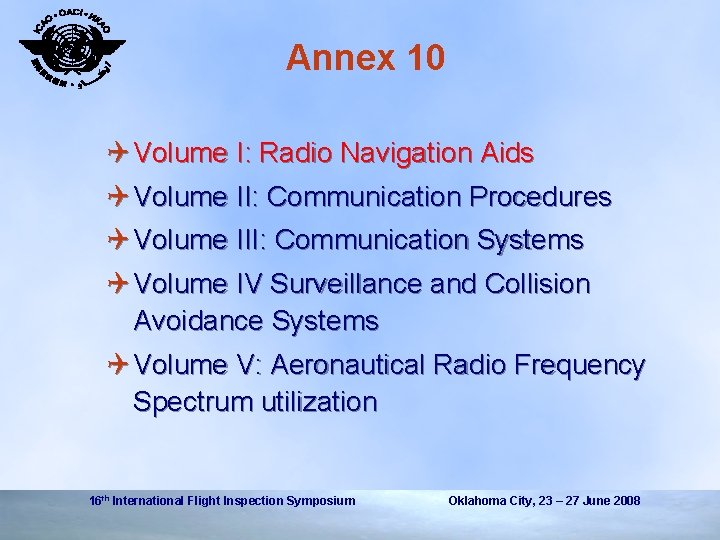
Annex 10 Q Volume I: Radio Navigation Aids Q Volume II: Communication Procedures Q Volume III: Communication Systems Q Volume IV Surveillance and Collision Avoidance Systems Q Volume V: Aeronautical Radio Frequency Spectrum utilization 16 th International Flight Inspection Symposium Oklahoma City, 23 – 27 June 2008
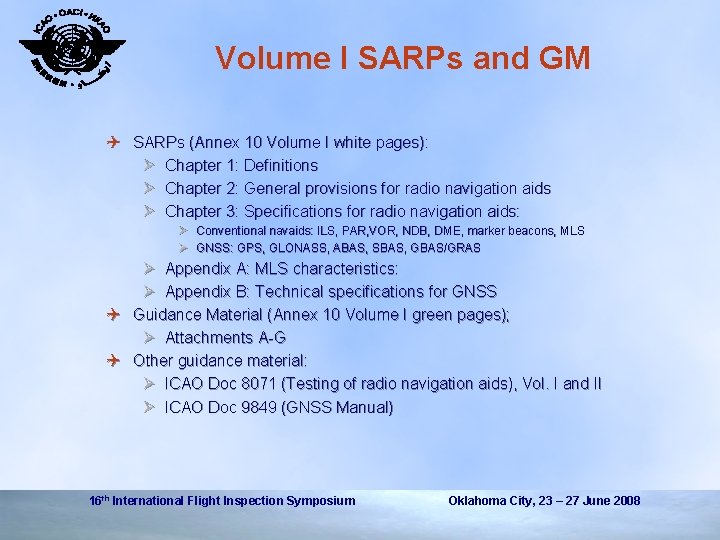
Volume I SARPs and GM Q SARPs (Annex 10 Volume I white pages): Ø Chapter 1: Definitions Ø Chapter 2: General provisions for radio navigation aids Ø Chapter 3: Specifications for radio navigation aids: Ø Conventional navaids: ILS, PAR, VOR, NDB, DME, marker beacons, MLS Ø GNSS: GPS, GLONASS, ABAS, SBAS, GBAS/GRAS Ø Appendix A: MLS characteristics: Ø Appendix B: Technical specifications for GNSS Q Guidance Material (Annex 10 Volume I green pages); Ø Attachments A-G Q Other guidance material: Ø ICAO Doc 8071 (Testing of radio navigation aids), Vol. I and II Ø ICAO Doc 9849 (GNSS Manual) 16 th International Flight Inspection Symposium Oklahoma City, 23 – 27 June 2008
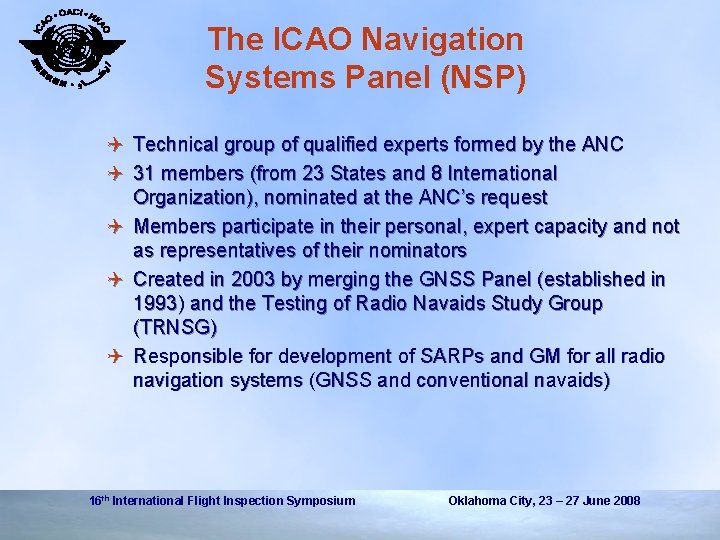
The ICAO Navigation Systems Panel (NSP) Q Technical group of qualified experts formed by the ANC Q 31 members (from 23 States and 8 International Organization), nominated at the ANC’s request Q Members participate in their personal, expert capacity and not as representatives of their nominators Q Created in 2003 by merging the GNSS Panel (established in 1993) and the Testing of Radio Navaids Study Group (TRNSG) Q Responsible for development of SARPs and GM for all radio navigation systems (GNSS and conventional navaids) 16 th International Flight Inspection Symposium Oklahoma City, 23 – 27 June 2008
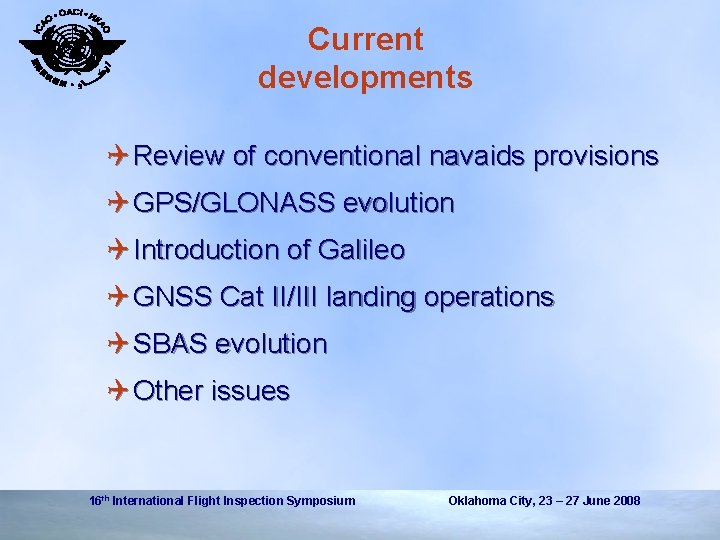
Current developments Q Review of conventional navaids provisions Q GPS/GLONASS evolution Q Introduction of Galileo Q GNSS Cat II/III landing operations Q SBAS evolution Q Other issues 16 th International Flight Inspection Symposium Oklahoma City, 23 – 27 June 2008
Review of conventional navaids provisions (1) Q Q Q Q General clean-up of obsolete or ambiguous material Restructuring of Chapter 2 (General provisions) Deletion of “protection dates” Complete revision of material on ILS critical and sensitive areas Review of VOR/DME service volumes and frequency planning material Alignment of DME accuracy Standard with actual avionics performance Deletion of NDB testing material MLS CAT III certification issues 16 th International Flight Inspection Symposium Oklahoma City, 23 – 27 June 2008
Review of conventional navaids provisions (2) Q Impact of changes on existing systems carefully evaluated Q Backwards compatibility assessment completed Q Most of the changes should raise no cost / implementation issues Q Feedback from consultation with States will be used to confirm these findings Q State Letter sent in June Q Amendment 84, to become applicable end 2009 16 th International Flight Inspection Symposium Oklahoma City, 23 – 27 June 2008
Review of conventional navaids provisions (3) Q Relaxations of ILS localizer coverage requirements are under review by NSP, in coordination with the OPSP Q Intent: to limit clearance signal reflection (multipath) from buildings Q Method: Raising the lower boundary of the coverage from 2000 ft height above threshold at 17 NM and +/- 15 degrees to a variable height (4500 ft max) at +/- 35 degrees Q Condition: “if operational requirements permit” (based on a specific operational impact evaluation) Q NSP recommendation expected at October 2008 meeting 16 th International Flight Inspection Symposium Oklahoma City, 23 – 27 June 2008
GPS SARPs evolution Q Short-term (Amendment 83 to Annex 10): Ø Harmonization with GPS Interface Specification IS-GPS-200 Q Longer-term: Ø SARPs for GPS L 5 signal (1176. 45 MHz), designed for safety-of-life uses 16 th International Flight Inspection Symposium Oklahoma City, 23 – 27 June 2008
GLONASS SARPs evolution Q Short-term (Amendment 83 to Annex 10): Ø Harmonization of the formulation of GLONASS accuracy, availability and reliability provisions with that of the corresponding GPS provisions Ø Modifications to carrier frequency plans to protect radio astronomy bands Q Longer-term: Ø SARPs for GLONASS L 3 signal in the 1164 – 1215 MHz band (GLONASS-K satellites) 16 th International Flight Inspection Symposium Oklahoma City, 23 – 27 June 2008
Introduction of Galileo SARPs Q Longer term: Galileo SARPs to be developed ØOpen Service (OS) ØSafety of Life (So. L) 16 th International Flight Inspection Symposium Oklahoma City, 23 – 27 June 2008
SBAS SARPs evolution Q SBAS: Satellite-based augmentation system (WAAS, EGNOS, MSAS, GAGAN) Q Short-term (Amendment 83 to Annex 10): Ø Harmonization with airborne receiver standards (RTCA DO-229 C/D) Q Mid term: Ø Investigate use of SBAS down to a 200 ft decision height (already planned for WAAS) Q Longer term: Ø SBAS L 5 SARPs 16 th International Flight Inspection Symposium Oklahoma City, 23 – 27 June 2008
GNSS Cat II/III operations Q Current GBAS SARPs support Cat I Q Development of GBAS SARPs for Cat II/III is ongoing ØNSP Cat II/III Subgroup Q Several conceptual options still under assessment 16 th International Flight Inspection Symposium Oklahoma City, 23 – 27 June 2008
Other SARPs issues Q Evolving ICAO policy on formulation of SARPs: Ø Assembly Resolution A 36 -13 (2007) Ø “ SARPs and PANS shall be drafted in clear, simple and concise language. SARPs shall consist of broad, mature and stable provisions specifying functional and performance requirements that provide for the requisite levels of safety, efficiency and interoperability. Supporting technical specifications, when developed by ICAO, shall be placed in separate documents to the extent possible; ” Ø “ In the development of SARPs, procedures and guidance material, ICAO should utilize, to the maximum extent appropriate and subject to the adequacy of a verification and validation process, the work of other recognized standards-making organizations. Material developed by these other standards-making organizations may be deemed appropriate by the Council as meeting ICAO requirements; in this case such material should be referenced in ICAO documentation; ” Q Evolving relationship with other standards-making organizations 16 th International Flight Inspection Symposium Oklahoma City, 23 – 27 June 2008
Doc 8071 Manual on testing of radio navigation aids QVolume I — Testing of Ground-based Radio Navigation Systems. QVolume II — Testing of Satellite-based Radio Navigation Systems. QVolume III — Testing of Surveillance Radar Systems. 16 th International Flight Inspection Symposium Oklahoma City, 23 – 27 June 2008
Doc 8071 evolution Q NSP CNTSG (Conventional Navaids and Testing Subgroup) is responsible for the development of updates to Doc 8071 Q New material on flight validation of instrument flight procedures introduced as Chapter 5 of Volume II in 2007 Q Similar material to be introduced as Chapter 8 of Volume I Q Additional corrigendum to Volume II (GBAS chapter) to be published shortly Q Package of Volume I changes to be developed by NSP CNTSG (October 2008 meeting), to align with the proposed changes to SARPs. 16 th International Flight Inspection Symposium Oklahoma City, 23 – 27 June 2008
END Thank you for your attention! 16 th International Flight Inspection Symposium Oklahoma City, 23 – 27 June 2008