
IBM User Technology DITA XML and SCORMbased Learning
IBM User Technology DITA XML and SCORM-based Learning Delivery John Hunt – DITA Learning Architect, IBM October 2004 | DITA and SCORM-based Learning Delivery © 2004 IBM Corporation
IBM User Technology Agenda Background: Why DITA? Introduction to DITA Reuse with topics and maps Adoption of DITA within IBM DITA, SCORM, and Learning Delivery DITA and SCORM- based Learning Delivery © 2004 IBM Corporation
IBM User Technology Background: Why DITA? DITA and SCORM- based Learning Delivery © 2004 IBM Corporation
IBM User Technology A brief history of markup D DITA and SCORM- based Learning Delivery © 2004 IBM Corporation
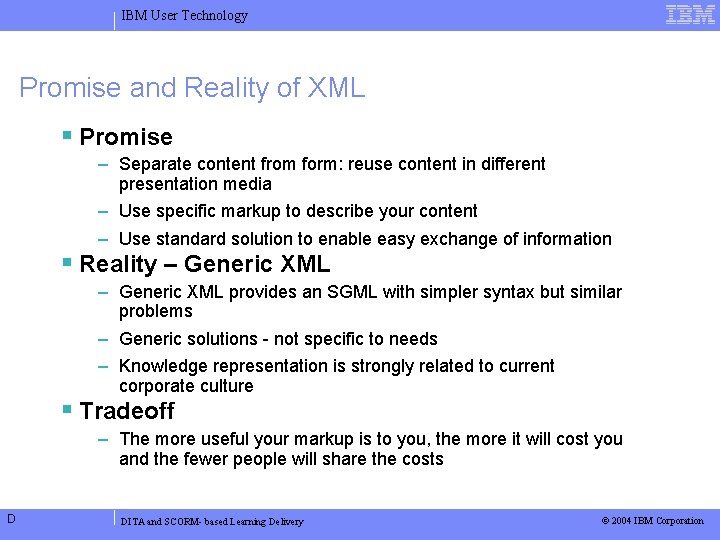
IBM User Technology Promise and Reality of XML Promise – Separate content from form: reuse content in different presentation media – Use specific markup to describe your content – Use standard solution to enable easy exchange of information Reality – Generic XML provides an SGML with simpler syntax but similar problems – Generic solutions - not specific to needs – Knowledge representation is strongly related to current corporate culture Tradeoff – The more useful your markup is to you, the more it will cost you and the fewer people will share the costs D DITA and SCORM- based Learning Delivery © 2004 IBM Corporation
IBM User Technology DITA designed to address these issues… What is DITA? DITA and SCORM- based Learning Delivery © 2004 IBM Corporation

IBM User Technology DITA XML defined Darwin: DITA utilizes principles of inheritance for specialization Information Typing: Focuses on the meaning and purpose of the content (concept, task, reference) Architecture: DITA offers a model for extension both of design and of processes G DITA and SCORM- based Learning Delivery © 2004 IBM Corporation
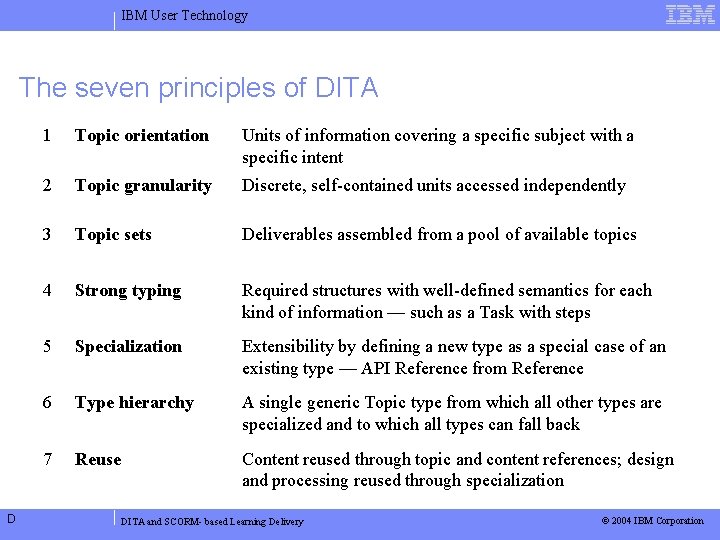
IBM User Technology The seven principles of DITA D 1 Topic orientation Units of information covering a specific subject with a specific intent 2 Topic granularity Discrete, self-contained units accessed independently 3 Topic sets Deliverables assembled from a pool of available topics 4 Strong typing Required structures with well-defined semantics for each kind of information — such as a Task with steps 5 Specialization Extensibility by defining a new type as a special case of an existing type — API Reference from Reference 6 Type hierarchy A single generic Topic type from which all other types are specialized and to which all types can fall back 7 Reuse Content reused through topic and content references; design and processing reused through specialization DITA and SCORM- based Learning Delivery © 2004 IBM Corporation
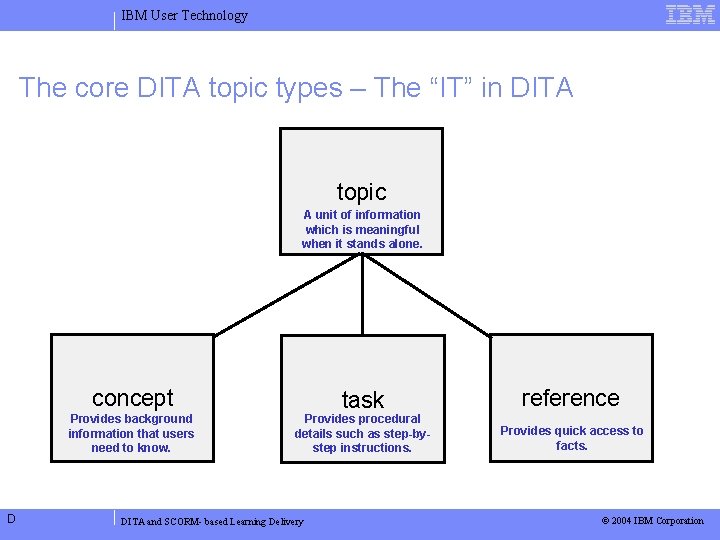
IBM User Technology The core DITA topic types – The “IT” in DITA topic A unit of information which is meaningful when it stands alone. concept Provides background information that users need to know. D task Provides procedural details such as step-bystep instructions. DITA and SCORM- based Learning Delivery reference Provides quick access to facts. © 2004 IBM Corporation
IBM User Technology Types of reuse with DITA Reuse of Content Reuse of Design Reuse of Processes DITA and SCORM- based Learning Delivery © 2004 IBM Corporation
IBM User Technology Reuse of content Reuse flows from the topic-based paradigm – Information types as delivery-neutral descriptions of topic content – A task is a task, regardless of where you read it When content is authored as standalone topics – Topics can be reused in different contexts – Topics can be: – Assembled into books and PDFs – Linked into webs – Served up from information center portals – Organized to support learning objectives – Topics from multiple components can be integrated as a solution D DITA and SCORM- based Learning Delivery © 2004 IBM Corporation
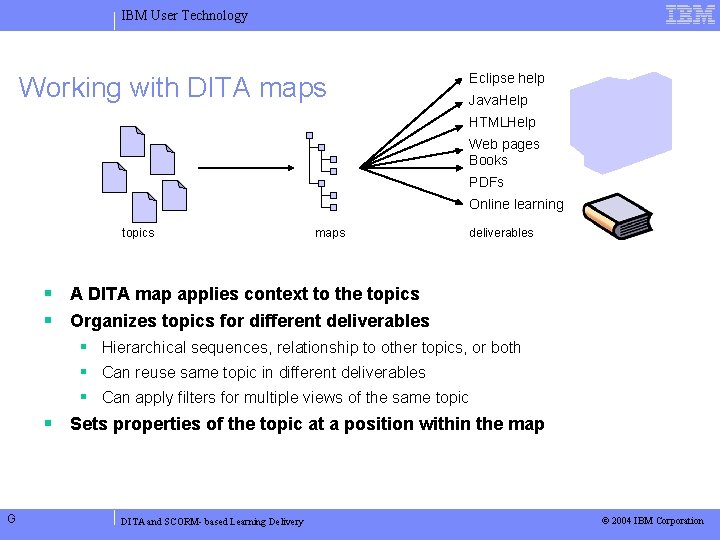
IBM User Technology Working with DITA maps Eclipse help Java. Help HTMLHelp Web pages Books PDFs Online learning topics maps deliverables A DITA map applies context to the topics Organizes topics for different deliverables Hierarchical sequences, relationship to other topics, or both Can reuse same topic in different deliverables Can apply filters for multiple views of the same topic Sets properties of the topic at a position within the map G DITA and SCORM- based Learning Delivery © 2004 IBM Corporation
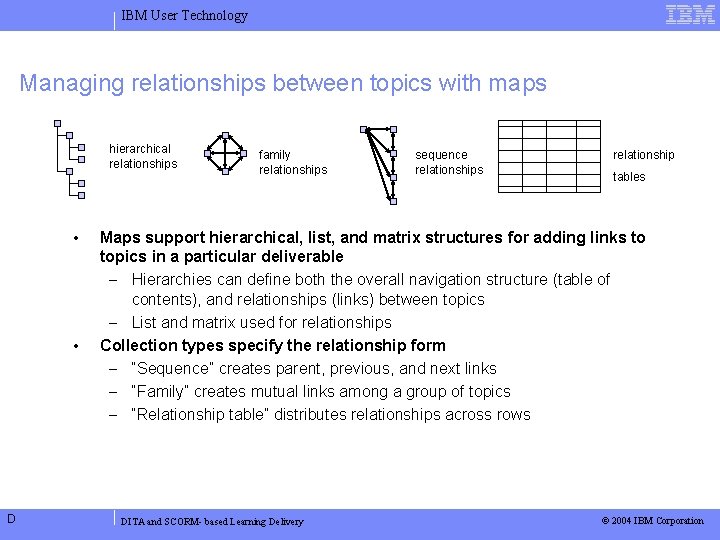
IBM User Technology Managing relationships between topics with maps hierarchical relationships • • D family relationships sequence relationships relationship tables Maps support hierarchical, list, and matrix structures for adding links to topics in a particular deliverable – Hierarchies can define both the overall navigation structure (table of contents), and relationships (links) between topics – List and matrix used for relationships Collection types specify the relationship form – “Sequence” creates parent, previous, and next links – “Family” creates mutual links among a group of topics – “Relationship table” distributes relationships across rows DITA and SCORM- based Learning Delivery © 2004 IBM Corporation
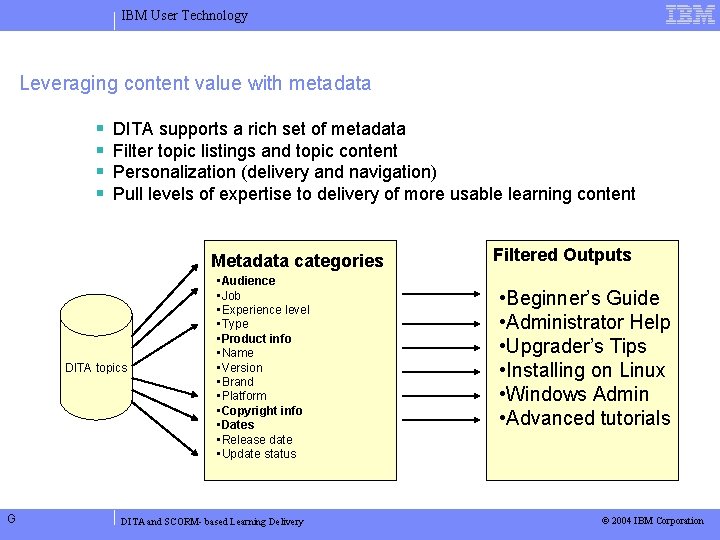
IBM User Technology Leveraging content value with metadata DITA supports a rich set of metadata Filter topic listings and topic content Personalization (delivery and navigation) Pull levels of expertise to delivery of more usable learning content Metadata categories DITA topics G • Audience • Job • Experience level • Type • Product info • Name • Version • Brand • Platform • Copyright info • Dates • Release date • Update status DITA and SCORM- based Learning Delivery Filtered Outputs • Beginner’s Guide • Administrator Help • Upgrader’s Tips • Installing on Linux • Windows Admin • Advanced tutorials © 2004 IBM Corporation
IBM User Technology Specialization and reuse of design DITA and SCORM- based Learning Delivery © 2004 IBM Corporation
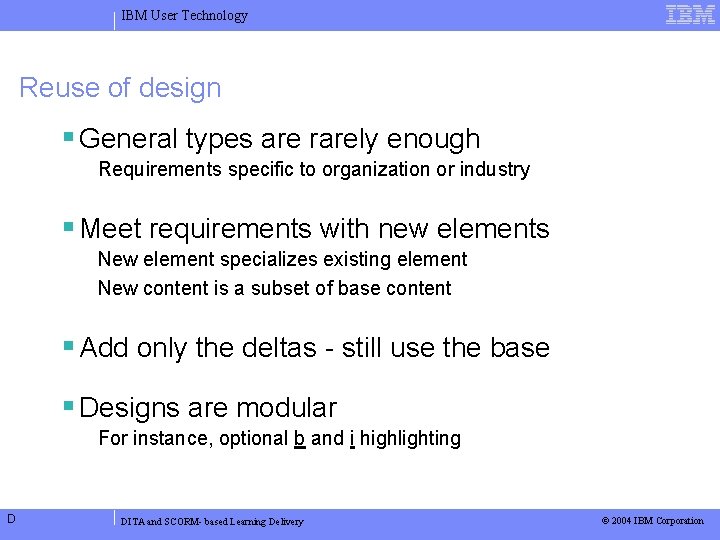
IBM User Technology Reuse of design General types are rarely enough Requirements specific to organization or industry Meet requirements with new elements New element specializes existing element New content is a subset of base content Add only the deltas - still use the base Designs are modular For instance, optional b and i highlighting D DITA and SCORM- based Learning Delivery © 2004 IBM Corporation
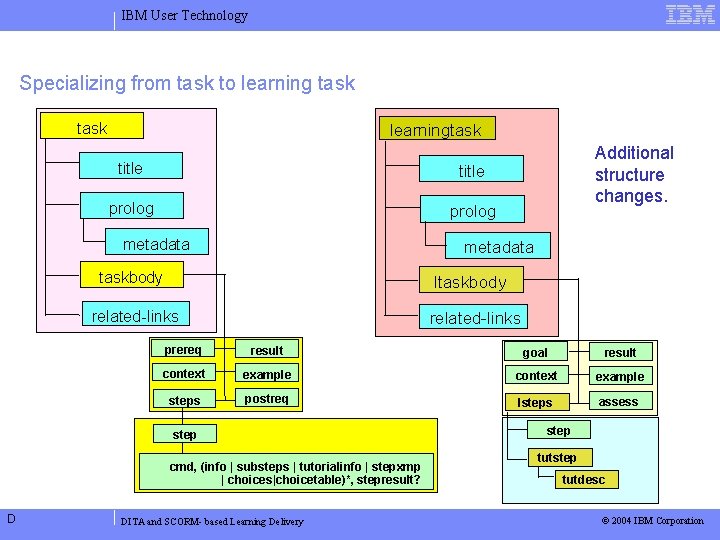
IBM User Technology Specializing from task to learning task learningtask title prolog metadata taskbody ltaskbody related-links prereq result goal result context taskxmp example context example steps postreq lsteps assess step cmd, (info | substeps | tutorialinfo | stepxmp | |xmp choices|choicetable)*, | choices)*, result? stepresult? D Additional structure changes. DITA and SCORM- based Learning Delivery step tutdesc © 2004 IBM Corporation
IBM User Technology Specialization of information types Topic is the base information type. Other information types are a delta in design and (where useful) processing G DITA and SCORM- based Learning Delivery © 2004 IBM Corporation
IBM User Technology Benefit of design reuse through specialization No need to reinvent the base vocabulary No impact from other designs that customize for different purposes Interoperability at the base type Reusable type hierarchies Output tailored to customers and information Consistency Learning support for new writers Explicit support of different product architectural requirements D DITA and SCORM- based Learning Delivery © 2004 IBM Corporation
IBM User Technology Specialization and reuse of processes DITA and SCORM- based Learning Delivery © 2004 IBM Corporation
IBM User Technology Reuse of processes Base processing in extensible XSLT Standard processing can be customized – Override standard processing as needed Processes for base elements apply to new specialized elements by default – Can use base processing – Can write custom processing if needed D DITA and SCORM- based Learning Delivery © 2004 IBM Corporation
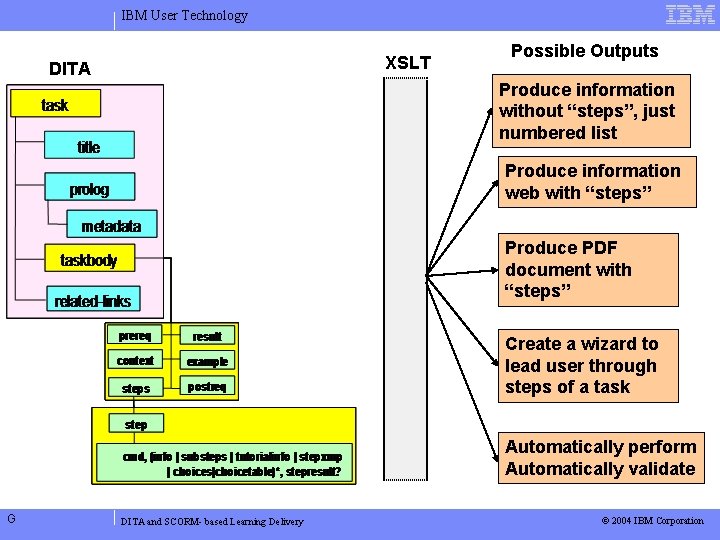
IBM User Technology DITA Task XSLT Possible Outputs Produce information without “steps”, just numbered list Produce information web with “steps” Produce PDF document with “steps” Create a wizard to lead user through steps of a task Automatically perform Automatically validate G DITA and SCORM- based Learning Delivery © 2004 IBM Corporation
IBM User Technology DITA, SCORM, Learning Delivery, and S 1000 D DITA has a clear strategic potential to provide a core XML-based content reuse model for the delivery of standards-based online learning. D DITA and SCORM- based Learning Delivery © 2004 IBM Corporation
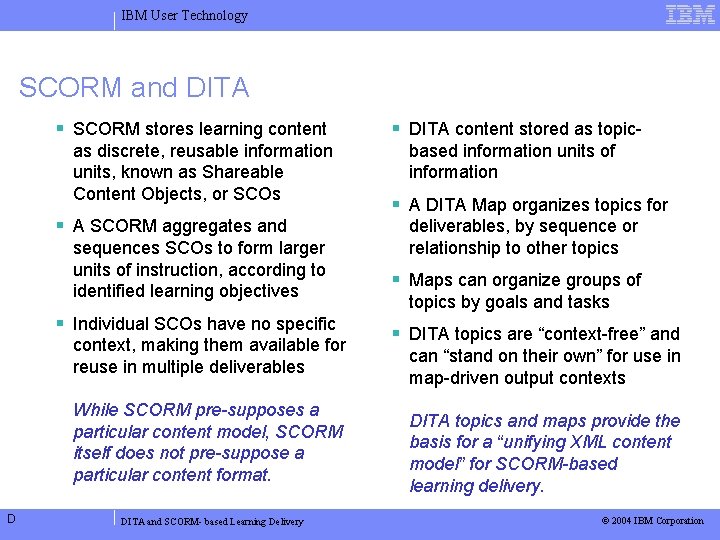
IBM User Technology SCORM and DITA SCORM stores learning content as discrete, reusable information units, known as Shareable Content Objects, or SCOs A SCORM aggregates and sequences SCOs to form larger units of instruction, according to identified learning objectives Individual SCOs have no specific context, making them available for reuse in multiple deliverables While SCORM pre-supposes a particular content model, SCORM itself does not pre-suppose a particular content format. D DITA and SCORM- based Learning Delivery DITA content stored as topicbased information units of information A DITA Map organizes topics for deliverables, by sequence or relationship to other topics Maps can organize groups of topics by goals and tasks DITA topics are “context-free” and can “stand on their own” for use in map-driven output contexts DITA topics and maps provide the basis for a “unifying XML content model” for SCORM-based learning delivery. © 2004 IBM Corporation
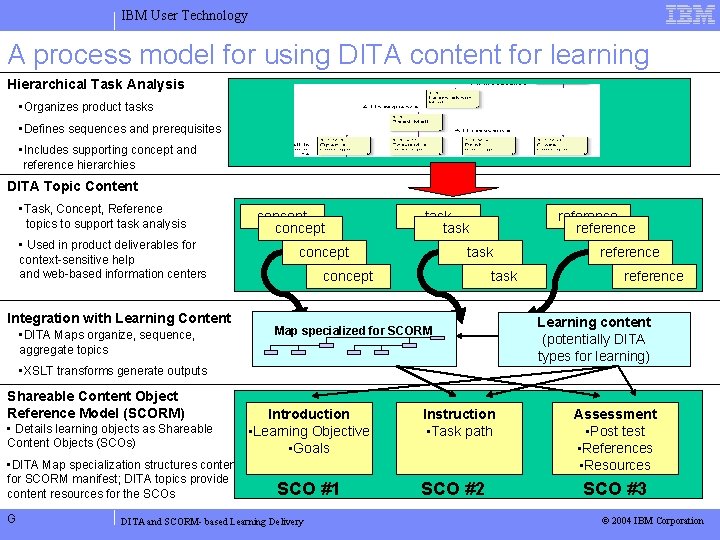
IBM User Technology A process model for using DITA content for learning Hierarchical Task Analysis • Organizes product tasks • Defines sequences and prerequisites • Includes supporting concept and reference hierarchies DITA Topic Content • Task, Concept, Reference topics to support task analysis • Used in product deliverables for context-sensitive help and web-based information centers Integration with Learning Content • DITA Maps organize, sequence, aggregate topics concept task concept reference task concept task Map specialized for SCORM • XSLT transforms generate outputs Shareable Content Object Reference Model (SCORM) • Details learning objects as Shareable Content Objects (SCOs) • DITA Map specialization structures content for SCORM manifest; DITA topics provide content resources for the SCOs G Introduction • Learning Objective • Goals SCO #1 DITA and SCORM- based Learning Delivery Instruction • Task path SCO #2 reference Learning content (potentially DITA types for learning) Assessment • Post test • References • Resources SCO #3 © 2004 IBM Corporation
IBM User Technology Information Center View / Learning View G DITA and SCORM- based Learning Delivery © 2004 IBM Corporation
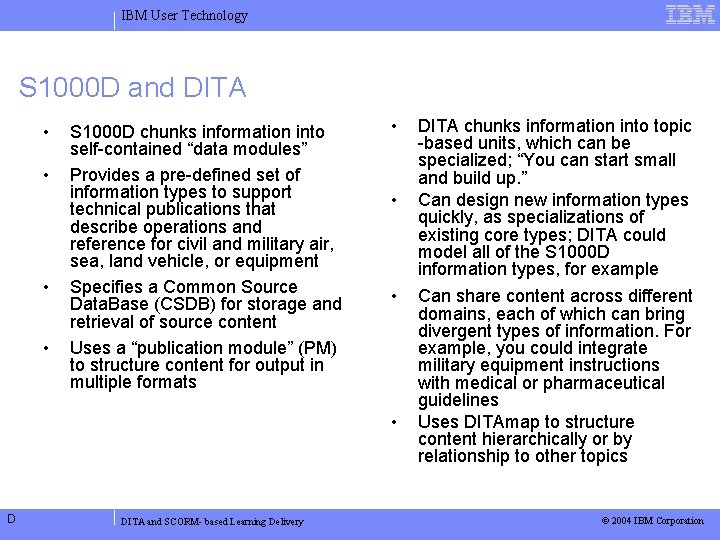
IBM User Technology S 1000 D and DITA • • S 1000 D chunks information into self-contained “data modules” Provides a pre-defined set of information types to support technical publications that describe operations and reference for civil and military air, sea, land vehicle, or equipment Specifies a Common Source Data. Base (CSDB) for storage and retrieval of source content Uses a “publication module” (PM) to structure content for output in multiple formats • • D DITA and SCORM- based Learning Delivery DITA chunks information into topic -based units, which can be specialized; “You can start small and build up. ” Can design new information types quickly, as specializations of existing core types; DITA could model all of the S 1000 D information types, for example Can share content across different domains, each of which can bring divergent types of information. For example, you could integrate military equipment instructions with medical or pharmaceutical guidelines Uses DITAmap to structure content hierarchically or by relationship to other topics © 2004 IBM Corporation
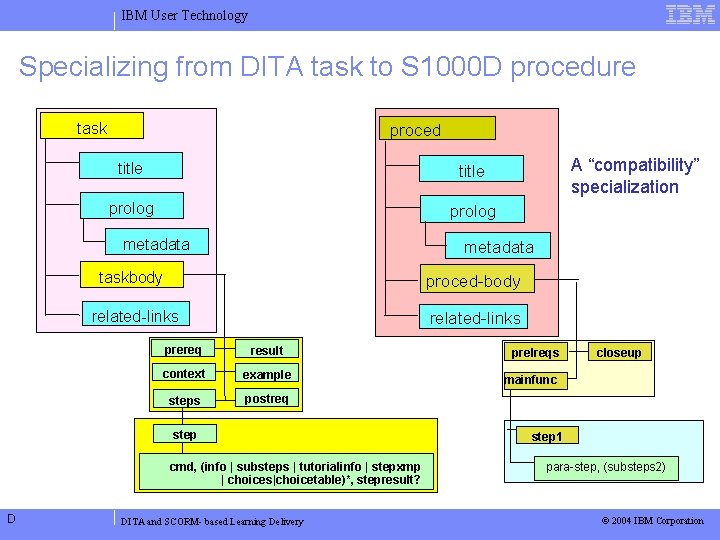
IBM User Technology Specializing from DITA task to S 1000 D procedure task proced title prolog metadata taskbody proced-body related-links prereq result context taskxmp example steps postreq step cmd, (info | substeps | tutorialinfo | stepxmp | |xmp choices|choicetable)*, | choices)*, result? stepresult? D Additional A “compatibility” structure specialization changes. DITA and SCORM- based Learning Delivery prelreqs closeup mainfunc step 1 para-step, (substeps 2) © 2004 IBM Corporation
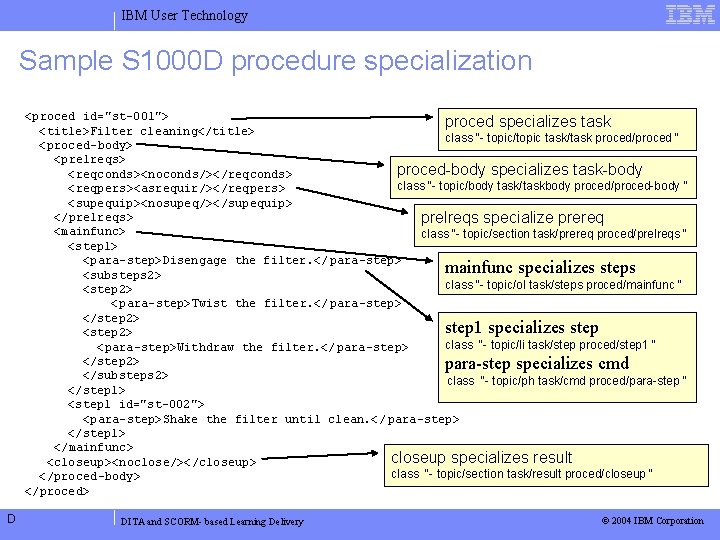
IBM User Technology Sample S 1000 D procedure specialization <proced id="st-001"> proced specializes task <title>Filter cleaning</title> class "- topic/topic task/task proced/proced " <proced-body> <prelreqs> proced-body specializes task-body <reqconds><noconds/></reqconds> class "- topic/body task/taskbody proced/proced-body " <reqpers><asrequir/></reqpers> <supequip><nosupeq/></supequip> </prelreqs> prelreqs specialize prereq <mainfunc> class "- topic/section task/prereq proced/prelreqs " <step 1> <para-step>Disengage the filter. </ para-step> mainfunc specializes steps <substeps 2> class "- topic/ol task/steps proced/mainfunc " <step 2> <para-step>Twist the filter. </ para-step> </step 2> step 1 specializes step <step 2> class "- topic/li task/step proced/step 1 “ <para-step>Withdraw the filter. </ para-step> </step 2> para-step specializes cmd </substeps 2> class "- topic/ph task/cmd proced/para-step " </step 1> <step 1 id="st-002"> <para-step>Shake the filter until clean. </ para-step> </step 1> </mainfunc> closeup specializes result <closeup><noclose/></closeup> class "- topic/section task/result proced/closeup " </proced-body> </proced> D DITA and SCORM- based Learning Delivery © 2004 IBM Corporation
IBM User Technology Summary DITA is a leading-edge solution for content reuse and processing – DITA topics – basic level of reuse structured, semantic content organized for deliverables with maps and transformed into deliverables using standards-based XSLT & XSL-FO DITA supports well-known methodologies for technical content – Topic-oriented, task-based DITA provides basis for re-purposing content for learning delivery – Directly re-purpose substantial amounts of help content for learning delivery, for example DITA bridges any topic-oriented content to learning delivery with SCORM D DITA and SCORM- based Learning Delivery © 2004 IBM Corporation
IBM User Technology DITA Resources DITA OASIS TC – http: //www. oasis-open. org/committees/tc_home. php? wg_abbrev=dita Introduction to the Darwin Information Typing Architecture – http: //www-106. ibm. com/developerworks/xml/library/x-dita 1 – Links from here to other related DITA articles on ibm. com DITA Downloads – http: //www-106. ibm. com/developerworks/xml/library/x-dita 6/xdita_downloads. html DITA on XML Cover Pages – http: //xml. coverpages. org/dita. html DITA and SCORM- based Learning Delivery © 2004 IBM Corporation
IBM User Technology Backup DITA and SCORM- based Learning Delivery © 2004 IBM Corporation
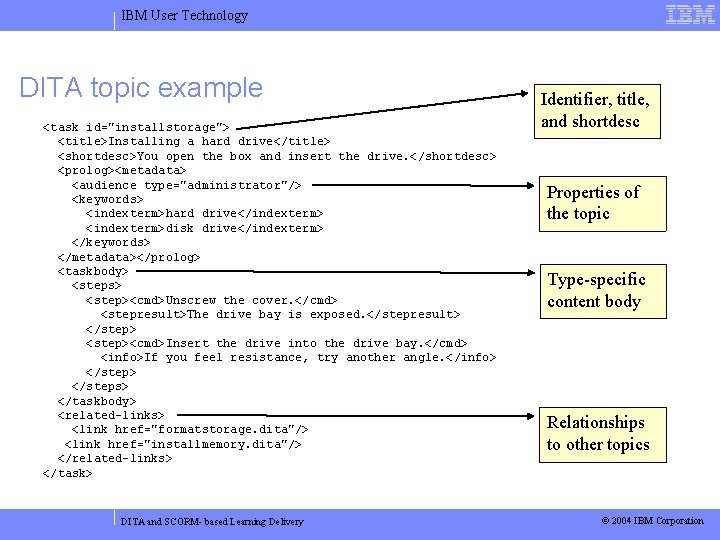
IBM User Technology DITA topic example <task id="installstorage"> <title>Installing a hard drive</title> <shortdesc>You open the box and insert the drive. </shortdesc> <prolog><metadata> <audience type="administrator"/> <keywords> <indexterm>hard drive</indexterm> <indexterm>disk drive</indexterm> </keywords> </metadata></prolog> <taskbody> <steps> <step><cmd>Unscrew the cover. </cmd> <stepresult>The drive bay is exposed. </stepresult> </step> <step><cmd>Insert the drive into the drive bay. </cmd> <info>If you feel resistance, try another angle. </info> </steps> </taskbody> <related-links> <link href="formatstorage. dita"/> <link href="installmemory. dita"/> </related-links> </task> DITA and SCORM- based Learning Delivery Identifier, title, and shortdesc Properties of the topic Type-specific content body Relationships to other topics © 2004 IBM Corporation
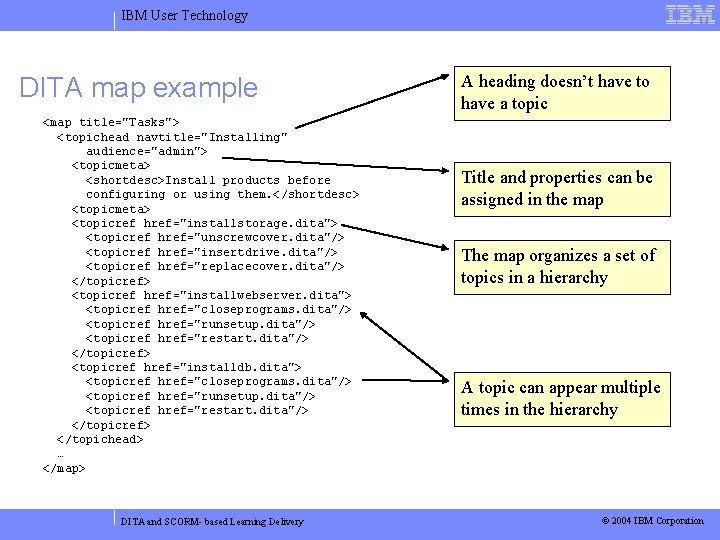
IBM User Technology DITA map example <map title="Tasks"> <topichead navtitle="Installing" audience="admin"> <topicmeta> <shortdesc>Install products before configuring or using them. </shortdesc> <topicmeta> <topicref href="installstorage. dita"> <topicref href="unscrewcover. dita"/> <topicref href="insertdrive. dita"/> <topicref href="replacecover. dita"/> </topicref> <topicref href="installwebserver. dita"> <topicref href="closeprograms. dita"/> <topicref href="runsetup. dita"/> <topicref href="restart. dita"/> </topicref> <topicref href="installdb. dita"> <topicref href="closeprograms. dita"/> <topicref href="runsetup. dita"/> <topicref href="restart. dita"/> </topicref> </topichead> … </map> DITA and SCORM- based Learning Delivery A heading doesn’t have to have a topic Title and properties can be assigned in the map The map organizes a set of topics in a hierarchy A topic can appear multiple times in the hierarchy © 2004 IBM Corporation
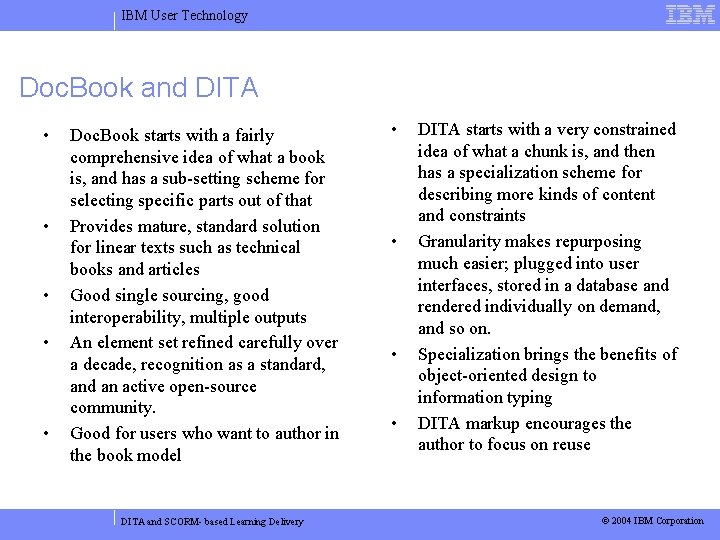
IBM User Technology Doc. Book and DITA • • • Doc. Book starts with a fairly comprehensive idea of what a book is, and has a sub-setting scheme for selecting specific parts out of that Provides mature, standard solution for linear texts such as technical books and articles Good single sourcing, good interoperability, multiple outputs An element set refined carefully over a decade, recognition as a standard, and an active open-source community. Good for users who want to author in the book model DITA and SCORM- based Learning Delivery • • DITA starts with a very constrained idea of what a chunk is, and then has a specialization scheme for describing more kinds of content and constraints Granularity makes repurposing much easier; plugged into user interfaces, stored in a database and rendered individually on demand, and so on. Specialization brings the benefits of object-oriented design to information typing DITA markup encourages the author to focus on reuse © 2004 IBM Corporation
- Slides: 35