
IBM TWENTY QUARTERS OF REVENUE DECLINE Presented by
IBM TWENTY QUARTERS OF REVENUE DECLINE Presented by CIO Corporate innovation online. com May, 2017 1
A perspective on the past and current decline, Gerstner’s initiatives and what IBM should do now Author: Peter Farwell Produced by CIO – Corporate innovation online. com 2
PETER FARWELL Peter Farwell, FCA, CFA. Peter has a B. A. (Maths and Physics) from the University of Toronto, and for one year studied philosophy at the University of Cambridge. Peter’s work experience includes being a Partner of the Public Accounting firm of Ernst & Young (formerly, Clarkson Gordon) from 1970 to formal retirement in 1998. Peter managed a group serving entrepreneurs, to help them build businesses, for three years and was the leader of the firm’s Canadian services to technology companies for twelve years. Newest essay; IBM; Can it survive? 3
IBM IN DIFFICULTY; SYMPTOMATIC EVIDENCE The stock price has dropped significantly since its peak in 2012 Revenue has been in decline since 2014 Main frame sales have almost vanished Concerns have been expressed by journalists about the state of IBM’s culture The main causes; IBM has not changed its vision to reflect the changing times: it is still focussed on providing solutions to the Big Problems of Big business, albeit with innovative technology; this is a mature market with limited growth prospects Leadership of the information technology world has passed from IBM to the new leaders: Apple, Google, Facebook, Amazon and even Microsoft 4
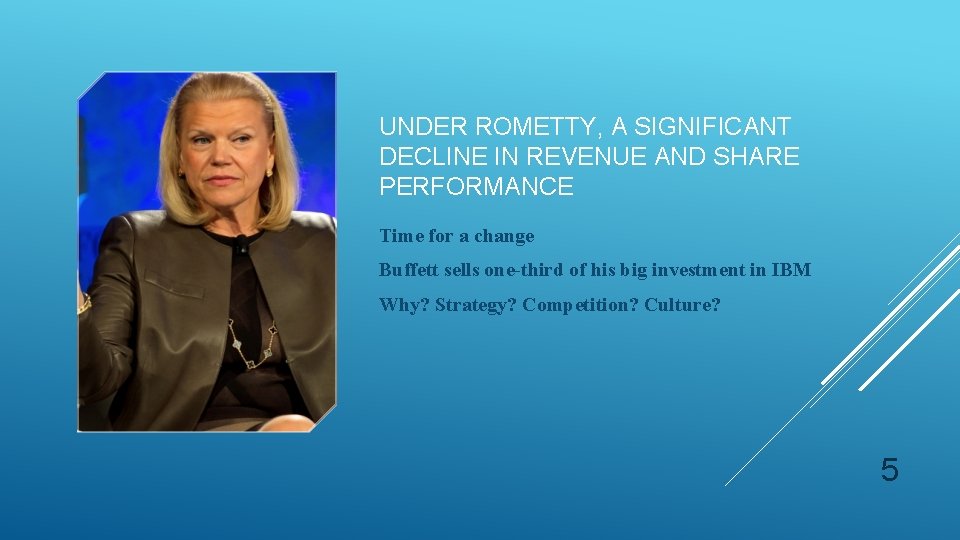
UNDER ROMETTY, A SIGNIFICANT DECLINE IN REVENUE AND SHARE PERFORMANCE Time for a change Buffett sells one-third of his big investment in IBM Why? Strategy? Competition? Culture? 5
IBM, has adopted new strategic focusses: The Cloud, Big Data Management, Advanced Analytics of Big Data, Ongoing security battles, and connecting to smartphones, tablets and other instruments allowing people in all walks of life to connect through the Internet. It also is spending $3 billion to develop technology for the Internet of Things. But the competition in all these areas is intense, from both established companies like Amazon, Apple and Microsoft, Cisco, Oracle and Salesforce, but also from new and rising companies such as Syapse. IBM has its hands full to beat this competition. BUT THINGS ARE NOT WORKING FAST ENOUGH FOR TODAY’S DYNAMICS 6
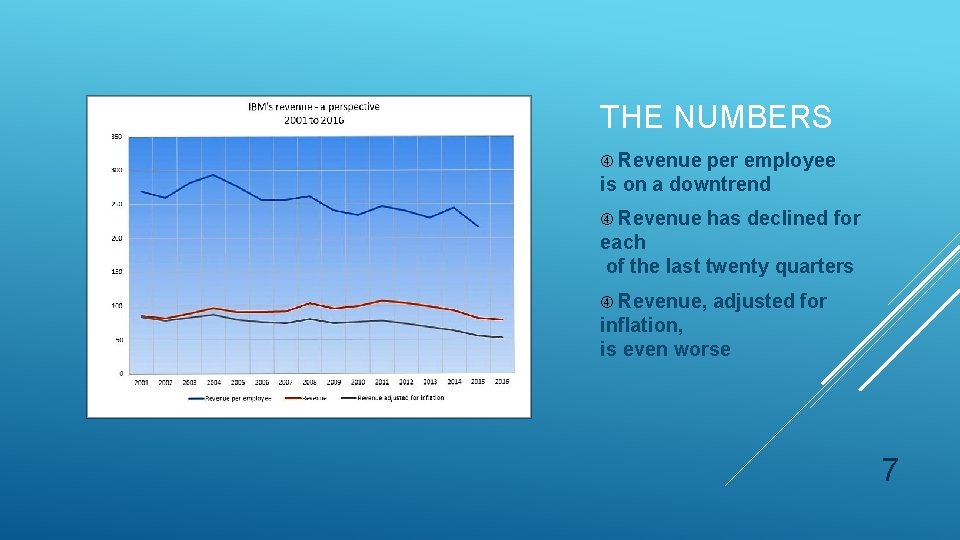
THE NUMBERS Revenue per employee is on a downtrend Revenue has declined for each of the last twenty quarters Revenue, adjusted for inflation, is even worse 7
WATSON’S IBM In the beginning, Thomas Watson Sr. established a culture of “respect, hard work, and ethical behaviour”. IBM people under Watson were honest, responsible, committed to what IBM did and stood for, dedicated to helping their customers. Watsons basic beliefs for IBMers were: Excellence in everything we do; Superior customer service; Respect for the Individual. These beliefs were reinforced by the compensation and benefit systems, in the employee education programs, in marketing and customer support systems 8
GERSTNER AT IBM; WHAT HE FOUND IN 1993; SIMILAR TO TODAY? But Gerstner believed IBM failed to keep its beliefs in tune with the changing market in which it operated. An example is the blue suit and tie dress code, appropriate when IBM’s customers wore this dress, but inappropriate when customers, particularly the technical buyers, changed what they wore to work. In a world where IBM was the dominant player for decades, the basic beliefs became perverted. “Superior customer service” came to mean “servicing our machines on the customers’ premises” instead of adjusting service to the customers changing business needs. 9
GERSTNER FOUND AN IBM GOVERNED BY LAID DOWN PROCEDURES AND CODIFICATION HAD REPLACED PERSONAL RESPONSIBILITY His first step was to eliminate rules and procedures and a focus on process, and replace them with a set of basic guiding principles such as; The market place is the driving force behind everything we do. We are a technology company with an overriding commitment to quality. Our primary measures of success are customer satisfaction and shareholder value. 10
When Gerstner retired in 2002 he viewed the changes to the IBM culture as a “Work in progress”. While he found “IBMers are energized, motivated, and stimulated as they haven’t been in a long time. ” What he hoped was that IBM would figure out a way to practice “continual, restless self-renewal” and not allow its culture to fall back into the bad habits he had found earlier. The key would be to remain focussed outward to its customers and the marketplace. Unfortunately, there is evidence that today, IBM has slipped back into bad habits. In his book: the Decline and fall of IBM, End of an American Icon, David Cringely, supported by a number of interviews of existing and former IBMers, the poor state of IBM’s culture. HAS IBM REVERTED SINCE GERSTNER? 11
The culture of a corporation is how the employees (and management) collectively feel about their work. It is usually founded on a common set of beliefs or values; and is manifest in the behaviours of the employees. In a good corporate culture, employees are passionate about their work, eager to please their customers, continually seeking to improve their delivery to their customers and good at collaboration. In a bad corporate culture, employees are unmotivated and lackadaisical about their work, look for motivation to internal factors such as internal politics, processes and internal performance measurements, lacking in innovative leadership, and are poor at cooperating with other employees. LET’S DEFINE CULTURE IN THIS CASE 12
FUTURE KEYS TO IBM’S SURVIVAL What IBM is doing about its predicament: New strategies; New approaches to improve its culture. What else it should do, five key things: Change the Board of Directors; Increase the focus on specific industries; Continue to work on improving its culture: Create a separate Entrepreneurial division to pursue new areas; Re-examine what it is doing in R&D. Summary and conclusion Yes it can survive, but it will require a lot of hard work! 13
IBM - Can IBM survive? $9. 00 IBM – Virginia Rometty has her hands full! This strategic review looks at IBM’s vision, strategies, culture and execution through three periods – the eras of the Watsons’, Gerstner, and Palisamo/Rometty. The author is Peter Farwell. 72 pages. February 15, 2016 GO TO CORPORATEINNOVATIONONLINE. COM TO GET THE WHOLE STORY 14
- Slides: 14