
IBM System z 10 Enterprise Class Parwez Hamid
IBM System z 10 Enterprise Class Parwez Hamid Senior Certified IT Specialist parwez_hamid@uk. ibm. com © 2008 IBM Corporation IBM Systems
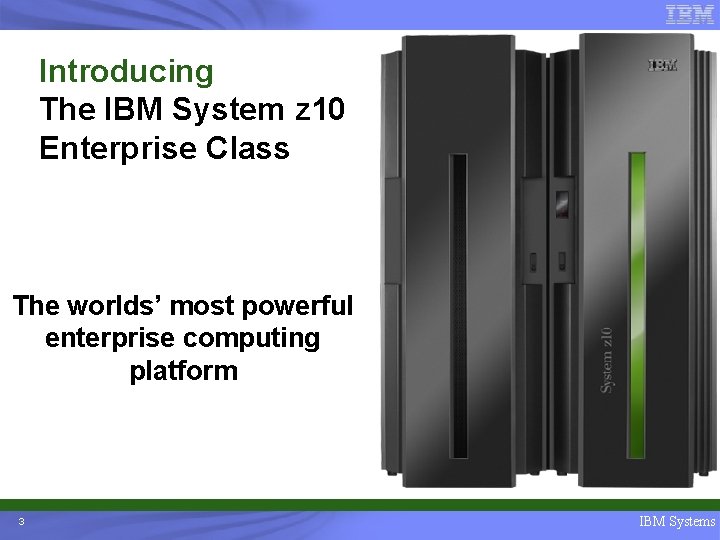
Introducing The IBM System z 10 Enterprise Class The worlds’ most powerful enterprise computing platform 3 IBM Systems
Introducing the IBM System z 10 TM Enterprise Class… a marriage of evolution and revolution Evolution – Scalability and virtualization to reduce cost and complexity – Improved efficiency to further reduce energy consumption – Improved security and resiliency to reduce risk – New heights in storage scalability and data protection 4 Revolution – 4. 4 GHz chip to deliver improved performance for CPU intensive workloads – ‘Just in time’ deployment of capacity resources – Vision to expand System z capabilities with Cell Broadband Engine. TM technology IBM Systems
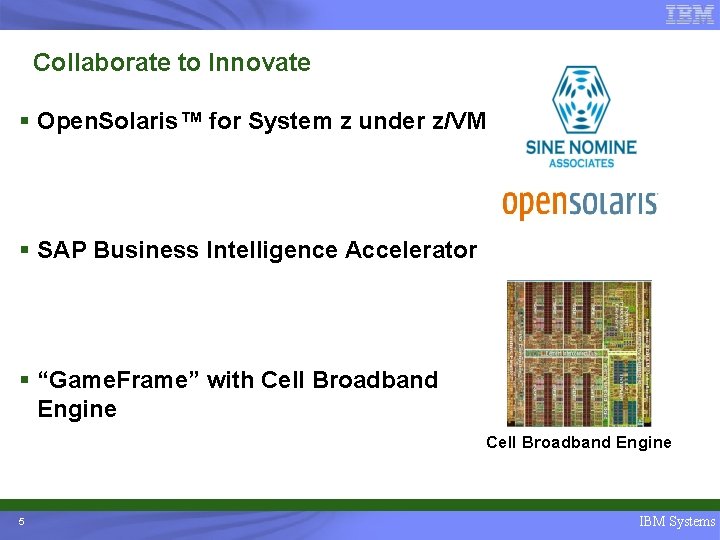
Collaborate to Innovate § Open. Solaris™ for System z under z/VM § SAP Business Intelligence Accelerator § “Game. Frame” with Cell Broadband Engine 5 IBM Systems
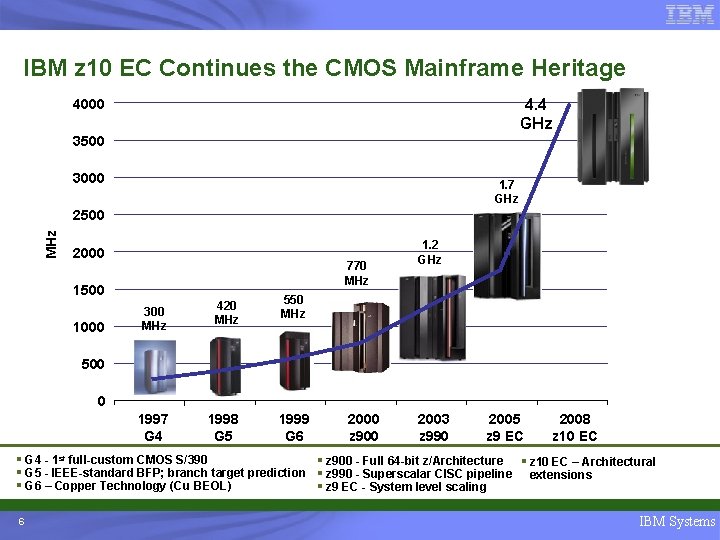
IBM z 10 EC Continues the CMOS Mainframe Heritage 4. 4 GHz 4000 3500 3000 1. 7 GHz MHz 2500 2000 770 MHz 1500 1000 300 MHz 420 MHz 1997 G 4 1998 G 5 1. 2 GHz 550 MHz 500 0 1999 G 6 2000 z 900 2003 z 990 2005 z 9 EC 2008 z 10 EC § G 4 - 1 st full-custom CMOS S/390 § z 900 - Full 64 -bit z/Architecture § z 10 EC – Architectural § G 5 - IEEE-standard BFP; branch target prediction § z 990 - Superscalar CISC pipeline extensions § G 6 – Copper Technology (Cu BEOL) § z 9 EC - System level scaling 6 IBM Systems
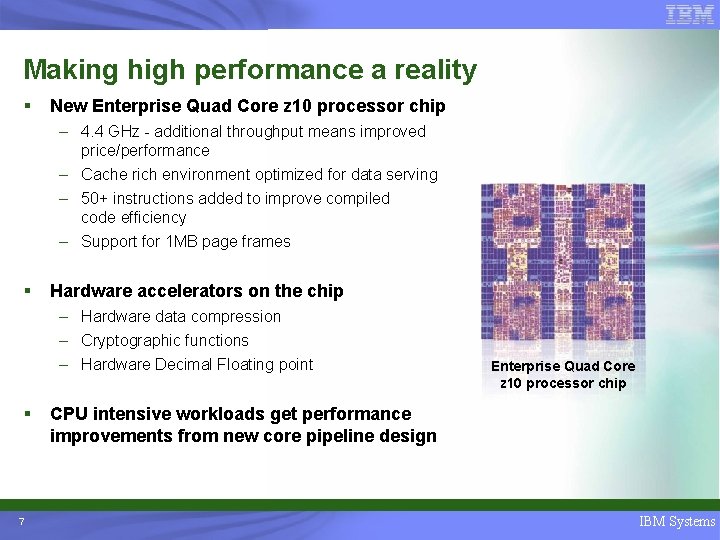
Making high performance a reality § New Enterprise Quad Core z 10 processor chip – 4. 4 GHz - additional throughput means improved price/performance – Cache rich environment optimized for data serving – 50+ instructions added to improve compiled code efficiency – Support for 1 MB page frames § Hardware accelerators on the chip – Hardware data compression – Cryptographic functions – Hardware Decimal Floating point § 7 Enterprise Quad Core z 10 processor chip CPU intensive workloads get performance improvements from new core pipeline design IBM Systems
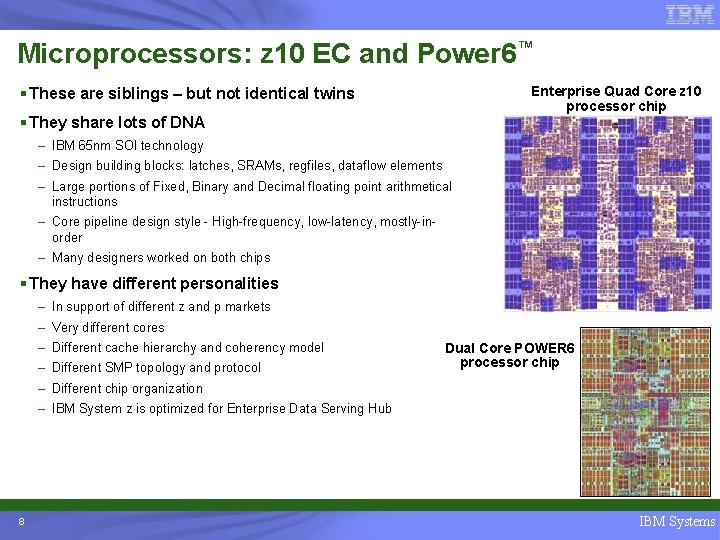
Microprocessors: z 10 EC and Power 6™ Enterprise Quad Core z 10 processor chip § These are siblings – but not identical twins § They share lots of DNA – IBM 65 nm SOI technology – Design building blocks: latches, SRAMs, regfiles, dataflow elements – Large portions of Fixed, Binary and Decimal floating point arithmetical instructions – Core pipeline design style - High-frequency, low-latency, mostly-inorder – Many designers worked on both chips § They have different personalities – In support of different z and p markets – Very different cores – Different cache hierarchy and coherency model – Different SMP topology and protocol Dual Core POWER 6 processor chip – Different chip organization – IBM System z is optimized for Enterprise Data Serving Hub 8 IBM Systems
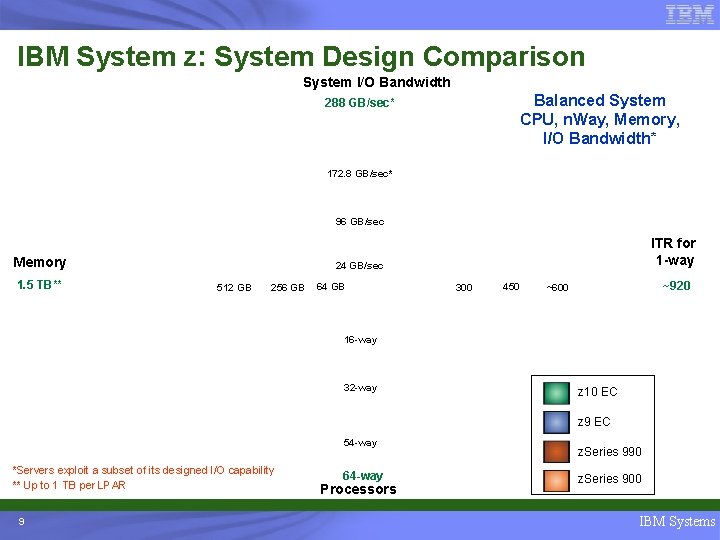
IBM System z: System Design Comparison System I/O Bandwidth Balanced System CPU, n. Way, Memory, I/O Bandwidth* 288 GB/sec* 172. 8 GB/sec* 96 GB/sec Memory 1. 5 TB** ITR for 1 -way 24 GB/sec 512 GB 256 GB 64 GB 300 450 ~920 ~600 16 -way 32 -way z 10 EC z 9 EC 54 -way *Servers exploit a subset of its designed I/O capability ** Up to 1 TB per LPAR 9 64 -way Processors z. Series 990 z. Series 900 IBM Systems
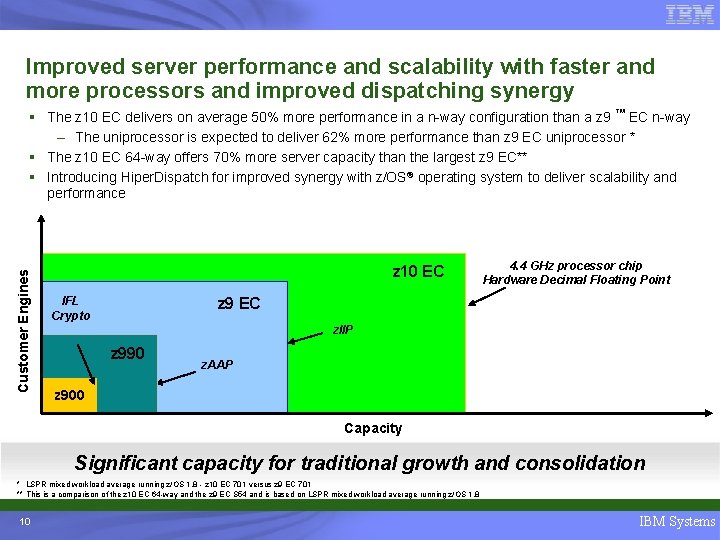
Improved server performance and scalability with faster and more processors and improved dispatching synergy Customer Engines § The z 10 EC delivers on average 50% more performance in a n-way configuration than a z 9 ™ EC n-way – The uniprocessor is expected to deliver 62% more performance than z 9 EC uniprocessor * § The z 10 EC 64 -way offers 70% more server capacity than the largest z 9 EC** § Introducing Hiper. Dispatch for improved synergy with z/OS® operating system to deliver scalability and performance z 10 EC 4. 4 GHz processor chip Hardware Decimal Floating Point z 9 EC IFL Crypto z. IIP z 990 z. AAP z 900 Capacity Significant capacity for traditional growth and consolidation * LSPR mixed workload average running z/OS 1. 8 - z 10 EC 701 versus z 9 EC 701 ** This is a comparison of the z 10 EC 64 -way and the z 9 EC S 54 and is based on LSPR mixed workload average running z/OS 1. 8 10 IBM Systems
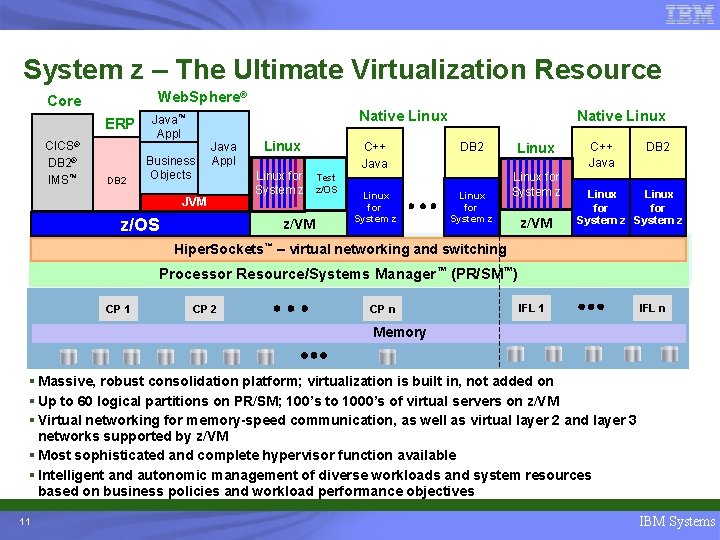
System z – The Ultimate Virtualization Resource Web. Sphere® Core ERP CICS® DB 2® IMS™ DB 2 ™ Java Appl. Busine Java ss Business Appl CICS Objects IMS s z/OS JVM z/OS Native Linux for Test System z z/OS z/VM C++ Java Linux for System z DB 2 Linux for System z z/VM C++ Java DB 2 Linux for System z Hiper. Sockets™ – virtual networking and switching Processor Resource/Systems Manager™ (PR/SM™) CP 1 CP 2 CP n IFL 1 IFL n Memory § Massive, robust consolidation platform; virtualization is built in, not added on § Up to 60 logical partitions on PR/SM; 100’s to 1000’s of virtual servers on z/VM § Virtual networking for memory-speed communication, as well as virtual layer 2 and layer 3 networks supported by z/VM § Most sophisticated and complete hypervisor function available § Intelligent and autonomic management of diverse workloads and system resources based on business policies and workload performance objectives 11 IBM Systems
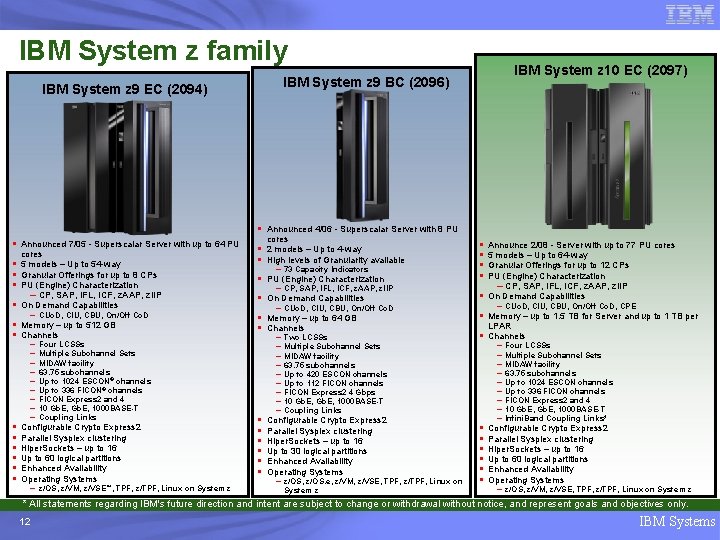
IBM System z family IBM System z 10 EC (2097) IBM System z 9 BC (2096) IBM System z 9 EC (2094) § Announced 4/06 - Superscalar Server with 8 PU § Announced 7/05 - Superscalar Server with up to 64 PU § § cores 5 models – Up to 54 -way Granular Offerings for up to 8 CPs PU (Engine) Characterization – CP, SAP, IFL, ICF, z. AAP, z. IIP On Demand Capabilities – CUo. D, CIU, CBU, On/Off Co. D § Memory – up to 512 GB § Channels § § § – – – – – Four LCSSs Multiple Subchannel Sets MIDAW facility 63. 75 subchannels Up to 1024 ESCON ® channels Up to 336 FICON® channels FICON Express 2 and 4 10 Gb. E, 1000 BASE-T Coupling Links Configurable Crypto Express 2 Parallel Sysplex clustering Hiper. Sockets – up to 16 Up to 60 logical partitions Enhanced Availability Operating Systems – z/OS, z/VM, z/VSE ™, TPF, z/TPF, Linux on System z cores § 2 models – Up to 4 -way § High levels of Granularity available – 73 Capacity Indicators § PU (Engine) Characterization – CP, SAP, IFL, ICF, z. AAP, z. IIP § On Demand Capabilities – CUo. D, CIU, CBU, On/Off Co. D § Memory – up to 64 GB § Channels § § § – – – – – Two LCSSs Multiple Subchannel Sets MIDAW facility 63. 75 subchannels Up to 420 ESCON channels Up to 112 FICON channels FICON Express 2 4 Gbps 10 Gb. E, 1000 BASE-T Coupling Links Configurable Crypto Express 2 Parallel Sysplex clustering Hiper. Sockets – up to 16 Up to 30 logical partitions Enhanced Availability Operating Systems – z/OS, z/OS. e, z/VM, z/VSE, TPF, z/TPF, Linux on System z § § Announce 2/08 - Server with up to 77 PU cores 5 models – Up to 64 -way Granular Offerings for up to 12 CPs PU (Engine) Characterization – CP, SAP, IFL, ICF, z. AAP, z. IIP § On Demand Capabilities – CUo. D, CIU, CBU, On/Off Co. D, CPE § Memory – up to 1. 5 TB for Server and up to 1 TB per LPAR § Channels § § § – – – – – Four LCSSs Multiple Subchannel Sets MIDAW facility 63. 75 subchannels Up to 1024 ESCON channels Up to 336 FICON channels FICON Express 2 and 4 10 Gb. E, 1000 BASE-T Infini. Band Coupling Links* Configurable Crypto Express 2 Parallel Sysplex clustering Hiper. Sockets – up to 16 Up to 60 logical partitions Enhanced Availability Operating Systems – z/OS, z/VM, z/VSE, TPF, z/TPF, Linux on System z * All statements regarding IBM's future direction and intent are subject to change or withdrawal without notice, and represent goals and objectives only. 12 IBM Systems
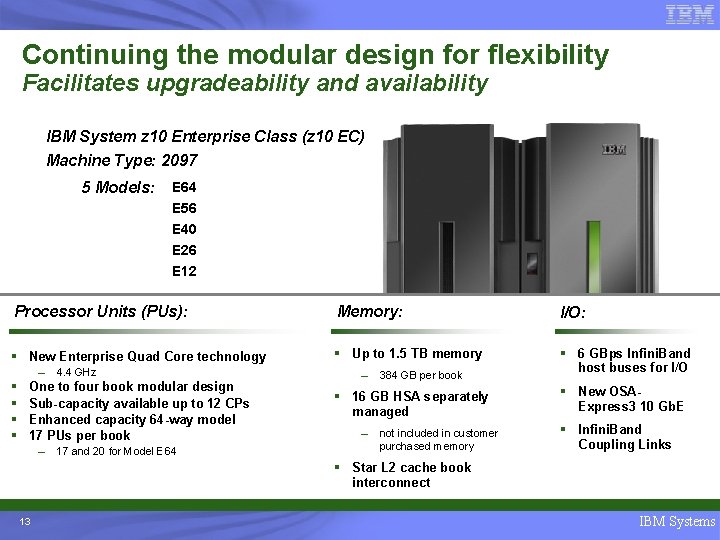
Continuing the modular design for flexibility Facilitates upgradeability and availability IBM System z 10 Enterprise Class (z 10 EC) Machine Type: 2097 5 Models: E 64 E 56 E 40 E 26 E 12 Processor Units (PUs): Memory: I/O: § New Enterprise Quad Core technology § Up to 1. 5 TB memory § 6 GBps Infini. Band host buses for I/O – § § 4. 4 GHz One to four book modular design Sub-capacity available up to 12 CPs Enhanced capacity 64 -way model 17 PUs per book – 17 and 20 for Model E 64 – 384 GB per book § 16 GB HSA separately managed – not included in customer purchased memory § New OSAExpress 3 10 Gb. E § Infini. Band Coupling Links § Star L 2 cache book interconnect 13 IBM Systems
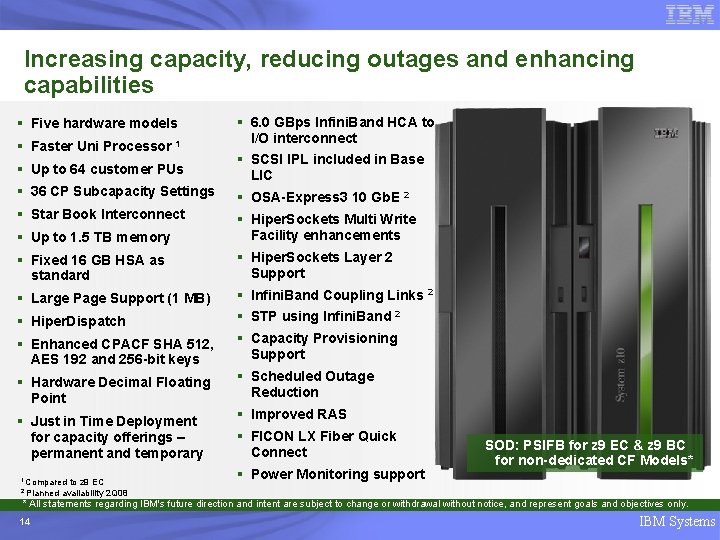
Increasing capacity, reducing outages and enhancing capabilities § Five hardware models § Faster Uni Processor 1 § 6. 0 GBps Infini. Band HCA to I/O interconnect § Up to 64 customer PUs § SCSI IPL included in Base LIC § 36 CP Subcapacity Settings § OSA-Express 3 10 Gb. E 2 § Star Book Interconnect § Up to 1. 5 TB memory § Hiper. Sockets Multi Write Facility enhancements § Fixed 16 GB HSA as standard § Hiper. Sockets Layer 2 Support § Large Page Support (1 MB) § Infini. Band Coupling Links 2 § Hiper. Dispatch § STP using Infini. Band 2 § Enhanced CPACF SHA 512, AES 192 and 256 -bit keys § Capacity Provisioning Support § Hardware Decimal Floating Point § Scheduled Outage Reduction § Just in Time Deployment for capacity offerings – permanent and temporary § FICON LX Fiber Quick Connect 1 Compared to z 9 EC 2 Planned availability 2 Q 08 § Improved RAS § Power Monitoring support SOD: PSIFB for z 9 EC & z 9 BC for non-dedicated CF Models* * All statements regarding IBM's future direction and intent are subject to change or withdrawal without notice, and represent goals and objectives only. 14 IBM Systems
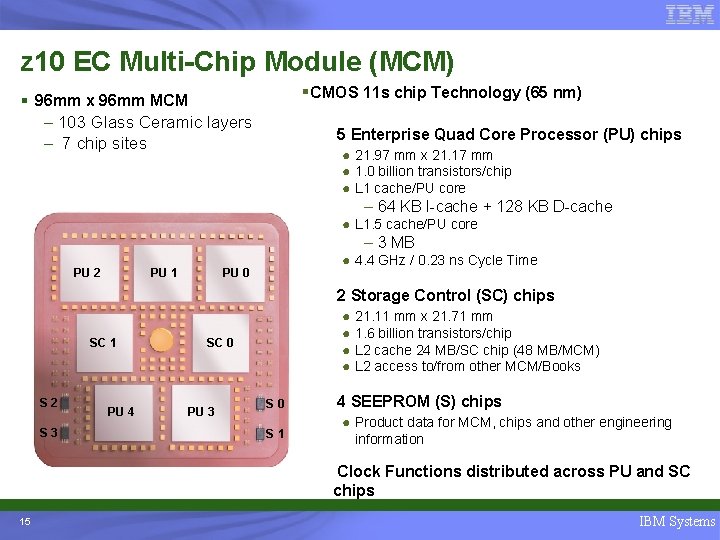
z 10 EC Multi-Chip Module (MCM) § CMOS 11 s chip Technology (65 nm) § 96 mm x 96 mm MCM – 103 Glass Ceramic layers – 7 chip sites 5 Enterprise Quad Core Processor (PU) chips ● 21. 97 mm x 21. 17 mm ● 1. 0 billion transistors/chip ● L 1 cache/PU core – 64 KB I-cache + 128 KB D-cache ● L 1. 5 cache/PU core – 3 MB PU 2 PU 1 ● 4. 4 GHz / 0. 23 ns Cycle Time PU 0 2 Storage Control (SC) chips SC 1 S 2 S 3 PU 4 ● 21. 11 mm x 21. 71 mm ● 1. 6 billion transistors/chip ● L 2 cache 24 MB/SC chip (48 MB/MCM) ● L 2 access to/from other MCM/Books SC 0 PU 3 S 0 S 1 4 SEEPROM (S) chips ● Product data for MCM, chips and other engineering information Clock Functions distributed across PU and SC chips 15 IBM Systems
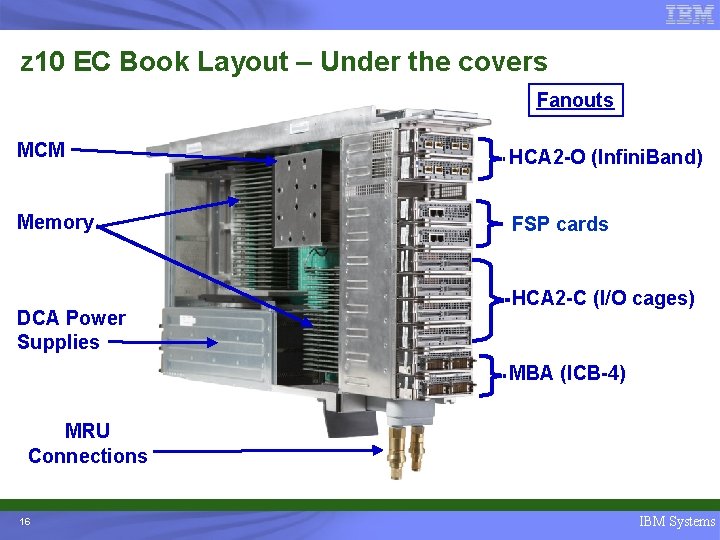
z 10 EC Book Layout – Under the covers Fanouts MCM HCA 2 -O (Infini. Band) Memory FSP cards DCA Power Supplies HCA 2 -C (I/O cages) MBA (ICB-4) MRU Connections 16 IBM Systems
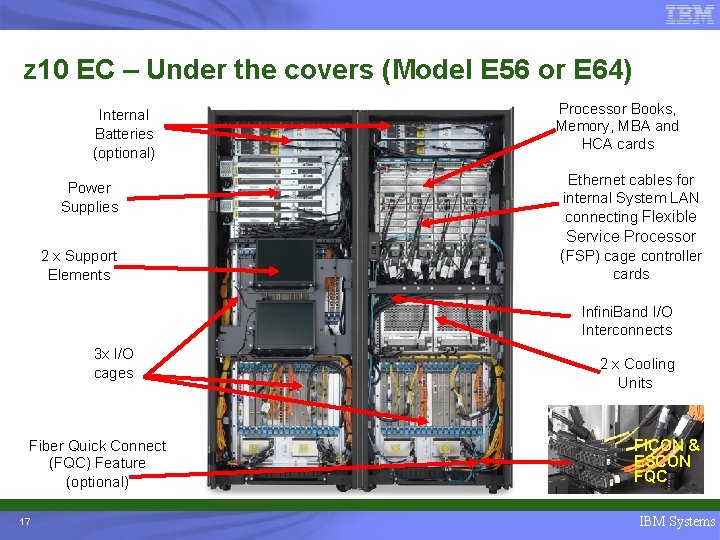
z 10 EC – Under the covers (Model E 56 or E 64) Internal Batteries (optional) Power Supplies Processor Books, Memory, MBA and HCA cards Ethernet cables for internal System LAN connecting Flexible Service Processor 2 x Support Elements (FSP) cage controller cards Infini. Band I/O Interconnects 3 x I/O cages Fiber Quick Connect (FQC) Feature (optional) 17 2 x Cooling Units FICON & ESCON FQC IBM Systems
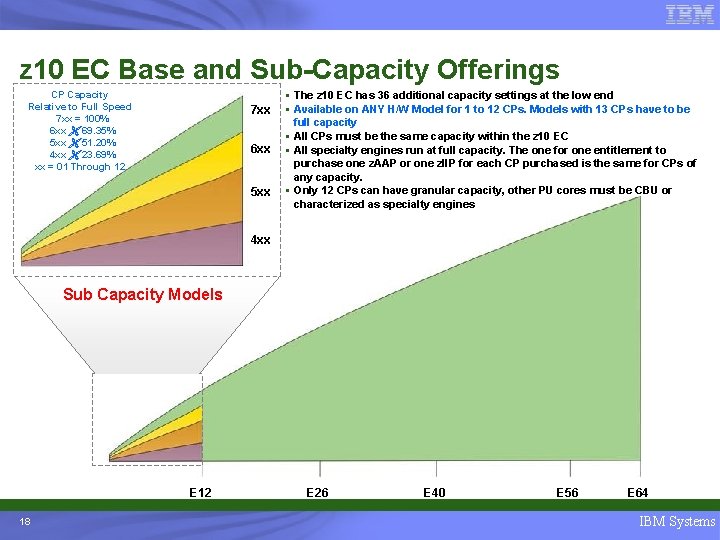
z 10 EC Base and Sub-Capacity Offerings CP Capacity Relative to Full Speed 7 xx = 100% 6 xx 69. 35% 5 xx 51. 20% 4 xx 23. 69% xx = 01 Through 12 7 xx 6 xx 5 xx § The z 10 EC has 36 additional capacity settings at the low end § Available on ANY H/W Model for 1 to 12 CPs. Models with 13 CPs have to be full capacity § All CPs must be the same capacity within the z 10 EC § All specialty engines run at full capacity. The one for one entitlement to purchase one z. AAP or one z. IIP for each CP purchased is the same for CPs of any capacity. § Only 12 CPs can have granular capacity, other PU cores must be CBU or characterized as specialty engines 4 xx Sub Capacity Models E 12 18 E 26 E 40 E 56 E 64 IBM Systems
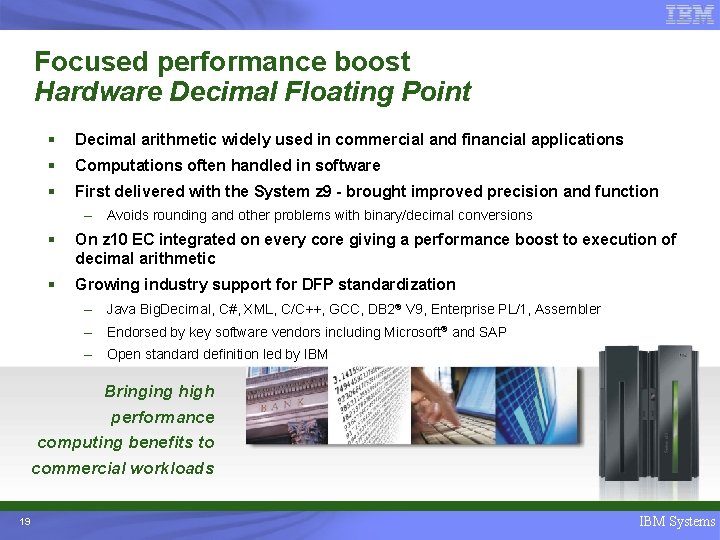
Focused performance boost Hardware Decimal Floating Point § Decimal arithmetic widely used in commercial and financial applications § Computations often handled in software § First delivered with the System z 9 - brought improved precision and function – Avoids rounding and other problems with binary/decimal conversions § On z 10 EC integrated on every core giving a performance boost to execution of decimal arithmetic § Growing industry support for DFP standardization – Java Big. Decimal, C#, XML, C/C++, GCC, DB 2® V 9, Enterprise PL/1, Assembler – Endorsed by key software vendors including Microsoft® and SAP – Open standard definition led by IBM Bringing high performance computing benefits to commercial workloads 19 IBM Systems
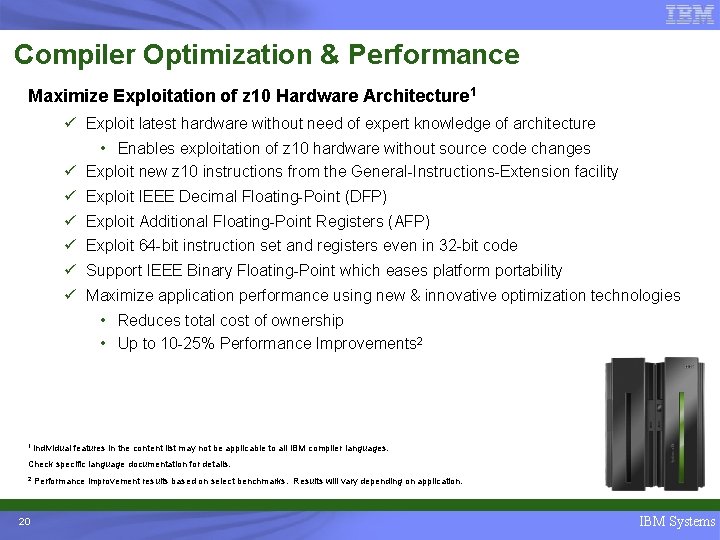
Compiler Optimization & Performance Maximize Exploitation of z 10 Hardware Architecture 1 ü Exploit latest hardware without need of expert knowledge of architecture • Enables exploitation of z 10 hardware without source code changes ü Exploit new z 10 instructions from the General-Instructions-Extension facility ü Exploit IEEE Decimal Floating-Point (DFP) ü Exploit Additional Floating-Point Registers (AFP) ü Exploit 64 -bit instruction set and registers even in 32 -bit code ü Support IEEE Binary Floating-Point which eases platform portability ü Maximize application performance using new & innovative optimization technologies • Reduces total cost of ownership • Up to 10 -25% Performance Improvements 2 1 Individual features in the content list may not be applicable to all IBM compiler languages. Check specific language documentation for details. 2 20 Performance improvement results based on select benchmarks. Results will vary depending on application. IBM Systems
z 10 EC Hiper. Dispatch § Hiper. Dispatch – z 10 EC unique function – Dispatcher Affinity (DA) - New z/OS Dispatcher – Vertical CPU Management (VCM) - New PR/SM Support § Mitigate impact of scaling differences between processor and memory – Access to memory and remote caches not scaling with processor speed – Increased performance sensitivity to cache misses in multi-processor system § Optimize performance by redispatching units of work to same processor group – Keep processes running near their cached instructions and data – Minimize transfers of data ownership among processors / books § Tight collaboration across entire z 10 EC hardware/firmware/OS stack – Concentrate logical processors around shared L 2 caches – Communicate effective cache topology for partition to OS – Dynamically optimize allocation of logical processors and units of work 21 IBM Systems
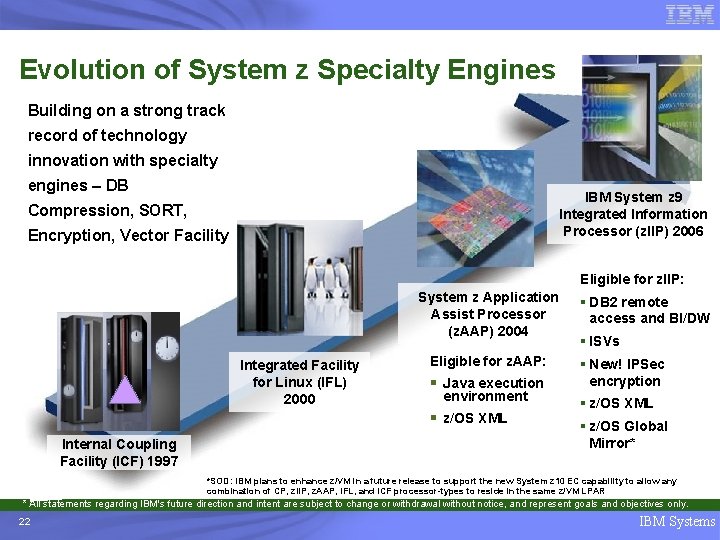
Evolution of System z Specialty Engines Building on a strong track record of technology innovation with specialty engines – DB IBM System z 9 Integrated Information Processor (z. IIP) 2006 Compression, SORT, Encryption, Vector Facility Eligible for z. IIP: System z Application Assist Processor (z. AAP) 2004 Integrated Facility for Linux (IFL) 2000 Eligible for z. AAP: § Java execution environment § z/OS XML Internal Coupling Facility (ICF) 1997 § DB 2 remote access and BI/DW § ISVs § New! IPSec encryption § z/OS XML § z/OS Global Mirror* *SOD: IBM plans to enhance z/VM in a future release to support the new System z 10 EC capability to allow any combination of CP, z. IIP, z. AAP, IFL, and ICF processor-types to reside in the same z/VM LPAR * All statements regarding IBM's future direction and intent are subject to change or withdrawal without notice, and represent goals and objectives only. 22 IBM Systems
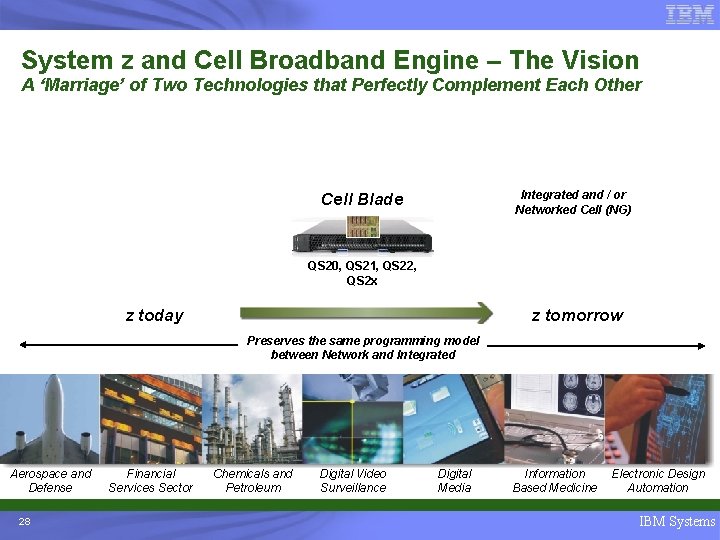
System z and Cell Broadband Engine – The Vision A ‘Marriage’ of Two Technologies that Perfectly Complement Each Other Integrated and / or Networked Cell (NG) Cell Blade QS 20, QS 21, QS 22, QS 2 x z today z tomorrow Preserves the same programming model between Network and Integrated Aerospace and Defense 28 Financial Services Sector Chemicals and Petroleum Digital Video Surveillance Digital Media Information Based Medicine Electronic Design Automation IBM Systems
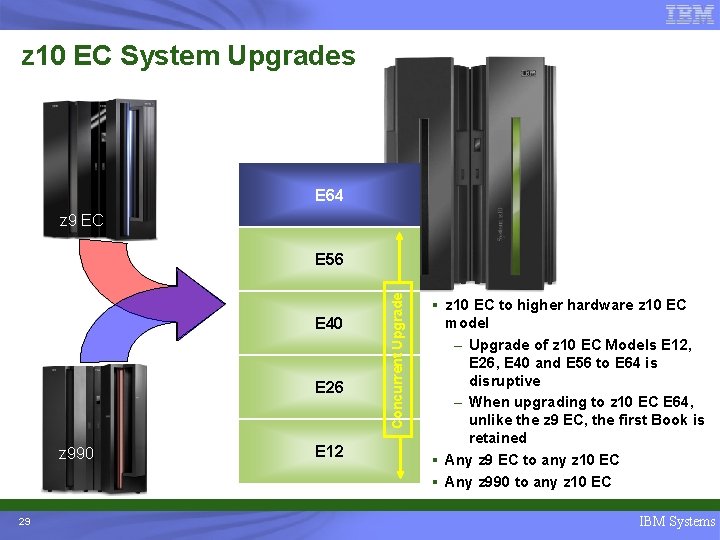
z 10 EC System Upgrades E 64 z 9 EC E 40 E 26 z 990 29 E 12 Concurrent Upgrade E 56 § z 10 EC to higher hardware z 10 EC model – Upgrade of z 10 EC Models E 12, E 26, E 40 and E 56 to E 64 is disruptive – When upgrading to z 10 EC E 64, unlike the z 9 EC, the first Book is retained § Any z 9 EC to any z 10 EC § Any z 990 to any z 10 EC IBM Systems
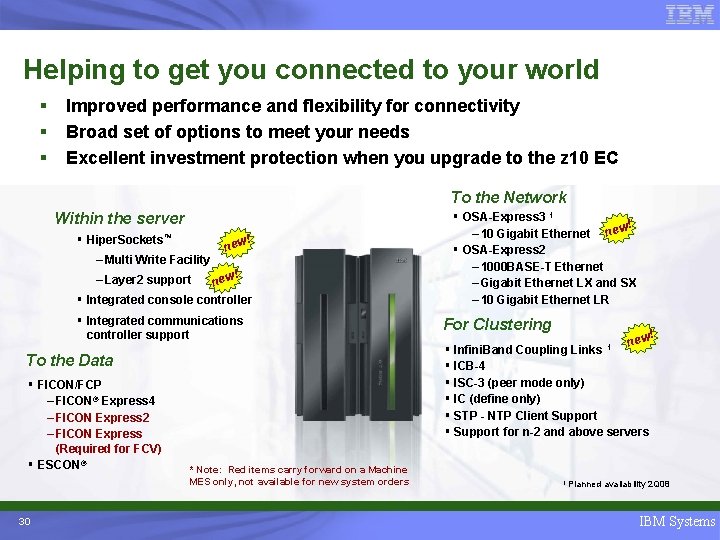
Helping to get you connected to your world § § § Improved performance and flexibility for connectivity Broad set of options to meet your needs Excellent investment protection when you upgrade to the z 10 EC To the Network Within the server § Hiper. Sockets™ § OSA-Express 3 1 ! – 10 Gigabit Ethernet new § OSA-Express 2 – 1000 BASE-T Ethernet – Gigabit Ethernet LX and SX – 10 Gigabit Ethernet LR ! – Multi Write Facility new ! new § Integrated console controller – Layer 2 support § Integrated communications controller support § § § To the Data § FICON/FCP – FICON® Express 4 – FICON Express 2 – FICON Express (Required for FCV) § ESCON® 30 For Clustering * Note: Red items carry forward on a Machine MES only, not available for new system orders ! new Infini. Band Coupling Links ICB-4 ISC-3 (peer mode only) IC (define only) STP - NTP Client Support for n-2 and above servers 1 1 Planned availability 2 Q 08 IBM Systems
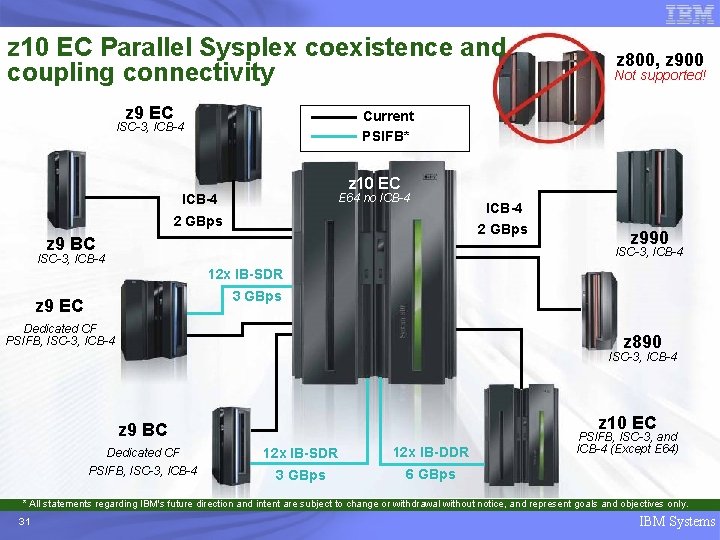
z 10 EC Parallel Sysplex coexistence and coupling connectivity z 9 EC z 800, z 900 Not supported! Current PSIFB* ISC-3, ICB-4 z 10 EC E 64 no ICB-4 2 GBps z 9 BC z 990 ISC-3, ICB-4 12 x IB-SDR 3 GBps z 9 EC Dedicated CF PSIFB, ISC-3, ICB-4 z 890 ISC-3, ICB-4 z 10 EC z 9 BC Dedicated CF 12 x IB-SDR 12 x IB-DDR PSIFB, ISC-3, ICB-4 3 GBps 6 GBps PSIFB, ISC-3, and ICB-4 (Except E 64) * All statements regarding IBM's future direction and intent are subject to change or withdrawal without notice, and represent goals and objectives only. 31 IBM Systems
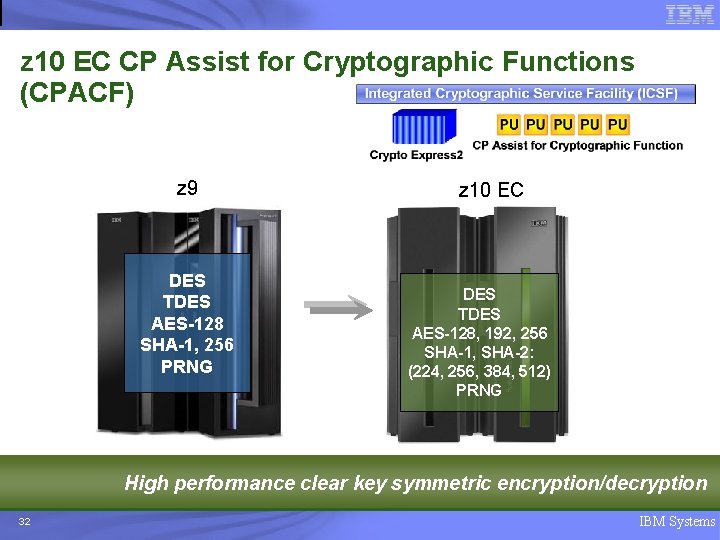
z 10 EC CP Assist for Cryptographic Functions (CPACF) z 9 DES TDES AES-128 SHA-1, 256 PRNG z 10 EC DES TDES AES-128, 192, 256 SHA-1, SHA-2: (224, 256, 384, 512) PRNG High performance clear key symmetric encryption/decryption 32 IBM Systems
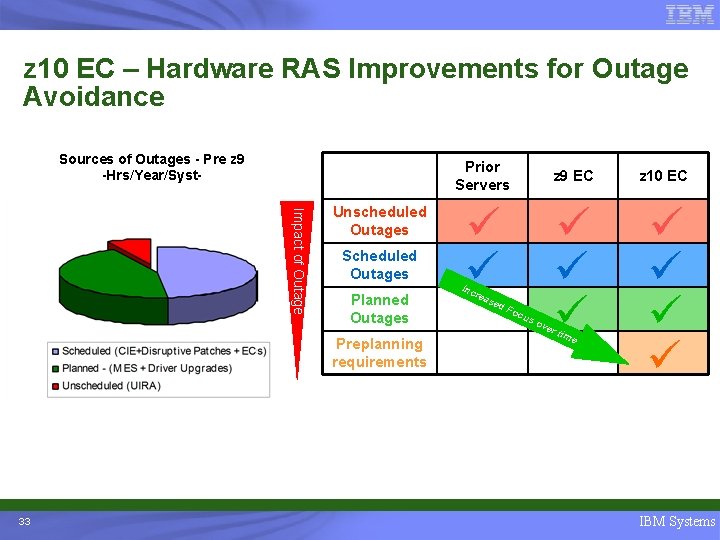
z 10 EC – Hardware RAS Improvements for Outage Avoidance Sources of Outages - Pre z 9 -Hrs/Year/Syst- Prior Servers Impact of Outage Unscheduled Outages Scheduled Outages Planned Outages Preplanning requirements 33 ü ü Inc rea sed Fo cus ove z 9 EC z 10 EC ü ü ü ü r ti me IBM Systems
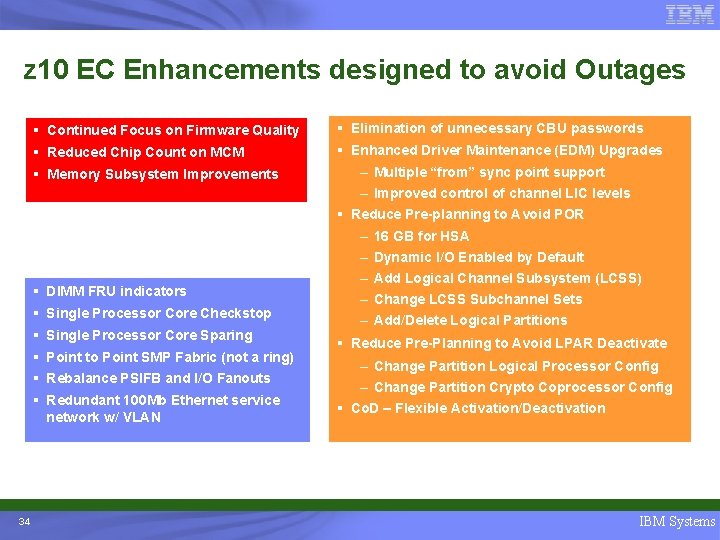
z 10 EC Enhancements designed to avoid Outages § Continued Focus on Firmware Quality § Elimination of unnecessary CBU passwords § Reduced Chip Count on MCM § Enhanced Driver Maintenance (EDM) Upgrades § Memory Subsystem Improvements – Multiple “from” sync point support – Improved control of channel LIC levels § Reduce Pre-planning to Avoid POR § DIMM FRU indicators § Single Processor Core Checkstop § Single Processor Core Sparing § Point to Point SMP Fabric (not a ring) § Rebalance PSIFB and I/O Fanouts § Redundant 100 Mb Ethernet service network w/ VLAN 34 – – – 16 GB for HSA Dynamic I/O Enabled by Default Add Logical Channel Subsystem (LCSS) Change LCSS Subchannel Sets Add/Delete Logical Partitions § Reduce Pre-Planning to Avoid LPAR Deactivate – Change Partition Logical Processor Config – Change Partition Crypto Coprocessor Config § Co. D – Flexible Activation/Deactivation IBM Systems
Just in time capacity gives you control § Permanent and temporary offerings – with you in charge – Permanent offerings – Capacity Upgrade on Demand (CUo. D), Customer Initiated Upgrade (CIU) – Temporary offerings include On/Off Capacity on Demand (On/Off Co. D) , Capacity Backup Upgrade (CBU) and a new one – Capacity for Planned Event (CPE) § No customer interaction with IBM at time of activation – Broader customer ability to order temporary capacity § Multiple offerings can be in use simultaneously – All offerings on Resource Link – Each offering independently managed and priced § Flexible offerings may be used to solve multiple situations – Configurations based on real time circumstances – Ability to dynamically move to any other entitled configuration § Offerings can be reconfigured or replenished dynamically – Modification possible even if offering is currently active – Some permanent upgrades permitted while temporary offerings are active § Policy based automation capabilities – Using Capacity Provisioning Manager with z/OS 1. 9 – Using scheduled operations via HMC 35 IBM Systems
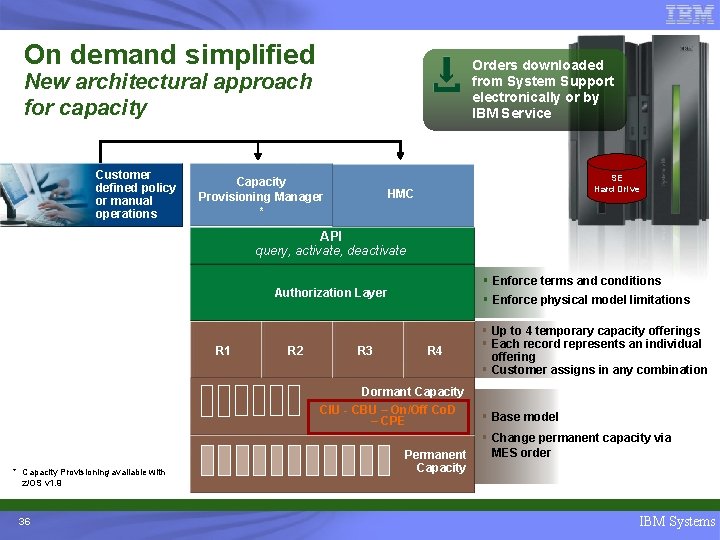
On demand simplified Orders downloaded from System Support electronically or by IBM Service New architectural approach for capacity Customer defined policy or manual operations Capacity Provisioning Manager * SE Hard Drive HMC API query, activate, deactivate § Enforce terms and conditions § Enforce physical model limitations Authorization Layer R 1 R 2 R 3 R 4 Dormant Capacity CIU - CBU – On/Off Co. D – CPE * Capacity Provisioning available with z/OS v 1. 9 36 Permanent Capacity § Up to 4 temporary capacity offerings § Each record represents an individual offering § Customer assigns in any combination § Base model § Change permanent capacity via MES order IBM Systems
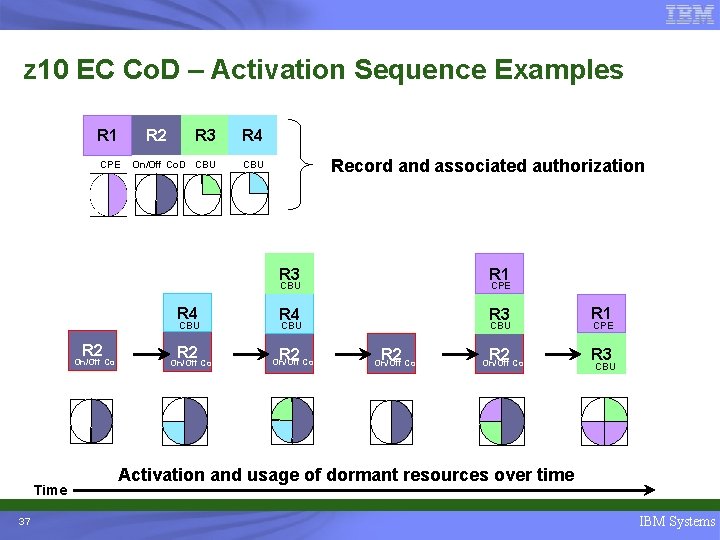
z 10 EC Co. D – Activation Sequence Examples R 1 R 2 CPE R 3 R 4 On/Off Co. D CBU Record and associated authorization R 3 R 1 R 4 R 3 R 1 R 2 R 3 CBU R 4 CBU R 2 On/Off Co. D Time 37 R 2 On/Off Co. D CPE CBU R 2 On/Off Co. D CPE CBU Activation and usage of dormant resources over time IBM Systems
Tracking energy consumption within the infrastructure § Resource. Link™ provides tools to estimates server energy requirements before you purchase a new system or an upgrade § Offers a 15% improvement in performance per KWh over z 9 EC § Has energy efficiency monitoring tool – Introduced on IBM System z 9 platform in April 2007 – Power and thermal information displayed via the System Activity Display (SAD) § New IBM Systems Director Active Energy Manager (AEM) for Linux on System z V 3. 1 – Offers a single view of actual energy usage across multiple heterogeneous IBM platforms within the infrastructure – AEM V 3. 1 energy management data can be exploited by Tivoli® enterprise solutions such as IBM Tivoli Monitoring, IBM Tivoli Usage and Accounting Manager, and IBM Tivoli OMEGAMON® XE on z/OS – AEM V 3. 1 is a key component of IBM’s Cool Blue™ portfolio within Project Big Green 38 IBM Systems
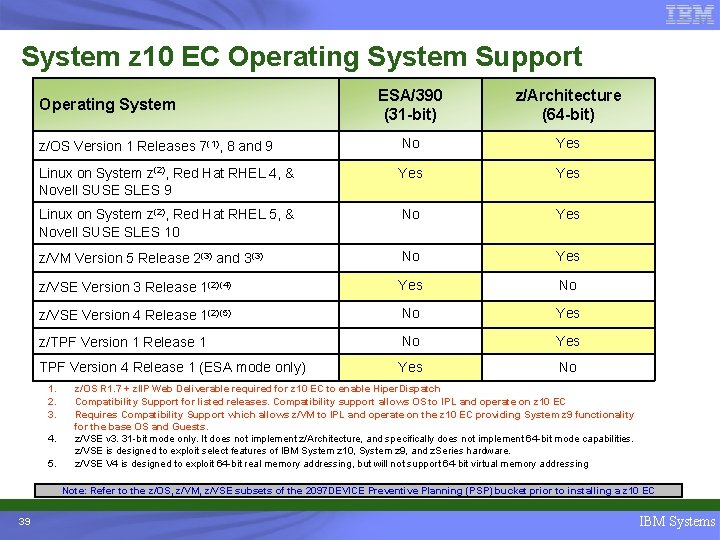
System z 10 EC Operating System Support ESA/390 (31 -bit) z/Architecture (64 -bit) z/OS Version 1 Releases 7(1), 8 and 9 No Yes Linux on System z(2), Red Hat RHEL 4, & Novell SUSE SLES 9 Yes Linux on System z(2), Red Hat RHEL 5, & Novell SUSE SLES 10 No Yes z/VM Version 5 Release 2(3) and 3(3) No Yes z/VSE Version 3 Release 1(2)(4) Yes No z/VSE Version 4 Release 1(2)(5) No Yes z/TPF Version 1 Release 1 No Yes TPF Version 4 Release 1 (ESA mode only) Yes No Operating System 1. 2. 3. 4. 5. z/OS R 1. 7 + z. IIP Web Deliverable required for z 10 EC to enable Hiper. Dispatch Compatibility Support for listed releases. Compatibility support allows OS to IPL and operate on z 10 EC Requires Compatibility Support which allows z/VM to IPL and operate on the z 10 EC providing System z 9 functionality for the base OS and Guests. z/VSE v 3. 31 -bit mode only. It does not implement z/Architecture, and specifically does not implement 64 -bit mode capabilities. z/VSE is designed to exploit select features of IBM System z 10, System z 9, and z. Series hardware. z/VSE V 4 is designed to exploit 64 -bit real memory addressing, but will not support 64 -bit virtual memory addressing Note: Refer to the z/OS, z/VM, z/VSE subsets of the 2097 DEVICE Preventive Planning (PSP) bucket prior to installing a z 10 EC 39 IBM Systems
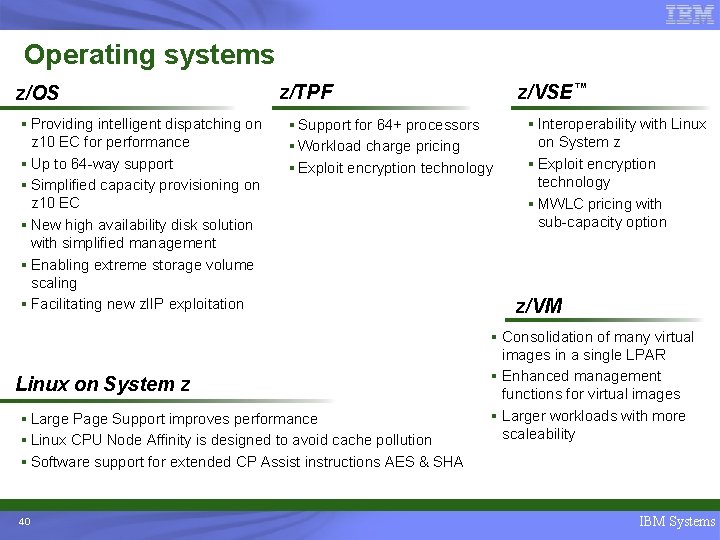
Operating systems z/OS § Providing intelligent dispatching on z 10 EC for performance § Up to 64 -way support § Simplified capacity provisioning on z 10 EC § New high availability disk solution with simplified management § Enabling extreme storage volume scaling § Facilitating new z. IIP exploitation § Support for 64+ processors § Workload charge pricing § Exploit encryption technology Linux on System z § Large Page Support improves performance § Linux CPU Node Affinity is designed to avoid cache pollution § Software support for extended CP Assist instructions AES & SHA 40 z/VSE™ z/TPF § Interoperability with Linux on System z § Exploit encryption technology § MWLC pricing with sub-capacity option z/VM § Consolidation of many virtual images in a single LPAR § Enhanced management functions for virtual images § Larger workloads with more scaleability IBM Systems
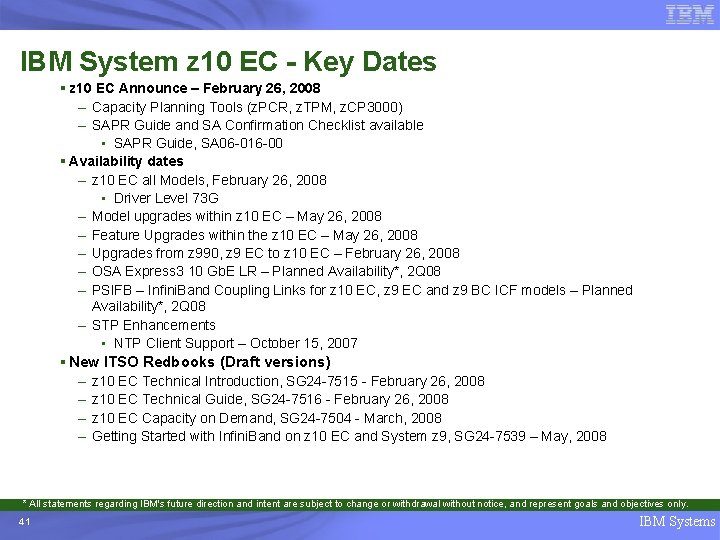
IBM System z 10 EC - Key Dates § z 10 EC Announce – February 26, 2008 – Capacity Planning Tools (z. PCR, z. TPM, z. CP 3000) – SAPR Guide and SA Confirmation Checklist available • SAPR Guide, SA 06 -016 -00 § Availability dates – z 10 EC all Models, February 26, 2008 • Driver Level 73 G – Model upgrades within z 10 EC – May 26, 2008 – Feature Upgrades within the z 10 EC – May 26, 2008 – Upgrades from z 990, z 9 EC to z 10 EC – February 26, 2008 – OSA Express 3 10 Gb. E LR – Planned Availability*, 2 Q 08 – PSIFB – Infini. Band Coupling Links for z 10 EC, z 9 EC and z 9 BC ICF models – Planned Availability*, 2 Q 08 – STP Enhancements • NTP Client Support – October 15, 2007 § New ITSO Redbooks (Draft versions) – z 10 EC Technical Introduction, SG 24 -7515 - February 26, 2008 – z 10 EC Technical Guide, SG 24 -7516 - February 26, 2008 – z 10 EC Capacity on Demand, SG 24 -7504 - March, 2008 – Getting Started with Infini. Band on z 10 EC and System z 9, SG 24 -7539 – May, 2008 * All statements regarding IBM's future direction and intent are subject to change or withdrawal without notice, and represent goals and objectives only. 41 IBM Systems
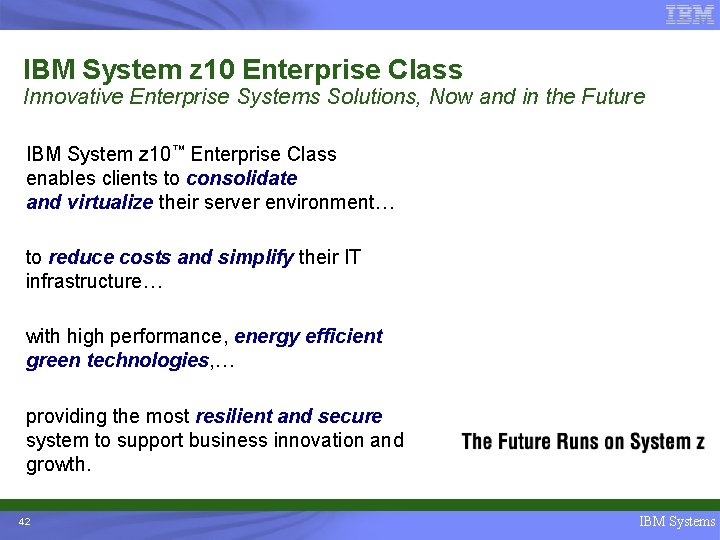
IBM System z 10 Enterprise Class Innovative Enterprise Systems Solutions, Now and in the Future IBM System z 10™ Enterprise Class enables clients to consolidate and virtualize their server environment… to reduce costs and simplify their IT infrastructure… with high performance, energy efficient green technologies, … providing the most resilient and secure system to support business innovation and growth. 42 IBM Systems

43 IBM Systems
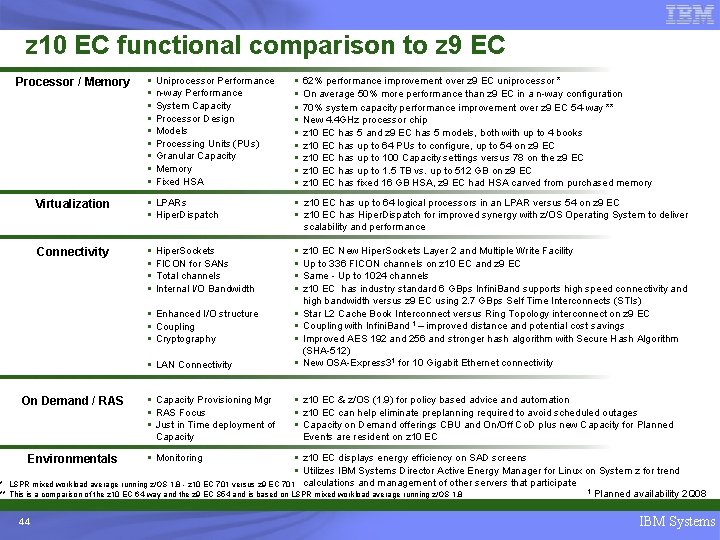
z 10 EC functional comparison to z 9 EC Processor / Memory § § § § § Uniprocessor Performance n-way Performance System Capacity Processor Design Models Processing Units (PUs) Granular Capacity Memory Fixed HSA § § § § § 62% performance improvement over z 9 EC uniprocessor * On average 50% more performance than z 9 EC in a n-way configuration 70% system capacity performance improvement over z 9 EC 54 -way ** New 4. 4 GHz processor chip z 10 EC has 5 and z 9 EC has 5 models, both with up to 4 books z 10 EC has up to 64 PUs to configure, up to 54 on z 9 EC z 10 EC has up to 100 Capacity settings versus 78 on the z 9 EC z 10 EC has up to 1. 5 TB vs. up to 512 GB on z 9 EC z 10 EC has fixed 16 GB HSA, z 9 EC had HSA carved from purchased memory Virtualization § LPARs § Hiper. Dispatch § z 10 EC has up to 64 logical processors in an LPAR versus 54 on z 9 EC § z 10 EC has Hiper. Dispatch for improved synergy with z/OS Operating System to deliver scalability and performance Connectivity § § Hiper. Sockets FICON for SANs Total channels Internal I/O Bandwidth § § § Enhanced I/O structure § Coupling § Cryptography § § LAN Connectivity § § Capacity Provisioning Mgr § RAS Focus § Just in Time deployment of Capacity § z 10 EC & z/OS (1. 9) for policy based advice and automation § z 10 EC can help eliminate preplanning required to avoid scheduled outages § Capacity on Demand offerings CBU and On/Off Co. D plus new Capacity for Planned Events are resident on z 10 EC On Demand / RAS z 10 EC New Hiper. Sockets Layer 2 and Multiple Write Facility Up to 336 FICON channels on z 10 EC and z 9 EC Same - Up to 1024 channels z 10 EC has industry standard 6 GBps Infini. Band supports high speed connectivity and high bandwidth versus z 9 EC using 2. 7 GBps Self Time Interconnects (STIs) Star L 2 Cache Book Interconnect versus Ring Topology interconnect on z 9 EC Coupling with Infini. Band 1 – improved distance and potential cost savings Improved AES 192 and 256 and stronger hash algorithm with Secure Hash Algorithm (SHA-512) New OSA-Express 31 for 10 Gigabit Ethernet connectivity § z 10 EC displays energy efficiency on SAD screens § Utilizes IBM Systems Director Active Energy Manager for Linux on System z for trend * LSPR mixed workload average running z/OS 1. 8 - z 10 EC 701 versus z 9 EC 701 calculations and management of other servers that participate 1 Planned availability 2 Q 08 ** This is a comparison of the z 10 EC 64 -way and the z 9 EC S 54 and is based on LSPR mixed workload average running z/OS 1. 8 Environmentals 44 § Monitoring IBM Systems
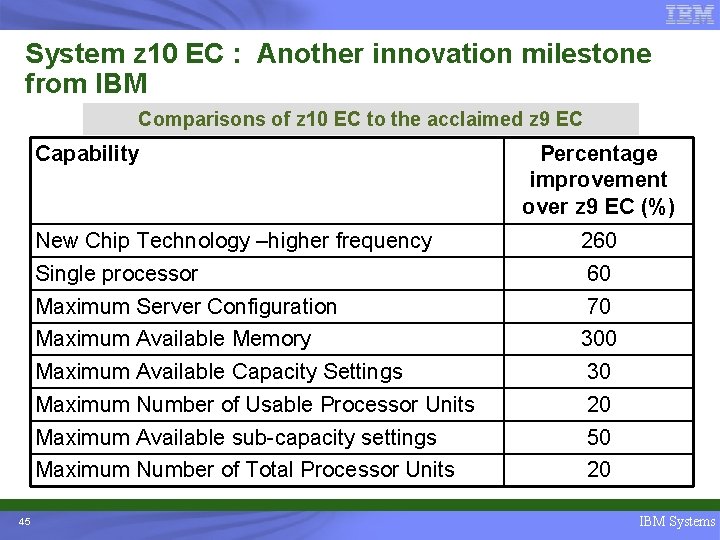
System z 10 EC : Another innovation milestone from IBM Comparisons of z 10 EC to the acclaimed z 9 EC Capability New Chip Technology –higher frequency Single processor Maximum Server Configuration Maximum Available Memory Maximum Available Capacity Settings Maximum Number of Usable Processor Units Maximum Available sub-capacity settings Maximum Number of Total Processor Units 45 Percentage improvement over z 9 EC (%) 260 60 70 30 20 50 20 IBM Systems
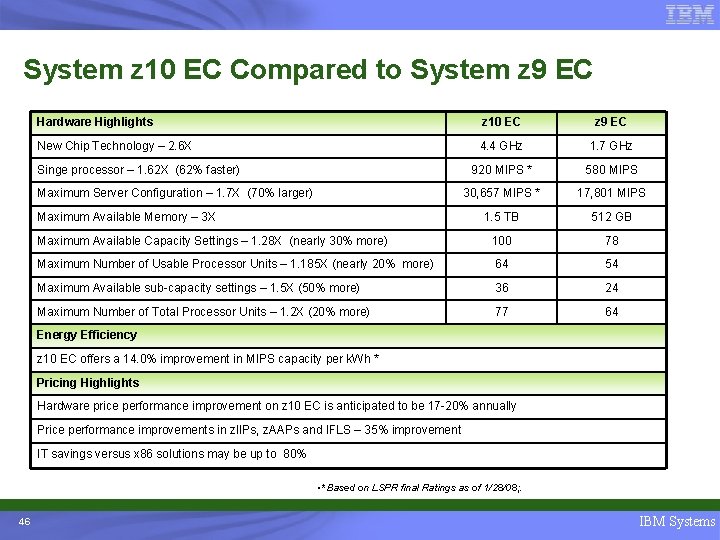
System z 10 EC Compared to System z 9 EC Hardware Highlights z 10 EC z 9 EC New Chip Technology – 2. 6 X 4. 4 GHz 1. 7 GHz 920 MIPS * 580 MIPS 30, 657 MIPS * 17, 801 MIPS 1. 5 TB 512 GB Maximum Available Capacity Settings – 1. 28 X (nearly 30% more) 100 78 Maximum Number of Usable Processor Units – 1. 185 X (nearly 20% more) 64 54 Maximum Available sub-capacity settings – 1. 5 X (50% more) 36 24 Maximum Number of Total Processor Units – 1. 2 X (20% more) 77 64 Singe processor – 1. 62 X (62% faster) Maximum Server Configuration – 1. 7 X (70% larger) Maximum Available Memory – 3 X Energy Efficiency z 10 EC offers a 14. 0% improvement in MIPS capacity per k. Wh * Pricing Highlights Hardware price performance improvement on z 10 EC is anticipated to be 17 -20% annually Price performance improvements in z. IIPs, z. AAPs and IFLS – 35% improvement IT savings versus x 86 solutions may be up to 80% • * Based on LSPR final Ratings as of 1/28/08; . 46 IBM Systems
- Slides: 40