
IBM STG Lab Services Enabling Applications for Independent
IBM STG Lab Services ® Enabling Applications for Independent Disk Pools commonly know as IASPs Fred Robinson - fdrobin@us. ibm. com Consulting Educator IBM i Technology Center – © IBM Corporation 2009
IBM i Objectives At the end of this session you should: Understand Independent Auxiliary Storage Pool (IASP) concepts and value § Gain a perspective on customer usage scenarios for IASPs – High Availability solutions – Server Consolidation – Workload Isolation § Understand, at a high level, what application and work management changes are needed to exploit IASP technology § Identify other considerations related to common uses of IASPs § Learn what’s new for IASPs in IBM i 6. 1 § Know where to go for more information and detailed assistance IBM i Technology Center (i. TC) © 2009 IBM Corporation
IBM i **** This page for IBM and Business Partners Only **** 1. Introduction to HA (HA Strategies & Planning for 2012 part 1 of 3) - Techtalk 2. Introduction to IBM HA and DR Technologies (HA Strategies & Planning for 2012 part 2 of 3) – Recorded (in Techdocs) 3. IBM Power HA Strategy – Techtalk (Feb 19) 4. Technology Positioning (HA Strategies & Planning for 2012 part 3 of 3) – Techtalk (Feb 24) 5. IBM CBU Enhancements – Techtalk ( Feb 25 th) 1. IASP Enablement - Techtalk (Feb 26 th) 2. i. Cluster Enhancements – Techtalk (March 3 rd) 3. Sizing Power. HA - Techtalk (March 12 th) 4. Geographical Mirroring for Native IBM i applications - Recorded 5. Geographical Mirroring for Hosted and VIOS environments - Recorded 6. DS 6000/DS 8000 Copy Services HA Sizing and Considerations - Techtalk (March 19 th( § Look for email from “STG Sales Education & Events Newsletter” for Techtalk dates § Techtalks: Smart. Zone for Power System Technical Training: o. IBM: http: //lt. be. ibm. com/smartzone/powertech o. Partner: http: //www. ibm. com/services/weblectures/smartzone/powertech IBM i Technology Center (i. TC) © 2009 IBM Corporation
IBM i Recap of Part 1 and Part 2 § IBM offers a growing number of single system and multi-system availability solutions, including software, OS and storage based technologies § Assess your use of single server availability options § All sizes of businesses should assess their business resiliency requirements – Use methodologies such as Business Impact Analysis (BIA) to better understand exposures and what should be done about them § IBM i and Power Systems offer 6 fundament technologies for business resiliency (native attached storage) 1. Logical Replication software 2. Switched IASP - Independent Auxiliary Storage Pool 3. IBM i Geographical Mirroring via OS 4. IBM System Storage LUN Level Switching 5. IBM System Storage Copy Services – simple copy 6. IBM System Storage Copy Services with IBM i § Some HA and DR technologies are unique to the IBM i Virtual Environments – Understand how application HA / DR requirements interact with design efforts for a virtualized solution environment § IBM i 6. 1 in conjunction with Power. HA offers dramatic HA/DR enhancements IBM i Technology Center (i. TC) © 2009 IBM Corporation

IBM i 6. 1 Power. HA § Provides choices in design, implementation and management of IBM i 6. 1 and SAN Storage IASP Cluster based replication technologies for HA and DR Power. HA for i (5761 -HAS) a. k. a HASM Cross Site Mirroring (XSM) “HA Switchable Resources” - option 41 – IBM i Geographic Mirroring • IBM i storage mgmt page level replication • Synchronous • Any internal or external storage Metro Mirror (SAN)* • SAN hardware replication • Synchronous • IBM SAN storage only Global Mirror (SAN)* • SAN hardware replication • Asynchronous • IBM SAN storage only Flash. Copy (SAN)* • SAN hardware replication • Point in time • IBM SAN storage only * This new support and capability added to IBM i and XSM with Power. HA and 6. 1, IBM SAN Only See www. redbooks. ibm. com: Implementing Power. HA for IBM i - SG 24 -7405 -00 (Nov 2008) IBM i Technology Center (i. TC) © 2009 IBM Corporation
IBM i IASPs (Independent Auxiliary Storage Pools) § IASPs - a building block of IBM i availability § Required for: ► IBM Power. HA for IBM i (i 6. 1) - Geographic Mirroring - Advanced Copy Services for DS 6000, DS 8000 • Flash. Copy, Metro Mirror and Global Mirror ► IASP Data Encryption (i 6. 1) ► Switched Disk ► IBM System Storage Copy Services Toolkit § IASP - an enabler for some server consolidations § IASP feasibility studies available § Enabling Applications for IASPs is usually easier than you think IBM i Technology Center (i. TC) © 2009 IBM Corporation
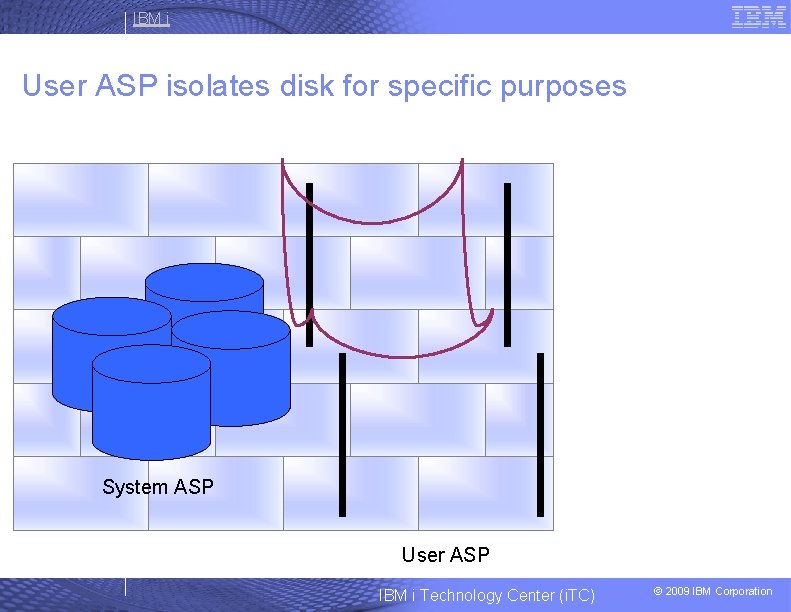
IBM i User ASP isolates disk for specific purposes System ASP User ASP IBM i Technology Center (i. TC) © 2009 IBM Corporation
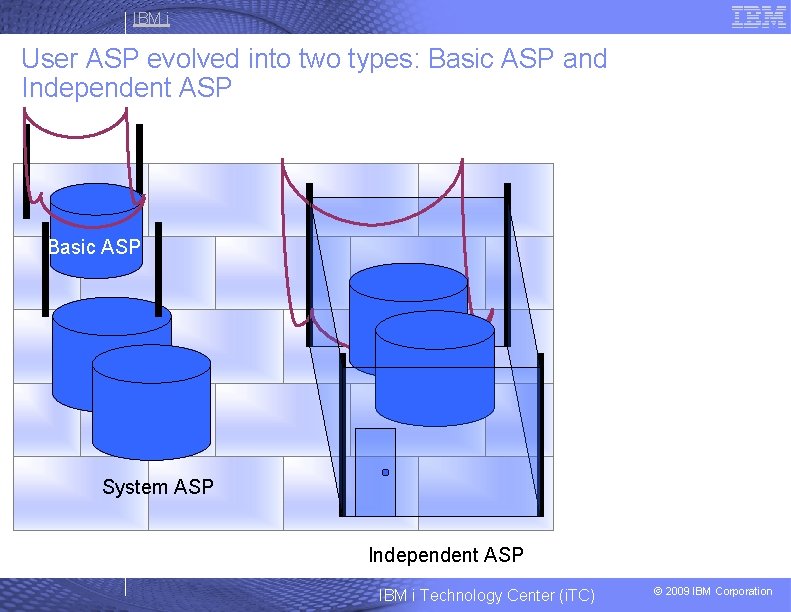
IBM i User ASP evolved into two types: Basic ASP and Independent ASP Basic ASP System ASP Independent ASP IBM i Technology Center (i. TC) © 2009 IBM Corporation
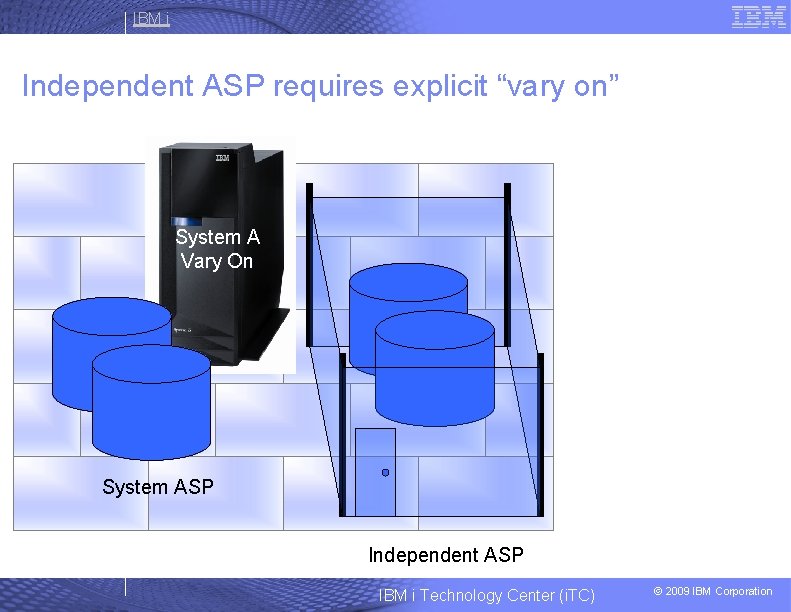
IBM i Independent ASP requires explicit “vary on” System A Vary On System ASP Independent ASP IBM i Technology Center (i. TC) © 2009 IBM Corporation
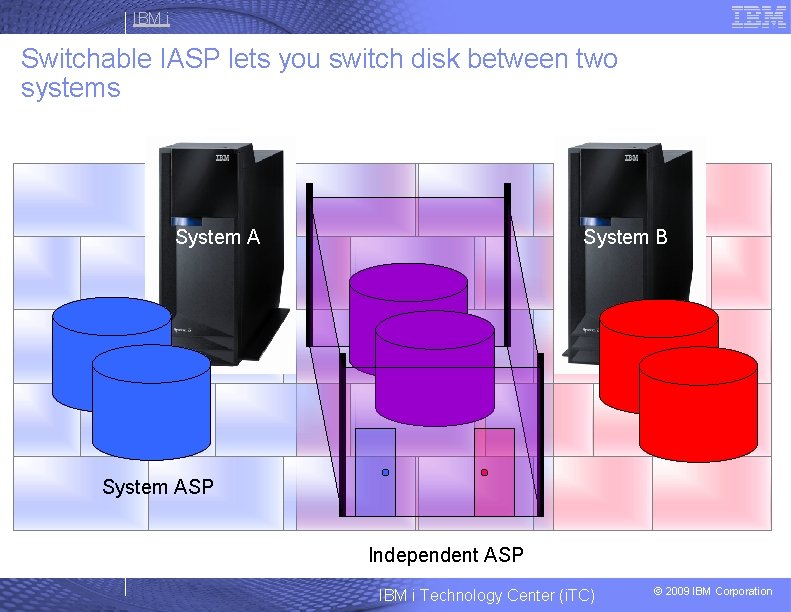
IBM i Switchable IASP lets you switch disk between two systems System A System B System ASP Independent ASP IBM i Technology Center (i. TC) © 2009 IBM Corporation
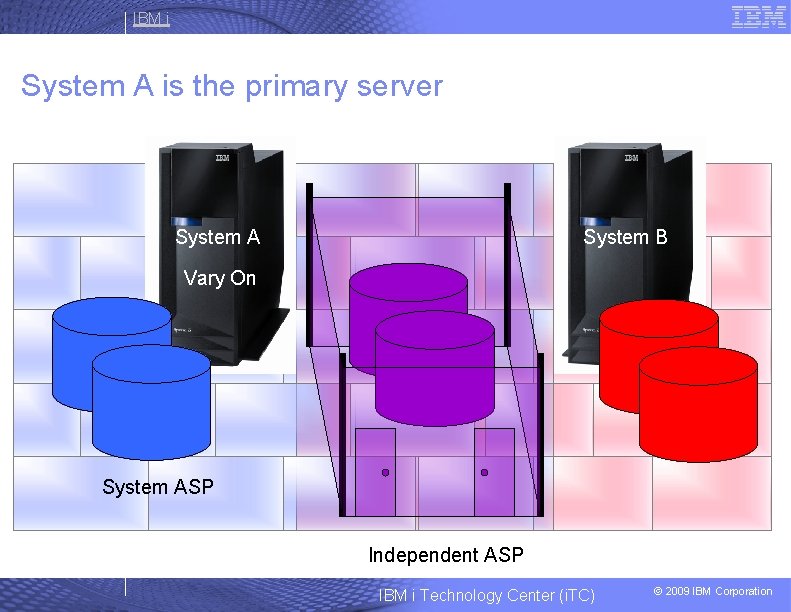
IBM i System A is the primary server System A System B Vary On System ASP Independent ASP IBM i Technology Center (i. TC) © 2009 IBM Corporation
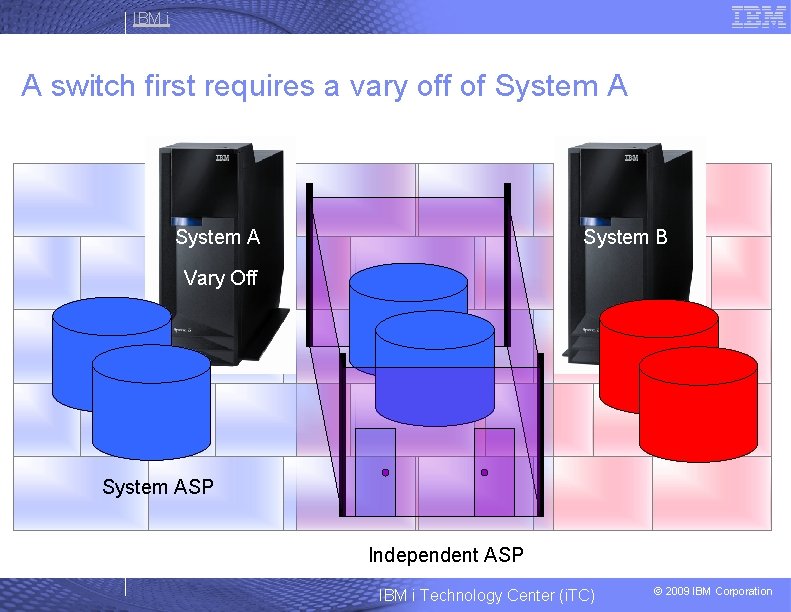
IBM i A switch first requires a vary off of System A System B Vary Off System ASP Independent ASP IBM i Technology Center (i. TC) © 2009 IBM Corporation
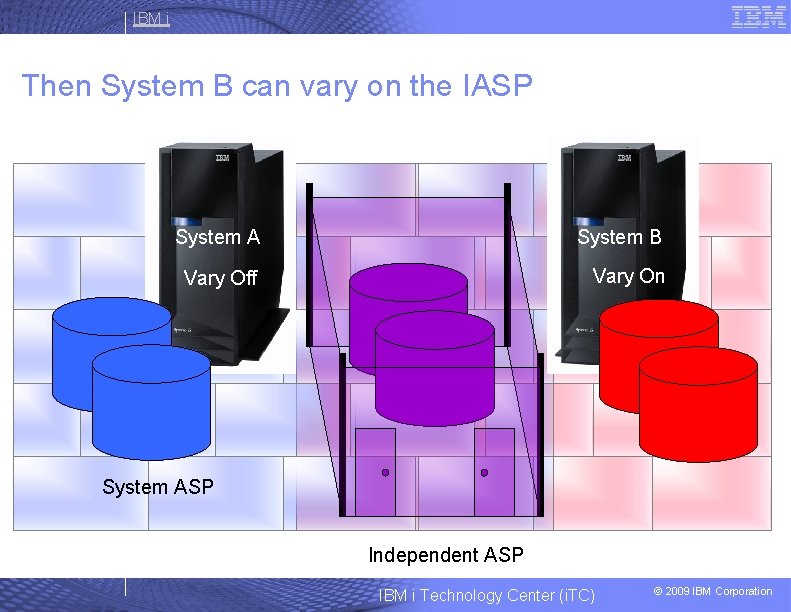
IBM i Then System B can vary on the IASP System A System B Vary Off Vary On System ASP Independent ASP IBM i Technology Center (i. TC) © 2009 IBM Corporation
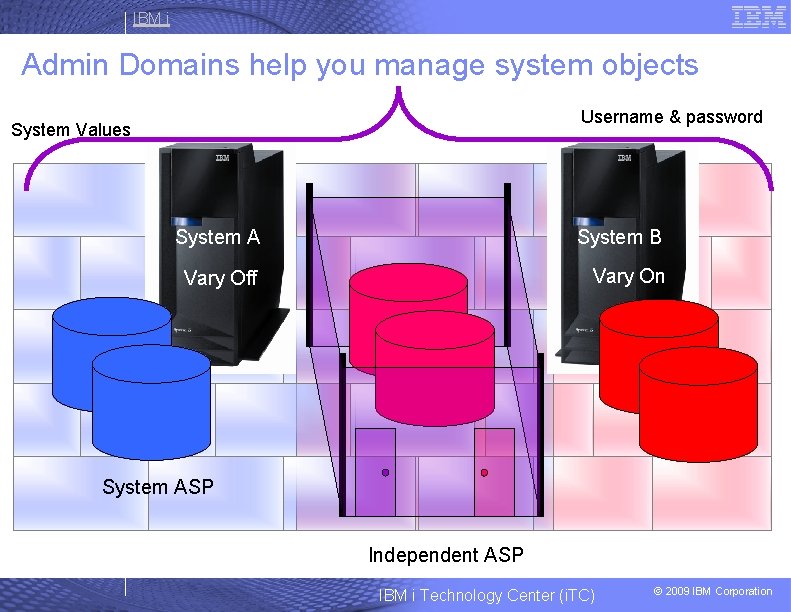
IBM i Admin Domains help you manage system objects Username & password System Values System A System B Vary Off Vary On System ASP Independent ASP IBM i Technology Center (i. TC) © 2009 IBM Corporation
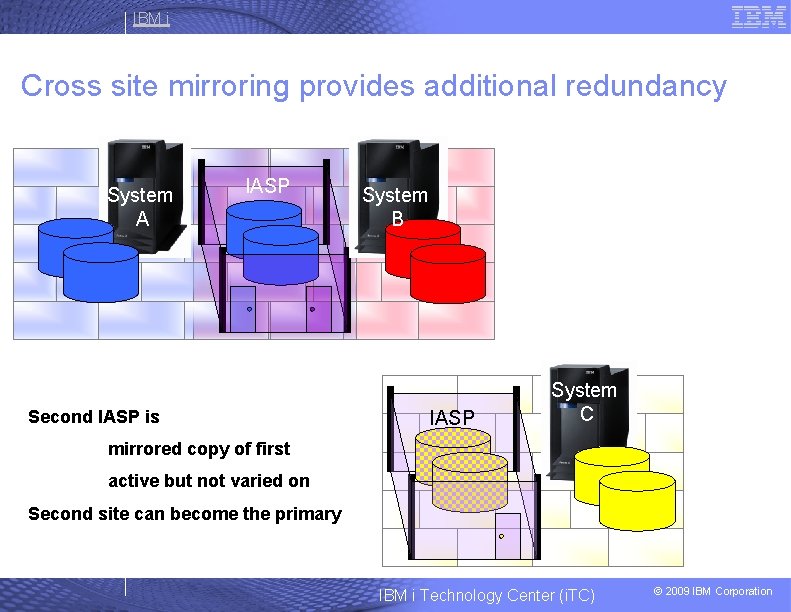
IBM i Cross site mirroring provides additional redundancy System A IASP Second IASP is System B IASP System C mirrored copy of first active but not varied on Second site can become the primary IBM i Technology Center (i. TC) © 2009 IBM Corporation
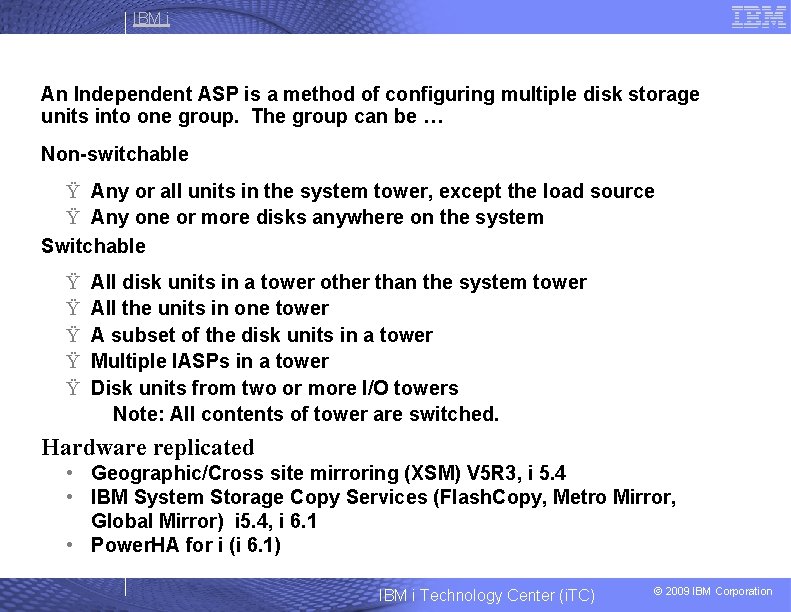
IBM i An Independent ASP is a method of configuring multiple disk storage units into one group. The group can be … Non-switchable Ÿ Any or all units in the system tower, except the load source Ÿ Any one or more disks anywhere on the system Switchable Ÿ Ÿ Ÿ All disk units in a tower other than the system tower All the units in one tower A subset of the disk units in a tower Multiple IASPs in a tower Disk units from two or more I/O towers Note: All contents of tower are switched. Hardware replicated • Geographic/Cross site mirroring (XSM) V 5 R 3, i 5. 4 • IBM System Storage Copy Services (Flash. Copy, Metro Mirror, Global Mirror) i 5. 4, i 6. 1 • Power. HA for i (i 6. 1) IBM i Technology Center (i. TC) © 2009 IBM Corporation
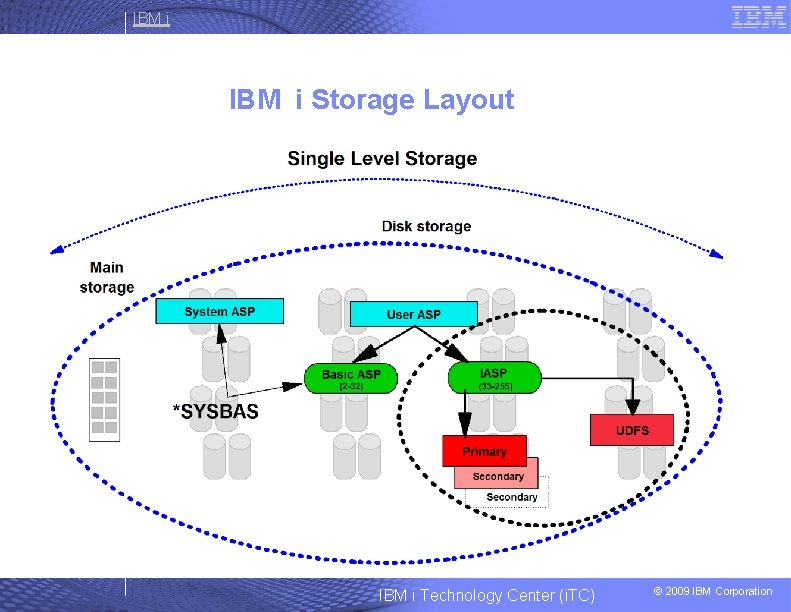
IBM i Storage Layout IBM i Technology Center (i. TC) © 2009 IBM Corporation
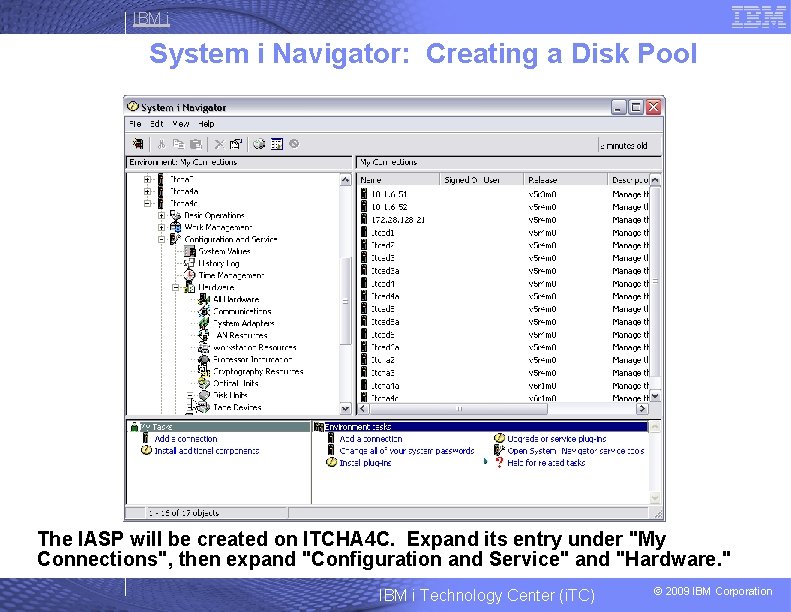
IBM i System i Navigator: Creating a Disk Pool The IASP will be created on ITCHA 4 C. Expand its entry under "My Connections", then expand "Configuration and Service" and "Hardware. " IBM i Technology Center (i. TC) © 2009 IBM Corporation
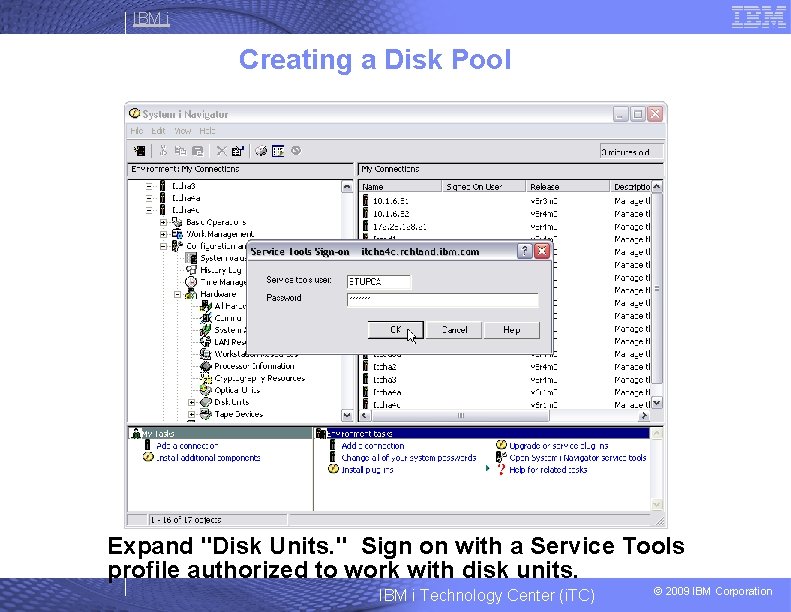
IBM i Creating a Disk Pool Expand "Disk Units. " Sign on with a Service Tools profile authorized to work with disk units. IBM i Technology Center (i. TC) © 2009 IBM Corporation
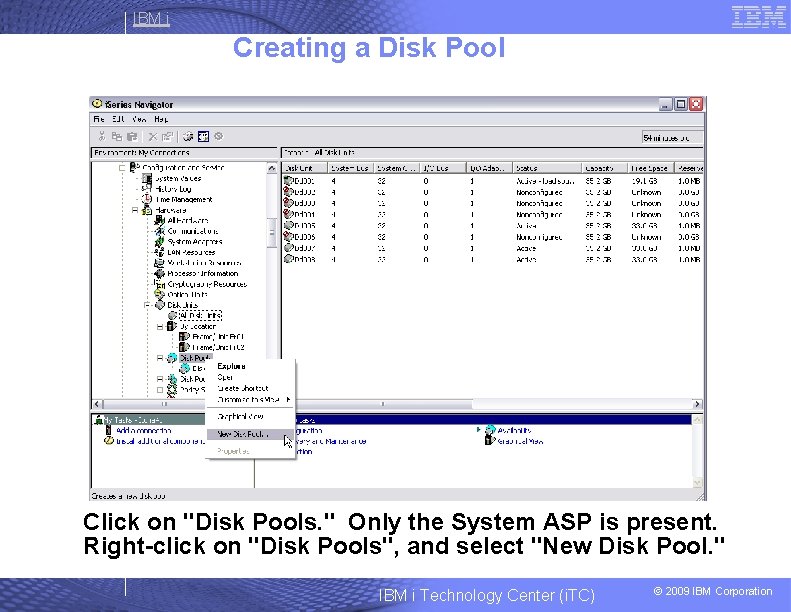
IBM i Creating a Disk Pool Click on "Disk Pools. " Only the System ASP is present. Right-click on "Disk Pools", and select "New Disk Pool. " IBM i Technology Center (i. TC) © 2009 IBM Corporation
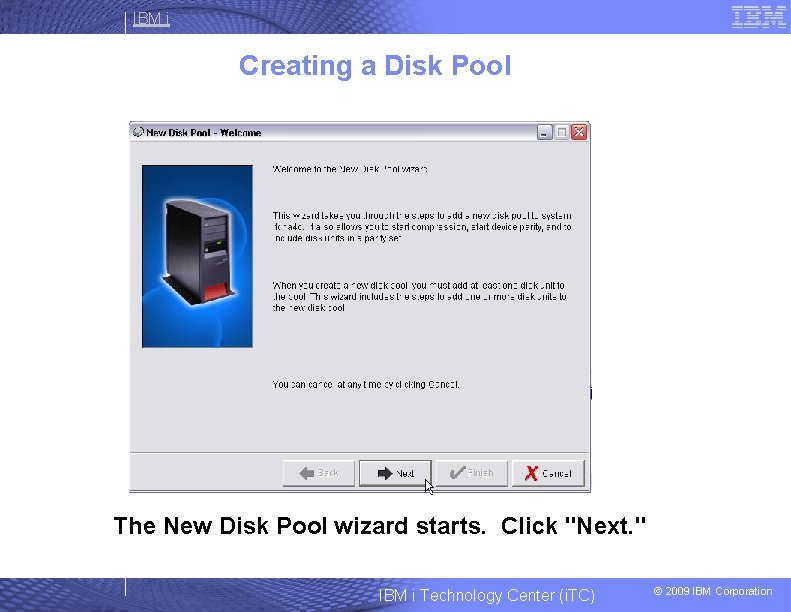
IBM i Creating a Disk Pool The New Disk Pool wizard starts. Click "Next. " IBM i Technology Center (i. TC) © 2009 IBM Corporation
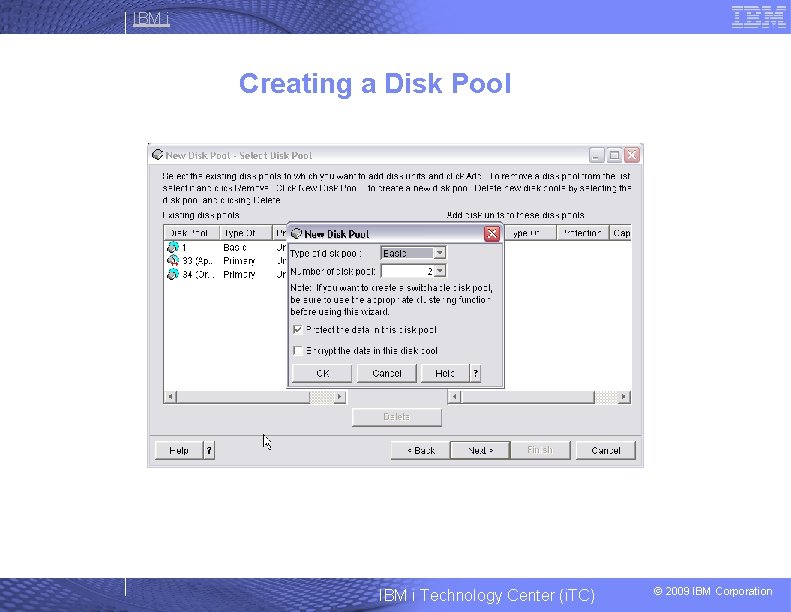
IBM i Creating a Disk Pool IBM i Technology Center (i. TC) © 2009 IBM Corporation
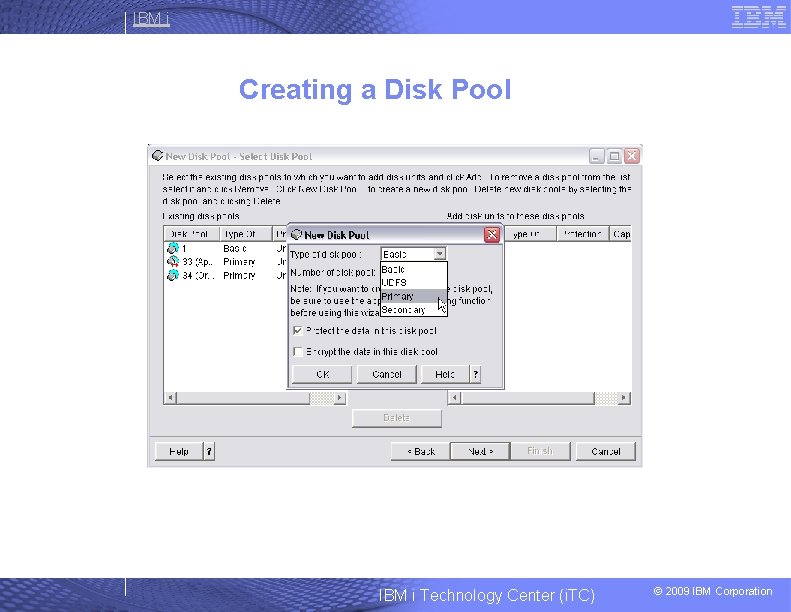
IBM i Creating a Disk Pool IBM i Technology Center (i. TC) © 2009 IBM Corporation
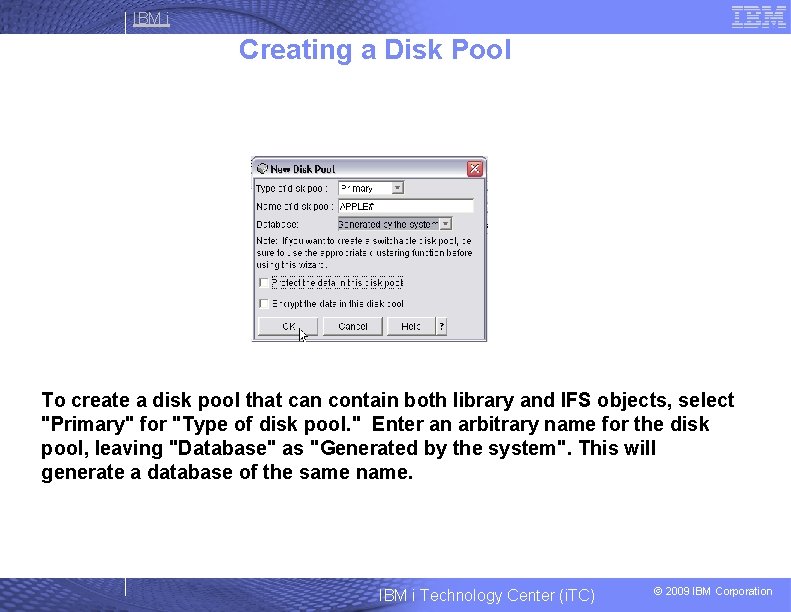
IBM i Creating a Disk Pool To create a disk pool that can contain both library and IFS objects, select "Primary" for "Type of disk pool. " Enter an arbitrary name for the disk pool, leaving "Database" as "Generated by the system". This will generate a database of the same name. IBM i Technology Center (i. TC) © 2009 IBM Corporation
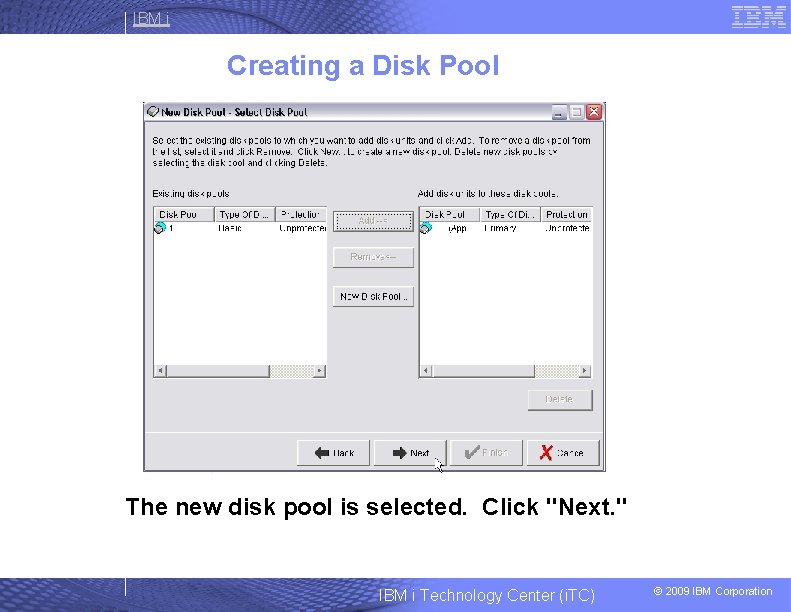
IBM i Creating a Disk Pool The new disk pool is selected. Click "Next. " IBM i Technology Center (i. TC) © 2009 IBM Corporation
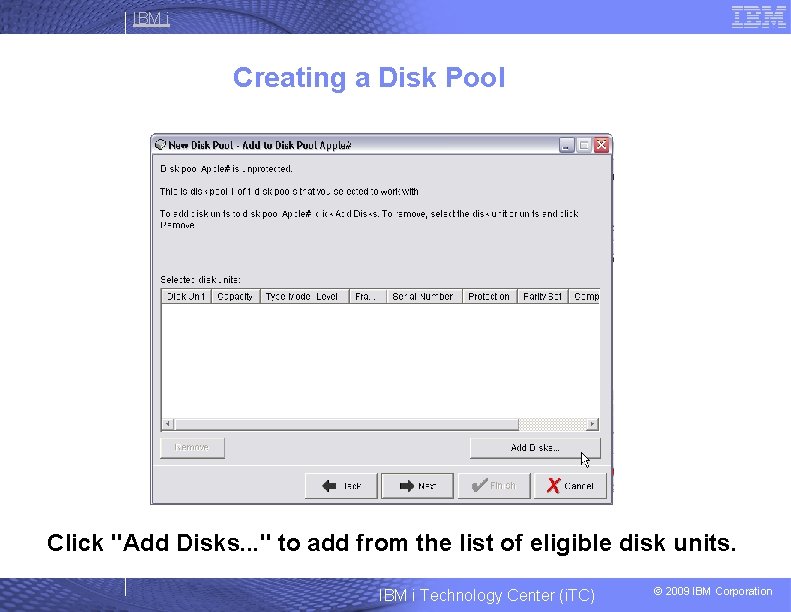
IBM i Creating a Disk Pool Click "Add Disks. . . " to add from the list of eligible disk units. IBM i Technology Center (i. TC) © 2009 IBM Corporation
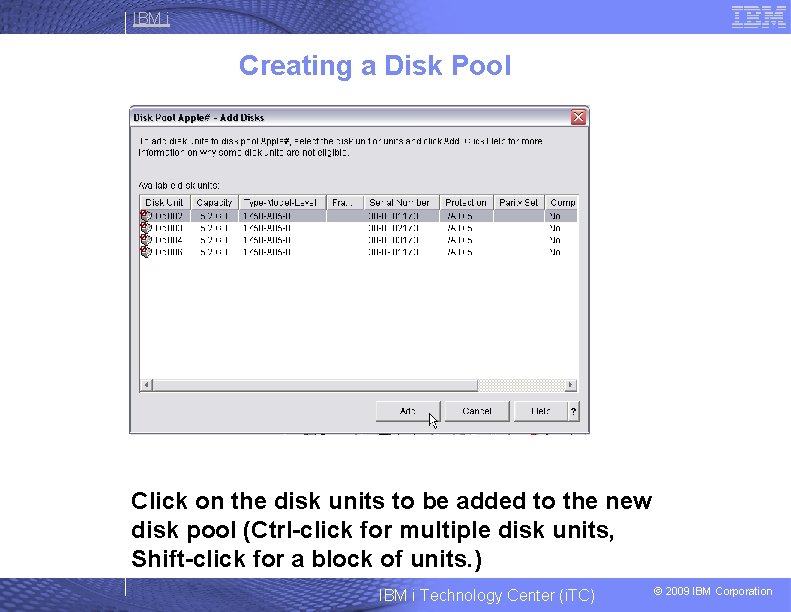
IBM i Creating a Disk Pool Click on the disk units to be added to the new disk pool (Ctrl-click for multiple disk units, Shift-click for a block of units. ) IBM i Technology Center (i. TC) © 2009 IBM Corporation
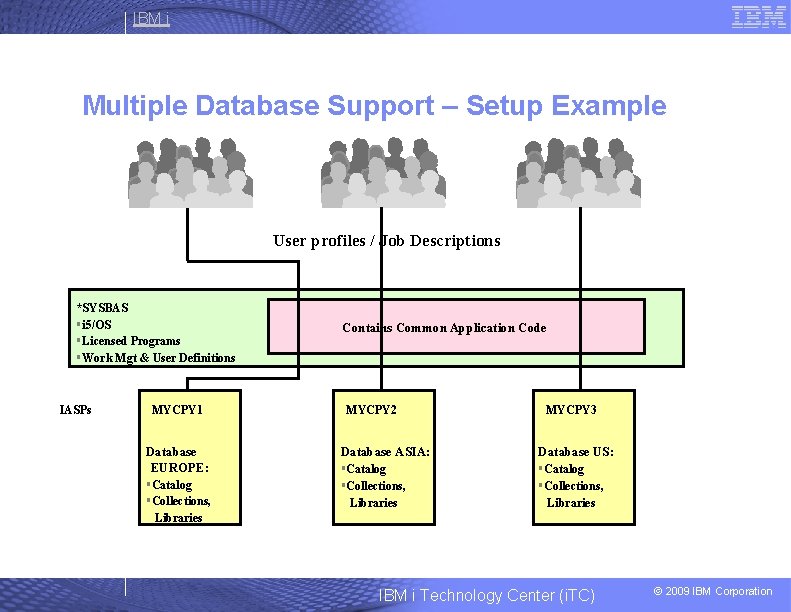
IBM i Multiple Database Support – Setup Example User profiles / Job Descriptions *SYSBAS §i 5/OS §Licensed Programs §Work Mgt & User Definitions IASPs MYCPY 1 Database EUROPE: §Catalog §Collections, Contains Common Application Code MYCPY 2 Database ASIA: §Catalog §Collections, Libraries MYCPY 3 Database US: §Catalog §Collections, Libraries IBM i Technology Center (i. TC) © 2009 IBM Corporation
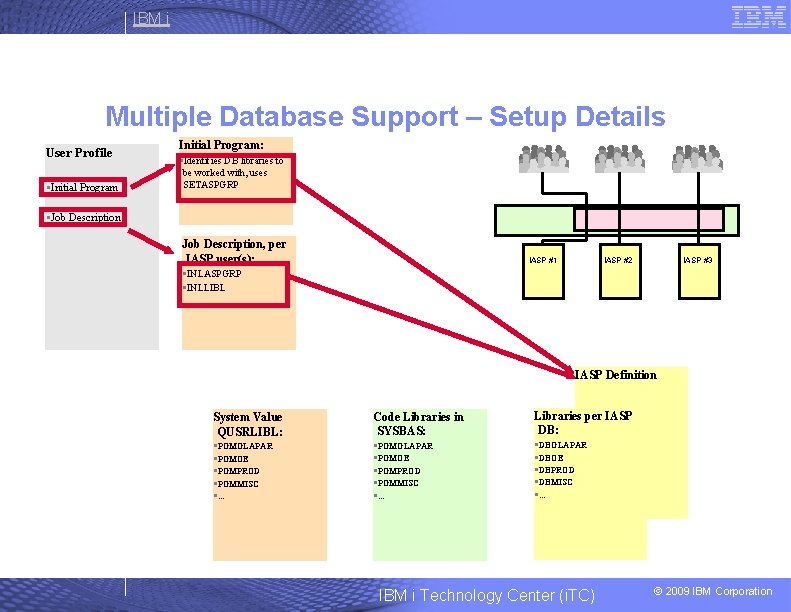
IBM i Multiple Database Support – Setup Details User Profile §Initial Program: §Identifies DB libraries to be worked with, uses SETASPGRP §Job Description, per IASP user(s): IASP #1 IASP #2 IASP #3 §INLASPGRP §INLLIBL IASP Definition System Value QUSRLIBL: Code Libraries in SYSBAS: Libraries per IASP DB: §PGMGLAPAR §PGMOE §PGMPROD §PGMMISC §. . . §DBGLAPAR §DBOE §DBPROD §DBMISC §. . . IBM i Technology Center (i. TC) © 2009 IBM Corporation
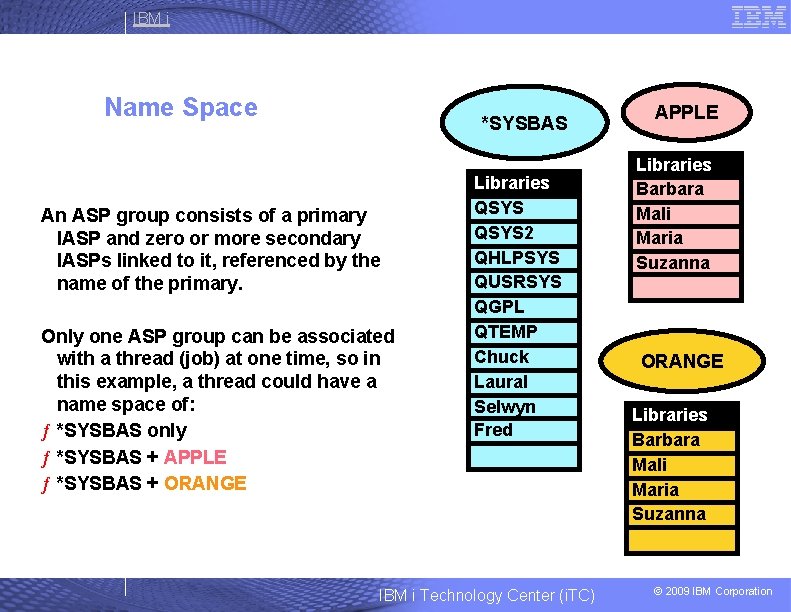
IBM i Name Space *SYSBAS An ASP group consists of a primary IASP and zero or more secondary IASPs linked to it, referenced by the name of the primary. Only one ASP group can be associated with a thread (job) at one time, so in this example, a thread could have a name space of: ƒ *SYSBAS only ƒ *SYSBAS + APPLE ƒ *SYSBAS + ORANGE Libraries QSYS 2 QHLPSYS QUSRSYS QGPL QTEMP Chuck Laural Selwyn Fred IBM i Technology Center (i. TC) APPLE Libraries Barbara Mali Maria Suzanna ORANGE Libraries Barbara Mali Maria Suzanna © 2009 IBM Corporation
IBM i Additional Characteristics of IASPs § Each ASP Group is represented as a separate DB 2 database instance. § Duplicate library names are allowed within different ASP groups on the same system. § Each job or thread always has visibility to objects in ASPs 1 -32 (System ASP + all Basic User ASPs), but is “attached” to, at most, one ASP group at a time. § Can be replicated or switched between multiple systems (requires additional software) IBM i Technology Center (i. TC) © 2009 IBM Corporation
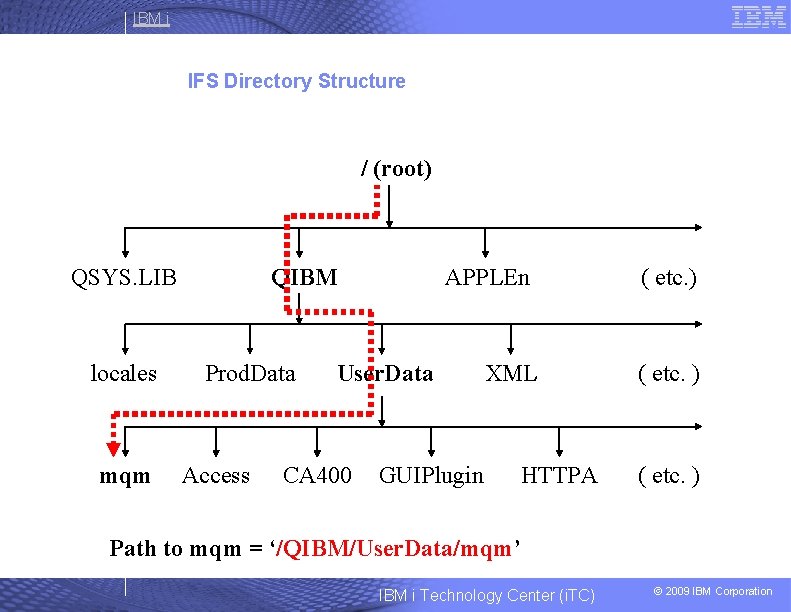
IBM i IFS Directory Structure / (root) QSYS. LIB locales mqm APPLEn QIBM Prod. Data Access User. Data CA 400 GUIPlugin XML HTTPA ( etc. ) Path to mqm = ‘/QIBM/User. Data/mqm’ IBM i Technology Center (i. TC) © 2009 IBM Corporation
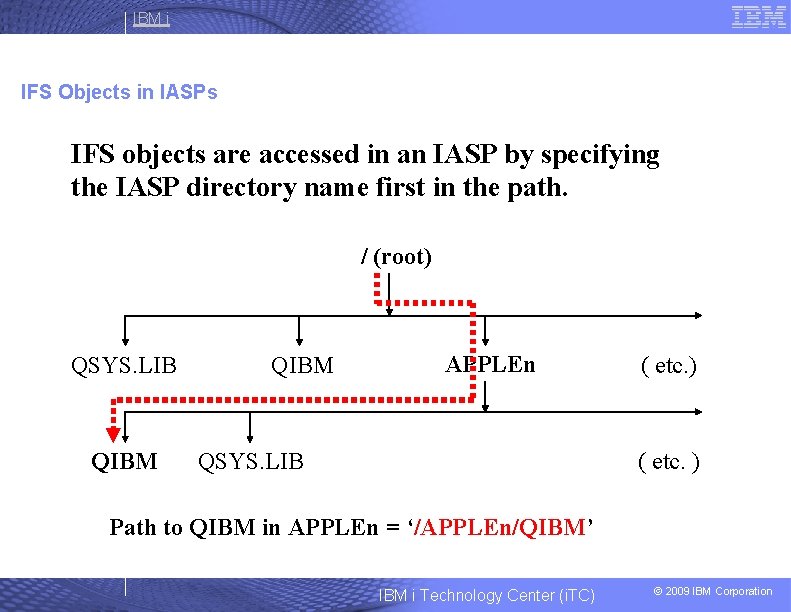
IBM i IFS Objects in IASPs IFS objects are accessed in an IASP by specifying the IASP directory name first in the path. / (root) QSYS. LIB QIBM APPLEn QSYS. LIB ( etc. ) Path to QIBM in APPLEn = ‘/APPLEn/QIBM’ IBM i Technology Center (i. TC) © 2009 IBM Corporation
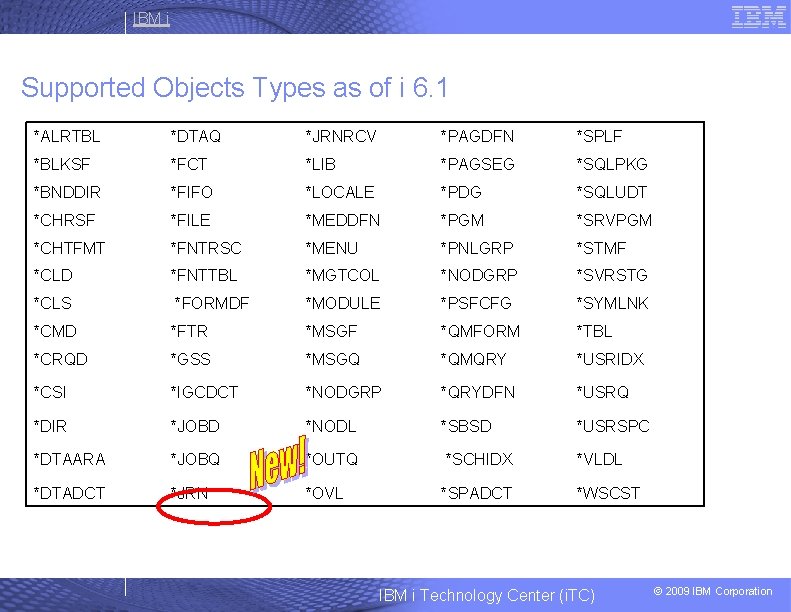
IBM i Supported Objects Types as of i 6. 1 *ALRTBL *DTAQ *JRNRCV *PAGDFN *SPLF *BLKSF *FCT *LIB *PAGSEG *SQLPKG *BNDDIR *FIFO *LOCALE *PDG *SQLUDT *CHRSF *FILE *MEDDFN *PGM *SRVPGM *CHTFMT *FNTRSC *MENU *PNLGRP *STMF *CLD *FNTTBL *MGTCOL *NODGRP *SVRSTG *CLS *FORMDF *MODULE *PSFCFG *SYMLNK *CMD *FTR *MSGF *QMFORM *TBL *CRQD *GSS *MSGQ *QMQRY *USRIDX *CSI *IGCDCT *NODGRP *QRYDFN *USRQ *DIR *JOBD *NODL *SBSD *USRSPC *DTAARA *JOBQ *OUTQ *SCHIDX *VLDL *DTADCT *JRN *OVL *SPADCT *WSCST IBM i Technology Center (i. TC) © 2009 IBM Corporation
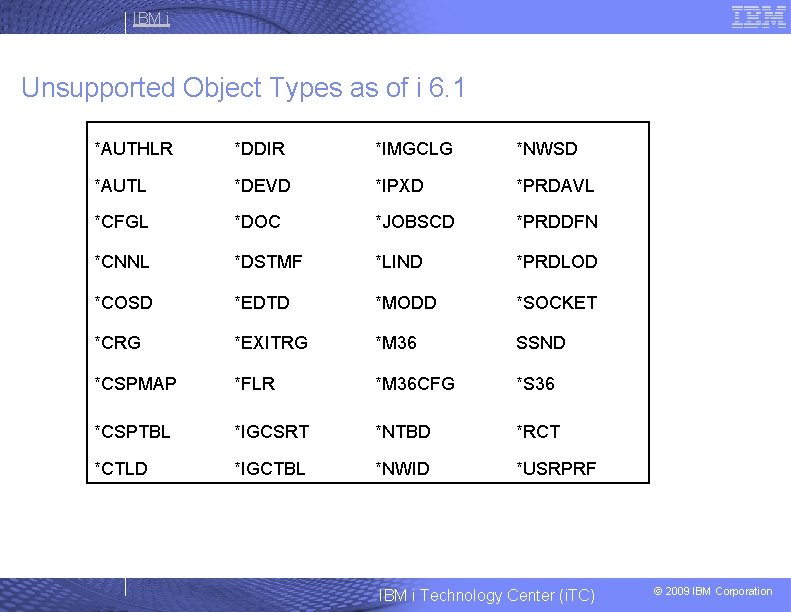
IBM i Unsupported Object Types as of i 6. 1 *AUTHLR *DDIR *IMGCLG *NWSD *AUTL *DEVD *IPXD *PRDAVL *CFGL *DOC *JOBSCD *PRDDFN *CNNL *DSTMF *LIND *PRDLOD *COSD *EDTD *MODD *SOCKET *CRG *EXITRG *M 36 SSND *CSPMAP *FLR *M 36 CFG *S 36 *CSPTBL *IGCSRT *NTBD *RCT *CTLD *IGCTBL *NWID *USRPRF IBM i Technology Center (i. TC) © 2009 IBM Corporation
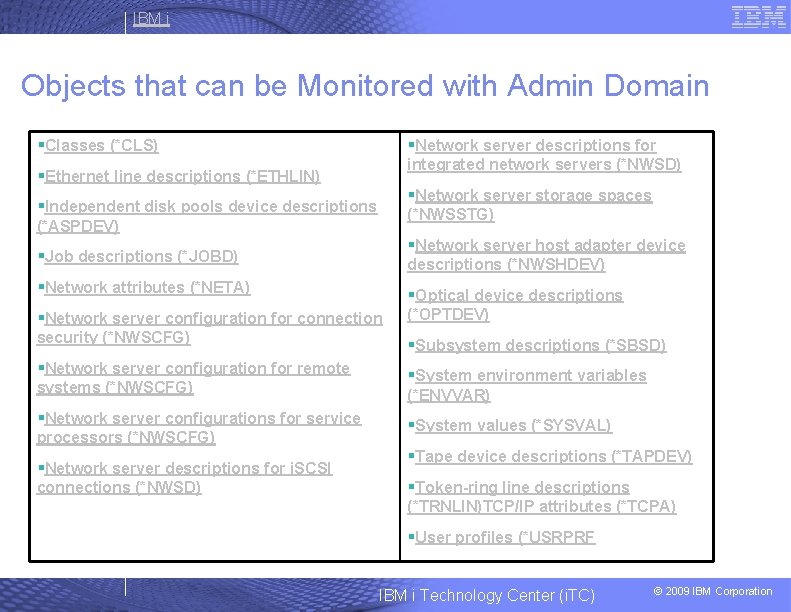
IBM i Objects that can be Monitored with Admin Domain §Classes (*CLS) §Network server descriptions for integrated network servers (*NWSD) §Ethernet line descriptions (*ETHLIN) §Network server storage spaces §Independent disk pools device descriptions (*NWSSTG) (*ASPDEV) §Network server host adapter device §Job descriptions (*JOBD) descriptions (*NWSHDEV) §Network attributes (*NETA) §Optical device descriptions §Network server configuration for connection (*OPTDEV) security (*NWSCFG) §Subsystem descriptions (*SBSD) §Network server configuration for remote §System environment variables systems (*NWSCFG) §Network server configurations for service processors (*NWSCFG) §Network server descriptions for i. SCSI connections (*NWSD) (*ENVVAR) §System values (*SYSVAL) §Tape device descriptions (*TAPDEV) §Token-ring line descriptions (*TRNLIN)TCP/IP attributes (*TCPA) §User profiles (*USRPRF IBM i Technology Center (i. TC) © 2009 IBM Corporation
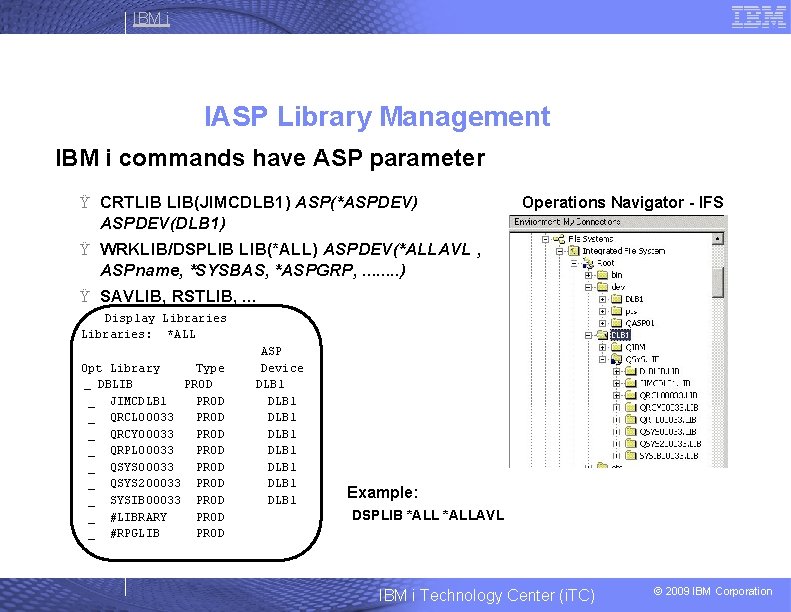
IBM i IASP Library Management IBM i commands have ASP parameter Ÿ CRTLIB LIB(JIMCDLB 1) ASP(*ASPDEV) ASPDEV(DLB 1) Operations Navigator - IFS Ÿ WRKLIB/DSPLIB LIB(*ALL) ASPDEV(*ALLAVL , ASPname, *SYSBAS, *ASPGRP, . . . . ) Ÿ SAVLIB, RSTLIB, . . . Display Libraries: *ALL Opt Library Type _ DBLIB PROD _ JIMCDLB 1 PROD _ QRCL 00033 PROD _ QRCY 00033 PROD _ QRPL 00033 PROD _ QSYS 200033 PROD _ SYSIB 00033 PROD _ #LIBRARY PROD _ #RPGLIB PROD ASP Device DLB 1 DLB 1 Example: DSPLIB *ALLAVL IBM i Technology Center (i. TC) © 2009 IBM Corporation
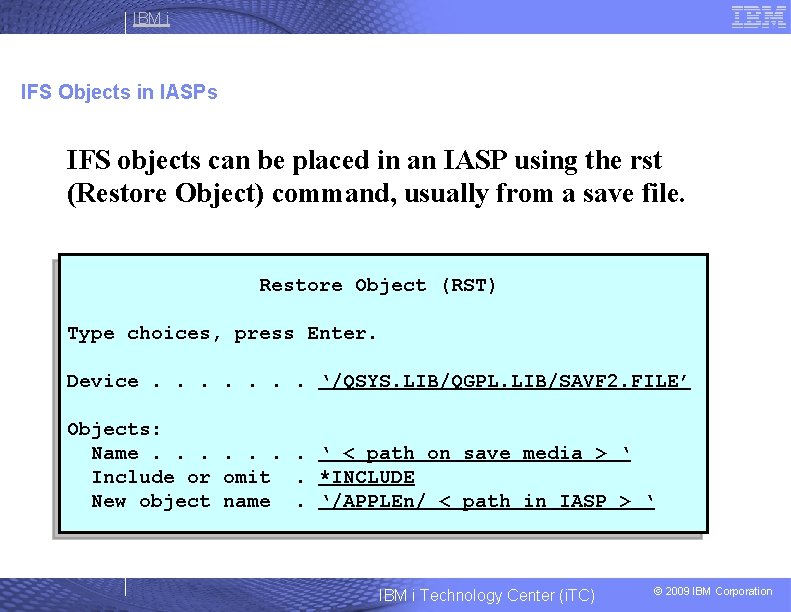
IBM i IFS Objects in IASPs IFS objects can be placed in an IASP using the rst (Restore Object) command, usually from a save file. Restore Object (RST) Type choices, press Enter. Device. . . . ‘/QSYS. LIB/QGPL. LIB/SAVF 2. FILE’ Objects: Name. . . . ‘ < path on save media > ‘ Include or omit. *INCLUDE New object name. ‘/APPLEn/ < path in IASP > ‘ IBM i Technology Center (i. TC) © 2009 IBM Corporation
IBM i Customer Usage Scenarios IBM i Technology Center (i. TC) © 2009 IBM Corporation
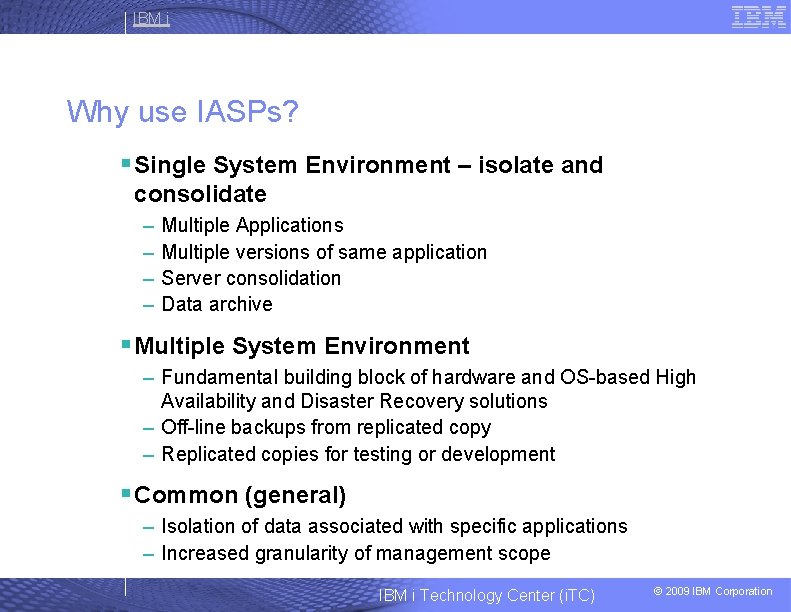
IBM i Why use IASPs? § Single System Environment – isolate and consolidate – – Multiple Applications Multiple versions of same application Server consolidation Data archive § Multiple System Environment – Fundamental building block of hardware and OS-based High Availability and Disaster Recovery solutions – Off-line backups from replicated copy – Replicated copies for testing or development § Common (general) – Isolation of data associated with specific applications – Increased granularity of management scope IBM i Technology Center (i. TC) © 2009 IBM Corporation
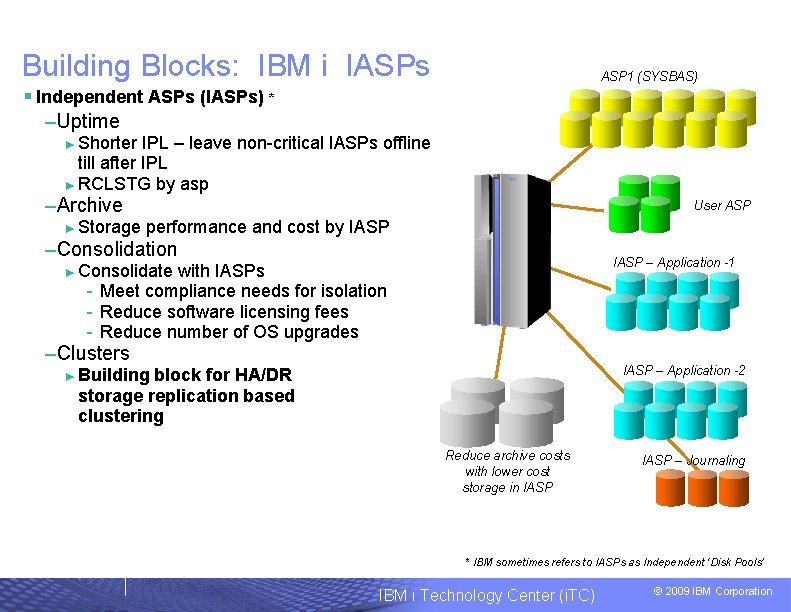
IBM i Building Blocks: IBM i IASPs ASP 1 (SYSBAS) § Independent ASPs (IASPs) * –Uptime ► Shorter IPL – leave non-critical IASPs offline till after IPL ► RCLSTG by asp –Archive ► Storage User ASP performance and cost by IASP –Consolidation IASP – Application -1 ► Consolidate with IASPs - Meet compliance needs for isolation - Reduce software licensing fees - Reduce number of OS upgrades –Clusters IASP – Application -2 ► Building block for HA/DR storage replication based clustering Reduce archive costs with lower cost storage in IASP – Journaling * IBM sometimes refers to IASPs as Independent ‘Disk Pools’ IBM i Technology Center (i. TC) © 2009 IBM Corporation
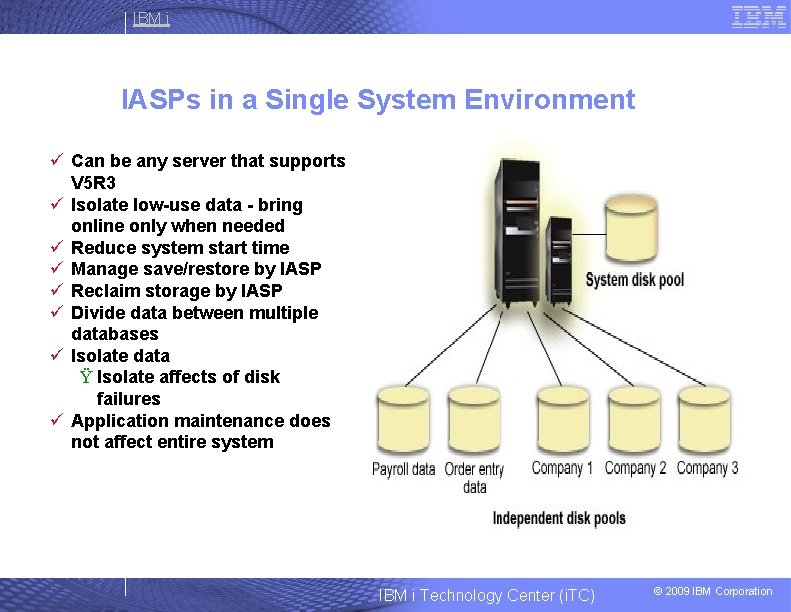
IBM i IASPs in a Single System Environment ü Can be any server that supports V 5 R 3 ü Isolate low-use data - bring online only when needed ü Reduce system start time ü Manage save/restore by IASP ü Reclaim storage by IASP ü Divide data between multiple databases ü Isolate data Ÿ Isolate affects of disk failures ü Application maintenance does not affect entire system IBM i Technology Center (i. TC) © 2009 IBM Corporation
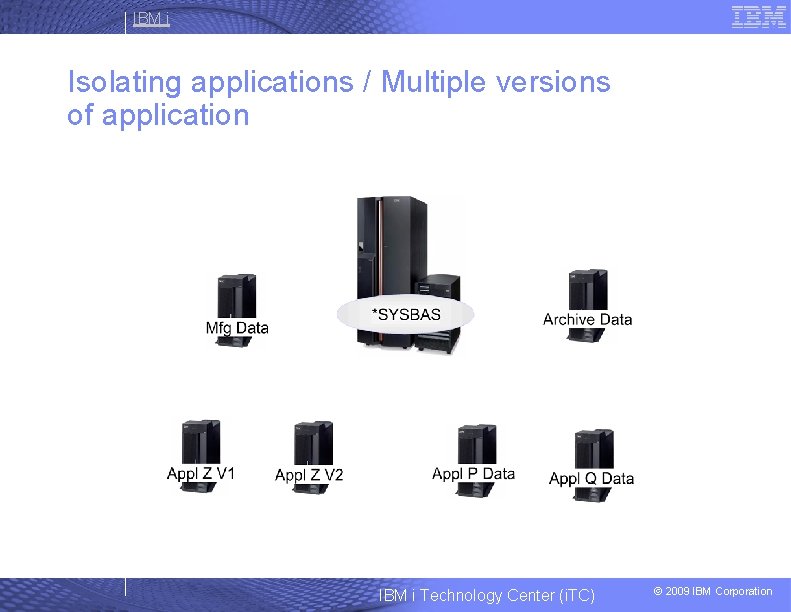
IBM i Isolating applications / Multiple versions of application IBM i Technology Center (i. TC) © 2009 IBM Corporation
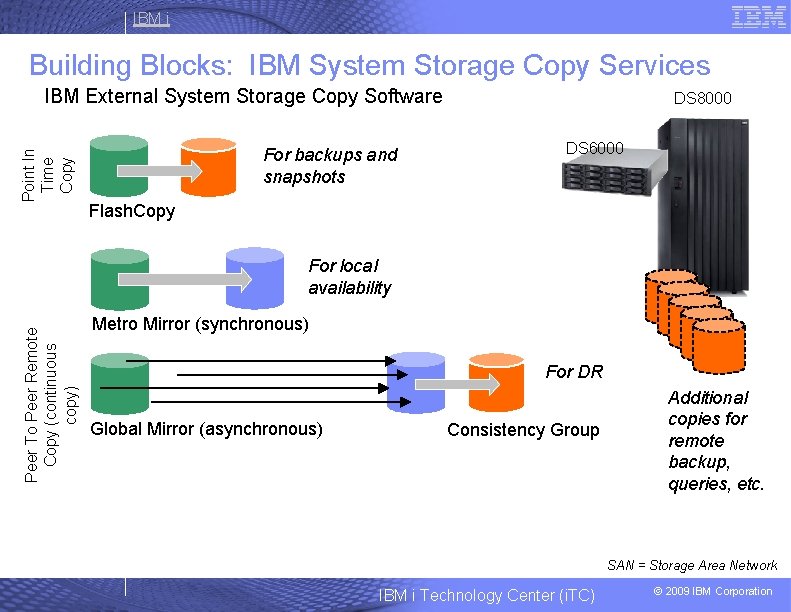
IBM i Building Blocks: IBM System Storage Copy Services Point In Time Copy IBM External System Storage Copy Software For backups and snapshots DS 8000 DS 6000 Flash. Copy Peer To Peer Remote Copy (continuous copy) For local availability Metro Mirror (synchronous) For DR Global Mirror (asynchronous) Consistency Group Additional copies for remote backup, queries, etc. SAN = Storage Area Network IBM i Technology Center (i. TC) © 2009 IBM Corporation
IBM i Considerations for Migrating to an IASPBased HA Solution IBM i Technology Center (i. TC) © 2009 IBM Corporation
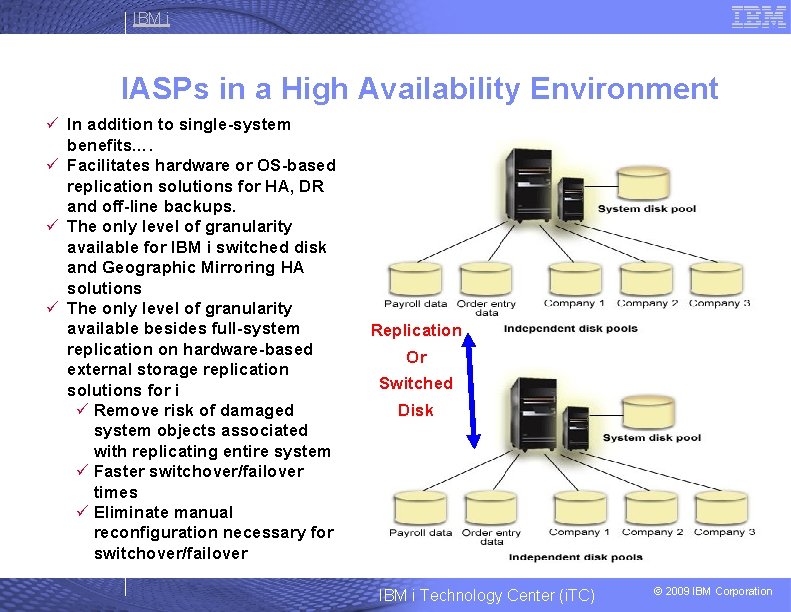
IBM i IASPs in a High Availability Environment ü In addition to single-system benefits…. ü Facilitates hardware or OS-based replication solutions for HA, DR and off-line backups. ü The only level of granularity available for IBM i switched disk and Geographic Mirroring HA solutions ü The only level of granularity available besides full-system replication on hardware-based external storage replication solutions for i ü Remove risk of damaged system objects associated with replicating entire system ü Faster switchover/failover times ü Eliminate manual reconfiguration necessary for switchover/failover Replication Or Switched Disk IBM i Technology Center (i. TC) © 2009 IBM Corporation
IBM i IASP HA Solution Considerations § IBM’s HA solutions and technologies for i are continuing to center around IASPs. § HA system/partition is available while in the “Contingency” role. – Is a unique system, not a complete replica of the source system – Unique instance of i operating system, LPPs, PTFs, etc – System is available, but IASPs replicated or shared from a “primary” system are NOT available unless switching or failing to contingency system. § If using OS or Hardware Based replication of IASP, processes will need to be in place for synchronizing necessary SYSBAS objects and settings § May need changes to processes such as change management, user and security management, system monitoring, etc. IBM i Technology Center (i. TC) © 2009 IBM Corporation
IBM i How do you get there? Common Changes and Application Considerations for IASPs IBM i Technology Center (i. TC) © 2009 IBM Corporation
IBM i Typical IASP Migration Project Outline § Determine how IASPs fit into your HA/DR/Server Consolidation/Offline backup strategy. § Perform initial proof-of-concept on subset of applications. § Educate administration and programming staff on IASP enablement considerations. § Set up test environment where application and work management changes for IASP enablement will be performed and tested. § Devise plan for synchronizing SYSBAS between primary and secondary systems, if applicable. § Test all process, application and work management changes. § Determine production migration strategy based on available hardware and replication options. § Test migration process on sandbox environment, if possible § Perform any necessary education to support personnel and users on process change, etc. § Execute production migration and implement revised HA strategy based on IASPs, if applicable. IBM i Technology Center (i. TC) © 2009 IBM Corporation
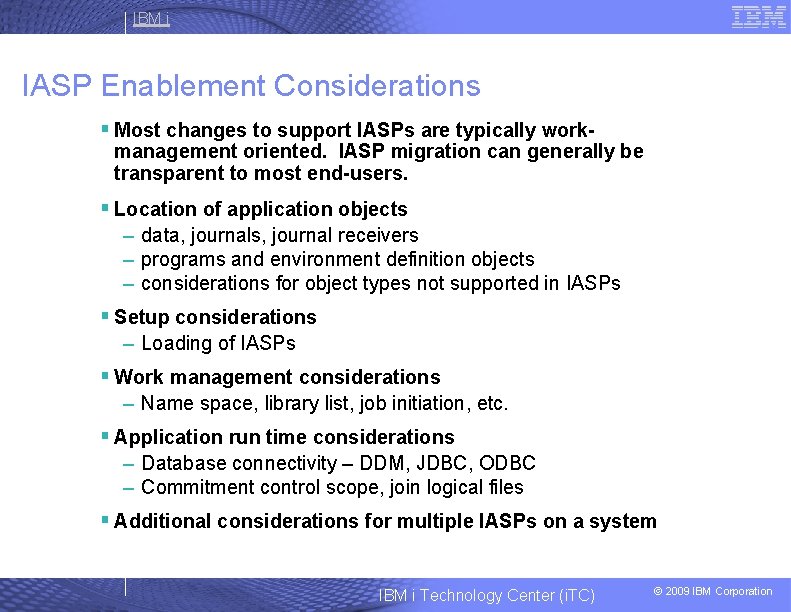
IBM i IASP Enablement Considerations § Most changes to support IASPs are typically work- management oriented. IASP migration can generally be transparent to most end-users. § Location of application objects – data, journals, journal receivers – programs and environment definition objects – considerations for object types not supported in IASPs § Setup considerations – Loading of IASPs § Work management considerations – Name space, library list, job initiation, etc. § Application run time considerations – Database connectivity – DDM, JDBC, ODBC – Commitment control scope, join logical files § Additional considerations for multiple IASPs on a system IBM i Technology Center (i. TC) © 2009 IBM Corporation
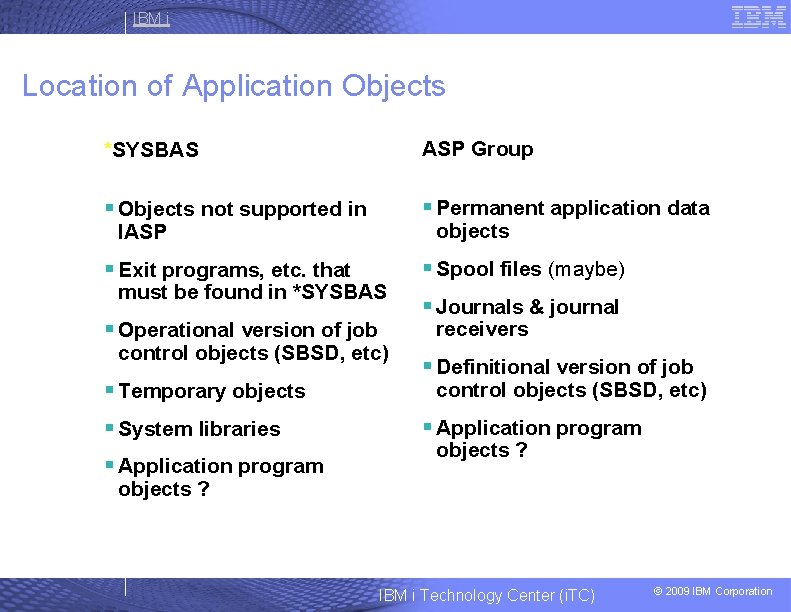
IBM i Location of Application Objects *SYSBAS ASP Group § Objects not supported in § Permanent application data § Exit programs, etc. that § Spool files (maybe) objects IASP must be found in *SYSBAS § Operational version of job receivers control objects (SBSD, etc) § Temporary objects § System libraries § Application program § Journals & journal § Definitional version of job control objects (SBSD, etc) § Application program objects ? IBM i Technology Center (i. TC) © 2009 IBM Corporation
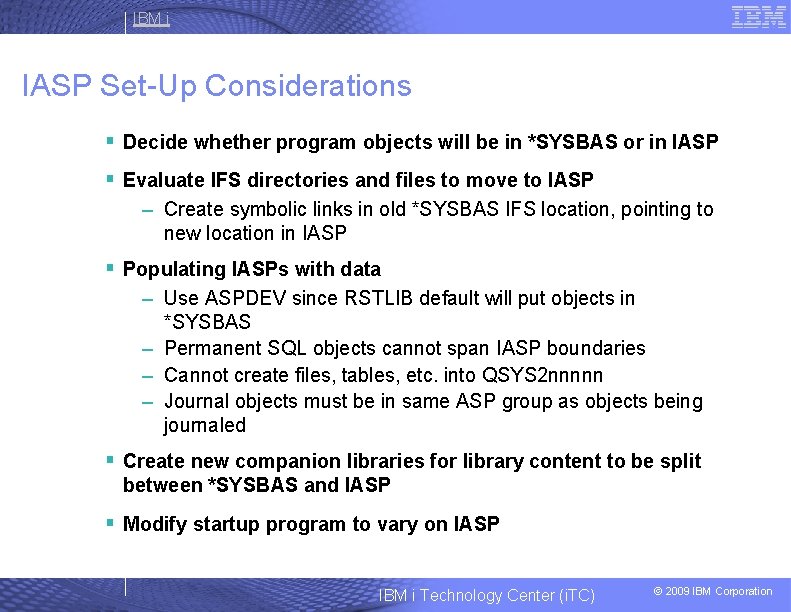
IBM i IASP Set-Up Considerations § Decide whether program objects will be in *SYSBAS or in IASP § Evaluate IFS directories and files to move to IASP – Create symbolic links in old *SYSBAS IFS location, pointing to new location in IASP § Populating IASPs with data – Use ASPDEV since RSTLIB default will put objects in *SYSBAS – Permanent SQL objects cannot span IASP boundaries – Cannot create files, tables, etc. into QSYS 2 nnnnn – Journal objects must be in same ASP group as objects being journaled § Create new companion libraries for library content to be split between *SYSBAS and IASP § Modify startup program to vary on IASP IBM i Technology Center (i. TC) © 2009 IBM Corporation
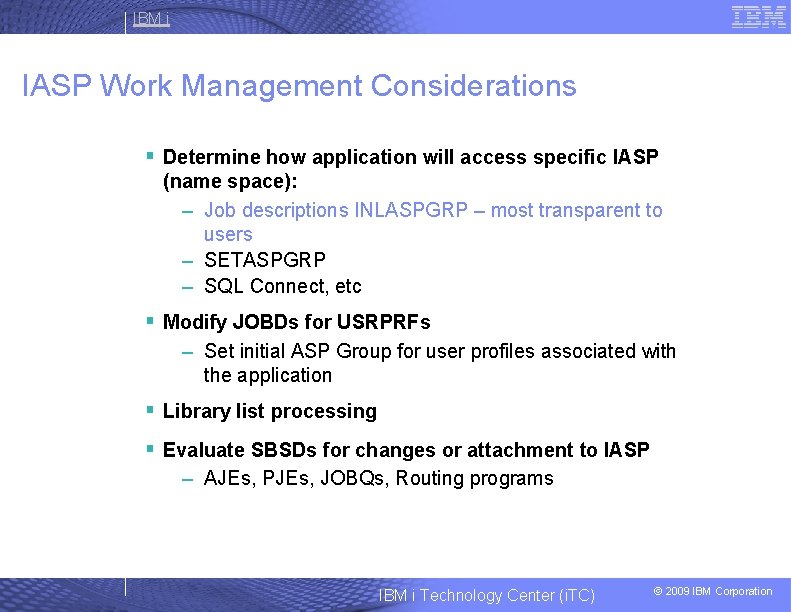
IBM i IASP Work Management Considerations § Determine how application will access specific IASP (name space): – Job descriptions INLASPGRP – most transparent to users – SETASPGRP – SQL Connect, etc § Modify JOBDs for USRPRFs – Set initial ASP Group for user profiles associated with the application § Library list processing § Evaluate SBSDs for changes or attachment to IASP – AJEs, PJEs, JOBQs, Routing programs IBM i Technology Center (i. TC) © 2009 IBM Corporation
IBM i IASP Database Considerations § Views, tables cannot span IASP boundary – No join logicals over physicals in different ASPs or ASP and SYSBAS § Commit block cannot span IASP boundary – If connected to IASP RDB, cannot commit changes against both IASP and *SYSBAS (except QTEMP) § Decide on RDB name for IASP – Single IASP on system, may want to give the old *LOCAL RDB name to the IASP instead. § DDM files – Configure to use *RDB for connectivity § New permanent libraries or collections for application: – CRTLIB LIB(library-name) ASP(*ASPDEV) ASPDEV(asp-device-name) – Create collection – default for INASP is the current library name space § JDBC, ODBC, FTP connectivity – Use JOBD of USRPRF to set INLASPGRP where possible IBM i Technology Center (i. TC) © 2009 IBM Corporation
IBM i IASP Application Considerations § Switching name spaces (SETASPGRP): – Typically avoid from within application – If use, release locks and pointer references first § IASP offline – if program objects remain in SYSBAS: – Application time out may need to increase for vary on processing – Application must handle object not available (as result of vary off, etc. ) § Evaluate use of SBMJOB and any commands with ASPDEV parameter to ensure desired behavior § Can use Vary on/off exit programs for IASP to perform application startup and shutdown processing IBM i Technology Center (i. TC) © 2009 IBM Corporation
IBM i New Function added in i 6. 1 IBM i Technology Center (i. TC) © 2009 IBM Corporation
IBM i New i 6. 1 IASP Related Enhancements § Support of job queues in IASP – Allows applications to run with IASP with fewer changes – Job queue entries not persistant § Support for associating an IASP with a subsystem description – Parameter added to subsystem description object – IASP must be available for subsystem to be active § Quiesce function – i Suspends transactions & operations to ensure that as much in-flight data as possible is written to disk § Support for pure SYSBAS transaction under commitment control – Can open commit transactions against SYSBASE in a job with an IASP in the namespace – Commit transactions still cannot cross SYSBASE/IASP boundaries § Avoiding IPL in previous cases where IASP could not be varied on § Encrypted IASPs – 5761 -SS 1 Option 45 - Encrypted ASP Enablement required IBM i Technology Center (i. TC) © 2009 IBM Corporation
IBM i Support for Job Queues in IASP § Job queue object can be created in IASP – Allows applications to run with IASP with fewer changes § Operationally, identical to JOBQ in SYSBAS: – User can manipulate jobs (submit, hold, release, etc. ) on JOBQ – User can manipulate JOBQ (clear, hold, release delete, etc. ) § Behavioral differences exist: – Jobs on JOBQ in IASP will not persist across vary off / vary on – Jobs on JOBQ in IASP will not be available on backup system after switchover or failover IBM i Technology Center (i. TC) © 2009 IBM Corporation
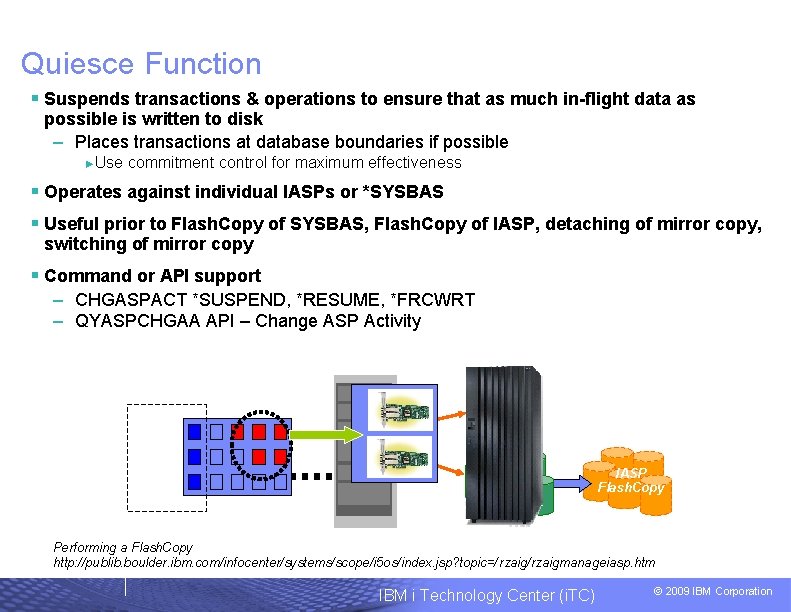
IBM i Quiesce Function § Suspends transactions & operations to ensure that as much in-flight data as possible is written to disk – Places transactions at database boundaries if possible ►Use commitment control for maximum effectiveness § Operates against individual IASPs or *SYSBAS § Useful prior to Flash. Copy of SYSBAS, Flash. Copy of IASP, detaching of mirror copy, switching of mirror copy § Command or API support – CHGASPACT *SUSPEND, *RESUME, *FRCWRT – QYASPCHGAA API – Change ASP Activity “i 5/OS Quiesce” ASP-1 Pinned pages will remain IASP copy ready for backup use IASP Flash. Copy Main Storage Performing a Flash. Copy http: //publib. boulder. ibm. com/infocenter/systems/scope/i 5 os/index. jsp? topic=/ rzaig/rzaigmanageiasp. htm IBM i Technology Center (i. TC) © 2009 IBM Corporation
IBM i Encryption for ASP § Protects data transmission to and from the disk drive (important in a SAN environment). § Protects data transmission in the cross site mirroring environment (only when the data being mirrored is on an encrypted independent disk pool). § Protects data in the case of theft of the disk drive. § Protects data in the case of return or resale of a disk drive (reduces the need to sanitize the disk drive). § Must be specified at IASP creation time – cannot be applied to existing IASPs. 5761 -SS 1 Option 45 - Encrypted ASP Enablement required IBM i Technology Center (i. TC) © 2009 IBM Corporation
IBM i Cluster Administrative Domain Enhancements § New commands / interfaces – Start / end admin domain – Add / remove admin domain monitored resource entries – Display admin domain monitored resource entries via WRKCLU § i 5. 4 Monitored Resources enhanced in i 6. 1 – User profiles (*USRPRF) – System values (*SYSVAL) § New Monitored Resources in i 6. 1 – Subsystem Descriptions (*SBSD) – Network Server Descriptions (*NWSD) of types *WINDOWSNT, *IXSVR, and *ISCSI – NWS Configurations (*NWSCFG) – NWSH Device Descriptions (*NWSHDEV) – NWS Storage Spaces (*NWSSTG) – Tape Device Descriptions (*TAPDEV) – Optical Device Descriptions (*OPTDEV) – Ethernet Line Descriptions (*ETHLIN) – Token-ring Line Descriptions (*TRNLIN) IBM i Technology Center (i. TC) © 2009 IBM Corporation
IBM i IASP Adoption in the Market IBM i Technology Center (i. TC) © 2009 IBM Corporation
IBM i Sample ISVs with announced IASP Support § Oracle – JD Edwards World and Enterprise One § SAP § Lawson M 3 § SPSS § Soft Landing § Vision Solutions § Manhattan § Many others have been implemented in clients IBM i Technology Center (i. TC) © 2009 IBM Corporation
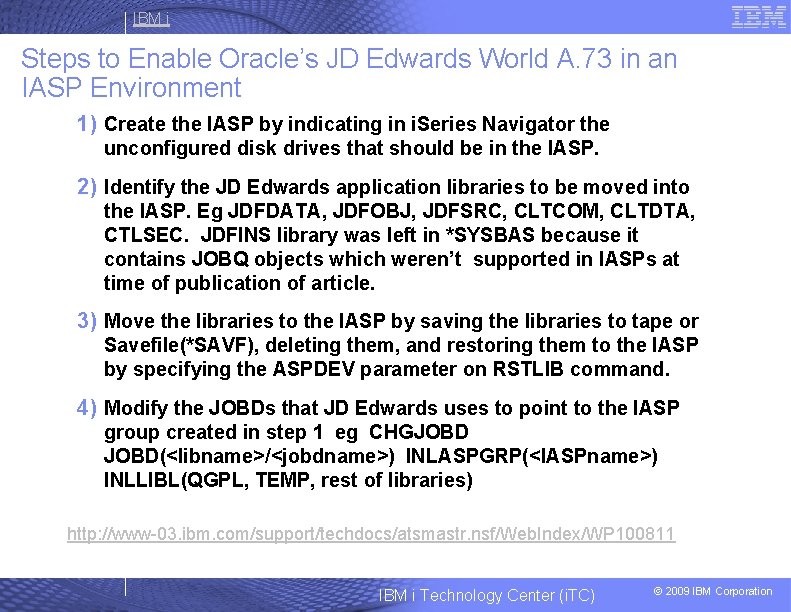
IBM i Steps to Enable Oracle’s JD Edwards World A. 73 in an IASP Environment 1) Create the IASP by indicating in i. Series Navigator the unconfigured disk drives that should be in the IASP. 2) Identify the JD Edwards application libraries to be moved into the IASP. Eg JDFDATA, JDFOBJ, JDFSRC, CLTCOM, CLTDTA, CTLSEC. JDFINS library was left in *SYSBAS because it contains JOBQ objects which weren’t supported in IASPs at time of publication of article. 3) Move the libraries to the IASP by saving the libraries to tape or Savefile(*SAVF), deleting them, and restoring them to the IASP by specifying the ASPDEV parameter on RSTLIB command. 4) Modify the JOBDs that JD Edwards uses to point to the IASP group created in step 1 eg CHGJOBD(<libname>/<jobdname>) INLASPGRP(<IASPname>) INLLIBL(QGPL, TEMP, rest of libraries) http: //www-03. ibm. com/support/techdocs/atsmastr. nsf/Web. Index/WP 100811 IBM i Technology Center (i. TC) © 2009 IBM Corporation
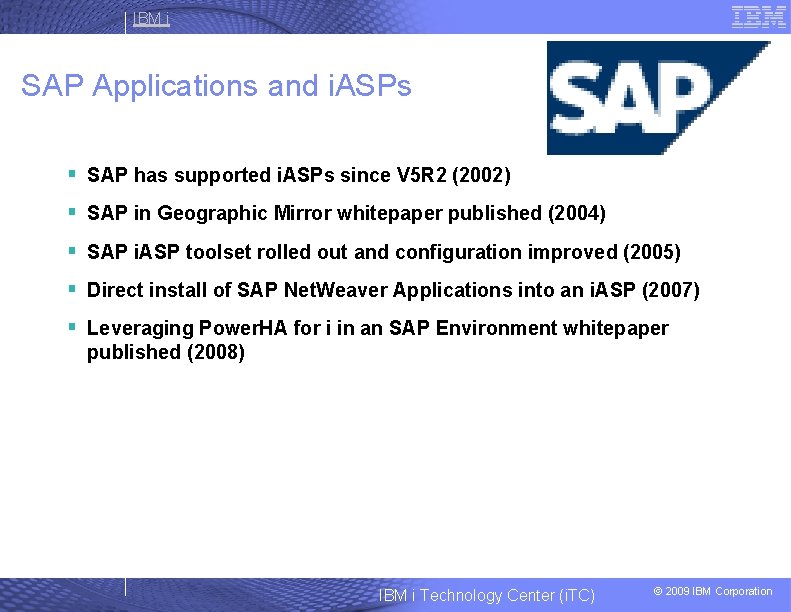
IBM i SAP Applications and i. ASPs § SAP has supported i. ASPs since V 5 R 2 (2002) § SAP in Geographic Mirror whitepaper published (2004) § SAP i. ASP toolset rolled out and configuration improved (2005) § Direct install of SAP Net. Weaver Applications into an i. ASP (2007) § Leveraging Power. HA for i in an SAP Environment whitepaper published (2008) IBM i Technology Center (i. TC) © 2009 IBM Corporation
IBM i Enabling SAP Applications for i. ASP § Separated i. ASP supported and non-i. ASP supported objects § Modified job descriptions, configuration files, and initialization programs § Modified SAP kernel to run in i. ASP – Code changes required to call ILE programs using IFS style convention i. e. /IASP/QSYS. LIB/SAP. LIB/… § Developed lightweight install process for backup host § Configure SAP application to use virtual hosts § Configure exit programs to automate restart of SAP applications after switchover or failover § For more information see http: //www. ibm. com/support/techdocs/atsmastr. nsf/Web. Index/WP 1013 25 IBM i Technology Center (i. TC) © 2009 IBM Corporation
IBM i Steps to implement Power. HA for i solution for Lawson M 3 1. Use Power. HA for i Solution Based GUI to: – Pick the HA solution you want to implement – Create i. ASP(s) and setup the HA environment – Migrate Lawson M 3 Business Engine and Life Cyle Manager ► User Profiles, IFS Directories, and Databases 2. Modify M 3 Business Engine to run under i. ASP 3. Installing Lawson M 3 Work. Place Application into i. ASP – Includes installing Web. Sphere 6. 1 into i. ASP – Modifying M 3 Work. Place to run under i. ASP 4. Create startup and shutdown exit programs § For more details see “Lawson M 3 on IBM Power. HA for I” Whitepaper – http: //www 03. ibm. com/support/techdocs/atsmastr. nsf/Web. Index/WP 101232 IBM i Technology Center (i. TC) © 2009 IBM Corporation
IBM i Customer’s Using IASPs § Many, many successful IASP implementations world-wide – Most for HA solutions – Most have single ASP group per system / partition § Wide variety of industries and sizes – – – Major financial institutions world wide Various international government holdings Telecommunications corporations world wide Major transportation and shipping companies Infrastructure and facilities providers ……. <insert your industry segment here> …… § IASP migrations can take days or months – depends on complexity of applications and environment IBM i Technology Center (i. TC) © 2009 IBM Corporation
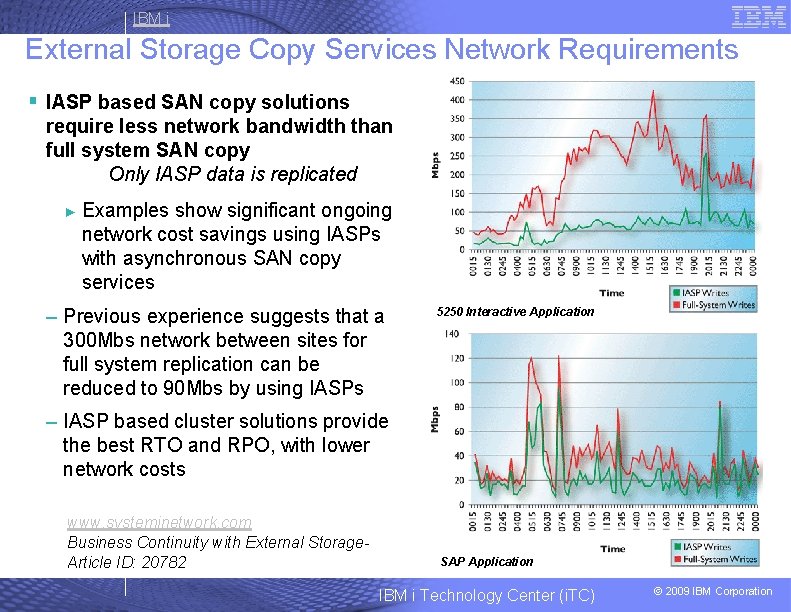
IBM i External Storage Copy Services Network Requirements § IASP based SAN copy solutions require less network bandwidth than full system SAN copy Only IASP data is replicated ► Examples show significant ongoing network cost savings using IASPs with asynchronous SAN copy services – Previous experience suggests that a 300 Mbs network between sites for full system replication can be reduced to 90 Mbs by using IASPs 5250 Interactive Application – IASP based cluster solutions provide the best RTO and RPO, with lower network costs www. systeminetwork. com Business Continuity with External Storage. Article ID: 20782 SAP Application IBM i Technology Center (i. TC) © 2009 IBM Corporation
IBM i References and Additional Material IBM i Technology Center (i. TC) © 2009 IBM Corporation
IBM i IASPs Resources § Publications - www. redbooks. ibm. com – i. Series Independent ASPs: A Guide to Moving Applications to IASPs – V 5 R 3, SG 24 -6802 -00 – IASP Performance Study on the i. Series Server, REDP-3771 -00 – Clustering and IASPs for Higher Availability on the i. Series Server, SG 24 -5194 -01 § Websites – i 5/OS HA website: ► Ibm. com/systems/i/ha – Info. Center ► http: //publib. boulder. ibm. com/infocenter/iseries/v 5 r 4/index. jsp § Education & Workshops - http: //www. ibm. com/servers/eserver/iseries/service/itc – AS 540 – IBM Power HA and IASP Implementation – IASP for ISV Workshop § IBM Lab Services IASP Feasibility Studies. IBM i Technology Center (i. TC) © 2009 IBM Corporation
IBM i AS 541 Power. HA & IASP Class Description § AS 541 Power. HA and IASP Enablement Rochester MN Cost $2500 per student – Learn about Power. HA from a series of presentations and gain practical experience through hands-on lab exercises. Learn to: ►Create disk pools (IASP) and place highly available objects into them · ►Use the methods that allow users to access information in a disk pool ►Manage an environment with multiple disk pools (server consolidation) ►Define an availability Environment using 5761 -HAS IBM Power. HA ►Compare and contrast the different options available for implementation under 5761 HAS - Geographic Mirroring using IBM i IASP Mirroring Technologies - Metro Mirror using IBM System Storage Copy Services, IBM i IASP and Clustering - Global Mirror using IBM System Storage Copy Services, IBM i IASP and Clustering ►Create and manage an IBM i family cluster including problem determination ►Establish and manage an environment with continuously available application objects using a geographic mirror disk pool ►Maintain consistent copies of key system objects like user profiles through operating system cluster resource services ►Enroll at: http: //ibm. com/services/learning search for AS 54 IBM i Technology Center (i. TC) © 2009 IBM Corporation
IBM i Resources: IBM Systems Lab Services Helping Clients to Design and Deploy IBM Systems and Storage Solutions Consulting, Design, Skills Transfer, Implementation Services Available: § High Availability Services – IASP Feasibility study – Improved Availability Assessment – Remote Availability Assessment § Performance Review & Optimization § SOA Services § HATS/Webfacing Services § Copy Services for SAN System Storage § Security Assessments § Voice over IP (Vo. IP) Services § LPAR Toolkit, LPAR Design and Configuration § System Migration Services § Server Consolidation § High & Low Level Architecture Reviews § Linux § Web. Sphere Application Server (WAS) § Web. Sphere Portal § Lotus Domino § IBM Workplace § Pre-coded & tested software components § System i, System p, System z, System Storage, System x, Blade. Center, Clustered Solutions § Data Center Services www. ibm. com/systems/services/labservices IBM i Technology Center (i. TC) © 2009 IBM Corporation
IBM i IASP Feasibility Workshop § IASP Feasibility Workshop – Lab Services personnel will assist you in evaluating customer applications for IASP enablement using IBM i partitions in Rochester or at your customer’s site. – Usually 5 days in length § Lab Services Contacts to Schedule a Study Americas Mark Even, (507) 253 -1313, even@us. ibm. com Europe SWE & Benoit Sirot, 33 -4 9211. 5012, sirot@fr. ibm. com NEE IOT’s Frank Kriss 507 -253 -1365 kriss@us. ibm. com Gerard Barneaud, 33 -4 9211. 4231, barneaud@fr. ibm. com AP US Contact for AP IBM i Technology Center (i. TC) Jenny Chen, 886 -2 -8170 -6895, jenychen@tw. ibm. com Jin-Ming Liu, (507) 253 -0391, jliu@us. ibm. com © 2009 IBM Corporation
IBM i What We’ve Learned Today § Independent Auxiliary Storage Pools are an Availability Building Block - A requirement for Power. HA § Each release brings enhancements to IASP § Help is available to help you access the changes needed to enable your application to IASP § It’s usually easier than you think to enable an application for IASP. IBM i Technology Center (i. TC) © 2009 IBM Corporation
IBM i Thank You ! IBM i Technology Center (i. TC) © 2009 IBM Corporation
IBM i Trademarks and Disclaimers 8 IBM Corporation 1994 -2008. All rights reserved. References in this document to IBM products or services do not imply that IBM intends to make them available in every country. Trademarks of International Business Machines Corporation in the United States, other countries, or both can be found on the World Wide Web at http: //www. ibm. com/legal/copytrade. shtml. Adobe, Acrobat, Post. Script and all Adobe-based trademarks are either registered trademarks or trademarks of Adobe Systems Incorporated in the United States, other countries, or both. Intel, Intel logo, Intel Inside logo, Intel Centrino logo, Celeron, Intel Xeon, Intel Speed. Step, Itanium, and Pentium are trademarks or registered trademarks of Intel Corporation or its subsidiaries in the United States and other countries. Linux is a registered trademark of Linus Torvalds in the United States, other countries, or both. Microsoft, Windows NT, and the Windows logo are trademarks of Microsoft Corporation in the United States, other countries, or both. IT Infrastructure Library is a registered trademark of the Central Computer and Telecommunications Agency which is now part of the Office of Government Commerce. ITIL is a registered trademark, and a registered community trademark of the Office of Government Commerce, and is registered in the U. S. Patent and Trademark Office. UNIX is a registered trademark of The Open Group in the United States and other countries. Cell Broadband Engine and Cell/B. E. are trademarks of Sony Computer Entertainment, Inc. , in the United States, other countries, or both and are used under license therefrom. Java and all Java-based trademarks are trademarks of Sun Microsystems, Inc. in the United States, other countries, or both. Other company, product, or service names may be trademarks or service marks of others. Information is provided "AS IS" without warranty of any kind. The customer examples described are presented as illustrations of how those customers have used IBM products and the results they may have achieved. Actual environmental costs and performance characteristics may vary by customer. Information concerning non-IBM products was obtained from a supplier of these products, published announcement material, or other publicly available sources and does not constitute an endorsement of such products by IBM. Sources for non-IBM list prices and performance numbers are taken from publicly available information, including vendor announcements and vendor worldwide homepages. IBM has not tested these products and cannot confirm the accuracy of performance, capability, or any other claims related to non-IBM products. Questions on the capability of non-IBM products should be addressed to the supplier of those products. All statements regarding IBM future direction and intent are subject to change or withdrawal without notice, and represent goals and objectives only. Some information addresses anticipated future capabilities. Such information is not intended as a definitive statement of a commitment to specific levels of performance, function or delivery schedules with respect to any future products. Such commitments are only made in IBM product announcements. The information is presented here to communicate IBM's current investment and development activities as a good faith effort to help with our customers' future planning. Performance is based on measurements and projections using standard IBM benchmarks in a controlled environment. The actual throughput or performance that any user will experience will vary depending upon considerations such as the amount of multiprogramming in the user's job stream, the I/O configuration, the storage configuration, and the workload processed. Therefore, no assurance can be given that an individual user will achieve throughput or performance improvements equivalent to the ratios stated here. Prices are suggested U. S. list prices and are subject to change without notice. Contact your IBM representative or Business Partner for the most current pricing in your geography. IBM i Technology Center (i. TC) © 2009 IBM Corporation
- Slides: 77