
IBM Software Group RUP and Agility at Scale
® IBM Software Group RUP and Agility at Scale Per Kroll pkroll@us. ibm. com © IBM Corporation

IBM Software Group Per Kroll - Background § Chief Architect, IBM Rational Expertise Development & Innovation (REDI) § Project lead – Eclipse Process Framework § Core Member – SWG Agile Adoption Team § (Co-) Author of 4 The Rational Unified Process Made Easy – A Practitioner’s Guide to RUP 4 Agility and Discipline Made Easy – Practices from Open. UP and RUP

IBM Software Group Agenda IBM Software Group is Going Agile What Is RUP? What is agile? Common Mistakes Implementing RUP Learning from Open. UP Implementing RUP – Agile Style Future direction Rational Team Concert Some parting thoughts
IBM Software Group Three 2008 SWG Development Priorities 1. Consumability § Deliver highly consumable products that delight clients and drive revenue growth. Consumability (noun): 1) The ease with which our customers can evaluate, buy, attain, install, and deal simply and effectively with product maintenance throughout the offering lifecycle. 2. Agile Development § 3. Adopt disciplined, adaptive development approaches. Use continuous stakeholder feedback to deliver high quality and consumable code through use cases and a series of short, time-boxed iterations. Community § Leverage the expertise of our diverse worldwide team of 25, 000 developers, IT architects and consultants. § Collaborate effectively across the team to share knowledge, assets and best practices -- driving innovation and skills across the community. § Unleash the Labs – Support the field directly in customer engagements
IBM Software Group Our Approach § Guiding principles 4 Kotter's, Poppendieck’s, Mike Cohn, Spirit of RUP 4 Guiding coalition, … § More pull than push 4 Leverage internal success stories 4 Free to choose how to become agile (but shared mental picture) § Build community 4 Agile@IBM 4 Conferences, training, leverage experts § Measure progress 4 Simple metrics 4 Ensure strong executive support
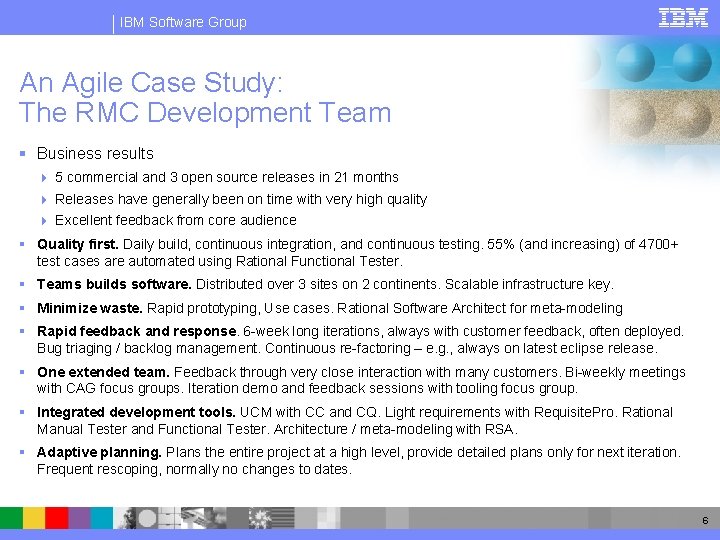
IBM Software Group An Agile Case Study: The RMC Development Team § Business results 4 5 commercial and 3 open source releases in 21 months 4 Releases have generally been on time with very high quality 4 Excellent feedback from core audience § Quality first. Daily build, continuous integration, and continuous testing. 55% (and increasing) of 4700+ test cases are automated using Rational Functional Tester. § Teams builds software. Distributed over 3 sites on 2 continents. Scalable infrastructure key. § Minimize waste. Rapid prototyping, Use cases. Rational Software Architect for meta-modeling § Rapid feedback and response. 6 -week long iterations, always with customer feedback, often deployed. Bug triaging / backlog management. Continuous re-factoring – e. g. , always on latest eclipse release. § One extended team. Feedback through very close interaction with many customers. Bi-weekly meetings with CAG focus groups. Iteration demo and feedback sessions with tooling focus group. § Integrated development tools. UCM with CC and CQ. Light requirements with Requisite. Pro. Rational Manual Tester and Functional Tester. Architecture / meta-modeling with RSA. § Adaptive planning. Plans the entire project at a high level, provide detailed plans only for next iteration. Frequent rescoping, normally no changes to dates. 6
IBM Software Group Agenda IBM Software Group is Going Agile What Is RUP? What is agile? Common Mistakes Implementing RUP Learning from Open. UP Implementing RUP – Agile Style Future direction Rational Team Concert Some parting thoughts
IBM Software Group Some Reflections on Process… § ‘Process” is a loaded word, with different meanings § Software development is about people working together. A process describes such a collaboration. § A process is a means of capturing and distributing relevant knowledge and practices § Process is a basis for change (from Lean Development by Poppendieck’s) § Process is not there to curb innovation. It is an aid that should be evolved as you learn what works and what does not work § Process improvement people are not always helping. The end goal is never to follow a process, it is to achieve good results.
IBM Software Group What Is RUP? § A set of principles § A collection of out-of-the-box processes to use as a starting point § A customizable process framework and knowledge base 4 supports implementation of the principles
IBM Software Group The Spirit of The Rational Unified Process 1. Attack major risks early and continuously… or they attack you 2. Ensure that you deliver value to your customer 3. Have a maniacal focus on working software 4. Accommodate change early in the project 5. Baseline an executable architecture early on 6. Build your system with services and components 7. Work closely together as one team 8. Make quality a way of life, not an afterthought
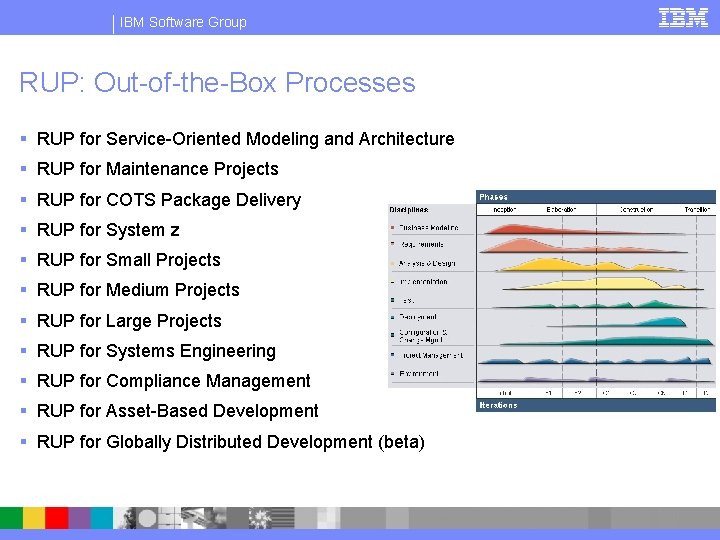
IBM Software Group RUP: Out-of-the-Box Processes § RUP for Service-Oriented Modeling and Architecture § RUP for Maintenance Projects § RUP for COTS Package Delivery § RUP for System z § RUP for Small Projects § RUP for Medium Projects § RUP for Large Projects § RUP for Systems Engineering § RUP for Compliance Management § RUP for Asset-Based Development § RUP for Globally Distributed Development (beta)
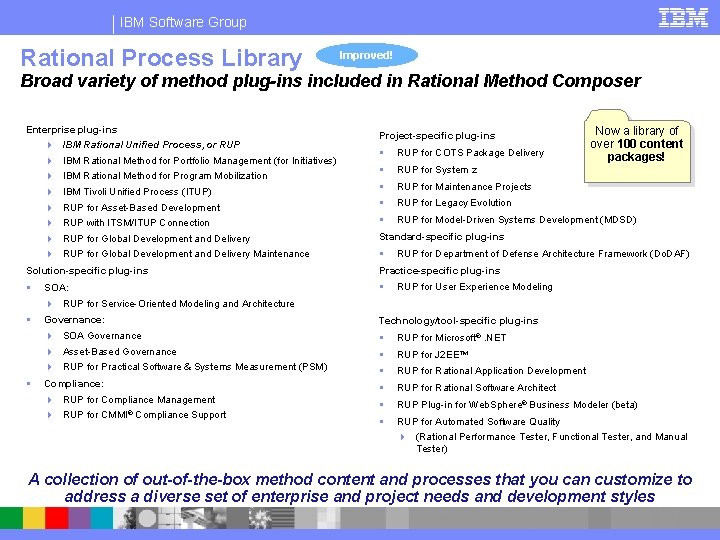
IBM Software Group Rational Process Library Improved! Broad variety of method plug-ins included in Rational Method Composer Enterprise plug-ins 4 4 4 4 IBM Rational Unified Process, or RUP Project-specific plug-ins Now a library of over 100 content packages! § RUP for COTS Package Delivery § RUP for System z § RUP for Maintenance Projects RUP for Asset-Based Development § RUP for Legacy Evolution RUP with ITSM/ITUP Connection § RUP for Model-Driven Systems Development (MDSD) RUP for Global Development and Delivery Standard-specific plug-ins RUP for Global Development and Delivery Maintenance § IBM Rational Method for Portfolio Management (for Initiatives) IBM Rational Method for Program Mobilization IBM Tivoli Unified Process (ITUP) RUP for Department of Defense Architecture Framework (Do. DAF) Solution-specific plug-ins Practice-specific plug-ins § § SOA: RUP for User Experience Modeling 4 RUP for Service-Oriented Modeling and Architecture § § Governance: Technology/tool-specific plug-ins 4 SOA Governance 4 Asset-Based Governance 4 RUP for Practical Software & Systems Measurement (PSM) § RUP for Microsoft®. NET § RUP for J 2 EE™ § RUP for Rational Application Development Compliance: § RUP for Rational Software Architect 4 RUP for Compliance Management 4 RUP for CMMI® Compliance Support § RUP Plug-in for Web. Sphere® Business Modeler (beta) § RUP for Automated Software Quality 4 (Rational Performance Tester, Functional Tester, and Manual Tester) A collection of out-of-the-box method content and processes that you can customize to address a diverse set of enterprise and project needs and development styles
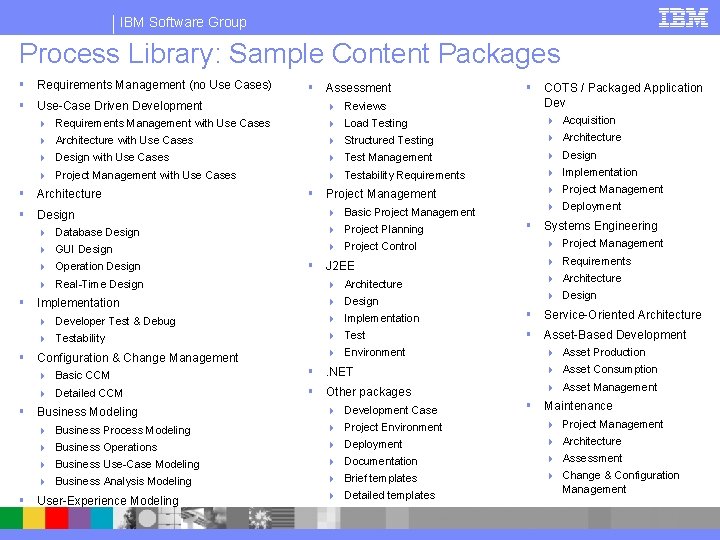
IBM Software Group Process Library: Sample Content Packages § Requirements Management (no Use Cases) § Use-Case Driven Development 4 4 Requirements Management with Use Cases Architecture with Use Cases Design with Use Cases Project Management with Use Cases § Architecture § Design 4 4 Database Design GUI Design § Assessment 4 4 4 Reviews Load Testing Structured Testing Test Management Testability Requirements § Project Management 4 Basic Project Management 4 Project Planning 4 Project Control Operation Design § J 2 EE Real-Time Design 4 4 4 § Implementation 4 Developer Test & Debug 4 Testability § Configuration & Change Management Architecture Design Business Analysis Modeling § User-Experience Modeling Design Implementation Project Management Deployment § Systems Engineering 4 4 Project Management Requirements Architecture Design § Asset-Based Development Environment 4 4 4 Business Use-Case Modeling Architecture Test § Business Modeling Business Operations Acquisition § Service-Oriented Architecture §. NET Business Process Modeling 4 4 4 Implementation 4 Basic CCM 4 Detailed CCM 4 4 § COTS / Packaged Application Dev § Other packages Development Case Project Environment Deployment Documentation Brief templates Detailed templates 4 Asset Production 4 Asset Consumption 4 Asset Management § Maintenance 4 4 Project Management Architecture Assessment Change & Configuration Management
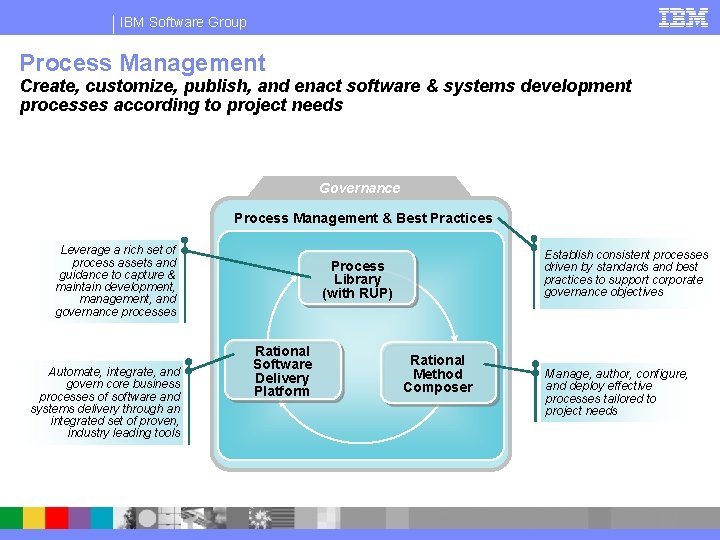
IBM Software Group Process Management Create, customize, publish, and enact software & systems development processes according to project needs Governance Process Management & Best Practices Leverage a rich set of process assets and guidance to capture & maintain development, management, and governance processes Automate, integrate, and govern core business processes of software and systems delivery through an integrated set of proven, industry leading tools Establish consistent processes driven by standards and best practices to support corporate governance objectives Process Library (with RUP) Rational Software Delivery Platform Rational Method Composer Manage, author, configure, and deploy effective processes tailored to project needs
IBM Software Group Capabilities: Rational Process Library § Provides process building blocks when constructing your own process 4 Do not use your top people to define basic practices, reuse what is known to work § Provides out-of-the-box processes 4 Dozen plus out-of-the box processes provided 4 Use as a starting point or as-is § Solves the ‘unique project’ versus ‘common practice’ problem 4 Have unique processes for different project types 4 Share common practices across different project types; Language, Approaches, Oversight, Resourcing, and Reuse § Integrates Development with the rest of the organization 4 If Development is there to support the business, it’s processes needs to be integrated with the rest of the business 4 Development – Operations, Development – IT Direction, Development - Resilience
IBM Software Group IBM Rational Method Composer Tool Capabilities § Create and manage reusable process packages (roles, tasks, artifacts, guidelines, examples, templates) § Create (low-level) reusable process patterns (e. g. design, implement and test a scenario) § Create (high-level) processes (WBS) for different project types. Optionally assembled from process patterns § Create derivatives of process packages, reference material, and processes § Provide easy upgrade to new versions of base set of process packages, reference materials and high-level processes § Ensure consistent presentation and structure of process content, including generated graphical representations § Effectively deploy best practices through Websites, guidance integrated in development environment, project management tools, business process modeling solutions
IBM Software Group Sample Supported Authoring Scenarios § Select and configure out-of-the-box processes 4 Select and deselect content packages, and the process will automatically update itself § Tailoring an out-of-the-box process 4 Customize the process as appropriate, modify workflows § Assemble new processes rapidly using existing high-level process patterns 4 Reuse content packages and existing process patterns § Creating a new process bottom-up from scratch reusing method content 4 Build a process from scratch, leverage existing process packages where appropriate
IBM Software Group Agenda IBM Software Group is Going Agile What Is RUP? What is agile? Common Mistakes Implementing RUP Learning from Open. UP Implementing RUP – Agile Style Future direction Rational Team Concert Some parting thoughts
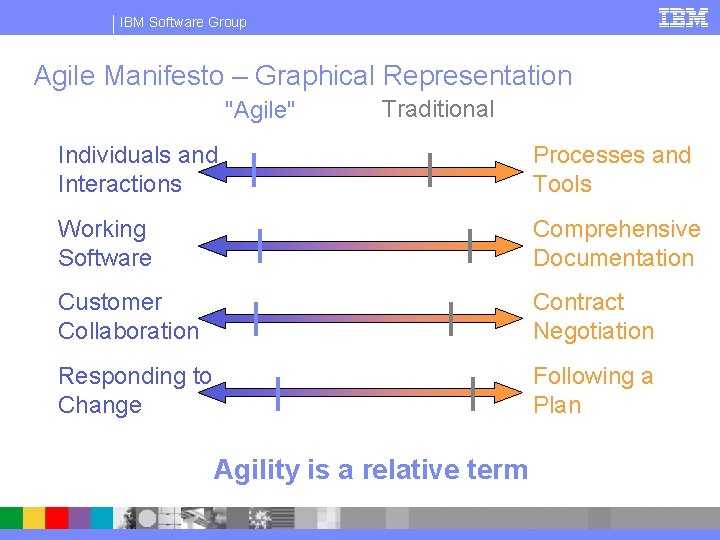
IBM Software Group Agile Manifesto – Graphical Representation "Agile" Individuals and Interactions Working Software Customer Collaboration Responding to Change | Traditional Processes and Tools | | Contract Negotiation | | Comprehensive Documentation | Agility is a relative term Following a Plan
IBM Software Group What is Agile? § An iterative and incremental (evolutionary) approach performed in a highly collaborative manner with just the right amount of ceremony to produce high quality software in a cost effective and timely manner which meets the changing needs of its stakeholders. § Core principles 4 “Fits just right” process 4 Continuous testing and validation 4 Consistent team collaboration 4 Rapid response to change 4 Ongoing customer involvement 4 Frequent delivery of working software “Agile” <capital ‘A’> – Dogmatic “agile” <lowercase ‘a’> - Pragmatic
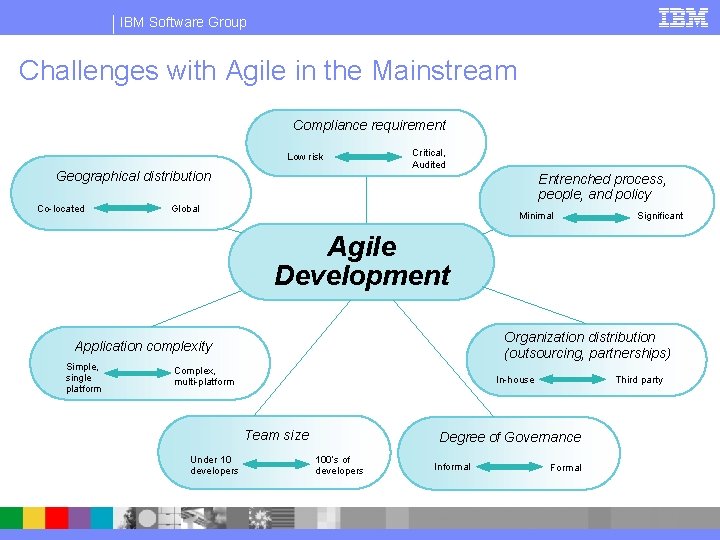
IBM Software Group Challenges with Agile in the Mainstream Compliance requirement Low risk Geographical distribution Co-located Critical, Audited Entrenched process, people, and policy Global Minimal Significant Agile Development Organization distribution (outsourcing, partnerships) Application complexity Simple, single platform Complex, multi-platform Team size Under 10 developers Third party In-house Degree of Governance 100’s of developers Informal Formal
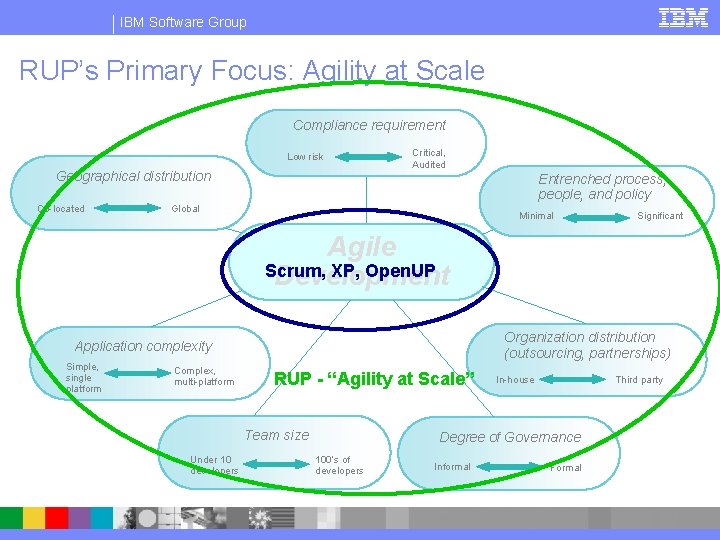
IBM Software Group RUP’s Primary Focus: Agility at Scale Compliance requirement Low risk Geographical distribution Co-located Critical, Audited Entrenched process, people, and policy Global Minimal Significant Agile Scrum, XP, Open. UP Development Organization distribution (outsourcing, partnerships) Application complexity Simple, single platform Complex, multi-platform RUP - “Agility at Scale” Team size Under 10 developers Third party In-house Degree of Governance 100’s of developers Informal Formal
IBM Software Group Agenda IBM Software Group is Going Agile What Is RUP? What is agile? Common Mistakes Implementing RUP Learning from Open. UP Implementing RUP – Agile Style Future direction Rational Team Concert Some parting thoughts
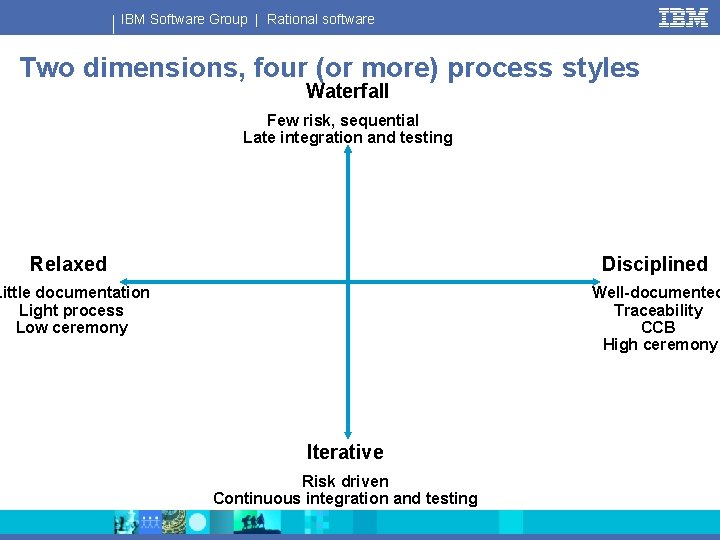
IBM Software Group | Rational software Two dimensions, four (or more) process styles Waterfall Few risk, sequential Late integration and testing Relaxed Disciplined Little documentation Light process Low ceremony Well-documented Traceability CCB High ceremony Iterative Risk driven Continuous integration and testing
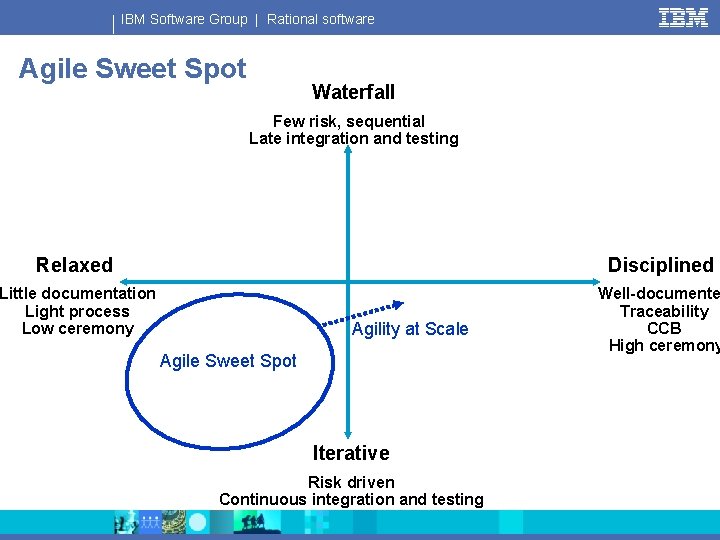
IBM Software Group | Rational software Agile Sweet Spot Waterfall Fewrisk, sequential Lateintegrationand andtesting Low. Relaxed Ceremony High Ceremony Disciplined Littledocumentation Lightprocess Low ceremony Agility at Scale Agile Sweet Spot Iterative Riskdriven Continuousintegrationand andtesting Well-documented Well-documente Traceability CCB High ceremony
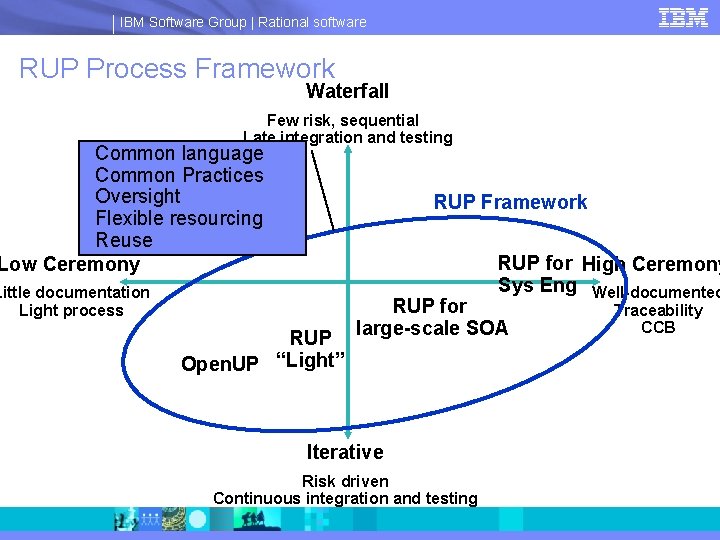
IBM Software Group | Rational software RUP Process Framework Waterfall Few risk, sequential Late integration and testing §Common language §Common Practices §Oversight §Flexible resourcing §Reuse Low Ceremony RUP Framework RUP for High Ceremony Sys Eng Well-documented Little documentation Light process RUP Open. UP “Light” RUP for large-scale SOA Iterative Risk driven Continuous integration and testing Traceability CCB
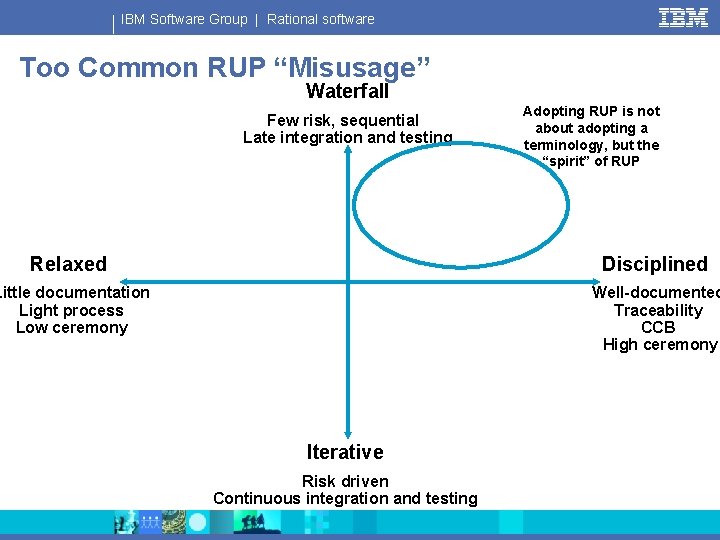
IBM Software Group | Rational software Too Common RUP “Misusage” Waterfall Few risk, sequential Late integration and testing Adopting RUP is not about adopting a terminology, but the “spirit” of RUP Relaxed Disciplined Little documentation Light process Low ceremony Well-documented Traceability CCB High ceremony Iterative Risk driven Continuous integration and testing
IBM Software Group | Rational software Common Pitfalls – Process Weight and Perfection § Too much formality / too many artifacts 4 Only produce the artifacts that add value, minimize formality if possible 4 Use informal resources (brief document templates) and not formal resources 4 When in doubt of value, don’t do it § Analysis Paralysis 4 You can improve upon things later on – move on 4 Focus on phase objectives. E. g. Inception is NOT about describing all requirements in detail
IBM Software Group | Rational software Common Pitfalls - Lifecycle § Following a waterfall process, versus RUP’s iterative processes 4 Look beyond a flawed 5 -minute perception of what RUP phases are about… 4 Produce working (tested) code every iteration (exception maybe Inception) § Big Upfront Architecture 4 Problem: Complete misunderstanding of what Elaboration is about 4 RUP focuses on rapidly producing an Executable Architecture 4 10 -20% of code, critical capabilities implemented, not a lot of paper design § Save the tricky part for later 4 Attack risks early, or they attack you 4 Hard on you now, but makes life easier later
IBM Software Group | Rational software Common Pitfalls – Organization and Mentality § Functional, Specialized Organization 4 Teams of generalists and multitasking experts 4 No place for “I only do <X>” mentality § No customer feedback until a late beta 4 Unlikely to build the right product 4 A lot of waste § No willingness to change things 4 Change enables improvement § Your process is stagnant versus evolving 4 Document changes in development case
IBM Software Group | Rational software Common Pitfalls – Development Approach § No developer testing 4 You can have a separate test team, but that does not free developers from having to build (and test) their application 4 Dedicated test team only if very complex environments and/or mission- or safety-critical systems § Continuous integration not happening 4 Daily build (or more frequently) minimizes rework § Testing not initiated until end of construction 4 You are unlikely to meet deadlines
IBM Software Group | Rational software Agenda IBM Software Group is Going Agile What Is RUP? What is agile? Common Mistakes Implementing RUP Learning from Open. UP Implementing RUP – Agile Style Future direction Rational Team Concert Some parting thoughts
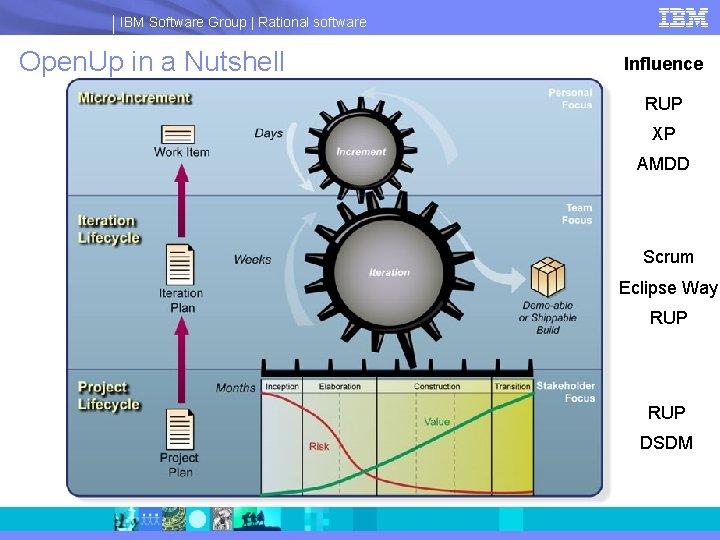
IBM Software Group | Rational software Open. Up in a Nutshell Influence RUP XP AMDD Scrum Eclipse Way RUP DSDM
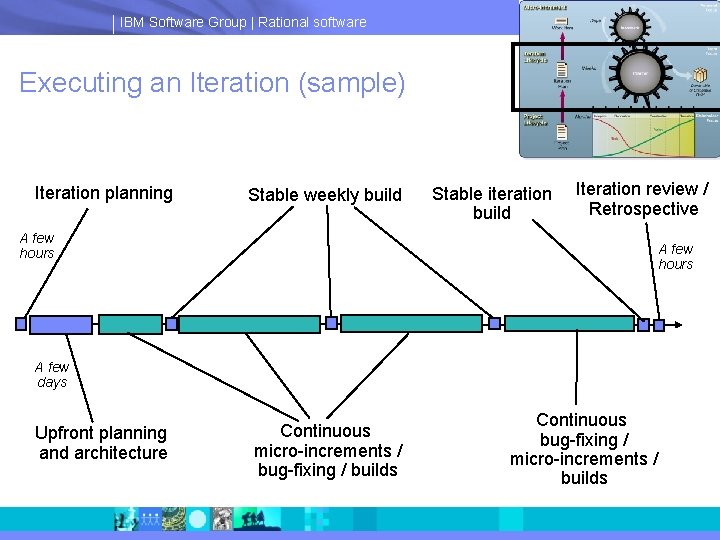
IBM Software Group | Rational software Executing an Iteration (sample) Iteration planning Stable weekly build Stable iteration build Iteration review / Retrospective A few hours A few days Upfront planning and architecture Continuous micro-increments / bug-fixing / builds Continuous bug-fixing / micro-increments / builds
IBM Software Group | Rational software What is Self-Organization About? § Motivate team members § Manager – coaching and leading, not directing § Decision making – People closest to the decision make the decision § Success - Team success is individual success, and vice-versa § Estimation – prove yourself right § Work assignment - Pull instead of push model § Manager still accountable § It is about involvement and respect, not wool sweaters and hugging
IBM Software Group | Rational software Evolving Applications through Micro-Increments § Each micro-increment 4 corresponds to 0. 5 -3 days person days of work 4 is added (and removed if necessary) to the build 4 needs to be properly tested 4 Needs to looked upon (requirements, design, implementation and testing) from a uservalue perspective (use-case driven) § A month-long iteration with 20 developers would consists of ~200 microincrements § Micro-increments provides the team with the ability to manage and demonstrate continuous progress § Micro-increments applies to any type of project activity
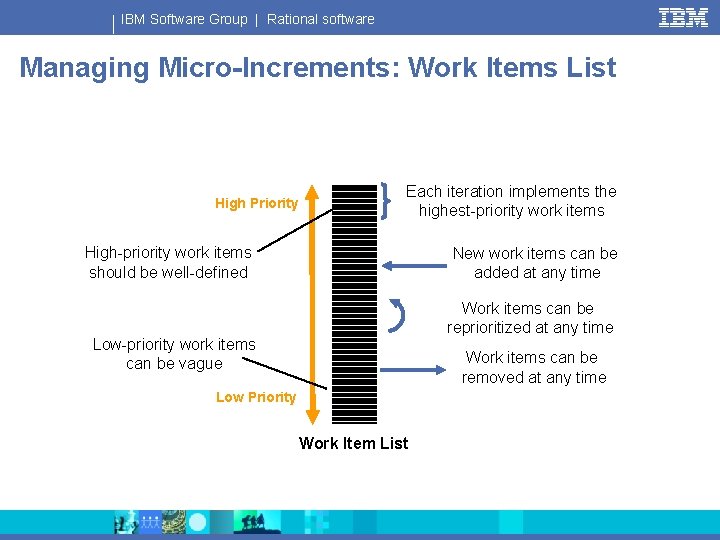
IBM Software Group | Rational software Managing Micro-Increments: Work Items List High Priority Each iteration implements the highest-priority work items High-priority work items should be well-defined New work items can be added at any time Work items can be reprioritized at any time Low-priority work items can be vague Work items can be removed at any time Low Priority Work Item List
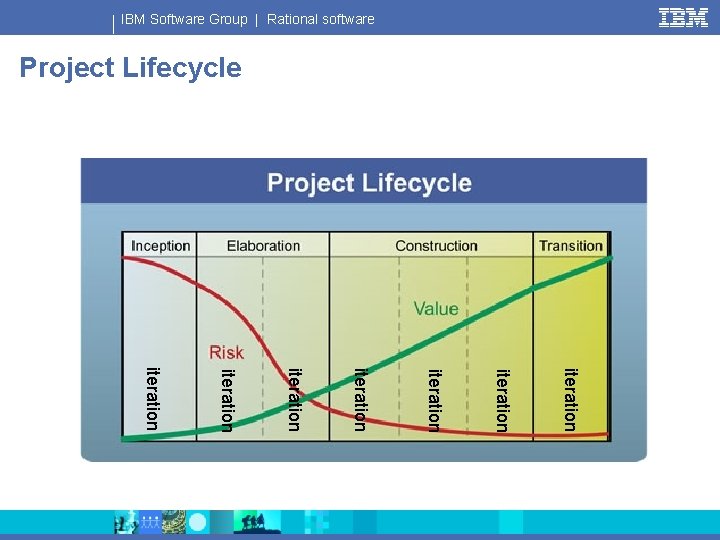
IBM Software Group | Rational software Project Lifecycle iteration iteration
IBM Software Group | Rational software Agenda IBM Software Group is Going Agile What Is RUP? What is agile? Common Mistakes Implementing RUP Learning from Open. UP Implementing RUP – Agile Style Future direction Rational Team Concert Some parting thoughts
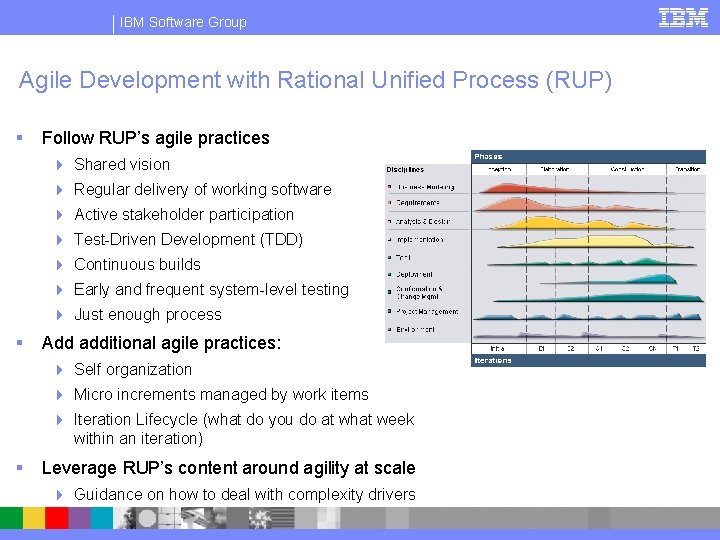
IBM Software Group Agile Development with Rational Unified Process (RUP) § Follow RUP’s agile practices 4 Shared vision 4 Regular delivery of working software 4 Active stakeholder participation 4 Test-Driven Development (TDD) 4 Continuous builds 4 Early and frequent system-level testing 4 Just enough process § Add additional agile practices: 4 Self organization 4 Micro increments managed by work items 4 Iteration Lifecycle (what do you do at what week within an iteration) § Leverage RUP’s content around agility at scale 4 Guidance on how to deal with complexity drivers
IBM Software Group Customize RUP § Start with a small out-of-the-box process 4 RUP for Small Projects / RUP for Maintenance § Customize it to meet your needs 4 Make it smaller by deselecting content packages not needed 4 Remove artifacts not needed (additional support for this in RMC 7. 2) § Publish the (delivery) process 4 Choose to publish only the delivery process, versus entire configuration § Leverage Development Case 4 A 1 -3 page description of the process you use 4 Reference your RUP process and other sources, no need to duplicate info § Improve the process every iteration 4 Update development case after each iteration review / retrospective 4 Update delivery process if significant changes
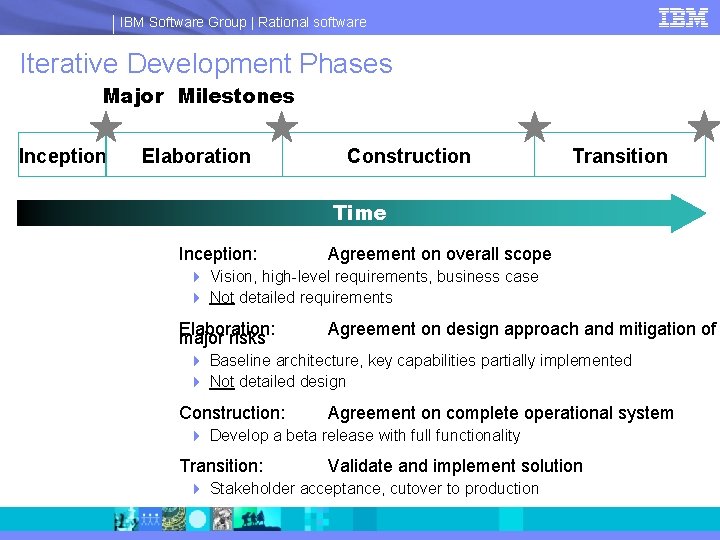
IBM Software Group | Rational software Iterative Development Phases Major Milestones Inception Elaboration Construction Transition Time Inception: Agreement on overall scope 4 Vision, high-level requirements, business case 4 Not detailed requirements Elaboration: major risks Agreement on design approach and mitigation of 4 Baseline architecture, key capabilities partially implemented 4 Not detailed design Construction: Agreement on complete operational system 4 Develop a beta release with full functionality Transition: Validate and implement solution 4 Stakeholder acceptance, cutover to production
IBM Software Group | Rational software Inception: Know What to Build § Typically one short iteration § Produce vision document and initial business case 4 Only produce what has value § Develop high-level project requirements 4 Initial use-case and (optional) domain models (10 -20% complete) 4 Focus on what is required to get agreement on ‘big picture’ § Manage project scope 4 Reduce risk by identifying key requirements 4 Acknowledge that requirements will change § Manage change, use iterative process § Produce conceptual prototypes as needed Inception Elaboration Construction Transition
IBM Software Group | Rational software Example: UCs in Inception § Inception: 5 people, 2 weeks (for a 6 month project) => 400 hours § 2 hour joint UC workshop with key stakeholders ~10 hours 4 15 UCs, 4 critical, 5 important, 6 less important § Outline UCs: 4 hours per critical, 2 per important, and 1 per less important ~ 32 4 Includes some potential UI mockups § UC walkthrough: 1 hour per important UC, 30 min for all others x 5 people ~ 48 hours 4 Focus is on extended team converging on what application they are building, not to lock down on requirements § Further updates based on walkthrough ~ 10 hours § Discussion: Is it worth to spend ~100 hours on getting concurrence on an initial UC Model? 4 Note – we know the UC model will evolve as project progresses
IBM Software Group | Rational software Elaboration: Know How to Build It by Building Some § Elaboration can be a day long or several iterations § Balance mitigating key technical and business risks with producing value (tested code) § Detail ~top 3 rd most essential requirements (so you can estimate and prioritize) § Produce (and validate) an executable and stable architecture 4 Define, implement and test interfaces of major components. Partially implement some key components. 4 Identify dependencies on external components and systems. Integrate shells/proxies of them. 4 Roughly 10% of code is implemented. § Drive architecture with key use cases 4 20% of use cases drive 80% of the architecture Inception Elaboration Construction Transition
IBM Software Group | Rational software Construction: Build The Product § Incrementally define, design, implement and test more and more scenarios 4 Incrementally evolve executable architecture to complete system 4 Evolve architecture as you go along § Frequent demonstrations and partial deployment 4 Partial deployment strategy depends greatly on what system you build § Daily build with automated build process § You may have to have a separate test team if you have 4 Complex test environments 4 Safety or mission critical systems Inception Elaboration Construction Transition
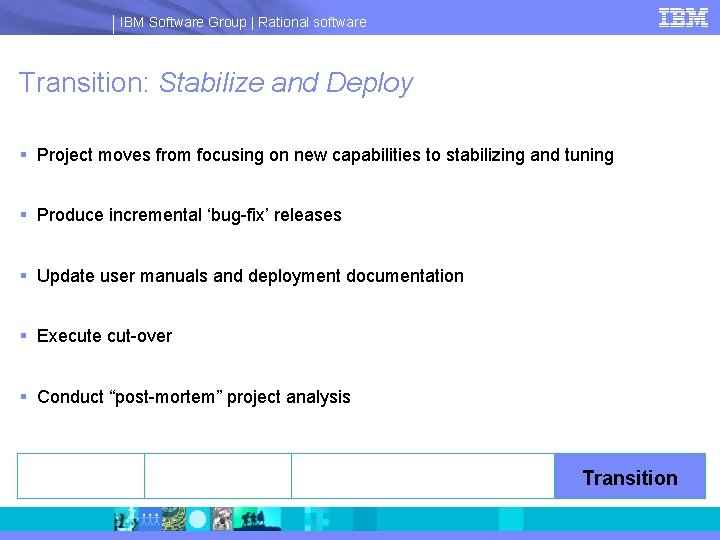
IBM Software Group | Rational software Transition: Stabilize and Deploy § Project moves from focusing on new capabilities to stabilizing and tuning § Produce incremental ‘bug-fix’ releases § Update user manuals and deployment documentation § Execute cut-over § Conduct “post-mortem” project analysis Inception Elaboration Construction Transition
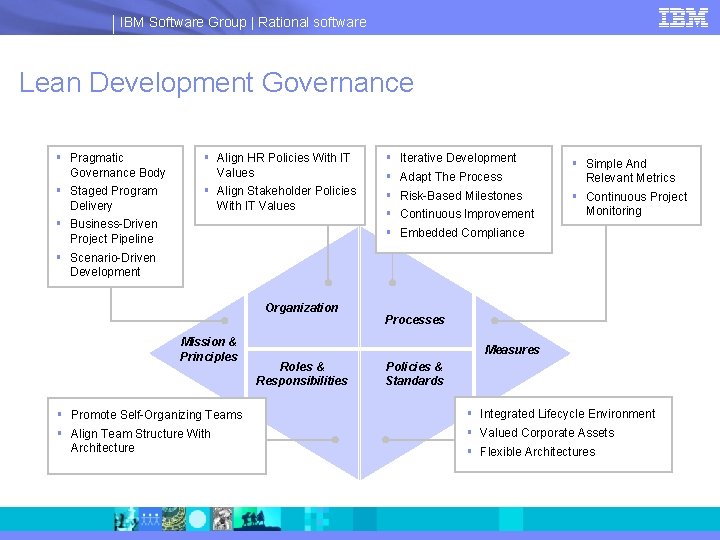
IBM Software Group | Rational software Lean Development Governance § Pragmatic Governance Body § Staged Program Delivery § Business-Driven Project Pipeline § Scenario-Driven Development § Align HR Policies With IT Values § Align Stakeholder Policies With IT Values Organization Mission & Principles § Promote Self-Organizing Teams § Align Team Structure With Architecture § § § Iterative Development Adapt The Process Risk-Based Milestones Continuous Improvement § Simple And Relevant Metrics § Continuous Project Monitoring Embedded Compliance Processes Measures Roles & Responsibilities Policies & Standards § Integrated Lifecycle Environment § Valued Corporate Assets § Flexible Architectures
IBM Software Group | Rational software Agenda IBM Software Group is Going Agile What Is RUP? What is agile? Common Mistakes Implementing RUP Learning from Open. UP Implementing RUP – Agile Style Future direction Rational Team Concert Some parting thoughts
IBM Software Group | Rational software Disclaimer This presentation covers current capabilities as well as potential future capabilities. The material discussing potential futures is directional in nature and does not imply any product commitment on the part of IBM. Concepts and prototypes shown in this presentation may or may not reflect current or future product function.
IBM Software Group | Rational software Loosely Coupled Practices § Easily configure the process to match your needs 4 Incrementally add practices as you need them § Develop a library of practices with minimum of dependencies between practices 4 Different companies can develop practices that work together, assuming they follow certain ‘interface specifications’ § Has the potential of focusing the industry on documentation of effective practices vs. “process branding wars” 4 Removes distractions
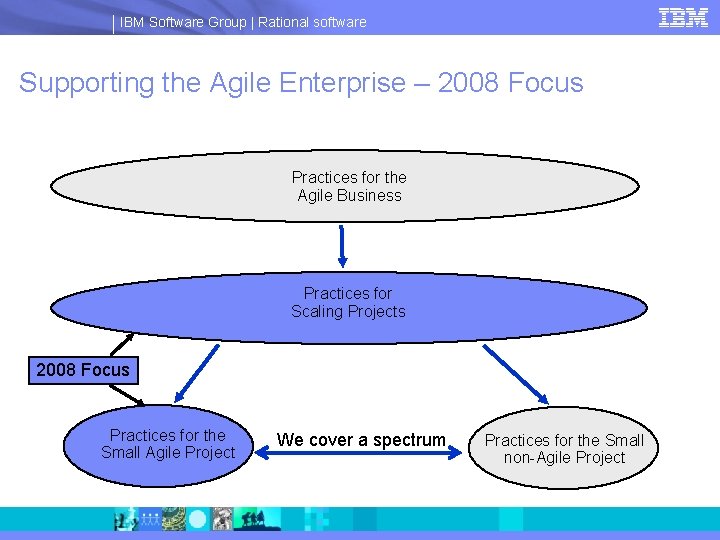
IBM Software Group | Rational software Supporting the Agile Enterprise – 2008 Focus Practices for the Agile Business Practices for Scaling Projects 2008 Focus Practices for the Small Agile Project We cover a spectrum Practices for the Small non-Agile Project
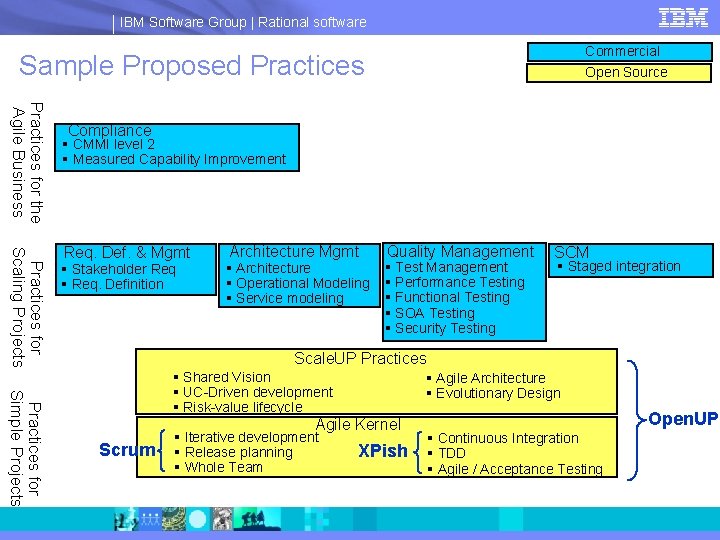
IBM Software Group | Rational software Commercial Open Source Sample Proposed Practices for the Agile Business Compliance § CMMI level 2 § Measured Capability Improvement Practices for Scaling Projects Req. Def. & Mgmt § Stakeholder Req § Req. Definition Architecture Mgmt § Architecture § Operational Modeling § Service modeling Quality Management § Test Management § Performance Testing § Functional Testing § SOA Testing § Security Testing SCM § Staged integration Scale. UP Practices for Simple Projects § Shared Vision § UC-Driven development § Risk-value lifecycle § Agile Architecture § Evolutionary Design Agile Kernel Scrum § Iterative development § Release planning § Whole Team XPish Open. UP § Continuous Integration § TDD § Agile / Acceptance Testing
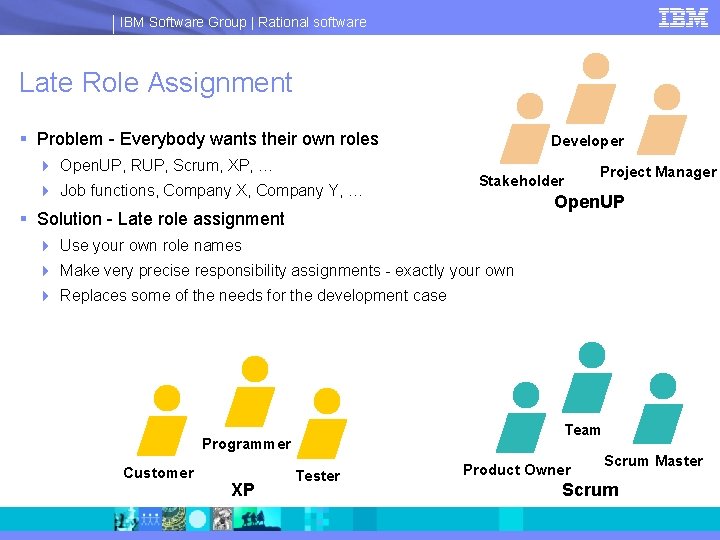
IBM Software Group | Rational software Late Role Assignment § Problem - Everybody wants their own roles 4 Open. UP, RUP, Scrum, XP, … 4 Job functions, Company X, Company Y, … Developer Stakeholder Project Manager • Open. UP § Solution - Late role assignment 4 Use your own role names 4 Make very precise responsibility assignments - exactly your own 4 Replaces some of the needs for the development case Team Programmer Customer • XP Tester Product Owner Scrum Master • Scrum
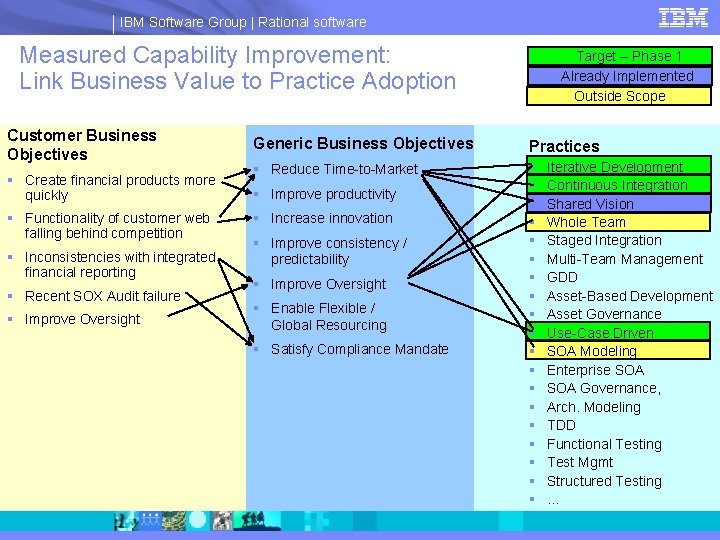
IBM Software Group | Rational software Measured Capability Improvement: Link Business Value to Practice Adoption Target – Phase 1 Already Implemented Outside Scope Customer Business Objectives Generic Business Objectives Practices § Create financial products more quickly § Reduce Time-to-Market § Improve productivity § § § § § Functionality of customer web falling behind competition § Inconsistencies with integrated financial reporting § Recent SOX Audit failure § Improve Oversight § Increase innovation § Improve consistency / predictability § Improve Oversight § Enable Flexible / Global Resourcing § Satisfy Compliance Mandate Iterative Development Continuous Integration Shared Vision Whole Team Staged Integration Multi-Team Management GDD Asset-Based Development Asset Governance Use-Case Driven SOA Modeling Enterprise SOA Governance, Arch. Modeling TDD Functional Testing Test Mgmt Structured Testing …
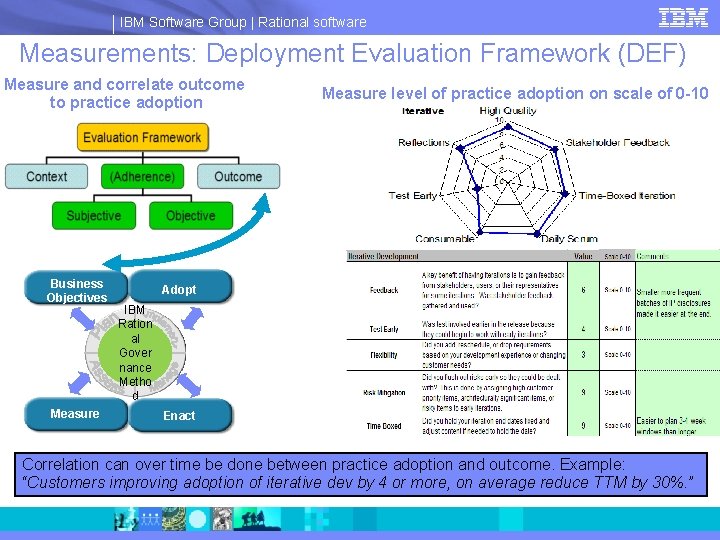
IBM Software Group | Rational software Measurements: Deployment Evaluation Framework (DEF) Measure and correlate outcome to practice adoption Business Objectives Measure level of practice adoption on scale of 0 -10 Adopt IBM Ration al Gover nance Metho d Enact Correlation can over time be done between practice adoption and outcome. Example: “Customers improving adoption of iterative dev by 4 or more, on average reduce TTM by 30%. ”
IBM Software Group | Rational software Agenda IBM Software Group is Going Agile What Is RUP? What is agile? Common Mistakes Implementing RUP Learning from Open. UP Implementing RUP – Agile Style Future direction Rational Team Concert Some parting thoughts
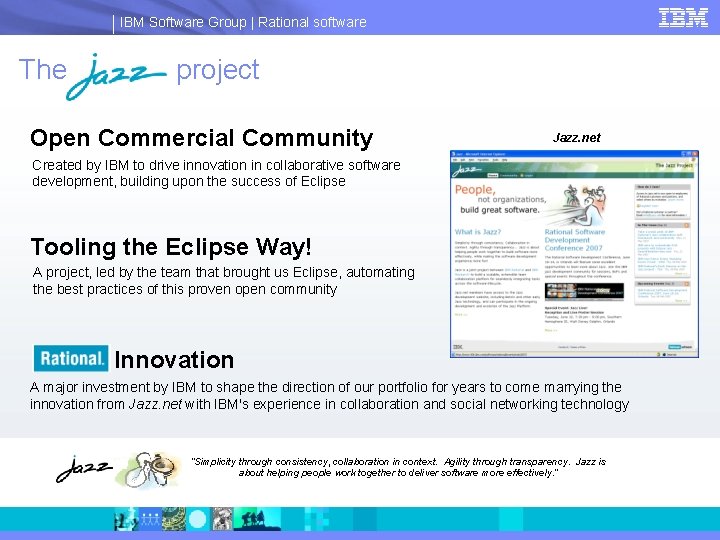
IBM Software Group | Rational software The project Open Commercial Community Jazz. net Created by IBM to drive innovation in collaborative software development, building upon the success of Eclipse Tooling the Eclipse Way! A project, led by the team that brought us Eclipse, automating the best practices of this proven open community Innovation A major investment by IBM to shape the direction of our portfolio for years to come marrying the innovation from Jazz. net with IBM's experience in collaboration and social networking technology “Simplicity through consistency, collaboration in context. Agility through transparency. Jazz is about helping people work together to deliver software more effectively. ”
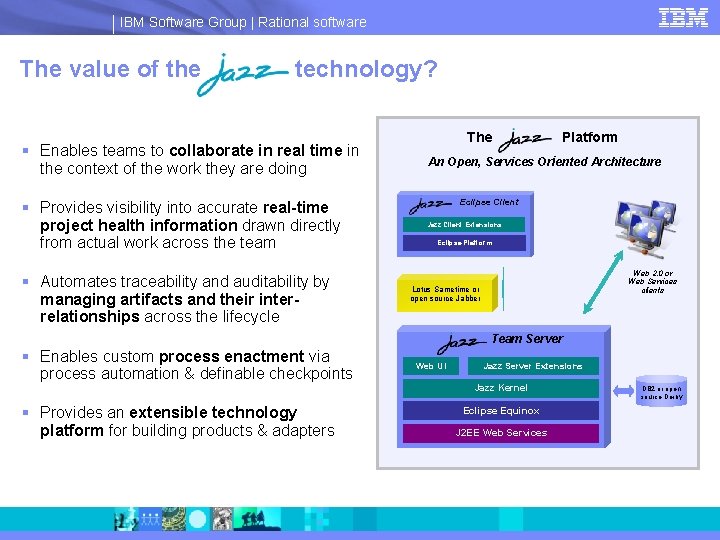
IBM Software Group | Rational software The value of the technology? § Enables teams to collaborate in real time in the context of the work they are doing § Provides visibility into accurate real-time project health information drawn directly from actual work across the team § Automates traceability and auditability by managing artifacts and their interrelationships across the lifecycle The Platform An Open, Services Oriented Architecture Eclipse Client Jazz Client Extensions Eclipse Platform Web 2. 0 or Web Services clients Lotus Sametime or open source Jabber Team Server § Enables custom process enactment via process automation & definable checkpoints Web UI Jazz Server Extensions Jazz Kernel § Provides an extensible technology platform for building products & adapters Eclipse Equinox J 2 EE Web Services DB 2 or open source Derby
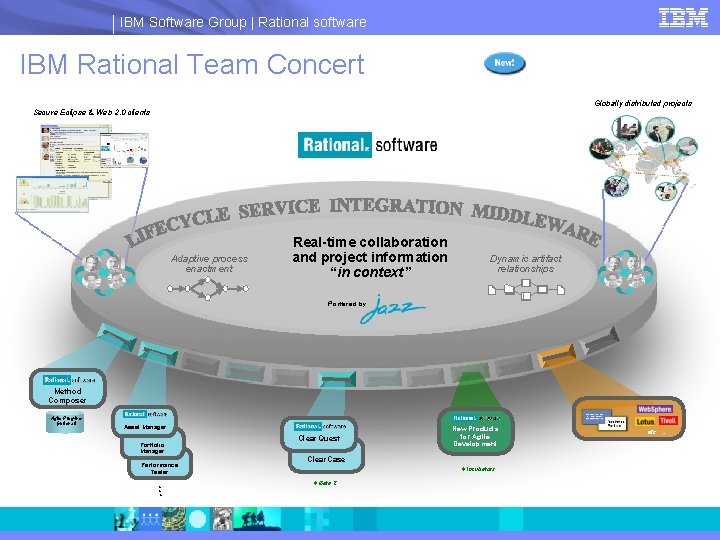
IBM Software Group | Rational software IBM Rational Team Concert Globally distributed projects Secure Eclipse & Web 2. 0 clients Adaptive process enactment Real-time collaboration and project information “in context” Dynamic artifact relationships Powered by Method Composer Asset Manager Portfolio Manager Performance Tester *** Agile Plug-ins (optional) Clear. Quest New Products for Agile Development Clear. Case ¬Incubators ¬Beta 2 etc …
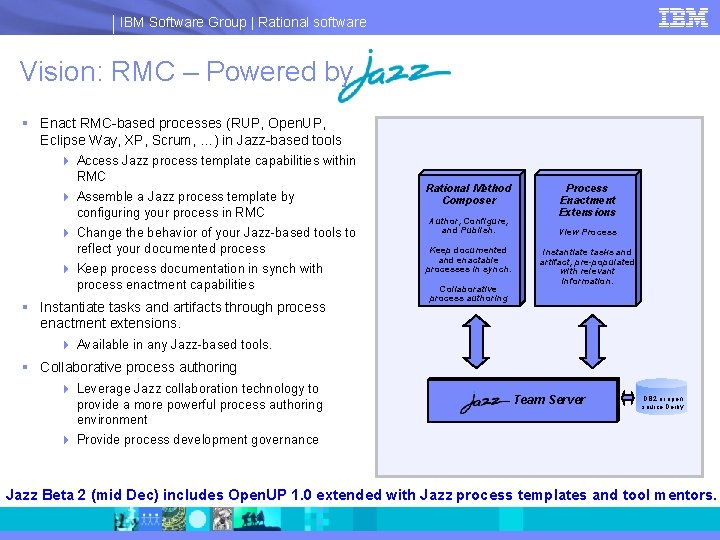
IBM Software Group | Rational software Vision: RMC – Powered by § Enact RMC-based processes (RUP, Open. UP, Eclipse Way, XP, Scrum, …) in Jazz-based tools 4 Access Jazz process template capabilities within RMC 4 Assemble a Jazz process template by configuring your process in RMC 4 Change the behavior of your Jazz-based tools to reflect your documented process 4 Keep process documentation in synch with process enactment capabilities § Instantiate tasks and artifacts through process enactment extensions. Rational Method Composer Author, Configure, and Publish. Keep documented and enactable processes in synch. Collaborative process authoring Process Enactment Extensions View Process Instantiate tasks and artifact, pre-populated with relevant information. 4 Available in any Jazz-based tools. § Collaborative process authoring 4 Leverage Jazz collaboration technology to provide a more powerful process authoring environment Team Server DB 2 or open source Derby 4 Provide process development governance Jazz Beta 2 (mid Dec) includes Open. UP 1. 0 extended with Jazz process templates and tool mentors.
IBM Software Group | Rational software Agenda IBM Software Group is Going Agile What Is RUP? What is agile? Common Mistakes Implementing RUP Learning from Open. UP Implementing RUP – Agile Style Future direction Rational Team Concert Some parting thoughts
IBM Software Group Parting Thoughts: Implementing RUP – Agile Style § Focus on principles of RUP § Chose a version of RUP suitable for your projects 4 Further customize it, and use development case as a living document § Only use what adds value to your project 4 Most artifacts are there to aid collaboration. Use them as such. 4 Some artifacts provides crucial persistency (audits, maintenance, extended audience, contractual situations, oversight, …) § A process is a baseline, evolve it as you improve 4 Do not let the “process police” dictate what makes sense 4 If you like practices outside RUP, include them
IBM Software Group Parting Thoughts: Succeeding with Agile § Agile Development is transforming how development is done 4 Placing greater demand on people, processes and tools § Agile can scale to accommodate technical and organizational complexity 4 Agility at Scale has unique needs 4 IBM Rational and partners brings a wealth of knowledge to help companies succeed in complex environments § IBM Rational is forging new ground in Agile Development 4 Bringing technology, services and best practices to help customers reduce the risk of Agile projects 4 Investing significant resources to improve Agile success
IBM Software Group Resources § All in one page: www. ibm. com/rational/agile/ § Rational Team Concert / Jazz: www. jazz. net § RMC / RUP: http: //www. ibm. com/developerworks/rational/products/rup/ http: //blog. haumer. net/ § EPF / Open. UP: http: //www. eclipse. org/epf/ § Guidance on incremental adoption of a process: Agility and Discipline Made Easy – Practices from Open. UP and RUP, Kroll and Mac. Isaac, Addison-Wesley, 2005
IBM Software Group Questions
IBM Software Group Thank You
- Slides: 67