
IBM Research GPU programming in A High Level
IBM Research GPU programming in A High Level Language Compiling X 10 to CUDA Dave Cunningham, Rajesh Bordawekar, Vijay Saraswat June 2011 © 2009 IBM Corporation
X 10/CUDA Why Program GPUs with X 10? Why program the GPU at all? • Many times faster for certain classes of applications • Hardware is cheap and widely available (as opposed to e. g. FPGA) Why write X 10 (instead of CUDA/Open. CL)? • Use the same programming model (APGAS) on GPU and CPU • Easier to write parallel/distributed GPU-aware programs • Better type safety • Higher level abstractions => fewer lines of code 2 10/25/2021 © 2009 IBM Corporation
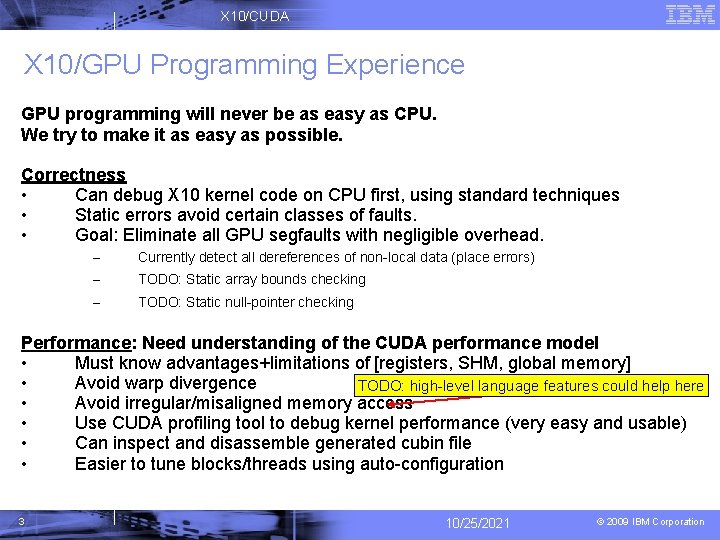
X 10/CUDA X 10/GPU Programming Experience GPU programming will never be as easy as CPU. We try to make it as easy as possible. Correctness • Can debug X 10 kernel code on CPU first, using standard techniques • Static errors avoid certain classes of faults. • Goal: Eliminate all GPU segfaults with negligible overhead. – Currently detect all dereferences of non-local data (place errors) – TODO: Static array bounds checking – TODO: Static null-pointer checking Performance: Need understanding of the CUDA performance model • Must know advantages+limitations of [registers, SHM, global memory] • Avoid warp divergence TODO: high-level language features could help here • Avoid irregular/misaligned memory access • Use CUDA profiling tool to debug kernel performance (very easy and usable) • Can inspect and disassemble generated cubin file • Easier to tune blocks/threads using auto-configuration 3 10/25/2021 © 2009 IBM Corporation
X 10/CUDA Why target CUDA and not Open. CL? 4 • • • In early 2009, Open. CL support was limited CUDA is based on C++ Open. CL based on C C++ features help us implement X 10 features (e. g. generics) By targeting CUDA we can re-use parts of existing C++ backend CUDA evolving fast, more interesting for high level languages (e. g. OOP) • • However there advantages in Open. CL too. . . We could support it in future 10/25/2021 © 2009 IBM Corporation
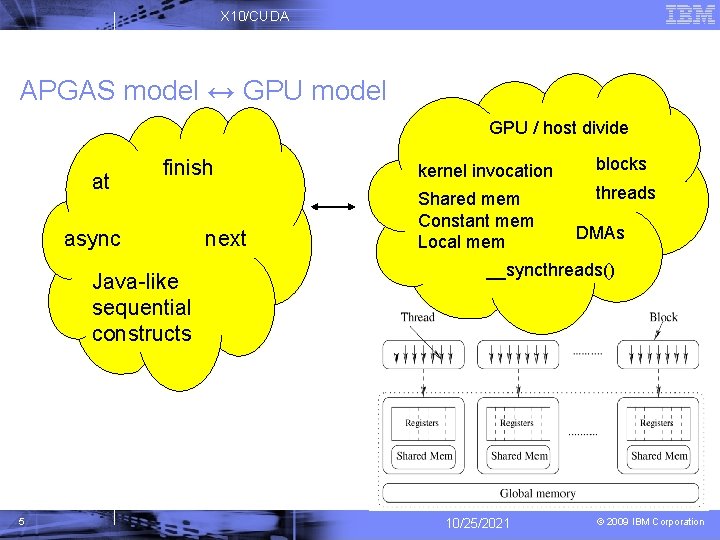
X 10/CUDA APGAS model ↔ GPU model GPU / host divide at finish async Java-like sequential constructs 5 next kernel invocation blocks Shared mem Constant mem Local mem threads DMAs __syncthreads() 10/25/2021 © 2009 IBM Corporation
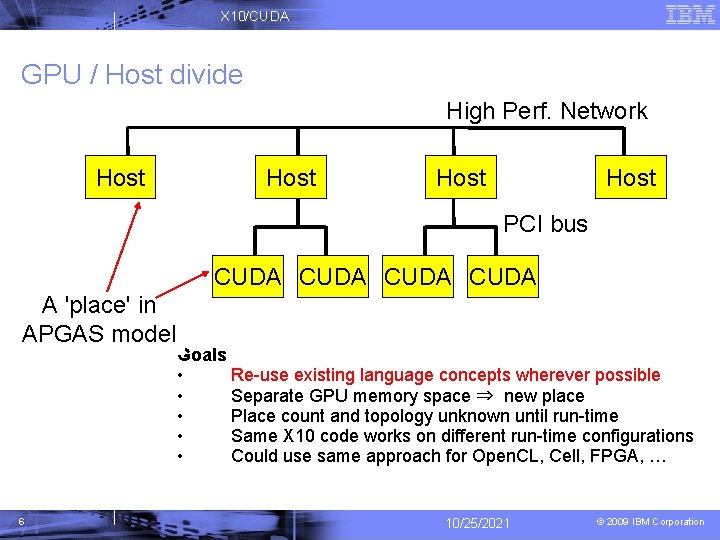
X 10/CUDA GPU / Host divide High Perf. Network Host PCI bus CUDA A 'place' in APGAS model 6 Goals • Re-use existing language concepts wherever possible • Separate GPU memory space ⇒ new place • Place count and topology unknown until run-time • Same X 10 code works on different run-time configurations • Could use same approach for Open. CL, Cell, FPGA, … 10/25/2021 © 2009 IBM Corporation
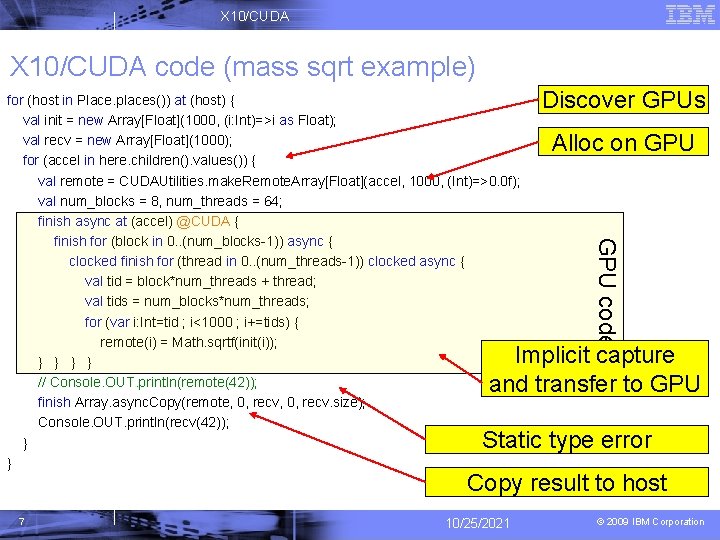
X 10/CUDA code (mass sqrt example) Discover GPUs Alloc on GPU code for (host in Place. places()) at (host) { val init = new Array[Float](1000, (i: Int)=>i as Float); val recv = new Array[Float](1000); for (accel in here. children(). values()) { val remote = CUDAUtilities. make. Remote. Array[Float](accel, 1000, (Int)=>0. 0 f); val num_blocks = 8, num_threads = 64; finish async at (accel) @CUDA { finish for (block in 0. . (num_blocks-1)) async { clocked finish for (thread in 0. . (num_threads-1)) clocked async { val tid = block*num_threads + thread; val tids = num_blocks*num_threads; for (var i: Int=tid ; i<1000 ; i+=tids) { remote(i) = Math. sqrtf(init(i)); } } // Console. OUT. println(remote(42)); finish Array. async. Copy(remote, 0, recv. size); Console. OUT. println(recv(42)); } } Implicit capture and transfer to GPU Static type error Copy result to host 7 10/25/2021 © 2009 IBM Corporation
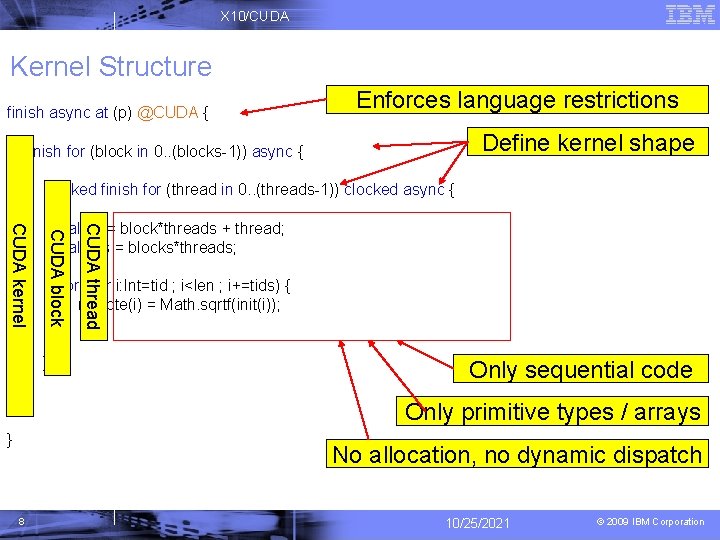
X 10/CUDA Kernel Structure finish async at (p) @CUDA { Enforces language restrictions Define kernel shape finish for (block in 0. . (blocks-1)) async { clocked finish for (thread in 0. . (threads-1)) clocked async { for (var i: Int=tid ; i<len ; i+=tids) { remote(i) = Math. sqrtf(init(i)); } } CUDA thread CUDA block CUDA kernel val tid = block*threads + thread; val tids = blocks*threads; Only sequential code Only primitive types / arrays No allocation, no dynamic dispatch 8 10/25/2021 © 2009 IBM Corporation
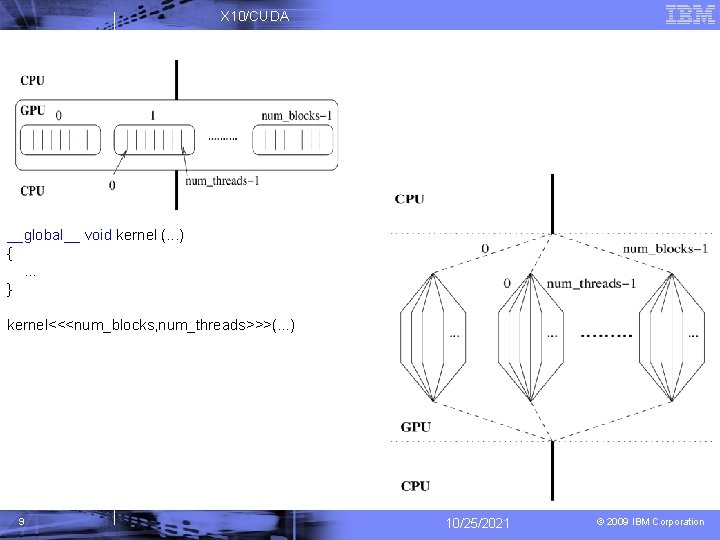
X 10/CUDA __global__ void kernel (. . . ) {. . . } kernel<<<num_blocks, num_threads>>>(. . . ) 9 10/25/2021 © 2009 IBM Corporation
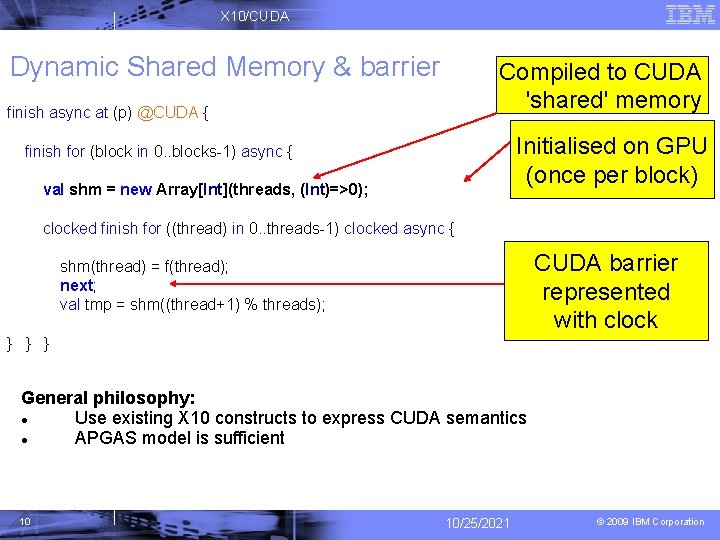
X 10/CUDA Dynamic Shared Memory & barrier Compiled to CUDA 'shared' memory finish async at (p) @CUDA { Initialised on GPU (once per block) finish for (block in 0. . blocks-1) async { val shm = new Array[Int](threads, (Int)=>0); clocked finish for ((thread) in 0. . threads-1) clocked async { CUDA barrier represented with clock shm(thread) = f(thread); next; val tmp = shm((thread+1) % threads); } } } General philosophy: Use existing X 10 constructs to express CUDA semantics APGAS model is sufficient 10 10/25/2021 © 2009 IBM Corporation
=>0); Compiled to CUDA](http://slidetodoc.com/presentation_image_h2/e9d1d4c89769ddf0dbd5deba9a6e92fd/image-11.jpg "X 10/CUDA Constant cache memory val arr = new Array[Int](threads, (Int)=>0); Compiled to CUDA")
X 10/CUDA Constant cache memory val arr = new Array[Int](threads, (Int)=>0); Compiled to CUDA 'constant' cache Automatically uploaded to GPU (just before kernel invocation) finish async at (p) @CUDA { val cmem : Sequence[Int] = arr. sequence(); finish for (block in 0. . (blocks-1)) async { clocked finish for ((thread) in 0. . (threads-1)) clocked async { val tmp = cmem(42); } } } ('Sequence' is an immutable array) General philosophy: Quite similar to 'shared' memory Again, APGAS model is sufficient 11 10/25/2021 © 2009 IBM Corporation
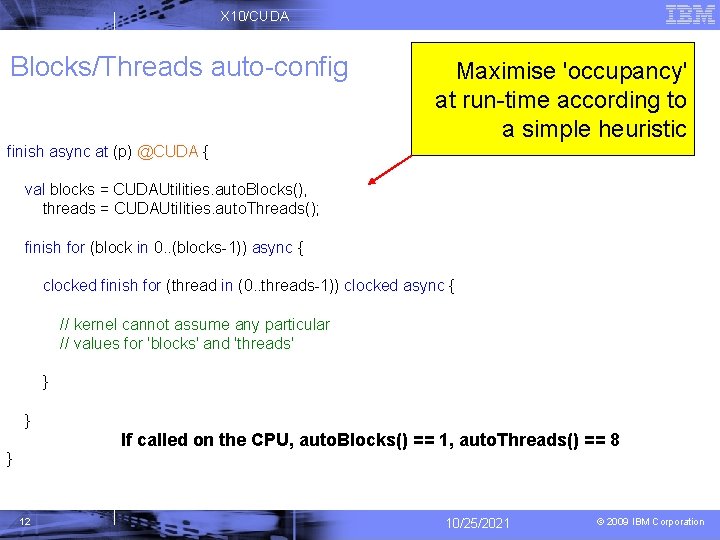
X 10/CUDA Blocks/Threads auto-config Maximise 'occupancy' at run-time according to a simple heuristic finish async at (p) @CUDA { val blocks = CUDAUtilities. auto. Blocks(), threads = CUDAUtilities. auto. Threads(); finish for (block in 0. . (blocks-1)) async { clocked finish for (thread in (0. . threads-1)) clocked async { // kernel cannot assume any particular // values for 'blocks' and 'threads' } } If called on the CPU, auto. Blocks() == 1, auto. Threads() == 8 } 12 10/25/2021 © 2009 IBM Corporation
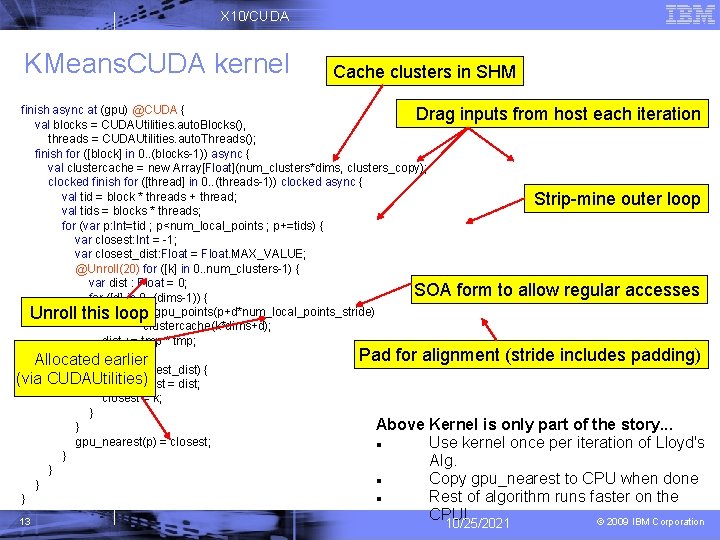
X 10/CUDA KMeans. CUDA kernel Cache clusters in SHM finish async at (gpu) @CUDA { Drag inputs from host each iteration val blocks = CUDAUtilities. auto. Blocks(), threads = CUDAUtilities. auto. Threads(); finish for ([block] in 0. . (blocks-1)) async { val clustercache = new Array[Float](num_clusters*dims, clusters_copy); clocked finish for ([thread] in 0. . (threads-1)) clocked async { val tid = block * threads + thread; Strip-mine outer loop val tids = blocks * threads; for (var p: Int=tid ; p<num_local_points ; p+=tids) { var closest: Int = -1; var closest_dist: Float = Float. MAX_VALUE; @Unroll(20) for ([k] in 0. . num_clusters-1) { var dist : Float = 0; SOA form to allow regular accesses for ([d] in 0. . (dims-1)) { tmp = gpu_points(p+d*num_local_points_stride) Unroll thisvalloop - clustercache(k*dims+d); dist += tmp * tmp; } Pad for alignment (stride includes padding) Allocated earlier if (dist < closest_dist) { (via CUDAUtilities) closest_dist = dist; closest = k; } Above Kernel is only part of the story. . . } gpu_nearest(p) = closest; Use kernel once per iteration of Lloyd's } Alg. } Copy gpu_nearest to CPU when done } Rest of algorithm runs faster on the } 13 CPU! 10/25/2021 © 2009 IBM Corporation
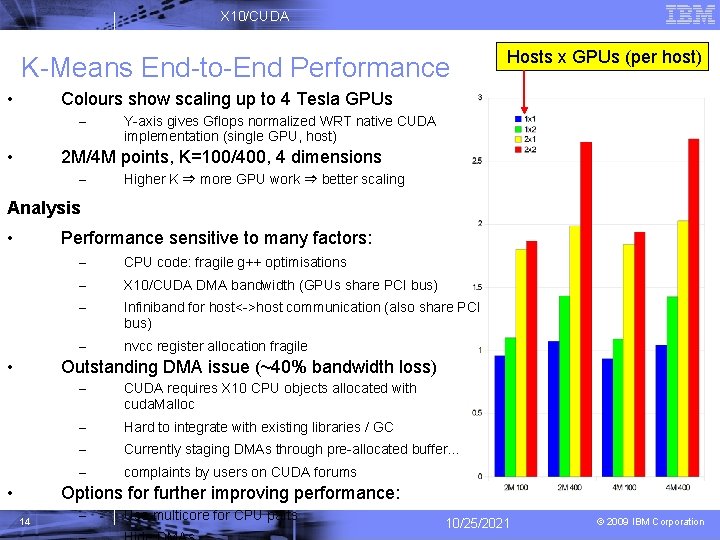
X 10/CUDA K-Means End-to-End Performance • Hosts x GPUs (per host) Colours show scaling up to 4 Tesla GPUs – • Y-axis gives Gflops normalized WRT native CUDA implementation (single GPU, host) 2 M/4 M points, K=100/400, 4 dimensions – Higher K ⇒ more GPU work ⇒ better scaling Analysis • Performance sensitive to many factors: • – CPU code: fragile g++ optimisations – X 10/CUDA DMA bandwidth (GPUs share PCI bus) – Infiniband for host<->host communication (also share PCI bus) – nvcc register allocation fragile Outstanding DMA issue (~40% bandwidth loss) • – CUDA requires X 10 CPU objects allocated with cuda. Malloc – Hard to integrate with existing libraries / GC – Currently staging DMAs through pre-allocated buffer. . . – complaints by users on CUDA forums Options for further improving performance: 14 – Use multicore for CPU parts 10/25/2021 © 2009 IBM Corporation
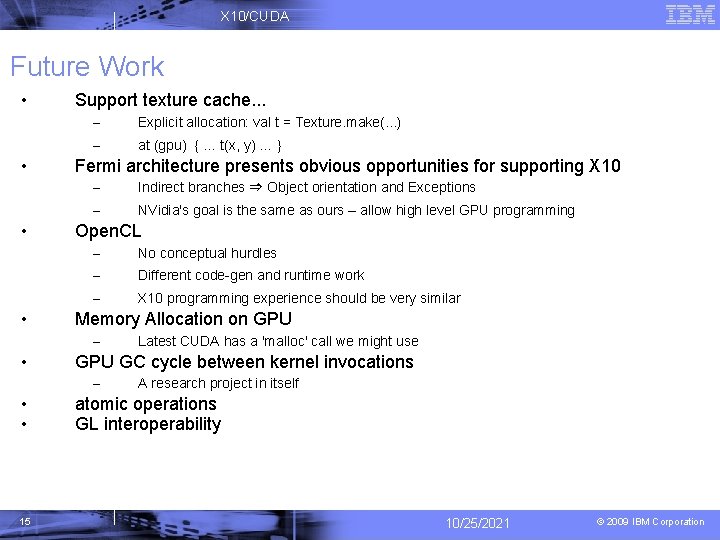
X 10/CUDA Future Work • • Support texture cache. . . – Explicit allocation: val t = Texture. make(. . . ) – at (gpu) { … t(x, y) … } Fermi architecture presents obvious opportunities for supporting X 10 – Indirect branches ⇒ Object orientation and Exceptions – NVidia's goal is the same as ours – allow high level GPU programming Open. CL – No conceptual hurdles – Different code-gen and runtime work – X 10 programming experience should be very similar Memory Allocation on GPU – • GPU GC cycle between kernel invocations – • • 15 Latest CUDA has a 'malloc' call we might use A research project in itself atomic operations GL interoperability 10/25/2021 © 2009 IBM Corporation
- Slides: 15