
IBM Passport Advantage Software Subcapacity License Counting Scenarios
IBM Passport Advantage Software Sub-capacity License Counting Scenarios - HP Virtualization Technologies NOTE: Review this presentation in conjunction with the most current Sub-capacity licensing overview presentation November 6, 2007 © 2007 IBM Corporation
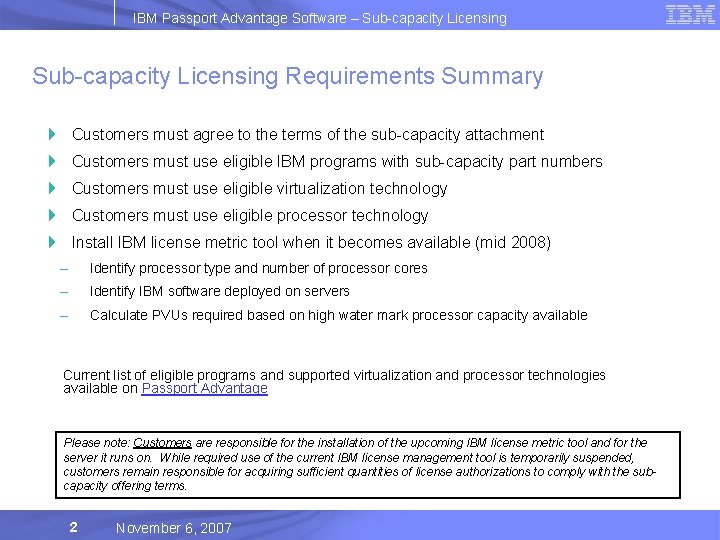
IBM Passport Advantage Software – Sub-capacity Licensing Requirements Summary Customers must agree to the terms of the sub-capacity attachment 4 4 4 Customers must use eligible IBM programs with sub-capacity part numbers Customers must use eligible virtualization technology Customers must use eligible processor technology Install IBM license metric tool when it becomes available (mid 2008) – Identify processor type and number of processor cores – Identify IBM software deployed on servers – Calculate PVUs required based on high water mark processor capacity available Current list of eligible programs and supported virtualization and processor technologies available on Passport Advantage Please note: Customers are responsible for the installation of the upcoming IBM license metric tool and for the server it runs on. While required use of the current IBM license management tool is temporarily suspended, customers remain responsible for acquiring sufficient quantities of license authorizations to comply with the subcapacity offering terms. 2 November 6, 2007
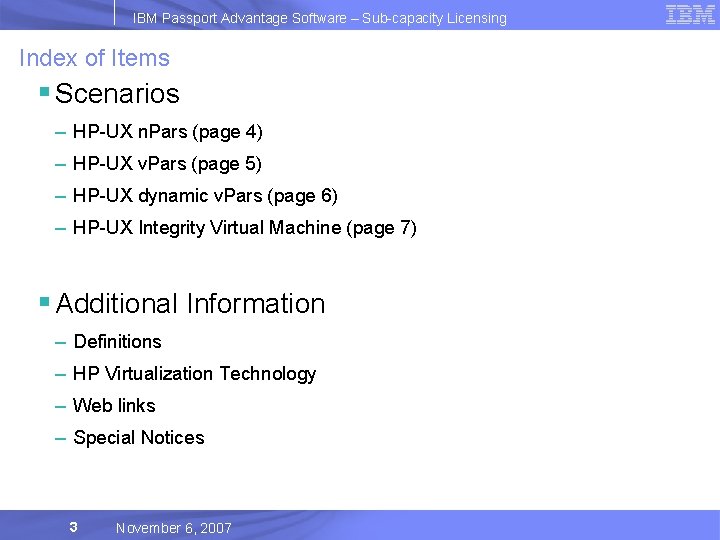
IBM Passport Advantage Software – Sub-capacity Licensing Index of Items § Scenarios – HP-UX n. Pars (page 4) – HP-UX v. Pars (page 5) – HP-UX dynamic v. Pars (page 6) – HP-UX Integrity Virtual Machine (page 7) § Additional Information – Definitions – HP Virtualization Technology – Web links – Special Notices 3 November 6, 2007
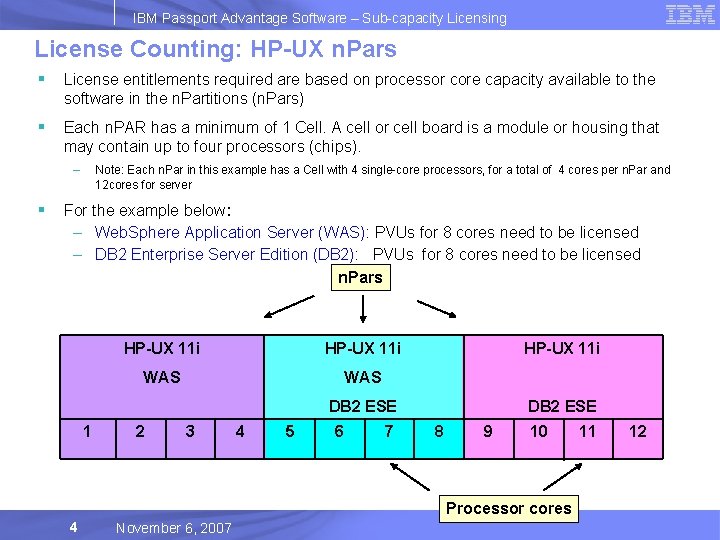
IBM Passport Advantage Software – Sub-capacity Licensing License Counting: HP-UX n. Pars § License entitlements required are based on processor core capacity available to the software in the n. Partitions (n. Pars) § Each n. PAR has a minimum of 1 Cell. A cell or cell board is a module or housing that may contain up to four processors (chips). – § Note: Each n. Par in this example has a Cell with 4 single-core processors, for a total of 4 cores per n. Par and 12 cores for server For the example below: – Web. Sphere Application Server (WAS): PVUs for 8 cores need to be licensed – DB 2 Enterprise Server Edition (DB 2): PVUs for 8 cores need to be licensed n. Pars HP-UX 11 i WAS HP-UX 11 i DB 2 ESE 1 2 3 4 5 6 7 DB 2 ESE 8 9 10 Processor cores 4 November 6, 2007 11 12
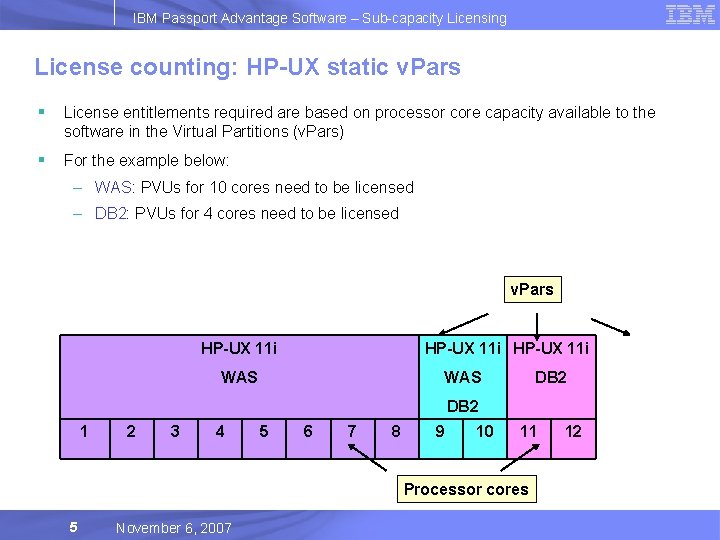
IBM Passport Advantage Software – Sub-capacity Licensing License counting: HP-UX static v. Pars § License entitlements required are based on processor core capacity available to the software in the Virtual Partitions (v. Pars) § For the example below: – WAS: PVUs for 10 cores need to be licensed – DB 2: PVUs for 4 cores need to be licensed v. Pars HP-UX 11 i WAS DB 2 1 2 3 4 5 6 7 8 9 10 11 Processor cores 5 November 6, 2007 12
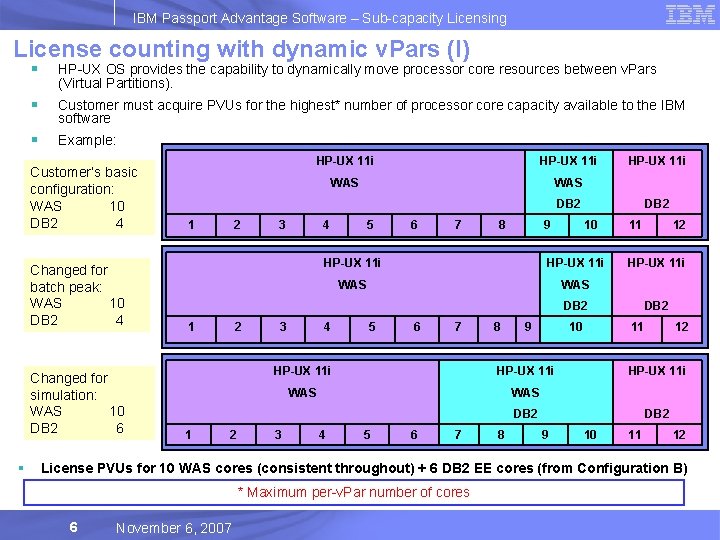
IBM Passport Advantage Software – Sub-capacity Licensing License counting with dynamic v. Pars (I) § HP-UX OS provides the capability to dynamically move processor core resources between v. Pars (Virtual Partitions). § Customer must acquire PVUs for the highest* number of processor core capacity available to the IBM software § Example: Customer’s basic configuration: WAS 10 DB 2 4 Changed for batch peak: WAS 10 DB 2 4 Changed for simulation: WAS 10 DB 2 6 § HP-UX 11 i WAS HP-UX 11 i DB 2 1 2 3 4 5 6 7 8 9 DB 2 10 HP-UX 11 i WAS 11 HP-UX 11 i DB 2 1 2 3 4 5 6 7 8 9 10 HP-UX 11 i WAS DB 2 11 2 3 4 5 6 7 8 12 HP-UX 11 i DB 2 1 12 DB 2 9 10 11 12 License PVUs for 10 WAS cores (consistent throughout) + 6 DB 2 EE cores (from Configuration B) * Maximum per-v. Par number of cores 6 November 6, 2007
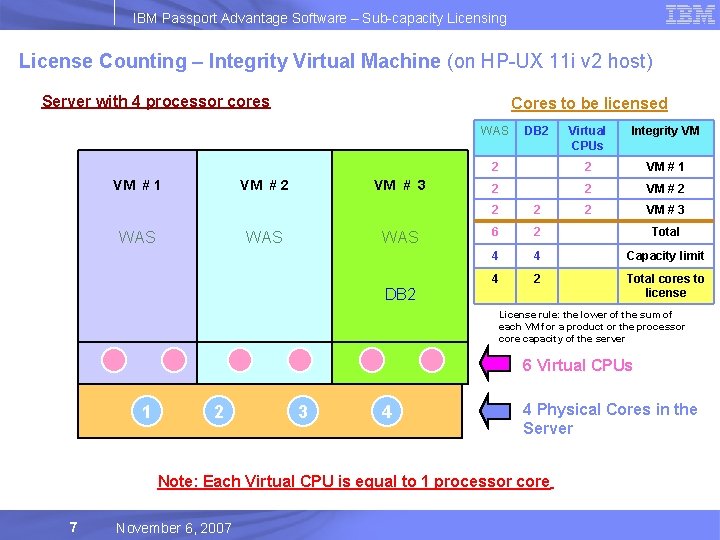
IBM Passport Advantage Software – Sub-capacity Licensing License Counting – Integrity Virtual Machine (on HP-UX 11 i v 2 host) Server with 4 processor cores Cores to be licensed WAS VM # 1 VM # 2 WAS VM # 3 WAS DB 2 Virtual CPUs Integrity VM 2 2 VM # 1 2 2 VM # 3 2 2 6 2 Total 4 4 Capacity limit 4 2 Total cores to license DB 2 License rule: the lower of the sum of each VM for a product or the processor core capacity of the server 6 Virtual CPUs 1 2 3 4 4 Physical Cores in the Server Note: Each Virtual CPU is equal to 1 processor core 7 November 6, 2007
IBM Passport Advantage Software – Sub-capacity Licensing Backup 8 November 6, 2007
IBM Passport Advantage Software – Sub-capacity Licensing Definitions & Parameters § Cell: – A cell or cell board is a module that primarily houses processors, memory, and the cell controller application -specific integrated circuits (ASICs). Up to four processor (chips) are contained in a cell. § Hard Partition (n. Par) – Offer electrical and software isolation. Each n. Par contains one or more cells (containing processors and memory) that are assigned to the partition for its exclusive use. – Absolute minimum is one cell. The cell does not have to be fully populated (e. g. can have just one processor (chip). – Any changes to the number of cores requires a reconfiguration and reboot of the hard partition § Virtual Partition (v. Par) – are separate operating system instances on the same n. Partition or system with operating system, application, and resource isolation. – HP-UX 11 i Virtual Partition enable you to dynamically move processing power between v. Pars as your workload requirements change. – You can allocate cores to a v. Par down to a granularity of a single core • Absolute minimum number of cores = 1. Per v. Par minimum number of cores is configurable. Changes to the perv. Par minimum requires a reboot of the v. Par. Absolute maximum number of cores for a v. Par = ( Total number of cores on the system minus number of cores associated with other v. Pars on the system). Per v. Par maximum number of cores is configurable. Changes to the per-v. Par maximum requires a reboot of the. • 9 November 6, 2007
IBM Passport Advantage Software – Sub-capacity Licensing Definitions & Parameters § HP Integrity Virtual Machines – Is a software partitioning product that provides virtualization of resources, shared CPU, shared I/O, and resourcing based on demand entitlement for HP Integrity servers running HP-UX 11 i v 2. – HP Integrity VM provides the ability to allocate CPU and I/O to an application at a granularity less than that of the physical hardware yet keeps applications separate from one another in their own operating system instance. – Integrity VM virtualizes the processing cores and software for the guest operating systems running on “virtual CPUs” in the virtual machine. A virtual CPU represents no more than one processor core. – You can allocate cores to a Integrity VM down to a granularity of a single core • Absolute minimum of v. CPUs (cores) = 1 core • Current absolute maximum of v. CPUs (cores) = 4 cores • The entitlement (share of physical core per v. CPU) may be changed dynamically in a range from 5% to 100%. This does not impact licensing. A single physical core can support up to 20 virtual machines 10 November 6, 2007

IBM Passport Advantage Software – Sub-capacity Licensing HP Virtualization Technology - HP Virtual Server Environment T I M Single Physical Node E n. Partitions Hard partitions within a node Single OS image Virtual Partitions or HP Integrity Virtual Machines within a hard partition Single node n. Par 1 OS image with HW fault isolation • Dedicated CPU, RAM & I/O • server n. Par 2 n. Par 1 v. Par 1 OS image with SW fault isolation • Dedicated CPU, RAM v. Par n n. Par 2 IVM 1 n. Par n 11 November 6, 2007 OS image with SW fault isolation • Virtualized and Shared CPU, I/O • Virtualized memory

IBM Passport Advantage Software – Sub-capacity Licensing Additional Information • More information about Passport Advantage Subcapacity Licensing can be found on Passport Advantage 12 November 6, 2007
IBM Passport Advantage Software – Sub-capacity Licensing Special Notices The following terms are registered trademarks of International Business Machines Corporation in the United States and/or other countries: AIX, AIX/L(logo), AIX 6 (logo), AS/400, Blade. Center, DB 2, Domino, e business(logo), e(logo)business, e(logo)server, i 5/OS, IBM(logo), ibm. com, IBM Business Partner (logo), Informix, Lotus Notes, MQSeries, Net. Data, Netfinity, Notes, NUMA-Q, Open. Power, Operating System/400, OS/400, Partner. World, Passport Advantage, POWERparallel, Power PC 603, Power PC 604, Power. PC(logo), p. Series, Rational, RISC System/6000, RS/6000, S/390, Sametime, Scalable POWERparallel Systems, Secure. Way, System/390, Tivoli(logo), Tivoli Management Environment, Tivoli Ready(logo), Web. Sphere, x. Series, z/OS, z. Series. The following terms are trademarks of International Business Machines Corporation in the United States and/or other countries: Advanced Micro-Partitioning, AIX 5 L, AIX PVMe, AS/400 e, Cloudscape, DB 2 OLAP Server, DB 2 Universal Database, DFDSM, DFSORT, DS 4000, DS 6000, DS 8000, e-business(logo), ebusiness on demand, Enterprise Workload Manager, e. Server, Express Middleware, Express Portfolio, Express Servers, HACMP/6000, IBM Total. Storage Proven, IBMLink, Intelligent Miner, i. Series, Micro-Partitioning, NUMACenter, On Demand Business logo, POWER, Power. Executive, Power Architecture, Power Everywhere, Power Family, Power PC, Power. PC Architecture, POWER 3, POWER 4+, POWER 5+, POWER 6+, Quickr, Redbooks, Sequent (logo), Sequent. LINK, Service Director, Smooth. Start, SP, System i 5, System p 5, System z 9, S/390 Parallel Enterprise Server, Tivoli Enterprise, TME 10, Total. Storage Proven, Virtualization Engine, Workload Partitions Manager, XArchitecture, z/9. A full list of U. S. trademarks owned by IBM may be found at: http: //www. ibm. com/legal/copytrade. shtml. The Power Architecture and Power. org wordmarks and the Power and Power. org logos and related marks are trademarks and service marks licensed by Power. org. UNIX is a registered trademark of The Open Group in the United States, other countries or both. Linux is a trademark of Linus Torvalds in the United States, other countries or both. Microsoft, Windows NT and the Windows logo are registered trademarks of Microsoft Corporation in the United States, other countries or both. Intel, Itanium, Pentium are registered trademarks and Xeon is a trademark of Intel Corporation or its subsidiaries in the United States, other countries or both. AMD Opteron is a trademark of Advanced Micro Devices, Inc. Java and all Java-based trademarks and logos are trademarks of Sun Microsystems, Inc. in the United States, other countries or both. TPC-C and TPC-H are trademarks of the Transaction Performance Processing Council (TPPC). SPECint, SPECfp, SPECjbb, SPECweb, SPECj. App. Server, SPEC OMP, SPECviewperf, SPECapc, SPEChpc, SPECjvm, SPECmail, SPECimap and SPECsfs are trademarks of the Standard Performance Evaluation Corp (SPEC). Cell Broadband Engine is a trademark of Sony Computer Entertainment Inc. Infini. Band, Infini. Band Trade Association and the Infini. Band design marks are trademarks and/or service marks of the Infini. Band Trade Association. Other company, product and service names may be trademarks or service marks of others. References in this publication to IBM products or services do not imply that IBM intends to make them available in all countries in which IBM operates. Offerings are subject to change, extension or withdrawal without notice. All statements regarding IBM future direction or intent are subject to change or withdrawal without notice and represent goals and objectives only. Revised September 28, 2007 13 November 6, 2007
- Slides: 13