
IBM Passport Advantage Software Scenarios Subcapacity License Counting
® IBM Passport Advantage Software. Scenarios Sub-capacity License Counting Sun Microsystems Virtualization NOTE: Review this presentation in conjunction with the most current Sub-capacity licensing overview presentation
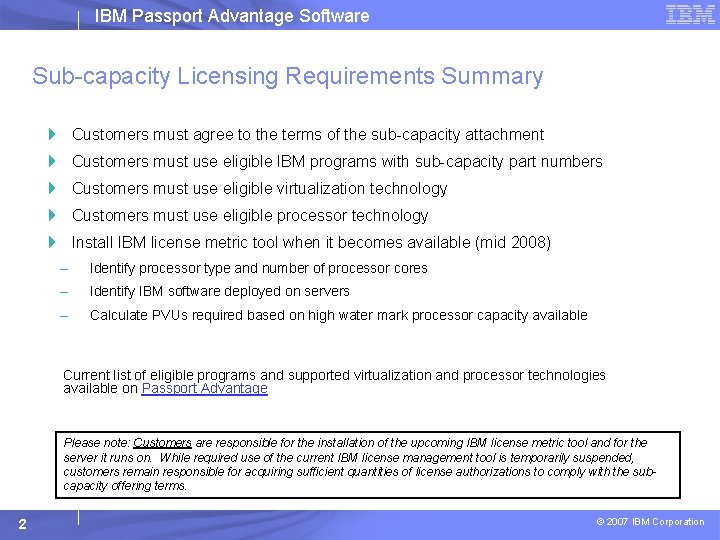
IBM Passport Advantage Software Sub-capacity Licensing Requirements Summary Customers must agree to the terms of the sub-capacity attachment 4 4 4 Customers must use eligible IBM programs with sub-capacity part numbers Customers must use eligible virtualization technology Customers must use eligible processor technology Install IBM license metric tool when it becomes available (mid 2008) – Identify processor type and number of processor cores – Identify IBM software deployed on servers – Calculate PVUs required based on high water mark processor capacity available Current list of eligible programs and supported virtualization and processor technologies available on Passport Advantage Please note: Customers are responsible for the installation of the upcoming IBM license metric tool and for the server it runs on. While required use of the current IBM license management tool is temporarily suspended, customers remain responsible for acquiring sufficient quantities of license authorizations to comply with the subcapacity offering terms. 2 © 2007 IBM Corporation
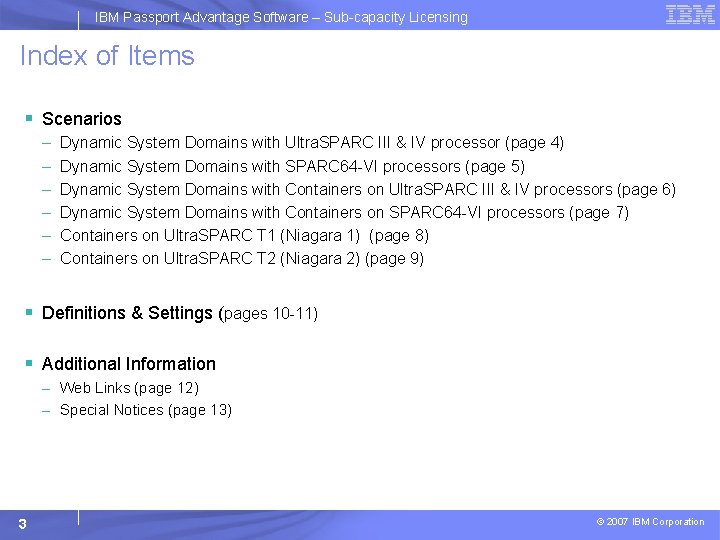
IBM Passport Advantage Software – Sub-capacity Licensing Index of Items § Scenarios – – – Dynamic System Domains with Ultra. SPARC III & IV processor (page 4) Dynamic System Domains with SPARC 64 -VI processors (page 5) Dynamic System Domains with Containers on Ultra. SPARC III & IV processors (page 6) Dynamic System Domains with Containers on SPARC 64 -VI processors (page 7) Containers on Ultra. SPARC T 1 (Niagara 1) (page 8) Containers on Ultra. SPARC T 2 (Niagara 2) (page 9) § Definitions & Settings (pages 10 -11) § Additional Information – Web Links (page 12) – Special Notices (page 13) 3 © 2007 IBM Corporation
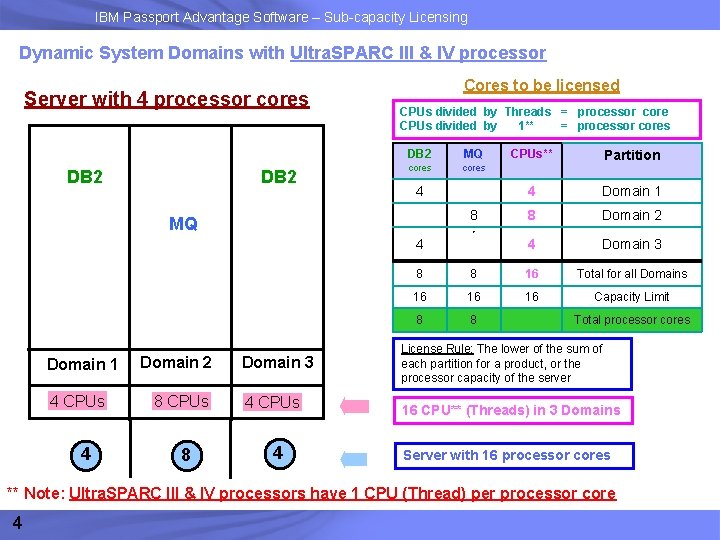
IBM Passport Advantage Software – Sub-capacity Licensing Dynamic System Domains with Ultra. SPARC III & IV processor Server with 4 processor cores DB 2 Cores to be licensed CPUs divided by Threads = processor core CPUs divided by 1** = processor cores DB 2 MQ cores 4 8 MQ 4 CPUs 4 Domain 2 8 CPUs 8 Partition 4 Domain 1 8 Domain 2 4 Domain 3 3 4 Domain 1 CPUs** Domain 3 4 CPUs 4 8 8 16 Total for all Domains 16 16 16 Capacity Limit 8 8 Total processor cores License Rule: The lower of the sum of each partition for a product, or the processor capacity of the server 16 CPU** (Threads) in 3 Domains Server with 16 processor cores ** Note: Ultra. SPARC III & IV processors have 1 CPU (Thread) per processor core 4
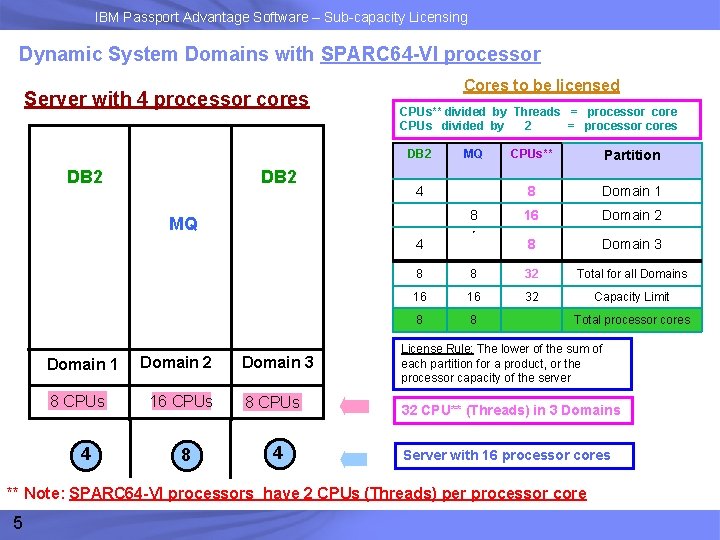
IBM Passport Advantage Software – Sub-capacity Licensing Dynamic System Domains with SPARC 64 -VI processor Server with 4 processor cores Cores to be licensed CPUs** divided by Threads = processor core CPUs divided by 2 = processor cores DB 2 MQ 4 8 MQ 8 CPUs 4 Domain 2 16 CPUs 8 Partition 8 Domain 1 16 Domain 2 8 Domain 3 3 4 Domain 1 CPUs** Domain 3 8 CPUs 4 8 8 32 Total for all Domains 16 16 32 Capacity Limit 8 8 Total processor cores License Rule: The lower of the sum of each partition for a product, or the processor capacity of the server 32 CPU** (Threads) in 3 Domains Server with 16 processor cores ** Note: SPARC 64 -VI processors have 2 CPUs (Threads) per processor core 5
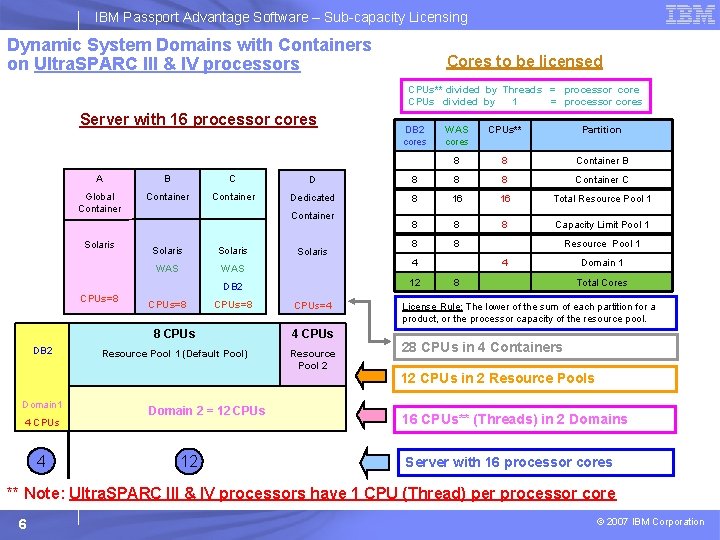
IBM Passport Advantage Software – Sub-capacity Licensing Dynamic System Domains with Containers on Ultra. SPARC III & IV processors Cores to be licensed CPUs** divided by Threads = processor core CPUs divided by 1 = processor cores Server with 16 processor cores 4 Partition 8 8 Container B C D 8 8 8 Container C Global Container Dedicated 8 16 16 Total Resource Pool 1 8 8 8 Capacity Limit Pool 1 8 8 CPUs=8 4 CPUs** B Container Solaris WAS Solaris 4 12 DB 2 Domain 1 WAS cores A Solaris DB 2 cores CPUs=8 CPUs=4 8 CPUs 4 CPUs Resource Pool 1 (Default Pool) Resource Pool 2 Domain 2 = 12 CPUs 12 Resource Pool 1 4 8 Domain 1 Total Cores License Rule: The lower of the sum of each partition for a product, or the processor capacity of the resource pool. 28 CPUs in 4 Containers 12 CPUs in 2 Resource Pools 16 CPUs** (Threads) in 2 Domains Server with 16 processor cores ** Note: Ultra. SPARC III & IV processors have 1 CPU (Thread) per processor core 6 © 2007 IBM Corporation
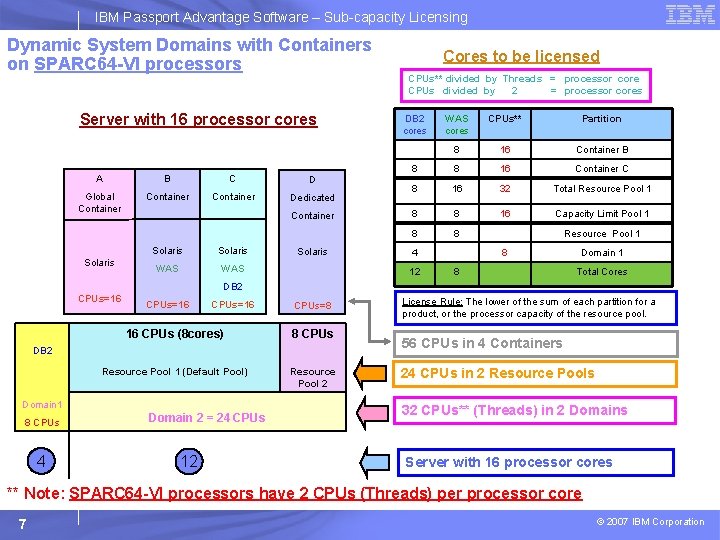
IBM Passport Advantage Software – Sub-capacity Licensing Dynamic System Domains with Containers on SPARC 64 -VI processors Server with 16 processor cores A B C D Global Container Dedicated Solaris Container Solaris WAS Solaris Cores to be licensed CPUs** divided by Threads = processor core CPUs divided by 2 = processor cores DB 2 cores WAS cores CPUs** Partition 8 16 Container B 8 8 16 Container C 8 16 32 Total Resource Pool 1 8 8 16 Capacity Limit Pool 1 8 8 4 12 Resource Pool 1 8 8 Domain 1 Total Cores DB 2 CPUs=16 CPUs=8 16 CPUs (8 cores) 8 CPUs Resource Pool 1 (Default Pool) Resource Pool 2 DB 2 Domain 1 8 CPUs 4 Domain 2 = 24 CPUs 12 License Rule: The lower of the sum of each partition for a product, or the processor capacity of the resource pool. 56 CPUs in 4 Containers 24 CPUs in 2 Resource Pools 32 CPUs** (Threads) in 2 Domains Server with 16 processor cores ** Note: SPARC 64 -VI processors have 2 CPUs (Threads) per processor core 7 © 2007 IBM Corporation
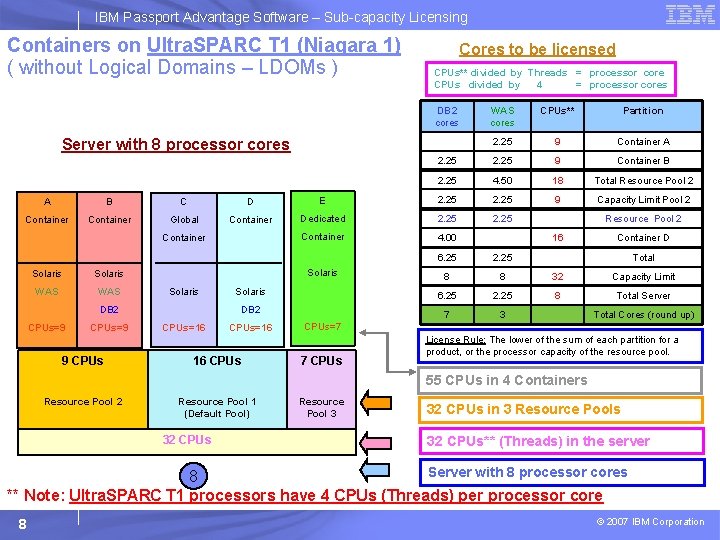
IBM Passport Advantage Software – Sub-capacity Licensing Containers on Ultra. SPARC T 1 (Niagara 1) ( without Logical Domains – LDOMs ) Cores to be licensed CPUs** divided by Threads = processor core CPUs divided by 4 = processor cores DB 2 cores WAS cores CPUs** Partition 2. 25 9 Container A 2. 25 9 Container B 2. 25 4. 50 18 Total Resource Pool 2 9 Capacity Limit Pool 2 Server with 8 processor cores A B C D E 2. 25 Container Global Container Dedicated 2. 25 Container 4. 00 Container Solaris WAS Solaris DB 2 CPUs=9 9 CPUs Solaris DB 2 CPUs=16 16 CPUs Resource Pool 2 16 Container D 6. 25 2. 25 Total 8 8 32 Capacity Limit 6. 25 2. 25 8 Total Server 7 3 Total Cores (round up) CPUs=7 7 CPUs License Rule: The lower of the sum of each partition for a product, or the processor capacity of the resource pool. 55 CPUs in 4 Containers Resource Pool 2 Resource Pool 1 (Default Pool) 32 CPUs Resource Pool 3 32 CPUs in 3 Resource Pools 32 CPUs** (Threads) in the server Server with 8 processor cores 8 ** Note: Ultra. SPARC T 1 processors have 4 CPUs (Threads) per processor core 8 © 2007 IBM Corporation
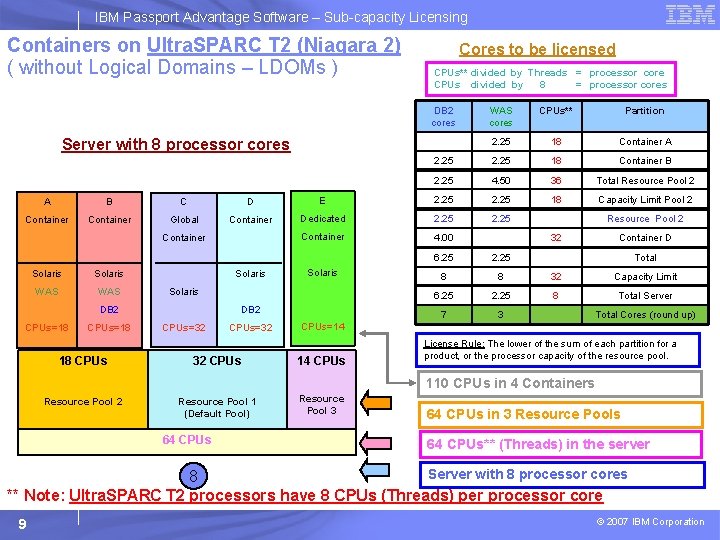
IBM Passport Advantage Software – Sub-capacity Licensing Containers on Ultra. SPARC T 2 (Niagara 2) ( without Logical Domains – LDOMs ) Cores to be licensed CPUs** divided by Threads = processor core CPUs divided by 8 = processor cores DB 2 cores WAS cores CPUs** Partition 2. 25 18 Container A 2. 25 18 Container B 2. 25 4. 50 36 Total Resource Pool 2 18 Capacity Limit Pool 2 Server with 8 processor cores A B C D E 2. 25 Container Global Container Dedicated 2. 25 Container 4. 00 Container Solaris WAS Solaris DB 2 CPUs=18 18 CPUs Solaris DB 2 CPUs=32 Resource Pool 2 32 Container D 6. 25 2. 25 Total 8 8 32 Capacity Limit 6. 25 2. 25 8 Total Server 7 3 Total Cores (round up) CPUs=14 32 CPUs 14 CPUs Resource Pool 1 (Default Pool) Resource Pool 3 License Rule: The lower of the sum of each partition for a product, or the processor capacity of the resource pool. 110 CPUs in 4 Containers Resource Pool 2 64 CPUs in 3 Resource Pools 64 CPUs** (Threads) in the server Server with 8 processor cores 8 ** Note: Ultra. SPARC T 2 processors have 8 CPUs (Threads) per processor core 9 © 2007 IBM Corporation
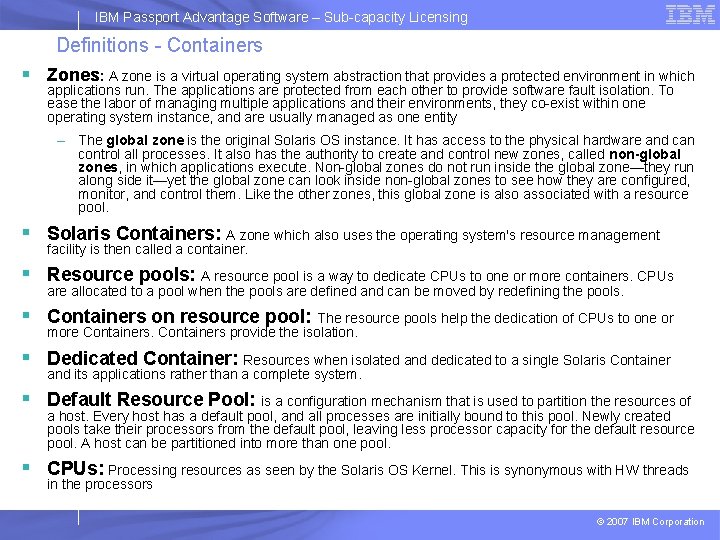
IBM Passport Advantage Software – Sub-capacity Licensing Definitions - Containers § Zones: A zone is a virtual operating system abstraction that provides a protected environment in which applications run. The applications are protected from each other to provide software fault isolation. To ease the labor of managing multiple applications and their environments, they co-exist within one operating system instance, and are usually managed as one entity – The global zone is the original Solaris OS instance. It has access to the physical hardware and can control all processes. It also has the authority to create and control new zones, called non-global zones, in which applications execute. Non-global zones do not run inside the global zone—they run along side it—yet the global zone can look inside non-global zones to see how they are configured, monitor, and control them. Like the other zones, this global zone is also associated with a resource pool. § Solaris Containers: A zone which also uses the operating system's resource management facility is then called a container. § Resource pools: A resource pool is a way to dedicate CPUs to one or more containers. CPUs are allocated to a pool when the pools are defined and can be moved by redefining the pools. § Containers on resource pool: The resource pools help the dedication of CPUs to one or more Containers provide the isolation. § Dedicated Container: Resources when isolated and dedicated to a single Solaris Container and its applications rather than a complete system. § Default Resource Pool: is a configuration mechanism that is used to partition the resources of a host. Every host has a default pool, and all processes are initially bound to this pool. Newly created pools take their processors from the default pool, leaving less processor capacity for the default resource pool. A host can be partitioned into more than one pool. § CPUs: Processing resources as seen by the Solaris OS Kernel. This is synonymous with HW threads in the processors © 2007 IBM Corporation
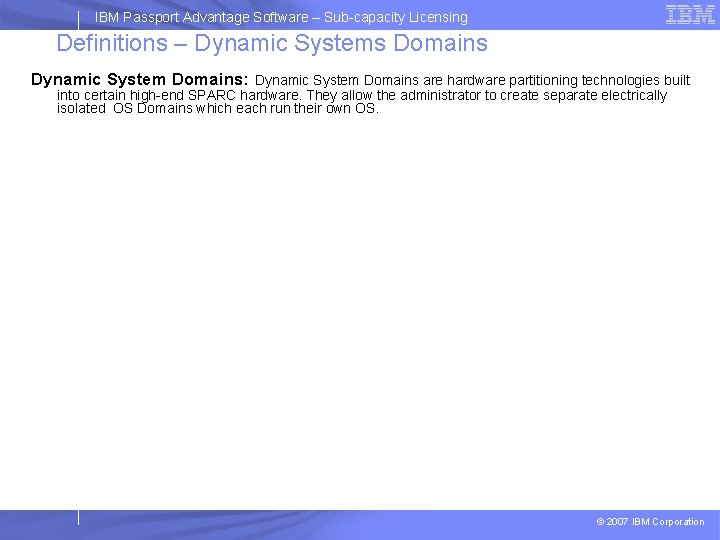
IBM Passport Advantage Software – Sub-capacity Licensing Definitions – Dynamic Systems Domains Dynamic System Domains: Dynamic System Domains are hardware partitioning technologies built into certain high-end SPARC hardware. They allow the administrator to create separate electrically isolated OS Domains which each run their own OS. © 2007 IBM Corporation
IBM Passport Advantage Software – Sub-capacity Licensing Additional Information • More information about Passport Advantage Subcapacity Licensing can be found on Passport Advantage 12 © 2007 IBM Corporation
IBM Passport Advantage Software – Sub-capacity Licensing Special Notices The following terms are registered trademarks of International Business Machines Corporation in the United States and/or other countries: AIX, AIX/L(logo), AIX 6 (logo), AS/400, Blade. Center, DB 2, Domino, e business(logo), e(logo)business, e(logo)server, i 5/OS, IBM(logo), ibm. com, IBM Business Partner (logo), Informix, Lotus Notes, MQSeries, Net. Data, Netfinity, Notes, NUMA-Q, Open. Power, Operating System/400, OS/400, Partner. World, Passport Advantage, POWERparallel, Power PC 603, Power PC 604, Power. PC(logo), p. Series, Rational, RISC System/6000, RS/6000, S/390, Sametime, Scalable POWERparallel Systems, Secure. Way, System/390, Tivoli(logo), Tivoli Management Environment, Tivoli Ready(logo), Web. Sphere, x. Series, z/OS, z. Series. The following terms are trademarks of International Business Machines Corporation in the United States and/or other countries: Advanced Micro-Partitioning, AIX 5 L, AIX PVMe, AS/400 e, Cloudscape, DB 2 OLAP Server, DB 2 Universal Database, DFDSM, DFSORT, DS 4000, DS 6000, DS 8000, e-business(logo), ebusiness on demand, Enterprise Workload Manager, e. Server, Express Middleware, Express Portfolio, Express Servers, HACMP/6000, IBM Total. Storage Proven, IBMLink, Intelligent Miner, i. Series, Micro-Partitioning, NUMACenter, On Demand Business logo, POWER, Power. Executive, Power Architecture, Power Everywhere, Power Family, Power PC, Power. PC Architecture, POWER 3, POWER 4+, POWER 5+, POWER 6+, Quickr, Redbooks, Sequent (logo), Sequent. LINK, Service Director, Smooth. Start, SP, System i 5, System p 5, System z 9, S/390 Parallel Enterprise Server, Tivoli Enterprise, TME 10, Total. Storage Proven, Virtualization Engine, Workload Partitions Manager, XArchitecture, z/9. A full list of U. S. trademarks owned by IBM may be found at: http: //www. ibm. com/legal/copytrade. shtml. The Power Architecture and Power. org wordmarks and the Power and Power. org logos and related marks are trademarks and service marks licensed by Power. org. UNIX is a registered trademark of The Open Group in the United States, other countries or both. Linux is a trademark of Linus Torvalds in the United States, other countries or both. Microsoft, Windows NT and the Windows logo are registered trademarks of Microsoft Corporation in the United States, other countries or both. Intel, Itanium, Pentium are registered trademarks and Xeon is a trademark of Intel Corporation or its subsidiaries in the United States, other countries or both. AMD Opteron is a trademark of Advanced Micro Devices, Inc. Java and all Java-based trademarks and logos are trademarks of Sun Microsystems, Inc. in the United States, other countries or both. TPC-C and TPC-H are trademarks of the Transaction Performance Processing Council (TPPC). SPECint, SPECfp, SPECjbb, SPECweb, SPECj. App. Server, SPEC OMP, SPECviewperf, SPECapc, SPEChpc, SPECjvm, SPECmail, SPECimap and SPECsfs are trademarks of the Standard Performance Evaluation Corp (SPEC). Cell Broadband Engine is a trademark of Sony Computer Entertainment Inc. Infini. Band, Infini. Band Trade Association and the Infini. Band design marks are trademarks and/or service marks of the Infini. Band Trade Association. Other company, product and service names may be trademarks or service marks of others. References in this publication to IBM products or services do not imply that IBM intends to make them available in all countries in which IBM operates. Offerings are subject to change, extension or withdrawal without notice. All statements regarding IBM future direction or intent are subject to change or withdrawal without notice and represent goals and objectives only. Revised September 28, 2007 13 © 2007 IBM Corporation
- Slides: 13