
IBM OCR project Workload Optimization on Hybrid Architectures
IBM OCR project Workload Optimization on Hybrid Architectures IBM T. J. Watson Research Center May 4, 2011 Chiron & Achilles © 2003 IBM Corporation
IBM Research Goal § Parallelism with hundreds and thousands of threads – Hardware is ready • Multi-core processor • IBM “POWER 7 is designed for multi-socket systems that scale up to 32 sockets, which means that a full 32 -socket system of 8 -core parts would support 1024 threads. ” – Software stack that is able to exploit/adapt to the parallelism provided by the hardware 2 © 2010 IBM Corporation

IBM Research Our practice § Our experience: locking/resource sharing has huge performance impact on hybrid systems/accelerators – Focus on scalability/performance § Identify/configure the shared resources – Hardware • Power 7: L 3 cache shared by sockets – Software • DB 2 connections, JVM GC and JIT threads, WAS servant regions, thread pools § Identify/analyze performance bottleneck – Tooling • • Oprofile: profiling the whole system running on Linux IBM WAIT Performance Tool: profiling JVM JLM (Java Lock Monitor): profiling JVM lock access Self developed LWT: profiling JVM JNI – Apply general practice of locking/data sharing 3 © 2010 IBM Corporation
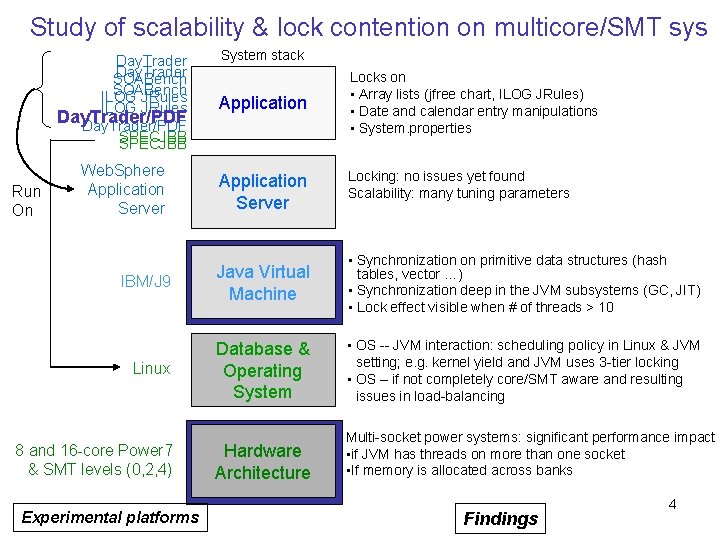
Study of scalability & lock contention on multicore/SMT sys Run On System stack Day. Trader SOABench ILOG JRules Day. Trader/PDF SPECJBB Application Locks on • Array lists (jfree chart, ILOG JRules) • Date and calendar entry manipulations • System. properties Web. Sphere Application Server Locking: no issues yet found Scalability: many tuning parameters IBM/J 9 Java Virtual Machine • Synchronization on primitive data structures (hash tables, vector …) • Synchronization deep in the JVM subsystems (GC, JIT) • Lock effect visible when # of threads > 10 Linux Database & Operating System • OS -- JVM interaction: scheduling policy in Linux & JVM setting; e. g. kernel yield and JVM uses 3 -tier locking • OS – if not completely core/SMT aware and resulting issues in load-balancing Hardware Architecture Multi-socket power systems: significant performance impact • if JVM has threads on more than one socket • If memory is allocated across banks 8 and 16 -core Power 7 & SMT levels (0, 2, 4) Experimental platforms Findings 4
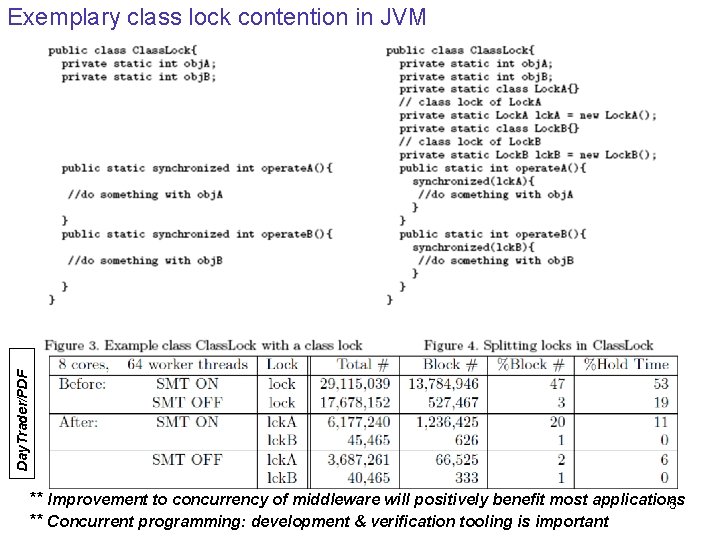
Day. Trader/PDF Exemplary class lock contention in JVM ** Improvement to concurrency of middleware will positively benefit most applications 5 ** Concurrent programming: development & verification tooling is important
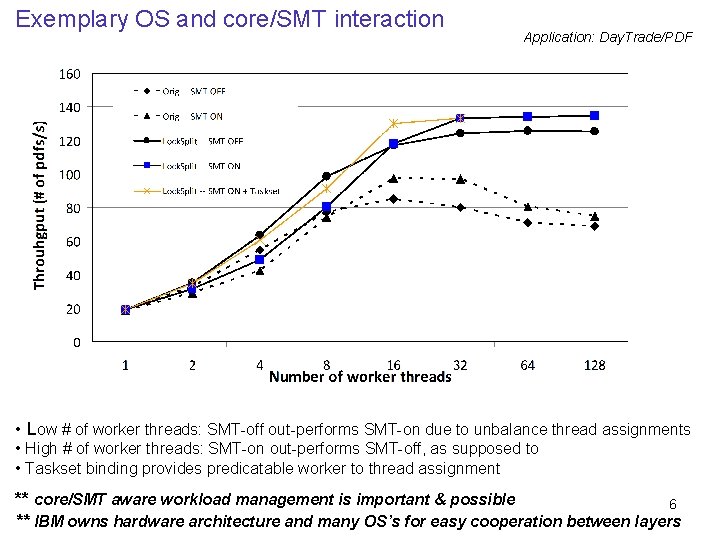
Exemplary OS and core/SMT interaction Application: Day. Trade/PDF • Low # of worker threads: SMT-off out-performs SMT-on due to unbalance thread assignments • High # of worker threads: SMT-on out-performs SMT-off, as supposed to • Taskset binding provides predicatable worker to thread assignment ** core/SMT aware workload management is important & possible 6 ** IBM owns hardware architecture and many OS’s for easy cooperation between layers
IBM Research Goal § Parallelism with hundreds and thousands of threads – Hardware is ready • Multi-core processor • IBM “POWER 7 is designed for multi-socket systems that scale up to 32 sockets, which means that a full 32 -socket system of 8 -core parts would support 1024 threads. ” – Software that is able to exploit/adapt to the parallelism provided by the hardware 7 © 2010 IBM Corporation
IBM Research Challenges of high parallelism § Complex commercial workload – Java workload – Non-intrusive to existing application • No/little modification of application level code, No need for annotation – Methodology/tools to identify parallelism of a workload • Identify parallelism bottleneck • Identify peak parallelism • Identify parallelism potential § Hybrid execution environment – Loosely-coupled, hybrid execution components (multi-tier) • Web Server, Application Server, DB server…, • Each tier can be a hybrid – Configurable hardware/execution environment – Methodology/tools to identify parallelism of an environment § Combination/match of commercial workload and execution environment – Identify which workload is best for which environment 8 © 2010 IBM Corporation
IBM Research backup 9 © 2010 IBM Corporation
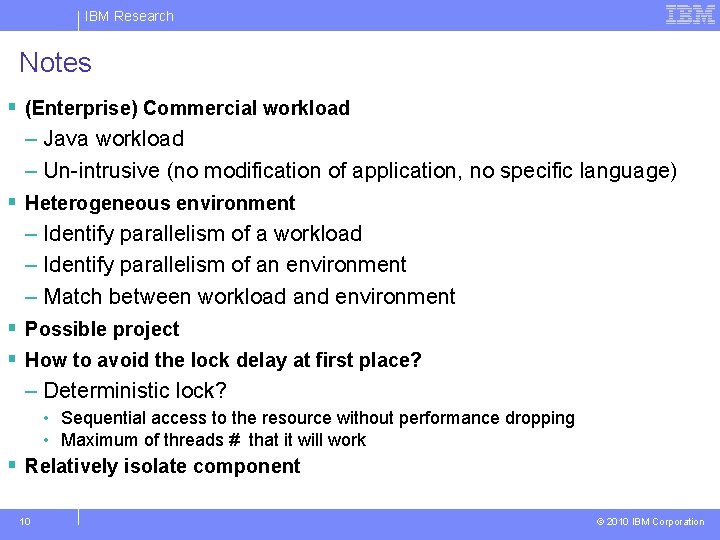
IBM Research Notes § (Enterprise) Commercial workload – Java workload – Un-intrusive (no modification of application, no specific language) § Heterogeneous environment – Identify parallelism of a workload – Identify parallelism of an environment – Match between workload and environment § Possible project § How to avoid the lock delay at first place? – Deterministic lock? • Sequential access to the resource without performance dropping • Maximum of threads # that it will work § Relatively isolate component 10 © 2010 IBM Corporation
IBM Research § WAIT report before § WAIT report after 11 © 2010 IBM Corporation

IBM Research OCR: Chiron § Scope of the research (2) Best practice for software development to exploit hybrid systems: • IBM lead : Grace Liu • Current experience: locking/data sharing has huge performance impact on hybrid systems / accelerators • New deterministic lock paradigm for parallel/threaded programs – Identify systematic lock usage in middleware and utility software – Establish the usage of the deterministic locking mechanisms on hybrid systems – Perform performance study with new locking mechanism for selected open source benchmark on hybrid systems – Study productivity improvement in debugging and test of the new lock mechanisms • Data-sharing – Data-sharing in general is protected by locks – Data-race-free enabled by deterministic locks MIT related project: Kendo • Prof. Saman Amarasinghe & student • Working framework for deterministic multi-threading on different hardware and Linux that can be used to identify locking problem • Strong or weak deterministic interleaving access to shared data • Data-race-free program executions 12 © 2010 IBM Corporation
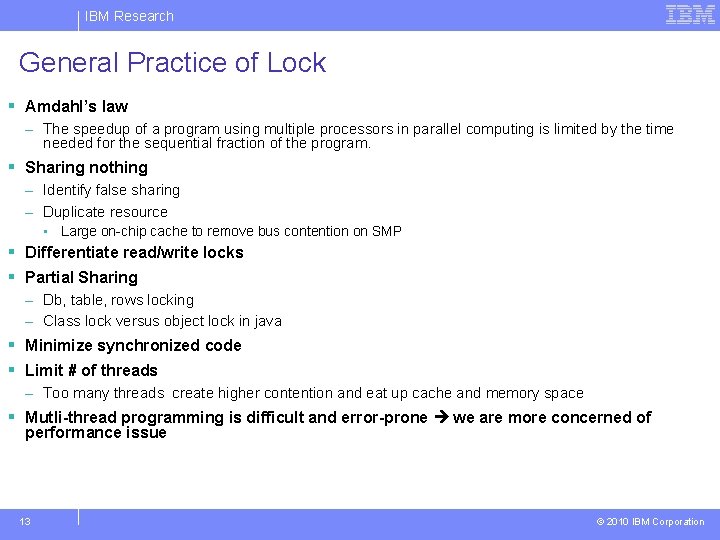
IBM Research General Practice of Lock § Amdahl’s law – The speedup of a program using multiple processors in parallel computing is limited by the time needed for the sequential fraction of the program. § Sharing nothing – Identify false sharing – Duplicate resource • Large on-chip cache to remove bus contention on SMP § Differentiate read/write locks § Partial Sharing – Db, table, rows locking – Class lock versus object lock in java § Minimize synchronized code § Limit # of threads – Too many threads create higher contention and eat up cache and memory space § Mutli-thread programming is difficult and error-prone we are more concerned of performance issue 13 © 2010 IBM Corporation
- Slides: 13