
IBM Global Business Services IBM Global 2008 CEO
IBM Global Business Services IBM Global 2008 CEO Study The Enterprise of the Future FEI Vancouver Chapter October 21, 2008 © Copyright IBM Corporation 2008
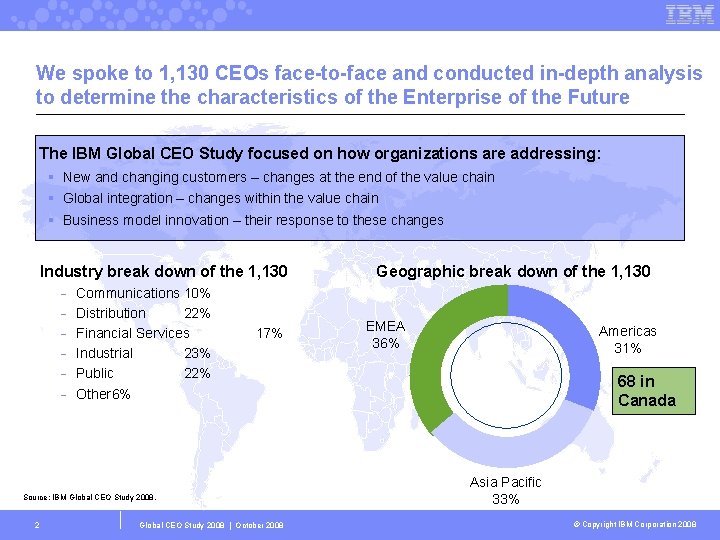
We spoke to 1, 130 CEOs face-to-face and conducted in-depth analysis to determine the characteristics of the Enterprise of the Future The IBM Global CEO Study focused on how organizations are addressing: § New and changing customers – changes at the end of the value chain § Global integration – changes within the value chain § Business model innovation – their response to these changes Industry break down of the 1, 130 - Communications 10% Distribution 22% Financial Services Industrial 23% Public 22% Other 6% 17% Source: IBM Global CEO Study 2008, 2 Global CEO Study 2008 | October 2008 Geographic break down of the 1, 130 EMEA 36% Americas 31% 68 in Canada Asia Pacific 33% © Copyright IBM Corporation 2008
CEOs see significant change and opportunity ahead, and are radically changing their business designs to respond CEOs are: § Expecting significant change (increased by 33%) § Clear that the ability to manage change has not kept pace – 39% feel unprepared § Investing heavily in engaging newly prosperous and more informed and collaborative customers § Moving aggressively toward global business designs, deeply changing capabilities, partnering more extensively and using M&A § Responding to customer expectations of corporate social responsibility as an opportunity to differentiate The collective wisdom of these CEOs has led us to the five core traits of the Enterprise of the Future. 3 Global CEO Study 2008 | October 2008 © Copyright IBM Corporation 2008
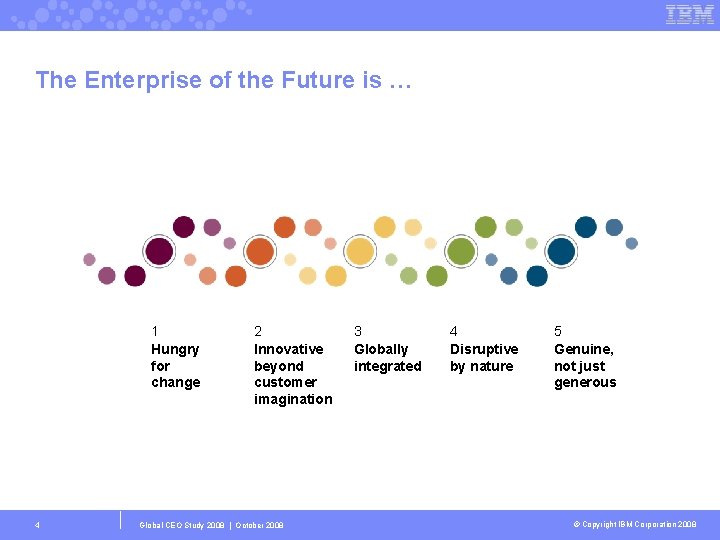
The Enterprise of the Future is … 1 Hungry for change 4 2 Innovative beyond customer imagination Global CEO Study 2008 | October 2008 3 Globally integrated 4 Disruptive by nature 5 Genuine, not just generous © Copyright IBM Corporation 2008
IBM Global Business Services The Enterprise of the Future is … Hungry for Change … capable of changing quickly and successfully. Instead of merely responding to trends, it shapes and leads them. Market and industry shifts are a chance to move ahead of the competition … and disadvantage competitors © Copyright IBM Corporation 2008
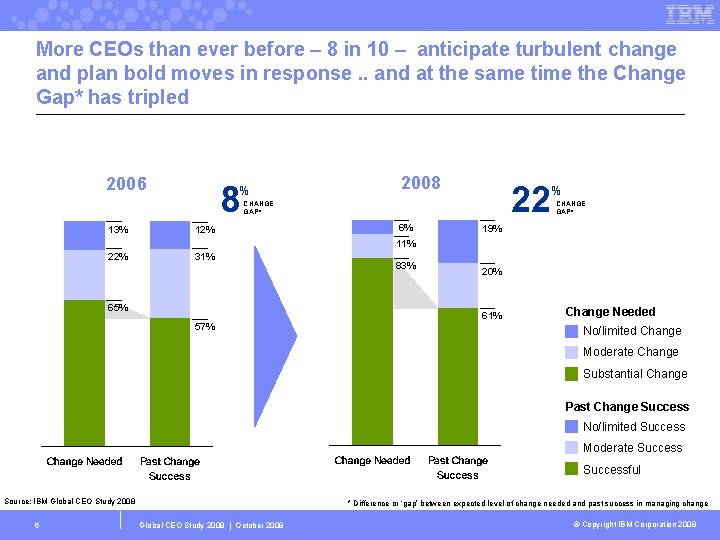
More CEOs than ever before – 8 in 10 – anticipate turbulent change and plan bold moves in response. . and at the same time the Change Gap* has tripled 2006 8 % 13% 12% 22% 31% 2008 22 CHANGE GAP* 6% % CHANGE GAP* 19% 11% 65% 83% 20% 61% 57% Change Needed No/limited Change Moderate Change Substantial Change Past Change Success No/limited Success Moderate Successful Source: IBM Global CEO Study 2008 6 * Difference or ‘gap’ between expected level of change needed and past success in managing change Global CEO Study 2008 | October 2008 © Copyright IBM Corporation 2008
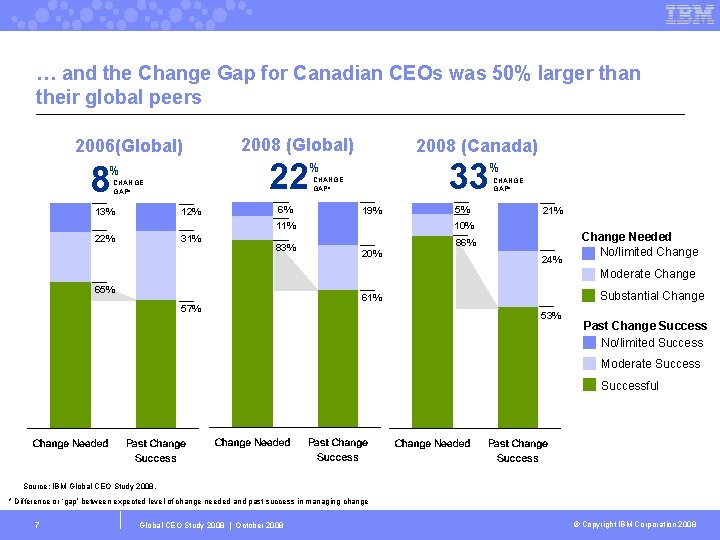
… and the Change Gap for Canadian CEOs was 50% larger than their global peers 2006(Global) 8 2008 (Global) 22 % CHANGE GAP* 13% 12% 22% 31% 6% 2008 (Canada) 33 % CHANGE GAP* 19% CHANGE GAP* 21% 10% 11% 83% 5% % 20% 86% 24% Change Needed No/limited Change Moderate Change 65% Substantial Change 61% 57% 53% Past Change Success No/limited Success Moderate Successful Source: IBM Global CEO Study 2008, * Difference or ‘gap’ between expected level of change needed and past success in managing change 7 Global CEO Study 2008 | October 2008 © Copyright IBM Corporation 2008
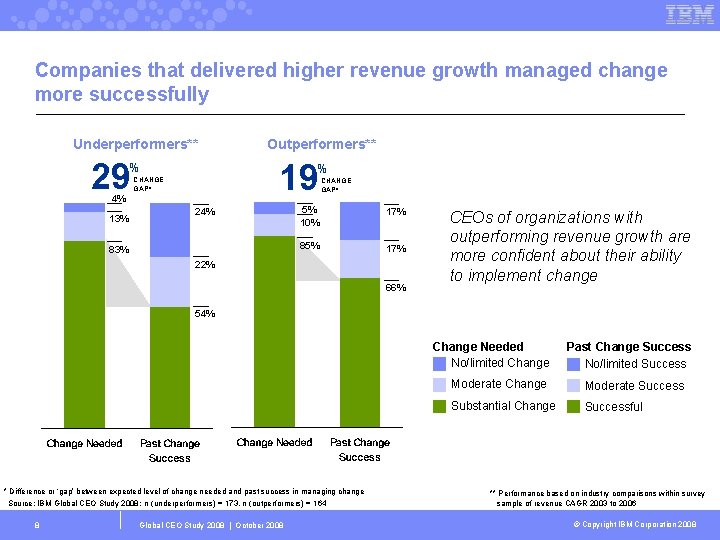
Companies that delivered higher revenue growth managed change more successfully Underperformers** 29 19 % % CHANGE GAP* 4% 13% Outperformers** 24% 83% CHANGE GAP* 5% 10% 17% 85% 17% 22% 66% CEOs of organizations with outperforming revenue growth are more confident about their ability to implement change 54% Change Needed No/limited Change * Difference or ‘gap’ between expected level of change needed and past success in managing change Source: IBM Global CEO Study 2008; n (underperformers) = 173, n (outperformers) = 164 8 Global CEO Study 2008 | October 2008 Past Change Success No/limited Success Moderate Change Moderate Success Substantial Change Successful ** Performance based on industry comparisons within survey sample of revenue CAGR 2003 to 2006 © Copyright IBM Corporation 2008
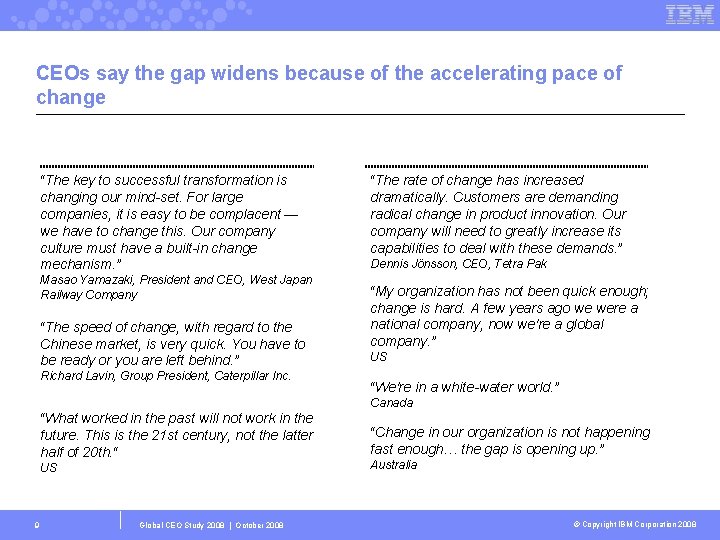
CEOs say the gap widens because of the accelerating pace of change “The key to successful transformation is changing our mind-set. For large companies, it is easy to be complacent — we have to change this. Our company culture must have a built-in change mechanism. ” Masao Yamazaki, President and CEO, West Japan Railway Company “The speed of change, with regard to the Chinese market, is very quick. You have to be ready or you are left behind. ” Richard Lavin, Group President, Caterpillar Inc. “The rate of change has increased dramatically. Customers are demanding radical change in product innovation. Our company will need to greatly increase its capabilities to deal with these demands. ” Dennis Jönsson, CEO, Tetra Pak “My organization has not been quick enough; change is hard. A few years ago we were a national company, now we're a global company. ” US “We're in a white-water world. ” Canada “What worked in the past will not work in the future. This is the 21 st century, not the latter half of 20 th. “ US 9 Global CEO Study 2008 | October 2008 “Change in our organization is not happening fast enough… the gap is opening up. ” Australia © Copyright IBM Corporation 2008
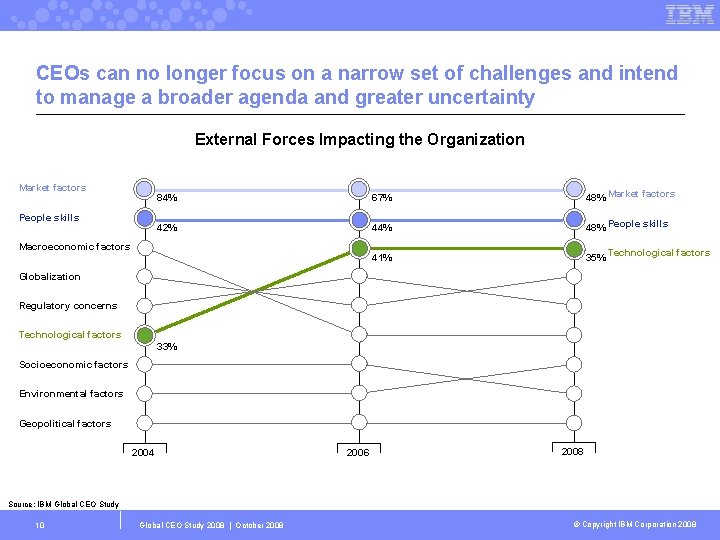
CEOs can no longer focus on a narrow set of challenges and intend to manage a broader agenda and greater uncertainty External Forces Impacting the Organization Market factors People skills 84% 67% 48% Market factors 42% 44% 48% People skills 41% 35% Macroeconomic factors Technological factors Globalization Regulatory concerns Technological factors 33% Socioeconomic factors Environmental factors Geopolitical factors 2004 2006 2008 Source: IBM Global CEO Study 10 Global CEO Study 2008 | October 2008 © Copyright IBM Corporation 2008
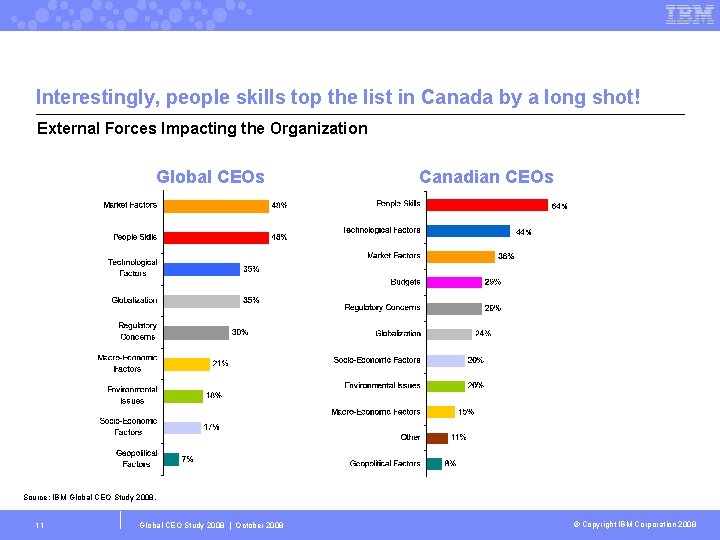
Interestingly, people skills top the list in Canada by a long shot! External Forces Impacting the Organization Global CEOs Canadian CEOs 64% 44% Source: IBM Global CEO Study 2008, 11 Global CEO Study 2008 | October 2008 © Copyright IBM Corporation 2008
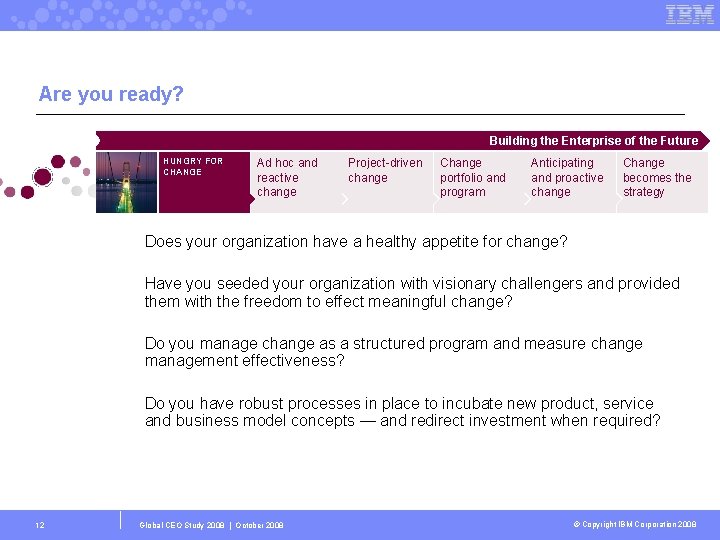
Are you ready? Building the Enterprise of the Future HUNGRY FOR CHANGE Ad hoc and reactive change Project-driven change Change portfolio and program Anticipating and proactive change Change becomes the strategy Does your organization have a healthy appetite for change? Have you seeded your organization with visionary challengers and provided them with the freedom to effect meaningful change? Do you manage change as a structured program and measure change management effectiveness? Do you have robust processes in place to incubate new product, service and business model concepts — and redirect investment when required? 12 Global CEO Study 2008 | October 2008 © Copyright IBM Corporation 2008
IBM Global Business Services The Enterprise of the Future is … Innovative Beyond Customer Imagination … surpasses the expectations of increasingly demanding customers. Deep collaborative relationships with customers and partners foster innovation © Copyright IBM Corporation 2008
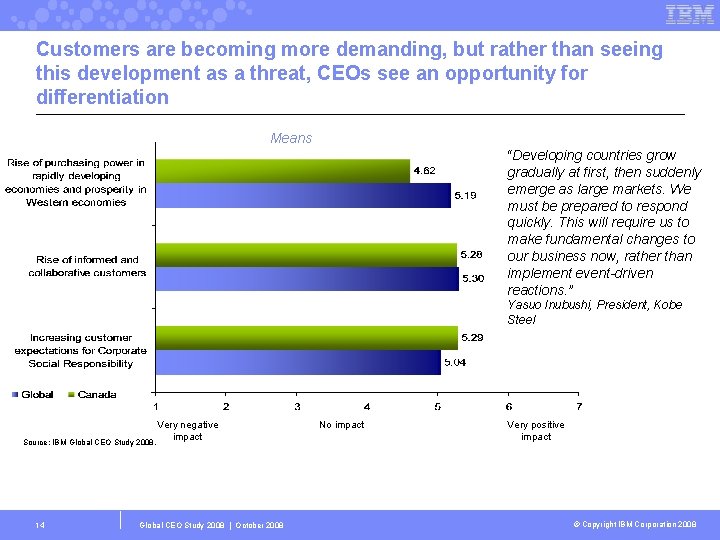
Customers are becoming more demanding, but rather than seeing this development as a threat, CEOs see an opportunity for differentiation Means “Developing countries grow gradually at first, then suddenly emerge as large markets. We must be prepared to respond quickly. This will require us to make fundamental changes to our business now, rather than implement event-driven reactions. ” Yasuo Inubushi, President, Kobe Steel Source: IBM Global CEO Study 2008, 14 Very negative impact Global CEO Study 2008 | October 2008 No impact Very positive impact © Copyright IBM Corporation 2008
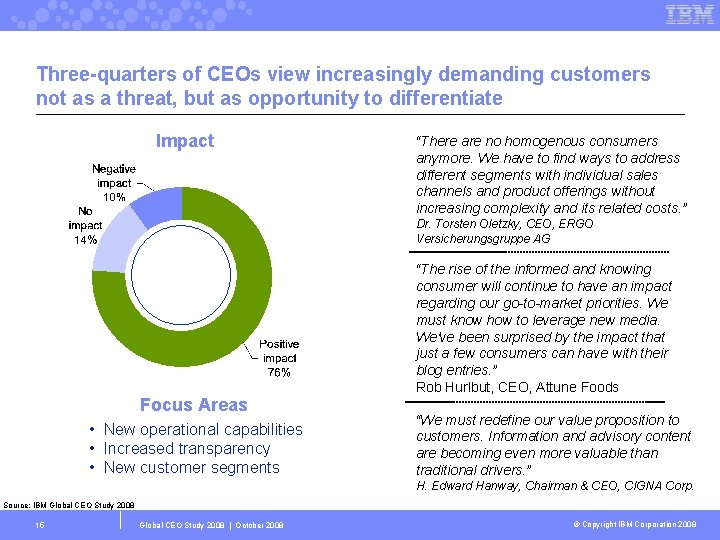
Three-quarters of CEOs view increasingly demanding customers not as a threat, but as opportunity to differentiate Impact “There are no homogenous consumers anymore. We have to find ways to address different segments with individual sales channels and product offerings without increasing complexity and its related costs. ” Dr. Torsten Oletzky, CEO, ERGO Versicherungsgruppe AG “The rise of the informed and knowing consumer will continue to have an impact regarding our go-to-market priorities. We must know how to leverage new media. We've been surprised by the impact that just a few consumers can have with their blog entries. ” Rob Hurlbut, CEO, Attune Foods Focus Areas • New operational capabilities • Increased transparency • New customer segments “We must redefine our value proposition to customers. Information and advisory content are becoming even more valuable than traditional drivers. ” H. Edward Hanway, Chairman & CEO, CIGNA Corp. Source: IBM Global CEO Study 2008 15 Global CEO Study 2008 | October 2008 © Copyright IBM Corporation 2008
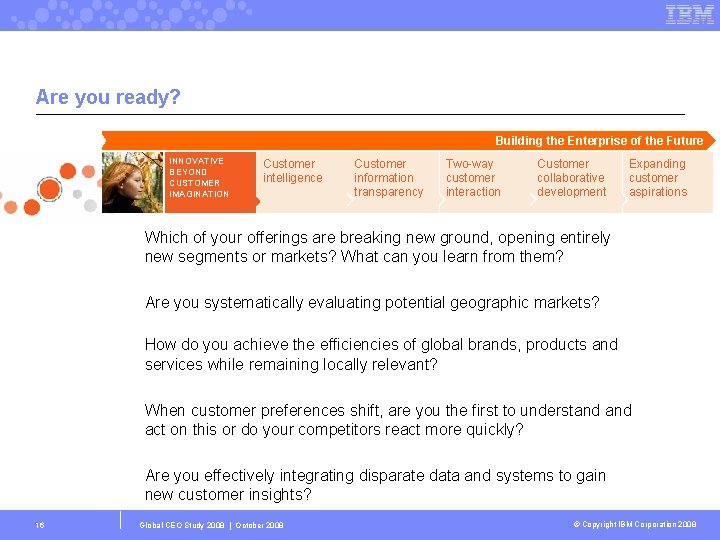
Are you ready? Building the Enterprise of the Future INNOVATIVE BEYOND CUSTOMER IMAGINATION Customer intelligence Customer information transparency Two-way customer interaction Customer collaborative development Expanding customer aspirations Which of your offerings are breaking new ground, opening entirely new segments or markets? What can you learn from them? Are you systematically evaluating potential geographic markets? How do you achieve the efficiencies of global brands, products and services while remaining locally relevant? When customer preferences shift, are you the first to understand act on this or do your competitors react more quickly? Are you effectively integrating disparate data and systems to gain new customer insights? 16 Global CEO Study 2008 | October 2008 © Copyright IBM Corporation 2008
IBM Global Business Services The Enterprise of the Future is … Globally Integrated … business designs are strategically designed to access the best capabilities, knowledge and assets from wherever they reside in the world and apply them wherever required © Copyright IBM Corporation 2008
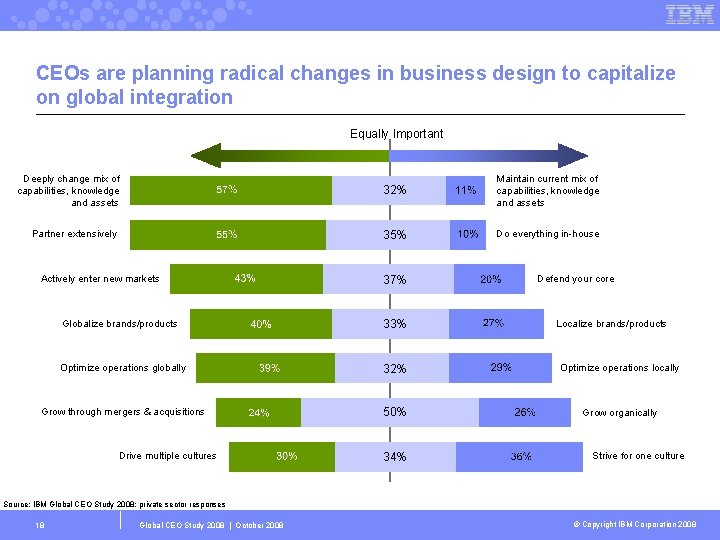
CEOs are planning radical changes in business design to capitalize on global integration Equally Important Deeply change mix of capabilities, knowledge and assets 32% Maintain current mix of capabilities, knowledge and assets Partner extensively 35% Do everything in-house Actively enter new markets 37% Defend your core Globalize brands/products 33% Optimize operations globally 32% Optimize operations locally Grow through mergers & acquisitions 50% Grow organically Drive multiple cultures 34% Localize brands/products Strive for one culture Source: IBM Global CEO Study 2008; private sector responses 18 Global CEO Study 2008 | October 2008 © Copyright IBM Corporation 2008
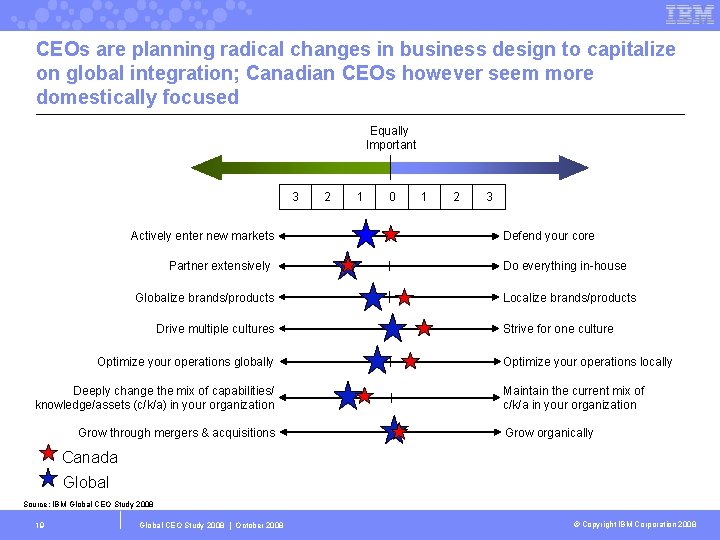
CEOs are planning radical changes in business design to capitalize on global integration; Canadian CEOs however seem more domestically focused Equally Important 3 Actively enter new markets Partner extensively Globalize brands/products Drive multiple cultures Optimize your operations globally Deeply change the mix of capabilities/ knowledge/assets (c/k/a) in your organization Grow through mergers & acquisitions 2 1 0 1 2 3 Defend your core Do everything in-house Localize brands/products Strive for one culture Optimize your operations locally Maintain the current mix of c/k/a in your organization Grow organically Canada Global Source: IBM Global CEO Study 2008 19 Global CEO Study 2008 | October 2008 © Copyright IBM Corporation 2008
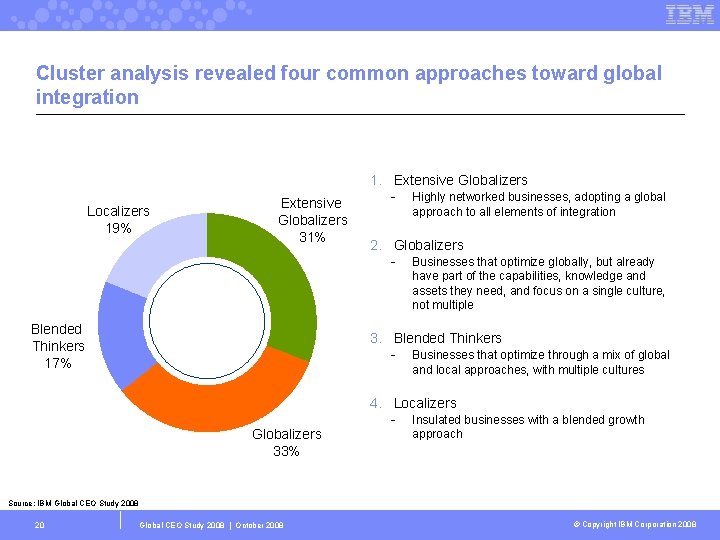
Cluster analysis revealed four common approaches toward global integration 1. Extensive Globalizers Localizers 19% Extensive Globalizers 31% - 2. Globalizers - Blended Thinkers 17% Highly networked businesses, adopting a global approach to all elements of integration Businesses that optimize globally, but already have part of the capabilities, knowledge and assets they need, and focus on a single culture, not multiple 3. Blended Thinkers - Businesses that optimize through a mix of global and local approaches, with multiple cultures 4. Localizers - Globalizers 33% Insulated businesses with a blended growth approach Source: IBM Global CEO Study 2008 20 Global CEO Study 2008 | October 2008 © Copyright IBM Corporation 2008
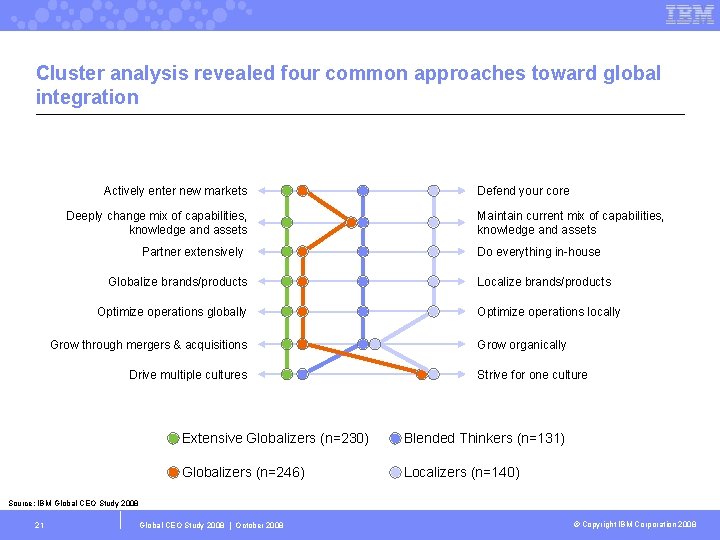
Cluster analysis revealed four common approaches toward global integration Actively enter new markets Deeply change mix of capabilities, knowledge and assets Partner extensively Globalize brands/products Optimize operations globally Grow through mergers & acquisitions Drive multiple cultures Defend your core Maintain current mix of capabilities, knowledge and assets Do everything in-house Localize brands/products Optimize operations locally Grow organically Strive for one culture Extensive Globalizers (n=230) Blended Thinkers (n=131) Globalizers (n=246) Localizers (n=140) Source: IBM Global CEO Study 2008 21 Global CEO Study 2008 | October 2008 © Copyright IBM Corporation 2008
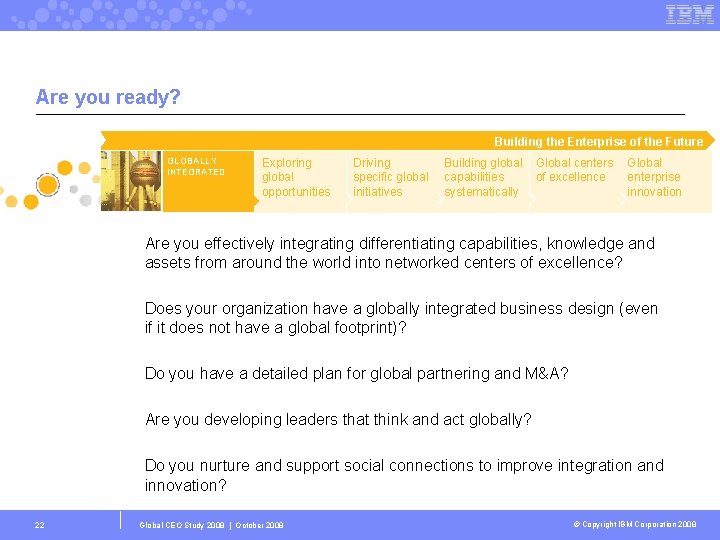
Are you ready? Building the Enterprise of the Future GLOBALLY INTEGRATED Exploring global opportunities Driving specific global initiatives Building global capabilities systematically Global centers of excellence Global enterprise innovation Are you effectively integrating differentiating capabilities, knowledge and assets from around the world into networked centers of excellence? Does your organization have a globally integrated business design (even if it does not have a global footprint)? Do you have a detailed plan for global partnering and M&A? Are you developing leaders that think and act globally? Do you nurture and support social connections to improve integration and innovation? 22 Global CEO Study 2008 | October 2008 © Copyright IBM Corporation 2008
IBM Global Business Services The Enterprise of the Future is … Disruptive by Nature … challenges existing business models, disrupting the basis of competition. Shifts the value proposition, overturns traditional delivery approaches and, as soon as opportunities arise, reinvents itself and its entire industry © Copyright IBM Corporation 2008
CEOs implement initiatives to evolve their business model; outperformers aim to disrupt their enterprise or industry model § Business Model Innovation. “Significantly changing the structure and / or financial model of the business”. There are three types of business model innovation: - - - 24 Industry model innovation – Innovating the industry value chain by Moving into new industries, redefining existing ones or creating entirely new value chains Revenue model innovation – Innovating how revenue is generated through new value propositions or pricing models Enterprise model innovation – Innovating value chain roles by Changing the extended enterprise to be either more integrated or more specialized or Transforming networks of employees, suppliers, customers and others Global CEO Study 2008 | October 2008 © Copyright IBM Corporation 2008
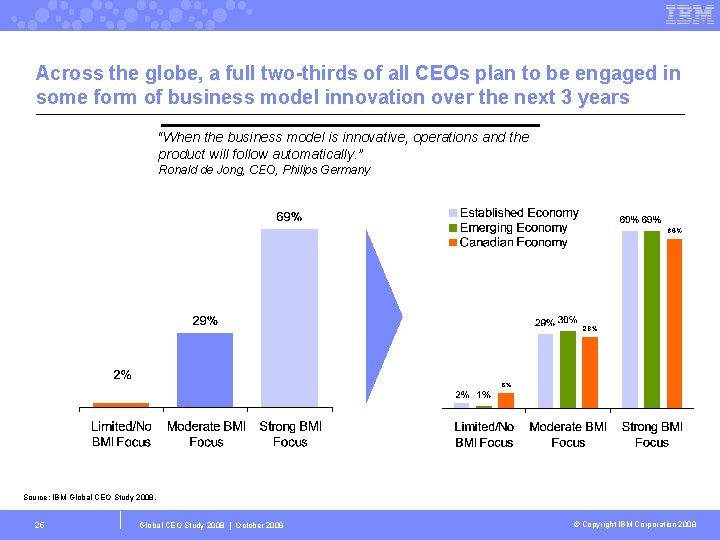
Across the globe, a full two-thirds of all CEOs plan to be engaged in some form of business model innovation over the next 3 years “When the business model is innovative, operations and the product will follow automatically. ” Ronald de Jong, CEO, Philips Germany Source: IBM Global CEO Study 2008, 25 Global CEO Study 2008 | October 2008 © Copyright IBM Corporation 2008
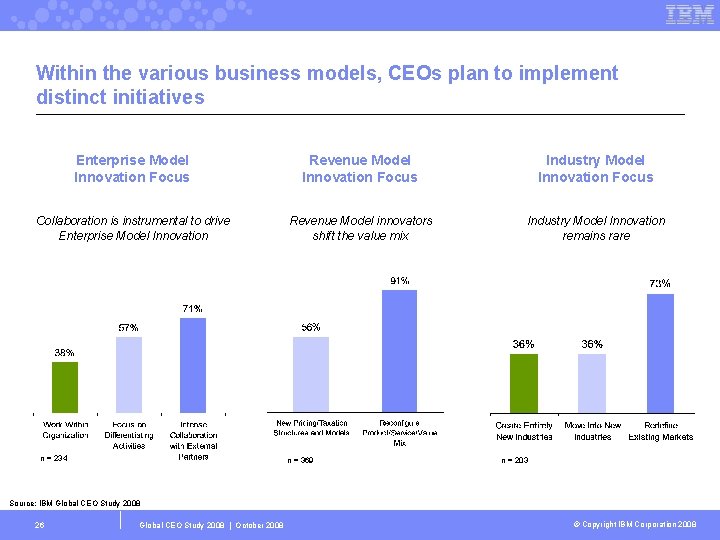
Within the various business models, CEOs plan to implement distinct initiatives Enterprise Model Innovation Focus Revenue Model Innovation Focus Industry Model Innovation Focus Collaboration is instrumental to drive Enterprise Model Innovation Revenue Model innovators shift the value mix Industry Model Innovation remains rare n = 234 n = 369 n = 203 Source: IBM Global CEO Study 2008 26 Global CEO Study 2008 | October 2008 © Copyright IBM Corporation 2008
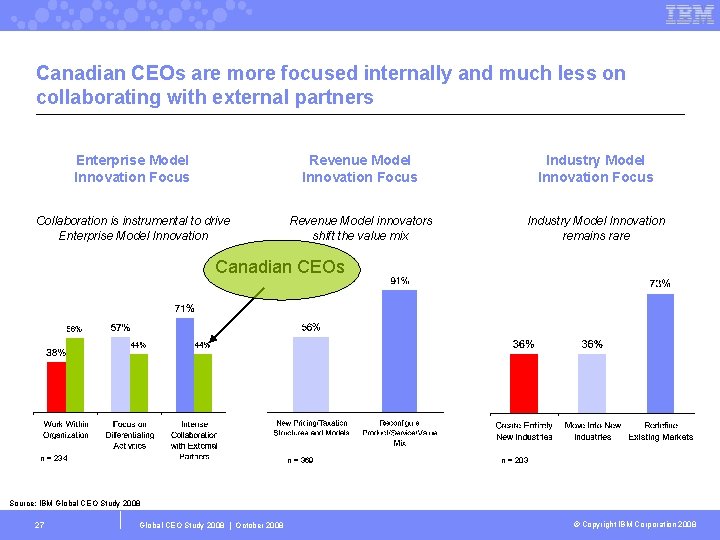
Canadian CEOs are more focused internally and much less on collaborating with external partners Enterprise Model Innovation Focus Revenue Model Innovation Focus Industry Model Innovation Focus Collaboration is instrumental to drive Enterprise Model Innovation Revenue Model innovators shift the value mix Industry Model Innovation remains rare Canadian CEOs n = 234 n = 369 n = 203 Source: IBM Global CEO Study 2008 27 Global CEO Study 2008 | October 2008 © Copyright IBM Corporation 2008
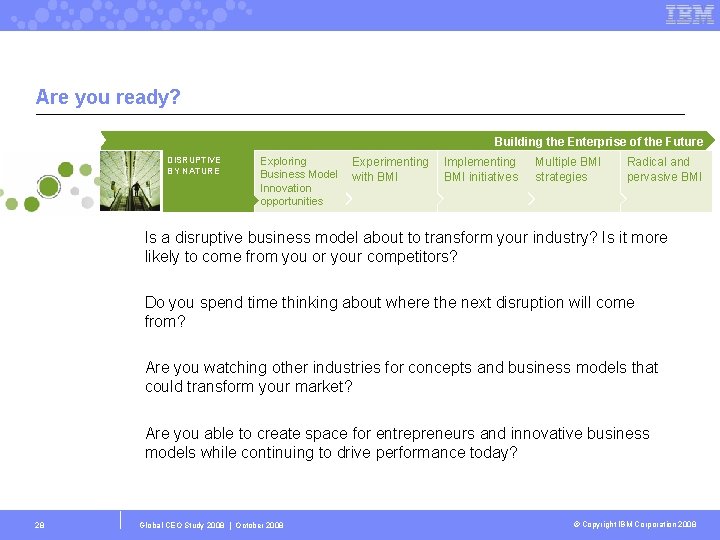
Are you ready? Building the Enterprise of the Future DISRUPTIVE BY NATURE Exploring Business Model Innovation opportunities Experimenting with BMI Implementing BMI initiatives Multiple BMI strategies Radical and pervasive BMI Is a disruptive business model about to transform your industry? Is it more likely to come from you or your competitors? Do you spend time thinking about where the next disruption will come from? Are you watching other industries for concepts and business models that could transform your market? Are you able to create space for entrepreneurs and innovative business models while continuing to drive performance today? 28 Global CEO Study 2008 | October 2008 © Copyright IBM Corporation 2008
IBM Global Business Services The Enterprise of the Future is … Genuine, not just Generous … doing well in the world goes beyond philanthropy and regulatory compliance. it reflects genuine concern for society in all actions and decisions and prospers and profit as a result © Copyright IBM Corporation 2008
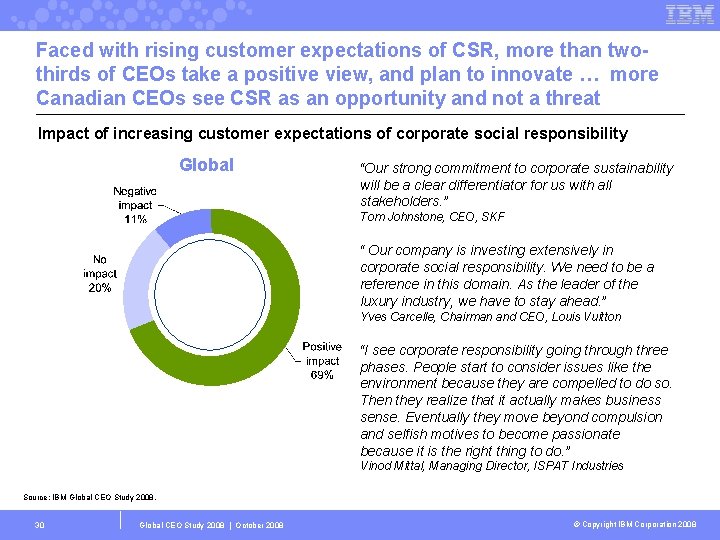
Faced with rising customer expectations of CSR, more than twothirds of CEOs take a positive view, and plan to innovate … more Canadian CEOs see CSR as an opportunity and not a threat Impact of increasing customer expectations of corporate social responsibility Global “Our strong commitment to corporate sustainability will be a clear differentiator for us with all stakeholders. ” Tom Johnstone, CEO, SKF “ Our company is investing extensively in corporate social responsibility. We need to be a reference in this domain. As the leader of the luxury industry, we have to stay ahead. ” Yves Carcelle, Chairman and CEO, Louis Vuitton “I see corporate responsibility going through three phases. People start to consider issues like the environment because they are compelled to do so. Then they realize that it actually makes business sense. Eventually they move beyond compulsion and selfish motives to become passionate because it is the right thing to do. ” Vinod Mittal, Managing Director, ISPAT Industries Source: IBM Global CEO Study 2008, 30 Global CEO Study 2008 | October 2008 © Copyright IBM Corporation 2008
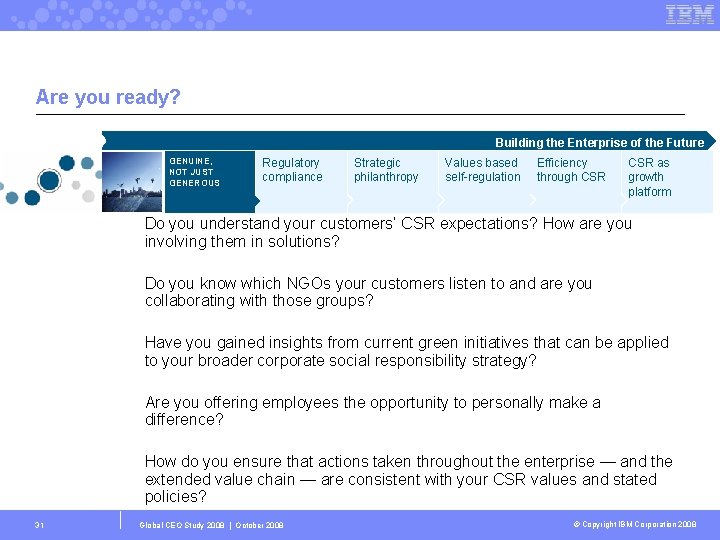
Are you ready? Building the Enterprise of the Future GENUINE, NOT JUST GENEROUS Regulatory compliance Strategic philanthropy Values based self-regulation Efficiency through CSR as growth platform Do you understand your customers’ CSR expectations? How are you involving them in solutions? Do you know which NGOs your customers listen to and are you collaborating with those groups? Have you gained insights from current green initiatives that can be applied to your broader corporate social responsibility strategy? Are you offering employees the opportunity to personally make a difference? How do you ensure that actions taken throughout the enterprise — and the extended value chain — are consistent with your CSR values and stated policies? 31 Global CEO Study 2008 | October 2008 © Copyright IBM Corporation 2008
IBM Global Business Services The Enterprise of the Future Positioning for Your Future © Copyright IBM Corporation 2008
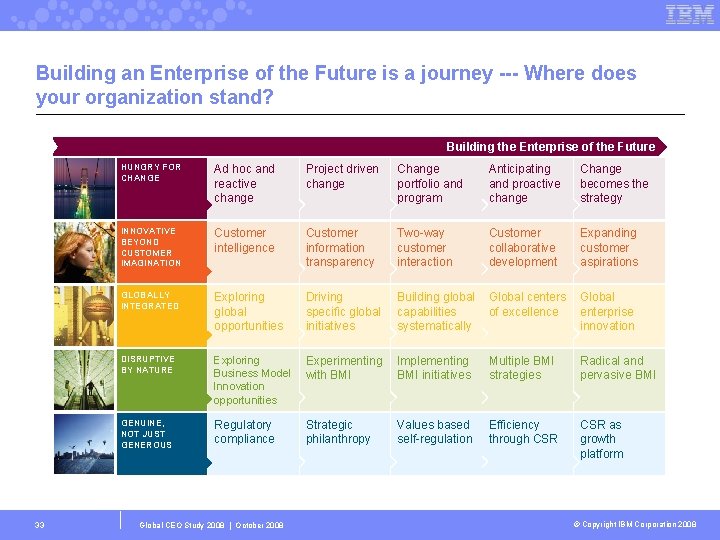
Building an Enterprise of the Future is a journey --- Where does your organization stand? Building the Enterprise of the Future 33 HUNGRY FOR CHANGE Ad hoc and reactive change Project driven change Change portfolio and program Anticipating and proactive change Change becomes the strategy INNOVATIVE BEYOND CUSTOMER IMAGINATION Customer intelligence Customer information transparency Two-way customer interaction Customer collaborative development Expanding customer aspirations GLOBALLY INTEGRATED Exploring global opportunities Driving specific global initiatives Building global capabilities systematically Global centers of excellence Global enterprise innovation DISRUPTIVE BY NATURE Exploring Business Model Innovation opportunities Experimenting with BMI Implementing BMI initiatives Multiple BMI strategies Radical and pervasive BMI GENUINE, NOT JUST GENEROUS Regulatory compliance Strategic philanthropy Values based self-regulation Efficiency through CSR as growth platform Global CEO Study 2008 | October 2008 © Copyright IBM Corporation 2008
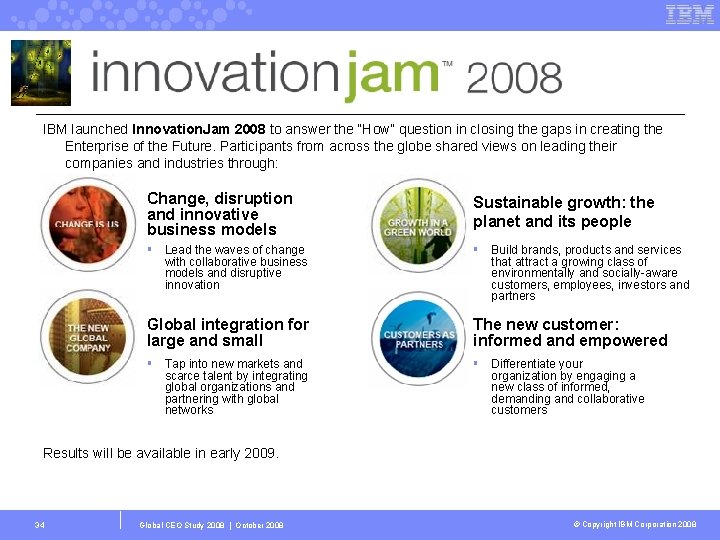
IBM launched Innovation. Jam 2008 to answer the “How” question in closing the gaps in creating the Enterprise of the Future. Participants from across the globe shared views on leading their companies and industries through: Change, disruption and innovative business models Sustainable growth: the planet and its people § Lead the waves of change with collaborative business models and disruptive innovation § Build brands, products and services that attract a growing class of environmentally and socially-aware customers, employees, investors and partners Global integration for large and small The new customer: informed and empowered § Tap into new markets and scarce talent by integrating global organizations and partnering with global networks § Differentiate your organization by engaging a new class of informed, demanding and collaborative customers Results will be available in early 2009. 34 Global CEO Study 2008 | October 2008 © Copyright IBM Corporation 2008
In Summary … § Organizations will evolve to the Enterprise of the Future § Need for change continues to accelerate due to both external and internal factors § Entities have only been successful in achieving large scale change about 60% of the time § The culture for and the management of change is thus receiving increasing focus § Change is required around 4 dimensions - - - 35 Innovation around the customer reflecting changing expectations for products and services and for how they are provided/delivered Global integration to exploit opportunities, capabilities, knowledge and assets where ever they may reside Rethinking business models sharpening focus Address changing expectations around corporate social responsibility Global CEO Study 2008 | October 2008 © Copyright IBM Corporation 2008
IBM Contact John Fursey Strategy & Change Consulting Leader IBM Global Business Services Canada 416 -478 -3354 jfursey@ca. ibm. com 36 Global CEO Study 2008 | October 2008 © Copyright IBM Corporation 2008
- Slides: 36