
IBM CEEMEA SOA SWAT Team Aligning Business with
IBM CEEMEA SOA SWAT Team Aligning Business with IT: Component Based Modelling & Methodologies Dr. Julius PETER SOA Sales Executive, CEMAAS SWG julius_peter@at. ibm. com Johannesburg, Aug. 21, 2008 © 2008 IBM Corporation
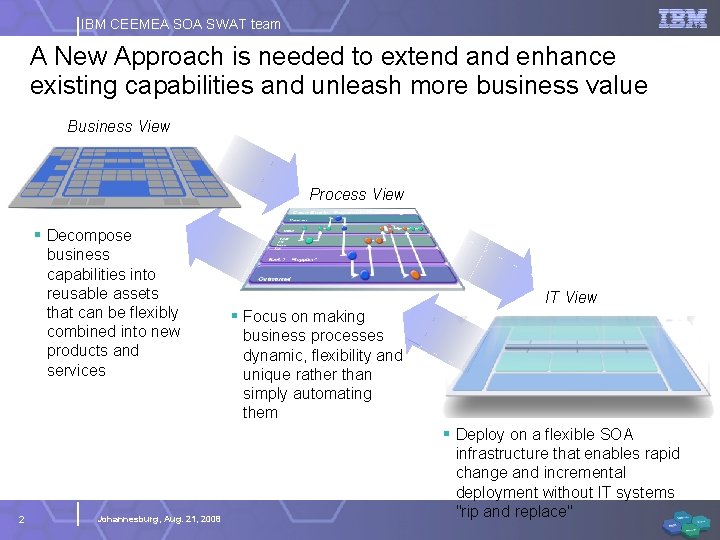
IBM CEEMEA SOA SWAT team A New Approach is needed to extend and enhance existing capabilities and unleash more business value Business View Process View § Decompose business capabilities into reusable assets that can be flexibly combined into new products and services § Focus on making IT View business processes dynamic, flexibility and unique rather than simply automating them § Deploy on a flexible SOA 2 Johannesburg, Aug. 21, 2008 infrastructure that enables rapid change and incremental deployment without IT systems "rip and replace"
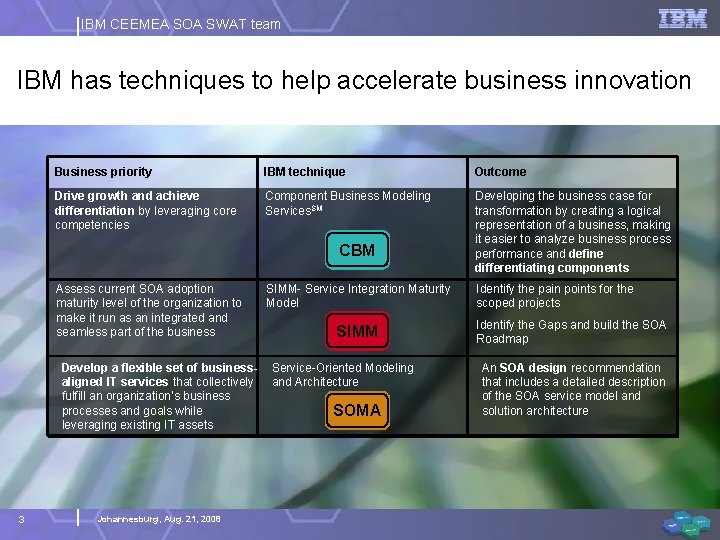
IBM CEEMEA SOA SWAT team IBM has techniques to help accelerate business innovation Business priority IBM technique Outcome Drive growth and achieve differentiation by leveraging core competencies Component Business Modeling Services. SM Developing the business case for transformation by creating a logical representation of a business, making it easier to analyze business process performance and define differentiating components CBM Assess current SOA adoption maturity level of the organization to make it run as an integrated and seamless part of the business Develop a flexible set of businessaligned IT services that collectively fulfill an organization’s business processes and goals while leveraging existing IT assets 3 Johannesburg, Aug. 21, 2008 SIMM- Service Integration Maturity Model SIMM Service-Oriented Modeling and Architecture SOMA Identify the pain points for the scoped projects Identify the Gaps and build the SOA Roadmap An SOA design recommendation that includes a detailed description of the SOA service model and solution architecture
IBM CEEMEA SOA SWAT team Grappling with the essential questions “How can we focus on the pieces of our business that drive growth and differentiation? ” Q. A. Deconstruct business into components, analyze processes, and distinguish between differentiating and enabling capabilities. 4 Johannesburg, Aug. 21, 2008
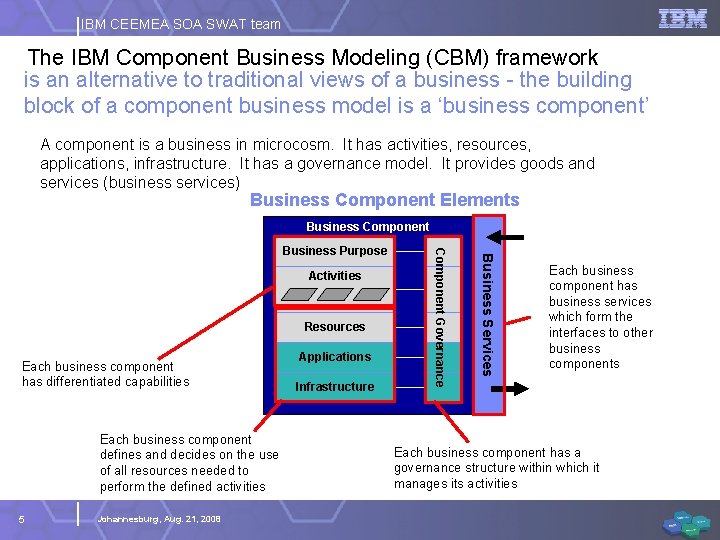
IBM CEEMEA SOA SWAT team The IBM Component Business Modeling (CBM) framework is an alternative to traditional views of a business - the building block of a component business model is a ‘business component’ A component is a business in microcosm. It has activities, resources, applications, infrastructure. It has a governance model. It provides goods and services (business services) Business Component Elements Business Component Resources Each business component has differentiated capabilities Each business component defines and decides on the use of all resources needed to perform the defined activities 5 Johannesburg, Aug. 21, 2008 Applications Infrastructure Business Services Activities Component Governance Business Purpose Each business component has business services which form the interfaces to other business components Each business component has a governance structure within which it manages its activities
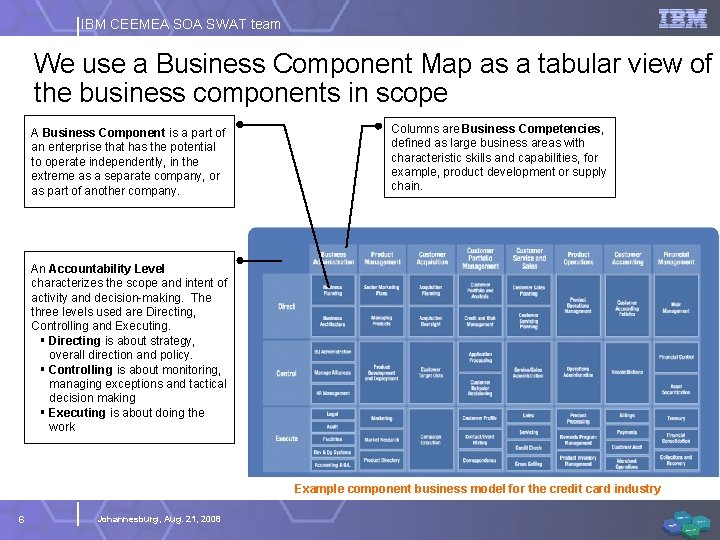
IBM CEEMEA SOA SWAT team We use a Business Component Map as a tabular view of the business components in scope A Business Component is a part of an enterprise that has the potential to operate independently, in the extreme as a separate company, or as part of another company. Columns are Business Competencies, defined as large business areas with characteristic skills and capabilities, for example, product development or supply chain. An Accountability Level characterizes the scope and intent of activity and decision-making. The three levels used are Directing, Controlling and Executing. § Directing is about strategy, overall direction and policy. § Controlling is about monitoring, managing exceptions and tactical decision making § Executing is about doing the work Example component business model for the credit card industry 6 Johannesburg, Aug. 21, 2008
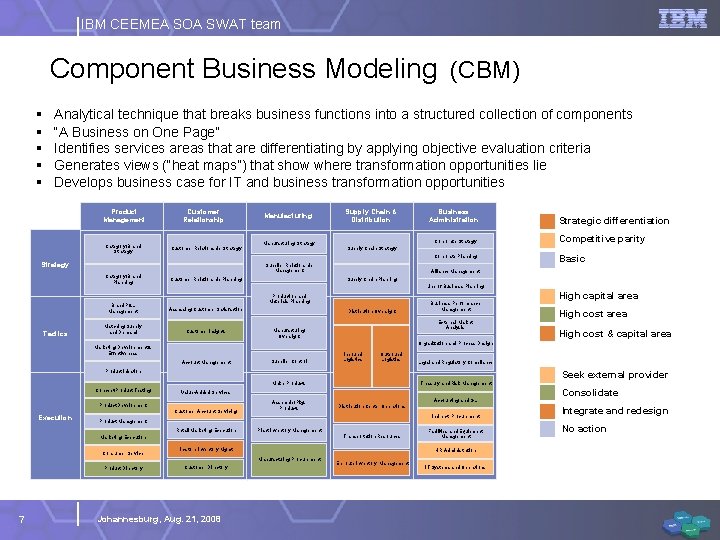
IBM CEEMEA SOA SWAT team Component Business Modeling (CBM) § § § Analytical technique that breaks business functions into a structured collection of components “A Business on One Page” Identifies services areas that are differentiating by applying objective evaluation criteria Generates views (“heat maps”) that show where transformation opportunities lie Develops business case for IT and business transformation opportunities Product Management Category/Brand Strategy Customer Relationship Strategy Brand P&L Management Tactics Matching Supply and Demand Manufacturing Strategy Supply Chain & Distribution Business Administration Corporate Strategy Supplier Relationship Management Line of Business Planning Assessing Customer Satisfaction Customer Insights Distribution Oversight Business Performance Management External Market Analysis Manufacturing Oversight Supplier Control Inbound Logistics Outbound Logistics Legal and Regulatory Compliance Value-Added Services Customer Account Servicing Assemble/Pkg. Products Distribution Center Operations Retail Marketing Execution Plant Inventory Management Transportation Resources In-store Inventory Mgmt Johannesburg, Aug. 21, 2008 Facilities and Equipment Management HR Administration Manufacturing Procurement Customer Directory Accounting and GL Indirect Procurement Marketing Execution 7 High cost & capital area Seek external provider Product Management Product Directory High cost area Treasury and Risk Management Make Products Consumer Service High capital area Organization and Process Design Product Ideation Execution Basic Alliance Management Production and Materials Planning Account Management Product Development Competitive parity Supply Chain Planning Customer Relationship Planning Marketing Development & Effectiveness Concept/Product Testing Strategic differentiation Supply Chain Strategy Corporate Planning Strategy Category/Brand Planning Manufacturing En route Inventory Management IT Systems and Operations Consolidate Integrate and redesign No action * Example of a CBM map for a consumer products company
IBM CEEMEA SOA SWAT team Grappling with the essential questions “How do I begin to understand the maturity level to support our business processes and goals? ” Q. A. Examine existing business to Assess your current SOA adoption maturity level Identify the pain points for the scoped projects Define the As-Is environment for the scoped projects Define the To-Be environment for the scoped projects 8 Johannesburg, Aug. 21, 2008
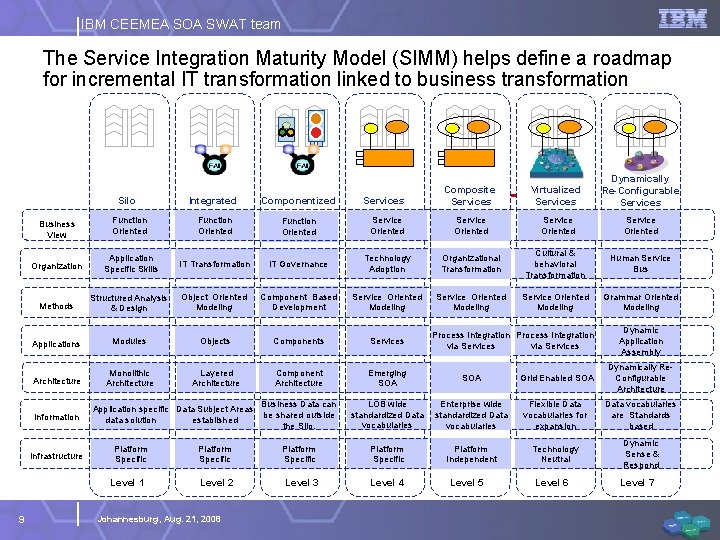
IBM CEEMEA SOA SWAT team The Service Integration Maturity Model (SIMM) helps define a roadmap for incremental IT transformation linked to business transformation Dynamically Re-Configurable Services Service Oriented Integrated Componentized Business View Function Oriented Service Oriented Organization Application Specific Skills IT Transformation IT Governance Technology Adoption Organizational Transformation Cultural & behavioral Transformation Human Service Bus Methods Structured Analysis & Design Object Oriented Modeling Component Based Development Service Oriented Modeling Grammar Oriented Modeling Applications Modules Objects Components Services Architecture Monolithic Architecture Layered Architecture Component Architecture Emerging SOA Grid Enabled SOA Dynamically Re. Configurable Architecture Business Data can be shared outside the Silo. LOB wide standardized Data vocabularies Enterprise wide standardized Data vocabularies Flexible Data vocabularies for expansion Data vocabularies are Standards based Platform Specific Platform Independent Technology Neutral Dynamic Sense & Respond Infrastructure Application specific Data Subject Areas data solution established Platform Specific Level 1 9 Virtualized Services Silo Information Platform Specific Level 2 Johannesburg, Aug. 21, 2008 Level 3 Services Composite Services Level 4 Process Integration via Services Level 5 Level 6 Dynamic Application Assembly Level 7
IBM CEEMEA SOA SWAT team Grappling with the essential questions “How do I architect and design a flexible application environment to support our business processes and goals? ” Q. A. Examine existing business processes and their related IT assets, prioritize the services that contribute the greatest business value and design through a costeffective architecture that enables them. 10 Johannesburg, Aug. 21, 2008
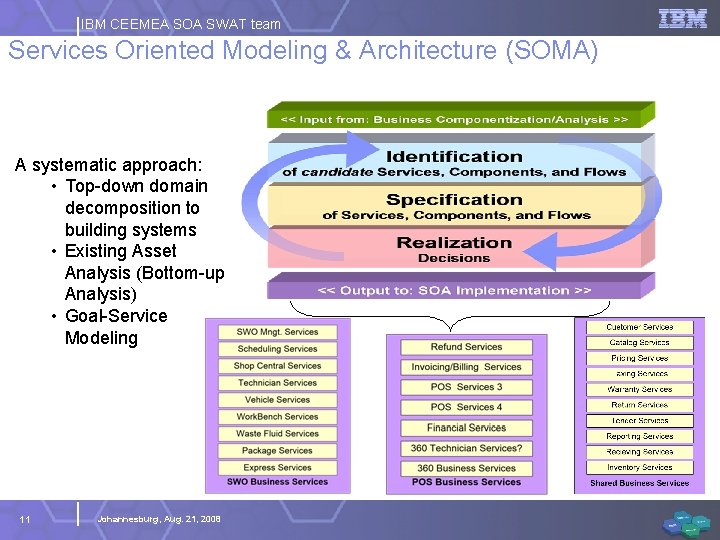
IBM CEEMEA SOA SWAT team Services Oriented Modeling & Architecture (SOMA) End-to-end SOA Method for the identification, specification, realization and implementation of services A systematic approach: • Top-down domain decomposition to building systems • Existing Asset Analysis (Bottom-up Analysis) • Goal-Service Modeling 11 Johannesburg, Aug. 21, 2008
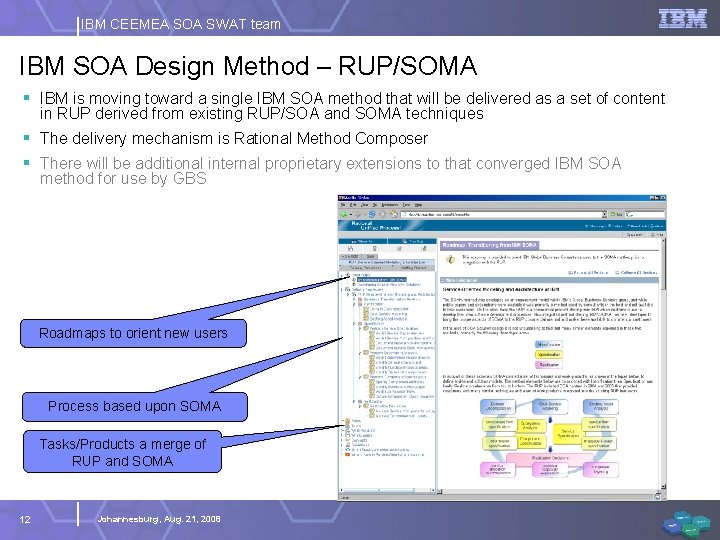
IBM CEEMEA SOA SWAT team IBM SOA Design Method – RUP/SOMA § IBM is moving toward a single IBM SOA method that will be delivered as a set of content in RUP derived from existing RUP/SOA and SOMA techniques § The delivery mechanism is Rational Method Composer § There will be additional internal proprietary extensions to that converged IBM SOA method for use by GBS Roadmaps to orient new users Process based upon SOMA Tasks/Products a merge of RUP and SOMA 12 Johannesburg, Aug. 21, 2008
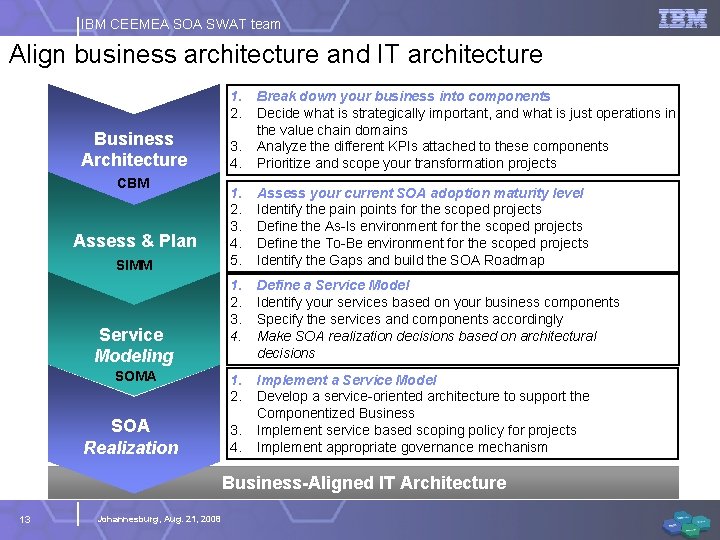
IBM CEEMEA SOA SWAT team Align business architecture and IT architecture 1. 2. Business Architecture CBM Assess & Plan SIMM Service Modeling SOMA SOA Realization 3. 4. Break down your business into components Decide what is strategically important, and what is just operations in the value chain domains Analyze the different KPIs attached to these components Prioritize and scope your transformation projects 1. 2. 3. 4. 5. Assess your current SOA adoption maturity level Identify the pain points for the scoped projects Define the As-Is environment for the scoped projects Define the To-Be environment for the scoped projects Identify the Gaps and build the SOA Roadmap 1. 2. 3. 4. Define a Service Model Identify your services based on your business components Specify the services and components accordingly Make SOA realization decisions based on architectural decisions 1. 2. Implement a Service Model Develop a service-oriented architecture to support the Componentized Business Implement service based scoping policy for projects Implement appropriate governance mechanism 3. 4. Business-Aligned IT Architecture 13 Johannesburg, Aug. 21, 2008
- Slides: 13