
IBM and the Algol project Exploring the challenges
IBM and the Algol project Exploring the challenges and dilemmas of early computer science research 5!7 David Nofre Ha. Po. P Oxford March 23, 2018
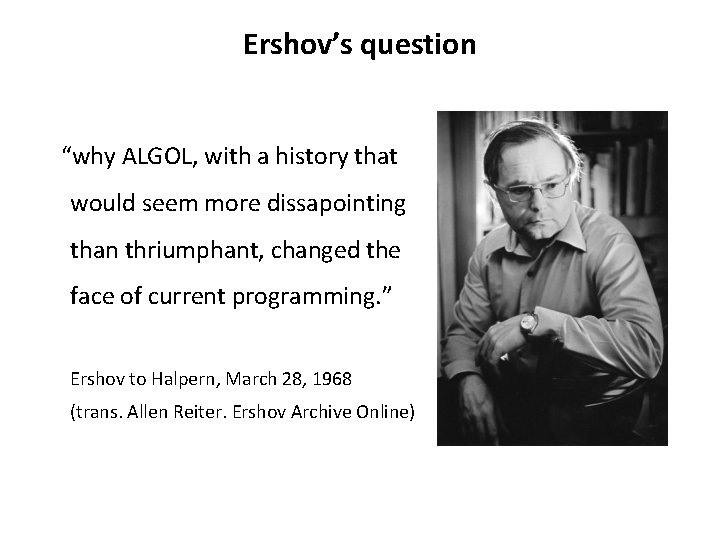
Ershov’s question “why ALGOL, with a history that would seem more dissapointing than thriumphant, changed the face of current programming. ” Ershov to Halpern, March 28, 1968 (trans. Allen Reiter. Ershov Archive Online)

Algol 58 & Algol 60 implementation By early 1963 : less than 10% operating computers • Data for Algol implementations: CACM, Datamation, AB, Software Preservation Group • Data for total number of commercial computers: Computer Comparison & Census Chart, annually in Business Automation Computer Characteristics Quarterly, by Charles W. Adams Associates Inc. Survey of Domestic Electronic Digital Computing Systems, BRL Computers in Europe 1966 (Amsterdam, 1966)
Understanding Algol’ s limited adoption • Algol community favors open-ended research • IBM & SHARE favor stability and maintenance • Threat of “common languages”: Algol, Cobol
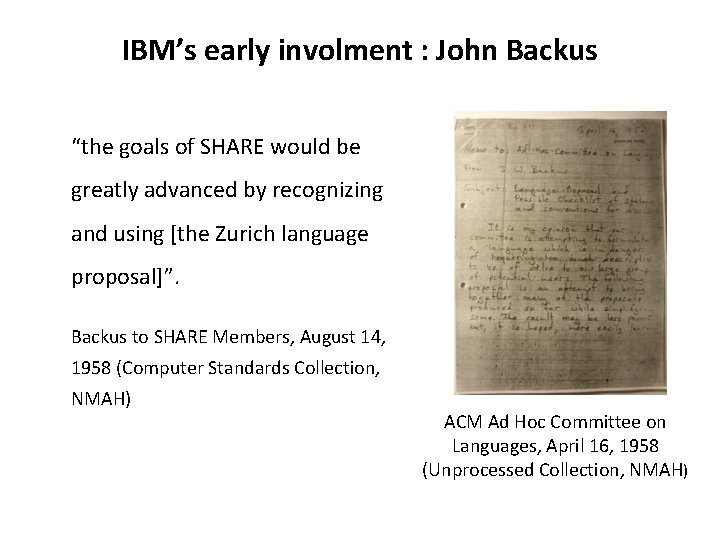
IBM’s early involment : John Backus “the goals of SHARE would be greatly advanced by recognizing and using [the Zurich language proposal]”. Backus to SHARE Members, August 14, 1958 (Computer Standards Collection, NMAH) ACM Ad Hoc Committee on Languages, April 16, 1958 (Unprocessed Collection, NMAH)
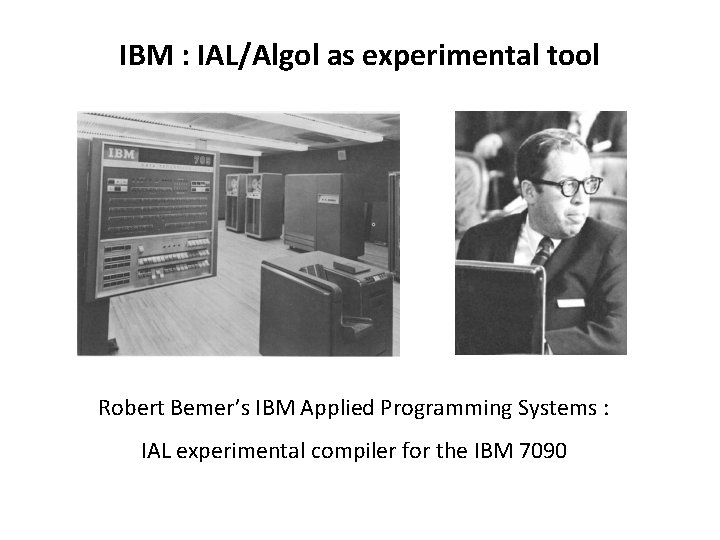
IBM : IAL/Algol as experimental tool Robert Bemer’s IBM Applied Programming Systems : IAL experimental compiler for the IBM 7090
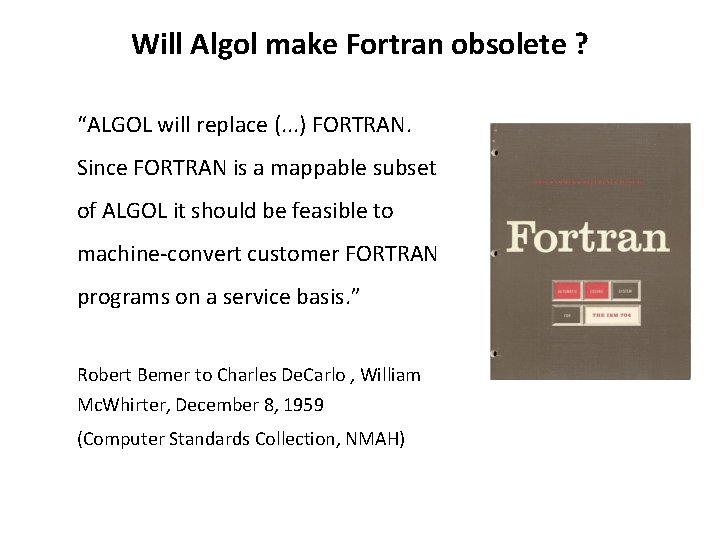
Will Algol make Fortran obsolete ? “ALGOL will replace (. . . ) FORTRAN. Since FORTRAN is a mappable subset of ALGOL it should be feasible to machine-convert customer FORTRAN programs on a service basis. ” Robert Bemer to Charles De. Carlo , William Mc. Whirter, December 8, 1959 (Computer Standards Collection, NMAH)
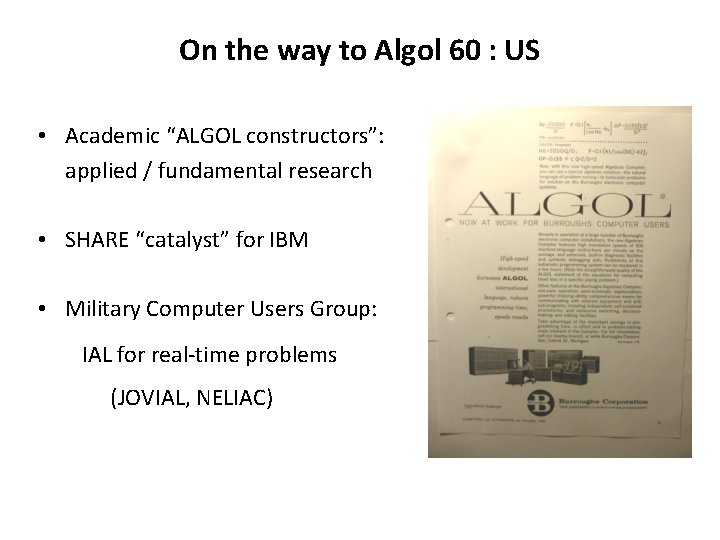
On the way to Algol 60 : US • Academic “ALGOL constructors”: applied / fundamental research • SHARE “catalyst” for IBM • Military Computer Users Group: IAL for real-time problems (JOVIAL, NELIAC)
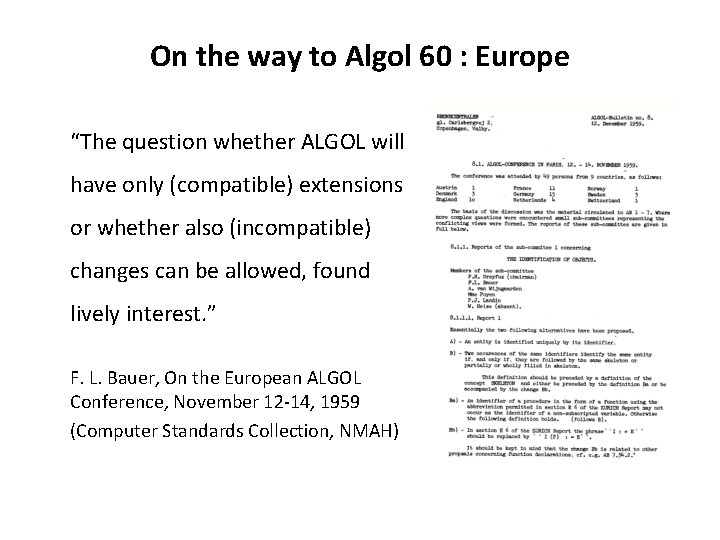
On the way to Algol 60 : Europe “The question whether ALGOL will have only (compatible) extensions or whether also (incompatible) changes can be allowed, found lively interest. ” F. L. Bauer, On the European ALGOL Conference, November 12 -14, 1959 (Computer Standards Collection, NMAH)
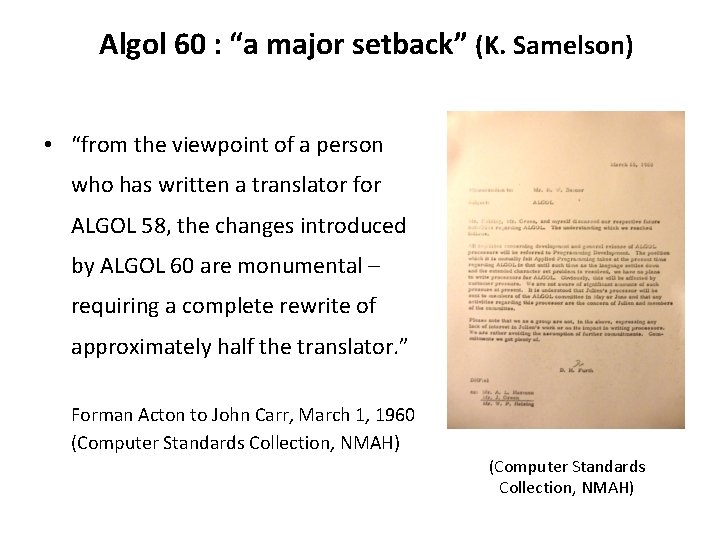
Algol 60 : “a major setback” (K. Samelson) • “from the viewpoint of a person who has written a translator for ALGOL 58, the changes introduced by ALGOL 60 are monumental – requiring a complete rewrite of approximately half the translator. ” Forman Acton to John Carr, March 1, 1960 (Computer Standards Collection, NMAH)
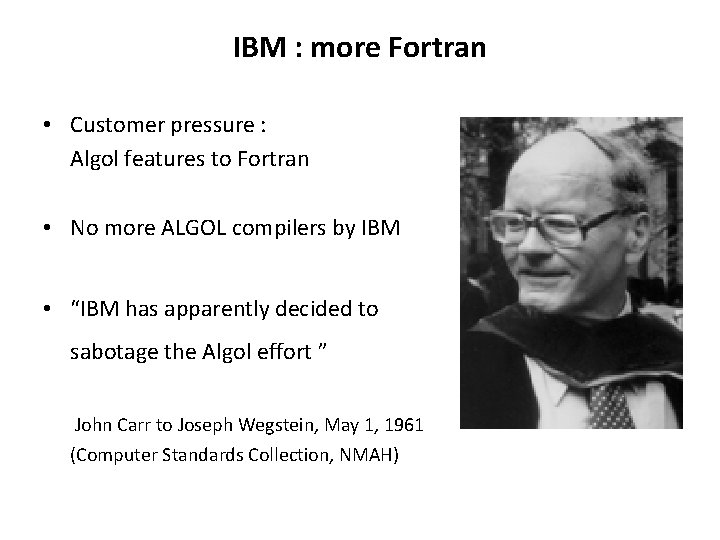
IBM : more Fortran • Customer pressure : Algol features to Fortran • No more ALGOL compilers by IBM • “IBM has apparently decided to sabotage the Algol effort ” John Carr to Joseph Wegstein, May 1, 1961 (Computer Standards Collection, NMAH)
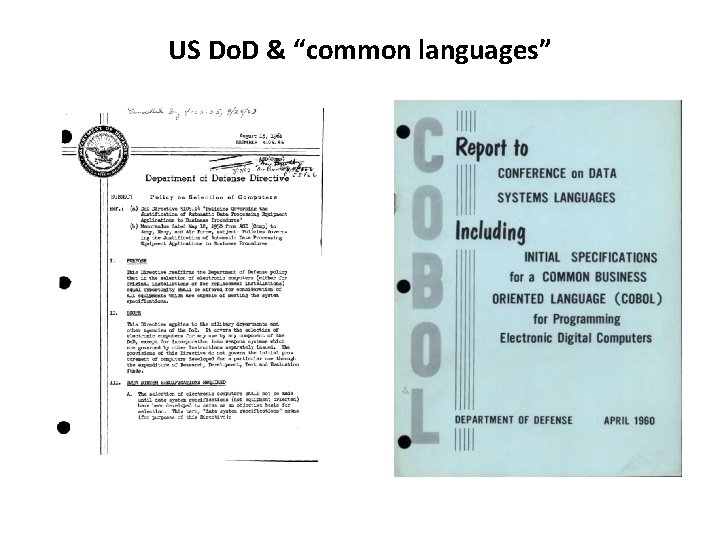
US Do. D & “common languages”
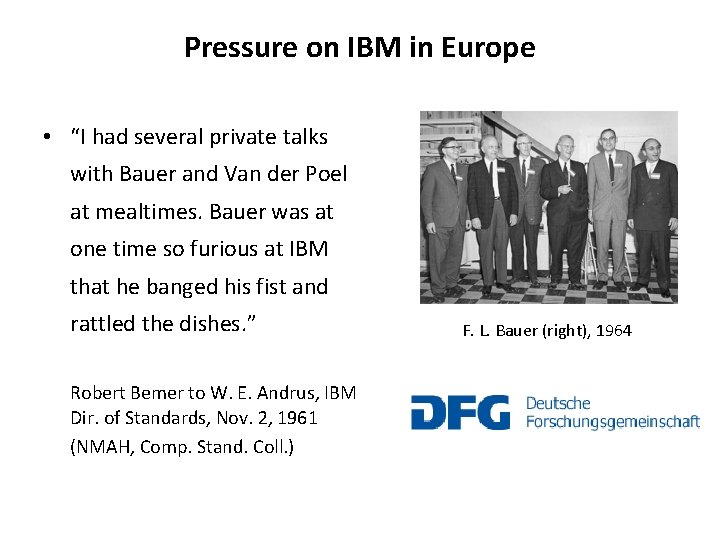
Pressure on IBM in Europe • “I had several private talks with Bauer and Van der Poel at mealtimes. Bauer was at one time so furious at IBM that he banged his fist and rattled the dishes. ” Robert Bemer to W. E. Andrus, IBM Dir. of Standards, Nov. 2, 1961 (NMAH, Comp. Stand. Coll. ) F. L. Bauer (right), 1964
IBM: Algol & Fortran ? IBM ALGOL/FORTRAN Policy Commitee, December 1961 • Cost of Algol 60 & Fortran II across machine lines ? • Loss of revenue by not having Algol ? • Time development Algol compilers ? • Moving to an Algol type of language ?
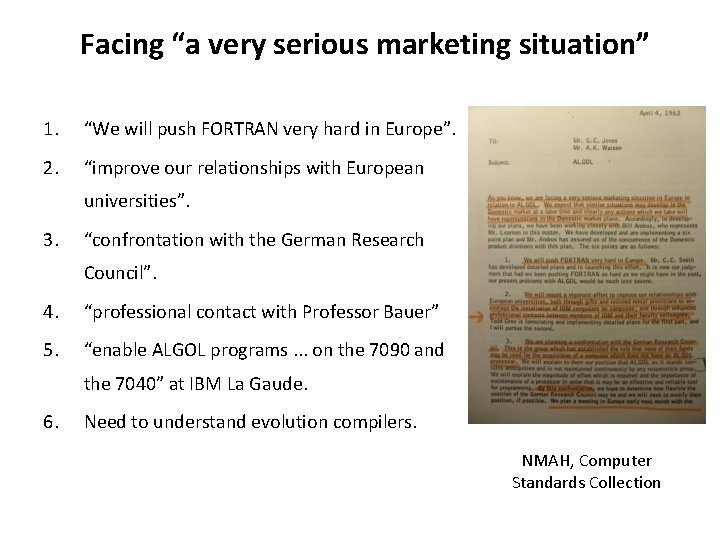
Facing “a very serious marketing situation” 1. “We will push FORTRAN very hard in Europe”. 2. “improve our relationships with European universities”. 3. “confrontation with the German Research Council”. 4. “professional contact with Professor Bauer” 5. “enable ALGOL programs. . . on the 7090 and the 7040” at IBM La Gaude. 6. Need to understand evolution compilers. NMAH, Computer Standards Collection
Conclusions - what can we learn? • Languages related to each other in unexpected ways • ‘Peripheries’ do shape developments in the ‘center’ • Instrumentality vs. intelligibility in computer science ?
- Slides: 16