
IB Sports exercise and health science Topic 5
IB Sports, exercise and health science Topic 5 Skill in sport 5. 3. 1 Distinguish between learning and performance Sub-topics 3. Principles of skill learning Occasionally good or one of performances are not a true indication of learning having taken place. There has to be a relatively permanent change in performance over time as a result of practice and or experience. Wesson et. al 2005
IB Sports, exercise and health science Topic 5 Skill in sport Sub-topics 3. Principles of skill learning Skill in sport 5. 3. 1 Distinguish between learning and performance Learning is a relatively permanent change in performance brought about by experience, excluding changes due to maturation and degeneration. Performance is a temporary occurrence, fluctuating over time. A change in performance over time is often used to infer learning. IBO February 2007
IB Sports, exercise and health science Topic 5 Skill in sport 5. 3. 2 Describe the phases (stages of learning) Sub-topics 3. Principles of skill learning Stages of Motor Learning 1. Cognitive/verbal (early phase) 2. Associative/motor (intermediate phase) 3. Autonomous (final phase) • Developed by Fitts and Posner (1967)
IB Sports, exercise and health science Topic 5 Skill in sport Sub-topics 3. Principles of skill learning Skill in sport 5. 3. 2 Describe the phases (stages of learning) Cognitive/Verbal Stage Is the earliest phase of learning, when the performer understands what needs to be done. There is quite a lot of trial and error in this stage, the beginner trying out certain movements which may be successful or fail. The successful strategies can be reinforced by the performer experiencing success or by being told by there teacher that the move is unsuccessful. Honeybourne et. al 2004
IB Sports, exercise and health science Topic 5 Skill in sport Sub-topics 3. Principles of skill learning Skill in sport 5. 3. 2 Describe the phases (stages of learning) Unsuccessful strategies should not be dismissed because all experiences can be worthwhile. The performer should understand why failure occurred in order to avoid the same experience in the future. To establish understanding teachers may use demonstrations or other methods of guidance. It is important that relevant cues are highlighted by the teacher and recognised by the performer. Honeybourne et. al 2004
IB Sports, exercise and health science Topic 5 Skill in sport Sub-topics 3. Principles of skill learning Skill in sport 5. 3. 2 Describe the phases (stages of learning) The associative/motor/practice stage In this stage the performer practices, and compares or associates the movements produced with the mental image. This is the stage at which feedback occurs and the learner gradually becomes more aware of the increasingly subtle and complex cues. During this stage a vast improvement in performance usually occurs. Honeybourne et. al 2004
IB Sports, exercise and health science Topic 5 Skill in sport 5. 3. 2 Describe the phases (stages of learning) The associative/motor/practice stage Sub-topics 3. Principles of skill learning • • Begin to “feel the movement” Feedback should be specific • Focus on knowledge of performance (KP) • Focus on knowledge of results (KR)
IB Sports, exercise and health science Topic 5 Skill in sport 5. 3. 2 Describe the phases (stages of learning) Sub-topics The autonomous stage/final phase 3. Principles of skill learning Is the final stage of the skill-learning process. Movements are becoming almost automatic, with very little conscious thought. Any distractions are largely ignored and the performer is able to concentrate on more peripheral strategies and tactics. Honeybourne et. al 2004
IB Sports, exercise and health science Topic 5 Skill in sport 5. 3. 2 Describe the phases (stages of learning) Sub-topics 3. Principles of skill learning It is said that during this stage motor programmes are completely formed in the long term memory and reaction time is short. Some performers may never reach this stage or may reach it with only very basic movement patterns. For performers to stay in this phase they must continuously refer back to the associative stage, where practice ensures that motor programmes are reinforced. Honeybourne et. al 2004
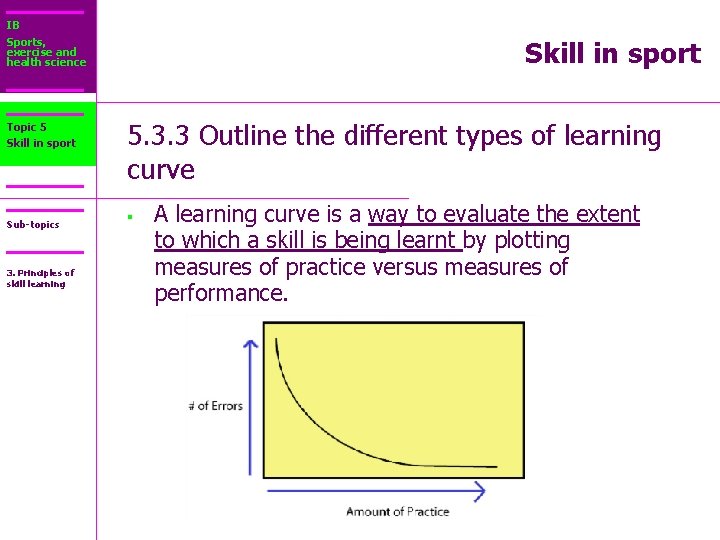
IB Sports, exercise and health science Topic 5 Skill in sport Sub-topics 3. Principles of skill learning Skill in sport 5. 3. 3 Outline the different types of learning curve § A learning curve is a way to evaluate the extent to which a skill is being learnt by plotting measures of practice versus measures of performance.
IB Sports, exercise and health science Skill in sport 5. 3. 3 Outline the different types of learning curve Topic 5 Skill in sport Sub-topics § 3. Principles of skill learning After steady improvements in performance, a learning plateau is a stage where there appears to be little or no improvement. This can be due to: § § § Lack of motivation Fatigue (over-training) Fundamentals learnt, next skill difficult Limited time devoted to practice Injury Coach unable to connect with athlete Reference 1: Board of Studies NSW (1999). Personal development, health and physical education: Stage 6 syllabus. Reference 2: Browne, S. (2001). HSC core 2 health priorities in Aust. : Summary quest. & sample HSC extended responses. Reference 3: Browne, S. , et. al. (2000). PDHPE application and inquiry: HSC course. Oxford University Press: Melbourne. Reference 4: Buchanan, D. & Nemec, M. (2003). HSC PDHPE. Mc. Millan Education Australia: Melbourne. Reference 5: Charles Sturt University. NSW HSC online. Available: http: //hsc. csu. edu. au/pdhpe/
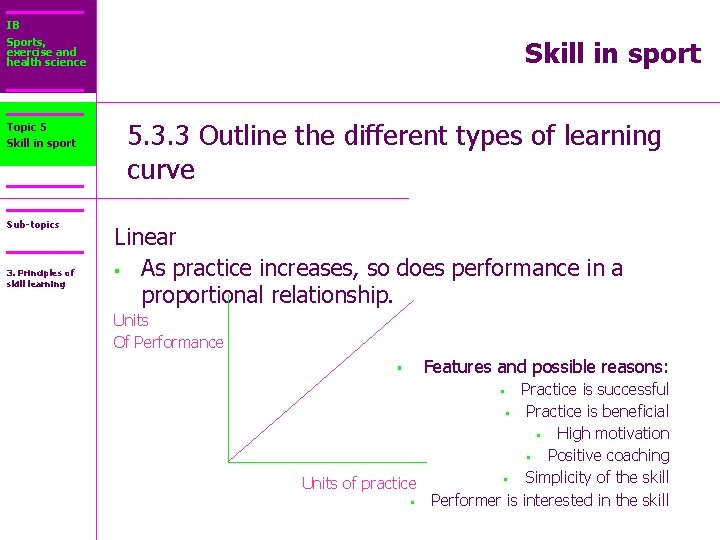
IB Sports, exercise and health science Topic 5 Skill in sport Sub-topics 3. Principles of skill learning Skill in sport 5. 3. 3 Outline the different types of learning curve Linear § As practice increases, so does performance in a proportional relationship. Units Of Performance § Features and possible reasons: Practice is successful § Practice is beneficial § High motivation § Positive coaching § Simplicity of the skill Units of practice § Performer is interested in the skill §
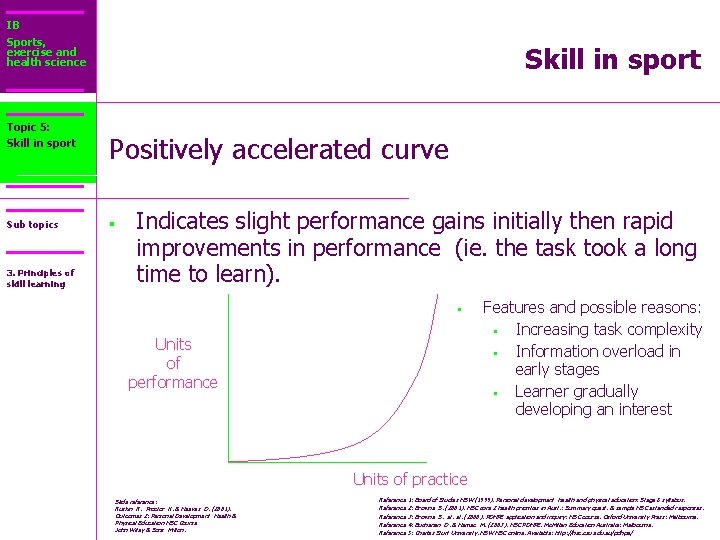
IB Sports, exercise and health science Topic 5: Core 2: Skill in sport Factors Sub topics 3. Principles of skill learning Skill in sport Positively accelerated curve § Indicates slight performance gains initially then rapid improvements in performance (ie. the task took a long time to learn). § Units of performance Features and possible reasons: § Increasing task complexity § Information overload in early stages § Learner gradually developing an interest Units of practice Slide reference: Ruskin, R. , Proctor, K. & Neeves, D. (2001). Outcomes 2: Personal Development, Health & Physical Education HSC Course John Wiley & Sons, Milton. Reference 1: Board of Studies NSW (1999). Personal development, health and physical education: Stage 6 syllabus. Reference 2: Browne, S. (2001). HSC core 2 health priorities in Aust. : Summary quest. & sample HSC extended responses. Reference 3: Browne, S. , et. al. (2000). PDHPE application and inquiry: HSC course. Oxford University Press: Melbourne. Reference 4: Buchanan, D. & Nemec, M. (2003). HSC PDHPE. Mc. Millan Education Australia: Melbourne. Reference 5: Charles Sturt University. NSW HSC online. Available: http: //hsc. csu. edu. au/pdhpe/
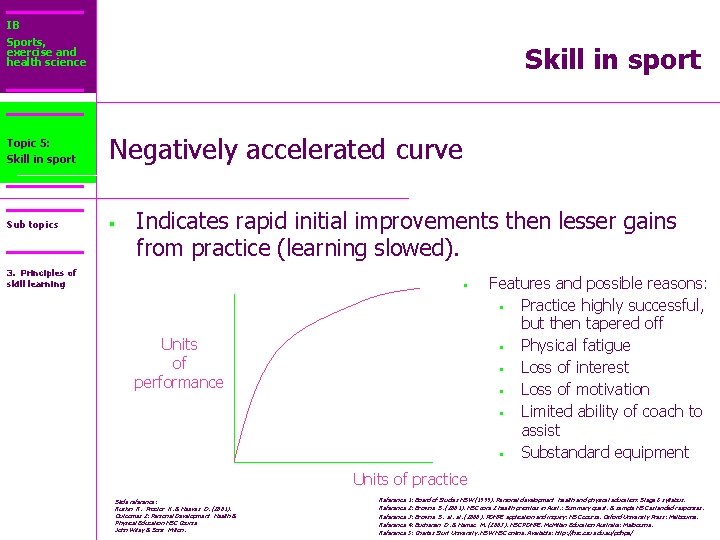
IB Sports, exercise and health science Skill in sport Topic 5: Skill in sport Negatively accelerated curve Sub topics § Indicates rapid initial improvements then lesser gains from practice (learning slowed). 3. Principles of skill learning § Units of performance Features and possible reasons: § Practice highly successful, but then tapered off § Physical fatigue § Loss of interest § Loss of motivation § Limited ability of coach to assist § Substandard equipment Units of practice Slide reference: Ruskin, R. , Proctor, K. & Neeves, D. (2001). Outcomes 2: Personal Development, Health & Physical Education HSC Course John Wiley & Sons, Milton. Reference 1: Board of Studies NSW (1999). Personal development, health and physical education: Stage 6 syllabus. Reference 2: Browne, S. (2001). HSC core 2 health priorities in Aust. : Summary quest. & sample HSC extended responses. Reference 3: Browne, S. , et. al. (2000). PDHPE application and inquiry: HSC course. Oxford University Press: Melbourne. Reference 4: Buchanan, D. & Nemec, M. (2003). HSC PDHPE. Mc. Millan Education Australia: Melbourne. Reference 5: Charles Sturt University. NSW HSC online. Available: http: //hsc. csu. edu. au/pdhpe/
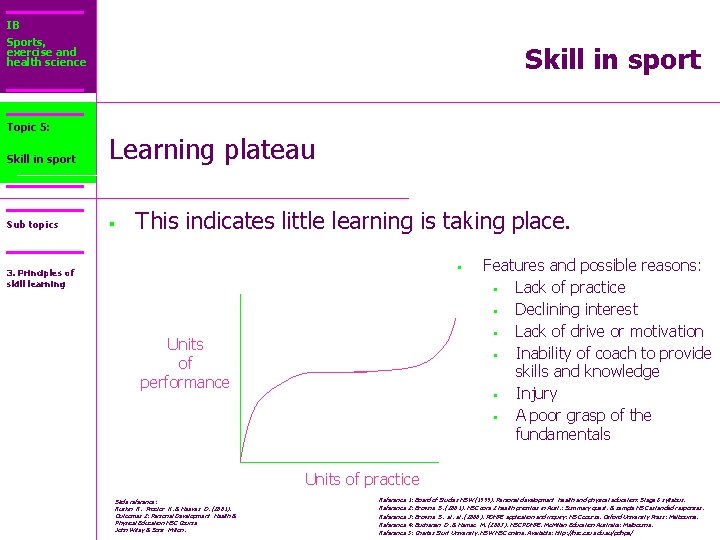
IB Sports, exercise and health science Topic 5: Core 2: Skill in sport Learning plateau Sub topics § This indicates little learning is taking place. § 3. Principles of skill learning Units of performance Features and possible reasons: § Lack of practice § Declining interest § Lack of drive or motivation § Inability of coach to provide skills and knowledge § Injury § A poor grasp of the fundamentals Units of practice Slide reference: Ruskin, R. , Proctor, K. & Neeves, D. (2001). Outcomes 2: Personal Development, Health & Physical Education HSC Course John Wiley & Sons, Milton. Reference 1: Board of Studies NSW (1999). Personal development, health and physical education: Stage 6 syllabus. Reference 2: Browne, S. (2001). HSC core 2 health priorities in Aust. : Summary quest. & sample HSC extended responses. Reference 3: Browne, S. , et. al. (2000). PDHPE application and inquiry: HSC course. Oxford University Press: Melbourne. Reference 4: Buchanan, D. & Nemec, M. (2003). HSC PDHPE. Mc. Millan Education Australia: Melbourne. Reference 5: Charles Sturt University. NSW HSC online. Available: http: //hsc. csu. edu. au/pdhpe/
IB Sports, exercise and health science Topic 5: Core 2: Skill in sport 5. 3. 4 Discuss factors that contribute to different rates of learning Sub topics § 3. Principles of skill learning § § Physical Demands – has physical maturation but not fit enough Motivation – the learner wants to learn Physical Maturation – the learner is good at knowing when they are ready to gain skill
IB Sports, exercise and health science Topic 5: Core 2: Skill in sport 5. 3. 5 Define the concept of transfer Sub topics § 3. Principles of skill learning Transfer in skill acquisition is the influence of learning and/or performance of one skill on the learning and/or performance of another. If this influences a skill yet to be learned or performed it is called proactive transfer, if it influences the performance of a previous learnt skill it is called retroactive. Honeybourne et. al 2004
IB Sports, exercise and health science Topic 5: Core 2: Skill in sport 5. 3. 5 Define the concept of transfer Sub topics § 3. Principles of skill learning § Transfer – the effect of the learning and performance 3 types of transfer § Positive § Negative § zero
IB Sports, exercise and health science Topic 5: Core 2: Skill in sport 5. 3. 5 Define the concept of transfer Sub topics § 3. Principles of skill learning § § POSITIVE TRANSFER § One skill can help in the learning or performance of another NEGATIVE TRANSFER § One skill may hinder the learning or performance of another skill ZERO TRANSFER § No effect Honeybourne et. al 2004
IB Sports, exercise and health science Topic 5: Core 2: Skill in sport Sub topics 3. Principles of skill learning Skill in sport 5. 3. 5 Define the concepts of transfer § Positive: § Learning in one task is promoted by previous learning in another § Is when skills/tasks that have been learned experienced help or facilitate the learning of other skills. § Similarities in both skill components and information processing characteristics will help increase the possibilities of positive transfer. Wesson et. al 2005
IB Sports, exercise and health science Topic 5: Core 2: Skill in sport Sub topics 3. Principles of skill learning Skill in sport 5. 3. 5 Define the concept of transfer § Negative § Learning of a new task is interfered with by knowledge of a similar activity § When one skill/task hinders or inhibits the learning or performance of another skill task this is known as negative transfer. Sports performers and coaches tend to believe this happens on a regular basis. Wesson et. al 2005
IB Sports, exercise and health science Topic 5: Core 2: Skill in sport 5. 3. 6 Outline the types of transfer Sub topics § 3. Principles of skill learning § Fortunately the effects are thought to be limited and certainly temporary; it’s thought to happen when a performer is required to produce a new response in a well known situation (familiar stimulus) In this case stimuli are identical or similar but the response requirement are different. Initial confusion is thought to be created more as a result of the performer having to adjust their cognitive processes rather than problems associated with motor control of the movement. Wesson et. al 2005
IB Sports, exercise and health science Topic 5: Core 2: Skill in sport Sub topics 3. Principles of skill learning Skill in sport 5. 3. 6 Outline the types of transfer § The familiar example of tennis having a negative effect on badminton is often quoted, but although the two games have similar aspects, tactics, use of space, court, net, racket, hand eye coordination etc, the wrist arm movement are very different. § Wesson et. al 2005
IB Sports, exercise and health science Topic 5: Core 2: Skill in sport Sub topics 3. Principles of skill learning Skill in sport 5. 3. 6 Outline the types of transfer § Bilateral transfer § § Occurs when learning is transferred from limb to limb i. e. from the right leg to the left leg. When a basketball coach tries to develop their players weaker dribbling hand by relating it to earlier skills learnt they are involved in bi-lateral transfer. This involves the player in transferring both motor proficiency and levels of cognitive involvement. § Wesson et. al 2005
IB Sports, exercise and health science Topic 5: Core 2: Skill in sport 5. 3. 6 Outline the types of transfer Sub topics § 3. Principles of skill learning § The performer is thought to adjust and transfer the parameters of stored motor programmes linked to one limb action to the other (schema theory). Thus, with practice, the levels of learning developed with the performers stronger or preferred hand or side can be transferred to the weaker hand or side. § Wesson et. al 2005
IB Sports, exercise and health science Topic 5: Core 2: Skill in sport Sub topics 3. Principles of skill learning Skill in sport 5. 3. 6 Outline the types of transfer § Inter-task: The effect of skill/task on a different or new skill/task is called inter-task transfer. Typical experiments would relate to the amount of time saved in learning, for instance the lay up shot in the game by using a particular type of drill in practice. Wesson et. al 2005
IB Sports, exercise and health science Topic 5: Core 2: Skill in sport Sub topics 3. Principles of skill learning Skill in sport 5. 3. 6 Outline the types of transfer § Intra-task: Transfer occurs when the relationship between two different types of practice or conditions of practice are considered. Comparisons can be made to show different types of practice conditions might influence the learning of a specific skill/task. Wesson et. al 2005
IB Sports, exercise and health science Topic 5: Core 2: Skill in sport 5. 3. 6 Outline the types of transfer Sub topics § 3. Principles of skill learning Near transfer: When a coach develops specific practices/skills which are very realistic and relevant to the real game situation in order to try and help players in future games, this is referred to as near transfer. Wesson et. al 2005
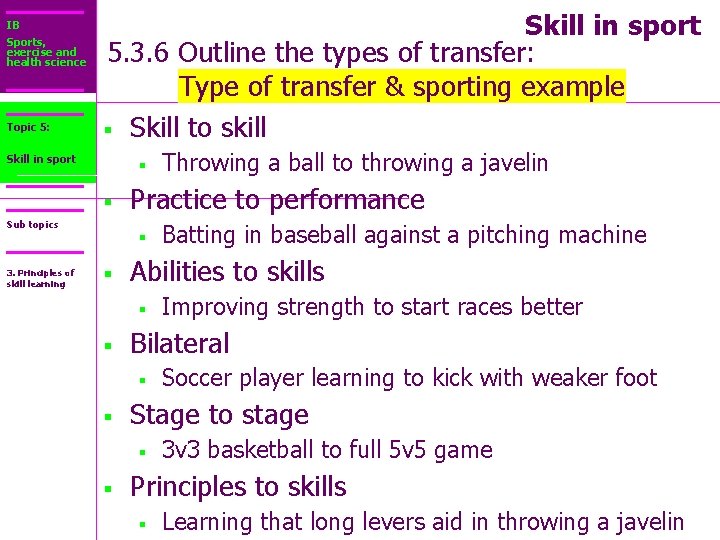
IB Sports, exercise and health science Topic 5: Core 2: Skill in sport 5. 3. 6 Outline the types of transfer: Type of transfer & sporting example § Skill to skill Skill in sport § § Sub topics 3. Principles of skill learning Practice to performance § § Soccer player learning to kick with weaker foot Stage to stage § § Improving strength to start races better Bilateral § § Batting in baseball against a pitching machine Abilities to skills § § Throwing a ball to throwing a javelin 3 v 3 basketball to full 5 v 5 game Principles to skills § Learning that long levers aid in throwing a javelin
IB Sports, exercise and health science Topic 5: Core 2: Skill in sport Sub topics 3. Principles of skill learning Skill in sport 5. 3. 7 Outline the different types of practice § Massed practice: § is it seen as being almost continuous practice with very little or no rest at all between attempts or blocks of trials. § Field hockey team practices shooting non-stop for 40 minutes § Better when the individual is: § Experienced § Older § Fitter § More motivated Wesson et. al 2004
IB Sports, exercise and health science Topic 5: Core 2: Skill in sport 5. 3. 7 Outline the different types of practice § Sub topics 3. Principles of skill learning Distributed practice: § is seen as practice with relatively long breaks or rest periods between each attempt or block of attempts § Shooting practice intermixed with short scrimmages § Better when the individual is: § Beginner § Less experienced § Limited preparation (physical/mental) § Less motivated Wesson et. al 2004
IB Sports, exercise and health science Topic 5: Core 2: Skill in sport 5. 3. 7 Outline the different types of practice § Variable practice: § Sub topics 3. Principles of skill learning § § practicing a skill in a variety of different contexts and experiencing the full range of situations in which the technique or tactic might be used in competition. The learner applies the skill to a number of different environments in practice, allowing both the development of the skill and the ability to adapt the skill to a range of possible situations. This is vital for open and interactive skills http: //www. brianmac. co. uk/continuum. htm
IB Sports, exercise and health science Topic 5: Core 2: Skill in sport 5. 3. 7 Outline the different types of practice Sub topics § Variable practice: 3. Principles of skill learning § § § Skills practiced in new/different situations. Useful for open skills. Helps the development of schema. Helps performer adapt to meet the demands of the situation. Practice should be similar to real game situation. Wesson et. al 2004
IB Sports, exercise and health science Topic 5: Core 2: Skill in sport 5. 3. 7 Outline the different types of practice § Sub topics 3. Principles of skill learning Mental practice: § § § Is the mental or cognitive rehearsal of a skill without actual physical movement. In the early stages of learning (cognitive phase) mental rehearsal is initially seen as the learner going through a skill/task and building up a mental picture of the expected performance in their mind (cognitive process). Advanced performers can use mental practice to rehearse possible alternative strategies or complex actions /sequences, thus almost pre-programming their effector systems and possibly helping with response preparation, reactions and anticipation. Wesson et. al 2004
IB Sports, exercise and health science Topic 5: Core 2: Skill in sport Sub topics 3. Principles of skill learning Skill in sport 5. 3. 7 Outline the different types of practice § Mental practice: § § Top skiers use it to rehearse turns, imagine the approach to gates and certain aspects of terrain. A traditionally held view has been that through mental practice a performer could slightly stimulate the neuromuscular systems involved in activities and thus stimulate the movement. Wesson et. al 2004
IB Sports, exercise and health science Topic 5: Core 2: Skill in sport Sub topics 3. Principles of skill learning Skill in sport 5. 3. 7 Outline the different types of practice § Fixed (drill) practice: § a specific movement is practiced repeatedly, often referred to as a drill. This type of practice is ideal for skills that are always performed in the same way, that do not require adapting to the environment. Closed, interactive and coactive skills tend to require fixed practice to allow the motor sequence to be perfected, since they will remain the same in practice as they will in competition. http: //www. brianmac. co. uk/continuum. htm
Skill in sport IB Sports, exercise and health science 5. 3. 8 Explain the different types of presentation Topic 5: Core 2: Skill in sport § Whole: • § Sub topics 3. Principles of skill learning § the activity or skill is presented in total and practiced as full/entire skilled movement or activity. It is argued that if a whole approach is used then a learner is able to develop their kinaesthetic awareness or total feel for the activity. This approach is seen as a more effective use of time and should be used whenever possible particularly when skills have low levels of complexity and high levels of organisation, e. g. bench press in weight training. In this case the components of the skill are unable to be broken down. Wesson et. al 2004
IB Sports, exercise and health science Topic 5: Core 2: Skill in sport 5. 3. 8 Explain the different types of presentation § Part: • Sub topics Skills which are very complex but low in organization lend themselves to being practised and learned more effectively by the parts method. An additional consideration is again how interrelated or independent the sub-routines are. Wesson et. al 2004 3. Principles of skill learning § § § Break down the movements in to smaller parts Parts are linked together into the final skill Example: Lay-up in basketball
IB Sports, exercise and health science Topic 5: Core 2: Skill in sport Sub topics 3. Principles of skill learning Skill in sport 5. 3. 8 Explain the different types of presentation § Part: • • • Activities such as freestyle are not too complex but low in organisation lend themselves to being taught by the part method. The arms action, breathing pattern and leg action can be analysed and taught individually. However, if the beginner does not experience the whole stroke there is possibility that the kinaesthetic feel for the whole action could be lost. Wesson et. al 2004
IB Sports, exercise and health science Skill in sport 5. 3. 8 Explain the different types of presentation Topic 5: Core 2: Skill in sport § Whole-part: -whole • • Sub topics 3. Principles of skill learning • A variation on whole or part method is often used with performers in the Cognitive/Associative stages The teacher/coach introduces the complete skill, highlighting the important elements. The performer then attempts to carry out the skill. As a result of any problems or faults observed, the teacher then breaks the whole skill down into sub-routines in order to allow the learner to practice appropriate areas of difficulty. Once the teacher is satisfied that the problem areas have been mastered the parts are integrated back into the whole skill. Wesson et. al 2004
Skill in sport IB Sports, exercise and health science 5. 3. 8 Explain the different types of presentation Topic 5: Core 2: Skill in sport Sub topics 3. Principles of skill learning § Progressive part: *** ADD THIS UNDER W-P-W § § The progressive part method is where earlier independent actions change their form to become something totally different. A learner taught complex skills by the progressive part method benefits from the positive aspects of both part and whole methods. Wesson et. al 2004
IB Sports, exercise and health science Topic 5: Core 2: Skill in sport Sub topics 3. Principles of skill learning Skill in sport 5. 3. 8 Explain the different types of presentation § Progressive part: § § A gymnast coach trying to develop a gymnast’s routine would often follow the progressive part method. All the relatively complex but independent parts of the routine e. g. handstand, cartwheel, hand spring, somersault e. t. c. are learnt in and practised in isolation, but then linked together in small units in order that the gymnast can experience and learnt how to fluently sequence individual skills together. Wesson et. al 2004
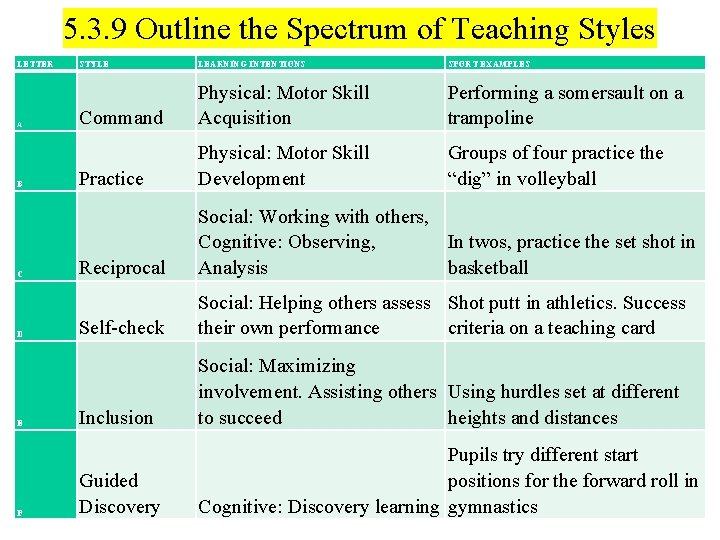
5. 3. 9 Outline the Spectrum of Teaching Styles LETTER A B C D E F STYLE LEARNING INTENTIONS SPORT EXAMPLES Command Physical: Motor Skill Acquisition Performing a somersault on a trampoline Practice Physical: Motor Skill Development Groups of four practice the “dig” in volleyball Reciprocal Social: Working with others, In twos, practice the set shot in Cognitive: Observing, basketball Analysis Self-check Social: Helping others assess Shot putt in athletics. Success their own performance criteria on a teaching card Inclusion Social: Maximizing involvement. Assisting others Using hurdles set at different heights and distances to succeed Guided Discovery Pupils try different start positions for the forward roll in Cognitive: Discovery learning gymnastics
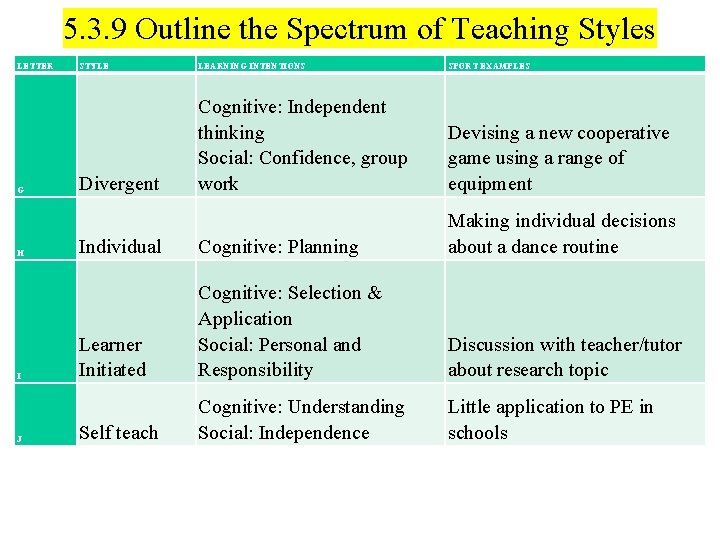
5. 3. 9 Outline the Spectrum of Teaching Styles LETTER G H I J STYLE LEARNING INTENTIONS SPORT EXAMPLES Divergent Cognitive: Independent thinking Social: Confidence, group work Devising a new cooperative game using a range of equipment Individual Cognitive: Planning Making individual decisions about a dance routine Learner Initiated Cognitive: Selection & Application Social: Personal and Responsibility Discussion with teacher/tutor about research topic Self teach Cognitive: Understanding Social: Independence Little application to PE in schools
IB Sports, exercise and health science Topic 5: Core 2: Skill in sport Sub topics Skill in sport 5. 3. 9 Outline the spectrum of teaching styles § Command: § 3. Principles of skill learning § § This is the authoritarian style. Within this approach there is little consideration given to the individual with all learners treated very much in the same way. This style is thought to inhibit cognitive learning as thinking and questioning are not encouraged by the teacher. The teacher is in full control of decision making process and the learner is not allowed to develop responsibility for their own learning. Wesson et. al 2004
IB Sports, exercise and health science Topic 5: Core 2: Skill in sport Sub topics 3. Principles of skill learning Skill in sport 5. 3. 9 Outline the spectrum of teaching styles § Command: § § § This can result in the learner becoming a clone of the teacher. It has limitations for developing open skills as these require the performer to adapt and make their own decisions. It is useful when working with beginners, large groups and in dangerous and limited time situations where safety is paramount. § Wesson et. al 2004
IB Sports, exercise and health science Topic 5: Core 2: Skill in sport Sub topics 3. Principles of skill learning Skill in sport 5. 3. 9 Outline the spectrum of teaching styles § Reciprocal: § § Although what is taught is still determined by the teacher, it allows learners to take slightly more responsibility and become more involved in the decision making process. The sessions are structured in order that the objectives are clearly stated to the learners. This situation lends itself to greater social interaction than the command style. The teacher is still required to give regular feedback and monitor progress. § Wesson et. al 2004
IB Sports, exercise and health science Topic 5: Core 2: Skill in sport Sub topics 3. Principles of skill learning Skill in sport 5. 3. 9 Outline the spectrum of teaching styles § Reciprocal: § This style of teaching is useful in developing a learner’s: § § Self image Confidence Communication skills (encourage interaction) Cognitive strategies (encourage decision making) § Wesson et. al 2004
IB Sports, exercise and health science Topic 5: Core 2: Skill in sport Sub topics 3. Principles of skill learning Skill in sport 5. 3. 9 Outline the spectrum of teaching styles § Problem-solving approach § § The problem solving approach encourages students to be creative and develop their individual cognitive and performance processes. According to their different sizes, shapes, abilities and capabilities learners can approach problems set by their teacher individually. § Wesson et. al 2004
IB Sports, exercise and health science Topic 5: Core 2: Skill in sport 5. 3. 9 Outline the spectrum of teaching styles Sub topics § Problem-solving approach 3. Principles of skill learning § For example: § § Find a way to dribble past your opponent in a 1 on 1 situation. How could you gain the attack from this situation? § Wesson et. al 2004
IB Sports, exercise and health science Topic 5: Core 2: Skill in sport Sub topics 3. Principles of skill learning Skill in sport 5. 3. 9 Outline the spectrum of teaching styles § Problem-solving approach § § This “cognitive perspective” approach is believed to have long term benefits as learners are encouraged to think about, understand adapt performance according to a variety of situations. Variety of practice is important for positive transfer and the development of schemas. It also allows learners to deal with new or novel situations. § Wesson et. al 2004
- Slides: 51