
IB PSYCHOLOGY SLINTERNAL ASSESSMENT EXPERIMENTAL RESEARCH jette hannibal

IB PSYCHOLOGY (SL)INTERNAL ASSESSMENT EXPERIMENTAL RESEARCH jette hannibal
CONSIDERATIONS IN EXPERIMENTAL RESEARCH • What is the aim of the experiment? • What studies and theories are considered in your research? • How do you plan to manipulate and measure variables? • How will you select participants? • Can the effect of confounding variables be minimized? - for example: How will you control for demand characteristics, order effects and participant variables? • Which experimental design will you use? • How will you deal with ethical issues? • How will you analyze the data you collect? • How will you discuss your findings? • How will you report your experiment? • How will you reference your sources ? jette hannibal
INTERNAL ASSESSMENT • Report according to IB guidelines • Maximum of 2000 words (HL) or 1500 words (SL) • HL/SL: a simple experiment (1 IV and 1 DV) • Ethical considerations (informed consent, debrief, no, physical or psychological harm ) • Use past tense • Use 3 rd person jette hannibal
ETHICAL CONSIDERATIONS • Non-human animals must not be used • No deception • No harm done to participants (physical or psychological) • Briefing • Debriefing jette hannibal • • Right to withdraw Confidentiality Informed consent Children: parental consent (under 16)
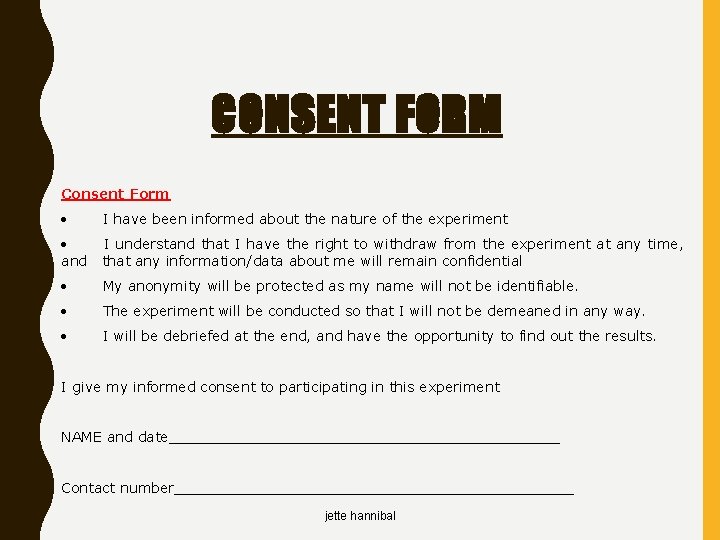
CONSENT FORM Consent Form · I have been informed about the nature of the experiment · I understand that I have the right to withdraw from the experiment at any time, and that any information/data about me will remain confidential · My anonymity will be protected as my name will not be identifiable. · The experiment will be conducted so that I will not be demeaned in any way. · I will be debriefed at the end, and have the opportunity to find out the results. I give my informed consent to participating in this experiment NAME and date______________________ Contact number_______________________ jette hannibal
TITLE PAGE • Information about the student – Name and number – Subject and level – Date of submission – Word count Title • Example of a title: An experiment to investigate the effect of imagery or rehearsal on recall
ABSTRACT Right after the title page and before the table of contents. It is a summary of important information about the study including: – The aim of the study – Procedure – Results of study – Conclusion The abstract should not exceed 200 words – and is not included in the overall word count. jette hannibal
TABLE OF CONTENTS • Table of contents follows the abstract. • All pages must be numbered. jette hannibal
INTRODUCTION: BACKGROUND LITERATURE AND JUSTIFICATION OF YOUR OWN RESEARCH • General introduction to the psychological subject area under investigation • Summary and analysis of key theories and previous research studies in the area including references, e. g. Stroop (1935) • Theories and studies must be analysed in sufficient detail – especially the replicated study • 2 - 3 studies (HL) or 1 study (SL) • Rationale and justification of your experiment • The aim (HL/SL) and hypotheses (HL) jette hannibal
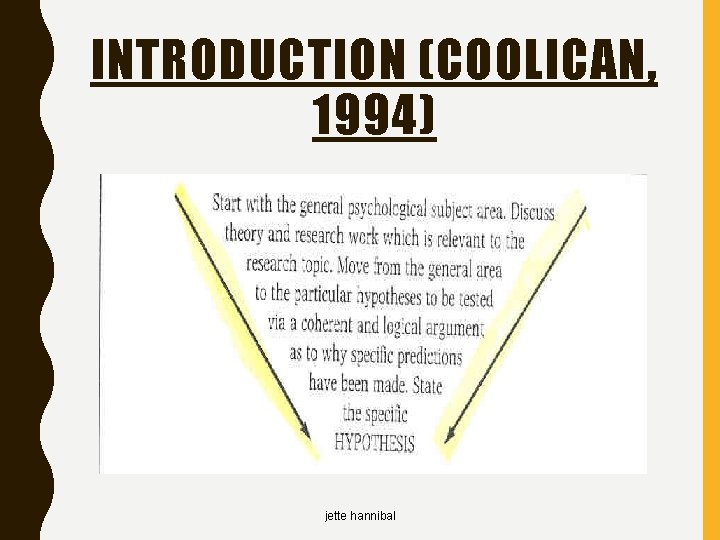
INTRODUCTION (COOLICAN, 1994) jette hannibal
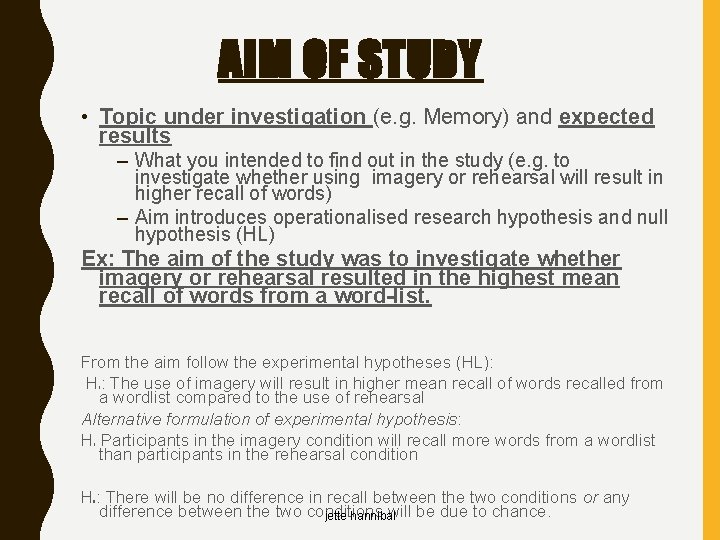
AIM OF STUDY • Topic under investigation (e. g. Memory) and expected results – What you intended to find out in the study (e. g. to investigate whether using imagery or rehearsal will result in higher recall of words) – Aim introduces operationalised research hypothesis and null hypothesis (HL) Ex: The aim of the study was to investigate whether imagery or rehearsal resulted in the highest mean recall of words from a word-list. From the aim follow the experimental hypotheses (HL): H : The use of imagery will result in higher mean recall of words recalled from a wordlist compared to the use of rehearsal Alternative formulation of experimental hypothesis: H Participants in the imagery condition will recall more words from a wordlist than participants in the rehearsal condition 1 1 H : There will be no difference in recall between the two conditions or any difference between the two conditions will be due to chance. jette hannibal 0
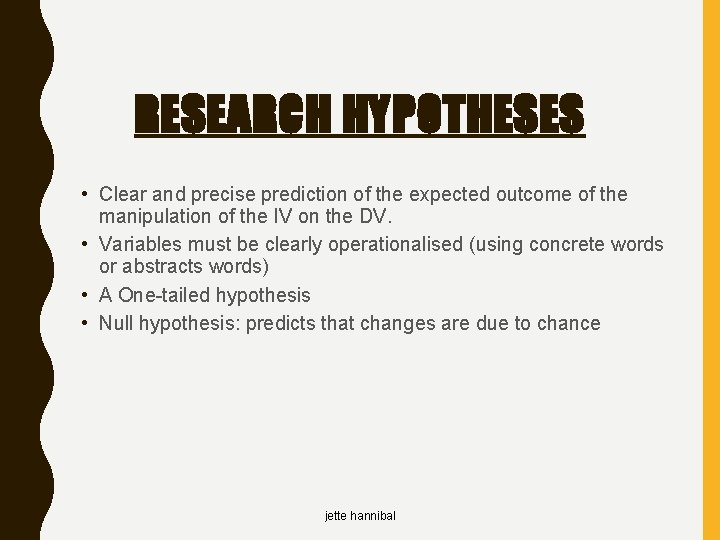
RESEARCH HYPOTHESES • Clear and precise prediction of the expected outcome of the manipulation of the IV on the DV. • Variables must be clearly operationalised (using concrete words or abstracts words) • A One-tailed hypothesis • Null hypothesis: predicts that changes are due to chance jette hannibal

EXAMPLES One-tailed: Participants given the office schema will recall a higher amount of office related objects than participants given no office schema. Null hypothesis: There will be no difference in the two situations or Higher recall of office related words will be due to chance. No Hypotheses in SL – only aim of study. jette hannibal
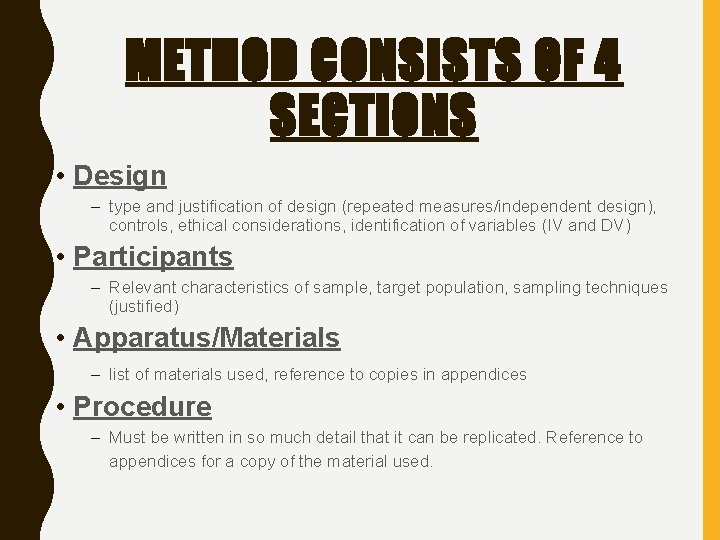
METHOD CONSISTS OF 4 SECTIONS • Design – type and justification of design (repeated measures/independent design), controls, ethical considerations, identification of variables (IV and DV) • Participants – Relevant characteristics of sample, target population, sampling techniques (justified) • Apparatus/Materials – list of materials used, reference to copies in appendices • Procedure – Must be written in so much detail that it can be replicated. Reference to appendices for a copy of the material used.
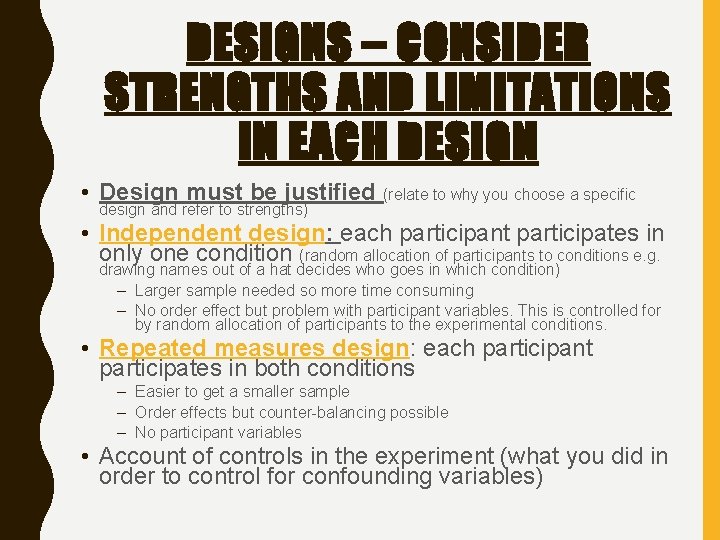
DESIGNS – CONSIDER STRENGTHS AND LIMITATIONS IN EACH DESIGN • Design must be justified (relate to why you choose a specific design and refer to strengths) • Independent design: each participant participates in only one condition (random allocation of participants to conditions e. g. drawing names out of a hat decides who goes in which condition) – Larger sample needed so more time consuming – No order effect but problem with participant variables. This is controlled for by random allocation of participants to the experimental conditions. • Repeated measures design: each participant participates in both conditions – Easier to get a smaller sample – Order effects but counter-balancing possible – No participant variables • Account of controls in the experiment (what you did in order to control for confounding variables)
IV AND DV • Must be operationalised and clear • Must reflect aim (and experimental hypothesis) (HL ONLY) • Stated at the end of the design section Example: • The IV in this experiment was whether participants used rehearsal or imagery • The DV was amount of words correctly recalled from the wordlist jette hannibal
SELECTION OF PARTICIPANTS • 20 participants in an IB experiment • Justify your sampling method • In principle good to have a represenative sample but not really possible in IA. Ask the following questions: – What is the target population? (the population you are interested in) What are relevant characteristics of your sample? your target population? Does your sample represent them? • In IB exp. : Opportunity sample: you take what is available because it is the most convenient and easiest – Easy and not time consuming (strenght) – Not a representative sample (weakness)
PROCEDURE • Clear description of what you did and in what order • Written in words (see samples) • Must be so clear that it can be replicated by another researcher • Refer to materials used in the experiment (and make a reference to an example of it in the appendices) • Use past tense, the third person and the passive voice: The participants were asked to. . . . jette hannibal
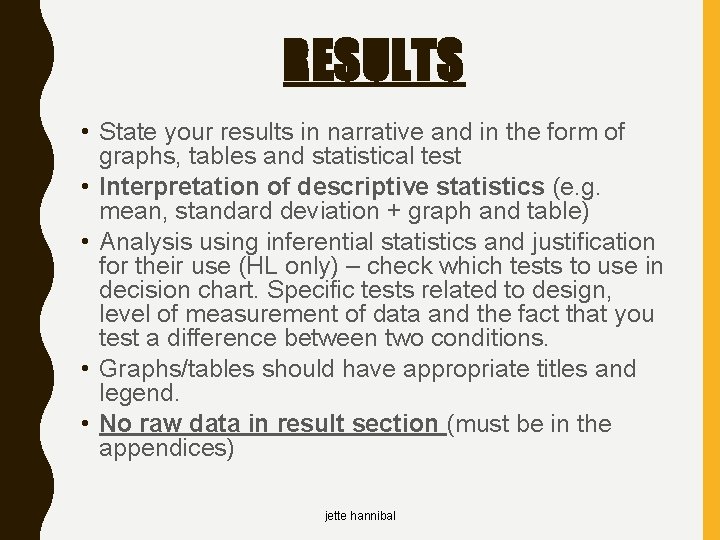
RESULTS • State your results in narrative and in the form of graphs, tables and statistical test • Interpretation of descriptive statistics (e. g. mean, standard deviation + graph and table) • Analysis using inferential statistics and justification for their use (HL only) – check which tests to use in decision chart. Specific tests related to design, level of measurement of data and the fact that you test a difference between two conditions. • Graphs/tables should have appropriate titles and legend. • No raw data in result section (must be in the appendices) jette hannibal
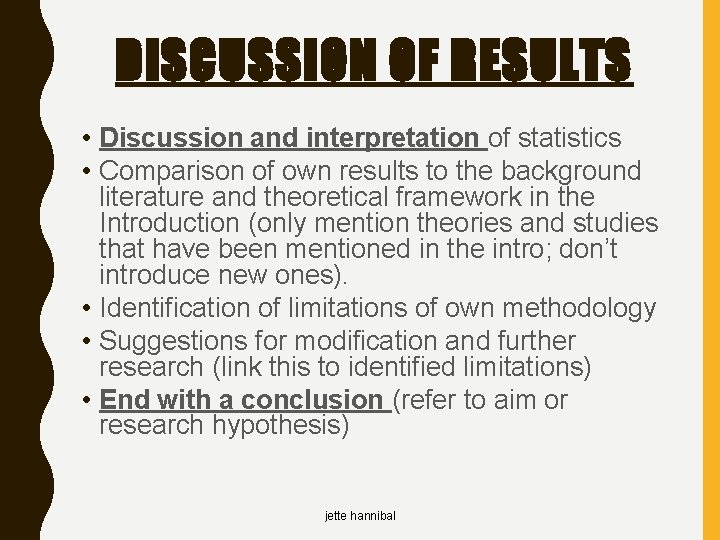
DISCUSSION OF RESULTS • Discussion and interpretation of statistics • Comparison of own results to the background literature and theoretical framework in the Introduction (only mention theories and studies that have been mentioned in the intro; don’t introduce new ones). • Identification of limitations of own methodology • Suggestions for modification and further research (link this to identified limitations) • End with a conclusion (refer to aim or research hypothesis) jette hannibal
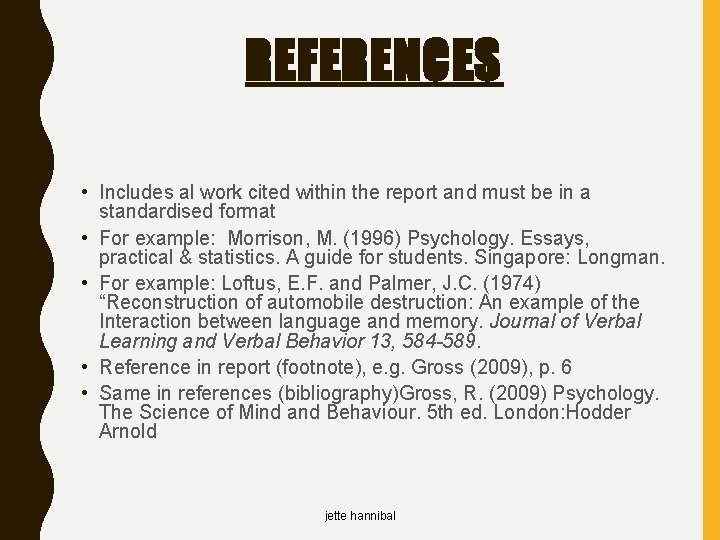
REFERENCES • Includes al work cited within the report and must be in a standardised format • For example: Morrison, M. (1996) Psychology. Essays, practical & statistics. A guide for students. Singapore: Longman. • For example: Loftus, E. F. and Palmer, J. C. (1974) “Reconstruction of automobile destruction: An example of the Interaction between language and memory. Journal of Verbal Learning and Verbal Behavior 13, 584 -589. • Reference in report (footnote), e. g. Gross (2009), p. 6 • Same in references (bibliography)Gross, R. (2009) Psychology. The Science of Mind and Behaviour. 5 th ed. London: Hodder Arnold jette hannibal
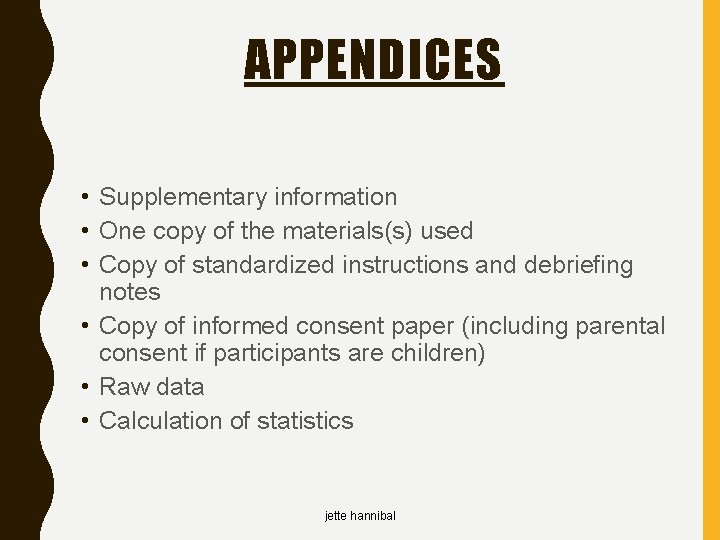
APPENDICES • Supplementary information • One copy of the materials(s) used • Copy of standardized instructions and debriefing notes • Copy of informed consent paper (including parental consent if participants are children) • Raw data • Calculation of statistics jette hannibal
CHECK LIST • Use check list paper to see if your report lives up to the assessment criteria. • Check the assessment criteria also jette hannibal
- Slides: 23