
IB PARENT MEETING International Baccalaureate Programme August 26
IB PARENT MEETING International Baccalaureate Programme August 26, 2019
WHAT IS MYP? MYP is the IB Middle Years Programme Primary Years Programme (PYP) is for grades PK-5 Middle Years Programme is for grades 6 -10. Our partner school for grades 6 -8 is Freedom Park School. Diploma and Career Related Programmes are for grades 11 -12. Unlike DP and CP, it’s is not a curriculum. It is a framework for teaching. All 9 -10 th graders are exposed to MYP teaching. Magnet students are responsible for the two projects to remain in the program. MYP has two projects: community and personal projects.
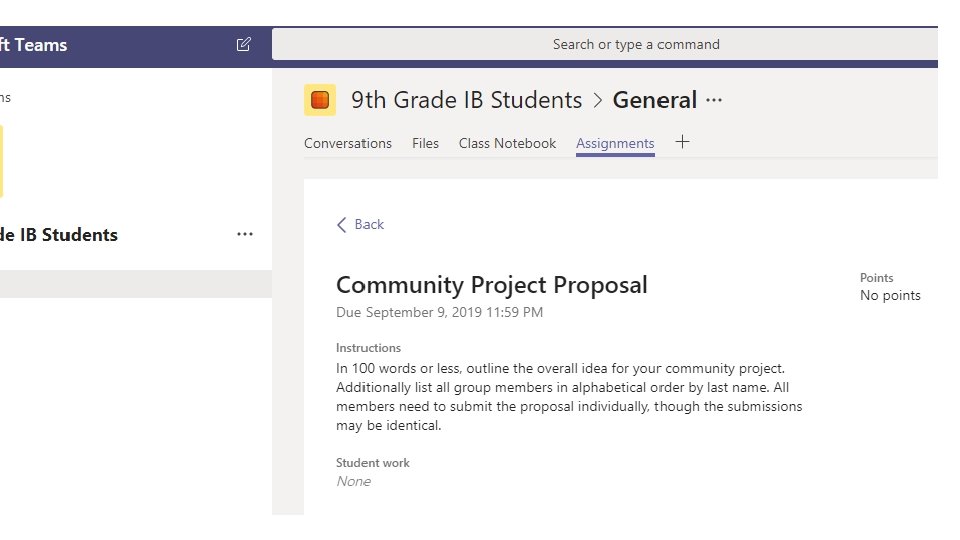
WHAT IS THE COMMUNITY PROJECT? For 9 th graders Focuses on community and service Can be completed in groups of 2 or 3 students, but must be a collaboration They may seek an outside mentor who has expertise in the area of interest Spend at least 15 hours on this project Consult counselors, church leaders, community organizations for ideas and to identify community needs
SOME 2018 -19 COMMUNITY PROJECTS Build and stock a little free library at a South Augusta school Create and help teach a workout plan for younger children to combat the problem of obesity Solicit businesses and create and sell discount cards to raise money for Heart and Soul Inc. Beautify the grounds of Richmond Academy by researching, purchasing, and planting flowers and installing pine straw in the courtyard by the lunchroom. Working with Savannah Riverkeepers to keep waterways clean of debris Build and maintain a community garden to supplement food banks Restore the ARC Victory Bell tower
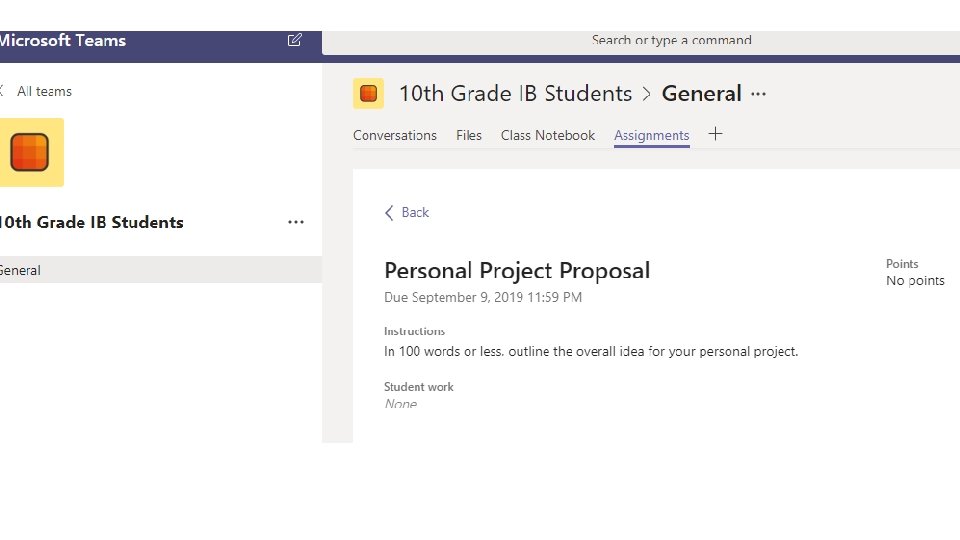
WHAT IS THE PERSONAL PROJECT? For 10 th graders The students’ chance to explore something they are personally interested in and develop an area of personal interest Since it is a PERSONAL project, this is to be completed individually Students NEED to seek an outside mentor who has expertise in the area of interest Spend at least 25 hours on this project
SOME 2018 -19 PERSONAL PROJECTS Design a video game Learn how to develop film in a darkroom Organize and host an international high school student-led Christian movement Design a better, safer football helmet Create an instructional video for utilizing the proper track and field training techniques Direct a short play at ARC Shadow an interior designer and redesign a room using techniques learned
MORE PERSONAL PROJECTS Study automotive repair in order to be able to change oil and brake pads on an F-150 Learn to play the piano Learn from my grandmother how to knit a blanket Build a garden to grow vegetables for my family Build a duck decoy Learn to braid hair to one’s scalp Organize a 5 K
COMMUNITY & PERSONAL PROJECTS Community projects have three main parts: PROCESS JOURNAL, PRODUCT/OUTCOME, and PRESENTATION Personal projects have three main parts: PROCESS JOURNAL, PRODUCT/OUTCOME, and REPORT Students will be assigned a faculty supervisor to ensure they are on track to complete the project by March 12 th. The project will be assessed based on the rubric in the project handbooks which are located on our website and on Microsoft Teams, which the students can access. Points will be deducted for not attending meetings with supervisors and improper citations. Bonus points will be added to projects turned in early. The project will count for an ELA grade. Must include a GLOBAL CONTEXT: identities and relationships, orientation in space and time, personal and cultural expression, scientific and technical innovation, globalization and sustainability, and fairness and development
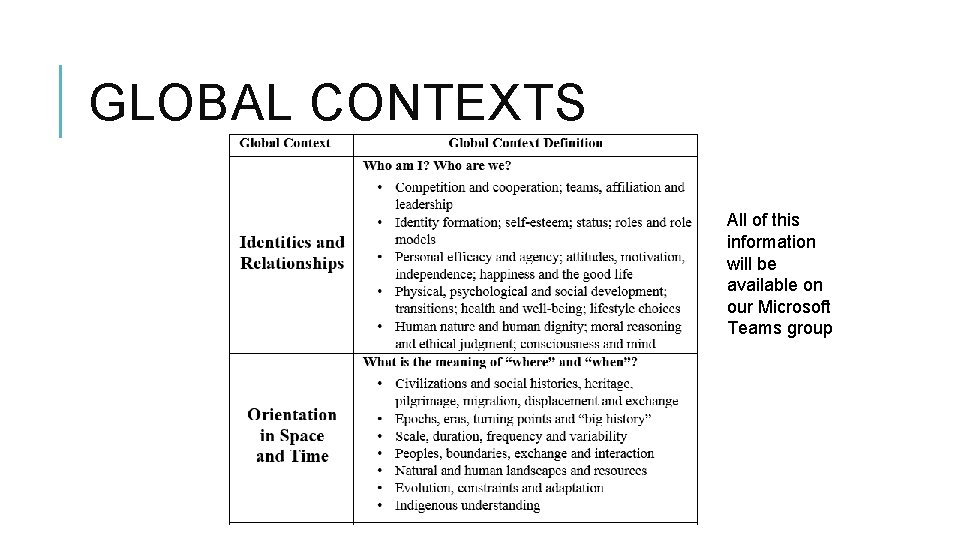
GLOBAL CONTEXTS All of this information will be available on our Microsoft Teams group
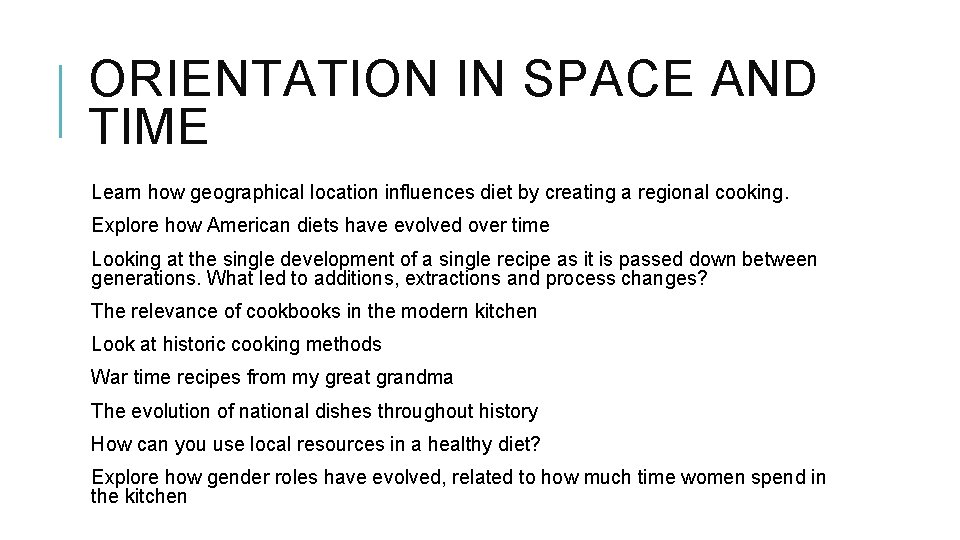
ORIENTATION IN SPACE AND TIME Learn how geographical location influences diet by creating a regional cooking. Explore how American diets have evolved over time Looking at the single development of a single recipe as it is passed down between generations. What led to additions, extractions and process changes? The relevance of cookbooks in the modern kitchen Look at historic cooking methods War time recipes from my great grandma The evolution of national dishes throughout history How can you use local resources in a healthy diet? Explore how gender roles have evolved, related to how much time women spend in the kitchen
PERSONAL AND CULTURAL EXPRESSION Exploring culturally specific spices and their use in various dishes Explore a variety of foods that have religious significance Exploring recipes in a particular country/region Unique recipes, using unusual ingredients
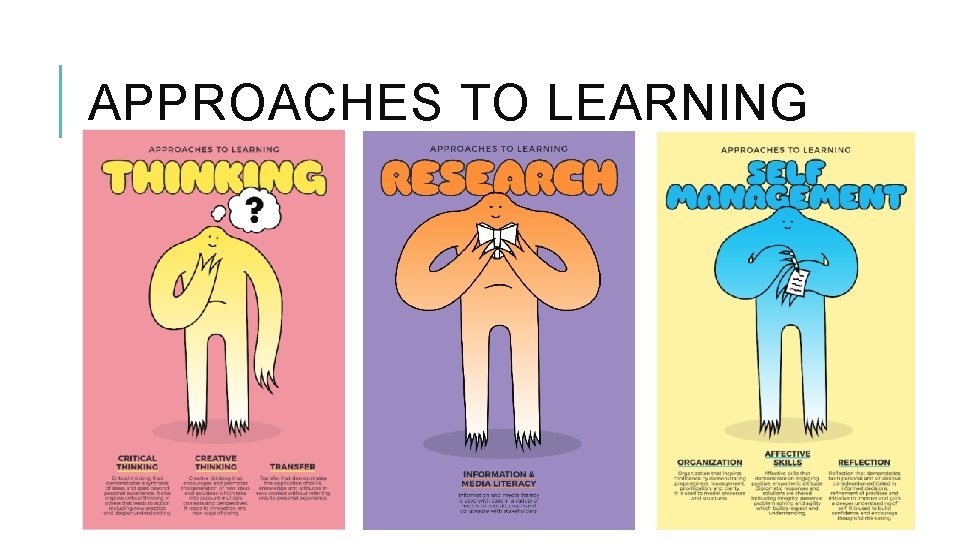
APPROACHES TO LEARNING
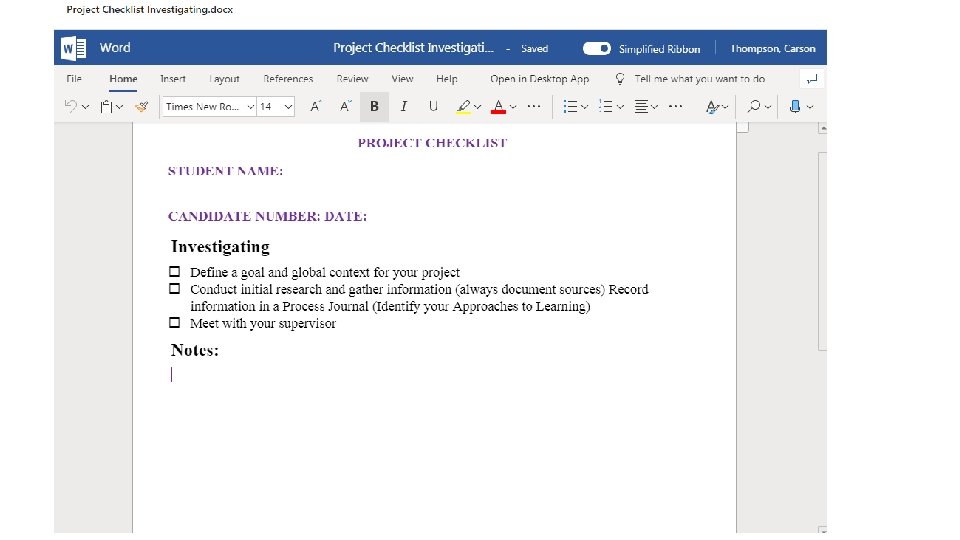
WHAT IS A PROCESS JOURNAL? A way to record progress throughout the entire project Place to record your ideas, thoughts, developments Place to record interactions with mentors and supervisors Place to store useful information Means of exploring ideas and solutions Brainstorming possible lines of inquiry Something to begin TODAY It does not need to be written in daily ALWAYS CONCLUDE EVERY ENTRY WITH “NEXT STEPS”
CREDIBLE SOURCES Always get the full citation while using materials published within last 10 years; the resource using the MLA format. research articles written by respected and well-known authors; websites registered by government and educational institutions (. gov, . edu, . ac); Don’t plan to go back and get it later. academic databases (i. e. Academic Search Premier or JSTOR); It can be hard to find. See materials from Google Scholar. easybib. com for DO NOT INCLUDE: help with MLA. INCLUDE: out-of-date materials (published over 10 years ago); posts from social networks (i. e. facebook); blogs; research articles without citations; websites ending in. com, . org, . net etc.
A NOTE ABOUT WIKIPEDIA Wikipedia can never be considered as a reliable source of information since it can be edited by anyone (Therefore it is non-credible website example). However, it can be used when you are first trying to understand the topic. Moreover, there are lots of further links and references that can be useful when doing a research or writing academic papers.
MOST IMPORTANT DATES TO REMEMBER Proposals are due through Microsoft Teams by SEPTEMBER 9. PROJECTS DUE MARCH 12 IB Expo Night is MARCH 19
TIMELINE Sep-Oct INVESTIGATE: Brainstorm ideas, submit proposal, research ideas, meet with supervisor, begin process journal Nov PLANNING: Continue research, plan, document in process journal, meet with supervisor Dec-Jan ACTION: Carry out the plan, document in process journal, meet with supervisor Feb REFLECTION: Type your paper, evaluate the action compared to plan, rehearse the presentation, document in process journal, meet with supervisor March PRESENTATION: Give all necessary paperwork to supervisor before making presentation, prepare for IB Expo on March 19. It is MANDATORY that you attend.
NEXT STEPS Brainstorm Ideas Join the Microsoft Team and check out due dates and documents provided Find and read the Personal Project handbook cover-to-cover Submit your proposal by Sept 9.
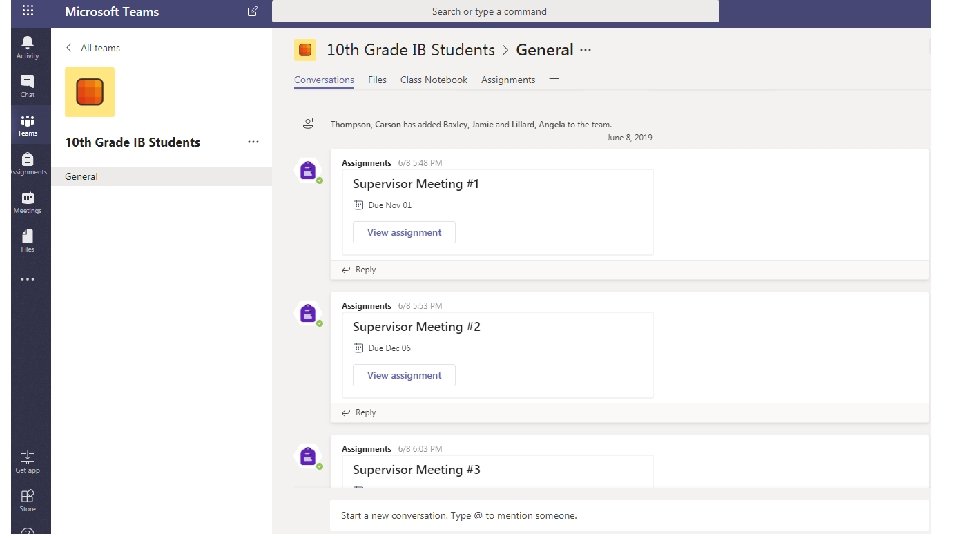
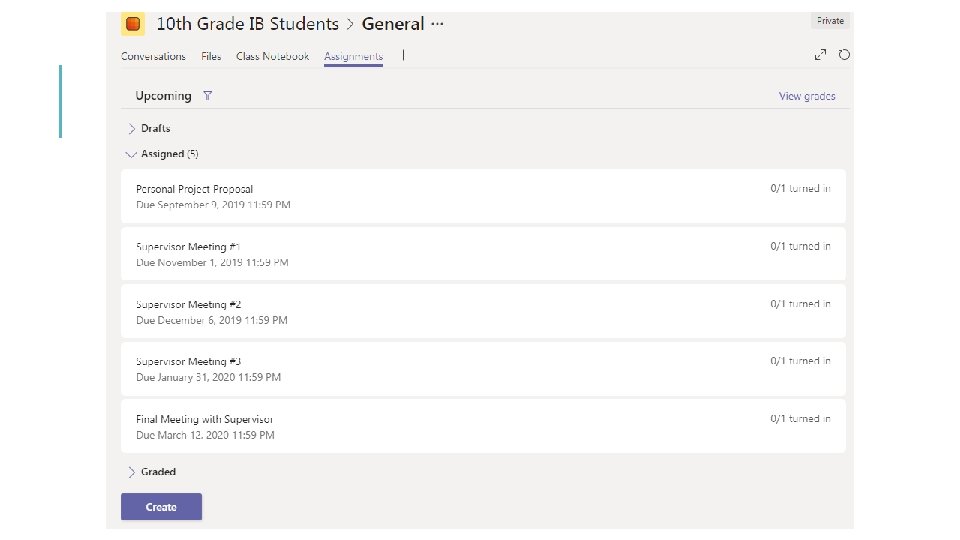
RCBOE EMAIL YOU ARE EXPECTED TO CHECK THAT ACCOUNT REGULARLY. I recommend installing it on your phone. I will be emailing your candidate number and other communication through that email address only. No more emails to Pookie 582@gmail. com You will need that email login to get to Teams. It is part of the Microsoft office Suite.
FROM MR. GUINN… * GPA: 5. 0 classes and effect on GPA/Rank * Projects: Required to stay in IB * NMSI: You NEED to go to Student Study Sessions!!!! English/Math/Science * AP Classes – expected to take exams – you will need to study on your own, too! *Accommodations for AP and IB exams-504 s/IEP * Behavior: Act right (Leaving campus w/o permission is 3 days OSS) * DP/CP: 10 th graders must decide soon! Early November!!!
ACADEMIC HONESTY-LEVEL ONE A Level One malpractice violation may occur unintentionally through laxity or as a result of inexperience and lack of knowledge of particular principles of academic integrity. Such violations usually involve a minor fraction of the total work, and occur on formative assessments. Situations that involve Level One violations will be considered as “teachable moments. ” In such a case, the teacher will impose the sanction during the resolution meeting with the student and notification will be reported to a parent and the IB Dean. Level One violations include, but are not limited to the following: Failing to provide appropriate citations or give accurate acknowledgement of sources over a minimal amount of the assignment. Attempting to paraphrase a limited section of the assignment without appropriate citations. Failure to use quotation marks to cite passages. Instances in which the author’s voice is not clearly differentiated from that of a source.
CONSEQUENCES FOR LEVEL ONE Level One First Offense Student will have the opportunity to redo the assignment or one comparable to it. The teacher will have an Academic Resolution Meeting with the student and discuss the violation. The teacher will notify a parent and the IB Dean. Level One Second Offense Student will have the opportunity to redo the assignment or one comparable to it. The teacher will have an Academic Resolution Meeting with the student and discuss the violation. The teacher will notify a parent and the IB Dean. Level One Third Offense Student will earn a zero for the assignment in question. Teacher will have an Academic Resolution Meeting with the student and discuss the violation. The IB Dean will discuss the violation with the student and parents. Further Level One offenses will be treated as Level Two offenses
ACADEMIC HONESTY-LEVEL TWO A Level Two malpractice violation is a more serious and immediate level of dishonesty. Level Two violations are indicative of a student’s conscious attempt to commit academic malpractice. Includes but not limited to • Sabotaging the work of another student • Fabricating or falsifying data or creating sources that are not factual • Using “text-spinners, ” “synonymizers, ” or other paraphrase software to disguise a source • Falsifying any documents by omission, mutilation, or addition • Paraphrasing or directly quoting a significant portion of an assignment without appropriate citations
CONSEQUENCES FOR LEVEL TWO ACADEMIC HONESTY VIOLATIONS INVOLVING OFFICIAL, FINAL IB SUBMISSIONS WILL BE AUTOMATICALLY TREATED AS A LEVEL TWO, THIRD OFFENSE. Level Two First Offense Student will earn a zero for the assignment in question Teacher will have an Academic Resolution Meeting with the student and discuss the violation. The teacher will notify the IB Dean in writing. he IB Dean will discuss the violation with the student and parents. Student will be on a probationary period of 90 school days. If the probationary period begins less than 90 school days before the end of the year, the probationary period will resume on the first day of the next school year. Further Level Two violations during the probationary period will be evaluated by the Academic Ethics Team and may result in immediate
CONSEQUENCES FOR LEVEL TWO, CONTINUED Level Two Second Offense Student will earn a zero for the assignment in question. Teacher will have an Academic Resolution Meeting with the student and discuss the violation. The teacher will notify the IB Dean in writing. The IB Dean will discuss the violation with the student and parents. Student will be on a probationary period of 90 school days. If the probationary period begins less than 90 school days before the end of the year, the probationary period will resume on the first day of the next school year. Further Level Two violations during the probationary period will be evaluated by the Academic Ethics Team and may result in immediate dismissal from the IB Programme. Level Two Third Offense The student will earn a zero (if applicable) for the assignment in question. The teacher will notify the IB Dean and the student’s parents. An Academic Ethics Team made up of the Principal, IB Dean, a counselor, and at least two DP teachers will meet to decide upon disciplinary action which may include dismissal from the IB Programme. This may result in out-of-zone students having to return to their zoned school.
HOW IS IB DIFFERENT? The IB Middle Years, Diploma, and Career-related Programs: Create IB Learners Are recognized globally for their rigor and depth Develop community-minded citizens Encourage intellectual curiosity Fashion a coherent, integrated view of academia and the world around.
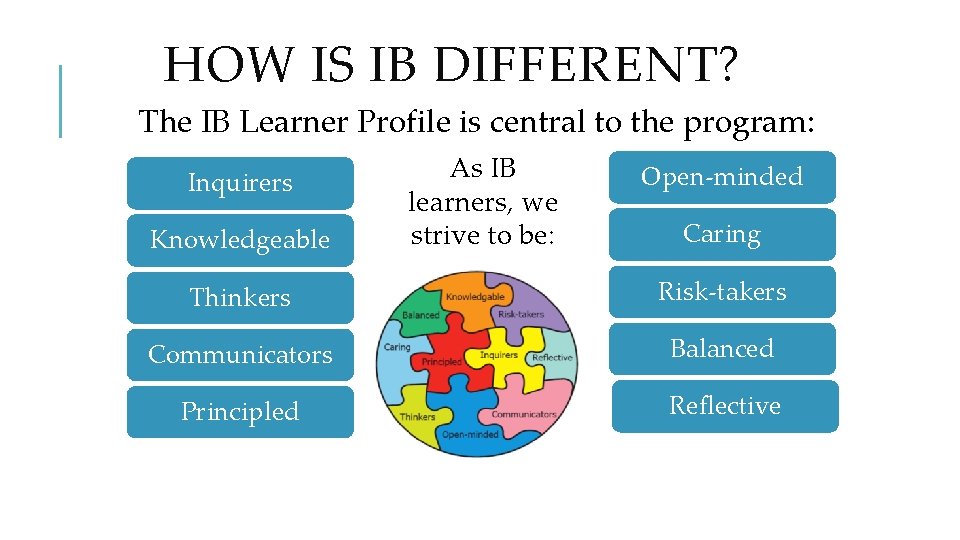
HOW IS IB DIFFERENT? The IB Learner Profile is central to the program: Inquirers Knowledgeable As IB learners, we strive to be: Open-minded Caring Thinkers Risk-takers Communicators Balanced Principled Reflective
THE PURPOSE OF IB IS DIFFERENT FROM THE PURPOSE OF DUALENROLLMENT * IB is designed specifically to strongly prepare students for success at the university level * IB focuses on critical thinking, self-reflection, and time-management * You can (and should) earn college credit through IB test scores Students typically earn between 3 and 28 credit hours – all colleges have different score requirements * The point of dual-enrollment (DE) is to earn college credit while still in high school * DE is a great way to save time and money * Grades earned in DE are part of your official college transcript! * Keep your maturity level in mind when pursuing DE!
IB DIPLOMA PROGRAMME (DP) CURRICULUM IB English Literature (2 years) IB History of the Americas (2 Years) IB Biology/Physics (2 Years) IB Spanish (2 Years) IB Econ/IB Music/IB Visual Arts/IB Psych (2 Years) IB Math Studies (1 Year) Theory of Knowledge (TOK) (2 Years)
DIPLOMA REQUIREMENTS YOU SHOULD EARN IT! * Globally, 75% of DP candidates earn the diploma * Our students are as smart and capable as any in the world! * Our staff is highly trained and dedicated to our students! * We are here to support you – if you do what is required, you WILL succeed!
HOW TO EARN AN IB DP DIPLOMA * Earn at least 24 points and successfully complete: All assessments * CAS * Extended Essay * TOK * DP students must take 3 Higher Level (HL) classes and 3 Standard Level (SL) classes SL: at least 150 hours of instruction HL: at least 240 hours of instruction (plus one more topic and one more paper than SL) * IB classes are graded on a 1 -7 scale (4 -7 is considered an acceptable score) * Each class grade is generated from two types of assessment components Internal Assessments (IA) – graded by the teacher with samples sent to IB for moderation External Assessments (EA) – graded by IB examiners, these are essays and exams
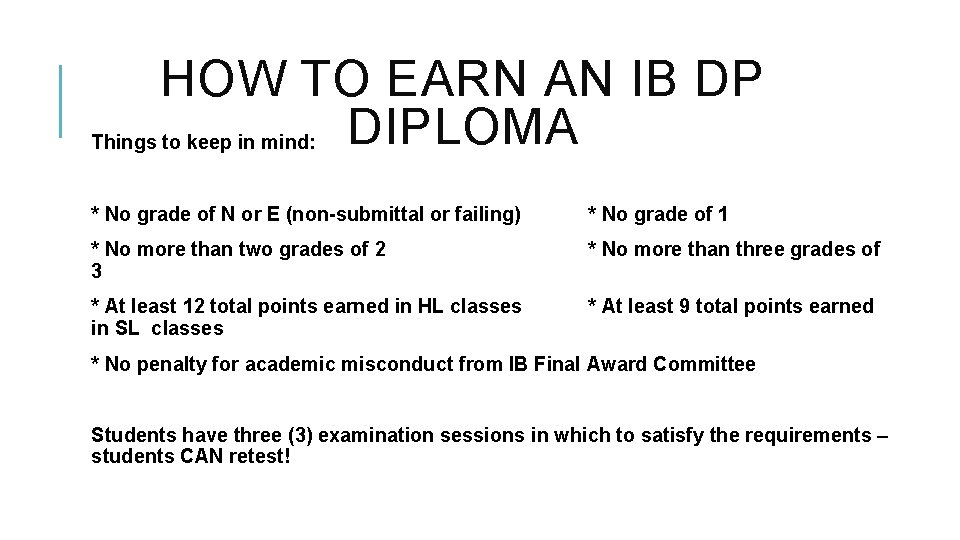
HOW TO EARN AN IB DP DIPLOMA Things to keep in mind: * No grade of N or E (non-submittal or failing) * No grade of 1 * No more than two grades of 2 3 * No more than three grades of * At least 12 total points earned in HL classes in SL classes * At least 9 total points earned * No penalty for academic misconduct from IB Final Award Committee Students have three (3) examination sessions in which to satisfy the requirements – students CAN retest!
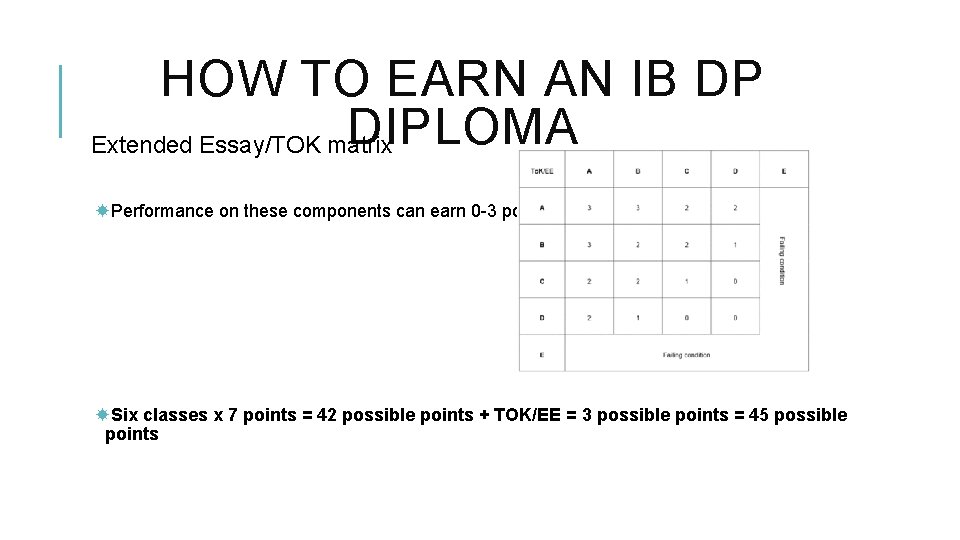
HOW TO EARN AN IB DP DIPLOMA Extended Essay/TOK matrix Performance on these components can earn 0 -3 points Six classes x 7 points = 42 possible points + TOK/EE = 3 possible points = 45 possible points
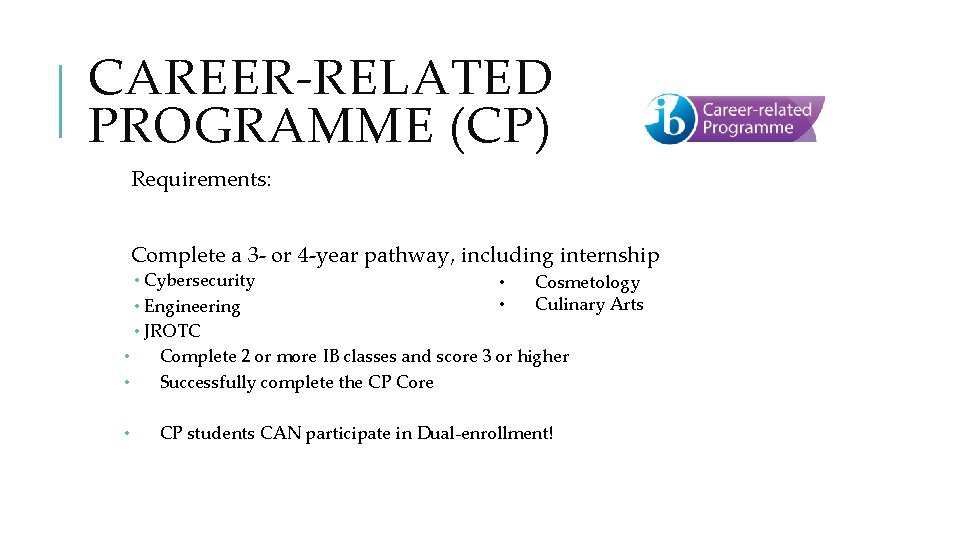
CAREER-RELATED PROGRAMME (CP) Requirements: Complete a 3 - or 4 -year pathway, including internship • Cybersecurity • Cosmetology • Culinary Arts • Engineering • JROTC • Complete 2 or more IB classes and score 3 or higher • Successfully complete the CP Core • CP students CAN participate in Dual-enrollment!
SKINNY SCHEDULES * To meet IB and Georgia graduation requirements * Purple/Gold days * Students travel together in 1 st period * All Spanish classes for IB students are skinnied * 9 th Grade: Scientific Research (IB 101) * 10 th Grade: Honors Economics * 11 th Grade: TOK or PPS (CP students may take Spanish or ES&S) * 12 th Grade: TOK or PPS (Spanish Year 2 or senior privilege)
- Slides: 40