
IB Math Studies Year 1 I Sets of
IB Math Studies Year 1 I. Sets of Numbers
Natural #s: N Set of positive integers including zero. {0, 1, 2, 3, 4, …}
Integers: Z Positive and negative whole numbers and zero. No fractions or decimals {…-5, -4, -3, -2, -1, 0, 1, 2, 3, …} Positive integers: Z+ ={1, 2, 3, …}
Rational #s: Q Can be written as the ratio p/q of 2 integers where q ≠ 0. In other words: any number that can be written as a fraction! Includes integers, natural numbers, repeating decimals, terminating decimals Ex: ½, -4. 13, 5. 6666…, √ 144
Positive Rational #s: Q+ Written in set notation form {x|xєQ, x>0} Read: x such that x is an element of the rational #s and x is greater than 0
Irrational #s: I These numbers CANNOT be written as the ratio of 2 integers (can’t be written as a fraction) Ex: √ 2, π, e
Real #s: R All of the above sets of #s are real numbers For IB, we’re not going to be studying the Complex Number System
Represent Real #s Graphically On a number line, remember 0 is the origin. To the left are negative numbers and to the right are positive #s.
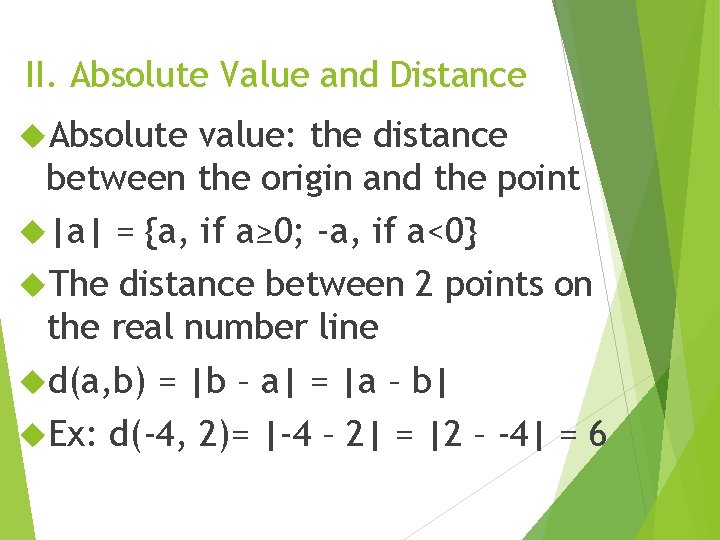
II. Absolute Value and Distance Absolute value: the distance between the origin and the point |a| = {a, if a≥ 0; -a, if a<0} The distance between 2 points on the real number line d(a, b) = |b – a| = |a – b| Ex: d(-4, 2)= |-4 – 2| = |2 – -4| = 6
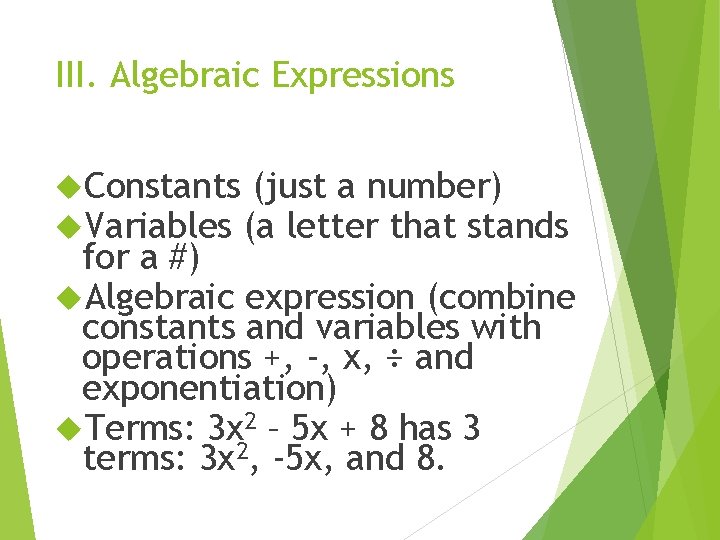
III. Algebraic Expressions Constants (just a number) Variables (a letter that stands for a #) Algebraic expression (combine constants and variables with operations +, -, x, ÷ and exponentiation) Terms: 3 x 2 – 5 x + 8 has 3 terms: 3 x 2, -5 x, and 8.
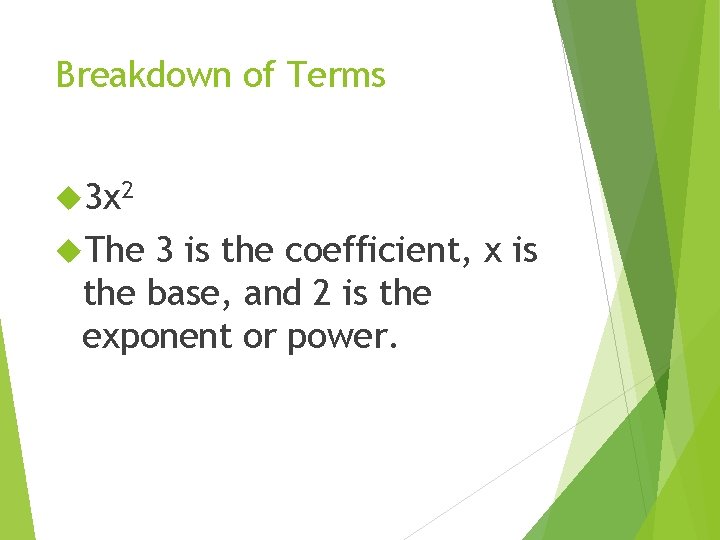
Breakdown of Terms 3 x 2 The 3 is the coefficient, x is the base, and 2 is the exponent or power.
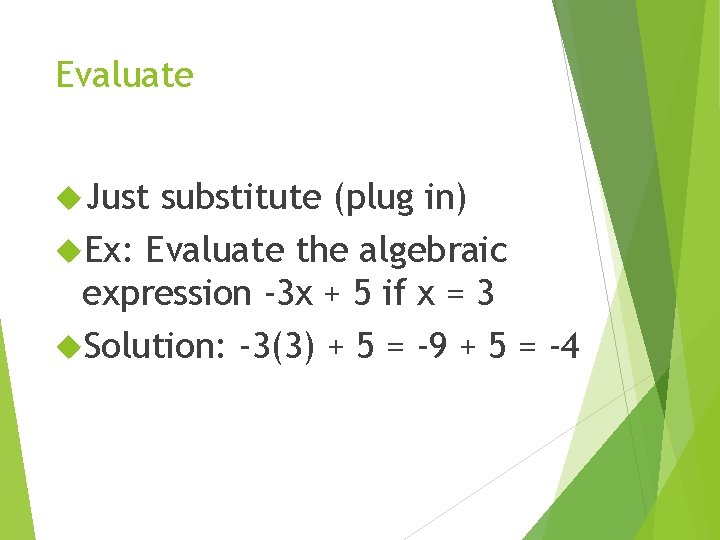
Evaluate Just substitute (plug in) Ex: Evaluate the algebraic expression -3 x + 5 if x = 3 Solution: -3(3) + 5 = -9 + 5 = -4
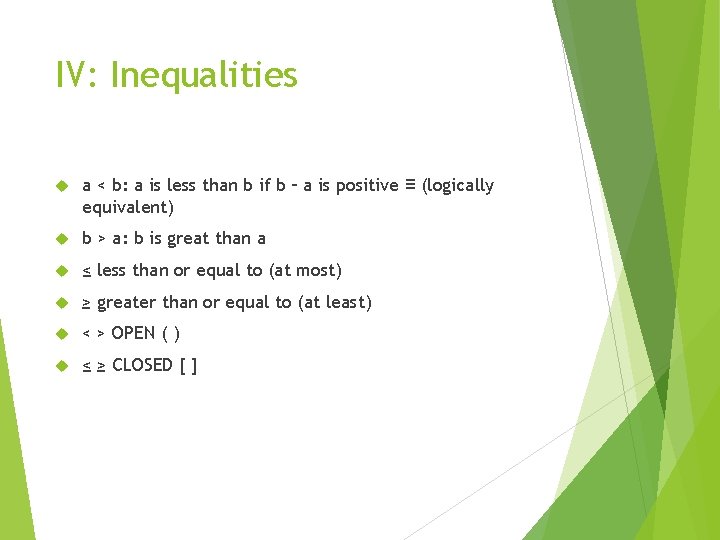
IV: Inequalities a < b: a is less than b if b – a is positive ≡ (logically equivalent) b > a: b is great than a ≤ less than or equal to (at most) ≥ greater than or equal to (at least) < > OPEN ( ) ≤ ≥ CLOSED [ ]

Continue notes on your own paper
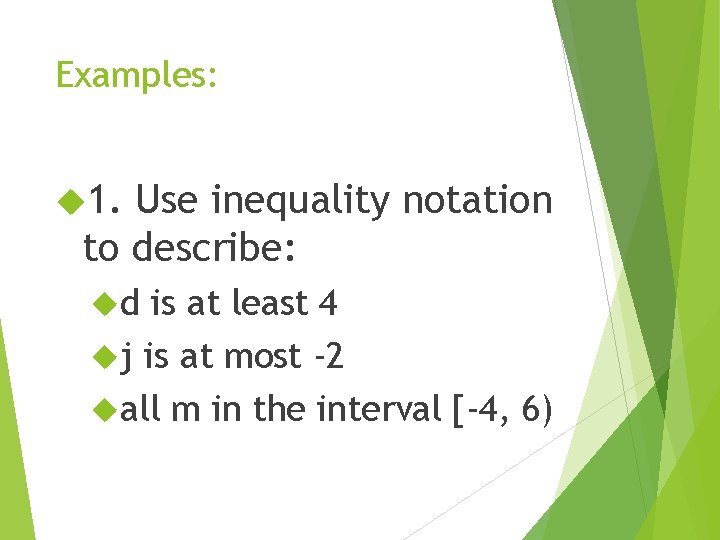
Examples: 1. Use inequality notation to describe: d is at least 4 j is at most -2 all m in the interval [-4, 6)
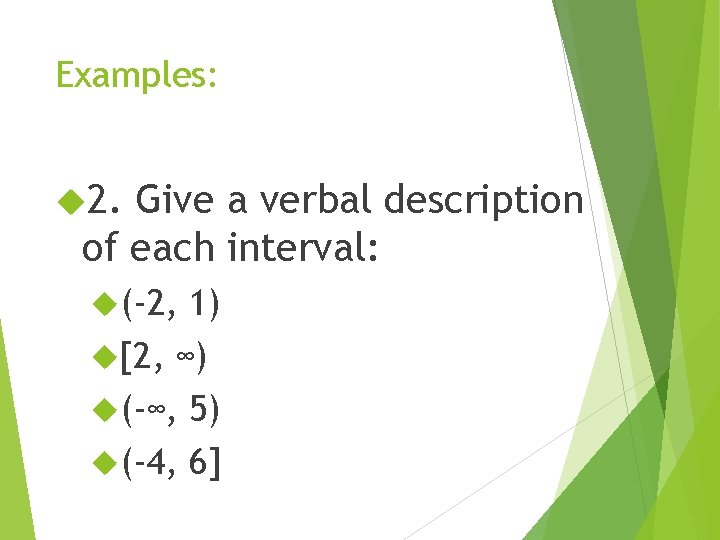
Examples: 2. Give a verbal description of each interval: (-2, 1) [2, ∞) (-∞, 5) (-4, 6]
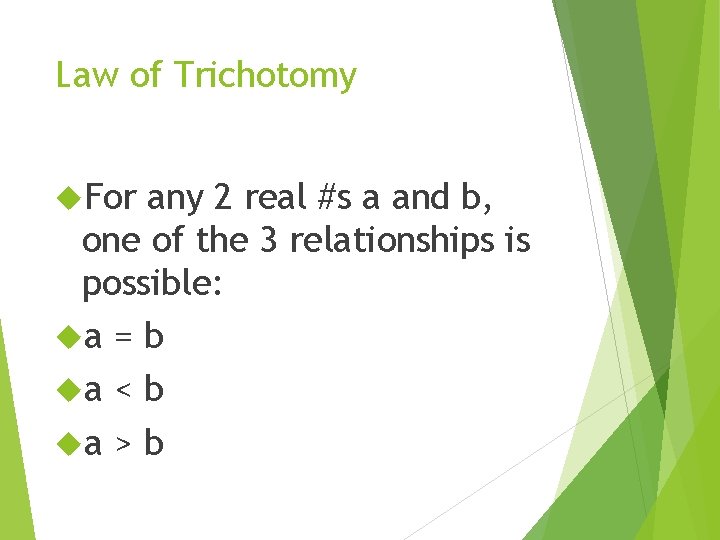
Law of Trichotomy For any 2 real #s a and b, one of the 3 relationships is possible: a = b a < b a > b
HW: Set #2 #1 -6 AND #19 -28
- Slides: 18