
IB Exam Review Tips Revision sorting your material
IB Exam Review Tips
Revision – sorting your material • • You will have notes, p/copies, books etc from 2 years worth of work You have knowledge from your IA and maybe your EE You have knowledge from studying Papers 1, 2, 3 You need to organize your material in relation to the dot points for each topic You need to check that you have covered enough of the dot points to answer a range of essay questions asked in the exam You need to know where to go to find more information to fill gaps You probably have big files of history notes – you will not learn these just by reading them. To prepare for exams you have to condense these notes down to a manageable size.

Revision • • Cue cards /flash cards Posters /mind maps Chronologies/ timelines Recordings Study buddies Comparison charts Repetition Teaching someone else
Revision - Exam writing skills • Go through past exams (questions) • Identify and clarify command historical terms • Produce essay plans for questions – identify facts needed to answer a question • Practise writing in the allocated time for each exam/essay • Work with a study buddy and use mark schemes to mark each other’s essays
What to do in the exam room • Read questions carefully in 5 minute reading time • Choose questions from sections you have studied • Do a brief plan, or write down keys words at the start of your essay to keep ideas organized • This way you wont forget relevant areas • Watch your timing – leave time to answer the correct number of questions/essays • Write legibly – it makes it easier for the examiner to mark • Number your answers/essays clearly on answer book and on the cover sheet

Exam related - DANGER ZONES • • Paper 1 Use the marks as a guide to length of answer Paper 2 Follow instructions and answer 1 essay from each topic • Paper 3 • Avoid choosing questions from areas of the course that you have not been taught
Exam related – Common mistakes and how to avoid them • Telling the story: • You need to link your information to the question – not write a narrative • Writing general answers: • You must include detailed evidence to support your ideas • Spending too long on questions: • Timing is crucial in the exam • Don’t spend too long on one question – then not have enough time to write the other/s • Missing the focus of a question: • Use the command clarifying terms to identify the focus of the question

Exams - Tips for revising • Different things work for different people but here are some that MAY help you. . . • Ensure that you are doing some revision each day. • This should be going over your notes, revising quotes etc. • If you don’t remember everything you need, perhaps ask your teacher. • It’s good to re write notes as you remember things when you physically write them down. • Use highlighters and coloured pens to indicate – important ideas, etc • Use a method of revision that best suits you. • This may be mind maps, diagrams, lists, notes etc. If you think diagrammatically. • You may find drawing the information as a cartoon more helpful. Find what works for you.
Paper 1 • • • Question 1: This question tests comprehension of sources – it will ask you to state clearly what source is saying – do not use direct quotes only => otherwise, the examiner will never know you have actually understood. In this question, one mark = one point. Do not use dot points! • • • Question 2: This question asks you to be an historian => 2 Paragraphs- One on Values, one on Limitations The value + limitation of the source must be analysed with reference to its origin + purpose + content => • • Question 3: This question will ask you to examine the similarities AND differences between 2 sources. The wording changes + you need to work it out which it is asking you to do. Never deal with the sources separately! Always make sure you restrict yourself to discussion of the specific issue it asks you to. Do not talk focus on Origin and Purpose- it is about similarities/differences of Content • Question 4: · Q 4 is an essay + you must make an argument in response to the question · You must also use both material from the sources and your own knowledge => always note when you are using material from sources. It’s all about how USEFUL the sources are as historical documents.
SL/HL Paper 2 What can you do and what will you do? • • • • You will write on ONE essay from Causes +Effects of 20 th Century War and ONE essay from Cold War: Superpowers and Rivalries_. There will be two options per topic. You cannot write two essays from the same topic. I said, YOU CANNOT WRITE TWO ESSAYS FROM THE SAME TOPIC! You cannot guarantee any questions but past papers indicate some sort of pattern! You can be judicious in choosing your favored topics. What aspects of the two topics do you most want to write on? Topic __ - ________________________________ What other aspects do you think you could do OK on? Topic __ - ________________ Topic __- ________________ What other aspects do you think you could handle? Topic __ - ________________ Topic __- ________________ So that’s what you are going to study…. • • Your task is to… Go through past essay questions Write drafts for essays Write detailed plans for essays • •
Paper 2 common mistakes to avoid • Answering the wrong number of questions or choosing two questions from the same topic • Failing to read, understand follow command terms in the question • Failing to read, understand follow the other key words in the question • Writing a prepared answer to a question which does not fit the question • Failing to write an analytical essay
Paper 2 – what to do in the exam • • Use your 5 minutes of reading time wisely There are 5 topics on the exam – go to the 2 you have studied Read all the questions for your chosen topics Select the questions you can answer Reread the questions and make sure you can answer all parts Do you know what the question is asking you to do? Do you know enough factual content to answer the question? Choose questions which have clear directions and a tight focus for your response. • Avoid broad questions with indefinite focus and a wide geographical and chronological range. This might result in a vague general answer.
Paper 2 – what to write in the essay • You have 90 minutes in total which is 45 minutes per essay • Underline the command terms, key words, other terms and directions • You should be able to support your points with relevant content • Maybe write down some points that you can follow when you are writing the essay • Write a clear introduction answering the question, this helps to show the structure of your essay • It also shows the examiner that you have understood the question
Paper 2 & 3 essays – things to think about • • • What does the question mean? What should I include in my answer? How should I present my answer? What structure and content are required in my answer? What are the specific events, people, developments, ideas, policies that I must consider? • What is the time frame? • What details should be included in my answer? • What doesn’t belong in my answer?
Essay Writing – some tips! • Not a narrative • Answer the question being asked – and all parts of the question • Need to support your answer with dates, facts etc • Signposting – using words from the question throughout the essay • Create an argument as a sentence – then refer to it (with supporting material)
Be prepared- what do examiners say? • • • Many examiners have noted that students often write poor responses because they do not know or understand the terms used in the questions. Failing to know the difference between left and right wing states or the meaning of the word “ideology” may mean that you produce a weak response. If you don’t under stand the meaning of the command terms, it affects your ability to produce a good answer as you wont understand what is required for the question. Not noticing the word “both” in the question means that your response will be incomplete and will not score as well as you will concentrate on just one aspect. Similarly, failure to notice a term such as “either/or” might cause you to attempt to cover too much material, resulting in a poor grade. Paying close attention to any dates that are included in a question will help you to focus your response and avoid wasting time covering material outside the required period.
HL Paper 3 – exam structure • • The paper has 36 questions The questions are in chronological order Two questions on each section Need to answer 3 questions You have 2 hours and 30 mins to answer BE PREPARED read all bullet points from each sections: Great Depression, WWII, Cold War
HL Paper 3 • BE PREPARED • Under stand the question, get the focus right • Provide accurate, relevant, detailed evidence, know your facts • Demonstrate analysis and evaluation of the importance of the facts in relation to the question
HL Paper 3 – what to do in the exam • Use your reading time to identify the questions which you have learnt • Make note of the questions you will be happy to answer • Read the questions carefully – do you know enough to answer all of the question • Underline the command terms in the question • Write a quick plan of the issues / ideas you are going to write about • Watch your timing – spend 45 to 50 minutes on each essay
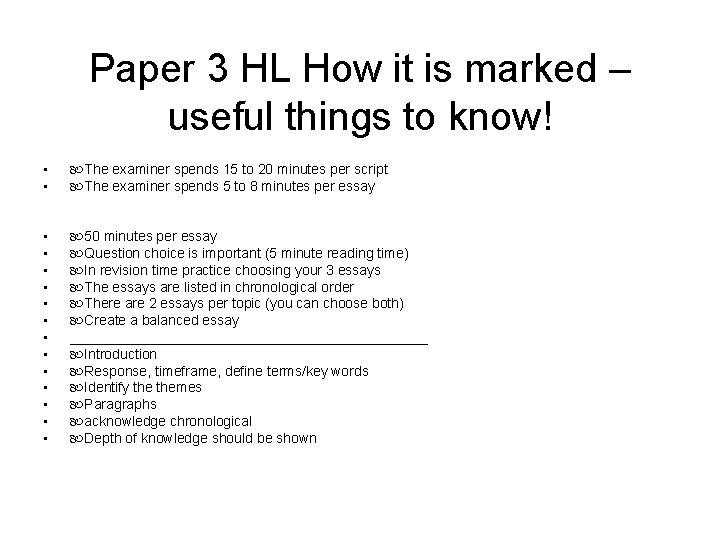
Paper 3 HL How it is marked – useful things to know! • • The examiner spends 15 to 20 minutes per script The examiner spends 5 to 8 minutes per essay • • • • 50 minutes per essay Question choice is important (5 minute reading time) In revision time practice choosing your 3 essays The essays are listed in chronological order There are 2 essays per topic (you can choose both) Create a balanced essay _______________________ Introduction Response, timeframe, define terms/key words Identify themes Paragraphs acknowledge chronological Depth of knowledge should be shown
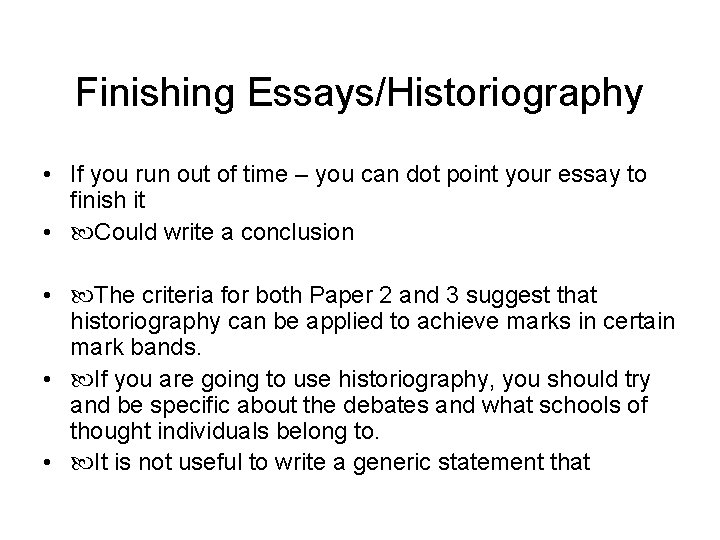
Finishing Essays/Historiography • If you run out of time – you can dot point your essay to finish it • Could write a conclusion • The criteria for both Paper 2 and 3 suggest that historiography can be applied to achieve marks in certain mark bands. • If you are going to use historiography, you should try and be specific about the debates and what schools of thought individuals belong to. • It is not useful to write a generic statement that
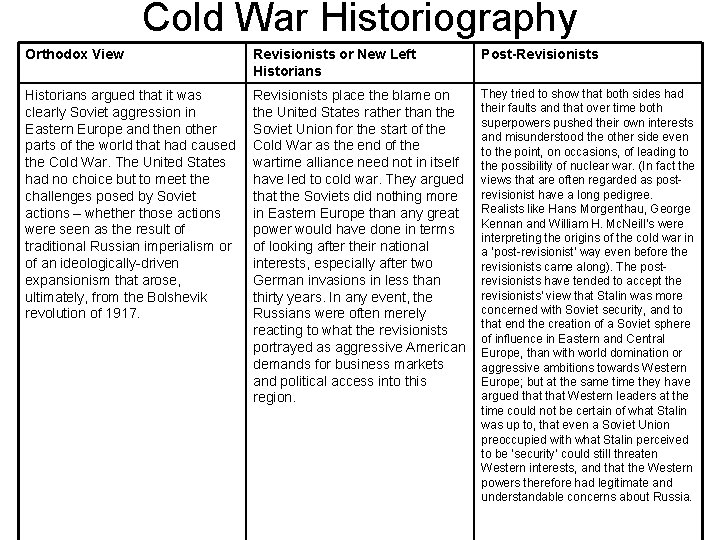
Cold War Historiography Orthodox View Revisionists or New Left Historians Post-Revisionists Historians argued that it was clearly Soviet aggression in Eastern Europe and then other parts of the world that had caused the Cold War. The United States had no choice but to meet the challenges posed by Soviet actions – whether those actions were seen as the result of traditional Russian imperialism or of an ideologically-driven expansionism that arose, ultimately, from the Bolshevik revolution of 1917. Revisionists place the blame on the United States rather than the Soviet Union for the start of the Cold War as the end of the wartime alliance need not in itself have led to cold war. They argued that the Soviets did nothing more in Eastern Europe than any great power would have done in terms of looking after their national interests, especially after two German invasions in less than thirty years. In any event, the Russians were often merely reacting to what the revisionists portrayed as aggressive American demands for business markets and political access into this region. They tried to show that both sides had their faults and that over time both superpowers pushed their own interests and misunderstood the other side even to the point, on occasions, of leading to the possibility of nuclear war. (In fact the views that are often regarded as postrevisionist have a long pedigree. Realists like Hans Morgenthau, George Kennan and William H. Mc. Neill’s were interpreting the origins of the cold war in a ‘post-revisionist’ way even before the revisionists came along). The postrevisionists have tended to accept the revisionists’ view that Stalin was more concerned with Soviet security, and to that end the creation of a Soviet sphere of influence in Eastern and Central Europe, than with world domination or aggressive ambitions towards Western Europe; but at the same time they have argued that Western leaders at the time could not be certain of what Stalin was up to, that even a Soviet Union preoccupied with what Stalin perceived to be ‘security’ could still threaten Western interests, and that the Western powers therefore had legitimate and understandable concerns about Russia.
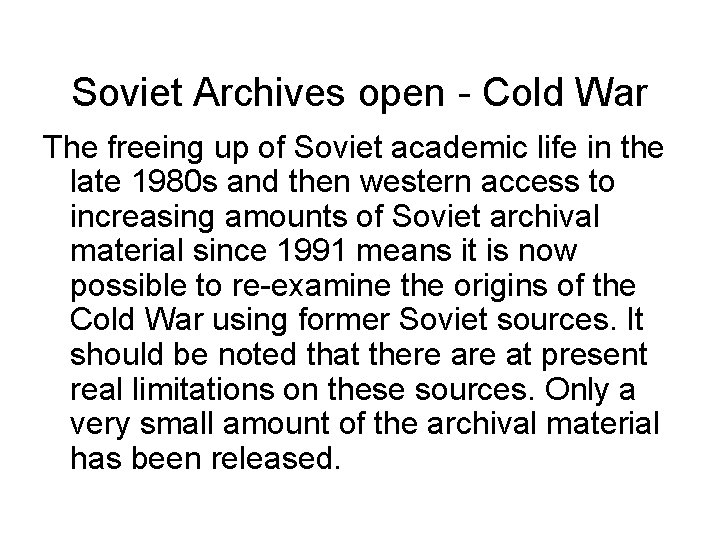
Soviet Archives open - Cold War The freeing up of Soviet academic life in the late 1980 s and then western access to increasing amounts of Soviet archival material since 1991 means it is now possible to re-examine the origins of the Cold War using former Soviet sources. It should be noted that there at present real limitations on these sources. Only a very small amount of the archival material has been released.
Who was to blame for the Cold War • Russian historians blamed Churchill (the British Prime Minister) and Truman (the American president, 1945– 1953). They said Truman and Churchill wanted to destroy the USSR, which was just defending itself. • • The Traditional View At first, western writers blamed Russia. They said Stalin was trying to build up a Soviet empire. • • The Revisionist View Later, however, some western historians blamed America. They said Truman had not understood how much Russia had suffered in the Second World War. • • The Post-Revisionists Later still, historians think BOTH sides were to blame – that there were hatreds on both sides. • Most recently, historians agree that the Cold War was primarily a clash of beliefs - Communism versus Capitalism.
Who was to blame for the Cold War? Historiography • • The Traditionalists Until the 1960 s, most historians followed the official government line – that the Cold War was the direct result of Stalin's aggressive Soviet expansionism. Allocation of blame was simple – the Soviets were to blame! The Revisionists In 1959, however, William Appleman Williams published his The Tragedy of American Diplomacy. Williams blamed the US for the Cold War. Williams, and the historians who followed him were called the ‘revisionists’. This ‘revisionist’ approach reached its height during the Vietnam War when many people suggested that America was as bad as Russia. Gar Alperovitz, in his book: Atomic Diplomacy: Hiroshima and Potsdam (1965), placed the blame for the Cold War on the Americans for their use of the atomic bomb One of the most extreme revisionists was Gabriel Kolko, who wrote The Limits of Power: The World and United States Foreign Policy in 1972 He suggested that Truman should have given Stalin the atomic bomb in 1945, claimed that Russia treated Poland well in 1945, and blamed South Korea for the Korean War of 1950 -3.
Who was to blame for the Cold War? Historiography • • • The Post-Revisionists As time went on, however, a group of historians called the ‘postrevisionists’ tried to present the foundations of the Cold War as neither the fault of the Americans or the USSR. The first was John Lewis Gaddis, The United States and the Origins of the Cold War (1972), who believed that both America and Russia wanted to keep the peace after the war but that conflict was caused by mutual misunderstanding, reactivity, and above all the American inability to understand Stalin's fears and need to defend himself after the war. Martin P. Leffler, in his book: A Preponderance of Power: National Security, the Truman Administration and the Cold War (1992) saw the Cold War as a clash of two military establishments both seeking world domination Marc Trachtenberg, A Contested Peace: The Making of the European Settlement, 1945 -1963 (1999) claimed that the Cold War was really about settling the German question in the aftermath of World War II.
Who was to blame for the Cold War? Historiography • Post – 1991 • In 1991, Communism in the Soviet Union collapsed. This has allowed historians to get to see the Russian archives, and to investigate what Russia was REALLY about in this period. In Inside the Kremlin's Cold War: from Stalin to Khrushchev (1997), the Russian historians Vladislav Zubok and Constantine Pleshakov, use declassified Soviet documents to analyse Stalin’s part in causing the Cold War. They reveal a fanatic belief in Communism, lots of personal faults and mistakes, but – above all – a genuine desire to avoid confrontation with the USA.
IB – Historiography Task – go through your texts, handouts and Internet (where relevant) – find the name of various key historians, include their perspective and then a comment they make regarding the knowledge area. Try and create a table for each of the topics studied over the two years.
- Slides: 28