
IB ECONOMICS 2 4 FISCAL POLICY 1 Explain
IB ECONOMICS 2. 4 FISCAL POLICY
1. Explain that the government earns revenue primarily from taxes (direct and indirect), as well as from the sale of goods and services and the sale of state-owned (government owned) An indirect tax (such as sales tax, a specific tax, value added tax (VAT), or goods and services tax (GST)) is a tax collected by an intermediary (such as a retail store) from the person who bears the ultimate economic burden of the tax (such as the consumer). The intermediary later files a tax return and forwards the tax proceeds to government with the return. In this sense, the term indirect tax is contrasted with a direct tax which is collected directly by government from the persons (legal or natural) on which it is imposed. Some commentators have argued that "a direct tax is one that cannot be shifted by the taxpayer to someone else, whereas an indirect tax can be. "
2. Explain that government spending can be classified into current expenditures, capital expenditures and transfer payments, providing examples of each. An operating expenditure, current expenditures or OPEX is an ongoing cost for running a product, business, or system. Capital expenditures or CAPEX are expenditures creating future benefits. A capital expenditure is incurred when a business/government spends money either to buy fixed assets or to add to the value of an existing fixed asset with a useful life extending beyond the taxable year. For example, the purchase of a photocopier involves CAPEX, and the annual paper, toner, power and maintenance costs represents OPEX.
2. Explain that government spending can be classified into current expenditures, capital expenditures and transfer payments, providing examples of each. A transfer payment (or government transfer or simply transfer) is a redistribution of income in the market system. These payments are considered to be exhaustive because they do not directly absorb resources or create output. In other words, the transfer is made without any exchange of goods or services. Examples of certain transfer payments include welfare (financial aid), social security, and government making subsidies for certain businesses (firms).
3. Distinguish between a budget deficit, a budget surplus and a balanced budget. The Government budget balance, also commonly referred to as general government balance, public budget balance, or public fiscal balance, is the overall result of a country's general government budget over the course of an accounting period (usually one year). It includes all government levels (from national to local) and public social security funds. The budget balance is the difference between government revenues (e. g. , tax) and spending. A positive balance is called a government budget surplus. A negative balance is called a government budget deficit. Budget Puzzle: You Fix the Budget
4. Explain the relationship between budget deficits/ surpluses and the public (government) debt. The government budget balance is used to assess the fiscal health of a country. Keynesian economics advocates a government budget deficit during recession or downturn as long as it is limited enough to render the structural government budget balance positive. The two basic elements of any budget are the revenues and expenses. In the case of the government, revenues are derived primarily from taxes. Government expenses include spending on current goods and services, which economists call government consumption; government investment expenditures such as infrastructure investment or research expenditure; and transfer payments like unemployment or retirement
4. Explain the relationship between budget deficits/ surpluses and the public (government) debt. Government debt (also known as public debt, national debt) is the debt owed by a central government. (In the U. S. and other federal states, "government debt" may also refer to the debt of a state or provincial government, municipal or local government. ) By contrast, the annual "government deficit" refers to the difference between government receipts and spending in a single year, that is, the increase of debt over a particular year.
5. Explain how changes in the level of government expenditure and/or taxes can influence the level of aggregate demand in an economy. Fiscal policy is the use of government revenue collection (taxation) and expenditure (spending) to influence the economy. The two main instruments of fiscal policy are government taxation and expenditure. Changes in the level and composition of taxation and government spending can impact the following variables in the economy: • Aggregate demand the level of economic activity; • The pattern of resource allocation; • The distribution of income. Fiscal policy refers to the use of the government budget to influence economic activity.
5. Explain how changes in the level of government expenditure and/or taxes can influence the level of aggregate demand in an economy. Governments use fiscal policy to influence the level of aggregate demand in the economy, in an effort to achieve economic objectives of price stability, full employment, and economic growth. Keynesian economics suggests that increasing government spending and decreasing tax rates are the best ways to stimulate aggregate demand, and decreasing spending & increasing taxes after the economic boom begins. Keynesians argue this method be used in times of recession or low economic activity as an essential tool for building the framework for strong economic growth and working towards full employment. In theory, the resulting deficits would be paid for by an expanded economy during the boom that would follow; this
5. Explain how changes in the level of government expenditure and/or taxes can influence the level of aggregate demand in an economy. Governments can use a budget surplus to do two things: to slow the pace of strong economic growth, and to stabilize prices when inflation is too high. Keynesian theory predicts that removing spending from the economy will reduce levels of aggregate demand contract the economy, thus stabilizing prices.
6. Explain the mechanism through which expansionary fiscal policy can help an economy close a deflationary (recessionary) gap. Expansionary Fiscal Policy Fiscal policy is said to be loose or expansionary when government spending exceeds revenue. In these cases, the fiscal budget is in deficit. While the absolute amount of deficit is important, what is often more important is the change in the deficit (or surplus). Government action to cut taxes, increase transfer payments or both, has the effect of raising households' disposable incomes and promoting consumer spending. Expansionary fiscal policy is used to address businesscycle instability that gives rise to the problem of unemployment, that is, to close a recessionary gap. This gap arises during a business-cycle contraction and typically gives rise to higher rates of unemployment.
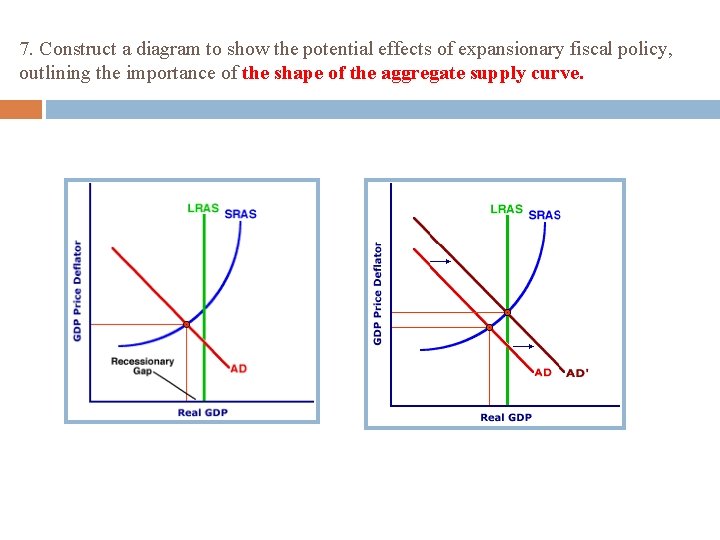
7. Construct a diagram to show the potential effects of expansionary fiscal policy, outlining the importance of the shape of the aggregate supply curve.
7. Construct a diagram to show the potential effects of expansionary fiscal policy, outlining the importance of the shape of the aggregate supply curve. The flatter the SRAS curve the less will be price pressure as AD increases. (Real GDP will be effected more so) The steeper the SRAS curve the more price pressure will increase as AD increase. (Less effect on Real GDP) The multiplier will have a larger effect on the economy in the flatter portion of the SRAS curve and the multiplier will have a small effect in the steeper portion of the SRAS curve due to higher price levels.
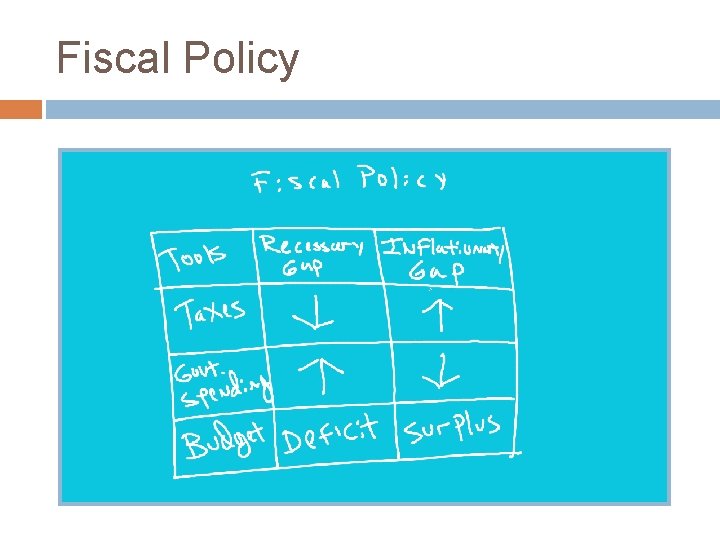
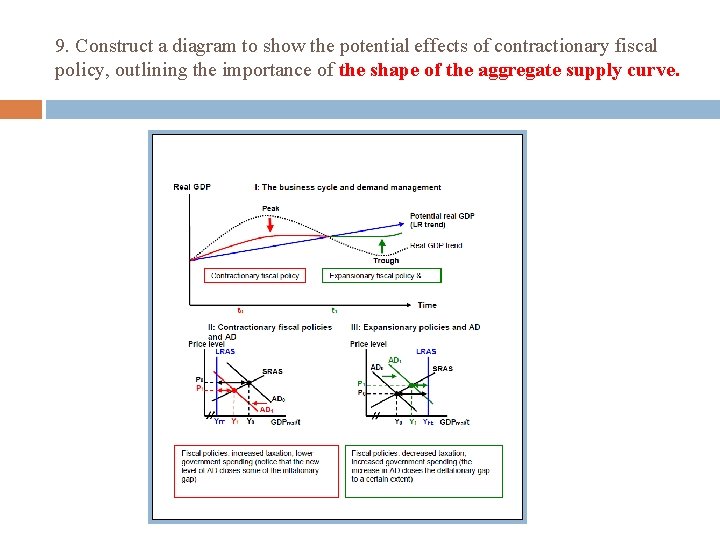
8. Explain the mechanism through which contractionary fiscal policy can help an economy close an inflationary gap. Contractionary Fiscal Policy Fiscal policy is said to be tight or contractionary when government revenue exceeds spending. In these cases, the fiscal budget is in surplus. While the absolute amount of surplus is important, what is often more important is the change in the surplus (or deficit). Government action to raise taxes, reduce transfer payments or both, has the effect of reducing households' disposable incomes and depressing consumer spending. Contractionary fiscal policy is designed to restrain the economy during or anticipation of an inflation-inducing business-cycle expansion.
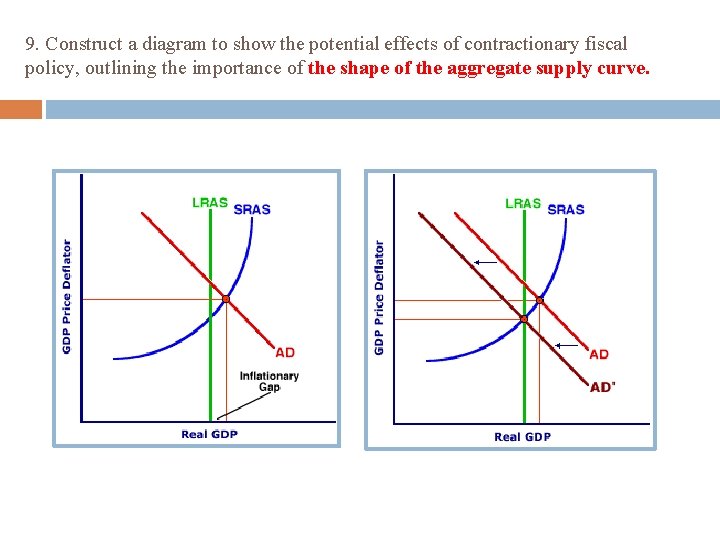
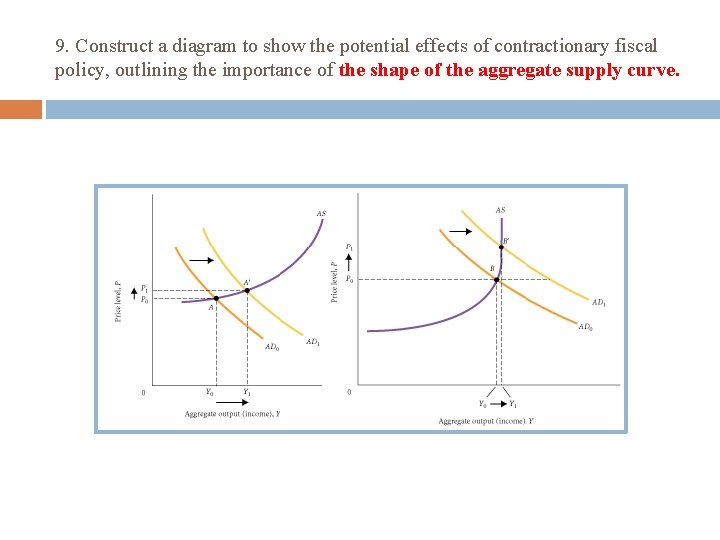
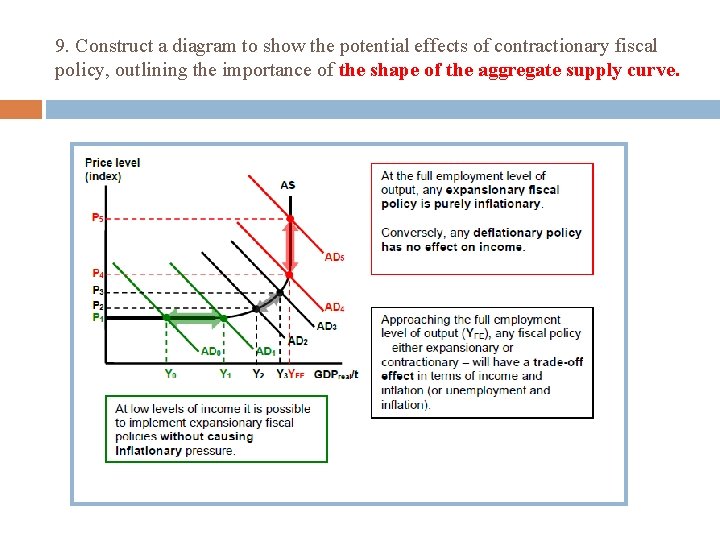
9. Construct a diagram to show the potential effects of contractionary fiscal policy, outlining the importance of the shape of the aggregate supply curve.
9. Construct a diagram to show the potential effects of contractionary fiscal policy, outlining the importance of the shape of the aggregate supply curve. The flatter the SRAS curve the less will be price pressure as AD decreases. (Real GDP will be effected more so) The `steeper the SRAS curve the more price pressure will decrease as AD decrease. (Less effect on Real GDP) The multiplier will have a larger effect on the economy in the flatter portion of the SRAS curve and the multiplier will have a small effect in the steeper portion of the SRAS curve due to higher price levels.
9. Construct a diagram to show the potential effects of contractionary fiscal policy, outlining the importance of the shape of the aggregate supply curve.
9. Construct a diagram to show the potential effects of contractionary fiscal policy, outlining the importance of the shape of the aggregate supply curve.
Fiscal Policy
9. Construct a diagram to show the potential effects of contractionary fiscal policy, outlining the importance of the shape of the aggregate supply curve.
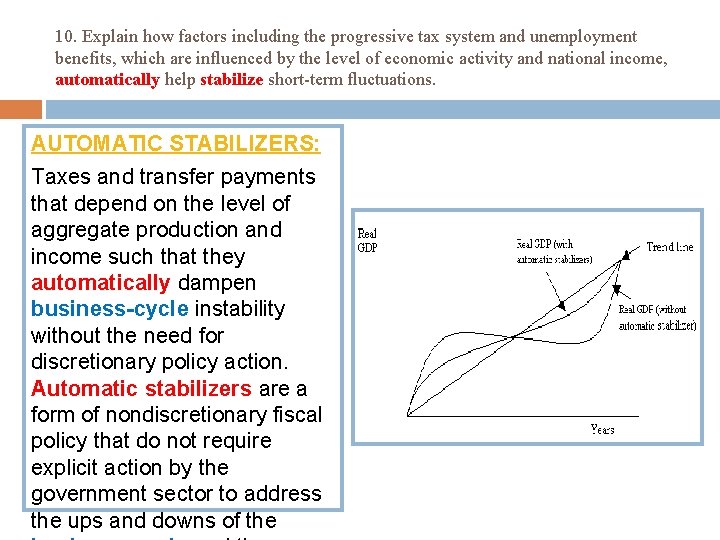
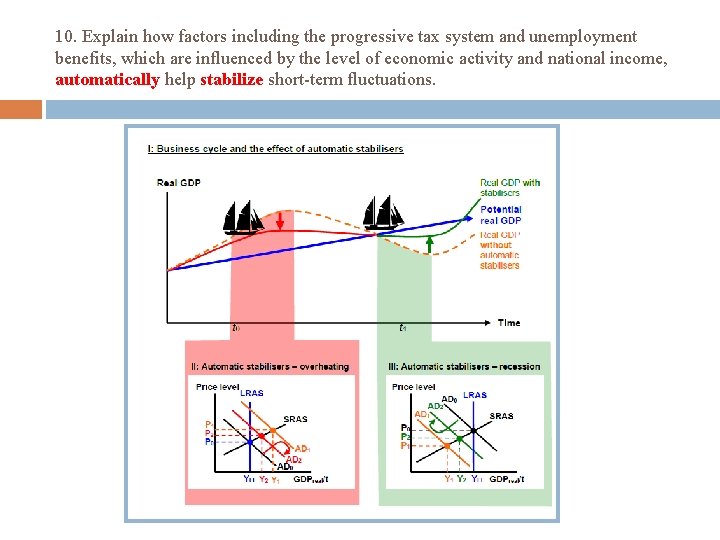
10. Explain how factors including the progressive tax system and unemployment benefits, which are influenced by the level of economic activity and national income, automatically help stabilize short-term fluctuations. AUTOMATIC STABILIZERS: Taxes and transfer payments that depend on the level of aggregate production and income such that they automatically dampen business-cycle instability without the need for discretionary policy action. Automatic stabilizers are a form of nondiscretionary fiscal policy that do not require explicit action by the government sector to address the ups and downs of the
10. Explain how factors including the progressive tax system and unemployment benefits, which are influenced by the level of economic activity and national income, automatically help stabilize short-term fluctuations. Automatic stabilizers are a part of the structure of the economy that work to limit the expansions and contractions of the business cycle over what they would be otherwise. Induced taxes and transfer payments, payments from and to the household sector to the government sector, that are based on the level of aggregate production and income are the source of automatic business-cycle stabilization.
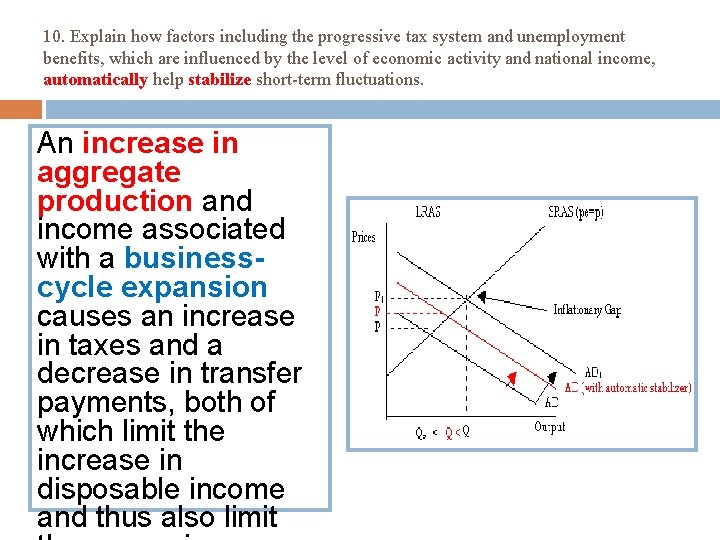
10. Explain how factors including the progressive tax system and unemployment benefits, which are influenced by the level of economic activity and national income, automatically help stabilize short-term fluctuations. An increase in aggregate production and income associated with a businesscycle expansion causes an increase in taxes and a decrease in transfer payments, both of which limit the increase in disposable income and thus also limit
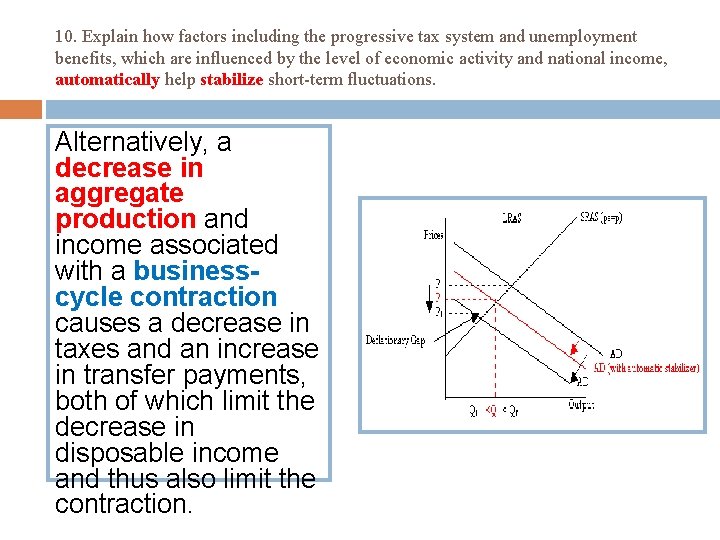
10. Explain how factors including the progressive tax system and unemployment benefits, which are influenced by the level of economic activity and national income, automatically help stabilize short-term fluctuations. Alternatively, a decrease in aggregate production and income associated with a businesscycle contraction causes a decrease in taxes and an increase in transfer payments, both of which limit the decrease in disposable income and thus also limit the contraction.
10. Explain how factors including the progressive tax system and unemployment benefits, which are influenced by the level of economic activity and national income, automatically help stabilize short-term fluctuations. Income taxes are generally at least somewhat progressive. This means that as household incomes fall during a recession, households pay lower rates on their incomes as income tax. Therefore, income tax revenue tends to fall faster than the fall in household income. Corporate tax is generally based on profits, rather than revenue. In a recession profits tend to fall much faster than revenue. Therefore, a company pays much less tax while having slightly less economic activity. Sales tax depends on the dollar volume of sales, which tends to fall during recessions. Most governments also pay unemployment and welfare benefits. Generally speaking, the number of unemployed people and those on low incomes who are entitled to other benefits increases in a recession and decreases in a boom.
10. Explain how factors including the progressive tax system and unemployment benefits, which are influenced by the level of economic activity and national income, automatically help stabilize short-term fluctuations.
11. Evaluate the view that fiscal policy can be used to promote long-term economic growth (increases in potential output) indirectly by creating an economic environment that is favorable to private investment, and directly through government spending on physical capital goods and human capital formation, as well as provision of incentives for firms to invest. Governments that have focus on getting the fundamentals of economic management right can promote long-term economic growth. They can worked to reduce their debt and control inflation and put in place sustainable fiscal policies. Indirectly governments can promote economic growth by demonstrating sound and stable fiscal policies that encourage private investment. Directly by spending on infrastructure that encourage factor mobility and promoting an education system that build a population of skill labor that encourages private investment.
11. Evaluate the view that fiscal policy can be used to promote long-term economic growth (increases in potential output) indirectly by creating an economic environment that is favorable to private investment, and directly through government spending on physical capital goods and human capital formation, as well as provision of incentives for firms to invest. Countries with higher levels of economic freedom substantially outperform others in economic growth, per capita incomes, health care, education, protection of the environment, and reduction of poverty, according to data collected for the 2015 Index of Economic Freedom. Countries that have shown long-term economic growth have scored well in the following categories: � Rule of Law (property rights, freedom from corruption); � Limited Government (fiscal freedom, government spending); � Regulatory Efficiency (business freedom, labor freedom, monetary freedom); and � Open Markets (trade freedom, investment freedom,
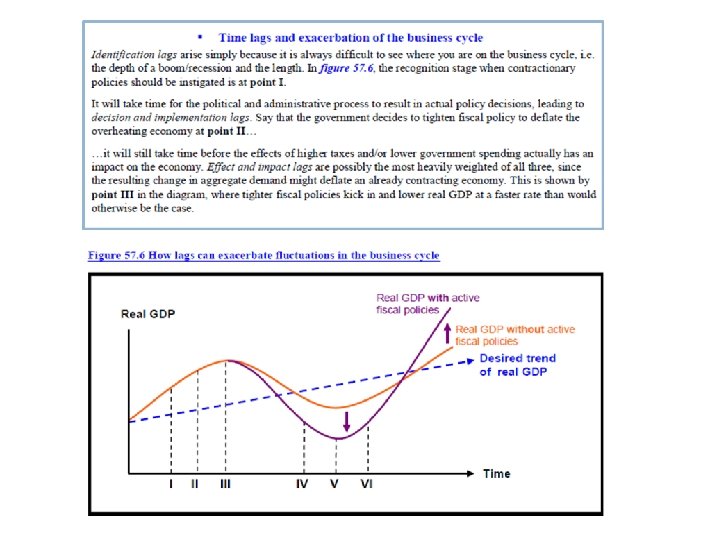
12. Evaluate the effectiveness of fiscal policy through consideration of factors including the ability to target sectors of the economy, the direct impact on aggregate demand, the effectiveness of promoting economic activity in a recession, time lags, political constraints, crowding out, and the inability to deal with supply-side causes of instability. Policy Lags: The use of fiscal policy encounters time lags, or policy lags, between the onset of an economic problem, such as a business-cycle contraction, and the full impact of the policy designed to correct the problem. A business-cycle contraction that hits the economy on January 1 st cannot be correct with fiscal policy by January 2 nd.
12. Evaluate the effectiveness of fiscal policy through consideration of factors including the ability to target sectors of the economy, the direct impact on aggregate demand, the effectiveness of promoting economic activity in a recession, time lags, political constraints, crowding out, and the inability to deal with supply-side causes of instability. The goal of fiscal policy is to stabilize the business cycle, to counter contractions and expansions. However, policy lags can cause fiscal policy to destabilize the economy. It can worsen the ups and downs of the business cycle. The impact of expansionary fiscal policy to correct a business-cycle contraction, for example, might occur during the ensuing expansion, which can then overstimulate the economy and cause inflation. Or the impact of contractionary fiscal policy designed to reduce inflation might not occur until the onset of a subsequent contraction. In both cases, the resulting policy is not counter-cyclical, but pro-cyclical.
12. Evaluate the effectiveness of fiscal policy through consideration of factors including the ability to target sectors of the economy, the direct impact on aggregate demand, the effectiveness of promoting economic activity in a recession, time lags, political constraints, crowding out, and the inability to deal with supply-side causes of instability. Four types of policy lags are common. • Recognition Lag: This is the time it takes to identify the existence of a problem. It takes time to obtain economic measurements. Once data are obtained, it takes time to analyze and evaluate the data to document the problem. • Decision Lag: This is the time it takes to decide on a suitable course of action, then pass whatever legislation, laws, or administrative rules are needed. For fiscal policy, this requires an act of Congress, signed into law by the President. These decisions could take days, weeks, or even months.
12. Evaluate the effectiveness of fiscal policy through consideration of factors including the ability to target sectors of the economy, the direct impact on aggregate demand, the effectiveness of promoting economic activity in a recession, time lags, political constraints, crowding out, and the inability to deal with supply-side causes of instability. • • Implementation Lag: This is the time it takes to implement the chosen policy. A spending change requires actions by dozens, hundreds, or even thousands of different government agencies, all of which need to decide on to change their budgets. A tax change requires the distribution of new tax rates and responses by those paying the taxes. The implementation of fiscal policy is also likely to take weeks if not months. Impact Lag: This lag is the time it takes any change initiated by a government policy to actually impact the producers and consumers in the economy. A key part of the impact lag is the multiplier. A change in government spending or taxes must work its way through the economy, triggering subsequent changes in production and income, which induces changes in consumption, which causes more changes in production and income, which induces further changes in consumption. An impact lag of one to two years is not uncommon.
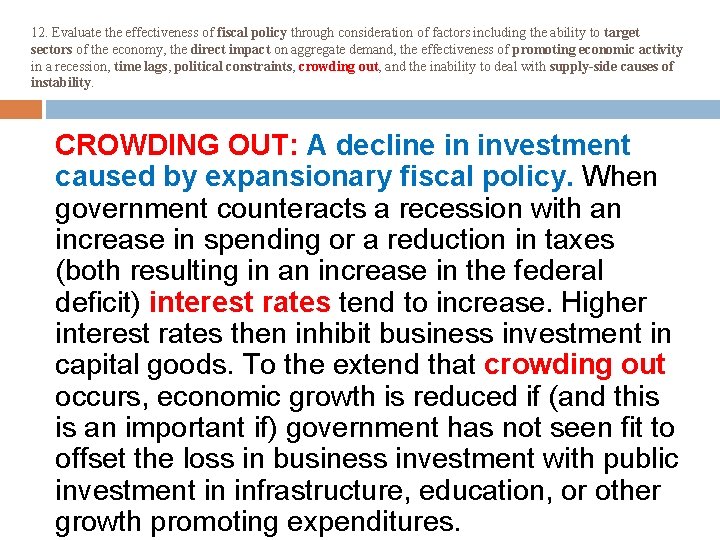
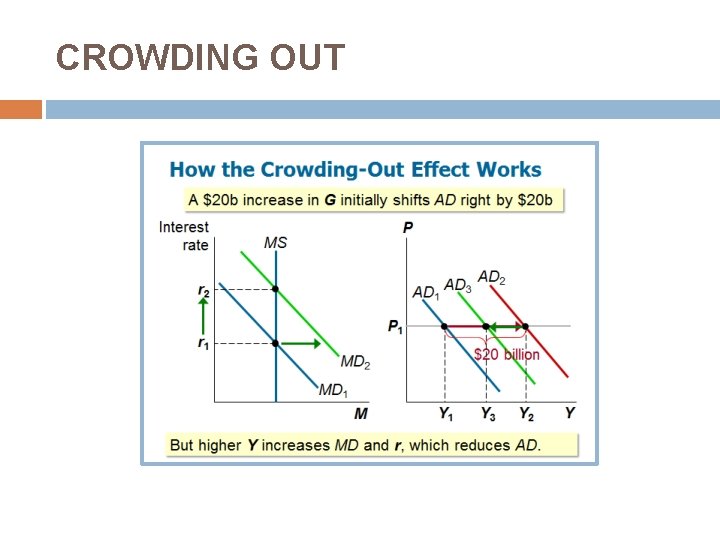
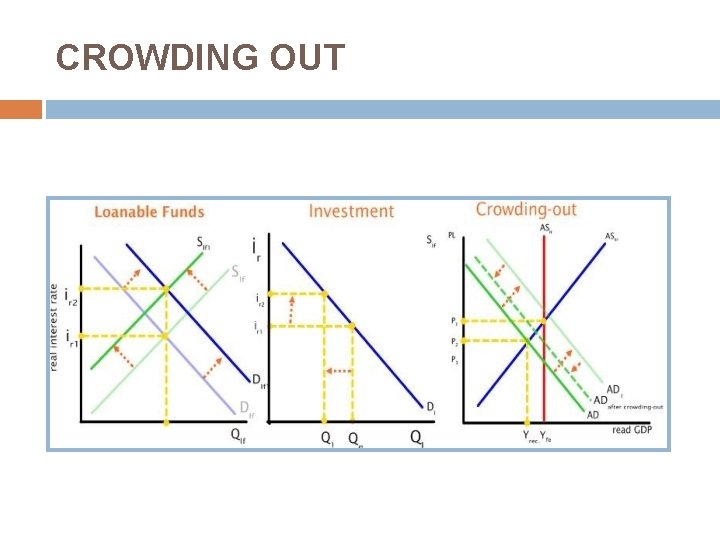
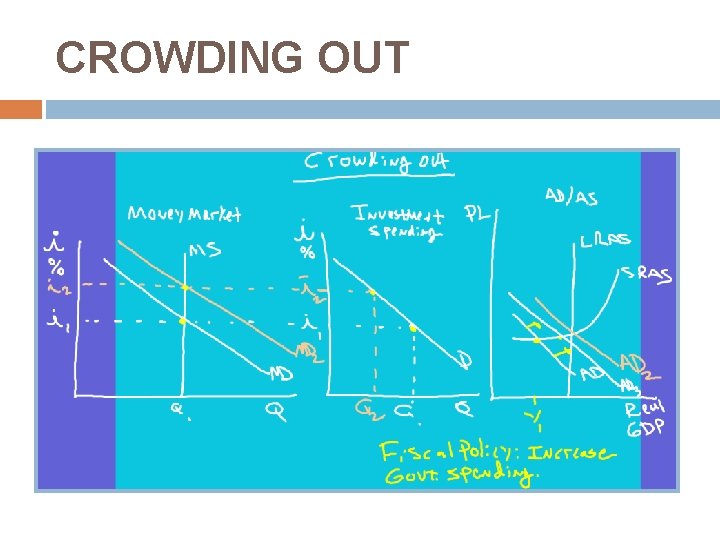
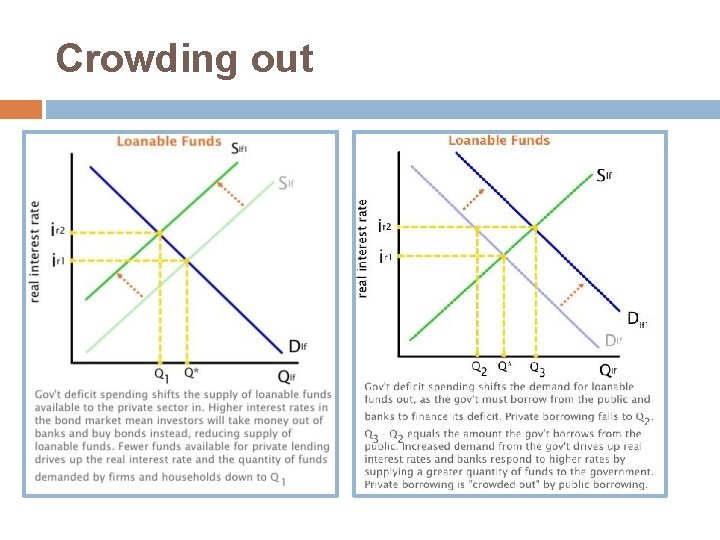
12. Evaluate the effectiveness of fiscal policy through consideration of factors including the ability to target sectors of the economy, the direct impact on aggregate demand, the effectiveness of promoting economic activity in a recession, time lags, political constraints, crowding out, and the inability to deal with supply-side causes of instability. CROWDING OUT: A decline in investment caused by expansionary fiscal policy. When government counteracts a recession with an increase in spending or a reduction in taxes (both resulting in an increase in the federal deficit) interest rates tend to increase. Higher interest rates then inhibit business investment in capital goods. To the extend that crowding out occurs, economic growth is reduced if (and this is an important if) government has not seen fit to offset the loss in business investment with public investment in infrastructure, education, or other growth promoting expenditures.
CROWDING OUT
CROWDING OUT
CROWDING OUT
Crowding out
12. Evaluate the effectiveness of fiscal policy through consideration of factors including the ability to target sectors of the economy, the direct impact on aggregate demand, the effectiveness of promoting economic activity in a recession, time lags, political constraints, crowding out, and the inability to deal with supply-side causes of instability. Political Problems: The government might have other priorities than economic stability like providing public goods and services and redistributing of income. State and local governments face constitutional requirements to balance their budgets so would not be able to deficit spend in a recession. There may be an expansionary bias among politicians who find it hard to cut popular government programs or raise taxes. Politicians goals might be to be reelected rather than national economic goals.
12. Evaluate the effectiveness of fiscal policy through consideration of factors including the ability to target sectors of the economy, the direct impact on aggregate demand, the effectiveness of promoting economic activity in a recession, time lags, political constraints, crowding out, and the inability to deal with supply-side causes of instability. Net Export Effect: In the classical view, the expansionary fiscal policy also decreases net exports, which has a mitigating effect on national output and income. When government borrowing increases interest rates it attracts foreign capital from foreign investors. Therefore, when foreign capital flows into the country undergoing fiscal expansion, demand for that country's currency increases. The increased demand causes that country's currency to appreciate. Once the currency appreciates, goods originating from that country now cost more to foreigners than they did before and foreign goods now cost less than they did before. Consequently, exports decrease and imports increase.
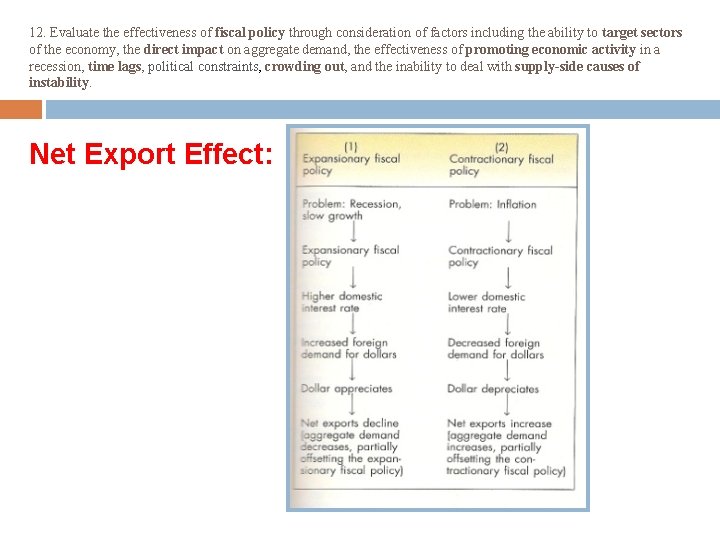
12. Evaluate the effectiveness of fiscal policy through consideration of factors including the ability to target sectors of the economy, the direct impact on aggregate demand, the effectiveness of promoting economic activity in a recession, time lags, political constraints, crowding out, and the inability to deal with supply-side causes of instability. Net Export Effect:
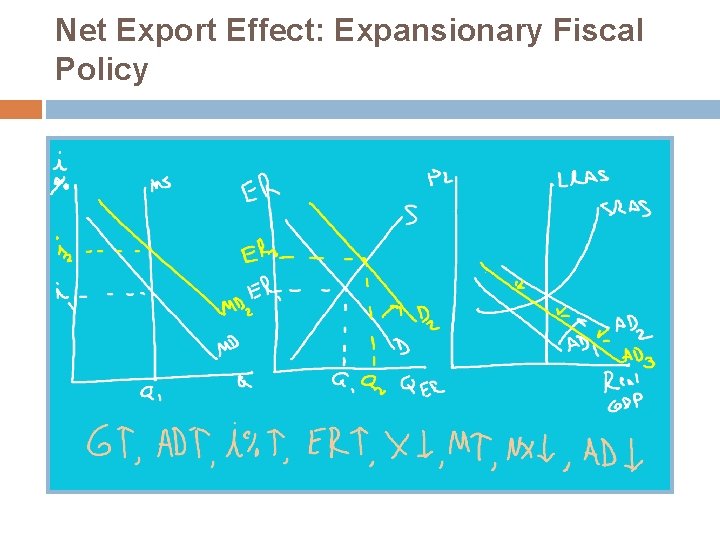
Net Export Effect: Expansionary Fiscal Policy
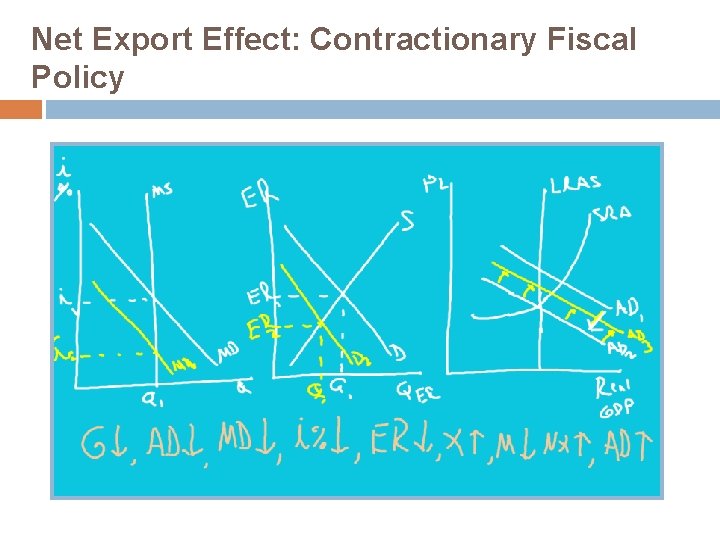
Net Export Effect: Contractionary Fiscal Policy
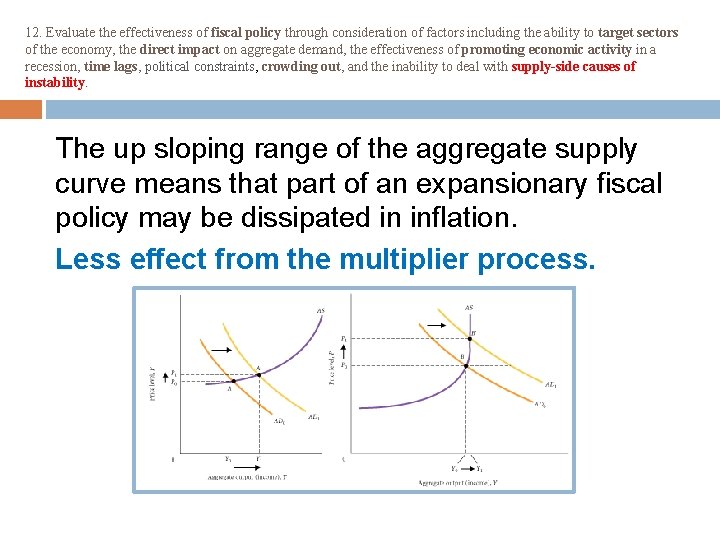
12. Evaluate the effectiveness of fiscal policy through consideration of factors including the ability to target sectors of the economy, the direct impact on aggregate demand, the effectiveness of promoting economic activity in a recession, time lags, political constraints, crowding out, and the inability to deal with supply-side causes of instability. The up sloping range of the aggregate supply curve means that part of an expansionary fiscal policy may be dissipated in inflation. Less effect from the multiplier process.
12. Evaluate the effectiveness of fiscal policy through consideration of factors including the ability to target sectors of the economy, the direct impact on aggregate demand, the effectiveness of promoting economic activity in a recession, time lags, political constraints, crowding out, and the inability to deal with supply-side causes of instability. Supply side and demand side shocks can lead to instability in the economy. Shocks are unexpected events that influence the demand / supply in an economy. Supply Side Shocks These affect the costs and prices of supply � These • • • can include: Technology Natural disasters which impact the supply of particular goods e. g. crops Political situations that influence the supply of particular products e. g. oil
Using information from the text/data and your knowledge of economics, evaluate the role of fiscal policy in stimulating the economy. Positive role that fiscal policy may have: the effect direct investment may have on business investment the possible effect on consumer spending and confidence lower production costs as a result of tax cuts in indirect taxes direct tax cuts increase disposable income supply side benefits of increased government spending on infrastructure possible increase in business confidence multiplier and accelerator effects impact on employment.
Using information from the text/data and your knowledge of economics, evaluate the role of fiscal policy in stimulating the economy. Negative role fiscal policy may have: inflationary pressures conflicting with growth and the desire to stimulate the economy is the package powerful enough to convince investors? inflexibility in that it cannot be changed easily and quickly time lags for policy measures to have an effect financing a budget deficit “crowding out” effect of increased borrowing could add to the trade deficit. (Net Export
Evaluation of public spending of Fiscal Policy The advantages: Public spending can have a considerable impact on the level of aggregate demand, and compensate for failings in other components of aggregate demand, such as a fall in household spending on consumer goods and firms spending on capital goods. If the spending is on capital items, then infrastructure can be improved, and this can help improve economic growth. Public spending can be targeted to achieve a wide range of economic objectives, such as reducing unemployment, achieving more equity, road building,
Evaluation of public spending of Fiscal Policy The disadvantages: There may be a considerable time-lag between spending and the benefits of spending. For example, a decision to increase spending on education will take months to implement, and years and decades to see the full benefits. In trying to promote growth or reduce unemployment government spending can be inflationary, especially if the government has to borrow from the financial markets or if the spending is too fast, such as with an increase in current spending on wages. There is a potential ‘trade off’ between unemployment and inflation. If the aim of an increase in public spending is to create jobs there is the strong possibility that inflation will be created, and growth in jobs may only be temporary as the economy readjusts to the previous
Evaluation of tax policy of Fiscal policy The advantages: Indirect taxes can be targeted very specifically at altering behavior, such as ‘polluter pays’ taxes, and taxes on demerit goods. Taxation can stabilize the macro-economy automatically, through fiscal drag and boost. Discretionary changes in direct taxes can help regulate aggregate demand. Taxes and welfare spending can also be used to help reduce the income gap between rich and poor, reduce poverty, and to help to promote equity
Evaluation of tax policy of Fiscal policy The disadvantages: Changing tax rates, allowances and bands, is a highly complex business, especially in comparison with changing interest rates. Because of this changes are relatively infrequent, with only small adjustments being made each year in the annual budget. Households may increase or reduce their savings following tax changes, so the effect on household spending of an increase or decrease in taxes may be weak. There may be considerable time-lags between changing taxes and changes in house -hold spending. Higher taxes may have a disincentive effect on work and enterprise, as some individuals alter their perception of the relative costs and benefits of work, in comparison with leisure.
- Slides: 51