
IB DP Biology Unit 1 6 Cell division
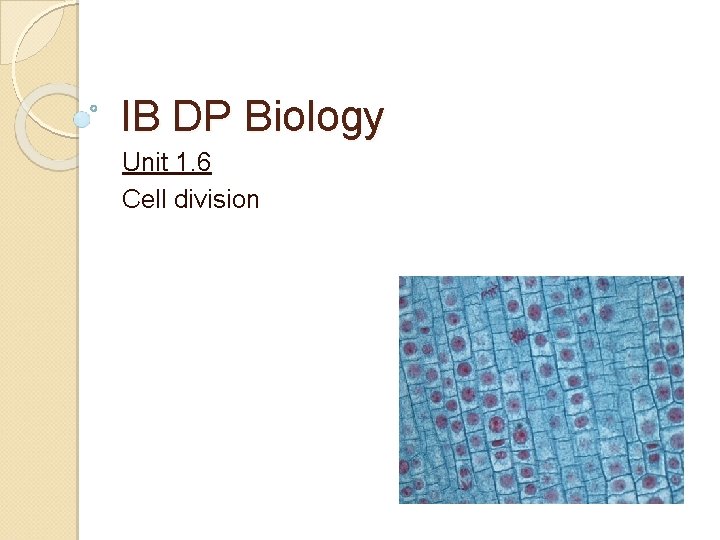
IB DP Biology Unit 1. 6 Cell division
1. 6. U 4 Interphase is a very active phase of the cell cycle with many processes occurring in the nucleus and cytoplasm.
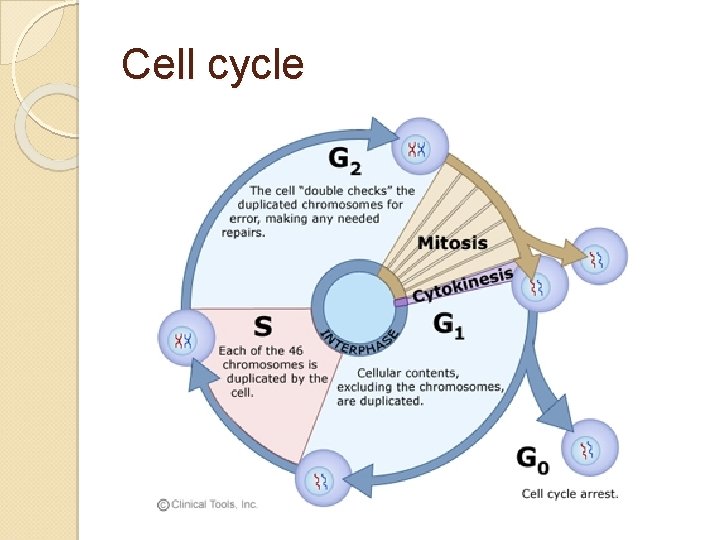
Cell cycle
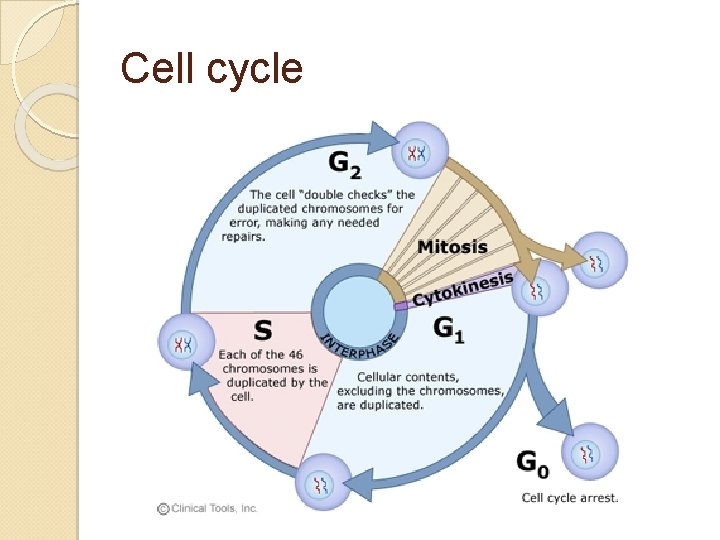
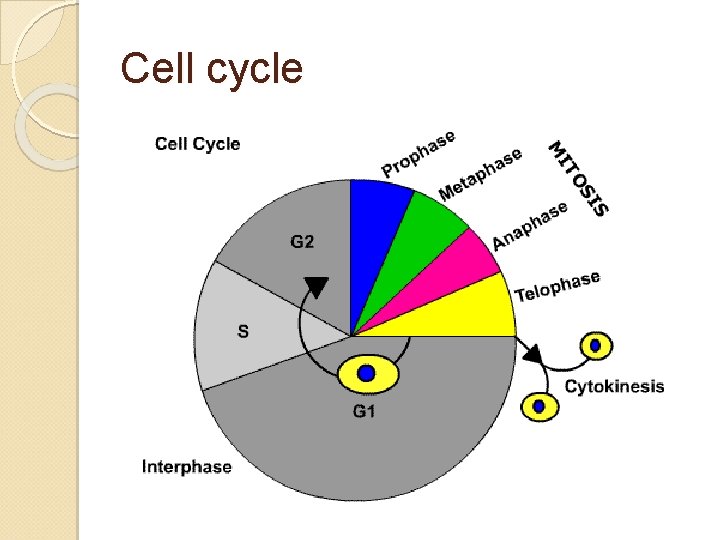
Cell cycle Interphase Cell spends most of its life in interphase Has three stages ◦ G 1 (Gap 1) ◦ S (Synthesis) ◦ G 2 (Gap 2)
Cell cycle Interphase Gap 1: ◦ Cell growth ◦ Protein synthesis ◦ Cellular contents are duplicated But not DNA!
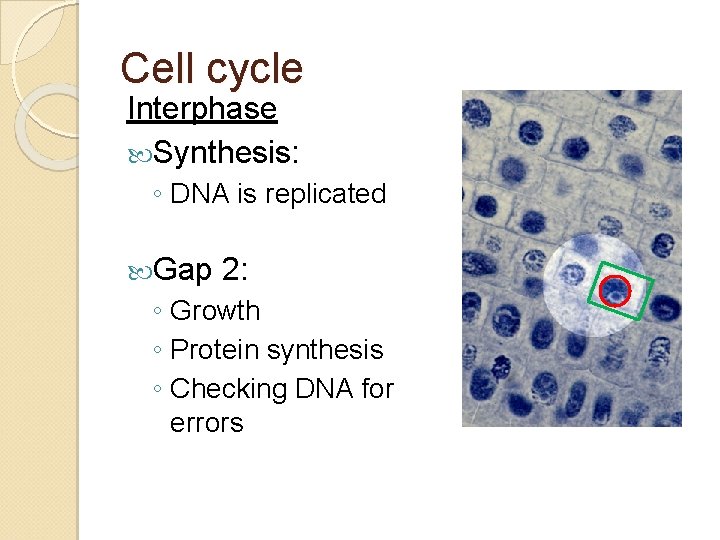
Cell cycle Interphase Synthesis: ◦ DNA is replicated Gap 2: ◦ Growth ◦ Protein synthesis ◦ Checking DNA for errors
Cell cycle
1. 6. U 1 Mitosis is division of the nucleus into two genetically identical daughter nuclei.
Cell cycle Mitosis = nuclear division Main function of mitosis is to create two genetically identical daughter nucleii
Cell cycle Mitosis = nuclear division Mitosis is used in: ◦ Growth ◦ Replacement of dead cells ◦ Asexual reproduction Binary fission ◦ Embryonic development ◦ Tissue repair It’s GREAT!
1. 6. U 2 Chromosomes condense by supercoiling during mitosis.
Cell cycle Mitosis = nuclear division Chromosomes are supercoiled DNA ◦ Makes them easier to move during mitosis Before mitosis, chromosomes are replicated ◦ Makes two identical copies, which remain attached to each other
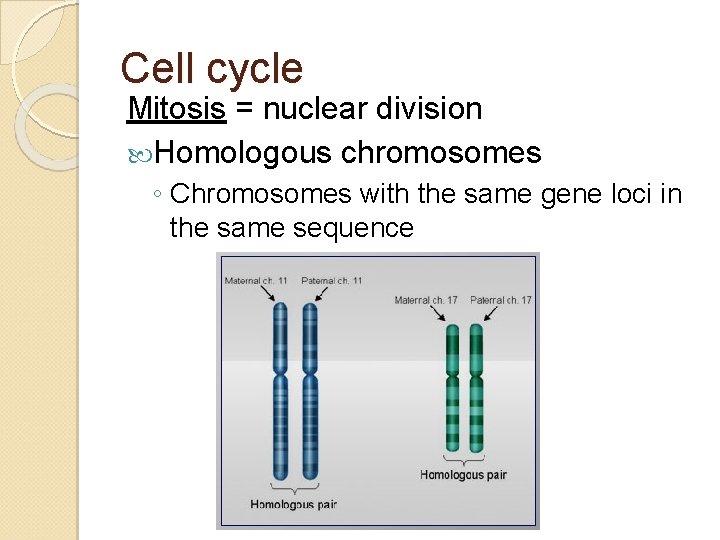
Cell cycle Mitosis = nuclear division Homologous chromosomes ◦ Chromosomes with the same gene loci in the same sequence
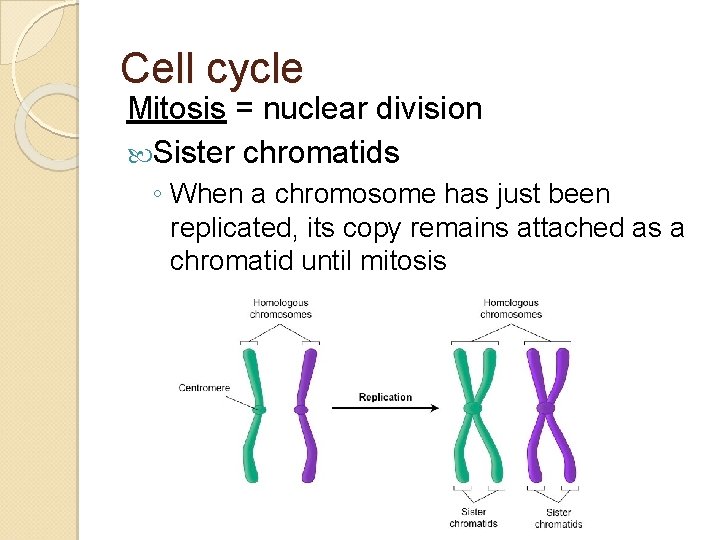
Cell cycle Mitosis = nuclear division Sister chromatids ◦ When a chromosome has just been replicated, its copy remains attached as a chromatid until mitosis
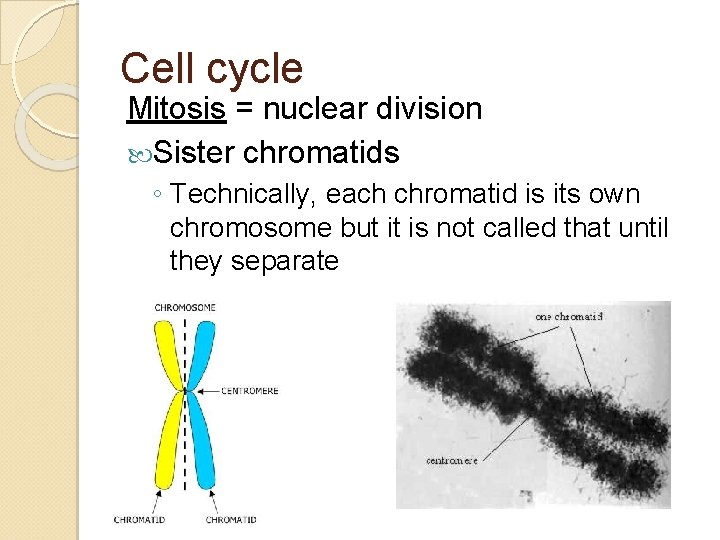
Cell cycle Mitosis = nuclear division Sister chromatids ◦ Technically, each chromatid is its own chromosome but it is not called that until they separate
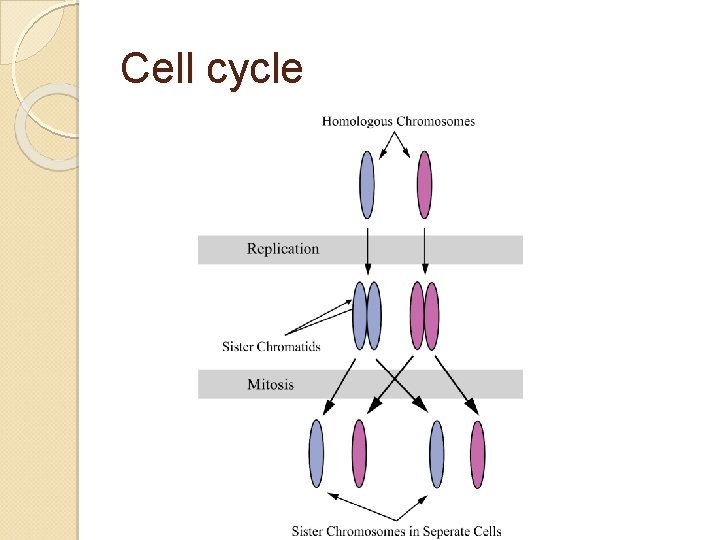
Cell cycle
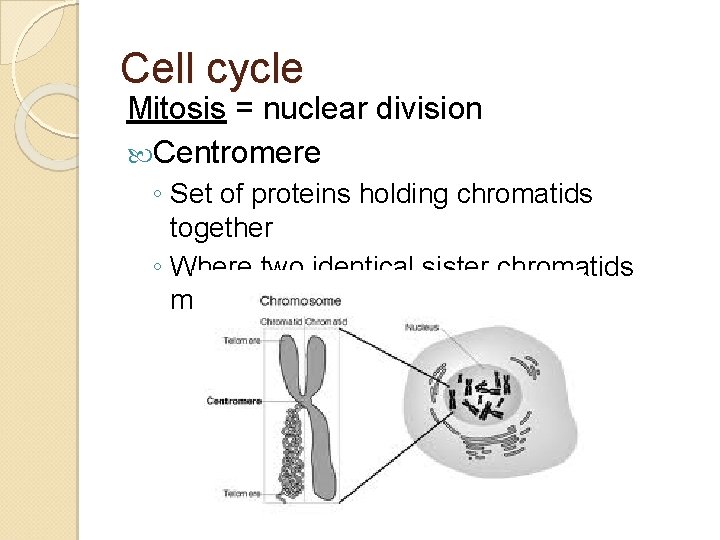
Cell cycle Mitosis = nuclear division Centromere ◦ Set of proteins holding chromatids together ◦ Where two identical sister chromatids meet
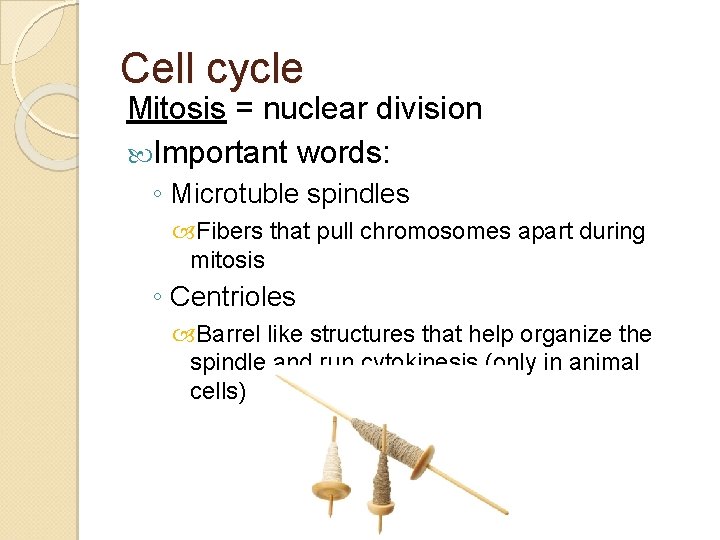
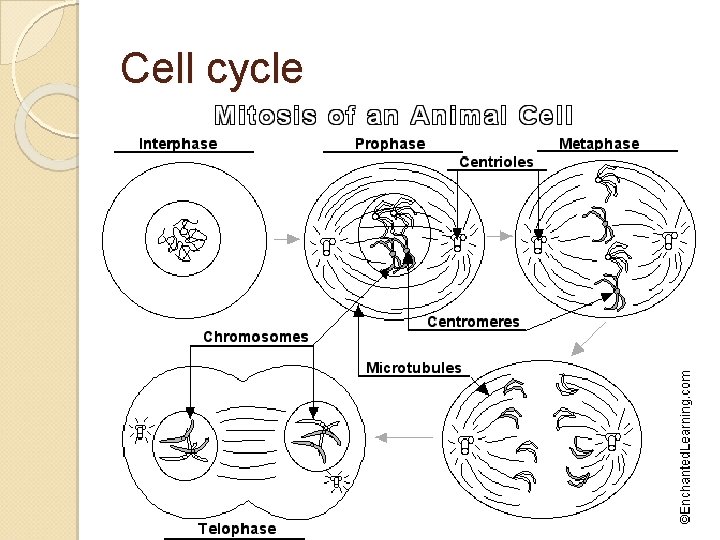
Cell cycle Mitosis = nuclear division Important words: ◦ Microtuble spindles Fibers that pull chromosomes apart during mitosis ◦ Centrioles Barrel like structures that help organize the spindle and run cytokinesis (only in animal cells)
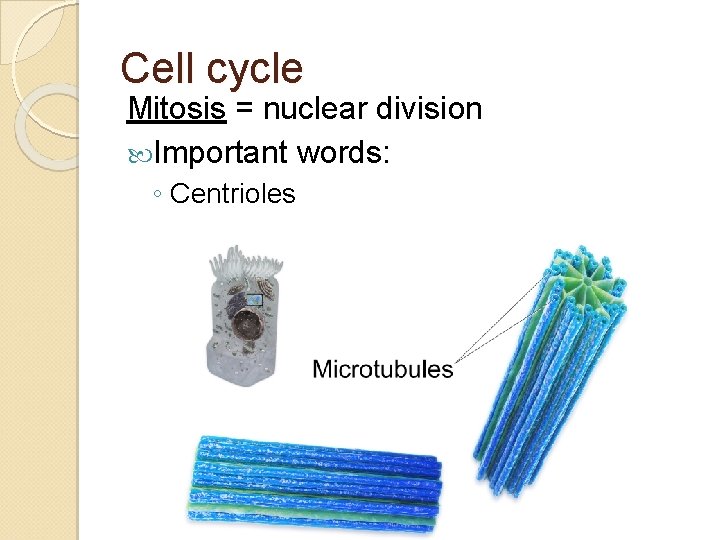
Cell cycle Mitosis = nuclear division Important words: ◦ Centrioles
1. 6. S 1 Identification of phases of mitosis in cells viewed with a microscope or in a micrograph.
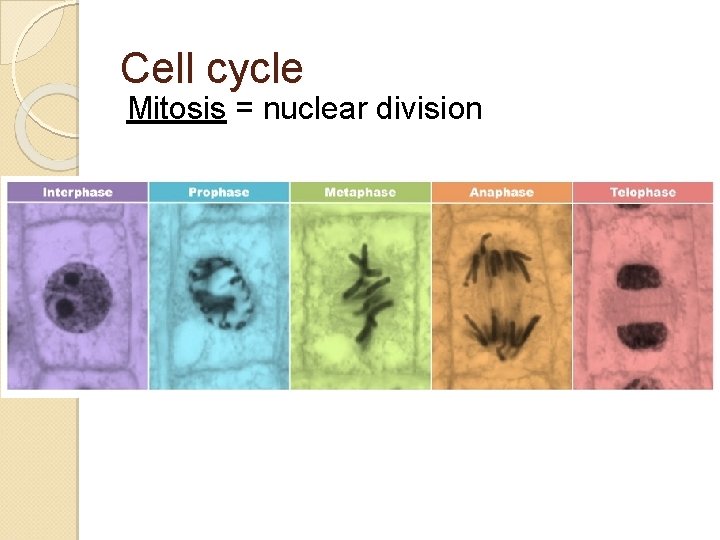
Cell cycle Mitosis = nuclear division ◦ Prophase = P for preparation ◦ Metaphase = M is middle ◦ Anaphase ◦ Telophase. ◦ Cytokinesis Not part of mitosis!!! ◦ Professors Meet At The Cafeteria
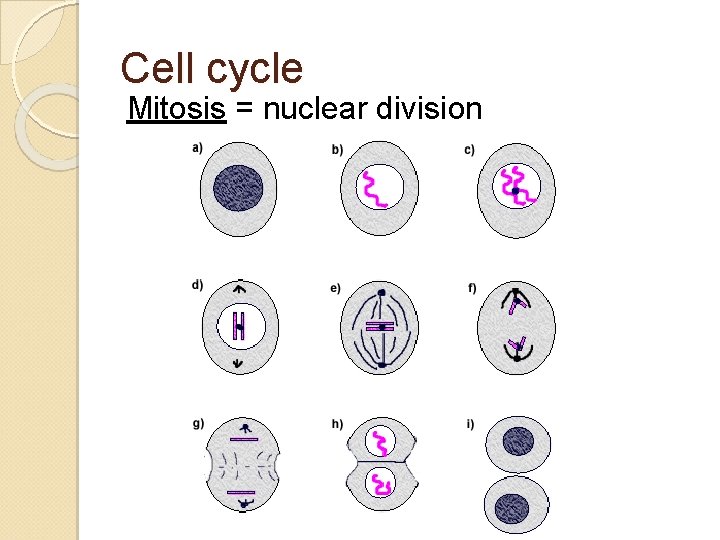
Cell cycle Mitosis = nuclear division
Cell cycle Mitosis = nuclear division Prophase ◦ Chromosomes condense and become visible By supercoiling ◦ Centrioles move to opposite poles ◦ Nuclear membrane disappears
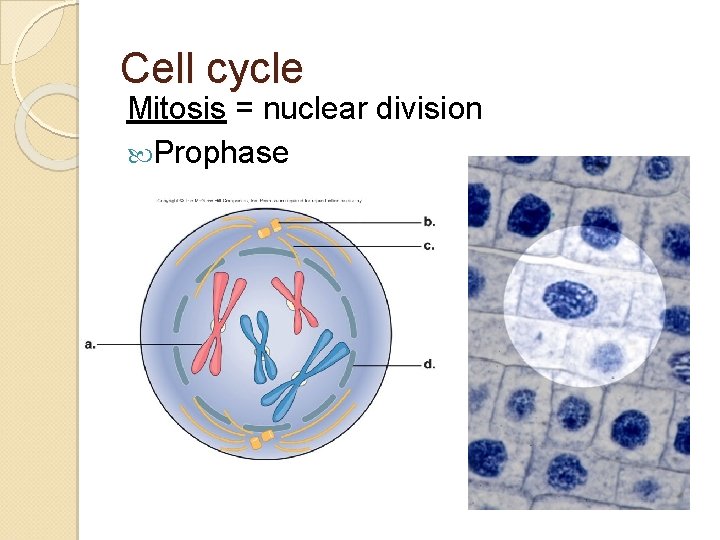
Cell cycle Mitosis = nuclear division Prophase
Cell cycle Mitosis = nuclear division Metaphase ◦ Spindle microtubules attach to chromosome centromeres ◦ Chromosomes move to the equator ◦ M = middle
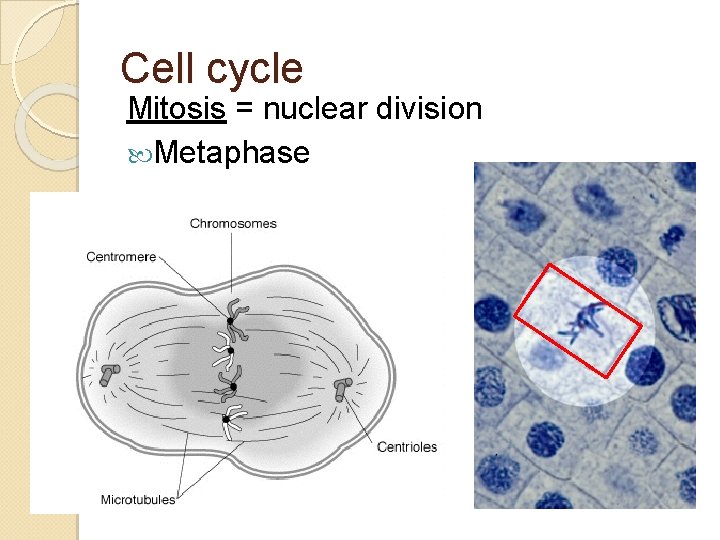
Cell cycle Mitosis = nuclear division Metaphase
Cell cycle Mitosis = nuclear division Anaphase ◦ Centromeres split as spindle microtubules pull chromatids to opposite poles After centromeres split, sister chromatids are known as sister chromosomes ◦ Sister chromosomes move to opposite poles as microtubules shorten
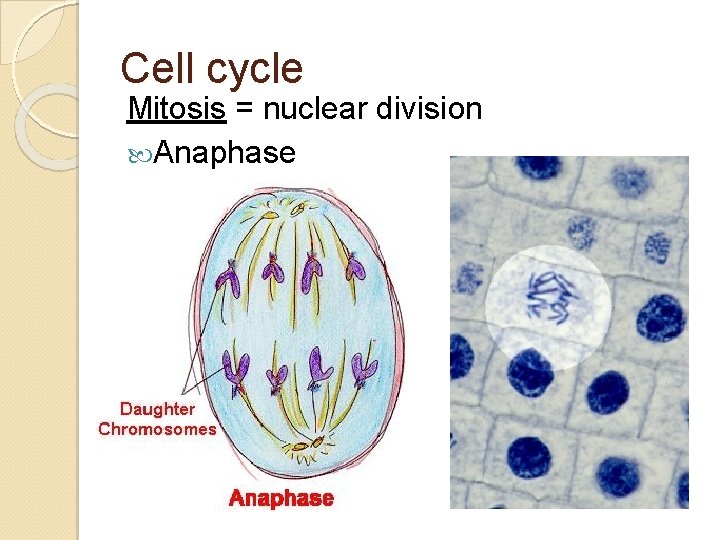
Cell cycle Mitosis = nuclear division Anaphase
Cell cycle Mitosis = nuclear division Telophase ◦ Sister chromosomes have arrived at poles ◦ Centrioles replicate ◦ Nuclear membrane becomes visible ◦ Chromosomes decondense Becoming chromatin
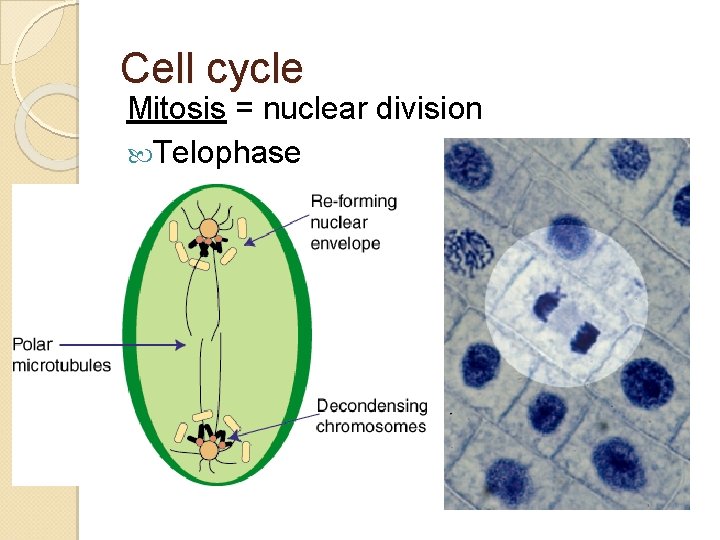
Cell cycle Mitosis = nuclear division Telophase
Cell cycle Mitosis = nuclear division
Cell cycle Mitosis = nuclear division Prophase – Chromosomes condensed but still confined to a nuclear region Metaphase – Chromosomes aligned along the equator of the cell Anaphase – Two distinct clusters of chromosomes at poles of the cell Telophase – Two nuclear regions present within a single cell (difficult to see as cytokinesis occurs
1. 6. S 2 Determination of a mitotic index from a micrograph.
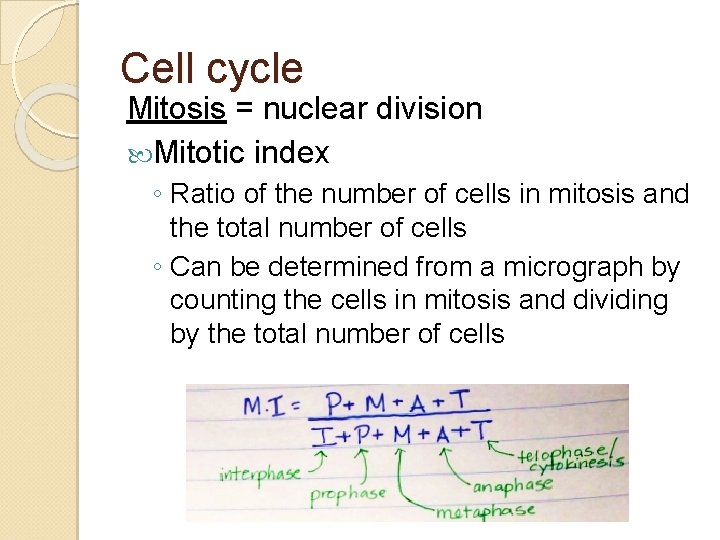
Cell cycle Mitosis = nuclear division Mitotic index ◦ Ratio of the number of cells in mitosis and the total number of cells ◦ Can be determined from a micrograph by counting the cells in mitosis and dividing by the total number of cells
Cell cycle Mitosis = nuclear division Mitotic index ◦ Ranges from 0 to 1 ◦ 0 means no cells are in mitosis ◦ 1 means every cell is in mitosis
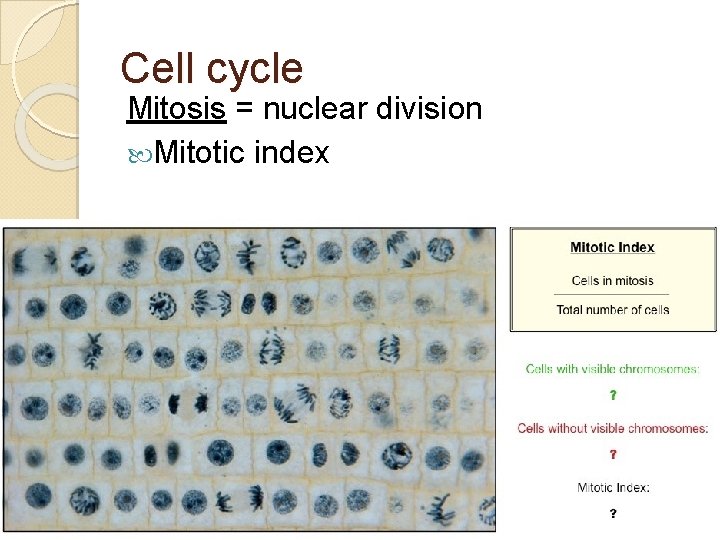
Cell cycle Mitosis = nuclear division Mitotic index
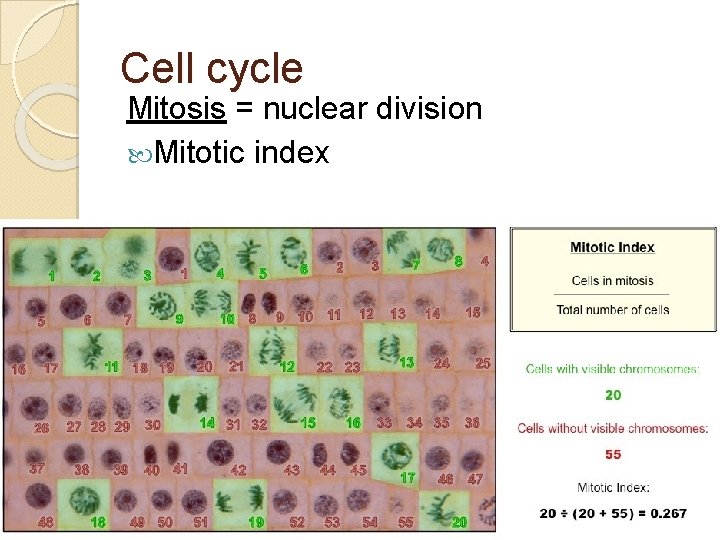
Cell cycle Mitosis = nuclear division Mitotic index
Cell cycle Mitosis = nuclear division Mitotic index ◦ The higher the MI, the more likely the tissue is cancerous ◦ If a cancer treatment is working, the tissue’s MI should be decreasing
1. 6. U 3 Cytokinesis occurs after mitosis and is different in plant and animal cells.
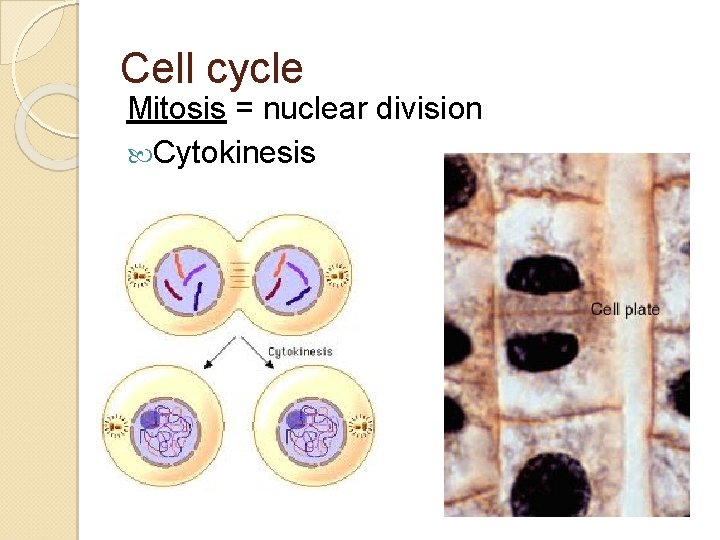
Cell cycle Mitosis = nuclear division Cytokinesis ◦ Division of the cytoplasm of a parent cell into two daughter cells ◦ Mitosis refers to the division of the nucleus (and the DNA in it) ◦ Cytokinesis refers to the division of the cytoplasm (and the organelles in it)
Cell cycle Mitosis = nuclear division Cytokinesis ◦ Plant cells need to form a new cell wall during cytokinesis while animal cells do not The growing cell wall is called a cell plate
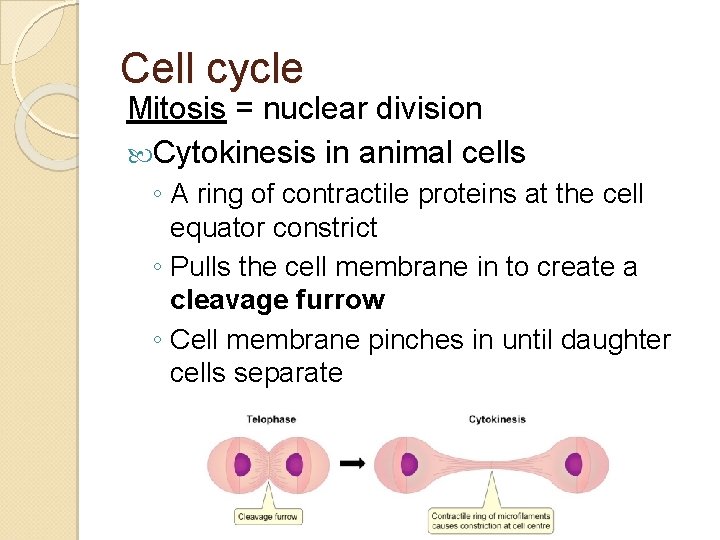
Cell cycle Mitosis = nuclear division Cytokinesis in animal cells ◦ A ring of contractile proteins at the cell equator constrict ◦ Pulls the cell membrane in to create a cleavage furrow ◦ Cell membrane pinches in until daughter cells separate
Cell cycle Mitosis = nuclear division Cytokinesis in plant cells ◦ Golgi sends vesicles full of pectin, which align at the cell equator Cell plate begins growing from the middle as cellulose is added ◦ Vesicles all fuse together in a long line until they form two full membranes
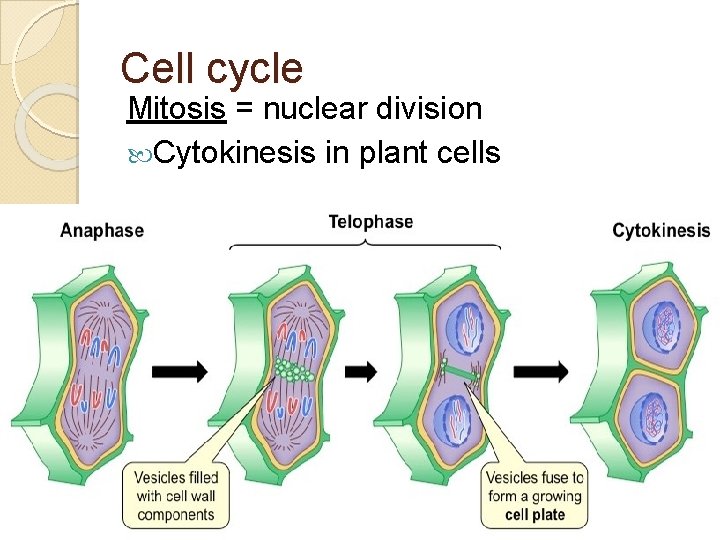
Cell cycle Mitosis = nuclear division Cytokinesis in plant cells
Cell cycle Mitosis = nuclear division Cytokinesis
Cell cycle
Cell cycle
Cell cycle Mitosis
Cell cycle Mitosis produces genetically identical nuclei ◦ DNA replication during S phase of interphase produces two identical copies of DNA ◦ Identical sets of DNA are attached to each other as sister chromatids Two chromatids for each of the chromosomes
Cell cycle Mitosis produces genetically identical nuclei ◦ Mitosis segregates the two chromatids of each chromosome to opposite poles Forms two identical nuclei Each with one complete copy of the original DNA ◦ Cytokinesis separates the two daughter nuclei into two identical daughter cells
Cell cycle Mitosis
MAJOR SOURCES Thank you to my favorite sources of information when making these lectures! Chris Paine (Shanghai, CH) www. bioknowledgy. weebly. com John Burrell (Bangkok, TH) www. click 4 biology. info Dave Ferguson (Kobe, JA) http: //canada. canacad. ac. jp/High/49 Brent Cornell (Melbourne, AU) http: //ib. bioninja. com. au/ Gretel von Bargen (WA, USA) http: //www. biologyforlife. com/ Andrew Allott – Biology for the IB Diploma C. J. Clegg – Biology for the IB Diploma Weem, Talbot, Mayrhofer – Biology for the International Baccalaureate Howard Hugh’s Medical Institute – www. hhmi. org/biointeractive Mr. Hoye’s TOK Website – http: //mrhoyestokwebsite. com And all the contributors at www. You. Tube. com
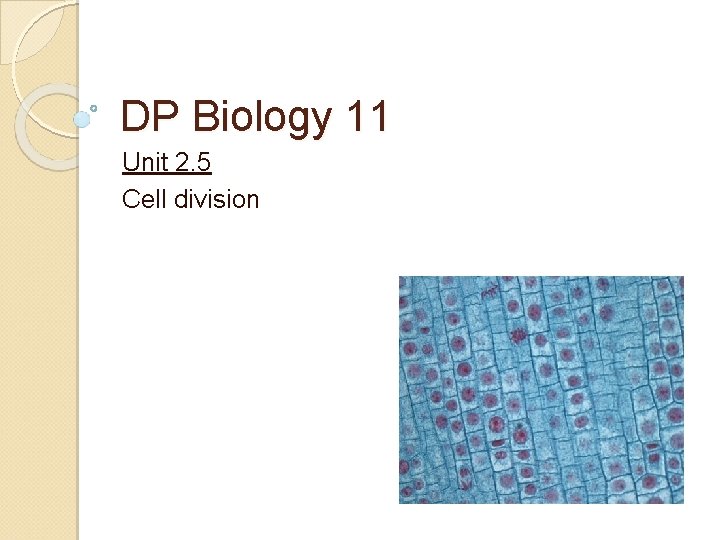
DP Biology 11 Unit 2. 5 Cell division
1. 6. U 5 Cyclins are involved in the control of the cell cycle.
Cell cycle Mitosis Cell cycle needs to be controlled ◦ Should only make new cells when they are needed ◦ Should only move on to the next phase of the cell cycle when the current one is complete Cyclins are proteins that control the progression of the cell cycle
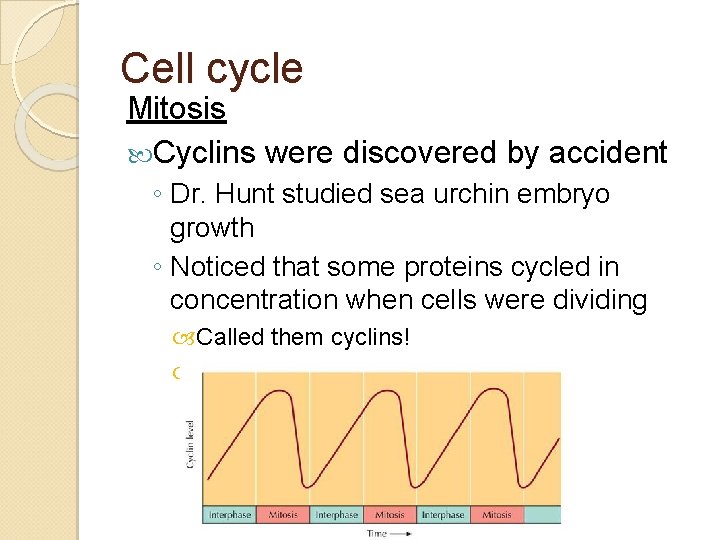
Cell cycle Mitosis Cyclins were discovered by accident ◦ Dr. Hunt studied sea urchin embryo growth ◦ Noticed that some proteins cycled in concentration when cells were dividing Called them cyclins! Won Nobel prize in 2001!
Cell cycle Mitosis Cyclins activate cyclin dependent kinases (CDKs) ◦ Control cell cycle processes through phosphorylation Adding energy using a phosphate group Not ATP, but like ATP!
Cell cycle Mitosis Cyclins activate cyclin dependent kinases (CDKs) ◦ When a cyclin and CDK form a complex: Complex will bind to a target protein and modify it via phosphorylation ◦ Phosphorylated target protein will trigger some specific event within the cell cycle Ex. centrosome duplication, etc. ◦ After the event has happened, cyclin runs out of energy and CDK is inactive again
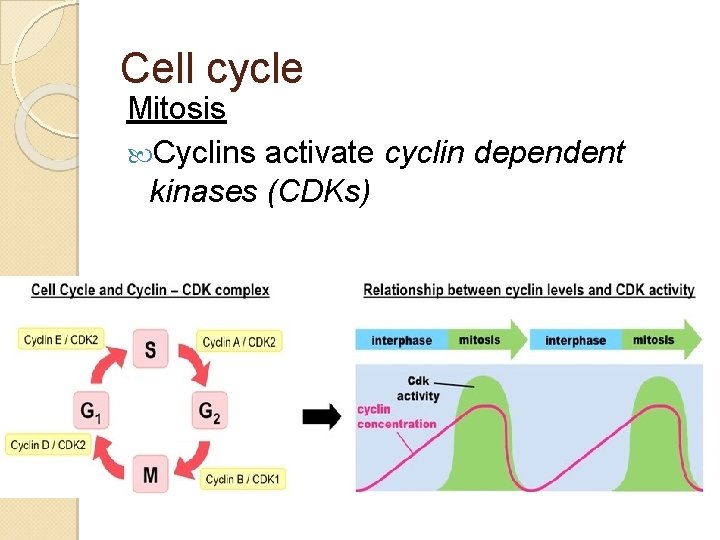
Cell cycle Mitosis Cyclins activate cyclin dependent kinases (CDKs)
1. 6. U 6 Mutagens, oncogenes and metastasis are involved in the development of primary and secondary tumours.
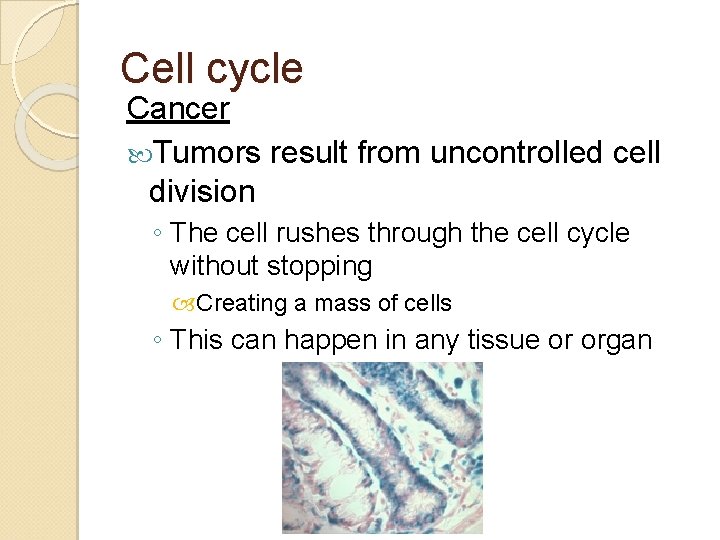
Cell cycle Cancer Tumors result from uncontrolled cell division ◦ The cell rushes through the cell cycle without stopping Creating a mass of cells ◦ This can happen in any tissue or organ
Cell cycle Cancer Tumor ◦ A mass of tissue caused by abnormal growth Metastasis ◦ When cells from a tumor spread to other parts of the body Via blood or lymph vessels
Cell cycle Cancer Primary Tumor ◦ Tumor caused by mutations Secondary Tumor ◦ Tumor caused by cancer that has metastasized from somewhere else
Cell cycle Cancer Benign ◦ A tumor that lacks the ability to invade other tissues or metastasize Malignant ◦ A tumor made of cells that can invade other tissues and metastasize
Cell cycle Cancer ◦ A disease causes by malignant tumors Mutagen ◦ A substance that causes genetic mutation UV radiation, chemicals, etc. Carcinogen ◦ A substance capable of causing cancer Only mutagens that result in uncontrolled cell division are carcinogens
Cell cycle Cancer
Cell cycle Cancer happens when cells accumulate mutations in the genes that control the cell cycle ◦ The cycle goes out of control ◦ Cancer Genome Project found most cancers have 60+ mutations
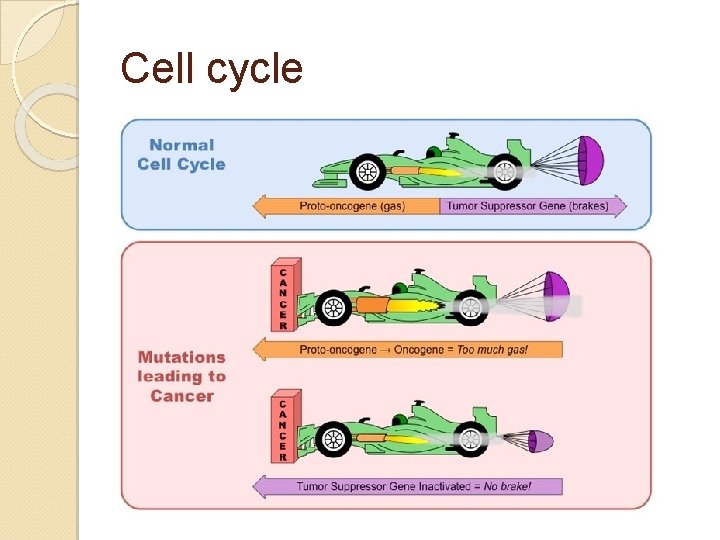
Cell cycle Cancer Some genes code for proteins that help the cell move through the cell cycle ◦ Ex. Genes for cyclins! If these genes are mutated, they become oncogenes: ◦ Genes that move the cell through the cell cycle even when a cell should not divide
Cell cycle Cancer Tumor suppressor genes stop a cell from dividing when it shouldn’t ◦ These can mutate and allow cells to divide Cancer happens when BOTH types of genes are mutated ◦ Oncogenes and tumor suppressor genes
Cell cycle
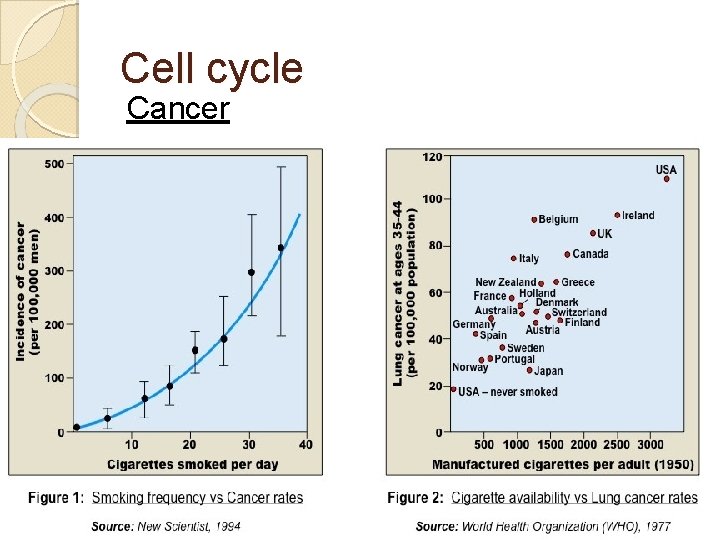
1. 6. A 1 The correlation between smoking and incidence of cancers.
Statistics Correlation and Causation When examining the effect of one variable on another, they could be: ◦ Positively correlated Increasing one, increases the other ◦ Negatively correlated Increasing one, decreases the other ◦ Not correlated There is no relationship between the variables
Statistics Correlation and Causation Correlations show related two variables are to each other ◦ 1 = strong positive correlation ◦ 0 = no correlation ◦ -1 = strong negative correlation
Statistics Correlation and Causation Correlation does not imply causation! ◦ Ice cream sales and the number of shark attacks on swimmers are correlated. ◦ Skirt lengths and stock prices are highly correlated (as stock prices go up, skirt lengths get shorter). ◦ The number of cavities in elementary school children and vocabulary size have a strong positive correlation.
Statistics Correlation and Causation Correlation does not imply causation! ◦ Once a correlation has been established from the data, you still need to determine what the cause of the relationship might be
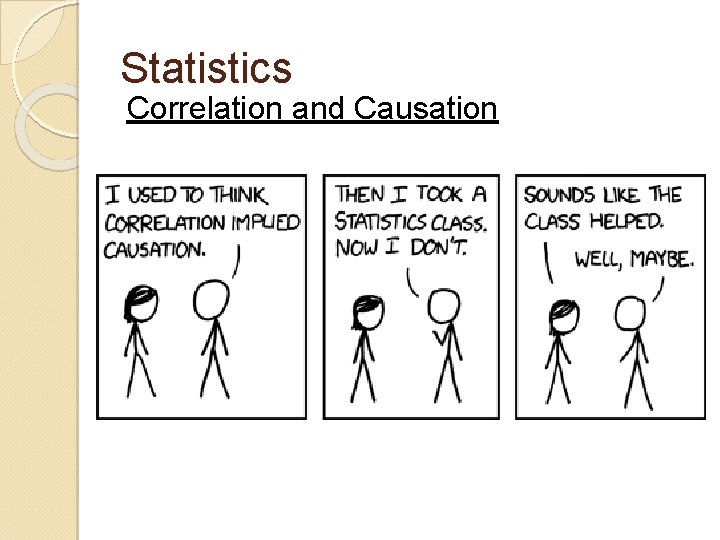
Statistics Correlation and Causation
Statistics Correlation and Causation Correlation does not imply causation! For X and Y ◦ X could cause Y, or Y could cause X ◦ Both X and Y might be caused by Z ◦ X causes Z, which causes Y ◦ Your data is a coincidence! http: //tylervigen. com/spurious-correlations
Cell cycle Cancer There is a strong link between smoking and the incidence of cancers ◦ Cigarette smoke contains over 4, 000 chemical compounds Over 60 of which are known to be carcinogenic
Cell cycle Cancer There is a strong positive correlation between the frequency of smoking and the development of cancer ◦ Lung cancer is strongly correlated with smoking, with ~90% of lung cancers attributable to tobacco use ◦ Smoking also increases the risk of over a dozen other cancers, including mouth, stomach, liver, panceas and bowel
Cell cycle Cancer
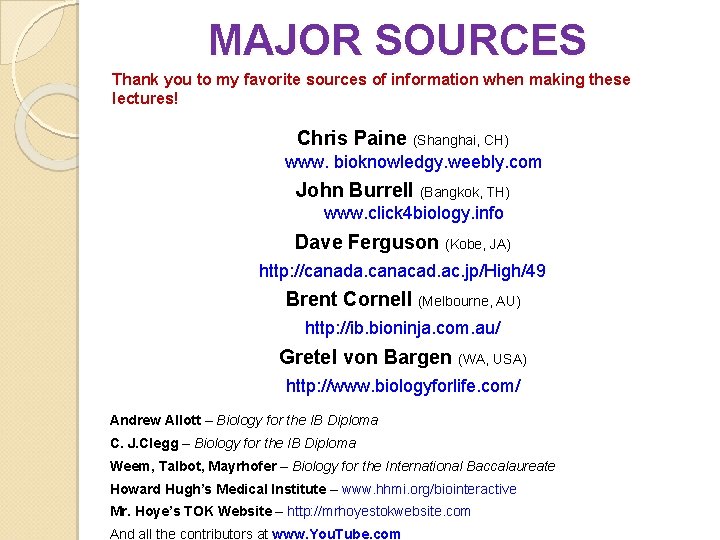
MAJOR SOURCES Thank you to my favorite sources of information when making these lectures! Chris Paine (Shanghai, CH) www. bioknowledgy. weebly. com John Burrell (Bangkok, TH) www. click 4 biology. info Dave Ferguson (Kobe, JA) http: //canada. canacad. ac. jp/High/49 Brent Cornell (Melbourne, AU) http: //ib. bioninja. com. au/ Gretel von Bargen (WA, USA) http: //www. biologyforlife. com/ Andrew Allott – Biology for the IB Diploma C. J. Clegg – Biology for the IB Diploma Weem, Talbot, Mayrhofer – Biology for the International Baccalaureate Howard Hugh’s Medical Institute – www. hhmi. org/biointeractive Mr. Hoye’s TOK Website – http: //mrhoyestokwebsite. com And all the contributors at www. You. Tube. com
- Slides: 81