
IB BIOLOGY INTERNAL ASSESSMENT PART 1 PERSONAL ENGAGEMENT

IB BIOLOGY INTERNAL ASSESSMENT PART 1 PERSONAL ENGAGEMENT and EXPLORATION
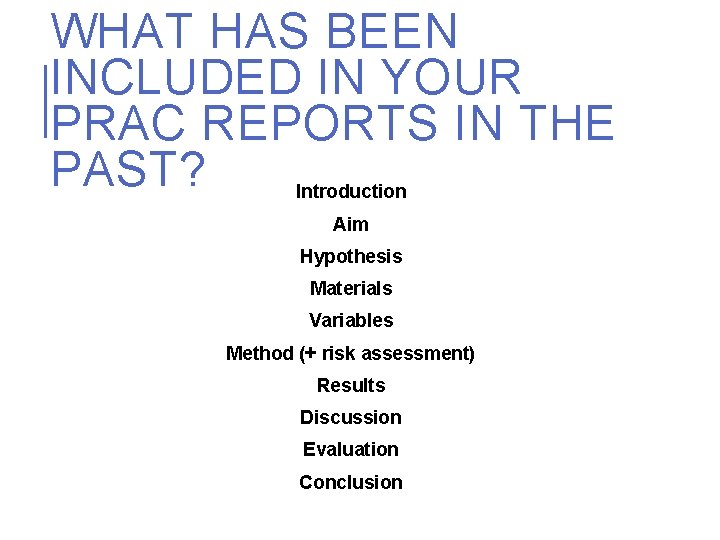
WHAT HAS BEEN INCLUDED IN YOUR PRAC REPORTS IN THE PAST? Introduction Aim Hypothesis Materials Variables Method (+ risk assessment) Results Discussion Evaluation Conclusion
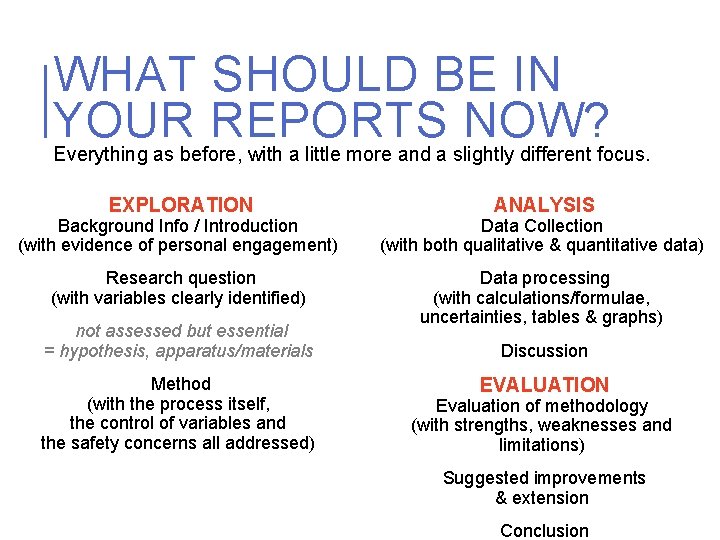
WHAT SHOULD BE IN YOUR REPORTS NOW? Everything as before, with a little more and a slightly different focus. EXPLORATION ANALYSIS Background Info / Introduction (with evidence of personal engagement) Data Collection (with both qualitative & quantitative data) Research question (with variables clearly identified) Data processing (with calculations/formulae, uncertainties, tables & graphs) not assessed but essential = hypothesis, apparatus/materials Method (with the process itself, the control of variables and the safety concerns all addressed) Discussion EVALUATION Evaluation of methodology (with strengths, weaknesses and limitations) Suggested improvements & extension Conclusion
WHAT ELSE DO YOU NEED TO AWARE OF IN YOUR REPORTS? COMMUNICATION You get marks for the structure & clarity of your report, so present your work in a coherent way! You get marks for having a concise report. There is a 12 page maximum on your investigation (6 page minimum). This will be difficult. I have marked an 82 page report in the past! You need to utilise subject-specific terminology and conventions.
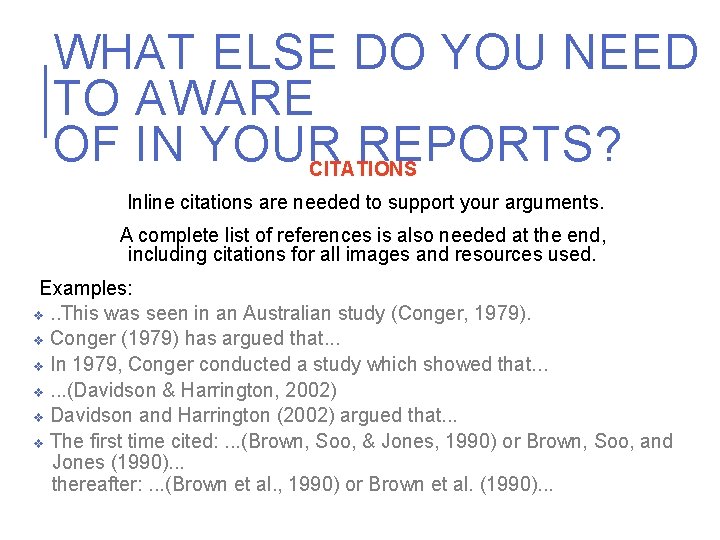
WHAT ELSE DO YOU NEED TO AWARE OF IN YOUR REPORTS? CITATIONS Inline citations are needed to support your arguments. A complete list of references is also needed at the end, including citations for all images and resources used. Examples: v. . This was seen in an Australian study (Conger, 1979). v Conger (1979) has argued that. . . v In 1979, Conger conducted a study which showed that. . . v. . . (Davidson & Harrington, 2002) v Davidson and Harrington (2002) argued that. . . v The first time cited: . . . (Brown, Soo, & Jones, 1990) or Brown, Soo, and Jones (1990). . . thereafter: . . . (Brown et al. , 1990) or Brown et al. (1990). . .

CRITERION - PERSONAL ENGAGEMENT Marks Descriptor Aspect 1: The evidence of personal engagement with the exploration is clear with significant independent thinking, initiative or insight. 2 Aspect 2: The justification given for choosing the research question and/or the topic under investigation demonstrates personal significance, interest or curiosity. Aspect 3: There is evidence of personal input and initiative in the designing, implementing or presentation of the investigation.

CRITERION EXPLORATION Marks Descriptor Aspect 1: The topic of the investigation is identified and a relevant and fully focused research question is clearly described. Aspect 2: The background information provided for the investigation is entirely appropriate and relevant and enhances the understanding of the context of the investigation. 6 Aspect 3: The methodology of the investigation is highly appropriate to address the research question because it takes into consideration all, or nearly all, of the significant factors that may influence the relevance, reliability and sufficiency of the collected data. Aspect 4: The report shows evidence of full awareness of the significant safety, ethical or environmental issues that are relevant to the methodology of the investigation.
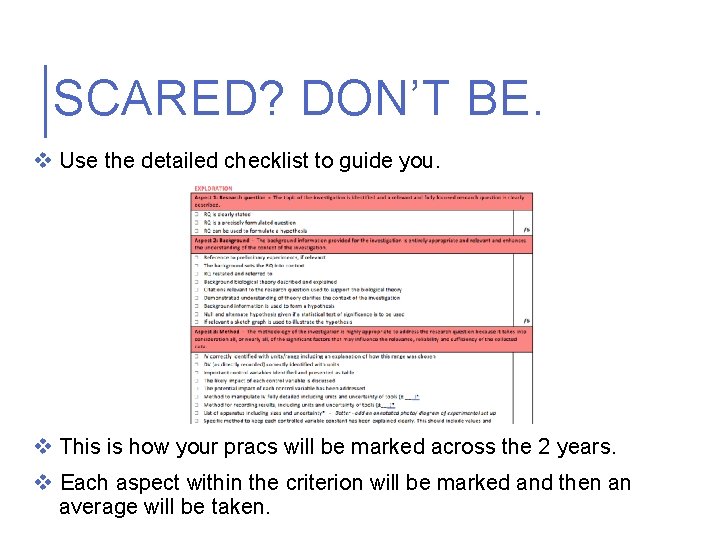
SCARED? DON’T BE. v Use the detailed checklist to guide you. v This is how your pracs will be marked across the 2 years. v Each aspect within the criterion will be marked and then an average will be taken.
NOW FOR A BIT OF FUN We are going to do an experiment together which involves the effect of the colour of noise (white, pink, brown) on your concentration while doing a task. Do some research now – can you find any relevant resources about the colour of noise and/or noise and concentration?
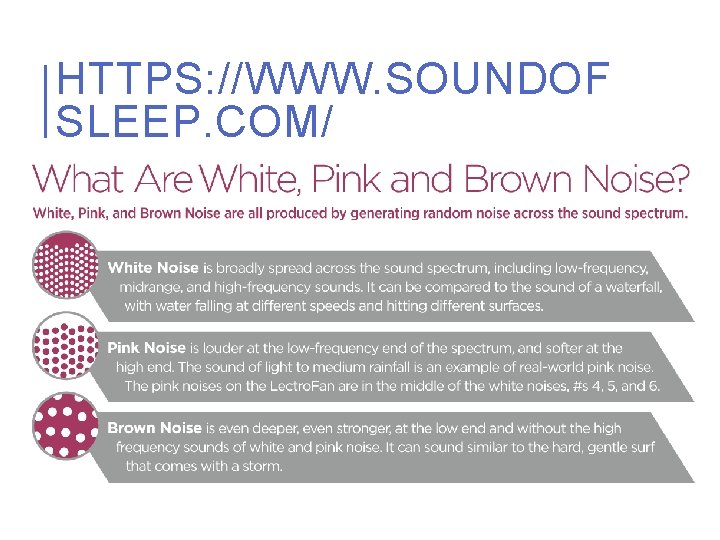
HTTPS: //WWW. SOUNDOF SLEEP. COM/
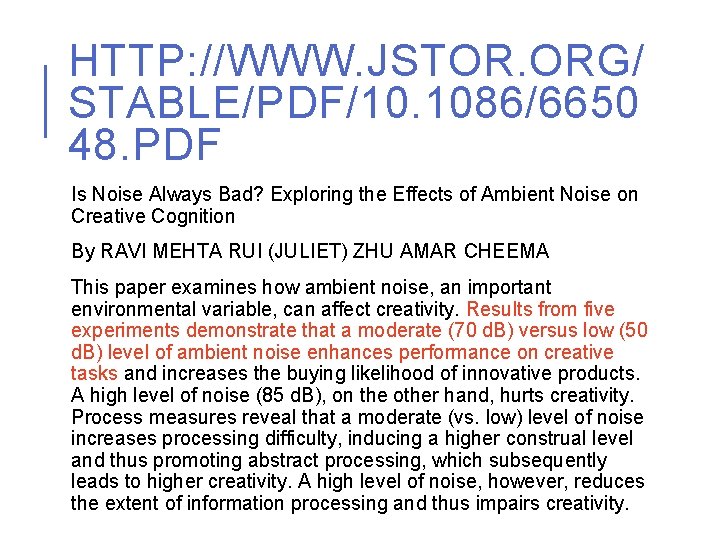
HTTP: //WWW. JSTOR. ORG/ STABLE/PDF/10. 1086/6650 48. PDF Is Noise Always Bad? Exploring the Effects of Ambient Noise on Creative Cognition By RAVI MEHTA RUI (JULIET) ZHU AMAR CHEEMA This paper examines how ambient noise, an important environmental variable, can affect creativity. Results from five experiments demonstrate that a moderate (70 d. B) versus low (50 d. B) level of ambient noise enhances performance on creative tasks and increases the buying likelihood of innovative products. A high level of noise (85 d. B), on the other hand, hurts creativity. Process measures reveal that a moderate (vs. low) level of noise increases processing difficulty, inducing a higher construal level and thus promoting abstract processing, which subsequently leads to higher creativity. A high level of noise, however, reduces the extent of information processing and thus impairs creativity.
NOW FOR A BIT OF FUN We are going to do 4 word searches! - a control, white, pink and brown noise Don’t forget to fill in your details on the front page!
WHAT WAS THE POINT OF THAT? You just performed an experiment that collected quantitative data! I gave you the basic methodology – but it is now up to you to put together the first part of your report. We will play / work with the data next lesson.

More details to help you
INTRODUCTION Firstly, do some research! If you are using a specific plant, look it up. If you are using an enzyme, discuss enzyme action and your specific enzyme. If you have based your work on a reaction, provide it here. Then, explain any personal connection to the topic. Demonstrate independent thinking, initiative, insight, interest and curiosity Justify why you have selected your research question There must be evidence of your personal input into the design, implementation and presentation of the investigation. Finally, state your research question! It should be focused and must refer to the IV and DV.
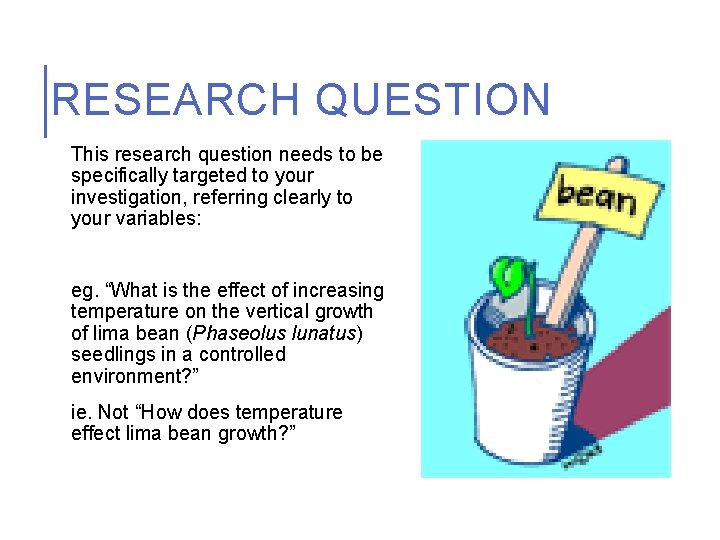
RESEARCH QUESTION This research question needs to be specifically targeted to your investigation, referring clearly to your variables: eg. “What is the effect of increasing temperature on the vertical growth of lima bean (Phaseolus lunatus) seedlings in a controlled environment? ” ie. Not “How does temperature effect lima bean growth? ”
HYPOTHESIS Make an educated guess as to what you think will happen. A graph can be used to here to show the predicted trend in your results. You do not need to justify your predictions, but it is more correct to do so. Always start with, “It is expected that. . . ” Again, be specific to your research question and your selected conditions.
MATERIALS / APPARATUS Be specific! State quantities, volumes, dimensions, shapes, brand, instrumental error, etc eg. water 100 cm 3 distilled water
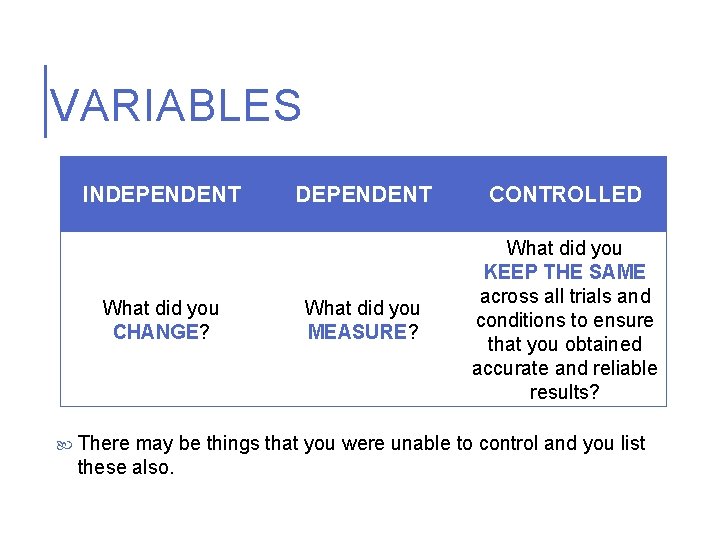
VARIABLES INDEPENDENT What did you CHANGE? There DEPENDENT CONTROLLED What did you MEASURE? What did you KEEP THE SAME across all trials and conditions to ensure that you obtained accurate and reliable results? may be things that you were unable to control and you list these also.
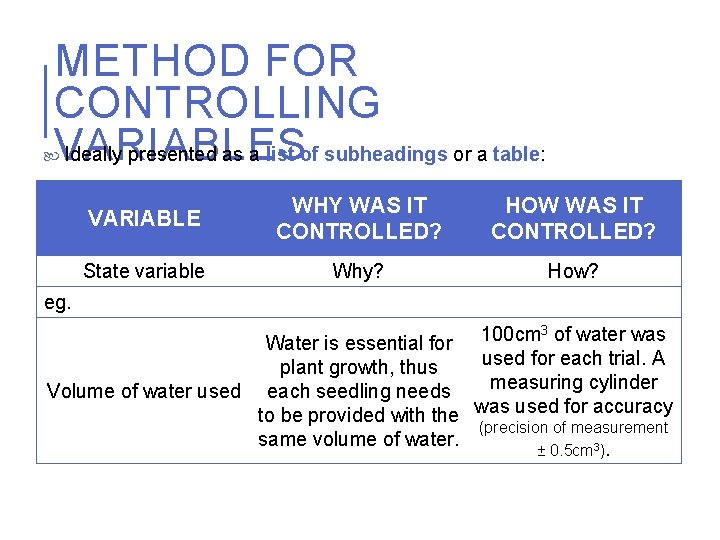
METHOD FOR CONTROLLING VARIABLES Ideally presented as a list of subheadings or a table: VARIABLE WHY WAS IT CONTROLLED? HOW WAS IT CONTROLLED? State variable Why? How? eg. 3 of water was 100 cm Water is essential for used for each trial. A plant growth, thus measuring cylinder Volume of water used each seedling needs to be provided with the was used for accuracy (precision of measurement same volume of water. ± 0. 5 cm 3).
METHOD FOR COLLECTING DATA This just needs to be sequential and detailed. Aim for a range of conditions (5 is ideal) and a number of trials (10 is ideal). If you are using an electronic device, include the steps for its calibration. You can include diagrams here to help you. Ideally, should be written in third person, past tense - but this is not essential.
SAFETY, ETHICAL OR ENVIRONMENTAL ISSUES This must be included below your method to show that you have considered all issues associated with the methodology that you have used. Include anything that is relevant to your investigation: v wearing safety goggles and lab coats v safe disposal of wastes v informed consent for human subjects v safe use of glassware and availability of first aid
OTHER HANDY DANDY HINTS. . . Always ask for help if you are unsure! The more thorough your Design, the more reliable your data will be and the more you will have to talk about in the later sections of your report! Ms Werba’s pet peeve: Never use the word amount unless you are counting. . . eg. an amount of sheep. . . Otherwise, there is a better word! eg. volume, mass, etc
- Slides: 23