
IATA WMO AMDAR Collaboration Claudia Mariscal Manager Product
IATA / WMO AMDAR Collaboration Claudia Mariscal Manager Product and Business Development Safety and Flight Operations October 2018
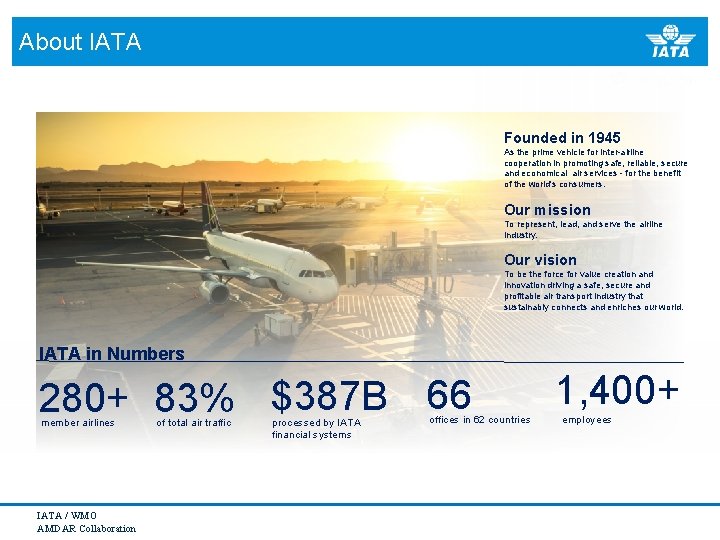
About IATA in Brief Founded in 1945 As the prime vehicle for inter-airline cooperation in promoting safe, reliable, secure and economical air services - for the benefit of the world's consumers. Our mission To represent, lead, and serve the airline industry. Our vision To be the force for value creation and innovation driving a safe, secure and profitable air transport industry that sustainably connects and enriches our world. IATA in Numbers 280+ 83% $387 B 66 member airlines IATA / WMO AMDAR Collaboration of total air traffic processed by IATA financial systems offices in 62 countries 1, 400+ employees
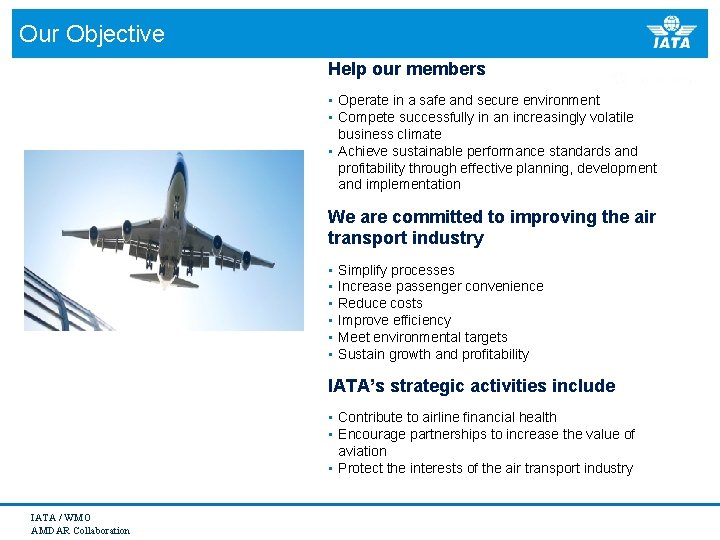
Our Objective Help our members • Operate in a safe and secure environment • Compete successfully in an increasingly volatile business climate • Achieve sustainable performance standards and profitability through effective planning, development and implementation We are committed to improving the air transport industry • • • Simplify processes Increase passenger convenience Reduce costs Improve efficiency Meet environmental targets Sustain growth and profitability IATA’s strategic activities include Alexandre de Juniac Director General & CEO, IATA / WMO AMDAR Collaboration • Contribute to airline financial health • Encourage partnerships to increase the value of aviation • Protect the interests of the air transport industry
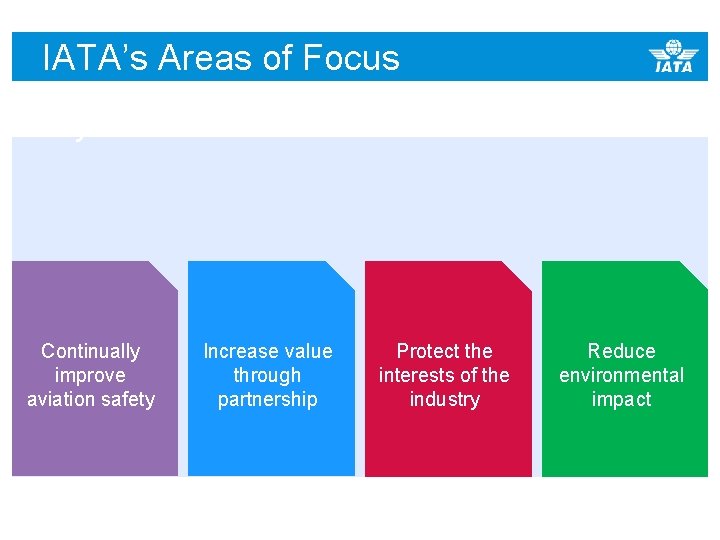
IATA’s Areas of Focus Key Issues Continually improve aviation safety Increase value through partnership Protect the interests of the industry Reduce environmental impact
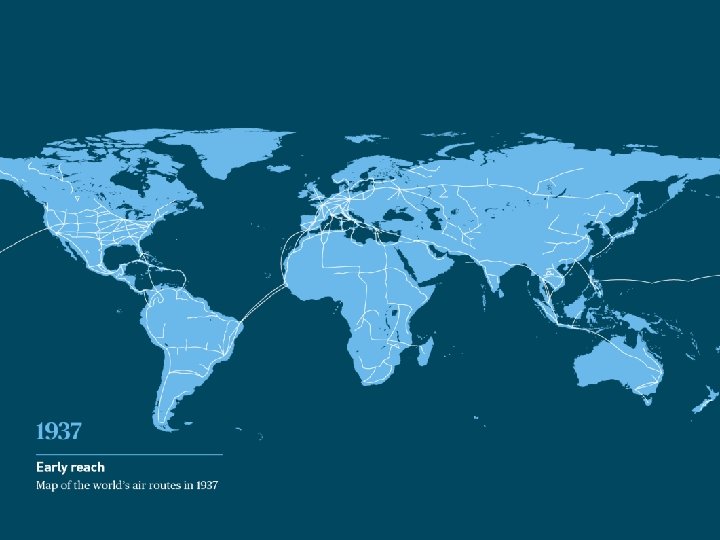
History
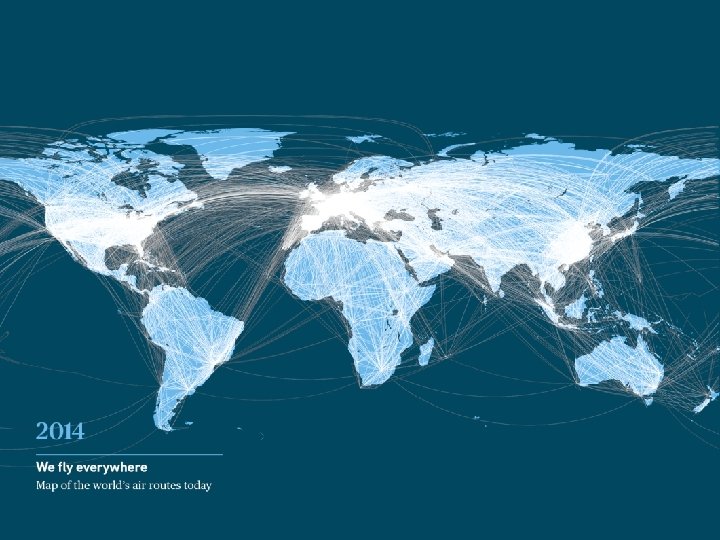
History
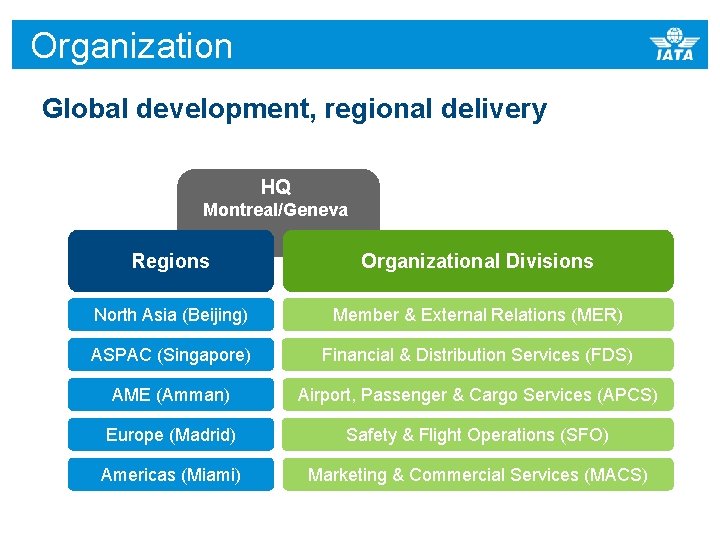
Organization Global development, regional delivery HQ Montreal/Geneva Regions Organizational Divisions North Asia (Beijing) Member & External Relations (MER) ASPAC (Singapore) Financial & Distribution Services (FDS) AME (Amman) Airport, Passenger & Cargo Services (APCS) Europe (Madrid) Safety & Flight Operations (SFO) Americas (Miami) Marketing & Commercial Services (MACS)
IATA Value Proposition § Backbone of global, interconnected industry § Global/Regional/Local advocacy § Promoting aviation § Commercial services § Setting global standards
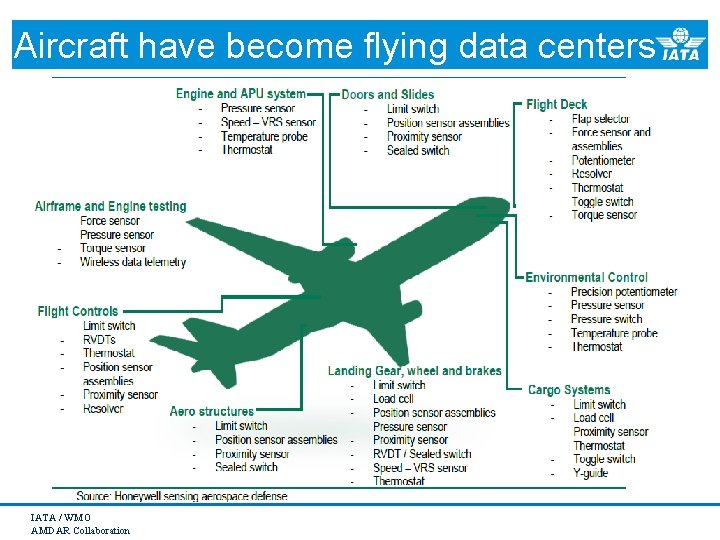
Aircraft have become flying data centers IATA / WMO AMDAR Collaboration
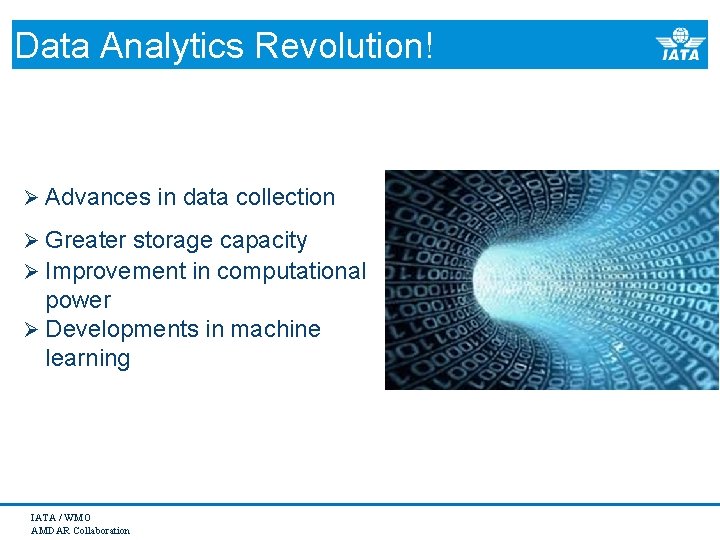
Data Analytics Revolution! Ø Advances in data collection Ø Greater storage capacity Ø Improvement in computational power Ø Developments in machine learning IATA / WMO AMDAR Collaboration
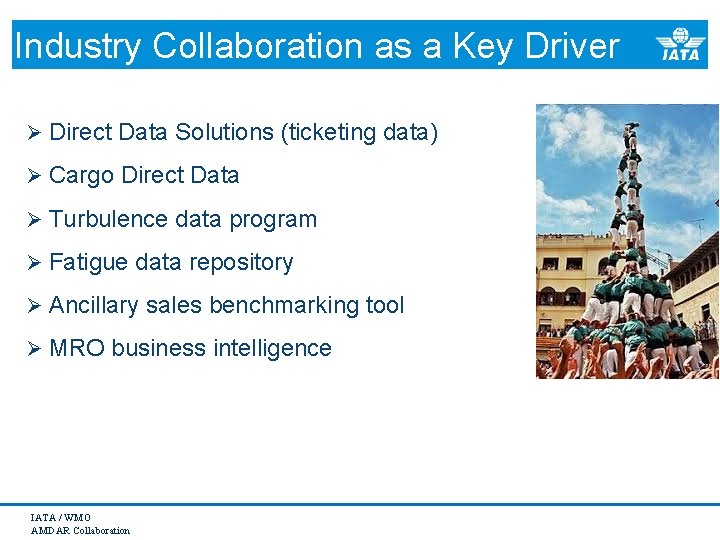
Industry Collaboration as a Key Driver Ø Direct Data Solutions (ticketing data) Ø Cargo Direct Data Ø Turbulence data program Ø Fatigue data repository Ø Ancillary sales benchmarking tool Ø MRO business intelligence IATA / WMO AMDAR Collaboration
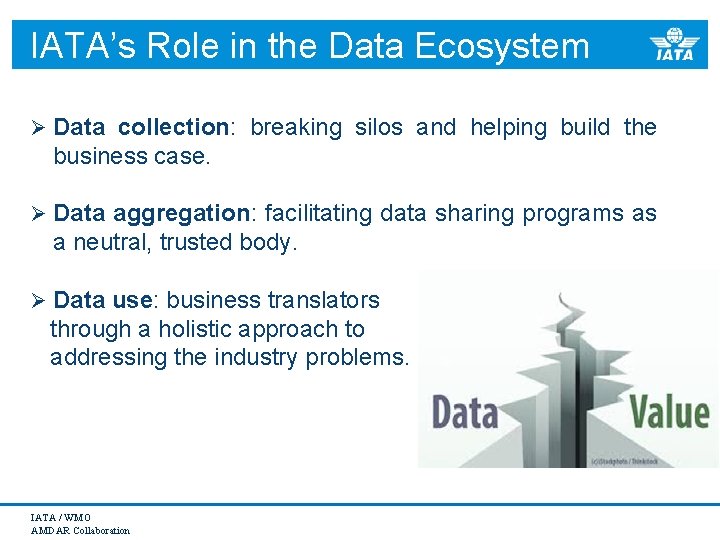
IATA’s Role in the Data Ecosystem Ø Data collection: breaking silos and helping build the business case. Ø Data aggregation: facilitating data sharing programs as a neutral, trusted body. Ø Data use: business translators through a holistic approach to addressing the industry problems. IATA / WMO AMDAR Collaboration
Flight Operations Efficiency IATA Global Turbulence Database Development
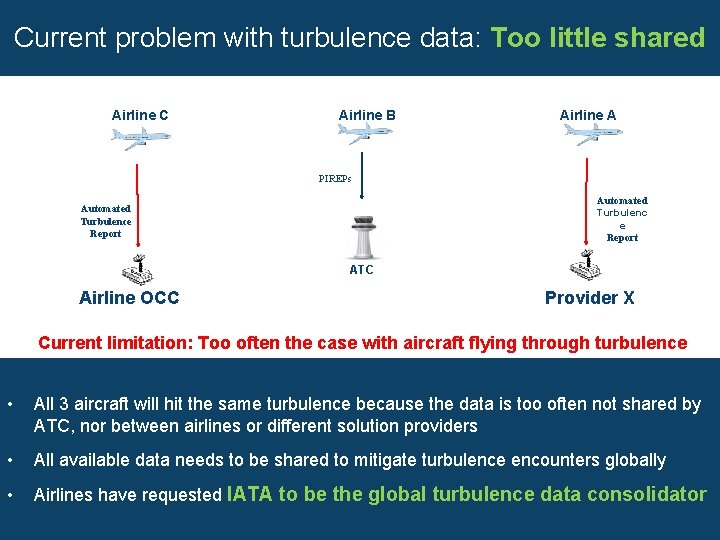
Current problem with turbulence data: Too little shared Airline C Airline B Airline A PIREPs Automated Turbulenc e Report Automated Turbulence Report ATC Airline OCC Provider X Current limitation: Too often the case with aircraft flying through turbulence • All 3 aircraft will hit the same turbulence because the data is too often not shared by ATC, nor between airlines or different solution providers • All available data needs to be shared to mitigate turbulence encounters globally • Airlines have requested IATA to be the global turbulence data consolidator
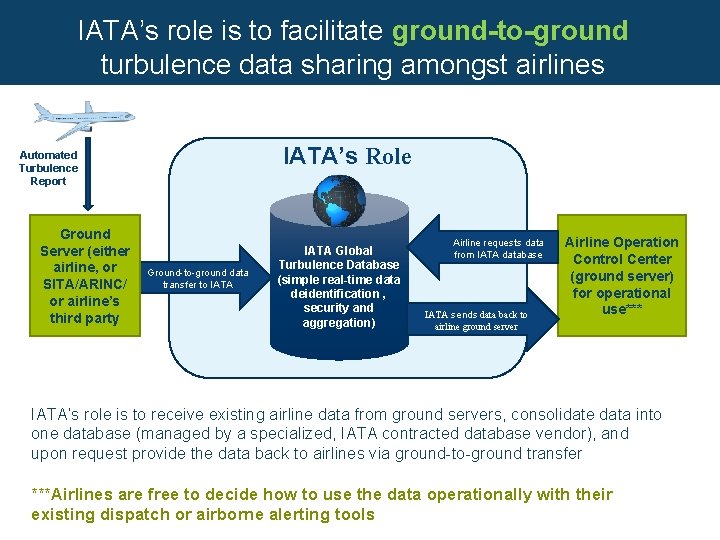
IATA’s role is to facilitate ground-to-ground turbulence data sharing amongst airlines IATA’s Role Automated Turbulence Report Ground Server (either airline, or SITA/ARINC/ or airline’s third party Ground-to-ground data transfer to IATA Global Turbulence Database (simple real-time data deidentification , security and aggregation) Airline requests data from IATA database IATA sends data back to airline ground server Airline Operation Control Center (ground server) for operational use*** IATA’s role is to receive existing airline data from ground servers, consolidate data into one database (managed by a specialized, IATA contracted database vendor), and upon request provide the data back to airlines via ground-to-ground transfer ***Airlines are free to decide how to use the data operationally with their existing dispatch or airborne alerting tools
Highly Collaborative Development IATA Turbulence Advisory Group: IATA Turbulence Data Exchange Platform 16 27 June, 2018
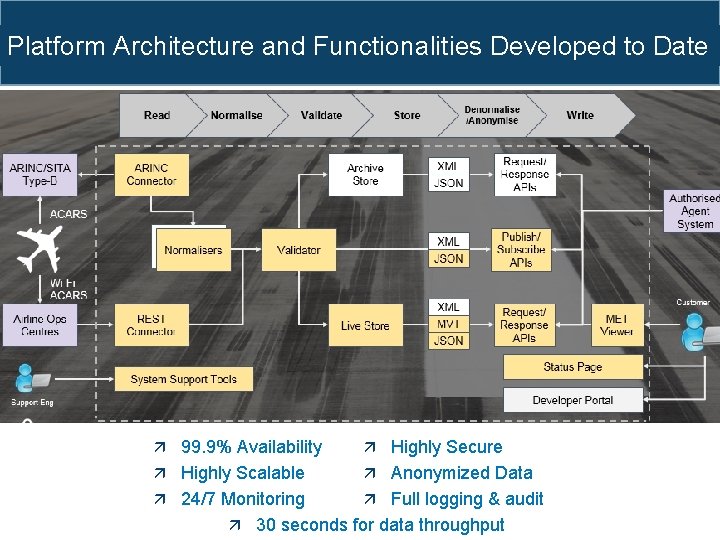
Platform Architecture and Functionalities Developed to Date ä 99. 9% Availability ä Highly Secure ä Highly Scalable ä Anonymized Data ä 24/7 Monitoring ä Full logging & audit IATA Turbulence Data Exchange Platform 17 ä 30 seconds for data throughput 27 June, 2018
IATA WMO Collaboration Progress to date § Working arrangement between WMO and IATA signed July 2017 § Platform to establish a partnership framework aimed at improving weather forecast for aviation § Con. Ops development – work in progress Goals § Focus on the expansion of the AMDAR program worldwide § Expand the AMDAR program to new airlines from datasparse areas § Protect airlines’ ownership of this data
IATA WMO Collaboration IATA’s Envisaged Role § § § Promote AMDAR to it’s members Educate airlines on program benefits Close the historical NMHS / Airline “gap” Facilitate discussion amongst MET and aviation stakeholders Identify program efficiencies Airline benefits § Improved forecast accuracy, safety and greater operational efficiencies § Better control over which parties can access airline MET data § Cost-neutral participation in the AMDAR program
How IATA can help the airlines get onboard • Engage the right stakeholders within the airline industry • Educate the airlines about the importance of AMDAR and the benefits they can realize if they participate • Help the airlines build the business case for their Senior Management • Assist airlines in evaluating the required technical development to implement AMDAR reporting capability • Possibly commercialize existing AMDAR data to subsidize program participating for new airlines IATA / WMO AMDAR Collaboration
Let’s grow the AMDAR program together to enhance industry safety and efficiency by producing more accurate weather forecasts IATA / WMO AMDAR Collaboration
- Slides: 21