
IAEMs CEM 101 Basic Training Daryl Lee Spiewak
IAEM’s CEM 101 Basic Training Daryl Lee Spiewak, CEM, TCFM International Association of Emergency Managers CEM Commissioner daryls@brazos. org March 4, 2007
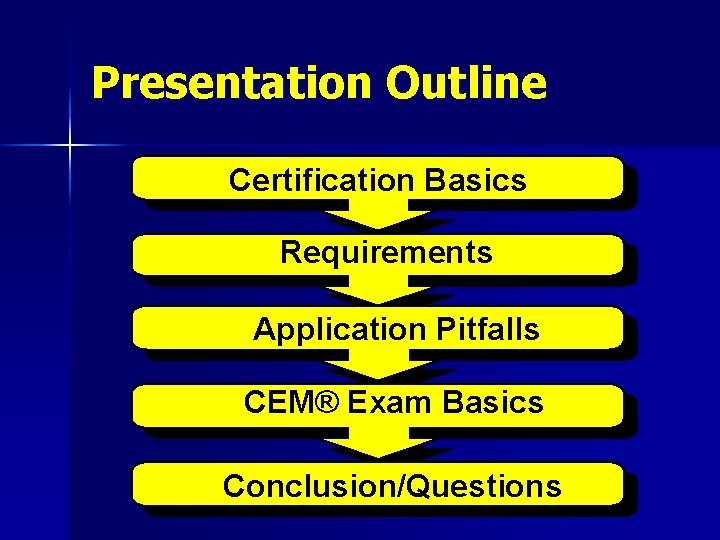
Presentation Outline Certification Basics Requirements Application Pitfalls CEM® Exam Basics Conclusion/Questions
Purpose of IAEM’s Certification Program Elevate the visibility of emergency managers n Encourage and mandate continued professional development, education and technical skills n Ensure minimal Knowledge, Skills and Abilities (KSAs) n
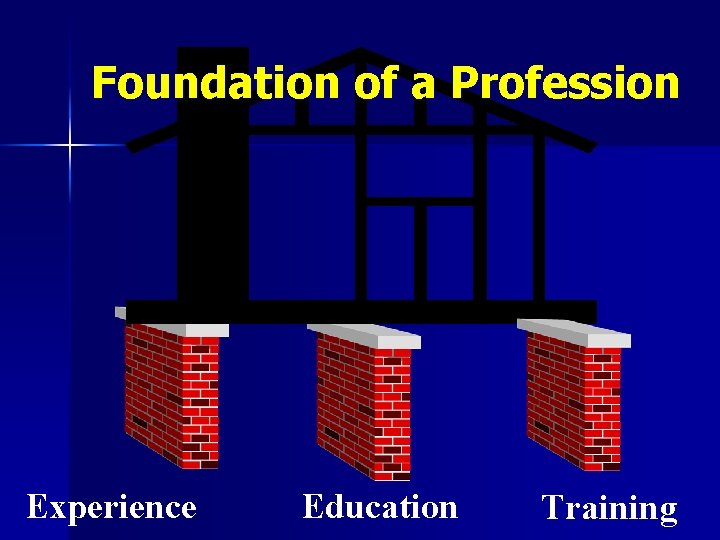
Foundation of a Profession Experience Education Training

Certification Process n Application n Credential Process n Testing n Re-Certification
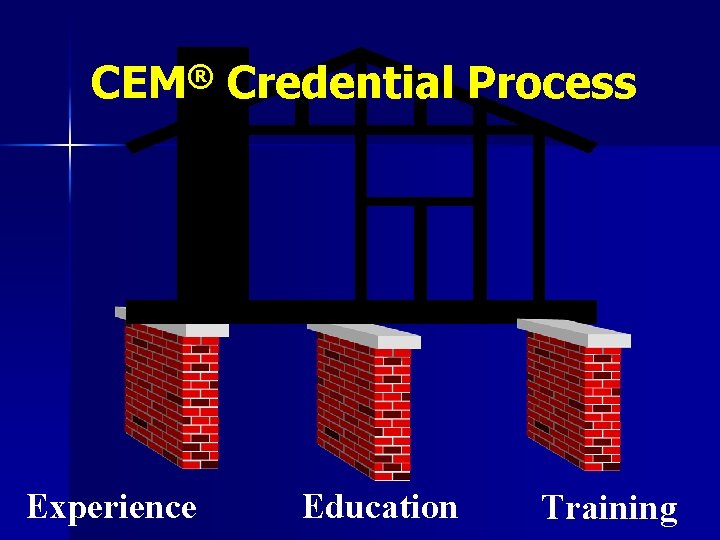
CEM® Credential Process Experience Education Training
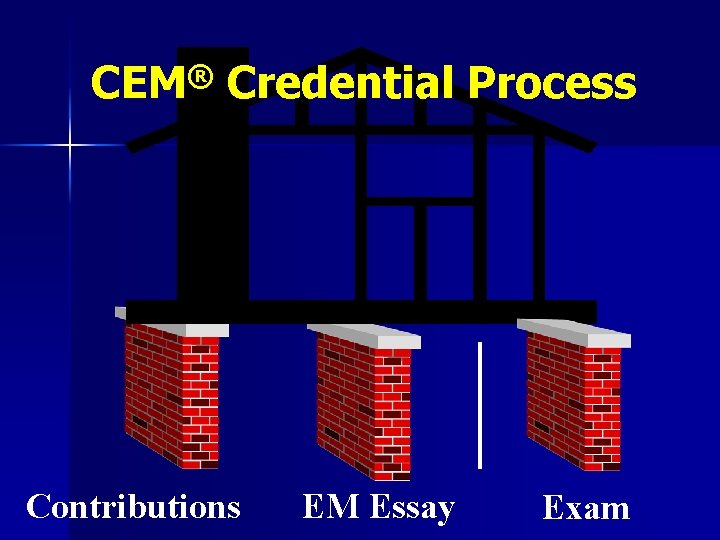
CEM® Credential Process Contributions EM Essay Exam
CEM® Commission Federal Government State Government Local Government Private Industry Education Military
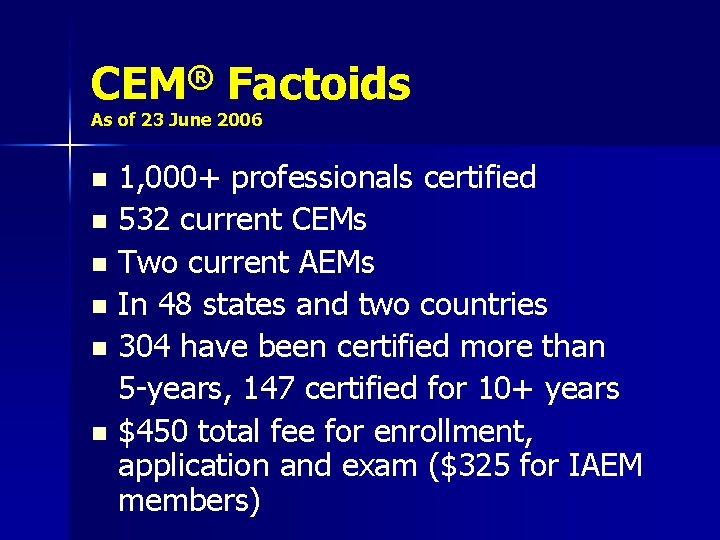
CEM® Factoids As of 23 June 2006 1, 000+ professionals certified n 532 current CEMs n Two current AEMs n In 48 states and two countries n 304 have been certified more than 5 -years, 147 certified for 10+ years n $450 total fee for enrollment, application and exam ($325 for IAEM members) n
® CEM Requirements – Application Packet n Emergency management experience – 3 years FTE comprehensive EM – 2 years FTE with 4 -year EM degree n Three professional references – One must be current supervisor – Include job descriptions, not resume n Actual disaster/contingency experience or substantive role in managing a full-scale exercise
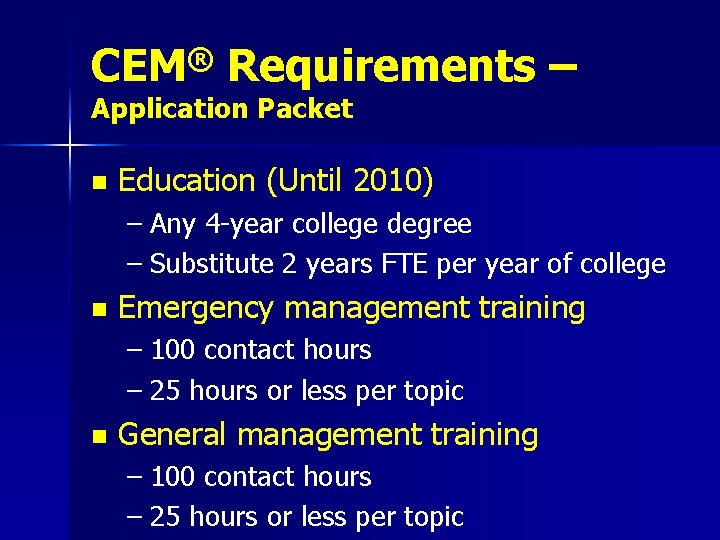
® CEM Requirements – Application Packet n Education (Until 2010) – Any 4 -year college degree – Substitute 2 years FTE per year of college n Emergency management training – 100 contact hours – 25 hours or less per topic n General management training – 100 contact hours – 25 hours or less per topic
® CEM Requirements – Application Packet n Six of 14 contributions to the profession – Professional membership – Professional conference attendance – Leadership – Service – Special assignment – Speaking – Teaching
® CEM Requirements – Application Packet n Six of 14 contributions to the profession – Course development – Publication – Audiovisual or interactive product – Awards, honors, or special recognition – State/Province certifications – Legislative contact – Other
® CEM Requirements – Application Packet n Emergency management essay – Scenario-based – 1, 000 or so words – 12 Knowledge, Skills & Abilities Criteria – 24 out of 41 points (59%) – Signed verification statement
CEM® Requirements – Application Packet n Comprehensive EM exam – 100 multiple choice questions – Passing score is 75% n Recertification every 5 years

® AEM Requirements – Application Packet n The same requirements as the CEM® except n No education requirement – No degree! – No college! – No experience substitution!

Application Complete

Application Pitfalls General Considerations n Application Packet Killers – Incompleteness – Sloppiness – Lack of order – Lack of documentation – Missing information/signatures – Invalidated claims
Application Pitfalls - Work History and Experience n Application Packet Killers – Lack of comprehensive emergency management experience – Official job description missing – Unaccounted employment periods – Lack of volunteer hours’ documentation – Missing documentation showing relationship or % of time in emergency management
Application Pitfalls Professional References n Application Packet Killers – Missing three professional references – References not familiar with candidate’s work history – Missing or inaccurate contact numbers – After-work and weekend contact numbers helpful

Application Pitfalls - Actual Disaster or Exercise Experience n Application Packet Killers – Significant role not explained – Significant role not documented – Tangential roles too often claimed
Application Pitfalls Education n Application Packet Killers – Official or notarized transcripts best – Copy of official transcript OK – Transcript provided does not list degree conferred – Graduate transcripts OK. They usually show BA/BS degree earned
Application Pitfalls Management Training n Application Packet Killers – General management training claimed for emergency management training – Emergency management training claimed for general management training – More than 25 hours per topic area claimed – Graduate classes = 15 contact hours per credit hour – FEMA IS courses usually = 10 contact hours
Application Pitfalls - Contributions to the Profession n Application Packet Killers – Cannot be required by job – Six different contributions – Missing documentation or documentation does not prove claim of contribution – Contribution did not meet requirements – Missing signatures or contact information – Must be a contribution and not an attribution
Application Pitfalls - Emerency Management Essay n Application Packet Killers – Required statement not provided and signed – Did not solve the problem statement – Did not cover the KSAs – Difficult to read – Too many grammar and spelling errors – Not double spaced – This is an essay, not a book, not a report, or not a magazine article

CEM® EXAM Basics n 100 Questions n 60% - 80% Core Questions n 20% - 40% Country-Specific Questions n 75% to Pass n Pass Exam BEFORE or AFTER Packet Submission
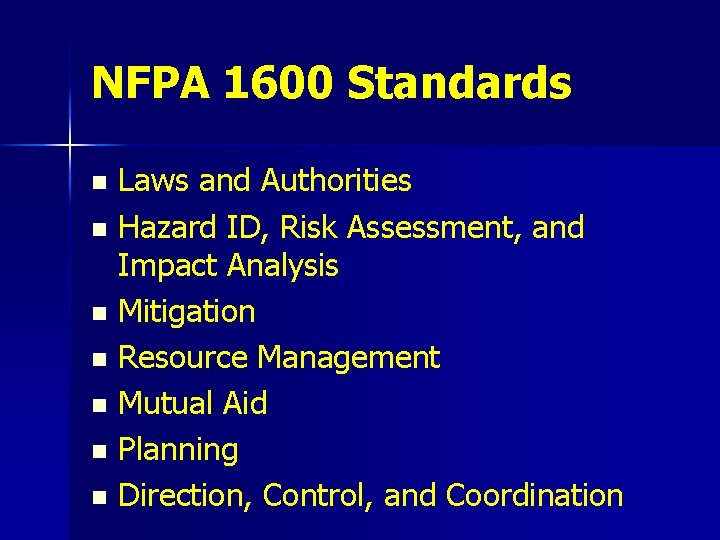
NFPA 1600 Standards Laws and Authorities n Hazard ID, Risk Assessment, and Impact Analysis n Mitigation n Resource Management n Mutual Aid n Planning n Direction, Control, and Coordination n
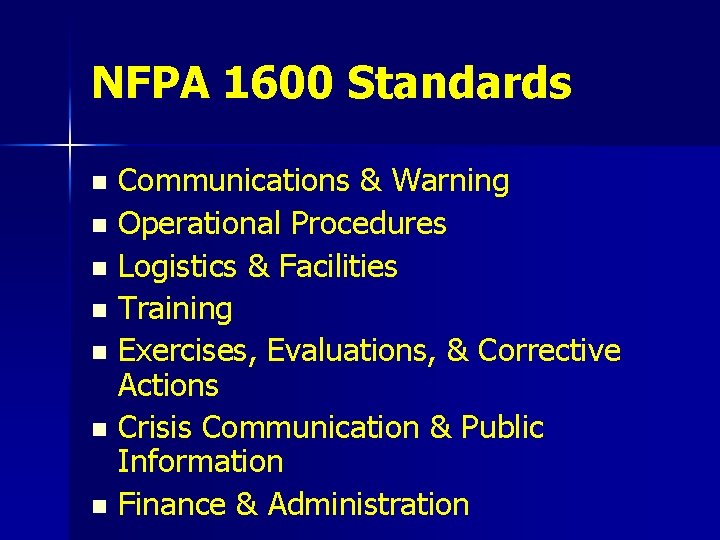
NFPA 1600 Standards Communications & Warning n Operational Procedures n Logistics & Facilities n Training n Exercises, Evaluations, & Corrective Actions n Crisis Communication & Public Information n Finance & Administration n

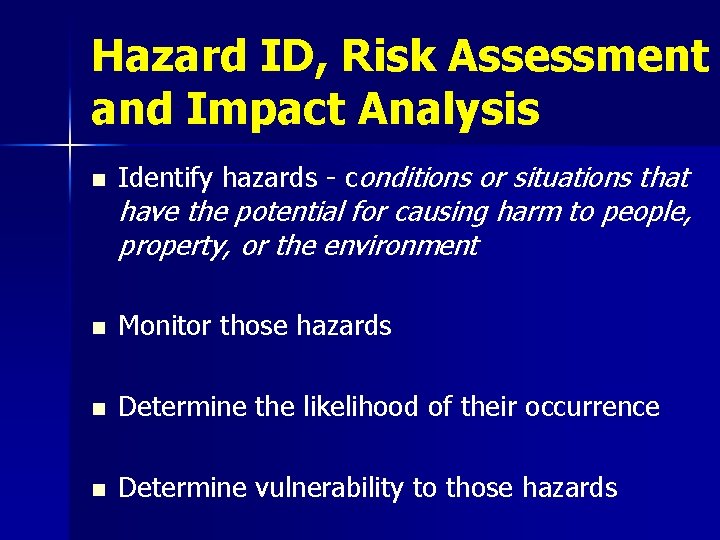
Hazard ID, Risk Assessment and Impact Analysis n Identify hazards - conditions or situations that n Monitor those hazards n Determine the likelihood of their occurrence n Determine vulnerability to those hazards have the potential for causing harm to people, property, or the environment

Hazard ID, Risk Assessment and Impact Analysis n Natural hazards n Human-caused hazards –unintentional n Human-caused hazards - intentional
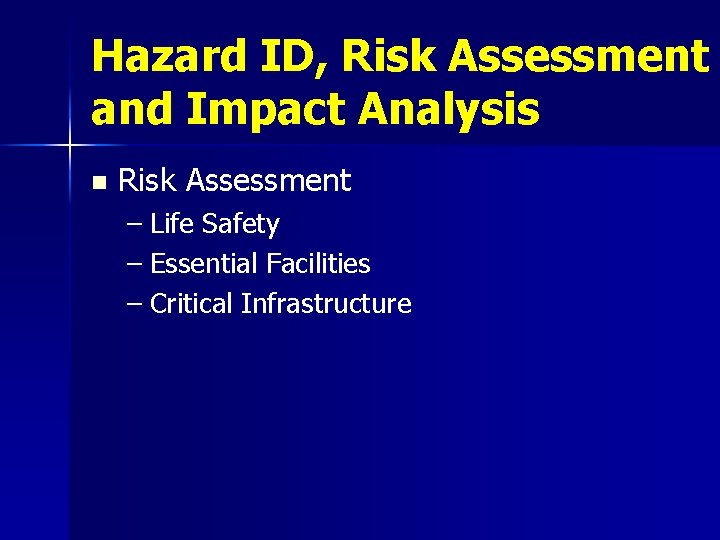
Hazard ID, Risk Assessment and Impact Analysis n Risk Assessment – Life Safety – Essential Facilities – Critical Infrastructure
Hazard ID, Risk Assessment and Impact Analysis n Impact Analysis – Predictability – Magnitude – Speed of Onset – Cascading Effects
Mitigation n Mitigate the effects of hazards that cannot be prevented n Mitigation strategy is based on – hazard identification and risk assessment – impact analysis – program constraints – operational experience – cost-benefit analysis
Resource Management n Management system for describing, inventorying, requesting, and tracking n Activating these systems prior to and during an incident n Dispatching resources prior to and during an incident
Resource Management n Deactivating or recalling resources during or after incidents n Contingency planning for resource shortfalls
Planning n Strategic plan n Emergency operations/response plan n Prevention plan n Mitigation plan n Recovery plan n Continuity plan
Planning n Functional roles and responsibilities n Lines of authority n The means to manage incident information
Planning - Principles n Do not reinvent the wheel. n Do not go it alone. n Use existing organizational structures n Research laws, ordinances, rules, etc.
Planning - Principles n Identify resources and gaps n Write the plan – Basic plan – Functional annexes – Hazard-specific appendices to support annexes
Planning - Annexes n Functional annexes – Direction and control – Communications – Warning – Public information – Evacuation – Mass care – Health & medical – Resource management
Direction, Control and Coordination n Incident management system to direct, control, and coordinate response and recovery operations n Describe specific organizational roles, titles, and responsibilities for each incident management function

Direction, Control and Coordination n Coordination with stakeholders directly involved in response, continuity and recovery operations
Communications and Warning n Communications systems and procedures – Established – Regularly tested n Notify officials n Alert emergency response personnel
Communications and Warning Which of the following pieces of information could be deleted from a 15 -second Public Service Announcement on drinking water safety? a. The city water supply is contaminated. b. Paul Lining has been named Director of Public Works. c. Water should be boiled before it is used or consumed. d. The “boil water” edict is in force until further notice.
Communications and Warning Which of the following pieces of information could be deleted from a 15 -second Public Service Announcement on drinking water safety? a. The city water supply is contaminated. b. Paul Lining has been named Director of Public Works. c. Water should be boiled before it is used or consumed. d. The “boil water” edict is in force until further notice.
Communications and Warning You need to warn the public about a collapsed bridge. What medium would be least useful in getting your message across? a. AM radio traffic update. b. Ham radio. c. Magazine feature story. d. Television.
Communications and Warning You need to warn the public about a collapsed bridge. What medium would be least useful in getting your message across? a. AM radio traffic update. b. Ham radio. c. Magazine feature story. d. Television.
Communications and Warning Why would a magazine feature article be least useful in getting your message across? What would you put in a magazine feature article?
Communications and Warning Why would a magazine feature article be least useful in getting your message across? Not timely. What would you put in a magazine feature article? Details, explanations, and analyses along with photos.
Operational Procedures n Response and recovery procedures based on consequences of identified hazards – Established – Implemented n Situation analysis – Needs assessment – Damage assessment – Identification of resources shortfalls
Logistics and Facilities n Procedures to locate, acquire, store, distribute, maintain, test, and account for procured and donated resources – Services – Personnel – Materials – Facilities
Logistics and Facilities n Establish an emergency operations center and an alternate EOC – Equipped – Maintained – Periodically tested

Training n Develop and implement a training/ educational curriculum to support the program n Create awareness and enhance the skills required to develop, implement, maintain, and execute the program

Training n Trained in the jurisdiction’s incident management system n Comply with all applicable regulatory requirements
Exercises, Evaluations, and Corrective Actions n Designed to evaluate program plans, procedures, and capabilities – Periodic reviews – Testing – Post-incident reports – Lessons learned – Performance evaluations – Exercises

Exercises, Evaluations, and Corrective Actions n Designed to test individual essential elements, interrelated elements or the entire plan(s) n Take corrective action on an deficiency identified
Crisis Communication and Public Information n Procedures to disseminate and respond to requests for pre-disaster, disaster and post-disaster information – Internal audiences – External audiences – The media

Crisis Communication and Public Information n Public awareness program – Advise the public – Use authorized agencies – Discuss threats to people, property, and the environment
Finance and Administration n Develop procedures to support the program before, during and after an emergency or a disaster – Finance – Administration

Laws and Authorities n Legislation n Regulations n Directives n Policies n Industry codes of practice
Laws and Authorities n Robert T. Stafford Act n Homeland Security Presidential Directives – HSPD 5 – Management of Domestic Incidents – HSPD 7 – Homeland Security Advisory System n National Response Plan n National Incident Management System

Laws and Authorities n Robert T. Stafford Act – FEMA’s Role and Responsibilities – Emergency Declarations – Public Assistance – Individual Assistance – Federal Coordinating Officer – State Coordinating Officer – Damage Assessments

Laws and Authorities n National Response Plan – Applies to all incidents requiring a coordinated Federal response – Always activated – Incidents of National Significance n Actual or potential high-impact event requiring robust and coordinated Federal response – Includes state, local, tribal authorities – Includes the Private Sector – Companion to the National Incident Management System (NIMS)
Laws and Authorities n National Incident Management System – Command Management – Preparedness – Resource Management – Communications and Information Management – Supporting Technologies
Resource Management n Management system for describing, inventorying, requesting, and tracking n Activating these systems prior to and during an incident n Dispatching resources prior to and during an incident
Resource Management n Deactivating or recalling resources during or after incidents n Contingency planning for shortfalls of resources
Mutual Aid n Determine need for mutual aid n Establish agreements n Reference mutual aid in the applicable program plan
Direction, Control and Coordination n Incident Command System – Common Terminology – Modular Organization – Management by Objectives – Incident Action Plans – Span of Control – Pre-designated Incident Locations and Facilities
Direction, Control and Coordination n Incident Command System – Comprehensive Resource Management – Integrated Communications – Establishment and Transfer of Command – Chain of Command & Unity of Command – Unified Command – Accountability – Deployment – Information and Intelligence Management
Command Responsible for incident management n Develops incident objectives n Approves the Incident Action Plan n Transfer Command n Unified Command n Supported by Public Information, Safety, and Liaison Officers n
Operations Manages tactical operations at the incident site n Involved in preparing the Incident Action Plan n
Planning Responsible for collecting, evaluating, and disseminating tactical information pertaining to the incident n Maintains information and intelligence on the current and forecasted situation n Prepares the Incident Action Plan n
Logistics Supports needs for the incident including ordering resources from offsite locations n Provides facilities, transportation, supplies, equipment, maintenance, and fueling n Includes communication and medical services to incident personnel n
Finance and Administration n Develop procedures to support the program before, during and after an emergency or a disaster – Financial (cost analysis & procurement) – Reimbursement (Claims) – Administrative Services (Time)
Practice Exam Questions n Which of the following hazards can be predicted days in advance? – A. Earthquake – B. Hurricane – C. Tsunami – D. Wildfire
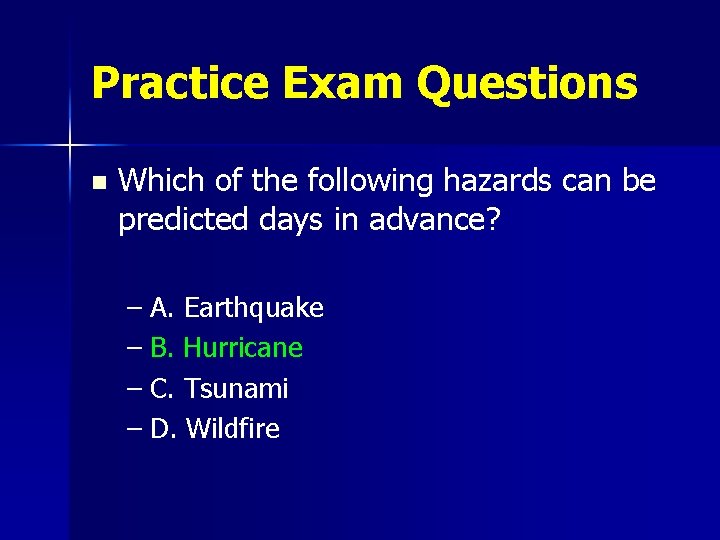
Practice Exam Questions n Which of the following hazards can be predicted days in advance? – A. Earthquake – B. Hurricane – C. Tsunami – D. Wildfire
Practice Exam Questions n In which phase of emergency management do you develop and exercise an emergency operations plan? – A. Mitigation – B. Preparedness – C. Response – D. Recovery
Practice Exam Questions n In which phase of emergency management do you develop and exercise an emergency operations plan? – A. Mitigation – B. Preparedness – C. Response – D. Recovery

Practice Exam Questions n Which of the following should be included in a mitigation plan? – A. Only easily achievable actions – B. Only a single action – C. Prioritized actions – D. Short-term actions

Practice Exam Questions n Which of the following should be included in a mitigation plan? – A. Only easily achievable actions – B. Only a single action – C. Prioritized actions – D. Short-term actions
Practice Exam Questions n Which of the following is not a role for the emergency operations center (EOC)? – A. Coordination during emergency response – B. Disaster planning – C. Disaster recovery – D. Reimbursement for damages
Practice Exam Questions n Which of the following is not a role for the emergency operations center (EOC)? – A. Coordination during emergency response – B. Disaster planning – C. Disaster recovery – D. Reimbursement for damages
Practice Exam Questions n Which of the following is a characteristic of a good emergency operations plan? – A. It is based on valid assumptions – B. Language is detailed and technical – C. Little involvement from outside agencies – D. Plan is not exercised
Practice Exam Questions n Which of the following is a characteristic of a good emergency operations plan? – A. It is based on valid assumptions – B. Language is detailed and technical – C. Little involvement from outside agencies – D. Plan is not exercised
Practice Exam Questions n Having a pre-event emergency plan in place will help: – A. Increase revenue to the community – B. Reduce response time – C. “Sell” an unpopular event – D. The sponsor avoids paying for local emergency services
Practice Exam Questions n Having a pre-event emergency plan in place will help: – A. Increase revenue to the community – B. Reduce response time – C. “Sell” an unpopular event – D. The sponsor avoids paying for local emergency services

The Effort Is Real CEM

The Benefits Are Real CEM
Go For It! CEM

- Slides: 98