
IAEA Training Material on Radiation Protection in Radiotherapy


- Slides: 64
IAEA Training Material on Radiation Protection in Radiotherapy Part 3 Biological Effects Lecture 2: High Doses in Radiation Therapy Part 3, lecture 2: High doses in radiation therapy
Overview l Radiobiology is of great importance for radiotherapy. It allows the optimization of a radiotherapy schedule for individual patients in regards to: n Total dose and number of fractions n Overall time of the radiotherapy course n Tumour control probability (TCP) and normal tissue complication probability (NTCP) Radiation Protection in Radiotherapy Part 3, lecture 2: High doses in radiation therapy 2
Objectives l l l To understand the radiobiological background of radiotherapy To be familiar with the concepts of tumour control probability and normal tissue complication probability To be aware of basic radiobiological models which can be used to describe the effects of radiation dose and fractionation Radiation Protection in Radiotherapy Part 3, lecture 2: High doses in radiation therapy 3
Contents 1. Basic Radiobiology 2. The linear quadratic model 3. The four ‘R’ s of radiotherapy 4. Time and fractionation Radiation Protection in Radiotherapy Part 3, lecture 2: High doses in radiation therapy 4
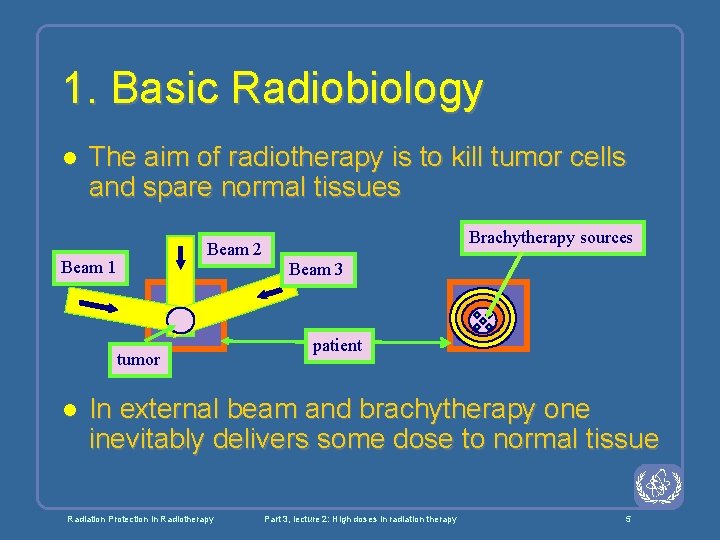
1. Basic Radiobiology l The aim of radiotherapy is to kill tumor cells and spare normal tissues Beam 1 Beam 3 tumor l Brachytherapy sources Beam 2 patient In external beam and brachytherapy one inevitably delivers some dose to normal tissue Radiation Protection in Radiotherapy Part 3, lecture 2: High doses in radiation therapy 5
Basic Radiobiology: target l l l The aim of radiotherapy is to kill tumour cells - they may be in a bulk tumor, in draining lymph nodes and/or in small microscopic spread. Tumour radiobiology is complex - the response depends not only on dose but also on individual radiosensitivity, timing, fraction size, other agents given concurrently (e. g. chemotherapy), … Several pathways to tumour sterilization exist (e. g. mitotic cell death, apoptosis (= programmed cell death), …) Radiation Protection in Radiotherapy Part 3, lecture 2: High doses in radiation therapy 6
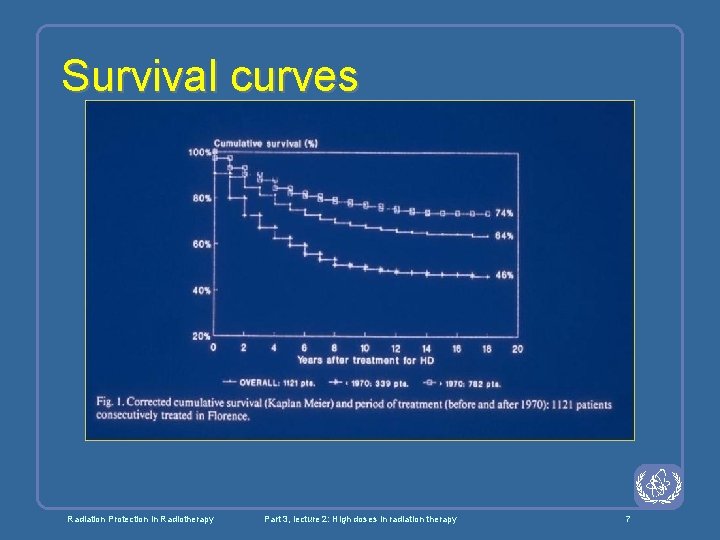
Survival curves Radiation Protection in Radiotherapy Part 3, lecture 2: High doses in radiation therapy 7
Radiobiology: tumor Irradiation kills cells l Different mechanisms of cell kill l Different radio-sensitivity of different tumours l Reduction in size makes tumour l n better oxygenated n grow faster Radiation Protection in Radiotherapy Part 3, lecture 2: High doses in radiation therapy 8
Radiobiology: micrometastasis Tumours may spread first through adjacent tissues and lymph nodes nearby l Need to irradiate small deposits of clonogenic cells early l Less dose required as each fraction of radiation reduces the number of cells by a certain factor l Radiation Protection in Radiotherapy Part 3, lecture 2: High doses in radiation therapy 9
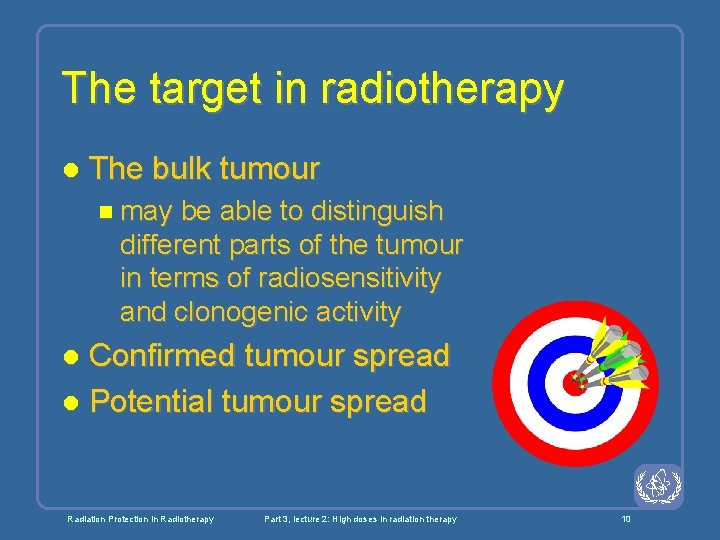
The target in radiotherapy l The bulk tumour n may be able to distinguish different parts of the tumour in terms of radiosensitivity and clonogenic activity Confirmed tumour spread l Potential tumour spread l Radiation Protection in Radiotherapy Part 3, lecture 2: High doses in radiation therapy 10
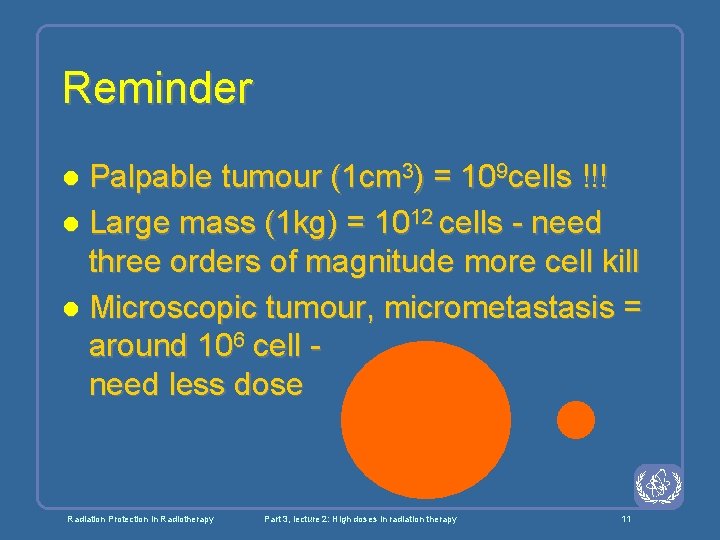
Reminder Palpable tumour (1 cm 3) = 109 cells !!! l Large mass (1 kg) = 1012 cells - need three orders of magnitude more cell kill l Microscopic tumour, micrometastasis = around 106 cell need less dose l Radiation Protection in Radiotherapy Part 3, lecture 2: High doses in radiation therapy 11
Radiobiology: normal tissues l l Sparing of normal tissues is essential for good therapeutic outcome The radiobiology of normal tissues may be even more complex as the one of tumours: n different organs respond differently n there is a response of a cell organization not just of a single cell n repair of damage is in general more important Radiation Protection in Radiotherapy Part 3, lecture 2: High doses in radiation therapy 12
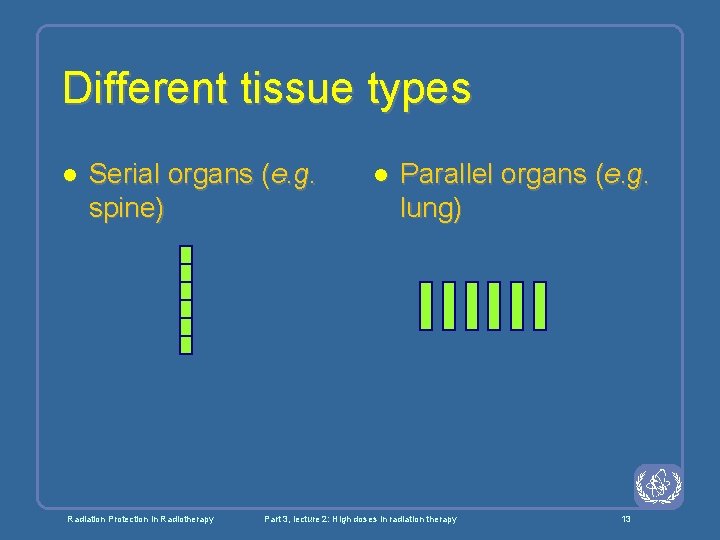
Different tissue types l Serial organs (e. g. spine) Radiation Protection in Radiotherapy l Parallel organs (e. g. lung) Part 3, lecture 2: High doses in radiation therapy 13
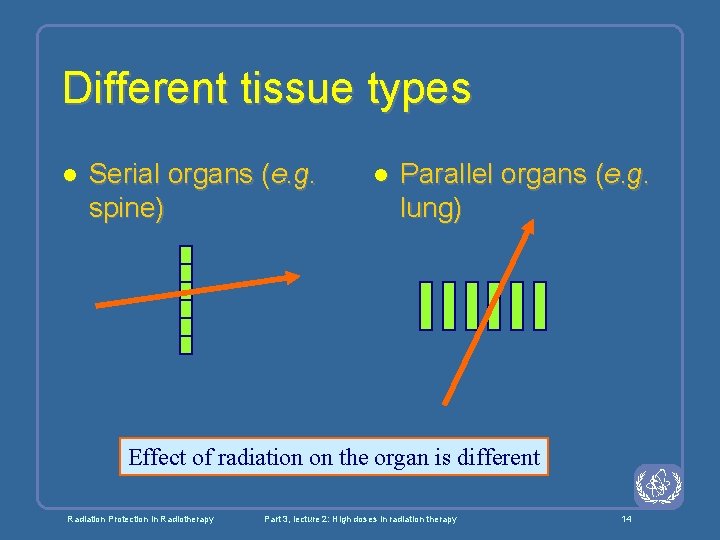
Different tissue types l Serial organs (e. g. spine) l Parallel organs (e. g. lung) Effect of radiation on the organ is different Radiation Protection in Radiotherapy Part 3, lecture 2: High doses in radiation therapy 14
Volume effects l The more normal tissue is irradiated in parallel organs n the greater the pain for the patient n the more chance that a whole organ fails Rule of thumb - the greater the volume the smaller the dose should be l In serial organs even a small volume irradiated beyond a threshold can lead to whole organ failure (e. g. spinal cord) l Radiation Protection in Radiotherapy Part 3, lecture 2: High doses in radiation therapy 15
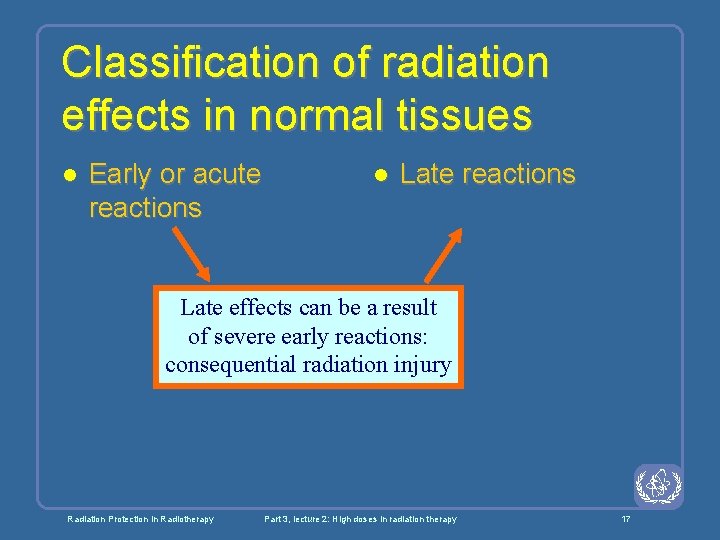
Classification of radiation effects in normal tissues l Early or acute reactions n n l l n Skin reddening, erythema Nausea Vomiting Tiredness Occurs typically during course of RT or within 3 months Radiation Protection in Radiotherapy Late reactions n n n l Telangectesia Spinal cord injury, paralysis Fibrosis Fistulas Occurs later than 6 months after irradiation Part 3, lecture 2: High doses in radiation therapy 16
Classification of radiation effects in normal tissues l Early or acute reactions l Late reactions Late effects can be a result of severe early reactions: consequential radiation injury Radiation Protection in Radiotherapy Part 3, lecture 2: High doses in radiation therapy 17
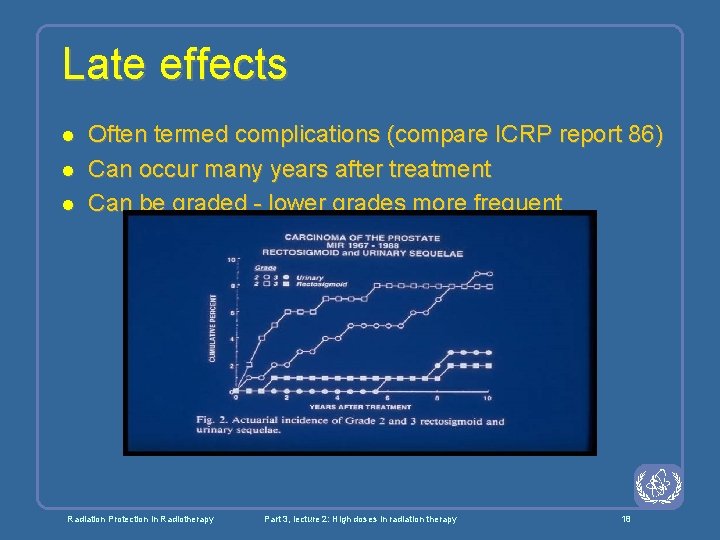
Late effects l l l Often termed complications (compare ICRP report 86) Can occur many years after treatment Can be graded - lower grades more frequent Radiation Protection in Radiotherapy Part 3, lecture 2: High doses in radiation therapy 18
A comment on vascularisation Blood vessels play a very important role in determining radiation effects both for tumours and for normal tissues. l Vascularisation determines oxygenation and therefore radiosensitivity l Late effects may be related to vascular damage l Radiation Protection in Radiotherapy Part 3, lecture 2: High doses in radiation therapy 19
Summary of radiation effects l l l Target in radiotherapy is bulk tumour and confirmed and/or suspected spread Need to know both effects on tumour and normal tissues Normal tissues need to be considered as a whole organ Radiation effects are complex - detailed discussion of radiation effects is beyond the scope of the course Models are used to reduce complexity and allow prediction of effects. . . Radiation Protection in Radiotherapy Part 3, lecture 2: High doses in radiation therapy 20
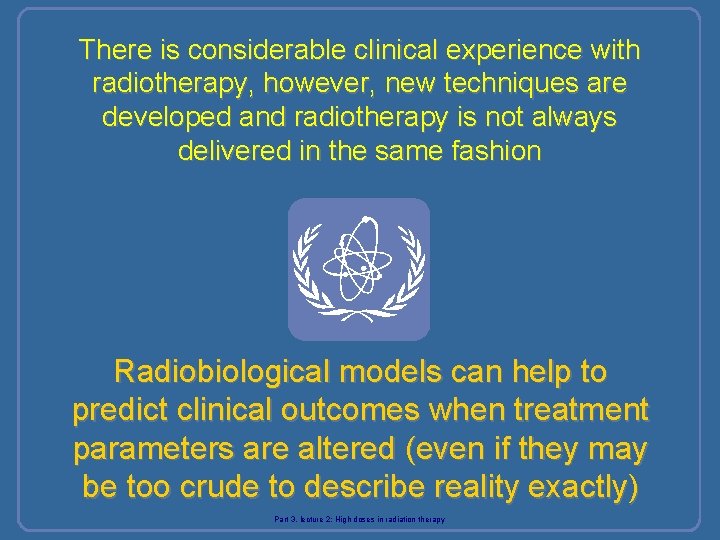
There is considerable clinical experience with radiotherapy, however, new techniques are developed and radiotherapy is not always delivered in the same fashion Radiobiological models can help to predict clinical outcomes when treatment parameters are altered (even if they may be too crude to describe reality exactly) Part 3, lecture 2: High doses in radiation therapy
Radiobiological models l l l Many models exist Based on clinical experience, cell experiments or just the beauty or simplicity of the mathematics One of the simplest and most used is the so called “linear quadratic” or “alpha/beta” model developed and modified by Thames, Withers, Dale, Fowler and many others. Radiation Protection in Radiotherapy Part 3, lecture 2: High doses in radiation therapy 22
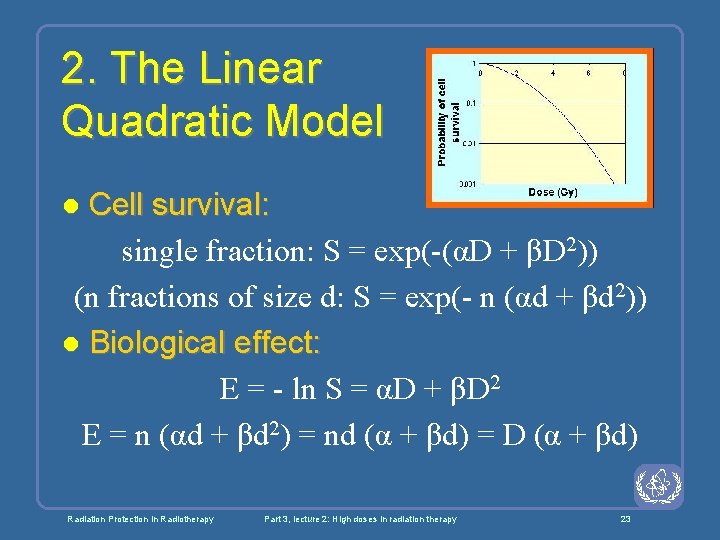
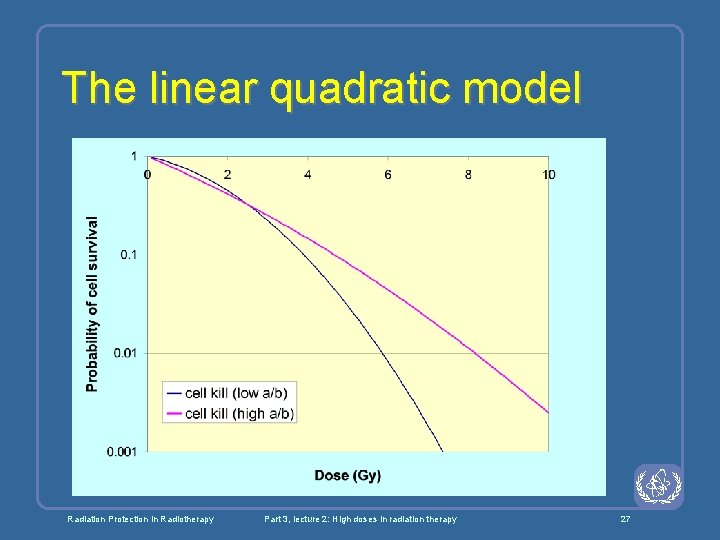
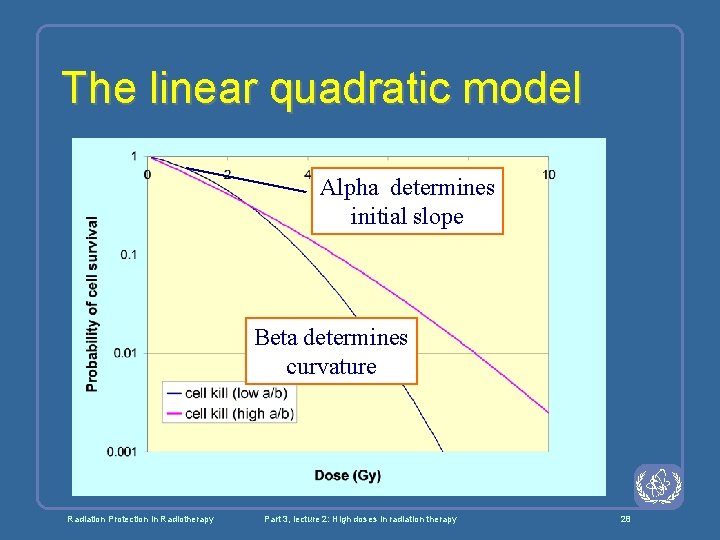
2. The Linear Quadratic Model Cell survival: single fraction: S = exp(-(αD + βD 2)) (n fractions of size d: S = exp(- n (αd + βd 2)) l Biological effect: E = - ln S = αD + βD 2 E = n (αd + βd 2) = nd (α + βd) = D (α + βd) l Radiation Protection in Radiotherapy Part 3, lecture 2: High doses in radiation therapy 23
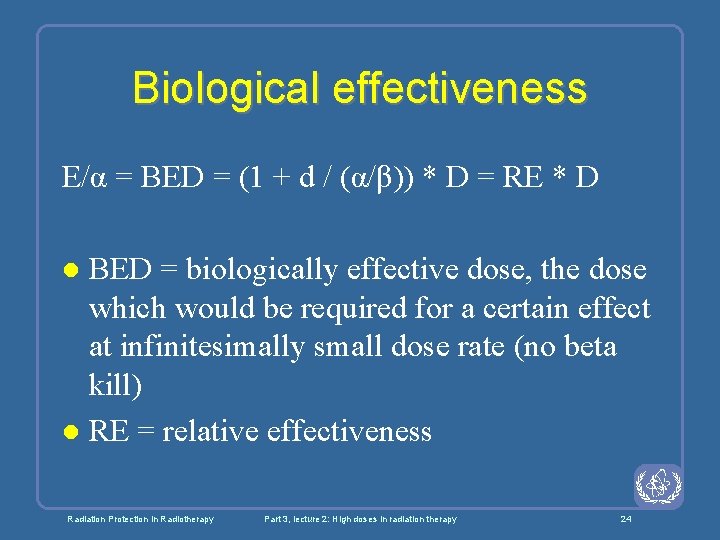
Biological effectiveness E/α = BED = (1 + d / (α/β)) * D = RE * D BED = biologically effective dose, the dose which would be required for a certain effect at infinitesimally small dose rate (no beta kill) l RE = relative effectiveness l Radiation Protection in Radiotherapy Part 3, lecture 2: High doses in radiation therapy 24
Quick question? ? ? What is the physical unit for the a/b ratio? Part 3, lecture 2: High doses in radiation therapy
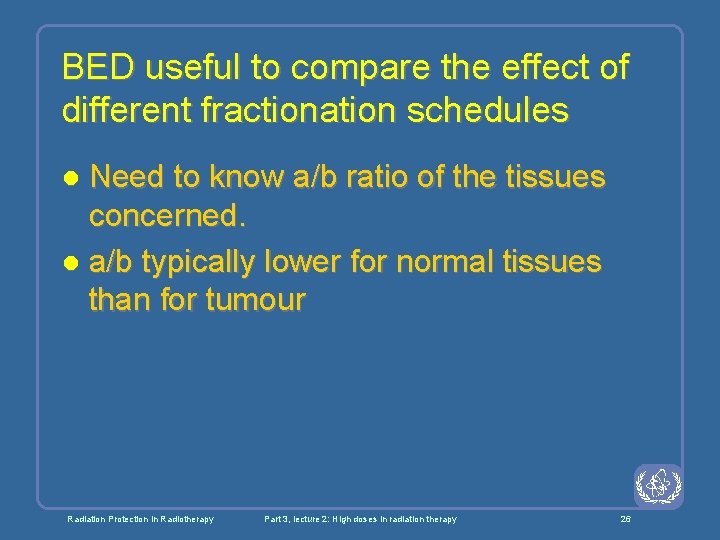
BED useful to compare the effect of different fractionation schedules Need to know a/b ratio of the tissues concerned. l a/b typically lower for normal tissues than for tumour l Radiation Protection in Radiotherapy Part 3, lecture 2: High doses in radiation therapy 26
The linear quadratic model Radiation Protection in Radiotherapy Part 3, lecture 2: High doses in radiation therapy 27
The linear quadratic model Alpha determines initial slope Beta determines curvature Radiation Protection in Radiotherapy Part 3, lecture 2: High doses in radiation therapy 28
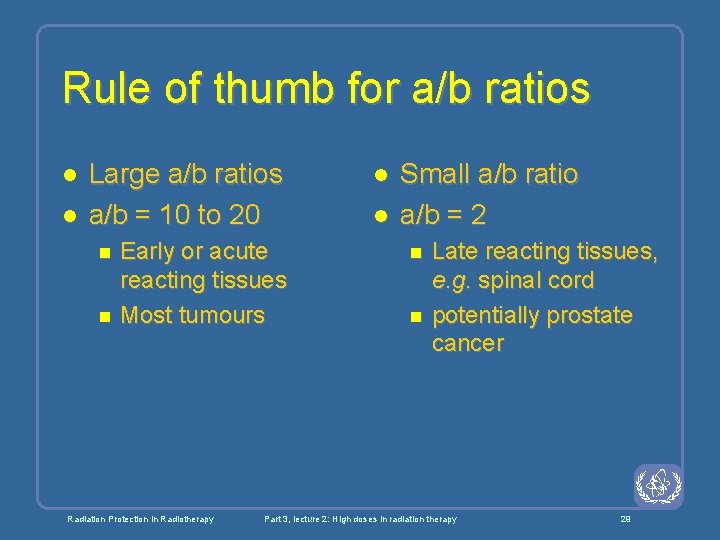
Rule of thumb for a/b ratios l l Large a/b ratios a/b = 10 to 20 n n Early or acute reacting tissues Most tumours Radiation Protection in Radiotherapy l l Small a/b ratio a/b = 2 n n Late reacting tissues, e. g. spinal cord potentially prostate cancer Part 3, lecture 2: High doses in radiation therapy 29
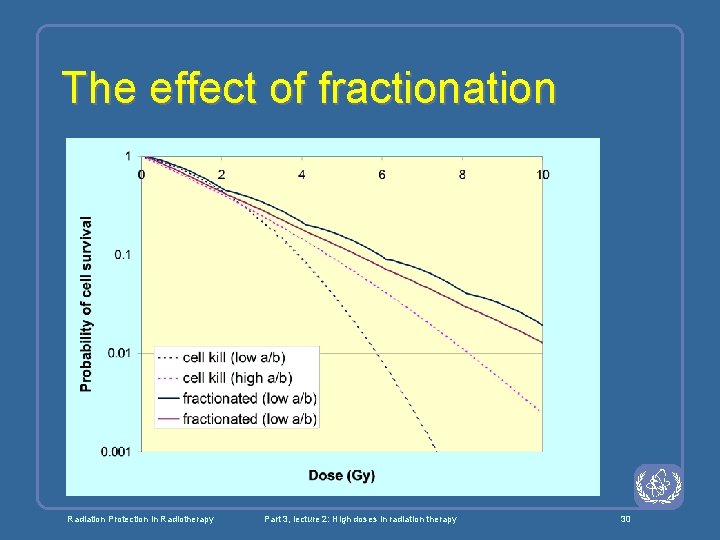
The effect of fractionation Radiation Protection in Radiotherapy Part 3, lecture 2: High doses in radiation therapy 30
Fractionation Tends to spare late reacting normal tissues - the smaller the size of the fraction the more sparing for tissues with low a/b l Prolongs treatment l Radiation Protection in Radiotherapy Part 3, lecture 2: High doses in radiation therapy 31
A note of caution This is only a model l Need to know the radiobiological data for patients l Important assumptions: l n There is full repair between two fractions n There is no proliferation of tumour cells the overall treatment time does not play a role. Radiation Protection in Radiotherapy Part 3, lecture 2: High doses in radiation therapy 32
3. The 4 Rs of radiotherapy l R Withers (1975) l Reoxygenation l Redistribution l Repair l Repopulation (or Regeneration) Radiation Protection in Radiotherapy Part 3, lecture 2: High doses in radiation therapy 33
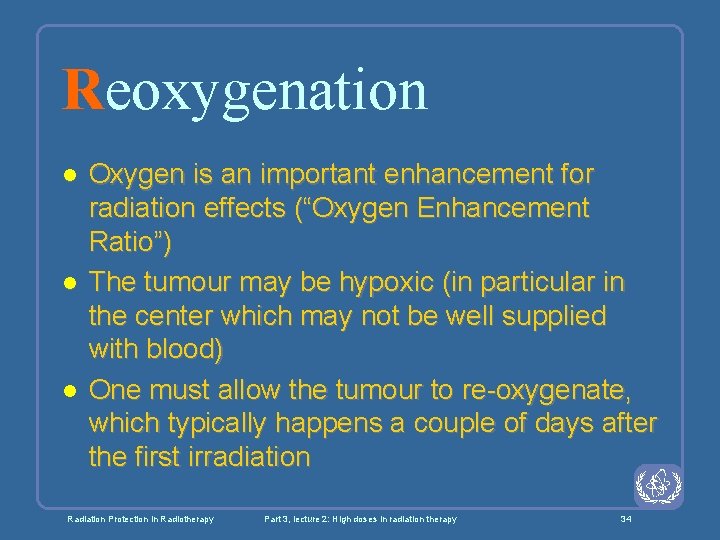
Reoxygenation l l l Oxygen is an important enhancement for radiation effects (“Oxygen Enhancement Ratio”) The tumour may be hypoxic (in particular in the center which may not be well supplied with blood) One must allow the tumour to re-oxygenate, which typically happens a couple of days after the first irradiation Radiation Protection in Radiotherapy Part 3, lecture 2: High doses in radiation therapy 34
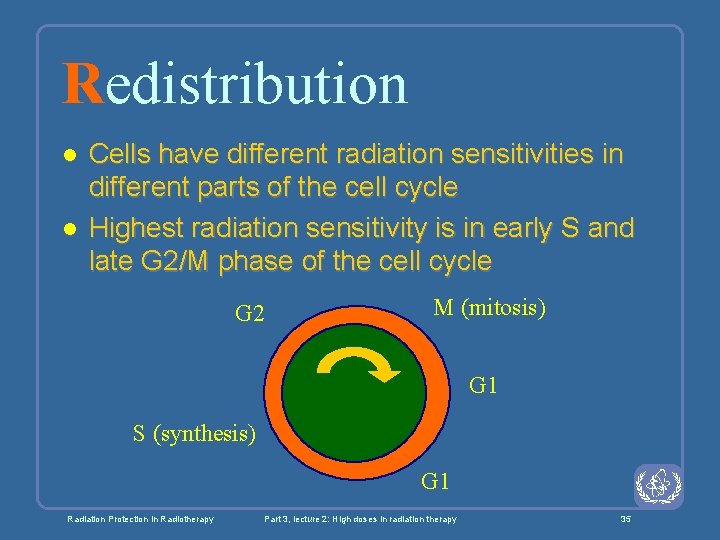
Redistribution l l Cells have different radiation sensitivities in different parts of the cell cycle Highest radiation sensitivity is in early S and late G 2/M phase of the cell cycle G 2 M (mitosis) G 1 S (synthesis) G 1 Radiation Protection in Radiotherapy Part 3, lecture 2: High doses in radiation therapy 35
Redistribution The distribution of cells in different phases of the cycle is normally not something which can be influenced however, radiation itself introduces a block of cells in G 2 phase which leads to a synchronization l One must consider this when irradiating cells with breaks of few hours. l Radiation Protection in Radiotherapy Part 3, lecture 2: High doses in radiation therapy 36
Repair l l All cells repair radiation damage This is part of normal damage repair in the DNA Repair is very effective because DNA is damaged significantly more due to ‘normal’ other influences (e. g. temperature, chemicals) than due to radiation (factor 1000!) The half time for repair, tr, is of the order of minutes to hours Radiation Protection in Radiotherapy Part 3, lecture 2: High doses in radiation therapy 37
Repair l l l It is essential to allow normal tissues to repair all repairable radiation damage prior to giving another fraction of radiation. This leads to a minimum interval between fractions of 6 hours Spinal cord seems to have a particularly slow repair - therefore, breaks between fractions should be at least 8 hours if spinal cord is irradiated. Radiation Protection in Radiotherapy Part 3, lecture 2: High doses in radiation therapy 38
Repopulation l l l Cell population also grows during radiotherapy For tumour cells this repopulation partially counteracts the cell killing effect of radiotherapy The potential doubling time of tumours, Tp (e. g. in head and neck tumours or cervix cancer) can be as short as 2 days - therefore one loses up to 1 Gy worth of cell killing when prolonging the course of radiotherapy Radiation Protection in Radiotherapy Part 3, lecture 2: High doses in radiation therapy 39
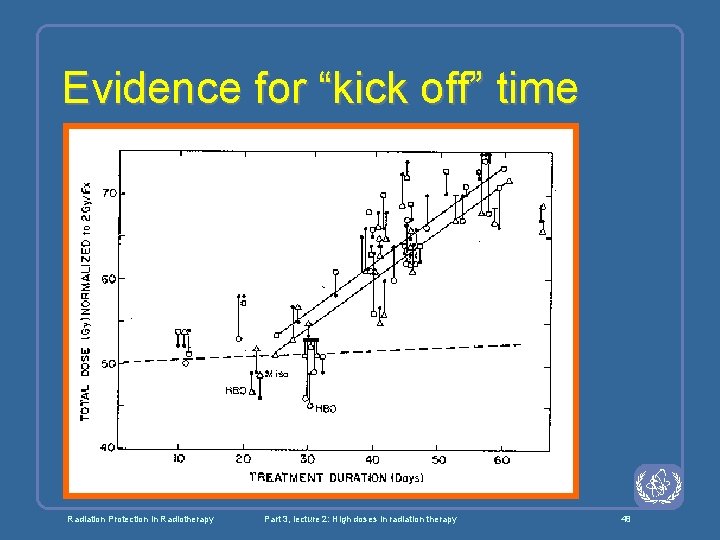
Repopulation l l The repopulation time of tumour cells appears to vary during radiotherapy - at the commencement it may be slow (e. g. due to hypoxia), however a certain time after the first fraction of radiotherapy (often termed the “kick-off time”, Tk) repopulation accelerates. Repopulation must be taken into account when protracting radiation e. g. due to scheduled (or unscheduled) breaks such as holidays. Radiation Protection in Radiotherapy Part 3, lecture 2: High doses in radiation therapy 40
Repopulation/ Regeneration l l Also normal tissue repopulate - this is an important mechanism to reduce acute side effects from e. g. the irradiation of skin or mucosa Radiation schedules must allow sufficient regeneration time for acutely reacting tissues. Radiation Protection in Radiotherapy Part 3, lecture 2: High doses in radiation therapy 41
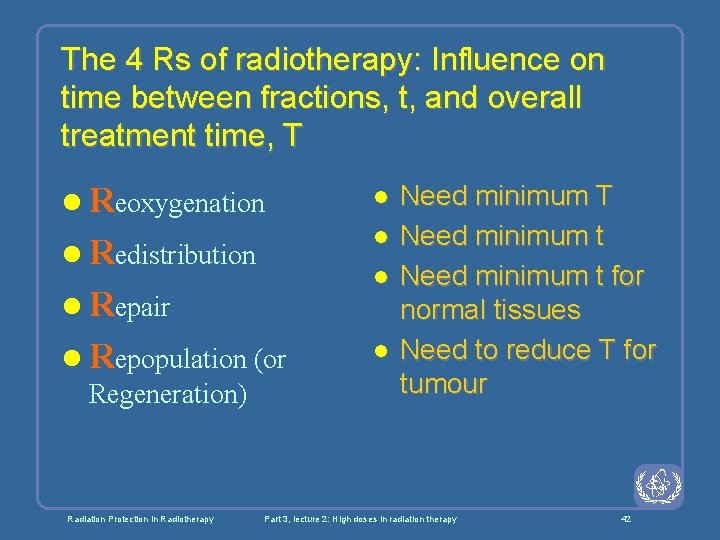
The 4 Rs of radiotherapy: Influence on time between fractions, t, and overall treatment time, T l Reoxygenation l l Redistribution l l l Repair l Repopulation (or Regeneration) Radiation Protection in Radiotherapy l Need minimum T Need minimum t for normal tissues Need to reduce T for tumour Part 3, lecture 2: High doses in radiation therapy 42
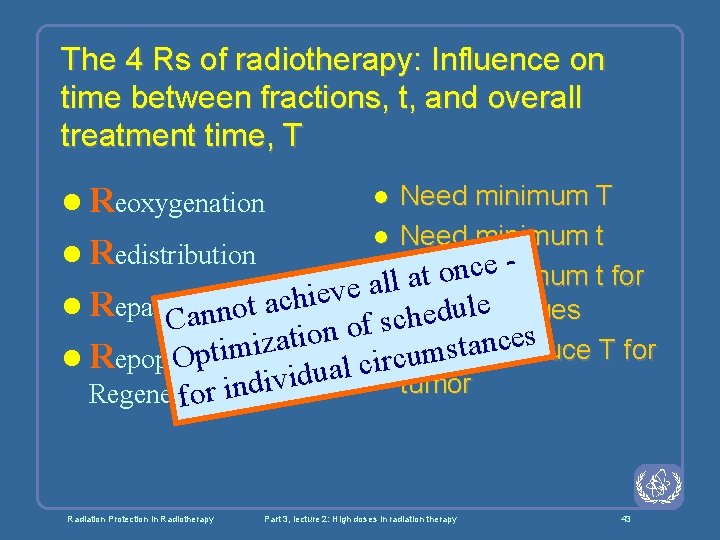
The 4 Rs of radiotherapy: Influence on time between fractions, t, and overall treatment time, T Need minimum T l Need minimum t l Redistribution e c n o lll. Need t minimum t for a a e v e i h c a e l Repair annot l normal tissues u d e h c C s f o n o s i e t c a z n i a t m l Need to reduce T for s l Repopulation Opti (or ual circum d i v i tumor d n i Regeneration) for l Reoxygenation Radiation Protection in Radiotherapy l Part 3, lecture 2: High doses in radiation therapy 43
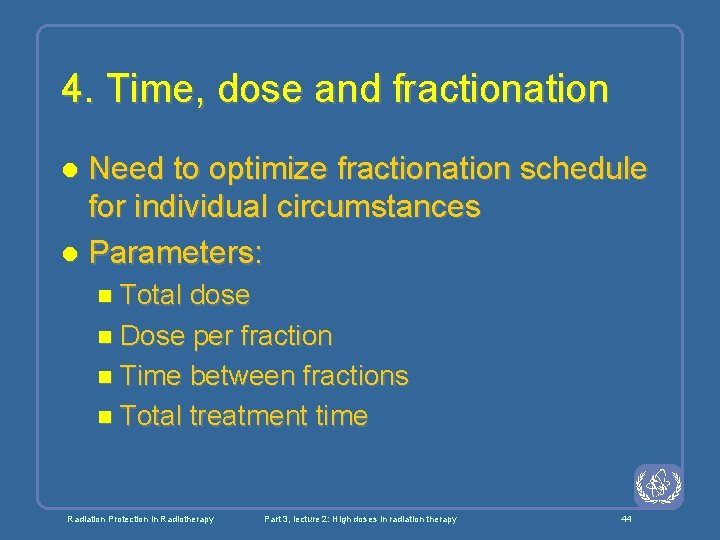
4. Time, dose and fractionation Need to optimize fractionation schedule for individual circumstances l Parameters: l n Total dose n Dose per fraction n Time between fractions n Total treatment time Radiation Protection in Radiotherapy Part 3, lecture 2: High doses in radiation therapy 44
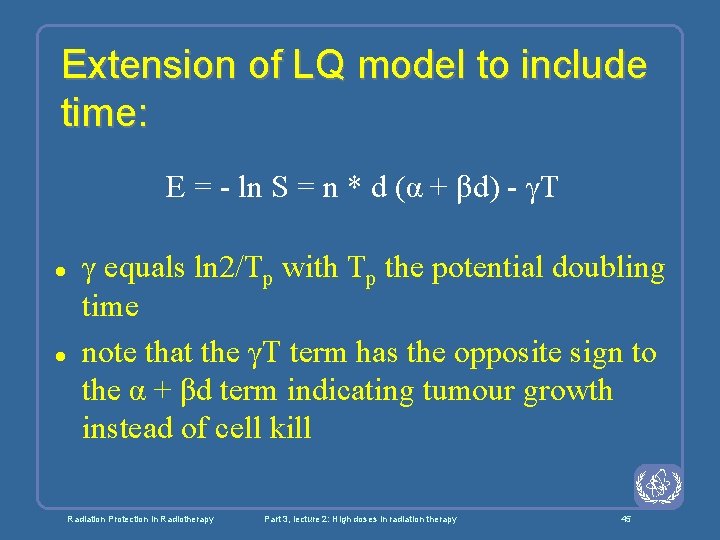
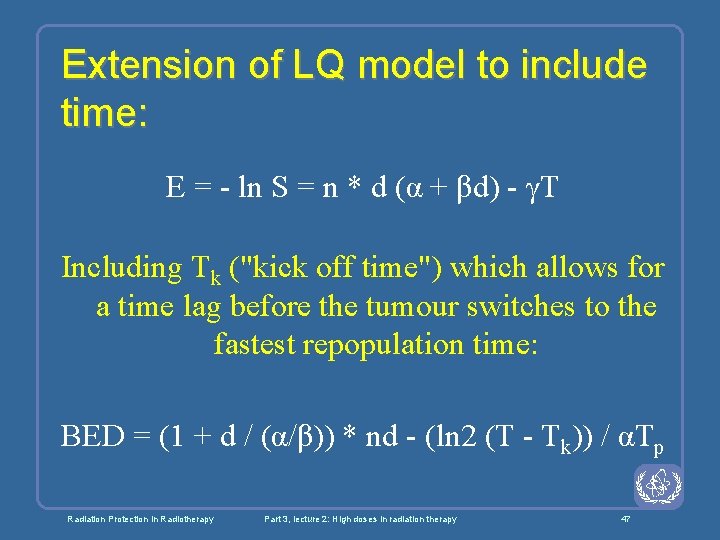
Extension of LQ model to include time: E = - ln S = n * d (α + βd) - γT l l γ equals ln 2/Tp with Tp the potential doubling time note that the γT term has the opposite sign to the α + βd term indicating tumour growth instead of cell kill Radiation Protection in Radiotherapy Part 3, lecture 2: High doses in radiation therapy 45
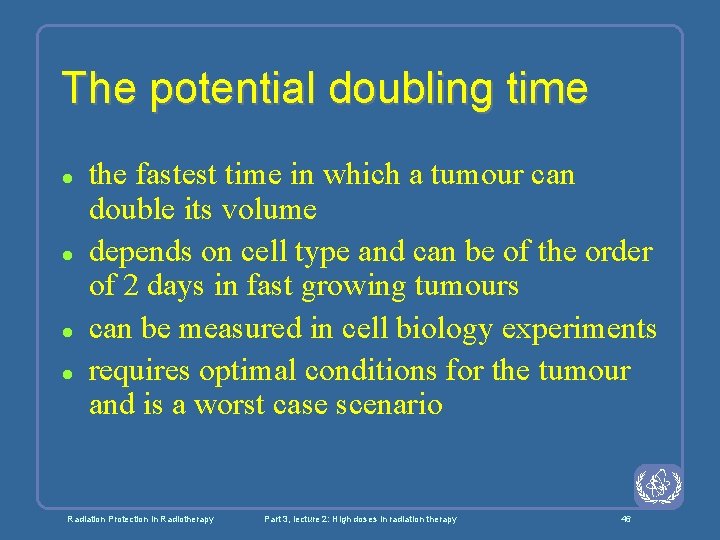
The potential doubling time l l the fastest time in which a tumour can double its volume depends on cell type and can be of the order of 2 days in fast growing tumours can be measured in cell biology experiments requires optimal conditions for the tumour and is a worst case scenario Radiation Protection in Radiotherapy Part 3, lecture 2: High doses in radiation therapy 46
Extension of LQ model to include time: E = - ln S = n * d (α + βd) - γT Including Tk ("kick off time") which allows for a time lag before the tumour switches to the fastest repopulation time: BED = (1 + d / (α/β)) * nd - (ln 2 (T - Tk)) / αTp Radiation Protection in Radiotherapy Part 3, lecture 2: High doses in radiation therapy 47
Evidence for “kick off” time Radiation Protection in Radiotherapy Part 3, lecture 2: High doses in radiation therapy 48
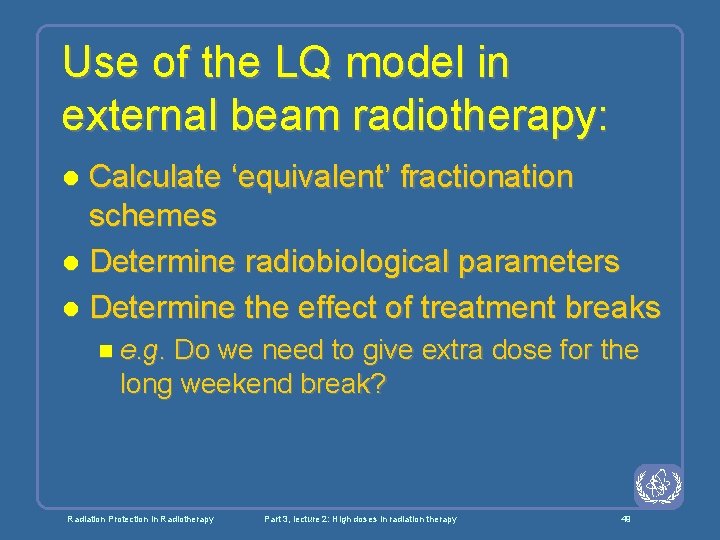
Use of the LQ model in external beam radiotherapy: Calculate ‘equivalent’ fractionation schemes l Determine radiobiological parameters l Determine the effect of treatment breaks l n e. g. Do we need to give extra dose for the long weekend break? Radiation Protection in Radiotherapy Part 3, lecture 2: High doses in radiation therapy 49
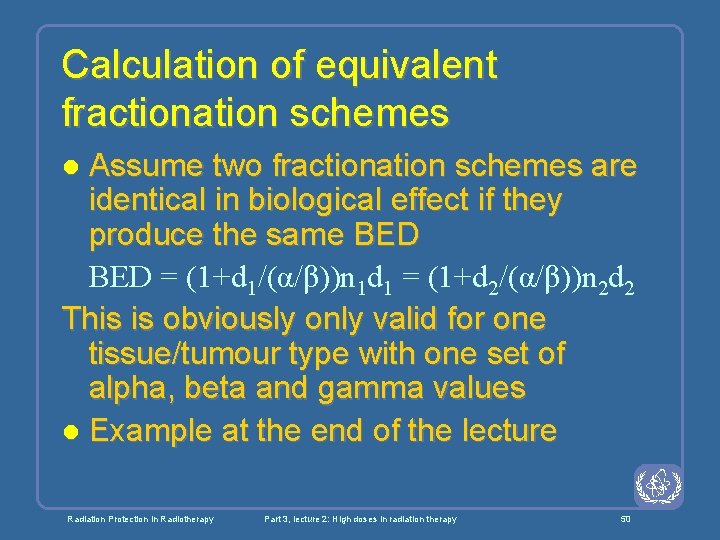
Calculation of equivalent fractionation schemes Assume two fractionation schemes are identical in biological effect if they produce the same BED = (1+d 1/(α/β))n 1 d 1 = (1+d 2/(α/β))n 2 d 2 This is obviously only valid for one tissue/tumour type with one set of alpha, beta and gamma values l Example at the end of the lecture l Radiation Protection in Radiotherapy Part 3, lecture 2: High doses in radiation therapy 50
Brachytherapy l Typically not a homogenous dose distribution n Low dose rate treatment possible n High dose rate treatments are typically given with larger fractions than external beam radiotherapy n Pulsed dose rate somewhere in between Radiation Protection in Radiotherapy Part 3, lecture 2: High doses in radiation therapy 51
LQ model can be extended to brachytherapy HDR with short high dose fractions can be handled very similarly to external beam radiotherapy l However, the dose inhomogeneities inherent in brachytherapy (compare parts 6 and 11 of the course) make a good calculation difficult. l Radiation Protection in Radiotherapy Part 3, lecture 2: High doses in radiation therapy 52
LDR brachytherapy An extension of the LQ model to cover low dose rates with significant repair occurring during treatment l Mathematics developed by R Dale (1985) l Too complex for present course… l Radiation Protection in Radiotherapy Part 3, lecture 2: High doses in radiation therapy 53
Brachytherapy l LQ model allows BED calculation for brachytherapy n comparison possible for external beam and brachytherapy n adding of biologically effective doses possible l Brachytherapy has the potential to minimize the dose to normal structures probably still the most important factor is good geometry of an implant Radiation Protection in Radiotherapy Part 3, lecture 2: High doses in radiation therapy 54
However, caution is necessary All models are just models l The radiobiological parameters are not well known l Parameters for a population of patients may not apply to an individual patient l Radiation Protection in Radiotherapy Part 3, lecture 2: High doses in radiation therapy 55
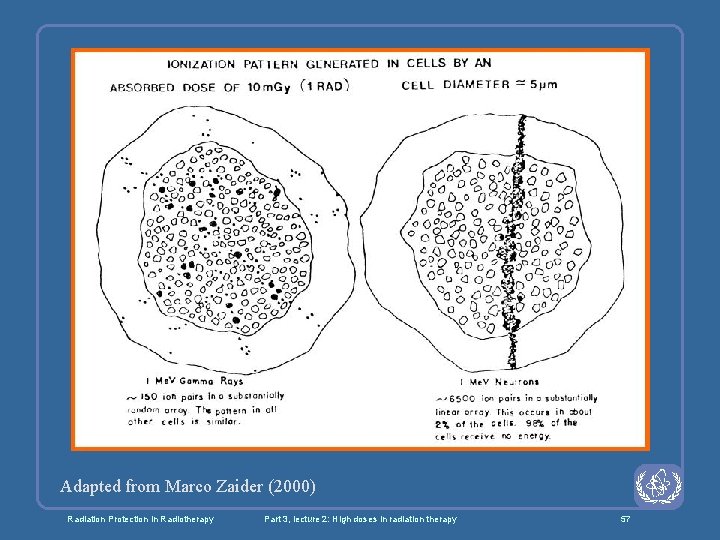
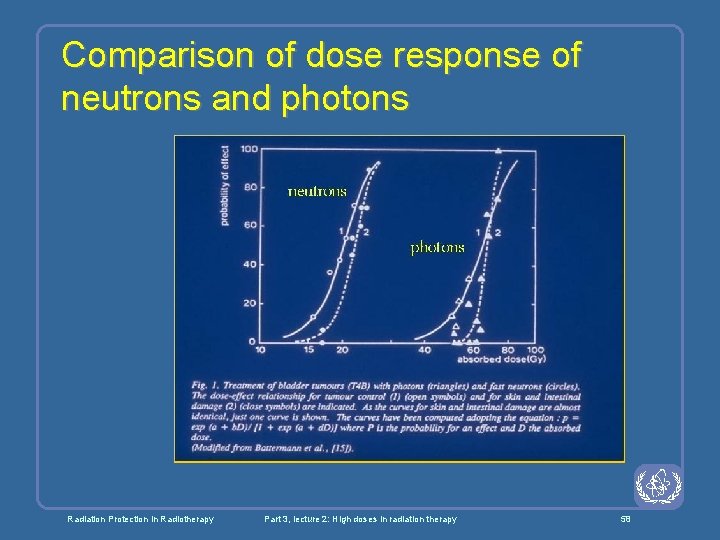
A note on different radiation qualities l Not only in radiation protection is there a different effectiveness of different radiation types - however: n The effect of concern is different n The Relative Biological Effectiveness (RBE values) is different - e. g. for neutrons in therapy RBE is about 3 n The effect of fractionation may be VERY different Radiation Protection in Radiotherapy Part 3, lecture 2: High doses in radiation therapy 56
Adapted from Marco Zaider (2000) Radiation Protection in Radiotherapy Part 3, lecture 2: High doses in radiation therapy 57
Comparison of dose response of neutrons and photons Radiation Protection in Radiotherapy Part 3, lecture 2: High doses in radiation therapy 58
Summary l l Radiobiology is essential to understand the effects of radiotherapy It is also important for radiation protection of the patient as it allows minimization of the radiation effects in healthy tissues There are models which allow to estimate the effect of a given radiotherapy schedule Caution is necessary when applying a model to an individual patient - clinical judgement should not be overruled Radiation Protection in Radiotherapy Part 3, lecture 2: High doses in radiation therapy 59
Where to Get More Information Other sessions l References: l n Steel G (ed): Radiobiology, 2 nd ed. 1997 n Hall E: Radiobiology for the radiologist, 3 rd ed. Lippincott, Philadelphia 1988 n Withers R. The four Rs of radiotherapy. Adv. Radiat. Biol. 5: 241 -271; 1975 Radiation Protection in Radiotherapy Part 3, lecture 2: High doses in radiation therapy 60
Any questions? Part 3, lecture 2: High doses in radiation therapy
Question: Please calculate the dose per fraction in a five fraction treatment for a palliative radiotherapy treatment which results in the same biologically effective dose to the tumour as a single fraction of 8 Gy (assume a/b = 20 Gy (tumour) or 2 Gy (spinal cord)). Part 3, lecture 2: High doses in radiation therapy
Answer (part 1) l l l Assuming no time effects (i. e. time between fractions is large enough to allow full repair and the overall treatment time is short enough to prohibit significant repopulation during the treatment) the biologically effective dose (BED) of the treatment schedules can be calculated as BED = nd (1 + d/(a/b)) with n number of fractions, d dose per fraction and a/b the alphabeta ratio BED (tumour, single fraction) = 1 * 8 (1 + 8/20) = 11. 2 Gy Radiation Protection in Radiotherapy Part 3, lecture 2: High doses in radiation therapy 63
Answer (part 2) l l to get a similar BED in five fractions for the tumour, one needs to deliver 2 Gy per fraction (BED = 11 Gy) BED (spinal cord, single fraction) = 1 * 8 (1 + 8/2) = 40 Gy to get a similar BED in five fractions for the spinal cord, one needs to deliver 3. 1 Gy per fraction (BED = 39. 5 Gy) This example illustrates how much more sensitive late reacting normal tissue is to fractionation. The single dose of 8 Gy is nearly 4 times more toxic to spinal cord than to a tumour. Radiation Protection in Radiotherapy Part 3, lecture 2: High doses in radiation therapy 64