
IAEA Training Material on Radiation Protection in Diagnostic
- Slides: 61
IAEA Training Material on Radiation Protection in Diagnostic and Interventional Radiology Adapted for Regional Training Course on RP of Patients for Radiographers Accra, Ghana, 11 -15 July 2011 RADIATION PROTECTION IN DIAGNOSTIC AND INTERVENTIONAL RADIOLOGY L 13: Occupational Radiation Protection IAEA International Atomic Energy Agency
Topics • • • Organization, responsibilities and training Conditions of service & special arrangements Classification of areas Local rules and procedures • Working with X rays Personal protective equipment Individual monitoring and exposure assessment Investigation and follow up Health surveillance Records IAEA 13: Occupational radiation protection 2
IAEA Training Material on Radiation Protection in Diagnostic and Interventional Radiology Part 13: Occupational radiation protection Topic 1: Responsibilities and training IAEA International Atomic Energy Agency
Occupational exposure – definition Exposure of workers incurred in the course of their work IAEA 13: Occupational radiation protection 4
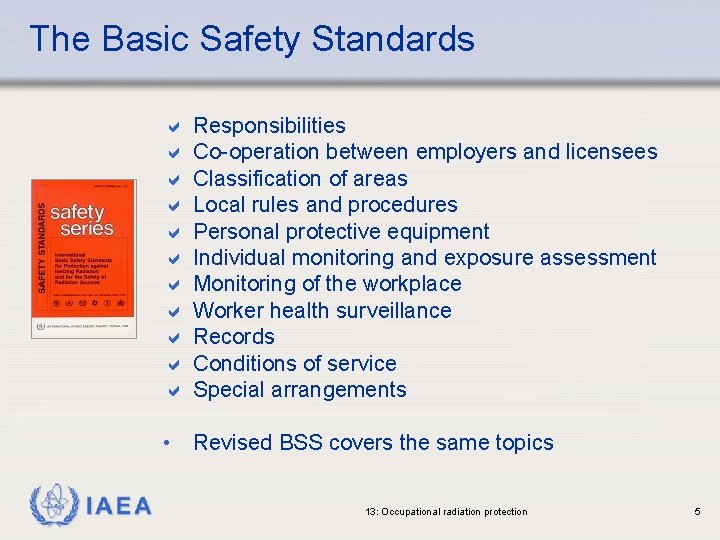
The Basic Safety Standards a a a Responsibilities Co-operation between employers and licensees Classification of areas Local rules and procedures Personal protective equipment Individual monitoring and exposure assessment Monitoring of the workplace Worker health surveillance Records Conditions of service Special arrangements • Revised BSS covers the same topics IAEA 13: Occupational radiation protection 5
Responsibilities (revised BSS) • Employers and licensees must ensure for all workers that: • Occupational dose limits are not exceeded • Protection and safety are optimized • Suitable and adequate facilities, equipment and services • • for protection are provided Appropriate monitoring equipment and personal protective equipment are provided and properly used Appropriate training is provided as well as periodic retraining and updating Adequate records are maintained A safety culture is provided IAEA 13: Occupational radiation protection 6
Responsibilities (revised BSS) Workers must: • follow any applicable rules for protection • use properly the monitoring devices and the personal protective equipment provided • co-operate with the employer and licensee with respect to protection • etc. . . IAEA 13: Occupational radiation protection 7
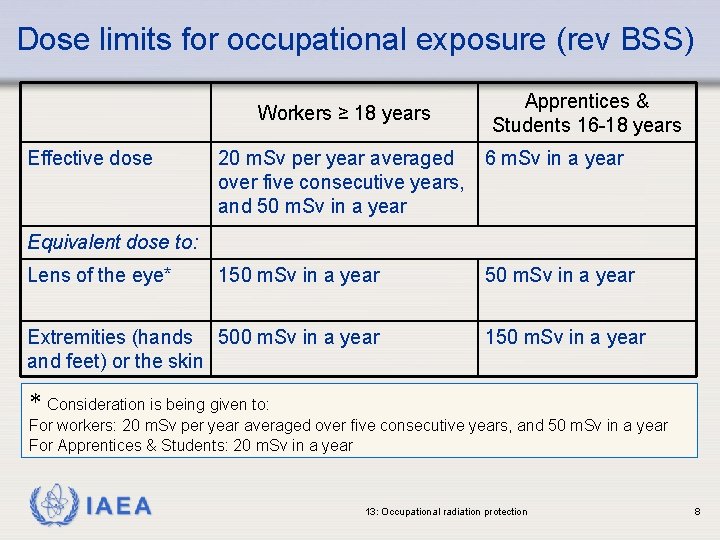
Dose limits for occupational exposure (rev BSS) Workers ≥ 18 years Effective dose Apprentices & Students 16 -18 years 20 m. Sv per year averaged 6 m. Sv in a year over five consecutive years, and 50 m. Sv in a year Equivalent dose to: Lens of the eye* 150 m. Sv in a year Extremities (hands 500 m. Sv in a year and feet) or the skin 50 m. Sv in a year 150 m. Sv in a year * Consideration is being given to: For workers: 20 m. Sv per year averaged over five consecutive years, and 50 m. Sv in a year For Apprentices & Students: 20 m. Sv in a year IAEA 13: Occupational radiation protection 8
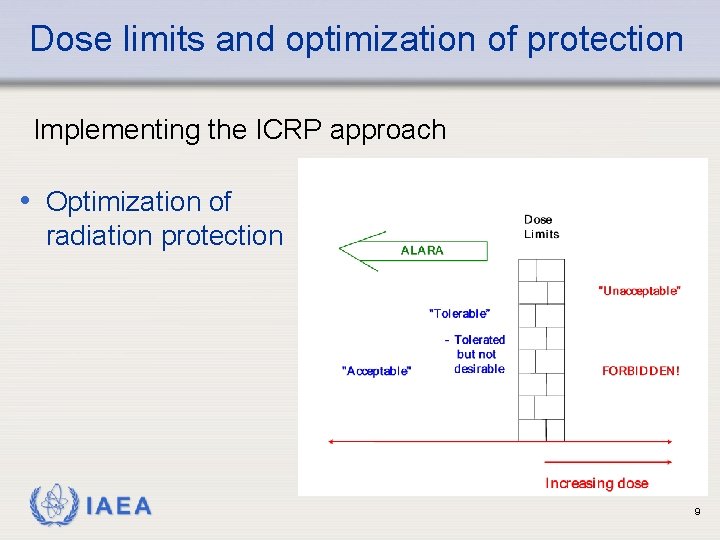
Dose limits and optimization of protection Implementing the ICRP approach • Optimization of radiation protection IAEA 9
IAEA Training Material on Radiation Protection in Diagnostic and Interventional Radiology Part 13: Occupational RP Topic 2: Conditions of service & special arrangements IAEA International Atomic Energy Agency
Conditions of service • Employers and licensees must not offer other benefits as substitutes for measures for protection and safety IAEA 13: Occupational radiation protection 11
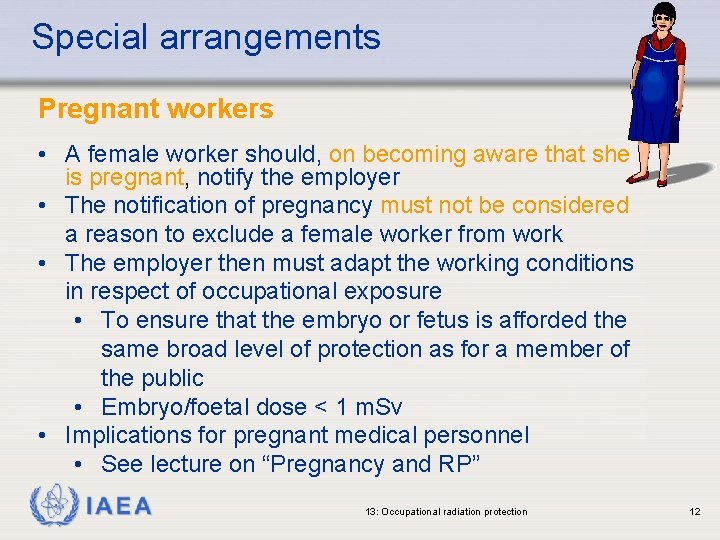
Special arrangements Pregnant workers • A female worker should, on becoming aware that she is pregnant, notify the employer • The notification of pregnancy must not be considered a reason to exclude a female worker from work • The employer then must adapt the working conditions in respect of occupational exposure • To ensure that the embryo or fetus is afforded the same broad level of protection as for a member of the public • Embryo/foetal dose < 1 m. Sv • Implications for pregnant medical personnel • See lecture on “Pregnancy and RP” IAEA 13: Occupational radiation protection 12
IAEA Training Material on Radiation Protection in Diagnostic and Interventional Radiology Part 13: Occupational RP Topic 3: Classification of Areas IAEA International Atomic Energy Agency
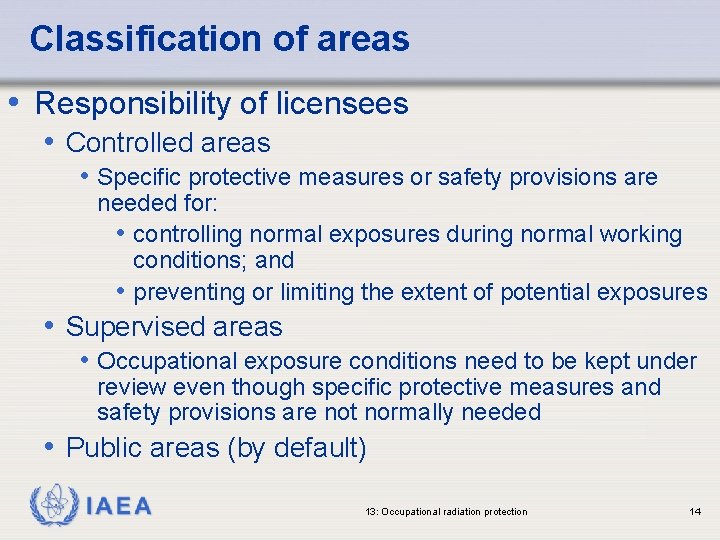
Classification of areas • Responsibility of licensees • Controlled areas • Specific protective measures or safety provisions are needed for: • controlling normal exposures during normal working conditions; and • preventing or limiting the extent of potential exposures • Supervised areas • Occupational exposure conditions need to be kept under review even though specific protective measures and safety provisions are not normally needed • Public areas (by default) IAEA 13: Occupational radiation protection 14
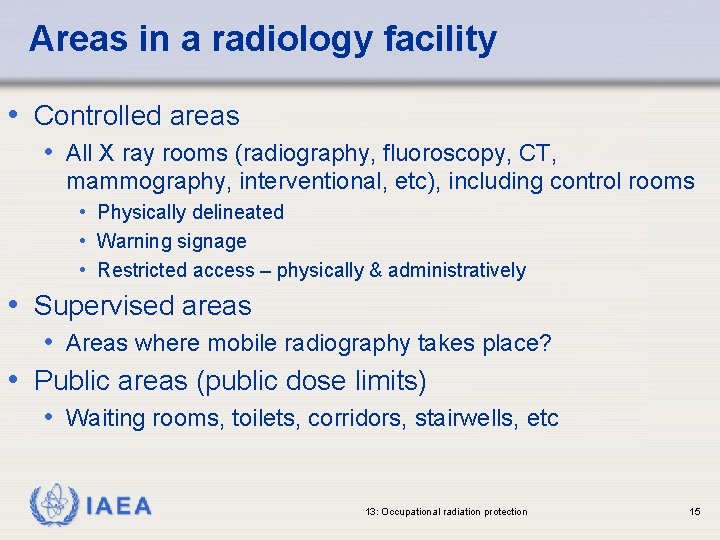
Areas in a radiology facility • Controlled areas • All X ray rooms (radiography, fluoroscopy, CT, mammography, interventional, etc), including control rooms • Physically delineated • Warning signage • Restricted access – physically & administratively • Supervised areas • Areas where mobile radiography takes place? • Public areas (public dose limits) • Waiting rooms, toilets, corridors, stairwells, etc IAEA 13: Occupational radiation protection 15
IAEA Training Material on Radiation Protection in Diagnostic and Interventional Radiology Part 13: Occupational RP Topic 4: Local rules and procedures - working with X rays IAEA International Atomic Energy Agency
Local rules and procedures (rev BSS) • Employers and licensees must (in consultation with workers): • Establish in writing such local rules and procedures as are necessary to ensure protection and safety for workers and other persons • Including investigation levels and their procedures • Make the local rules known to workers and to other persons • Ensure any work is adequately supervised • Designate a Radiation Protection Officer (RPO) IAEA 13: Occupational radiation protection 17
Medical personnel working with radiation • Two “sources” of occupational exposure • The radiation source (e. g. X Ray tube, Linac, sealed source, unsealed source) • Directly • Indirectly, through scatter or contamination • The patient • “Looking after” the patient (dose) IAEA 13: Occupational radiation protection 18
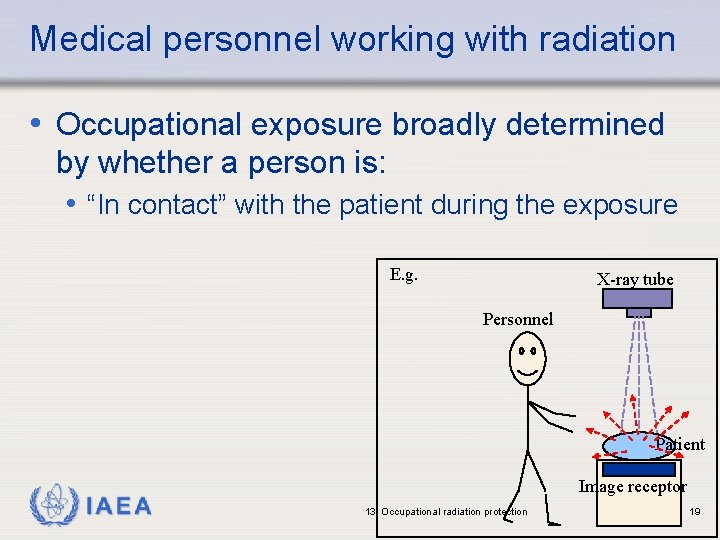
Medical personnel working with radiation • Occupational exposure broadly determined by whether a person is: • “In contact” with the patient during the exposure E. g. X-ray tube Personnel Patient IAEA Image receptor 13: Occupational radiation protection 19
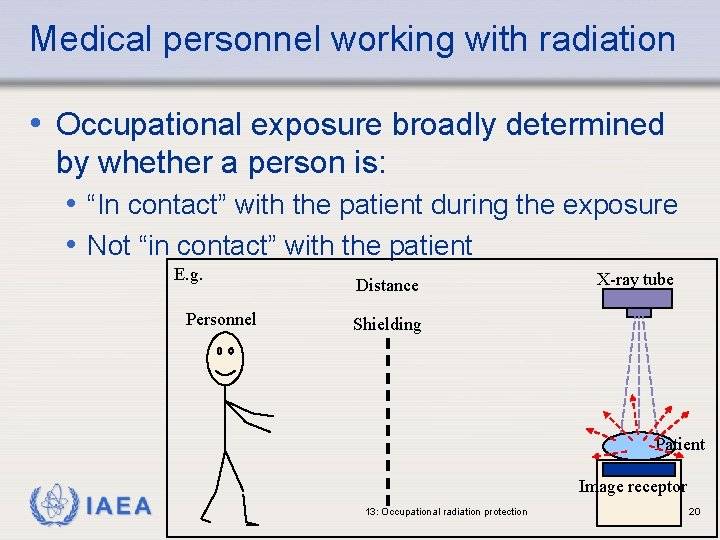
Medical personnel working with radiation • Occupational exposure broadly determined by whether a person is: • “In contact” with the patient during the exposure • Not “in contact” with the patient E. g. Personnel Distance X-ray tube Shielding Patient IAEA Image receptor 13: Occupational radiation protection 20
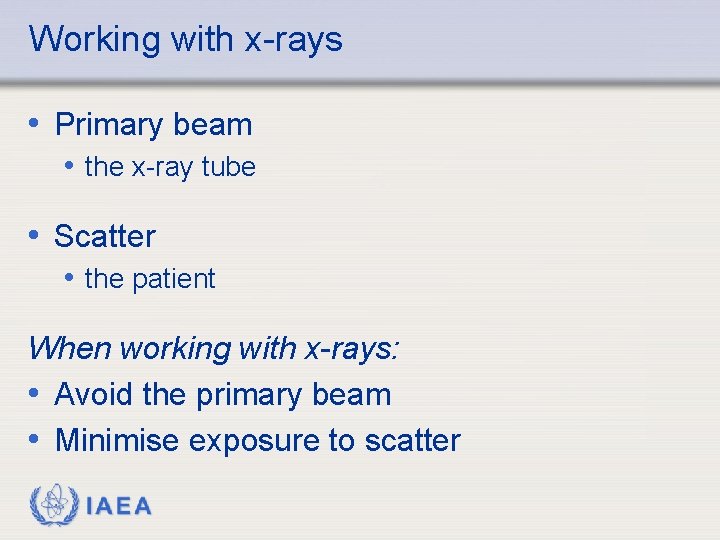
Working with x-rays • Primary beam • the x-ray tube • Scatter • the patient When working with x-rays: • Avoid the primary beam • Minimise exposure to scatter IAEA
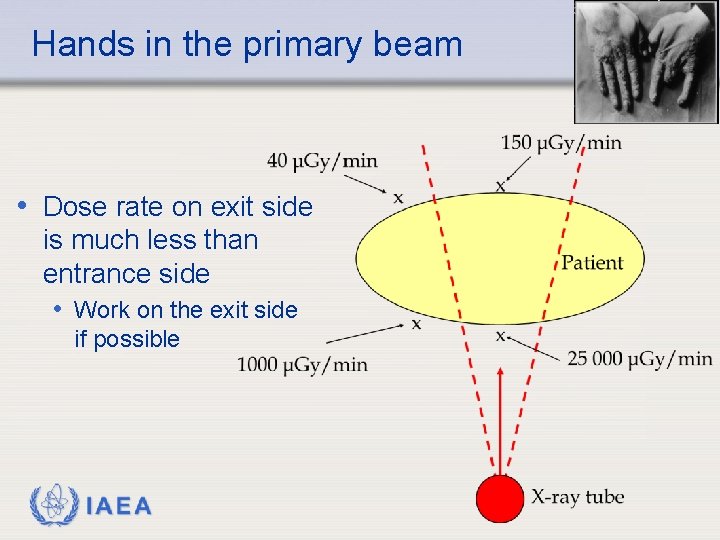
Hands in the primary beam • Dose rate on exit side is much less than entrance side • Work on the exit side if possible IAEA
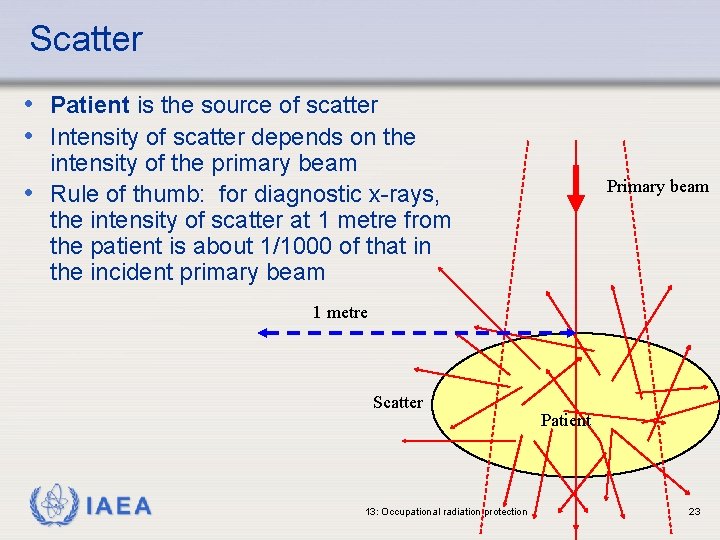
Scatter • Patient is the source of scatter • Intensity of scatter depends on the intensity of the primary beam • Rule of thumb: for diagnostic x-rays, the intensity of scatter at 1 metre from the patient is about 1/1000 of that in the incident primary beam Primary beam 1 metre Scatter IAEA 13: Occupational radiation protection Patient 23
For a given source of scatter • Distance • Time • Shielding are used to minimise occupational exposure IAEA
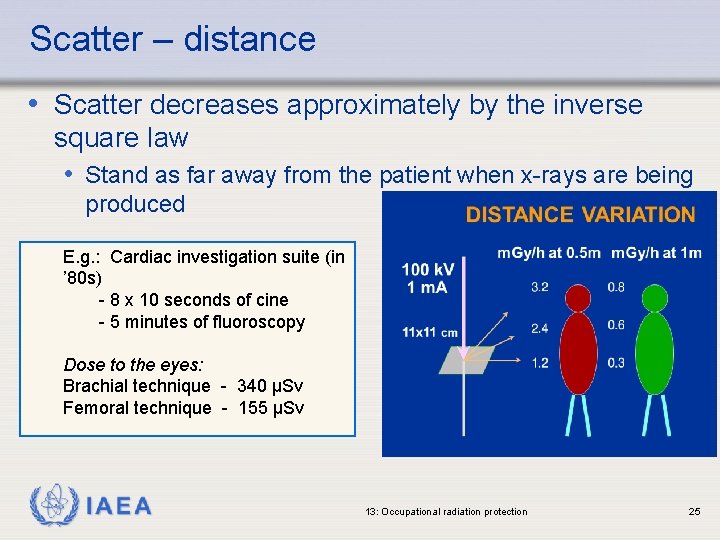
Scatter – distance • Scatter decreases approximately by the inverse square law • Stand as far away from the patient when x-rays are being produced E. g. : Cardiac investigation suite (in ’ 80 s) - 8 x 10 seconds of cine - 5 minutes of fluoroscopy Dose to the eyes: Brachial technique - 340 µSv Femoral technique - 155 µSv IAEA 13: Occupational radiation protection 25
Scatter – time • Minimise the time spent in areas where scatter is present • Only be in the X-ray room or theatre if required to be • Minimise the “beam on” time in fluoroscopy & interventional procedures • Use last image hold • Minimise the no. of and length of “cine” runs IAEA 13: Occupational radiation protection 26
Scatter – shielding • Shielding in walls, doors, windows, ceilings, floors • Permanent operator barriers • Personal protective equipment • Movable barriers IAEA 13: Occupational radiation protection 27
Factors affecting how much scatter • The patient • Big patients require more radiation • More scatter!! • How the examination is performed • Higher patient dose • Higher levels of scatter • Look after the patient!! • Covered in other lectures IAEA 13: Occupational radiation protection 28
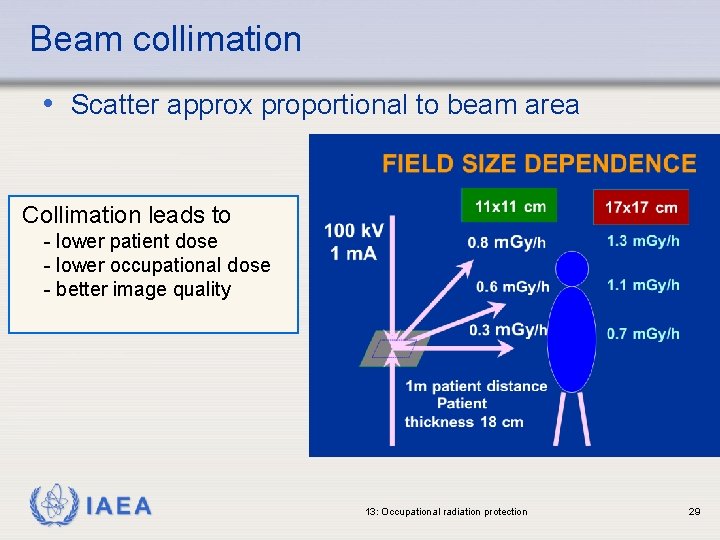
Beam collimation • Scatter approx proportional to beam area Collimation leads to - lower patient dose - lower occupational dose - better image quality IAEA 13: Occupational radiation protection 29
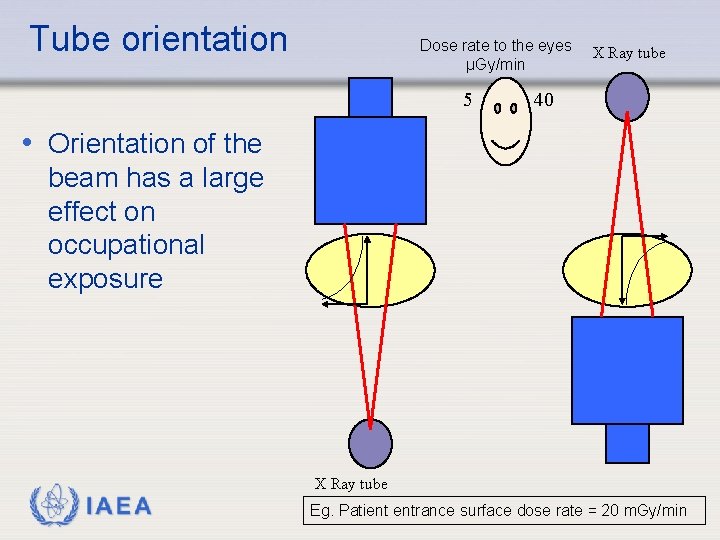
Tube orientation Dose rate to the eyes μGy/min 5 X Ray tube 40 • Orientation of the beam has a large effect on occupational exposure X Ray tube IAEA Eg. Patient entrance surface dose rate = 20 m. Gy/min
Equipment performance • The “state of health” of the imaging system, especially in fluoroscopy & interventional procedures • E. g. if the “II” input dose rates are high and/or image quality is poor • Patient dose rates are high • Scatter levels are high • Personnel doses are high • Need QA programme to ensure good operating condition of the system IAEA 13: Occupational radiation protection 31
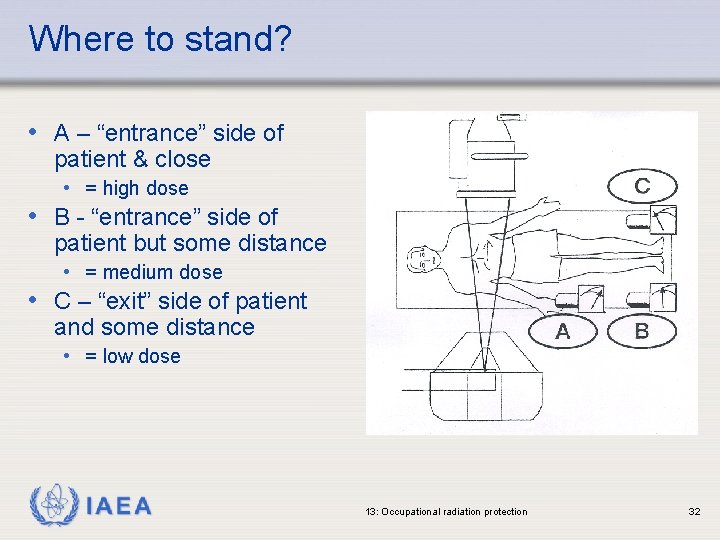
Where to stand? • A – “entrance” side of patient & close • = high dose • B - “entrance” side of patient but some distance • = medium dose • C – “exit” side of patient and some distance • = low dose IAEA 13: Occupational radiation protection 32
IAEA Training Material on Radiation Protection in Diagnostic and Interventional Radiology Part 13: Occupational RP Topic 5: Personal protective equipment IAEA International Atomic Energy Agency
Personal protective equipment • Employers and licensees must ensure that workers are provided with suitable and adequate personal protective equipment • Protective equipment includes lead aprons, thyroid protectors, protective eye-wear and gloves. The need for these protective devices should be established by the RPO IAEA 13: Occupational radiation protection 34
IAEA Training Material on Radiation Protection in Diagnostic and Interventional Radiology Part 13: Occupational RP Topic 6: Individual monitoring and exposure assessment IAEA International Atomic Energy Agency
Individual monitoring (I) • Individual dose monitoring must be undertaken for workers who normally work in controlled areas: • Radiologists, radiographers, nurses, medical physicists, the RPO • Other frequent users of X Ray systems such as cardiologists, endoscopists, anaesthetists, surgeons etc. , as well as ancillary workers who frequently work in controlled areas, also need to be monitored IAEA 13: Occupational radiation protection 36
Individual monitoring (II) • Individual external doses should be determined by using approved individual monitoring devices: • Thermoluminescent dosimeters (TLD) • Film badges • Optically stimulated luminescent dosimeters (OSL) • Direct Ion Store dosimeters (DIS) • Electronic dosimeters • Worn at chest level, between the shoulders and the waist • The monitoring period should be one month, and must not exceed three months IAEA 13: Occupational radiation protection 37
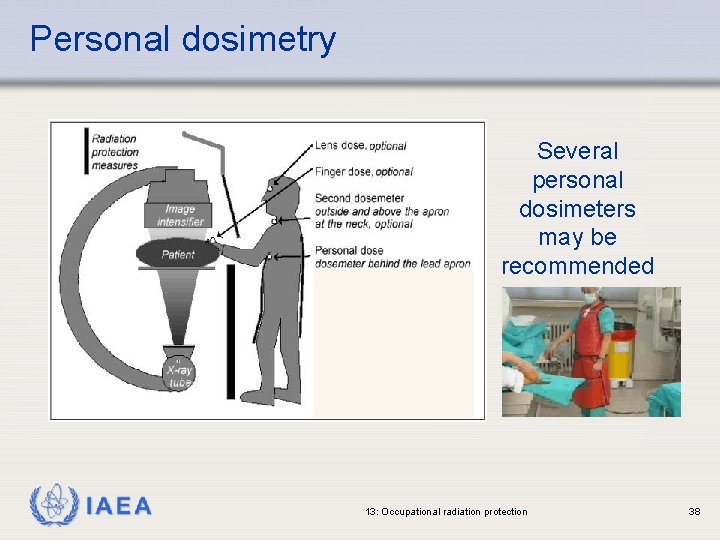
Personal dosimetry Several personal dosimeters may be recommended IAEA 13: Occupational radiation protection 38
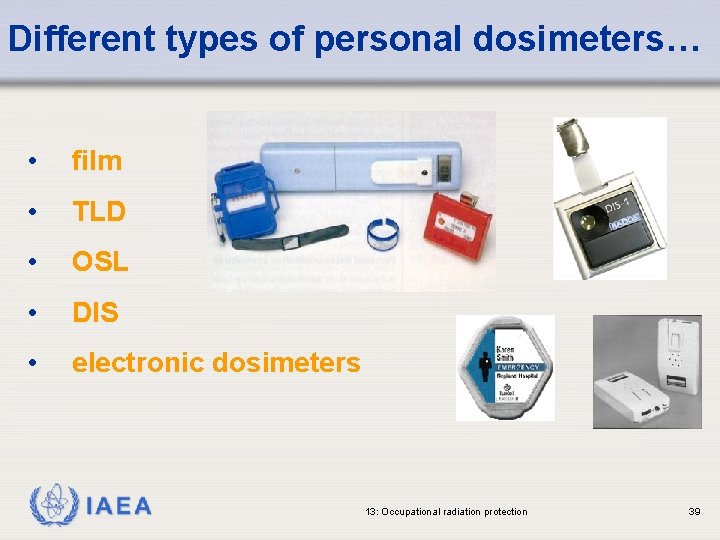
Different types of personal dosimeters… • film • TLD • OSL • DIS • electronic dosimeters IAEA 13: Occupational radiation protection 39
Individual monitoring (III) • Evaluation of dose is an important aspect of occupational radiation protection • It confirms compliance with dose limits • It confirms the effectiveness of optimization • It is important that workers always wear their dosimeters • It is important that workers return dosimeters on time for processing • Delays in the evaluation of a dosimeter can result in the loss of the stored information • It is important that the monitoring results are reviewed and used to improve RP IAEA 13: Occupational radiation protection 40
Individual monitoring when a lead apron is used (I) • The presence of the lead apron greatly influences doses to different parts of the body • If a single dosimeter only is worn, then: • If a lead apron is not always being worn • The dosimeter should be worn under the apron, between shoulder and waist, for estimating effective dose • If a lead apron is always being worn • The dosimeter should be worn above the apron, at collar level, for estimating equivalent dose to the lens of the eye, and can also be corrected to estimate effective dose • In the case of image guided interventional procedures two dosimeters should be considered (talk to the RPO) • However, need to be aware of local regulatory requirements IAEA 13: Occupational radiation protection 41
Exposure assessment • In some facilities and for some individuals with a low level of exposure (e. g. : general dental practitioners), area dosimetry to estimate the level of dose per procedure can be an acceptable alternative • In these cases, area dosimetry or some other individual dose evaluation per procedure could allow the RPO to estimate the typical level of risk IAEA 13: Occupational radiation protection 42
UNSCEAR • Average occupational exposures for medical workers (indicative values) • Conventional diagnostic radiology • ~ 0. 5 m. Sv, (0. 02 – 3. 1 m. Sv) per annum • Interventional procedures • ~ 0. 6 - 3. 1 m. Sv, (0. 4 – 29. 5 m. Sv) per annum • But there are limitations to the data • Few countries provided data • Professional groupings/work functions mixed • Occupational exposures vary widely between & within professions/work functions IAEA
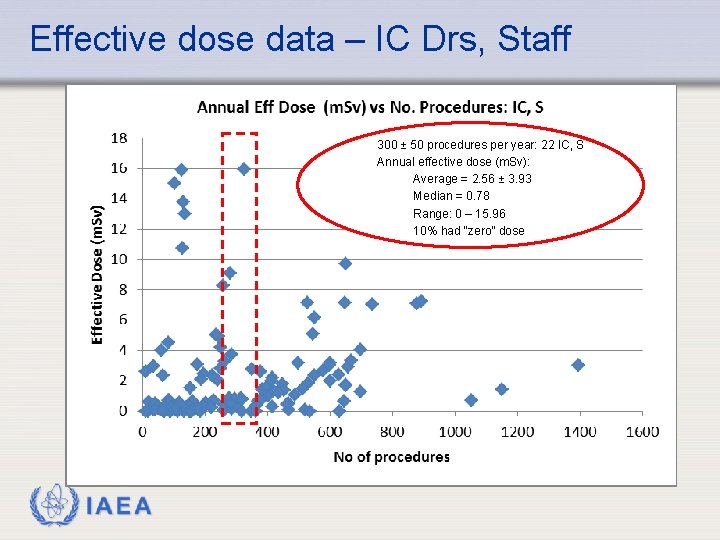
Effective dose data – IC Drs, Staff 300 ± 50 procedures per year: 22 IC, S Annual effective dose (m. Sv): Average = 2. 56 ± 3. 93 Median = 0. 78 Range: 0 – 15. 96 10% had “zero” dose IAEA
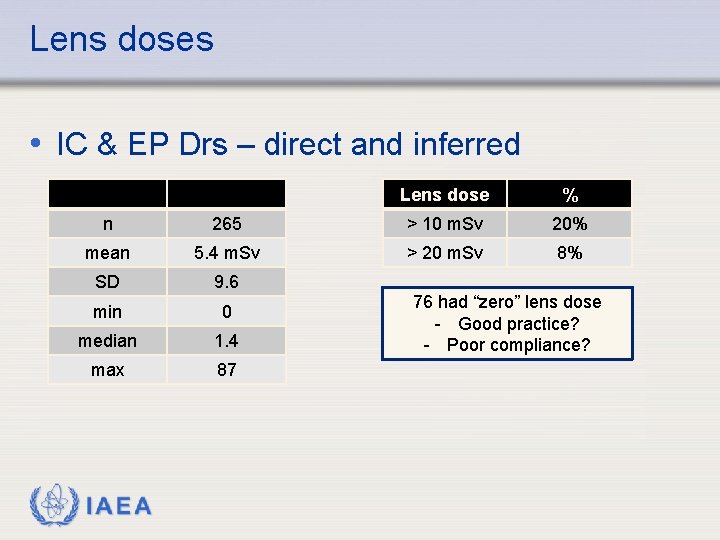
Lens doses • IC & EP Drs – direct and inferred Lens dose % n 265 > 10 m. Sv 20% mean 5. 4 m. Sv > 20 m. Sv 8% SD 9. 6 min 0 median 1. 4 max 87 IAEA 76 had “zero” lens dose - Good practice? - Poor compliance?
IAEA Training Material on Radiation Protection in Diagnostic and Interventional Radiology Part 13: Occupational RP Topic 7: Investigation and follow up IAEA International Atomic Energy Agency
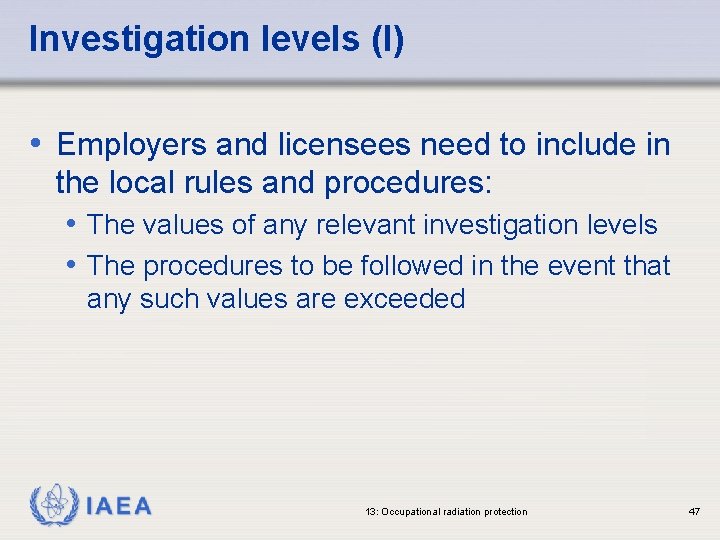
Investigation levels (I) • Employers and licensees need to include in the local rules and procedures: • The values of any relevant investigation levels • The procedures to be followed in the event that any such values are exceeded IAEA 13: Occupational radiation protection 47
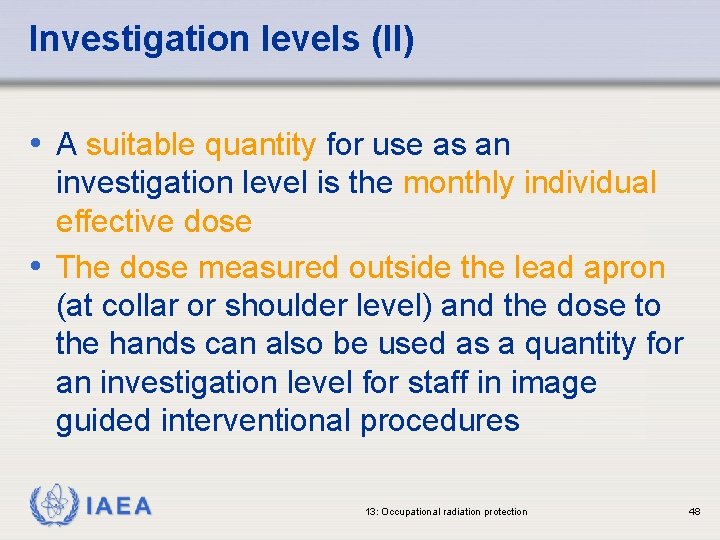
Investigation levels (II) • A suitable quantity for use as an investigation level is the monthly individual effective dose • The dose measured outside the lead apron (at collar or shoulder level) and the dose to the hands can also be used as a quantity for an investigation level for staff in image guided interventional procedures IAEA 13: Occupational radiation protection 48
Investigation levels (III) • Examples of investigation levels • Monthly values higher than, say, 0. 5 m. Sv (for the dosimeter worn under the lead apron) • Values higher than, say, 5 m. Sv per month for the over apron dosimeter or the hand or finger dosimeter • Investigation is to determine causes for the exposure and to implement corrective actions IAEA 13: Occupational radiation protection 49
IAEA Training Material on Radiation Protection in Diagnostic and Interventional Radiology Part 13: Occupational RP Topic 8: Health surveillance IAEA International Atomic Energy Agency
Health surveillance (I) • Primary purpose is to assess the initial and continuing fitness of employees for their intended tasks • Medical surveillance (medical examinations) to workers as specified by the Regulatory Body • Counselling should be provided for women who are or may be pregnant • This is especially relevant in image-guided interventional procedures IAEA 13: Occupational radiation protection 51
Health surveillance (II) • Under normal working conditions, the occupational doses incurred in a radiology department are much lower than the dose limits • No specific radiation-related medical examinations are normally required for persons who are occupationally exposed to ionizing radiation, as there are no diagnostic tests which yield information relevant to exposures that are close to or below dose limits IAEA 13: Occupational radiation protection 52
IAEA Training Material on Radiation Protection in Diagnostic and Interventional Radiology Part 13: Occupational RP Topic 9: Records IAEA International Atomic Energy Agency
Records (I) • The licensee must maintain: • Exposure records • RP training records • Investigation reports IAEA 13: Occupational radiation protection 54
Summary • Employers, licensees and workers each have • • • responsibilities with respect to occupational RP Local rules must be established and followed Personal protective equipment must be provided and used Individual monitoring and exposure assessment must take place Investigations must take place when indicated Records must be kept IAEA 13: Occupational radiation protection 55
Where to Get More Information • International Basic Safety Standards for Protection Against Ionizing Radiation and for the Safety of Radiation Sources. 115, Safety Standards. IAEA, February 1996. • “The 2007 Recommendations of the International Commission on Radiological Protection”, Pergamon, Oxford: 2007 (ICRP 103). IAEA 13: Occupational radiation protection 56
IAEA 13: Occupational radiation protection 57
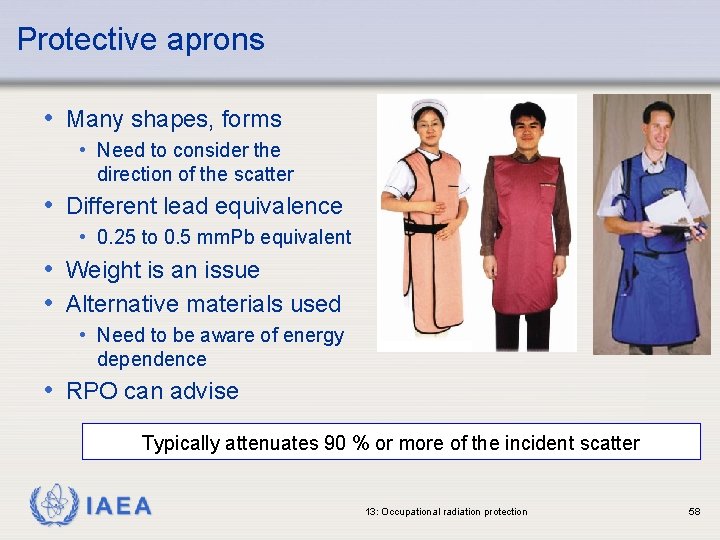
Protective aprons • Many shapes, forms • Need to consider the direction of the scatter • Different lead equivalence • 0. 25 to 0. 5 mm. Pb equivalent • Weight is an issue • Alternative materials used • Need to be aware of energy dependence • RPO can advise Typically attenuates 90 % or more of the incident scatter IAEA 13: Occupational radiation protection 58
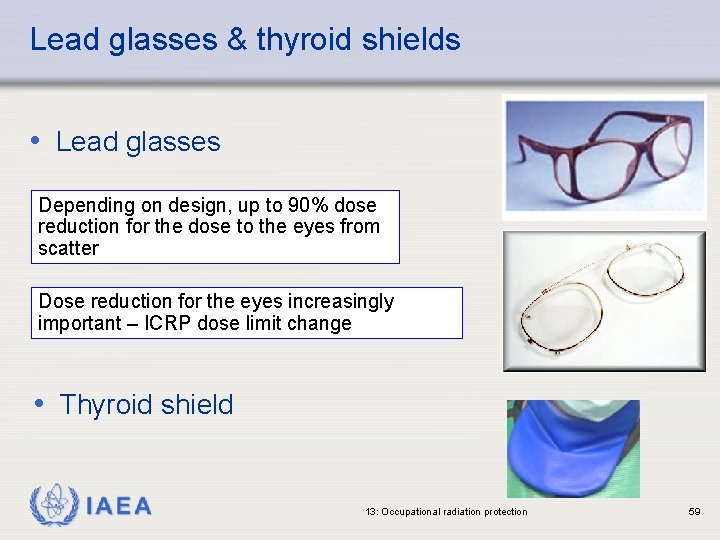
Lead glasses & thyroid shields • Lead glasses Depending on design, up to 90% dose reduction for the dose to the eyes from scatter Dose reduction for the eyes increasingly important – ICRP dose limit change • Thyroid shield IAEA 13: Occupational radiation protection 59
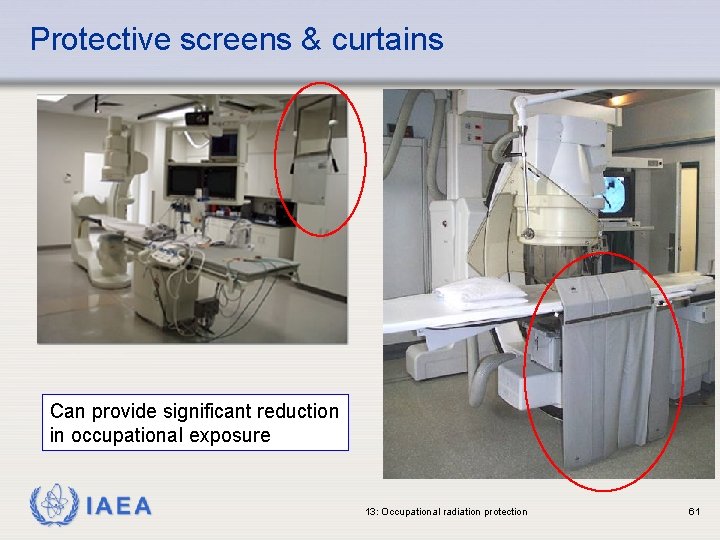
Personal protective equipment • Additional protective devices should be available in fluoroscopy and interventional rooms which include: • Ceiling suspended protective screens • Protective lead curtains mounted on the patient table • Protective lead curtains for the operator if the XRay tube is placed in an over couch geometry and if the radiologist must stand near the patient IAEA 13: Occupational radiation protection 60
Protective screens & curtains Can provide significant reduction in occupational exposure IAEA 13: Occupational radiation protection 61