
IAD and SES Dynamic Flows Introducing the Program

- Slides: 23
IAD and SES Dynamic Flows: Introducing the Program in Institutional Analysis of Social. Ecological Systems (PIASES) Framework Michael D. Mc. Ginnis and Elinor Ostrom Figures from a preliminary draft of a paper to be presented at 13 th Economics of Infrastructures Conference, Delft, Netherlands, April 27 -28, 2010 April 3, 2010 Draft Presented Wednesday, March 24, 2010, Workshop in Political Theory and Policy Analysis, Indiana University, Bloomington
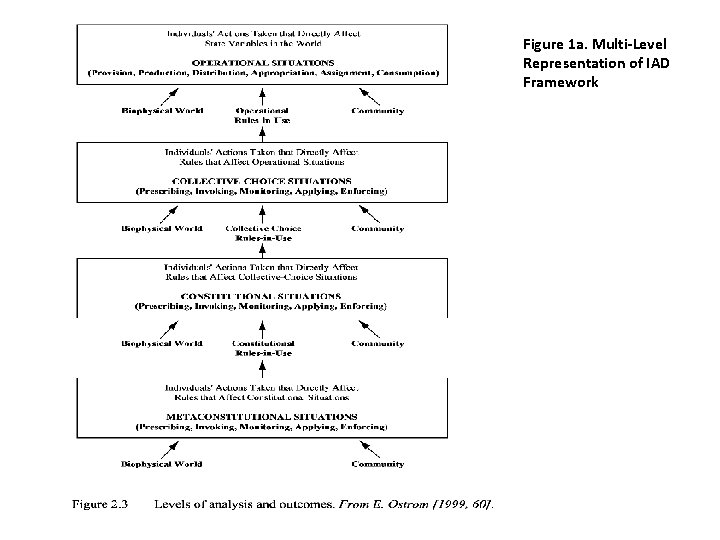
Figure 1: IAD Framework
Figure 1 a. Multi-Level Representation of IAD Framework
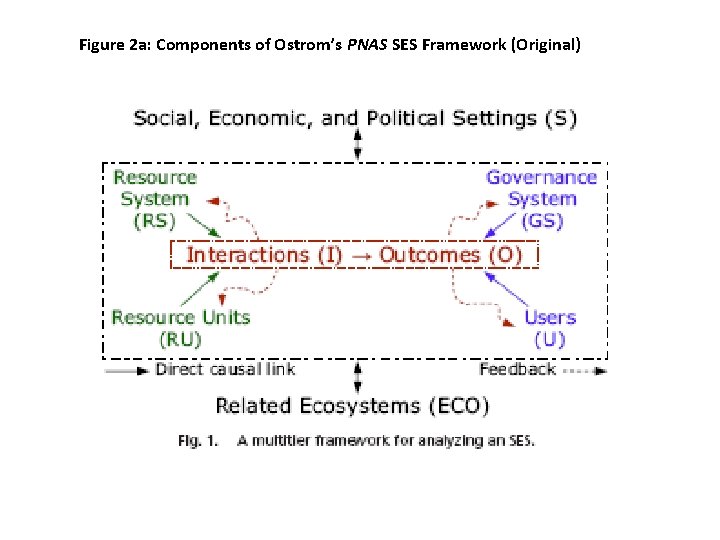
Figure 2 a: Components of Ostrom’s PNAS SES Framework (Original)
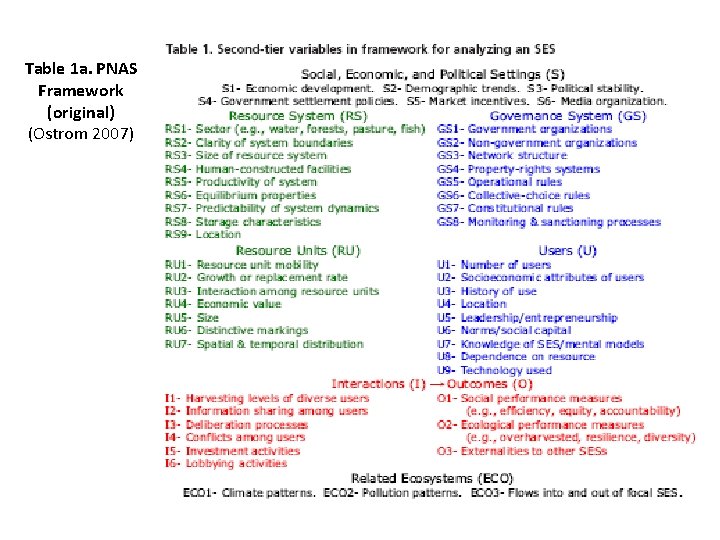
Table 1 a. PNAS Framework (original) (Ostrom 2007)
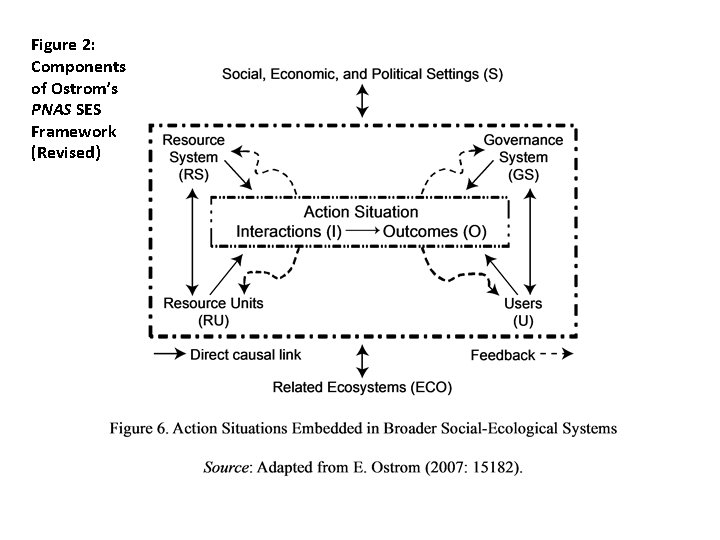
Figure 2: Components of Ostrom’s PNAS SES Framework (Revised)
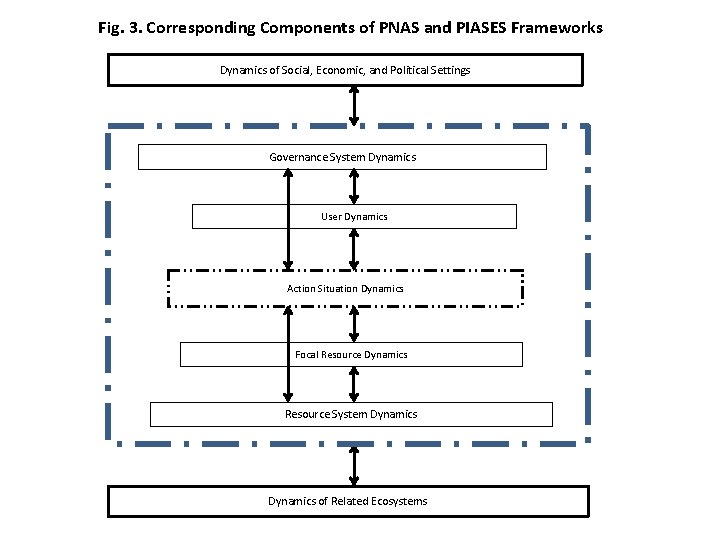
Fig. 3. Corresponding Components of PNAS and PIASES Frameworks Dynamics of Social, Economic, and Political Settings Governance System Dynamics User Dynamics Action Situation Dynamics Focal Resource Dynamics Resource System Dynamics of Related Ecosystems
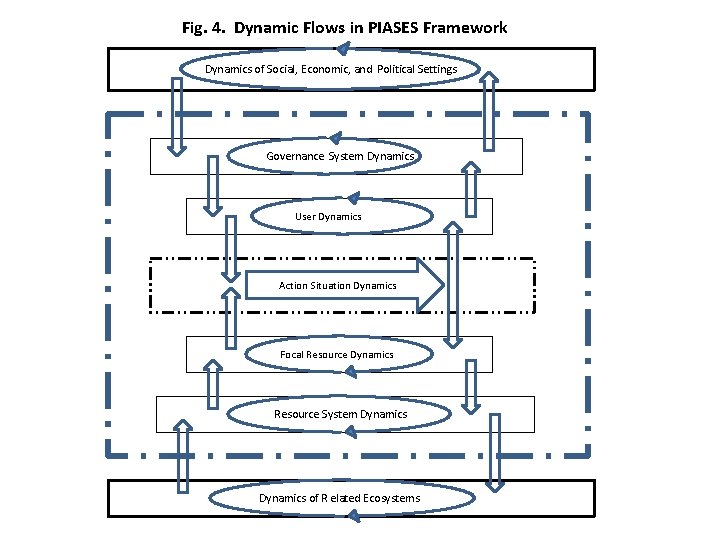
Fig. 4. Dynamic Flows in PIASES Framework Dynamics of Social, Economic, and Political Settings Governance System Dynamics User Dynamics Action Situation Dynamics Focal Resource Dynamics Resource System Dynamics Dynamics of R elated Ecosystems
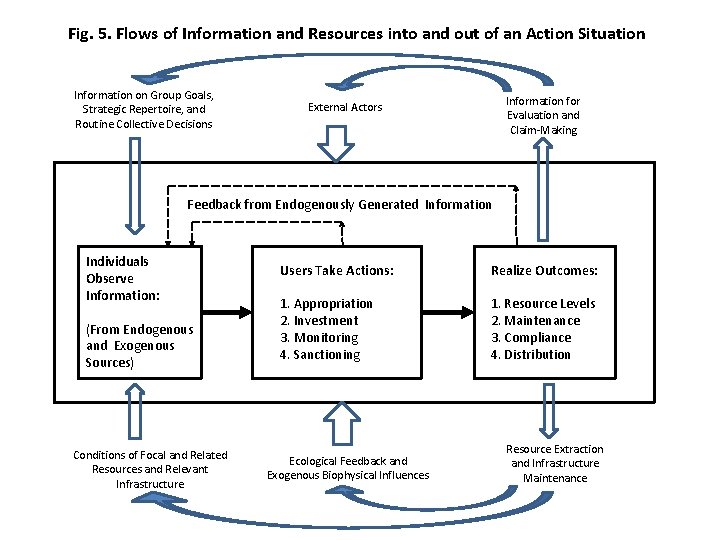
Fig. 5. Flows of Information and Resources into and out of an Action Situation Information on Group Goals, Strategic Repertoire, and Routine Collective Decisions Information for Evaluation and Claim-Making External Actors Feedback from Endogenously Generated Information Individuals Observe Information: (From Endogenous and Exogenous Sources) Conditions of Focal and Related Resources and Relevant Infrastructure Users Take Actions: Realize Outcomes: 1. Appropriation 2. Investment 3. Monitoring 4. Sanctioning 1. Resource Levels 2. Maintenance 3. Compliance 4. Distribution Ecological Feedback and Exogenous Biophysical Influences Resource Extraction and Infrastructure Maintenance
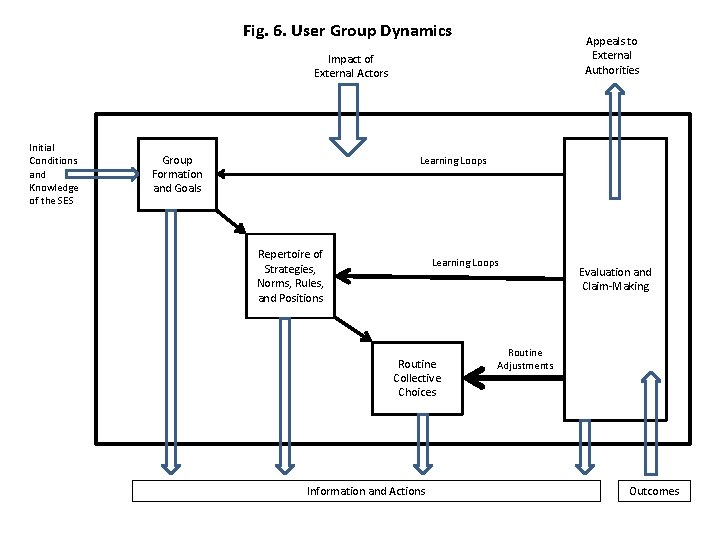
Fig. 6. User Group Dynamics Appeals to External Authorities Impact of External Actors Initial Conditions and Knowledge of the SES Group Formation and Goals Learning Loops Repertoire of Strategies, Norms, Rules, and Positions Learning Loops Routine Collective Choices Information and Actions Evaluation and Claim-Making Routine Adjustments Outcomes
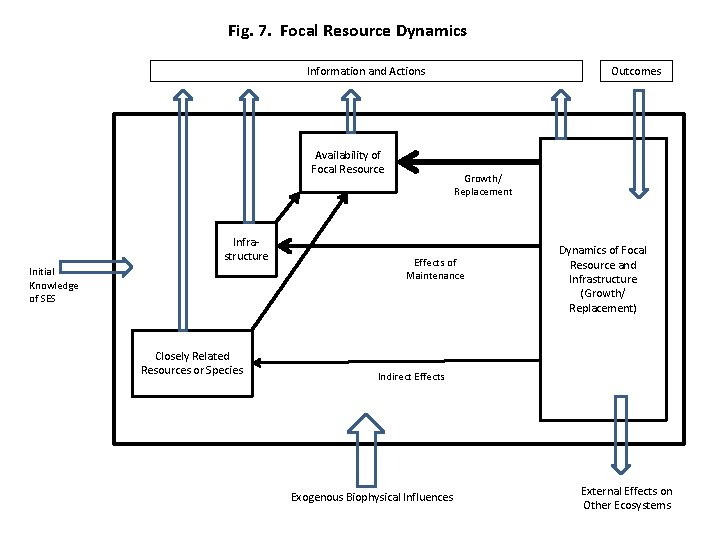
Fig. 7. Focal Resource Dynamics Information and Actions Availability of Focal Resource Infrastructure Initial Knowledge of SES Closely Related Resources or Species Outcomes Growth/ Replacement Effects of Maintenance Dynamics of Focal Resource and Infrastructure (Growth/ Replacement) Indirect Effects Exogenous Biophysical Influences External Effects on Other Ecosystems
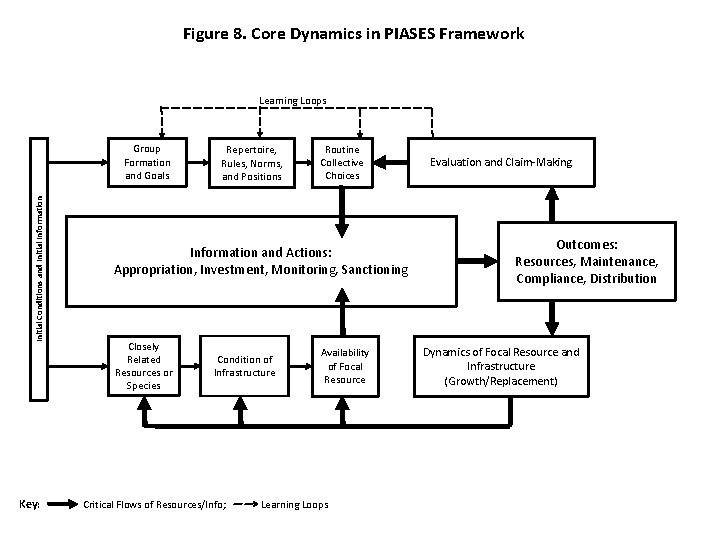
Figure 8. Core Dynamics in PIASES Framework Learning Loops Initial Conditions and Initial Information Group Formation and Goals Key: Repertoire, Rules, Norms, and Positions Routine Collective Choices Information and Actions: Appropriation, Investment, Monitoring, Sanctioning Closely Related Resources or Species Condition of Infrastructure Availability of Focal Resource Critical Flows of Resources/Info; Learning Loops Evaluation and Claim-Making Outcomes: Resources, Maintenance, Compliance, Distribution Dynamics of Focal Resource and Infrastructure (Growth/Replacement)
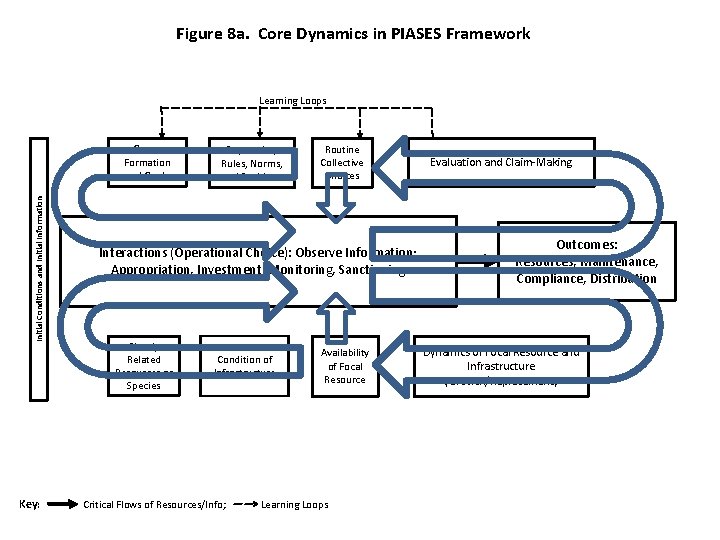
Figure 8 a. Core Dynamics in PIASES Framework Learning Loops Initial Conditions and Initial Information Group Formation and Goals Key: Repertoire, Rules, Norms, and Positions Routine Collective Choices Interactions (Operational Choice): Observe Information; Appropriation, Investment, Monitoring, Sanctioning Closely Related Resources or Species Condition of Infrastructure Availability of Focal Resource Critical Flows of Resources/Info; Learning Loops Evaluation and Claim-Making Outcomes: Resources, Maintenance, Compliance, Distribution Dynamics of Focal Resource and Infrastructure (Growth/Replacement)
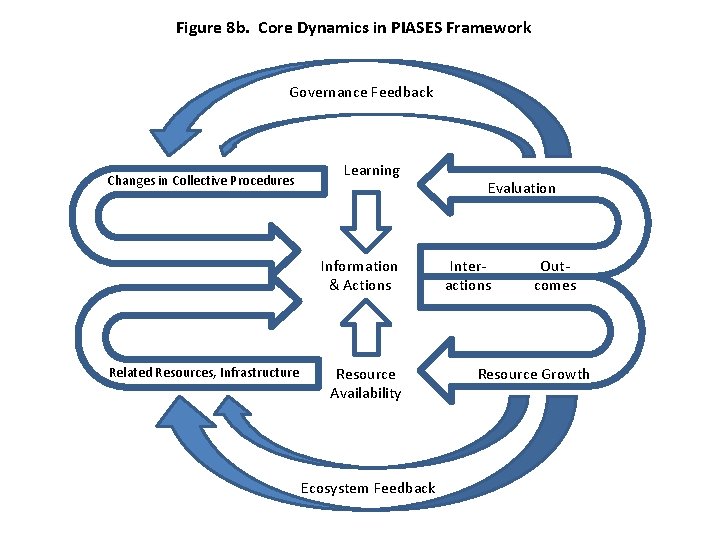
Figure 8 b. Core Dynamics in PIASES Framework Governance Feedback Changes in Collective Procedures Learning Information & Actions Related Resources, Infrastructure Resource Availability Ecosystem Feedback Evaluation Interactions Outcomes Resource Growth
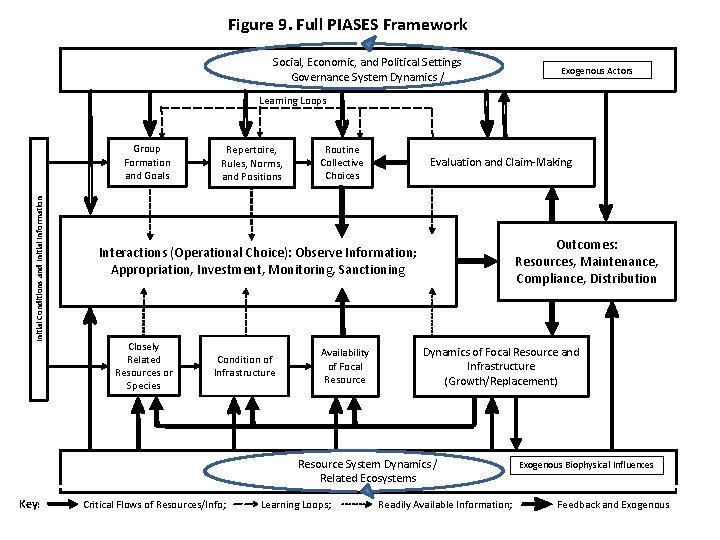
Figure 9. Full PIASES Framework Social, Economic, and Political Settings Governance System Dynamics / Exogenous Actors Learning Loops Initial Conditions and Initial Information Group Formation and Goals Repertoire, Rules, Norms, and Positions Routine Collective Choices Evaluation and Claim-Making Outcomes: Resources, Maintenance, Compliance, Distribution Interactions (Operational Choice): Observe Information; Appropriation, Investment, Monitoring, Sanctioning Closely Related Resources or Species Condition of Infrastructure Availability of Focal Resource Dynamics of Focal Resource and Infrastructure (Growth/Replacement) Resource System Dynamics / Related Ecosystems Key: Exogenous Biophysical Influences Critical Flows of Resources/Info; Learning Loops; Readily Available Information; Feedback and Exogenous
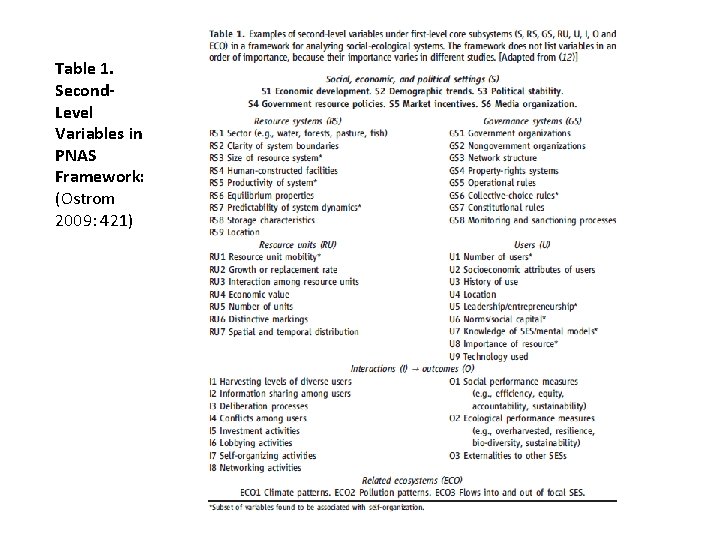
Table 1. Second. Level Variables in PNAS Framework: (Ostrom 2009: 421)
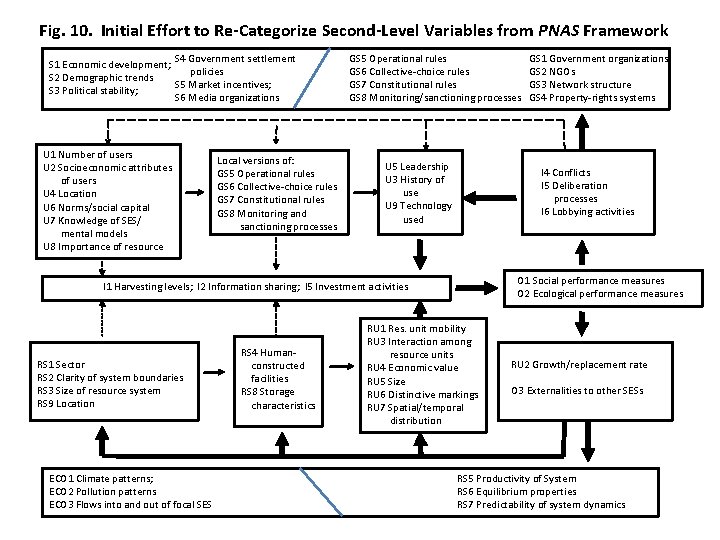
Fig. 10. Initial Effort to Re-Categorize Second-Level Variables from PNAS Framework S 4 Government settlement S 1 Economic development; policies S 2 Demographic trends S 5 Market incentives; S 3 Political stability; S 6 Media organizations U 1 Number of users U 2 Socioeconomic attributes of users U 4 Location U 6 Norms/social capital U 7 Knowledge of SES/ mental models U 8 Importance of resource Local versions of: GS 5 Operational rules GS 6 Collective-choice rules GS 7 Constitutional rules GS 8 Monitoring and sanctioning processes GS 5 Operational rules GS 6 Collective-choice rules GS 7 Constitutional rules GS 8 Monitoring/sanctioning processes U 5 Leadership U 3 History of use U 9 Technology used I 4 Conflicts I 5 Deliberation processes I 6 Lobbying activities O 1 Social performance measures O 2 Ecological performance measures I 1 Harvesting levels; I 2 Information sharing; I 5 Investment activities RS 1 Sector RS 2 Clarity of system boundaries RS 3 Size of resource system RS 9 Location ECO 1 Climate patterns; ECO 2 Pollution patterns ECO 3 Flows into and out of focal SES RS 4 Human constructed facilities RS 8 Storage characteristics GS 1 Government organizations GS 2 NGOs GS 3 Network structure GS 4 Property-rights systems RU 1 Res. unit mobility RU 3 Interaction among resource units RU 4 Economic value RU 5 Size RU 6 Distinctive markings RU 7 Spatial/temporal distribution RU 2 Growth/replacement rate O 3 Externalities to other SESs RS 5 Productivity of System RS 6 Equilibrium properties RS 7 Predictability of system dynamics
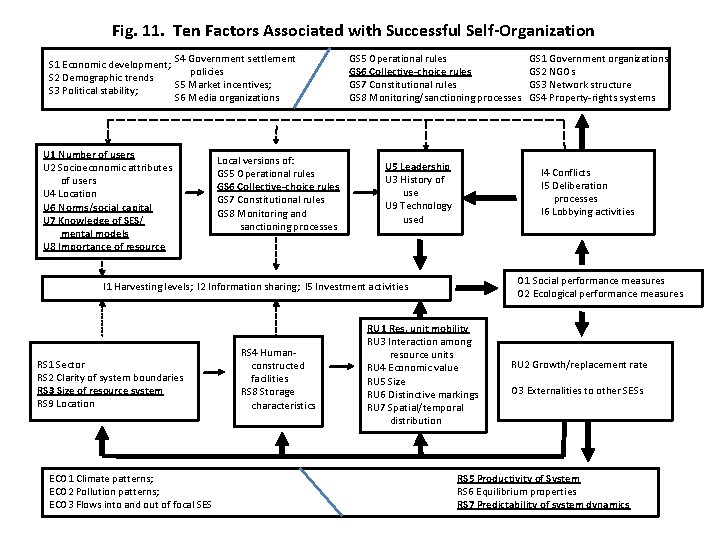
Fig. 11. Ten Factors Associated with Successful Self-Organization S 4 Government settlement S 1 Economic development; policies S 2 Demographic trends S 5 Market incentives; S 3 Political stability; S 6 Media organizations U 1 Number of users U 2 Socioeconomic attributes of users U 4 Location U 6 Norms/social capital U 7 Knowledge of SES/ mental models U 8 Importance of resource Local versions of: GS 5 Operational rules GS 6 Collective-choice rules GS 7 Constitutional rules GS 8 Monitoring and sanctioning processes GS 5 Operational rules GS 6 Collective-choice rules GS 7 Constitutional rules GS 8 Monitoring/sanctioning processes U 5 Leadership U 3 History of use U 9 Technology used I 4 Conflicts I 5 Deliberation processes I 6 Lobbying activities O 1 Social performance measures O 2 Ecological performance measures I 1 Harvesting levels; I 2 Information sharing; I 5 Investment activities RS 1 Sector RS 2 Clarity of system boundaries RS 3 Size of resource system RS 9 Location ECO 1 Climate patterns; ECO 2 Pollution patterns; ECO 3 Flows into and out of focal SES RS 4 Human constructed facilities RS 8 Storage characteristics GS 1 Government organizations GS 2 NGOs GS 3 Network structure GS 4 Property-rights systems RU 1 Res. unit mobility RU 3 Interaction among resource units RU 4 Economic value RU 5 Size RU 6 Distinctive markings RU 7 Spatial/temporal distribution RU 2 Growth/replacement rate O 3 Externalities to other SESs RS 5 Productivity of System RS 6 Equilibrium properties RS 7 Predictability of system dynamics
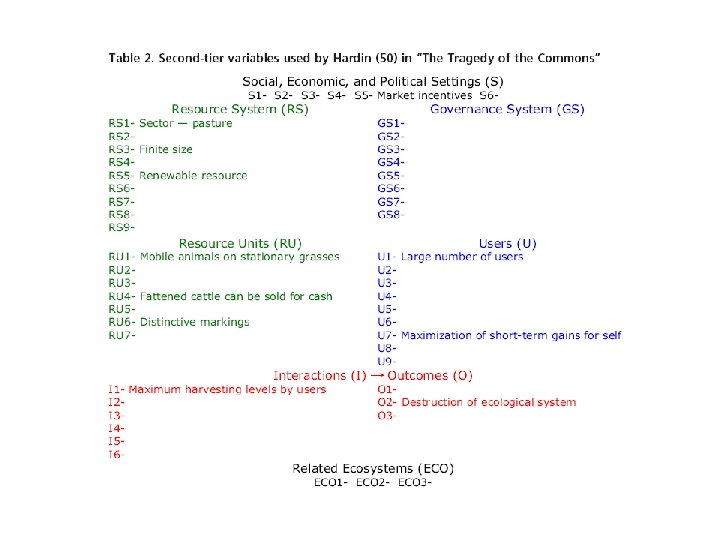
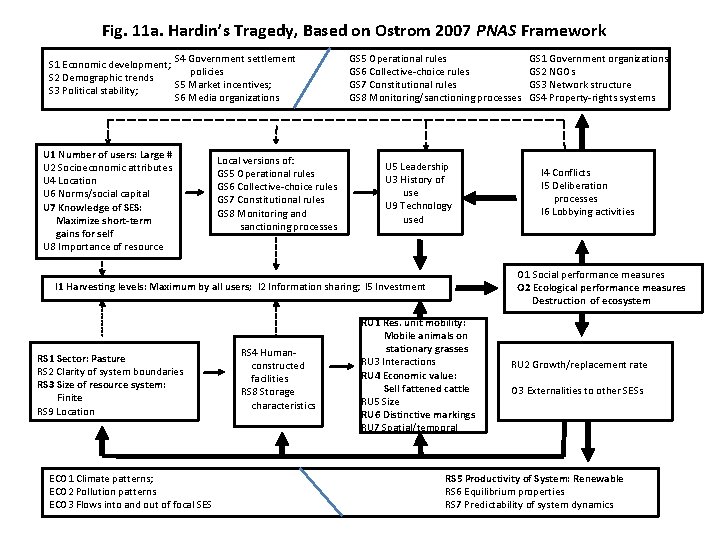
Fig. 11 a. Hardin’s Tragedy, Based on Ostrom 2007 PNAS Framework S 4 Government settlement S 1 Economic development; policies S 2 Demographic trends S 5 Market incentives; S 3 Political stability; S 6 Media organizations U 1 Number of users: Large # U 2 Socioeconomic attributes U 4 Location U 6 Norms/social capital U 7 Knowledge of SES: Maximize short-term gains for self U 8 Importance of resource Local versions of: GS 5 Operational rules GS 6 Collective-choice rules GS 7 Constitutional rules GS 8 Monitoring and sanctioning processes GS 5 Operational rules GS 6 Collective-choice rules GS 7 Constitutional rules GS 8 Monitoring/sanctioning processes U 5 Leadership U 3 History of use U 9 Technology used ECO 1 Climate patterns; ECO 2 Pollution patterns ECO 3 Flows into and out of focal SES RS 4 Human constructed facilities RS 8 Storage characteristics I 4 Conflicts I 5 Deliberation processes I 6 Lobbying activities O 1 Social performance measures O 2 Ecological performance measures Destruction of ecosystem I 1 Harvesting levels: Maximum by all users; I 2 Information sharing; I 5 Investment RS 1 Sector: Pasture RS 2 Clarity of system boundaries RS 3 Size of resource system: Finite RS 9 Location GS 1 Government organizations GS 2 NGOs GS 3 Network structure GS 4 Property-rights systems RU 1 Res. unit mobility: Mobile animals on stationary grasses RU 3 Interactions RU 4 Economic value: Sell fattened cattle RU 5 Size RU 6 Distinctive markings RU 7 Spatial/temporal RU 2 Growth/replacement rate O 3 Externalities to other SESs RS 5 Productivity of System: Renewable RS 6 Equilibrium properties RS 7 Predictability of system dynamics
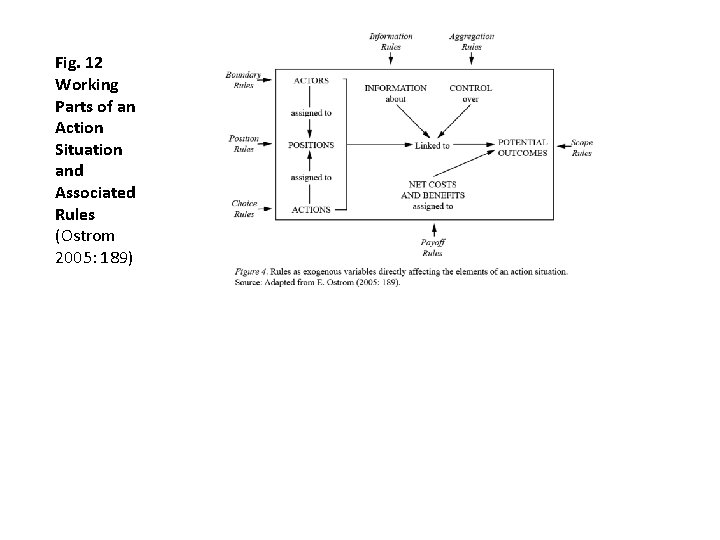
Fig. 12 Working Parts of an Action Situation and Associated Rules (Ostrom 2005: 189)
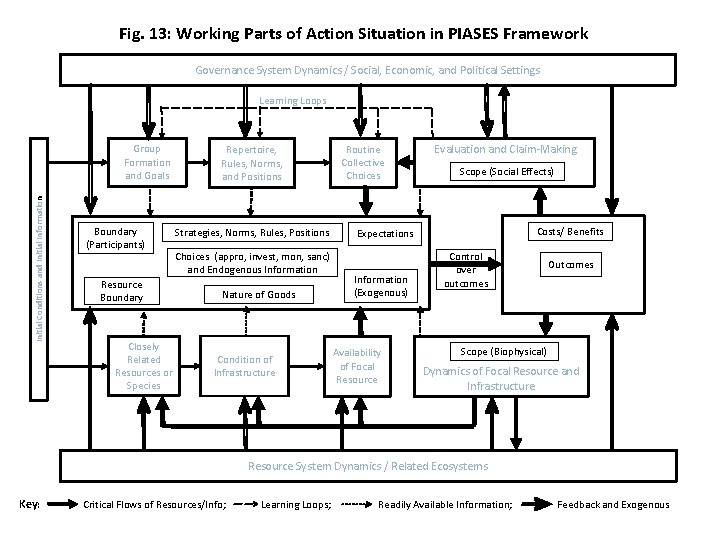
Fig. 13: Working Parts of Action Situation in PIASES Framework Governance System Dynamics / Social, Economic, and Political Settings Learning Loops Initial Conditions and Initial Information Group Formation and Goals Boundary (Participants) Repertoire, Rules, Norms, and Positions Strategies, Norms, Rules, Positions Choices (appro, invest, mon, sanc) and Endogenous Information Resource Boundary Closely Related Resources or Species Nature of Goods Condition of Infrastructure Routine Collective Choices Evaluation and Claim-Making Scope (Social Effects) Costs/ Benefits Expectations Information (Exogenous) Availability of Focal Resource Control over outcomes Outcomes Scope (Biophysical) Dynamics of Focal Resource and Infrastructure Resource System Dynamics / Related Ecosystems Key: Critical Flows of Resources/Info; Learning Loops; Readily Available Information; Feedback and Exogenous
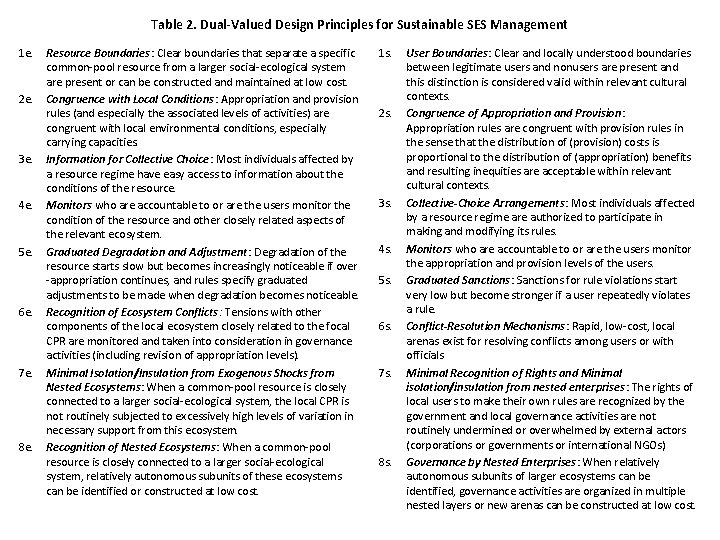
Table 2. Dual-Valued Design Principles for Sustainable SES Management 1 e. Resource Boundaries: Clear boundaries that separate a specific common-pool resource from a larger social-ecological system are present or can be constructed and maintained at low cost. 2 e. Congruence with Local Conditions : Appropriation and provision rules (and especially the associated levels of activities) are congruent with local environmental conditions, especially carrying capacities. 3 e. Information for Collective Choice: Most individuals affected by a resource regime have easy access to information about the conditions of the resource. 4 e. Monitors who are accountable to or are the users monitor the condition of the resource and other closely related aspects of the relevant ecosystem. 5 e. Graduated Degradation and Adjustment: Degradation of the resource starts slow but becomes increasingly noticeable if over -appropriation continues, and rules specify graduated adjustments to be made when degradation becomes noticeable. 6 e. Recognition of Ecosystem Conflicts: Tensions with other components of the local ecosystem closely related to the focal CPR are monitored and taken into consideration in governance activities (including revision of appropriation levels). 7 e. Minimal Isolation/Insulation from Exogenous Shocks from Nested Ecosystems: When a common-pool resource is closely connected to a larger social-ecological system, the local CPR is not routinely subjected to excessively high levels of variation in necessary support from this ecosystem. 8 e. Recognition of Nested Ecosystems: When a common-pool resource is closely connected to a larger social-ecological system, relatively autonomous subunits of these ecosystems can be identified or constructed at low cost. 1 s. User Boundaries: Clear and locally understood boundaries between legitimate users and nonusers are present and this distinction is considered valid within relevant cultural contexts. 2 s. Congruence of Appropriation and Provision: Appropriation rules are congruent with provision rules in the sense that the distribution of (provision) costs is proportional to the distribution of (appropriation) benefits and resulting inequities are acceptable within relevant cultural contexts. 3 s. Collective-Choice Arrangements: Most individuals affected by a resource regime are authorized to participate in making and modifying its rules. 4 s. Monitors who are accountable to or are the users monitor the appropriation and provision levels of the users. 5 s. Graduated Sanctions: Sanctions for rule violations start very low but become stronger if a user repeatedly violates a rule. 6 s. Conflict-Resolution Mechanisms: Rapid, low-cost, local arenas exist for resolving conflicts among users or with officials 7 s. Minimal Recognition of Rights and Minimal isolation/insulation from nested enterprises : The rights of local users to make their own rules are recognized by the government and local governance activities are not routinely undermined or overwhelmed by external actors (corporations or governments or international NGOs) 8 s. Governance by Nested Enterprises: When relatively autonomous subunits of larger ecosystems can be identified, governance activities are organized in multiple nested layers or new arenas can be constructed at low cost.