
IABA annual meeting 2018 IFRS 17 Insurance Contracts

IABA annual meeting 2018 IFRS 17 Insurance Contracts – the final standard is here! Introduction on the final standard and what it means to actuaries July 27, 2018
Agenda 1. Background 2. Overview 3. General Model 4. Premium Allocation Approach 5. Impacts to financial reporting 6. Transition Pw. C 2

1 – Background 3
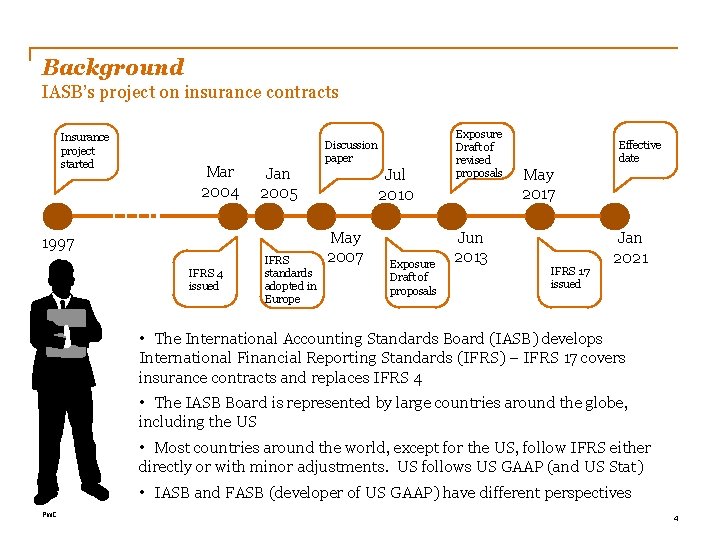
Background IASB’s project on insurance contracts Insurance project started Mar 2004 Discussion paper Jan 2005 1997 IFRS 4 issued IFRS standards adopted in Europe Jul 2010 May 2007 Exposure Draft of proposals Exposure Draft of revised proposals Jun 2013 Effective date May 2017 IFRS 17 issued Jan 2021 • The International Accounting Standards Board (IASB) develops International Financial Reporting Standards (IFRS) – IFRS 17 covers insurance contracts and replaces IFRS 4 • The IASB Board is represented by large countries around the globe, including the US • Most countries around the world, except for the US, follow IFRS either directly or with minor adjustments. US follows US GAAP (and US Stat) • IASB and FASB (developer of US GAAP) have different perspectives Pw. C 4
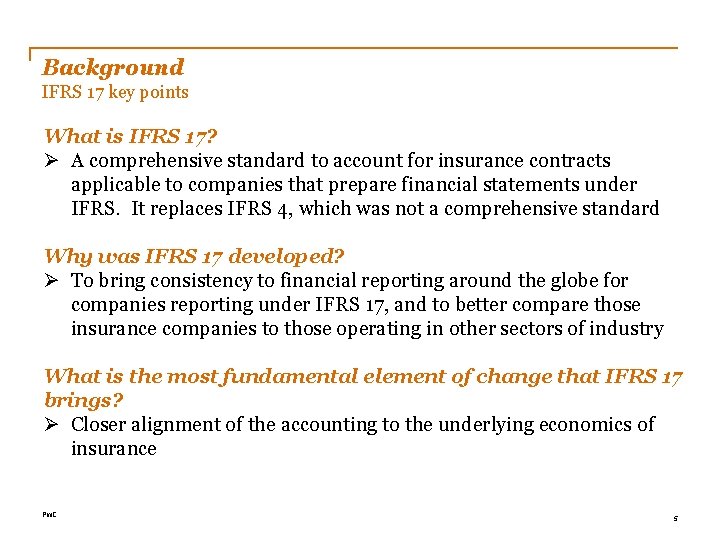
Background IFRS 17 key points What is IFRS 17? Ø A comprehensive standard to account for insurance contracts applicable to companies that prepare financial statements under IFRS. It replaces IFRS 4, which was not a comprehensive standard Why was IFRS 17 developed? Ø To bring consistency to financial reporting around the globe for companies reporting under IFRS 17, and to better compare those insurance companies to those operating in other sectors of industry What is the most fundamental element of change that IFRS 17 brings? Ø Closer alignment of the accounting to the underlying economics of insurance Pw. C 5

Background IFRS 17 improvements Existing issues How IFRS 17 improves accounting Variety of treatments depending on type of contract and company Consistent accounting for all insurance contracts by all companies Estimates for long-duration contracts not updated Estimates updated to reflect current market-based information Discount rate based on estimates does not reflect economic risks Discount rate reflects characteristics of the cash flows of the contract Lack of discounting for measurement of some contracts Measurement of insurance contract reflects time value where significant Little information on economic value of embedded options and guarantees Measurement reflects information about full range of possible outcomes The information presented on the slide was prepared by IFRS Foundation. http: //www. ifrs. org/Current-Projects/IASB-Projects/Insurance-Contracts/Documents/2016/project-overview-Feb-2016. pdf Pw. C 6
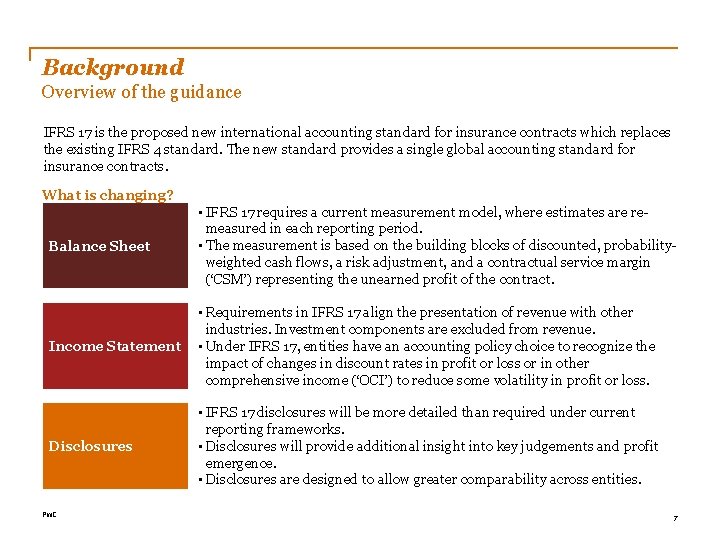
Background Overview of the guidance IFRS 17 is the proposed new international accounting standard for insurance contracts which replaces the existing IFRS 4 standard. The new standard provides a single global accounting standard for insurance contracts. What is changing? Balance Sheet • IFRS 17 requires a current measurement model, where estimates are remeasured in each reporting period. • The measurement is based on the building blocks of discounted, probabilityweighted cash flows, a risk adjustment, and a contractual service margin (‘CSM’) representing the unearned profit of the contract. Income Statement • Requirements in IFRS 17 align the presentation of revenue with other industries. Investment components are excluded from revenue. • Under IFRS 17, entities have an accounting policy choice to recognize the impact of changes in discount rates in profit or loss or in other comprehensive income (‘OCI’) to reduce some volatility in profit or loss. Disclosures • IFRS 17 disclosures will be more detailed than required under current reporting frameworks. • Disclosures will provide additional insight into key judgements and profit emergence. • Disclosures are designed to allow greater comparability across entities. Pw. C 7

2 – Overview 8
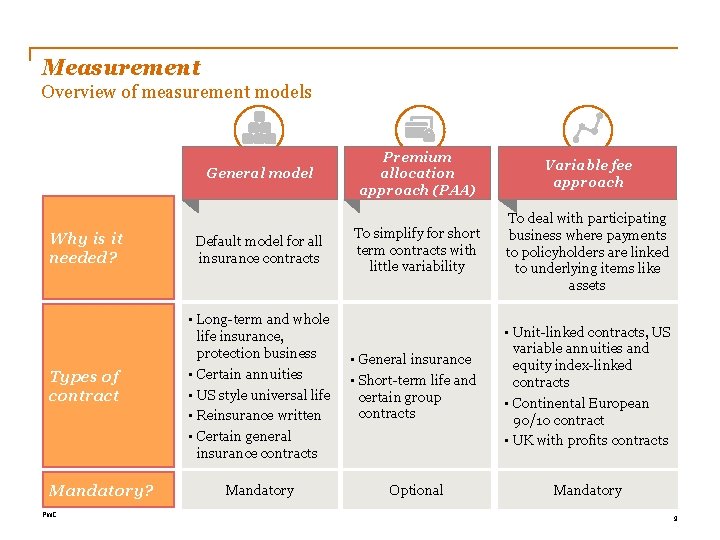
Measurement Overview of measurement models General model Premium allocation approach (PAA) Variable fee approach To simplify for short term contracts with little variability To deal with participating business where payments to policyholders are linked to underlying items like assets Why is it needed? Default model for all insurance contracts Types of contract • Long-term and whole life insurance, protection business • Certain annuities • US style universal life • Reinsurance written • Certain general insurance contracts • General insurance • Short-term life and certain group contracts • Unit-linked contracts, US variable annuities and equity index-linked contracts • Continental European 90/10 contract • UK with profits contracts Mandatory Optional Mandatory? Pw. C 9
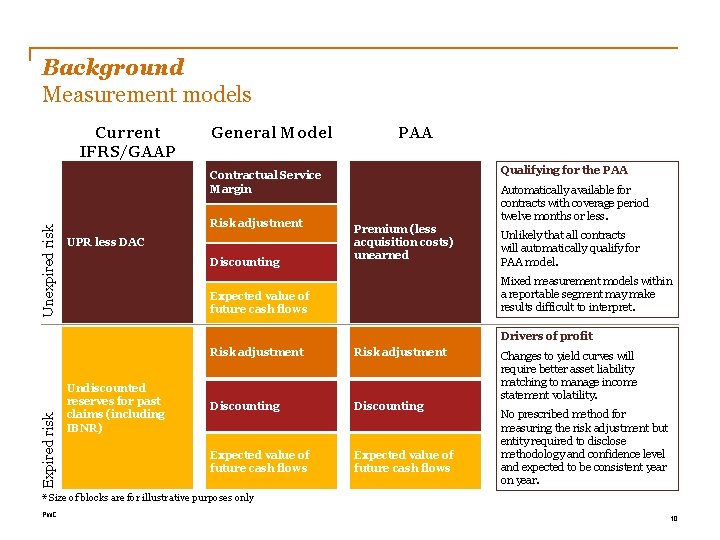
Background Measurement models Current IFRS/GAAP General Model PAA Qualifying for the PAA Unexpired risk Contractual Service Margin Risk adjustment UPR less DAC Discounting Automatically available for contracts with coverage period twelve months or less. Premium (less acquisition costs) unearned Unlikely that all contracts will automatically qualify for PAA model. Mixed measurement models within a reportable segment may make results difficult to interpret. Expected value of future cash flows Expired risk Drivers of profit Undiscounted reserves for past claims (including IBNR) Risk adjustment Discounting Expected value of future cash flows Changes to yield curves will require better asset liability matching to manage income statement volatility. No prescribed method for measuring the risk adjustment but entity required to disclose methodology and confidence level and expected to be consistent year on year. * Size of blocks are for illustrative purposes only Pw. C 10
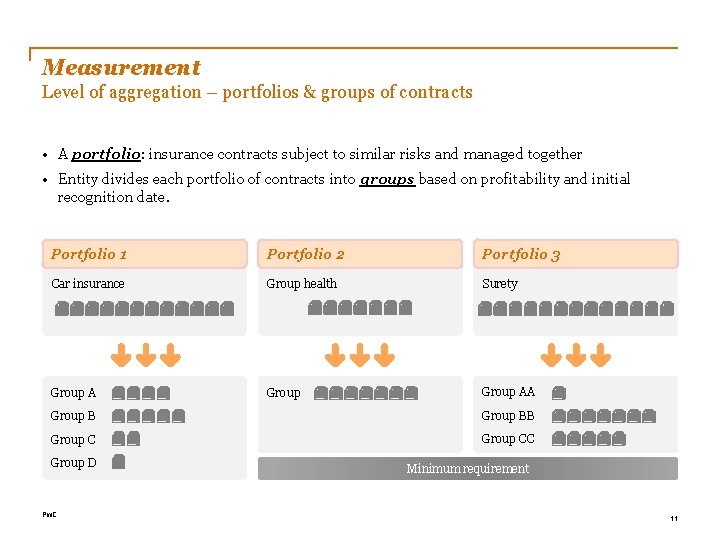
Measurement Level of aggregation – portfolios & groups of contracts • A portfolio: insurance contracts subject to similar risks and managed together • Entity divides each portfolio of contracts into groups based on profitability and initial recognition date. Portfolio 1 Portfolio 2 Portfolio 3 Car insurance Group health Surety Group AA Group BB Group CC Group D Pw. C Minimum requirement 11

3 – General model 12
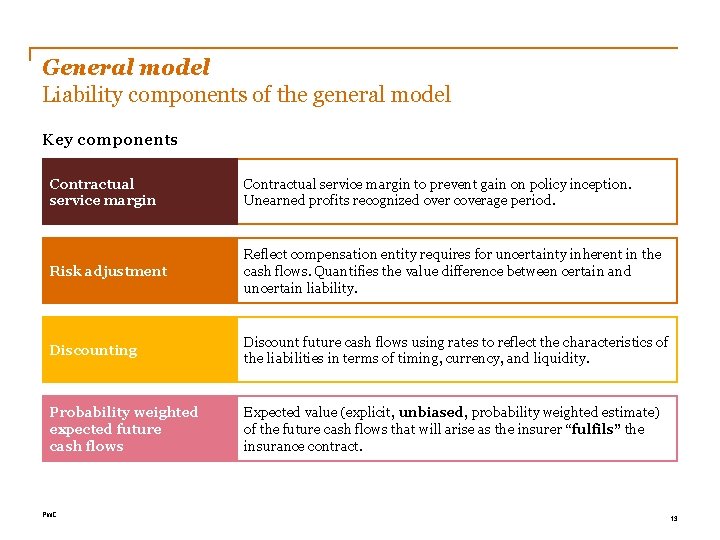
General model Liability components of the general model Key components Contractual service margin to prevent gain on policy inception. Unearned profits recognized over coverage period. Risk adjustment Reflect compensation entity requires for uncertainty inherent in the cash flows. Quantifies the value difference between certain and uncertain liability. Discounting Discount future cash flows using rates to reflect the characteristics of the liabilities in terms of timing, currency, and liquidity. Probability weighted expected future cash flows Expected value (explicit, unbiased, probability weighted estimate) of the future cash flows that will arise as the insurer “fulfils” the insurance contract. Pw. C 13
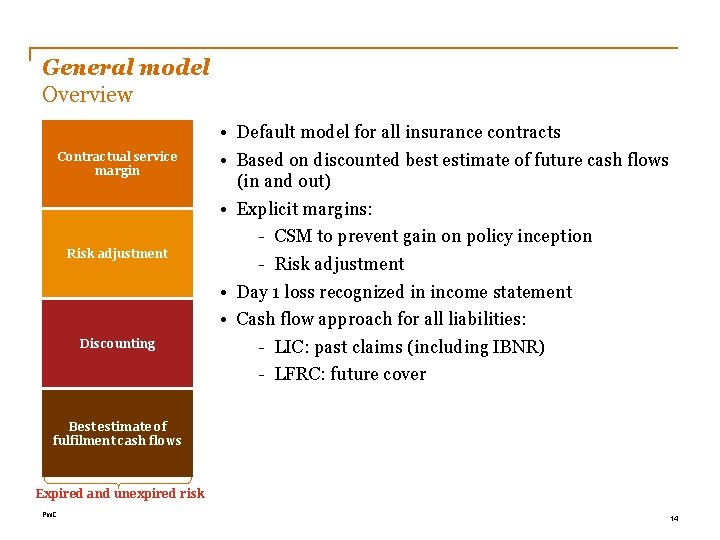
General model Overview Contractual service margin Risk adjustment Discounting • Default model for all insurance contracts • Based on discounted best estimate of future cash flows (in and out) • Explicit margins: - CSM to prevent gain on policy inception - Risk adjustment • Day 1 loss recognized in income statement • Cash flow approach for all liabilities: - LIC: past claims (including IBNR) - LFRC: future cover Best estimate of fulfilment cash flows Expired and unexpired risk Pw. C 14
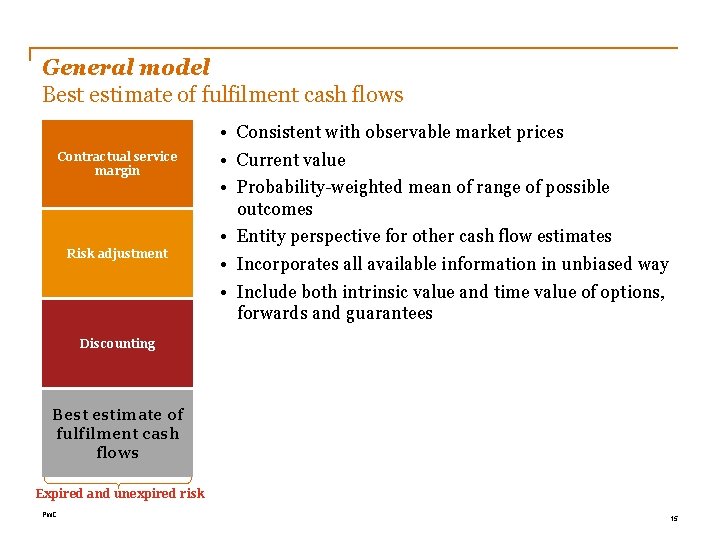
General model Best estimate of fulfilment cash flows Contractual service margin Risk adjustment • Consistent with observable market prices • Current value • Probability-weighted mean of range of possible outcomes • Entity perspective for other cash flow estimates • Incorporates all available information in unbiased way • Include both intrinsic value and time value of options, forwards and guarantees Discounting Best estimate of fulfilment cash flows Expired and unexpired risk Pw. C 15
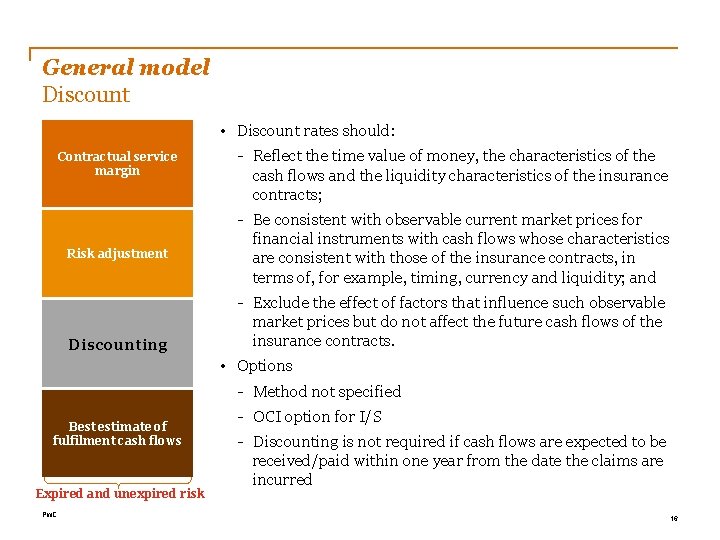
General model Discount • Discount rates should: Contractual service margin Risk adjustment Discounting - Reflect the time value of money, the characteristics of the cash flows and the liquidity characteristics of the insurance contracts; - Be consistent with observable current market prices for financial instruments with cash flows whose characteristics are consistent with those of the insurance contracts, in terms of, for example, timing, currency and liquidity; and - Exclude the effect of factors that influence such observable market prices but do not affect the future cash flows of the insurance contracts. • Options - Method not specified Best estimate of fulfilment cash flows Expired and unexpired risk Pw. C - OCI option for I/S - Discounting is not required if cash flows are expected to be received/paid within one year from the date the claims are incurred 16
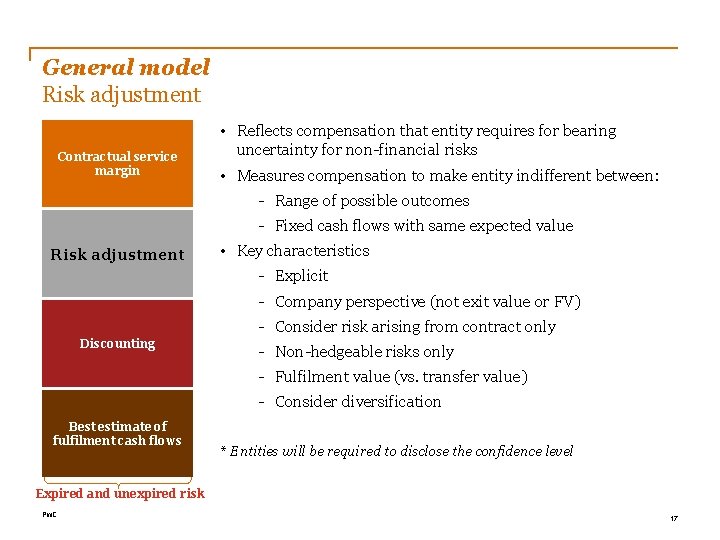
General model Risk adjustment Contractual service margin • Reflects compensation that entity requires for bearing uncertainty for non-financial risks • Measures compensation to make entity indifferent between: - Range of possible outcomes - Fixed cash flows with same expected value Risk adjustment • Key characteristics - Explicit - Company perspective (not exit value or FV) - Consider risk arising from contract only Discounting - Non-hedgeable risks only - Fulfilment value (vs. transfer value) - Consider diversification Best estimate of fulfilment cash flows * Entities will be required to disclose the confidence level Expired and unexpired risk Pw. C 17
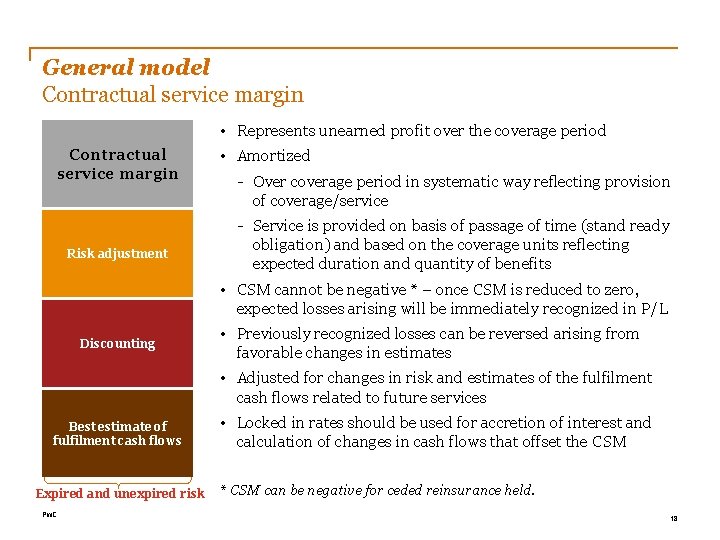
General model Contractual service margin • Represents unearned profit over the coverage period Contractual service margin Risk adjustment • Amortized - Over coverage period in systematic way reflecting provision of coverage/service - Service is provided on basis of passage of time (stand ready obligation) and based on the coverage units reflecting expected duration and quantity of benefits • CSM cannot be negative * – once CSM is reduced to zero, expected losses arising will be immediately recognized in P/L Discounting • Previously recognized losses can be reversed arising from favorable changes in estimates • Adjusted for changes in risk and estimates of the fulfilment cash flows related to future services Best estimate of fulfilment cash flows Expired and unexpired risk Pw. C • Locked in rates should be used for accretion of interest and calculation of changes in cash flows that offset the CSM * CSM can be negative for ceded reinsurance held. 18
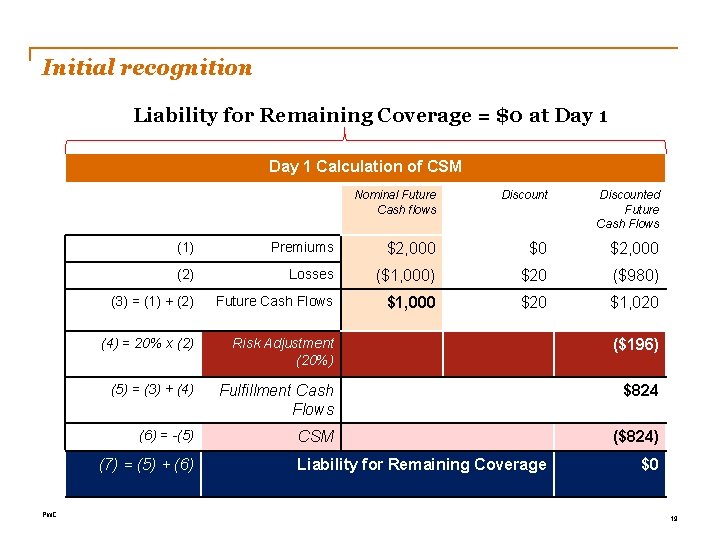
Initial recognition Liability for Remaining Coverage = $0 at Day 1 Calculation of CSM Discounted Future Cash Flows (1) Premiums $2, 000 $0 $2, 000 (2) Losses ($1, 000) $20 ($980) (3) = (1) + (2) Future Cash Flows $1, 000 $20 $1, 020 (4) = 20% x (2) Risk Adjustment (20%) ($196) (5) = (3) + (4) Fulfillment Cash Flows $824 (6) = -(5) CSM ($824) (7) = (5) + (6) Pw. C Nominal Future Cash flows Liability for Remaining Coverage $0 19

4 – Premium allocation approach 20
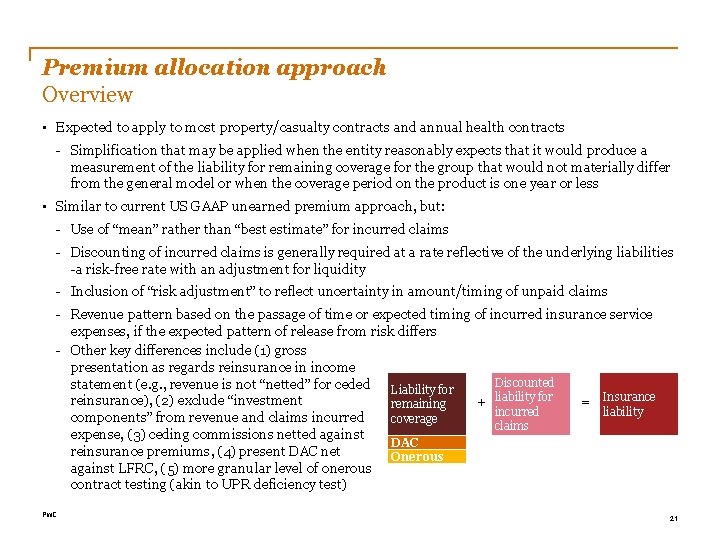
Premium allocation approach Overview • Expected to apply to most property/casualty contracts and annual health contracts - Simplification that may be applied when the entity reasonably expects that it would produce a measurement of the liability for remaining coverage for the group that would not materially differ from the general model or when the coverage period on the product is one year or less • Similar to current US GAAP unearned premium approach, but: - Use of “mean” rather than “best estimate” for incurred claims - Discounting of incurred claims is generally required at a rate reflective of the underlying liabilities -a risk-free rate with an adjustment for liquidity - Inclusion of “risk adjustment” to reflect uncertainty in amount/timing of unpaid claims - Revenue pattern based on the passage of time or expected timing of incurred insurance service expenses, if the expected pattern of release from risk differs - Other key differences include (1) gross presentation as regards reinsurance in income Discounted statement (e. g. , revenue is not “netted” for ceded Liability for reinsurance), (2) exclude “investment = Insurance + liability for remaining incurred liability components” from revenue and claims incurred coverage claims expense, (3) ceding commissions netted against DAC reinsurance premiums, (4) present DAC net Onerous against LFRC, (5) more granular level of onerous contract testing (akin to UPR deficiency test) Pw. C 21
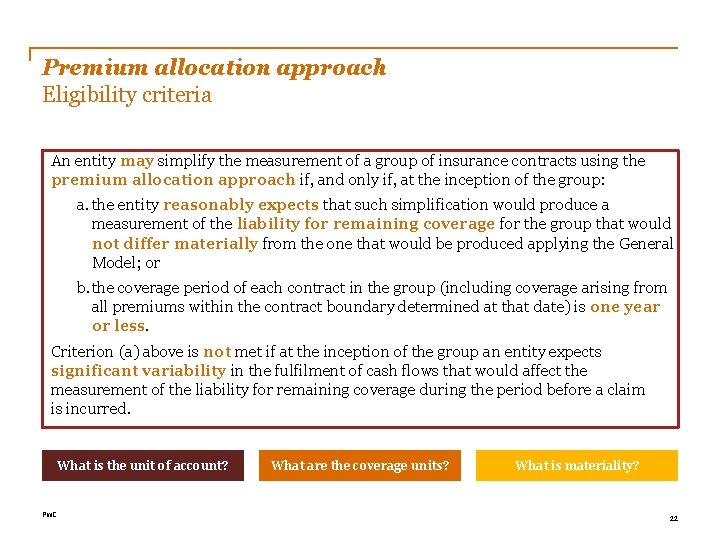
Premium allocation approach Eligibility criteria An entity may simplify the measurement of a group of insurance contracts using the premium allocation approach if, and only if, at the inception of the group: a. the entity reasonably expects that such simplification would produce a measurement of the liability for remaining coverage for the group that would not differ materially from the one that would be produced applying the General Model; or b. the coverage period of each contract in the group (including coverage arising from all premiums within the contract boundary determined at that date) is one year or less. Criterion (a) above is not met if at the inception of the group an entity expects significant variability in the fulfilment of cash flows that would affect the measurement of the liability for remaining coverage during the period before a claim is incurred. What is the unit of account? Pw. C What are the coverage units? What is materiality? 22
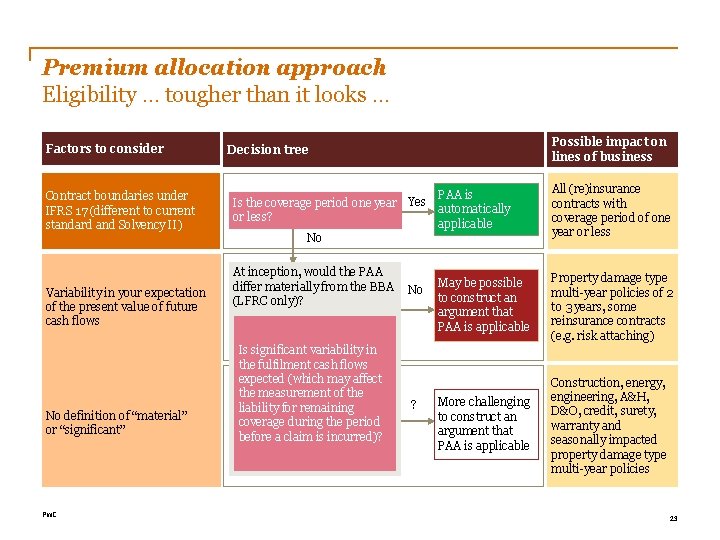
Premium allocation approach Eligibility … tougher than it looks … Factors to consider Contract boundaries under IFRS 17 (different to current standard and Solvency II) Variability in your expectation of the present value of future cash flows No definition of “material” or “significant” Pw. C Possible impact on lines of business Decision tree Is the coverage period one year Yes or less? PAA is automatically applicable All (re)insurance contracts with coverage period of one year or less May be possible to construct an argument that PAA is applicable Property damage type multi-year policies of 2 to 3 years, some reinsurance contracts (e. g. risk attaching) More challenging to construct an argument that PAA is applicable Construction, energy, engineering, A&H, D&O, credit, surety, warranty and seasonally impacted property damage type multi-year policies No At inception, would the PAA differ materially from the BBA No (LFRC only)? Is significant variability in the fulfilment cash flows expected (which may affect the measurement of the liability for remaining coverage during the period before a claim is incurred)? ? 23
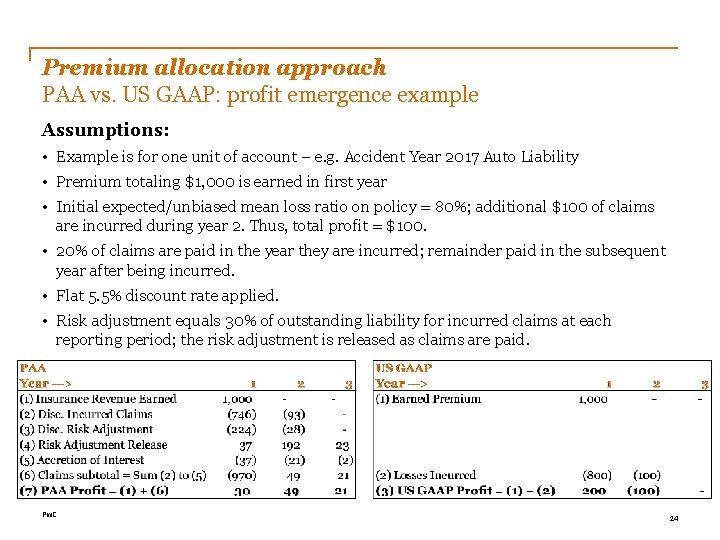
Premium allocation approach PAA vs. US GAAP: profit emergence example Assumptions: • Example is for one unit of account – e. g. Accident Year 2017 Auto Liability • Premium totaling $1, 000 is earned in first year • Initial expected/unbiased mean loss ratio on policy = 80%; additional $100 of claims are incurred during year 2. Thus, total profit = $100. • 20% of claims are paid in the year they are incurred; remainder paid in the subsequent year after being incurred. • Flat 5. 5% discount rate applied. • Risk adjustment equals 30% of outstanding liability for incurred claims at each reporting period; the risk adjustment is released as claims are paid. Pw. C 24
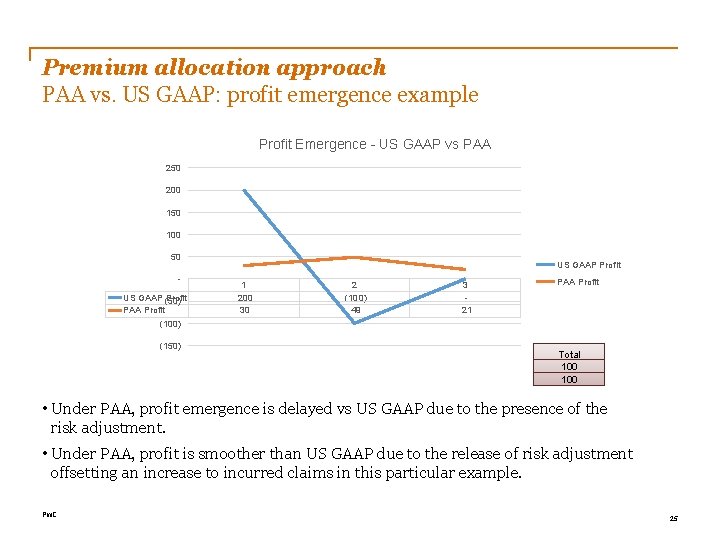
Premium allocation approach PAA vs. US GAAP: profit emergence example Profit Emergence - US GAAP vs PAA 250 200 150 100 50 US GAAP (50) Profit PAA Profit (100) (150) US GAAP Profit 1 200 30 2 (100) 49 3 21 PAA Profit Total 100 • Under PAA, profit emergence is delayed vs US GAAP due to the presence of the risk adjustment. • Under PAA, profit is smoother than US GAAP due to the release of risk adjustment offsetting an increase to incurred claims in this particular example. Pw. C 25
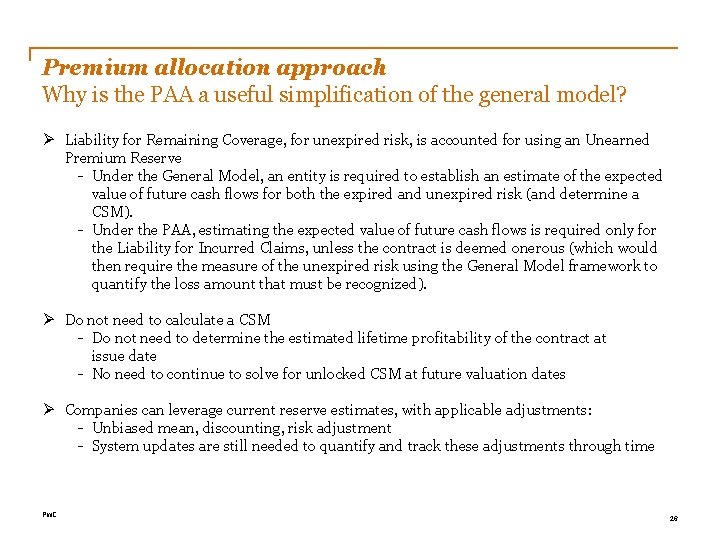
Premium allocation approach Why is the PAA a useful simplification of the general model? Ø Liability for Remaining Coverage, for unexpired risk, is accounted for using an Unearned Premium Reserve - Under the General Model, an entity is required to establish an estimate of the expected value of future cash flows for both the expired and unexpired risk (and determine a CSM). - Under the PAA, estimating the expected value of future cash flows is required only for the Liability for Incurred Claims, unless the contract is deemed onerous (which would then require the measure of the unexpired risk using the General Model framework to quantify the loss amount that must be recognized). Ø Do not need to calculate a CSM - Do not need to determine the estimated lifetime profitability of the contract at issue date - No need to continue to solve for unlocked CSM at future valuation dates Ø Companies can leverage current reserve estimates, with applicable adjustments: - Unbiased mean, discounting, risk adjustment - System updates are still needed to quantify and track these adjustments through time Pw. C 26

5 – Impacts to financial reporting 27
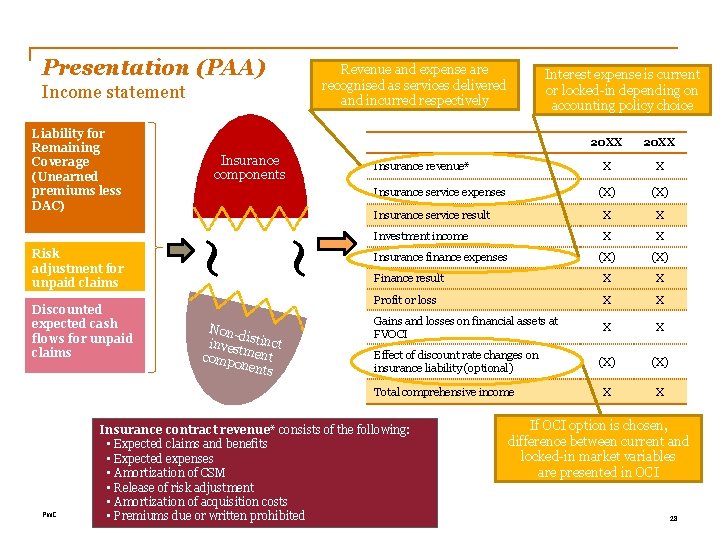
Presentation (PAA) Income statement Liability for Remaining Coverage (Unearned premiums less DAC) Discounted expected cash flows for unpaid claims Insurance components 20 XX X X (X) Insurance service result X X Investment income X X (X) Finance result X X Profit or loss X X Gains and losses on financial assets at FVOCI X X (X) X X Insurance revenue* Nond inves istinct comp tment onent s Insurance finance expenses Effect of discount rate changes on insurance liability (optional) Total comprehensive income Pw. C Interest expense is current or locked-in depending on accounting policy choice Insurance service expenses ~ ~ Risk adjustment for unpaid claims Revenue and expense are recognised as services delivered and incurred respectively Insurance contract revenue* consists of the following: • Expected claims and benefits • Expected expenses • Amortization of CSM • Release of risk adjustment • Amortization of acquisition costs • Premiums due or written prohibited If OCI option is chosen, difference between current and locked-in market variables are presented in OCI 28
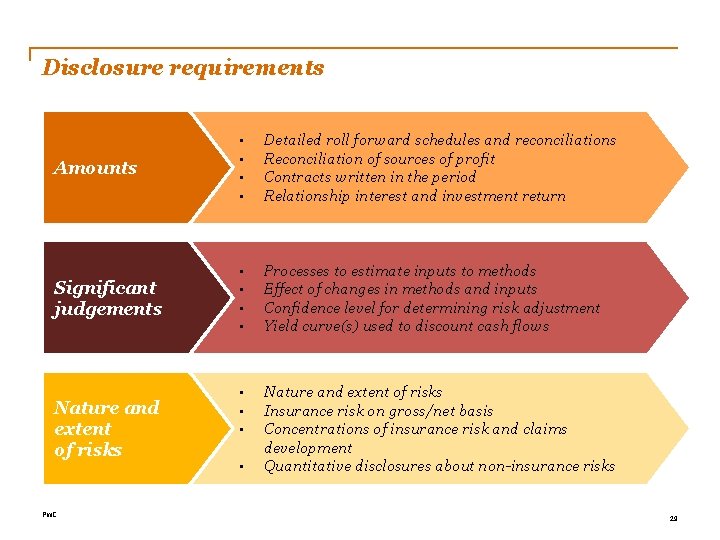
Disclosure requirements Amounts • • Detailed roll forward schedules and reconciliations Reconciliation of sources of profit Contracts written in the period Relationship interest and investment return Significant judgements • • Processes to estimate inputs to methods Effect of changes in methods and inputs Confidence level for determining risk adjustment Yield curve(s) used to discount cash flows • • • Nature and extent of risks Insurance risk on gross/net basis Concentrations of insurance risk and claims development Quantitative disclosures about non-insurance risks Nature and extent of risks Pw. C • 29

6 – Transition 30
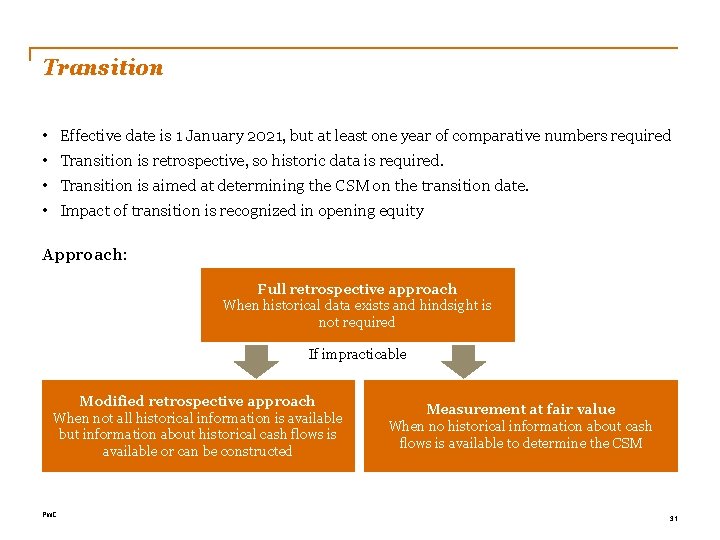
Transition • Effective date is 1 January 2021, but at least one year of comparative numbers required • Transition is retrospective, so historic data is required. • Transition is aimed at determining the CSM on the transition date. • Impact of transition is recognized in opening equity Approach: Full retrospective approach When historical data exists and hindsight is not required If impracticable Modified retrospective approach When not all historical information is available but information about historical cash flows is available or can be constructed Pw. C Measurement at fair value When no historical information about cash flows is available to determine the CSM 31
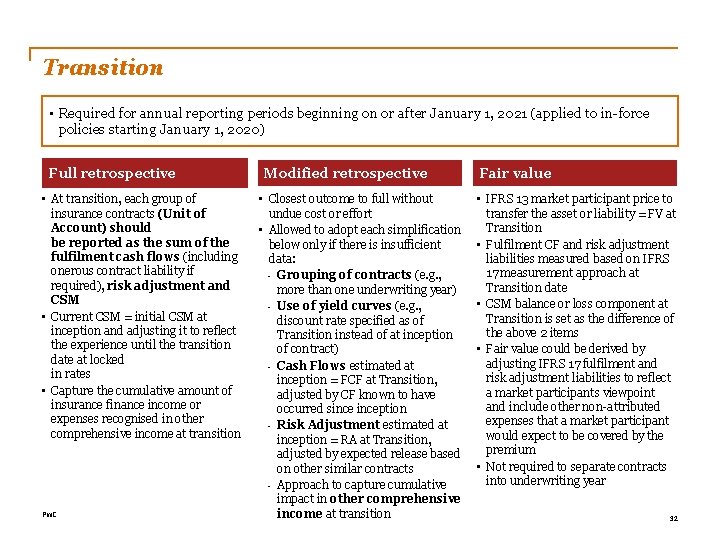
Transition • Required for annual reporting periods beginning on or after January 1, 2021 (applied to in-force policies starting January 1, 2020) Full retrospective Modified retrospective • At transition, each group of • Closest outcome to full without insurance contracts (Unit of Account) should be reported as the sum of the fulfilment cash flows (including onerous contract liability if required), risk adjustment and CSM • Current CSM = initial CSM at inception and adjusting it to reflect the experience until the transition date at locked in rates • Capture the cumulative amount of insurance finance income or expenses recognised in other comprehensive income at transition undue cost or effort • Allowed to adopt each simplification below only if there is insufficient data: - Grouping of contracts (e. g. , more than one underwriting year) - Use of yield curves (e. g. , discount rate specified as of Transition instead of at inception of contract) - Cash Flows estimated at inception = FCF at Transition, adjusted by CF known to have occurred sinception - Risk Adjustment estimated at inception = RA at Transition, adjusted by expected release based on other similar contracts - Approach to capture cumulative impact in other comprehensive income at transition Pw. C Fair value • IFRS 13 market participant price to • • transfer the asset or liability = FV at Transition Fulfilment CF and risk adjustment liabilities measured based on IFRS 17 measurement approach at Transition date CSM balance or loss component at Transition is set as the difference of the above 2 items Fair value could be derived by adjusting IFRS 17 fulfilment and risk adjustment liabilities to reflect a market participants viewpoint and include other non-attributed expenses that a market participant would expect to be covered by the premium Not required to separate contracts into underwriting year 32

Questions? Lela Patrik FCAS, MAAA Pw. C, Actuarial Services Director, Philadelphia (267) 330 -2237 lela. patrik@pwc. com Adam Kallin FCAS, MAAA Pw. C, Actuarial Services Manager, Atlanta (678) 419 -2272 adam. j. kallin@pwc. com Pw. C 33

This publication has been prepared for general guidance on matters of interest only, and does not constitute professional advice. You should not act upon the information contained in this publication without obtaining specific professional advice. No representation or warranty (express or implied) is given as to the accuracy or completeness of the information contained in this publication, and, to the extent permitted by law, Pw. C does do not accept or assume any liability, responsibility or duty of care for any consequences of you or anyone else acting, or refraining to act, in reliance on the information contained in this publication or for any decision based on it. © 2018 Pw. C. All rights reserved. Pw. C refers to the US member firm or one of its subsidiaries or affiliates, and may sometimes refer to the Pw. C network. Each member firm is a separate legal entity. Please see www. pwc. com/structure for further details. This document is for general information purposes only, and should not be used as a substitute for consultation with professional advisors. 34
- Slides: 34