
IA GALAXIES Department Head Dr G Petrov Assoc

- Slides: 24
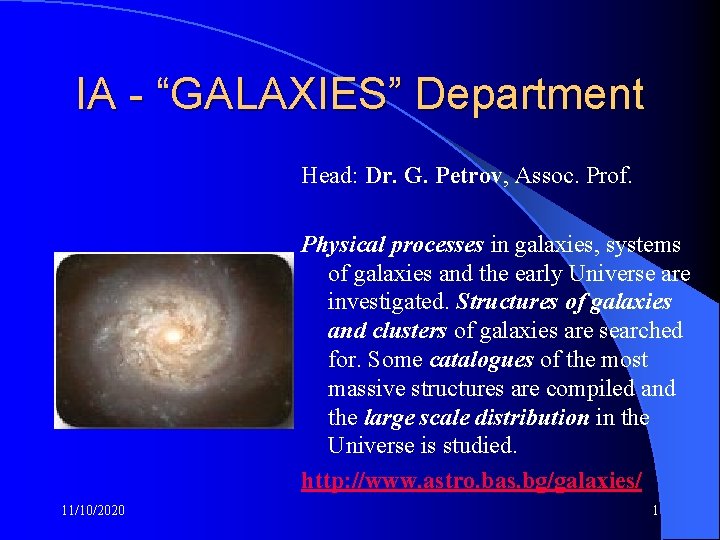
IA - “GALAXIES” Department Head: Dr. G. Petrov, Assoc. Prof. Physical processes in galaxies, systems of galaxies and the early Universe are investigated. Structures of galaxies and clusters of galaxies are searched for. Some catalogues of the most massive structures are compiled and the large scale distribution in the Universe is studied. http: //www. astro. bas. bg/galaxies/ 11/10/2020 1
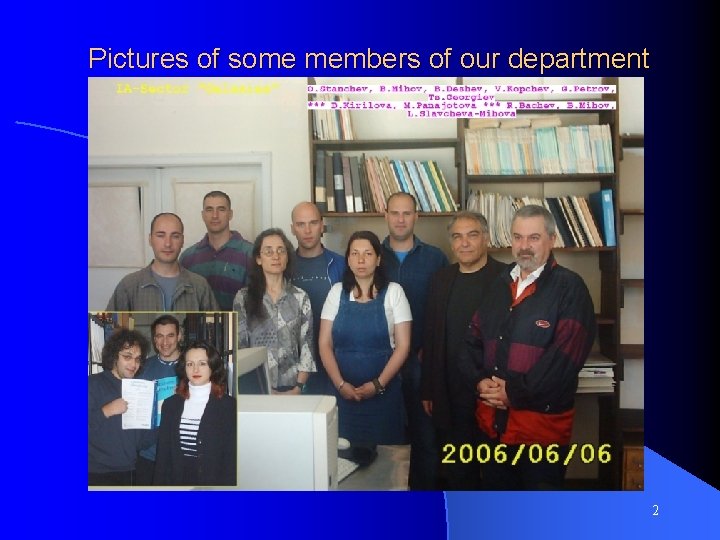
Pictures of some members of our department 2
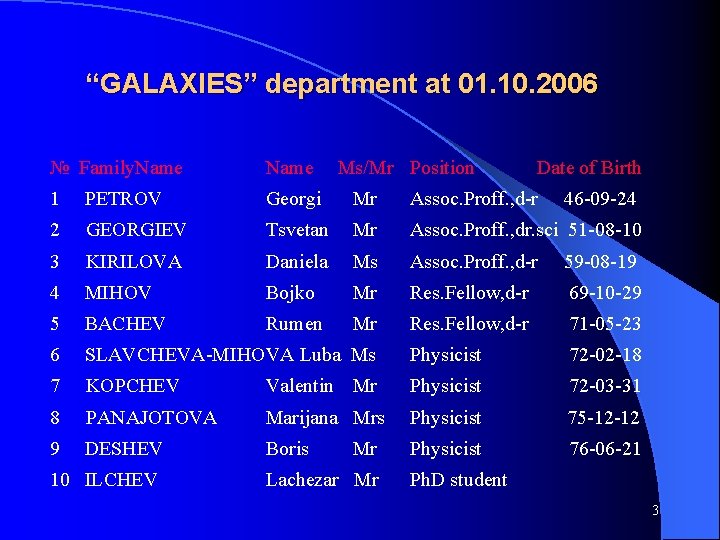
“GALAXIES” department at 01. 10. 2006 № Family. Name Ms/Mr Position Date of Birth 1 PETROV Georgi Mr Assoc. Proff. , d-r 46 -09 -24 2 GEORGIEV Tsvetan Mr Assoc. Proff. , dr. sci 51 -08 -10 3 KIRILOVA Daniela Ms Assoc. Proff. , d-r 59 -08 -19 4 MIHOV Bojko Mr Res. Fellow, d-r 69 -10 -29 5 BACHEV Rumen Mr Res. Fellow, d-r 71 -05 -23 6 SLAVCHEVA-MIHOVA Luba Ms Physicist 72 -02 -18 7 KOPCHEV Valentin Mr Physicist 72 -03 -31 8 PANAJOTOVA Marijana Mrs Physicist 75 -12 -12 9 DESHEV Boris Physicist 76 -06 -21 10 ILCHEV Lachezar Mr Mr Ph. D student 3
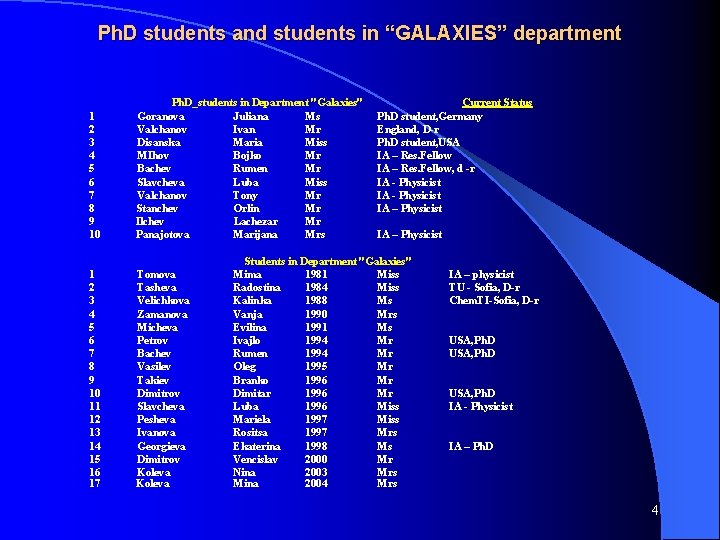
Ph. D students and students in “GALAXIES” department Ph. D_students in Department "Galaxies" 1 Goranova Juliana Ms 2 Valchanov Ivan Mr 3 Disanska Maria Miss 4 MIhov Bojko Mr 5 Bachev Rumen Mr 6 Slavcheva Luba Miss 7 Valchanov Tony Mr 8 Stanchev Orlin Mr 9 Ilchev Lachezar Mr 10 Panajotova Marijana Mrs 1 Tomova 2 Tasheva 3 Velichkova 4 Zamanova 5 Micheva 6 Petrov 7 Bachev 8 Vasilev 9 Takiev 10 Dimitrov 11 Slavcheva 12 Pesheva 13 Ivanova 14 Georgieva 15 Dimitrov 16 Koleva 17 Koleva Current Status Ph. D student, Germany England, D-r Ph. D student, USA IA – Res. Fellow, d -r IA - Physicist IA – Physicist Students in Department "Galaxies" Mima 1981 Miss Radostina 1984 Miss Kalinka 1988 Ms Vanja 1990 Mrs Evilina 1991 Ms Ivajlo 1994 Mr Rumen 1994 Mr Oleg 1995 Mr Branko 1996 Mr Dimitar 1996 Mr Luba 1996 Miss Mariela 1997 Miss Rositsa 1997 Mrs Ekaterina 1998 Ms Vencislav 2000 Mr Nina 2003 Mrs Mina 2004 Mrs IA – physicist TU - Sofia, D-r Chem. TI-Sofia, D-r USA, Ph. D IA - Physicist IA – Ph. D 4
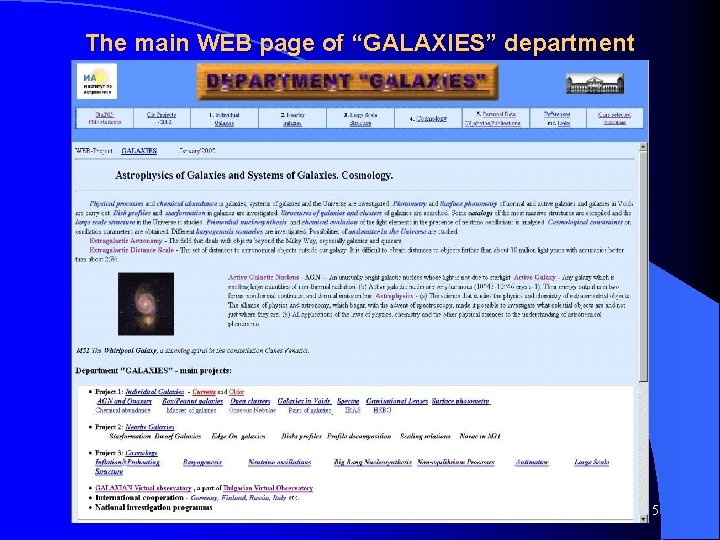
The main WEB page of “GALAXIES” department 5
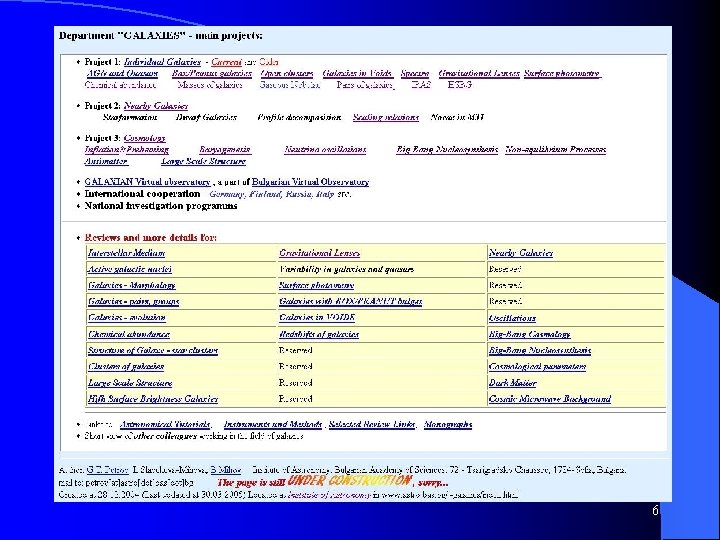
6
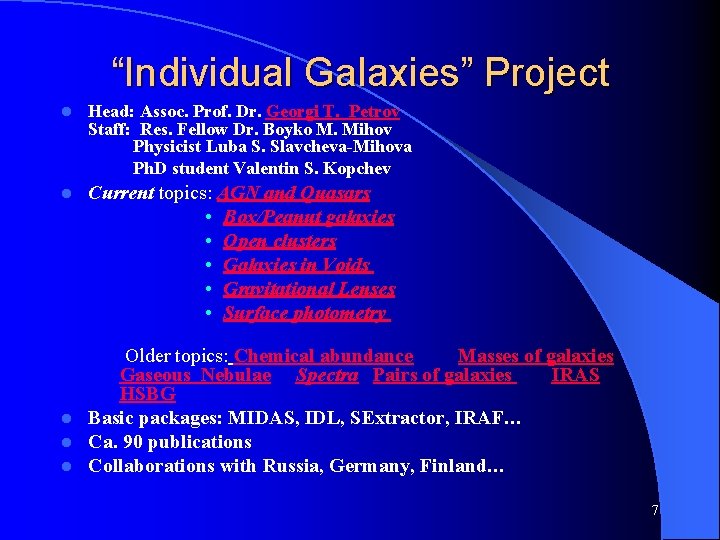
“Individual Galaxies” Project l Head: Assoc. Prof. Dr. Georgi T. Petrov Staff: Res. Fellow Dr. Boyko M. Mihov Physicist Luba S. Slavcheva-Mihova Ph. D student Valentin S. Kopchev Current topics: AGN and Quasars • Box/Peanut galaxies • Open clusters • Galaxies in Voids • Gravitational Lenses • Surface photometry Older topics: Chemical abundance Masses of galaxies Gaseous Nebulae Spectra Pairs of galaxies IRAS HSBG l Basic packages: MIDAS, IDL, SExtractor, IRAF… l Ca. 90 publications l Collaborations with Russia, Germany, Finland… l 7
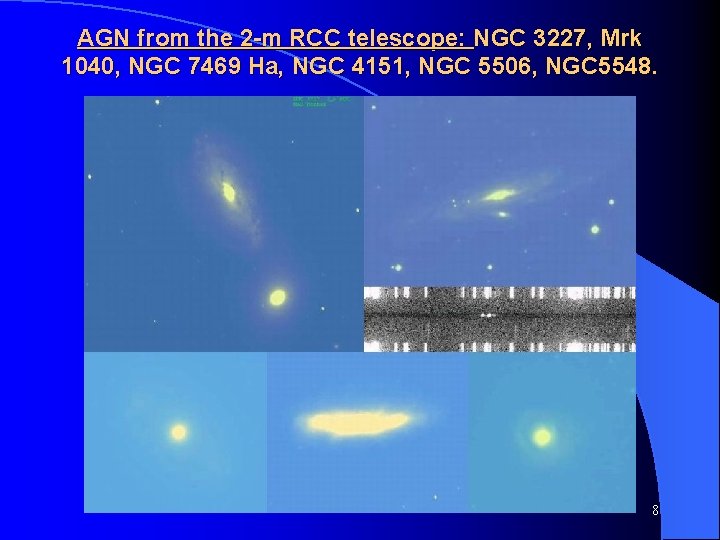
AGN from the 2 -m RCC telescope: NGC 3227, Mrk 1040, NGC 7469 Ha, NGC 4151, NGC 5506, NGC 5548. 8
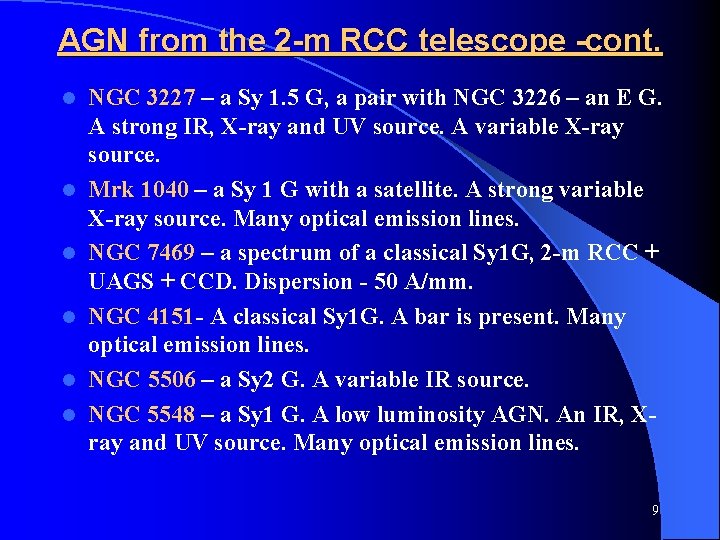
AGN from the 2 -m RCC telescope -cont. l l l NGC 3227 – a Sy 1. 5 G, a pair with NGC 3226 – an E G. A strong IR, X-ray and UV source. A variable X-ray source. Mrk 1040 – a Sy 1 G with a satellite. A strong variable X-ray source. Many optical emission lines. NGC 7469 – a spectrum of a classical Sy 1 G, 2 -m RCC + UAGS + CCD. Dispersion - 50 A/mm. NGC 4151 - A classical Sy 1 G. A bar is present. Many optical emission lines. NGC 5506 – a Sy 2 G. A variable IR source. NGC 5548 – a Sy 1 G. A low luminosity AGN. An IR, Xray and UV source. Many optical emission lines. 9
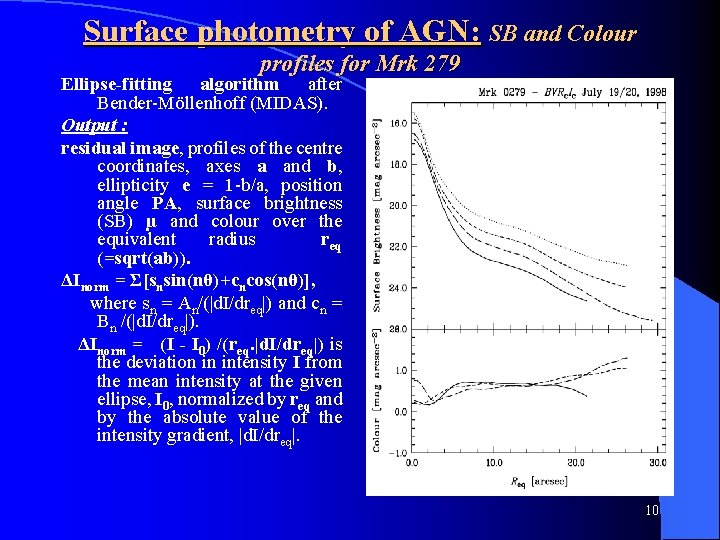
Surface photometry of AGN: SB and Colour profiles for Mrk 279 Ellipse-fitting algorithm after Bender-Möllenhoff (MIDAS). Output : residual image, profiles of the centre coordinates, axes a and b, ellipticity e = 1 -b/a, position angle PA, surface brightness (SB) µ and colour over the equivalent radius req (=sqrt(ab)). ΔInorm = Σ[snsin(nθ)+cncos(nθ)], where sn = An/(|d. I/dreq|) and cn = Bn /(|d. I/dreq|). ΔInorm = (I - I 0) /(req. |d. I/dreq|) is the deviation in intensity I from the mean intensity at the given ellipse, I 0, normalized by req and by the absolute value of the intensity gradient, |d. I/dreq|. 10
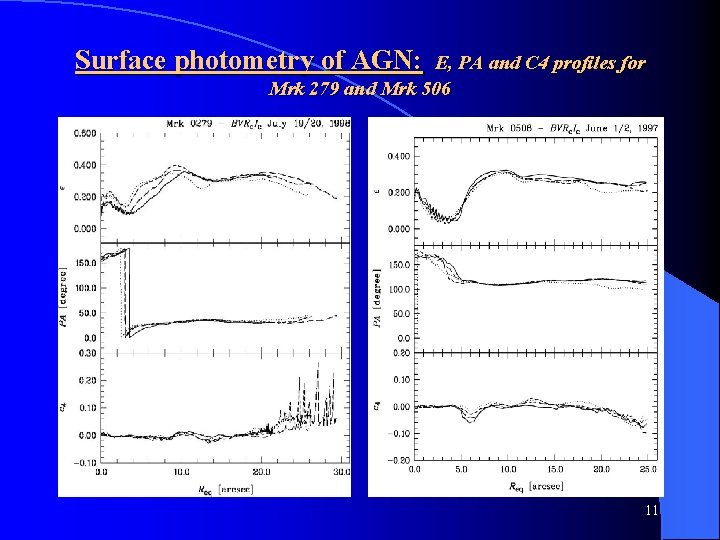
Surface photometry of AGN: E, PA and C 4 profiles for Mrk 279 and Mrk 506 11
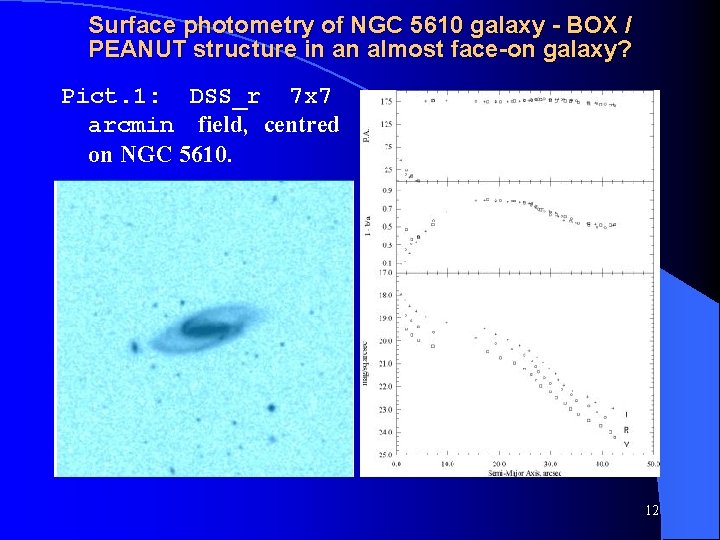
Surface photometry of NGC 5610 galaxy - BOX / PEANUT structure in an almost face-on galaxy? Pict. 1: DSS_r 7 x 7 arcmin field, centred on NGC 5610. 12
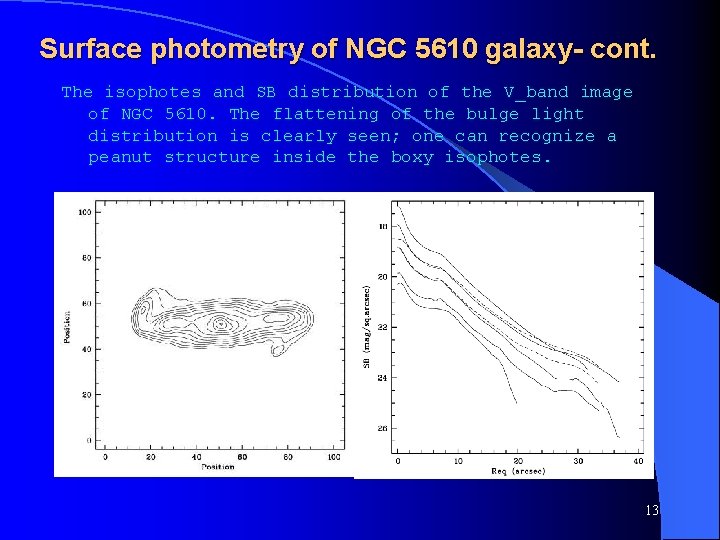
Surface photometry of NGC 5610 galaxy- cont. The isophotes and SB distribution of the V_band image of NGC 5610. The flattening of the bulge light distribution is clearly seen; one can recognize a peanut structure inside the boxy isophotes. 13
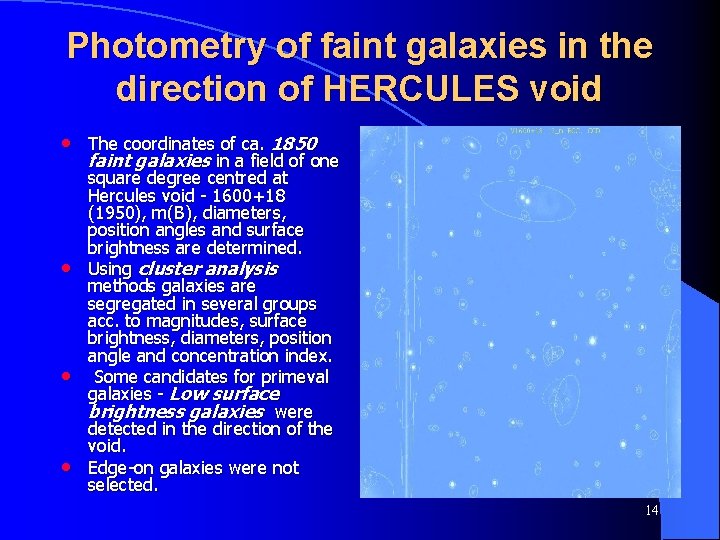
Photometry of faint galaxies in the direction of HERCULES void • The coordinates of ca. 1850 faint galaxies in a field of one • • • square degree centred at Hercules void - 1600+18 (1950), m(B), diameters, position angles and surface brightness are determined. Using cluster analysis methods galaxies are segregated in several groups acc. to magnitudes, surface brightness, diameters, position angle and concentration index. Some candidates for primeval galaxies - Low surface brightness galaxies were detected in the direction of the void. Edge-on galaxies were not selected. 14
“Nearby Galaxies” Project Head: Assoc. Prof. Dr. Sci. Tsvetan B. Georgiev Staff: Physycist Boris Deshev; Ph. D student Lachezar Ilchev l Current topics: l Star Formation Dwarf Galaxies Profile Decomposition Scaling relations Novae in M 31 Ca. 100 publications l Collaborations with Germany, Russia … l 15
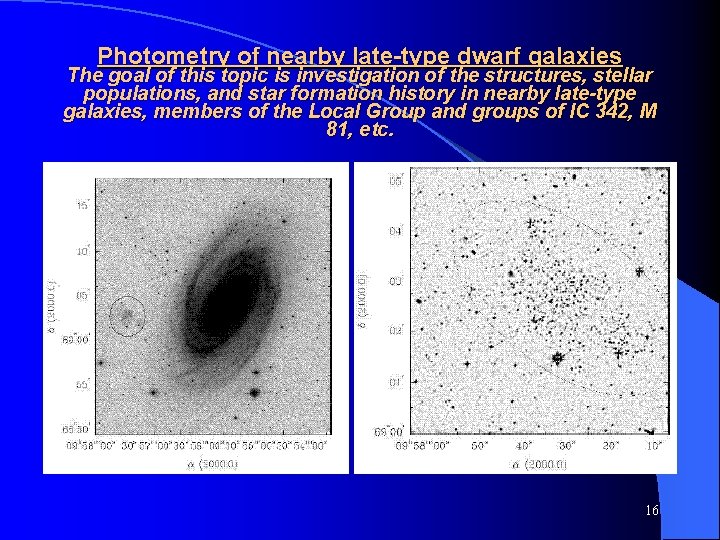
Photometry of nearby late-type dwarf galaxies The goal of this topic is investigation of the structures, stellar populations, and star formation history in nearby late-type galaxies, members of the Local Group and groups of IC 342, M 81, etc. 16
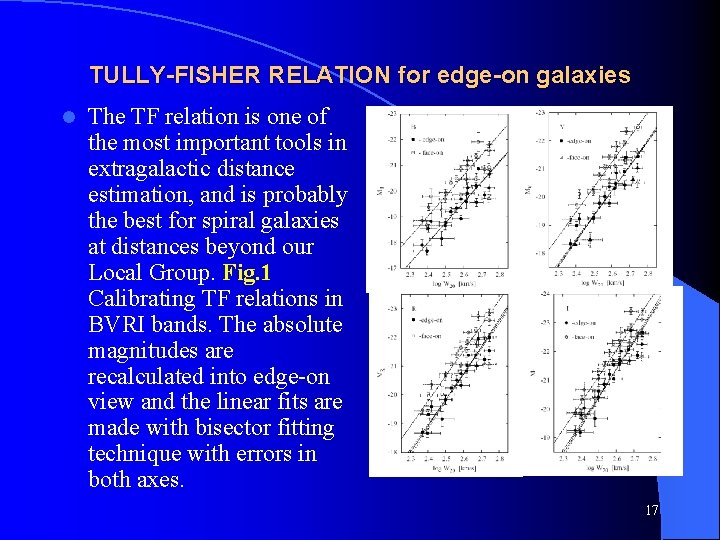
TULLY-FISHER RELATION for edge-on galaxies l The TF relation is one of the most important tools in extragalactic distance estimation, and is probably the best for spiral galaxies at distances beyond our Local Group. Fig. 1 Calibrating TF relations in BVRI bands. The absolute magnitudes are recalculated into edge-on view and the linear fits are made with bisector fitting technique with errors in both axes. 17
“Cosmology” Project People involved : senior researcher Ph. D. Daniela P. Kirilova, physicist Mariana P. Panayotova, l Collaboration with : senior researcher Ph. D. Mihail V. Chizhov , professor Matey D. Mateev, Ph. D. Todor Velchev, Physical Faculty, Sofia University; prof. Alexander D. Dolgov, INFN, Ferrara, Italy; prof. Jean-Marie Frère, senior Ph. D. Michel Tytgat, Universite Libre de Bruxelles, Brussels, Belgium l International projects with : High Energy Section, International Centre of Theoretical Physics, l Trieste, Italy (2000 -2006); Sector of Theoretical Physics, Universite Libre de Bruxelles, Brussels, Belgium (2003 -2005); Theory Division, CERN, Geneve, Switzerland (2002); Theoretical Astrophysics Center, Niels Bohr Institute, Copenhagen, Denmark (1997); Theory Division, JINR, Dubna, Russia (1986 -1990). l l Ph. D. project : Astrophysics of the early Universe l Ph. D. student: Mariana P. Panayotova 18
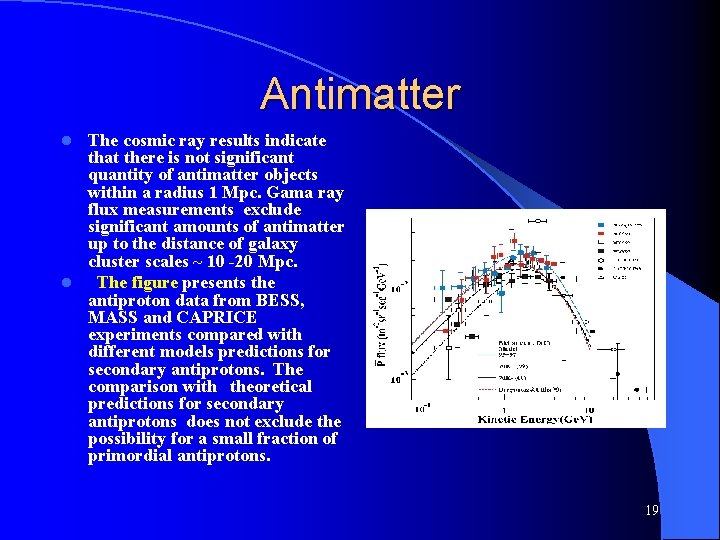
Antimatter The cosmic ray results indicate that there is not significant quantity of antimatter objects within a radius 1 Mpc. Gama ray flux measurements exclude significant amounts of antimatter up to the distance of galaxy cluster scales ~ 10 -20 Mpc. l The figure presents the antiproton data from BESS, MASS and CAPRICE experiments compared with different models predictions for secondary antiprotons. The comparison with theoretical predictions for secondary antiprotons does not exclude the possibility for a small fraction of primordial antiprotons. l 19
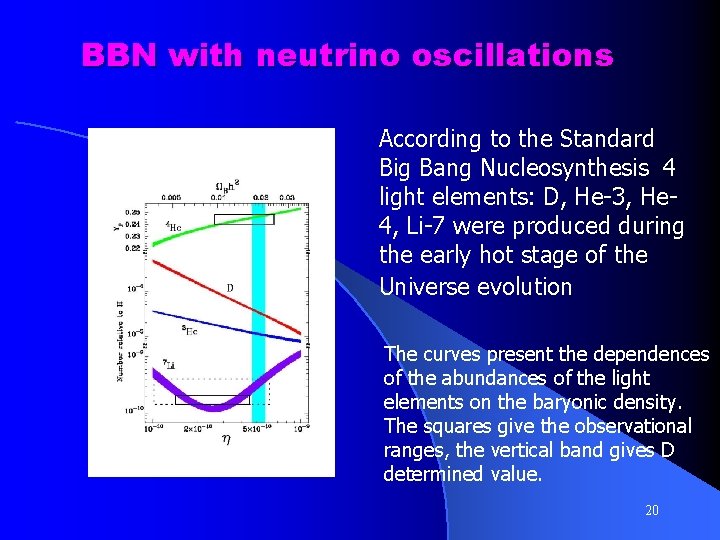
BBN with neutrino oscillations According to the Standard Big Bang Nucleosynthesis 4 light elements: D, He-3, He 4, Li-7 were produced during the early hot stage of the Universe evolution The curves present the dependences of the abundances of the light elements on the baryonic density. The squares give the observational ranges, the vertical band gives D determined value. 20
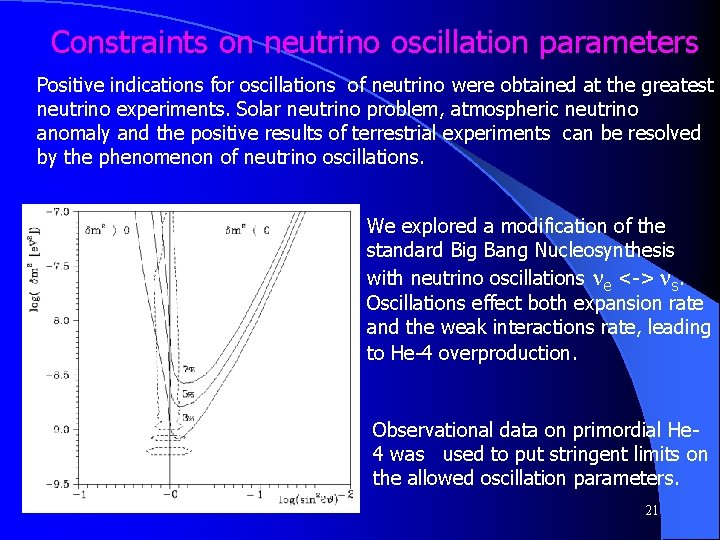
Constraints on neutrino oscillation parameters Positive indications for oscillations of neutrino were obtained at the greatest neutrino experiments. Solar neutrino problem, atmospheric neutrino anomaly and the positive results of terrestrial experiments can be resolved by the phenomenon of neutrino oscillations. We explored a modification of the standard Big Bang Nucleosynthesis with neutrino oscillations ne <-> ns. Oscillations effect both expansion rate and the weak interactions rate, leading to He-4 overproduction. Observational data on primordial He 4 was used to put stringent limits on the allowed oscillation parameters. 21
Baryogenesis We analyze numerically a baryogenesis model, based on the Afleck-Dine baryogenesis scenario. l We are providing more precise account for the particle creation processes, which were proved to play an essential role for baryogenesis. The model allows natural production of large antimatter domains in the Universe. l 22
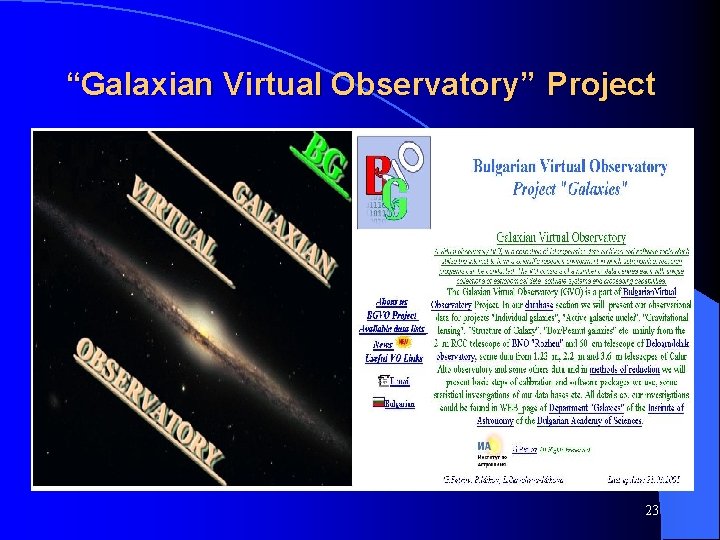
“Galaxian Virtual Observatory” Project 23
Thank You! 24