
I W O W IE V M R


- Slides: 30
I W O W IE V M R O E O V R O S S N A A L C F H O A D W IM T O P L E M T E N T IT IN H E
E ND E G G A A A U N U G O G T I N N T A EN I A L IS L M U IC P Q O M C A DE VEL A E C D A
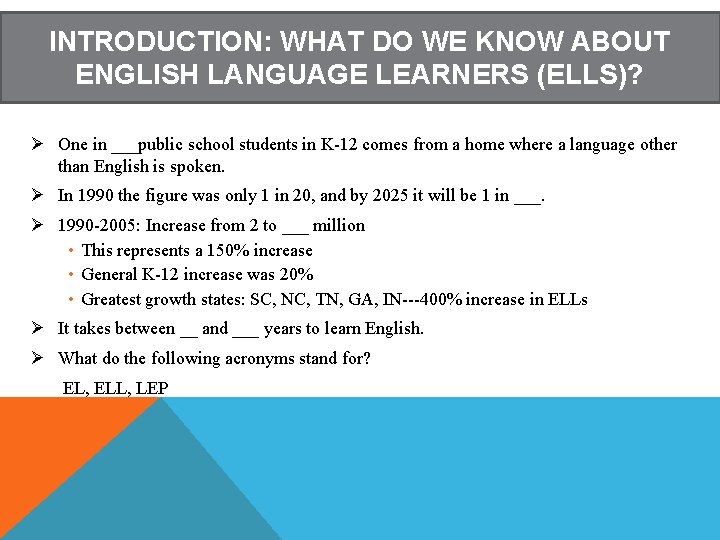
INTRODUCTION: WHAT DO WE KNOW ABOUT ENGLISH LANGUAGE LEARNERS (ELLS)? Ø One in ___public school students in K-12 comes from a home where a language other than English is spoken. Ø In 1990 the figure was only 1 in 20, and by 2025 it will be 1 in ___. Ø 1990 -2005: Increase from 2 to ___ million • This represents a 150% increase • General K-12 increase was 20% • Greatest growth states: SC, NC, TN, GA, IN---400% increase in ELLs Ø It takes between __ and ___ years to learn English. Ø What do the following acronyms stand for? EL, ELL, LEP
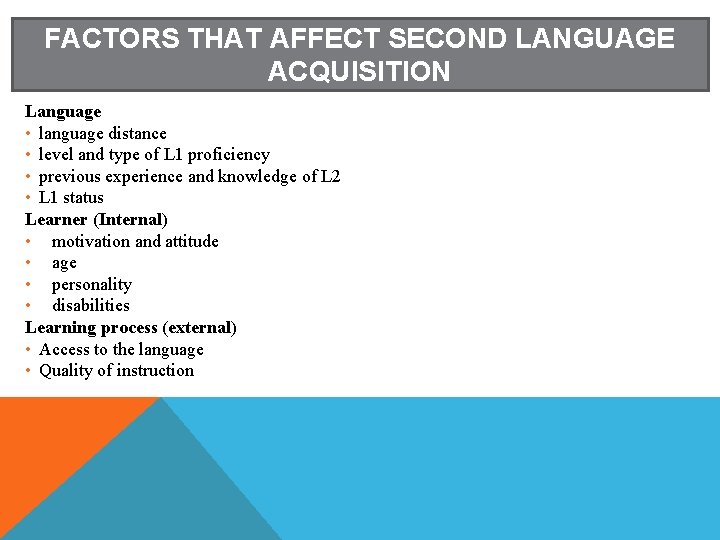
FACTORS THAT AFFECT SECOND LANGUAGE ACQUISITION Language • language distance • level and type of L 1 proficiency • previous experience and knowledge of L 2 • L 1 status Learner (Internal) • motivation and attitude • age • personality • disabilities Learning process (external) • Access to the language • Quality of instruction
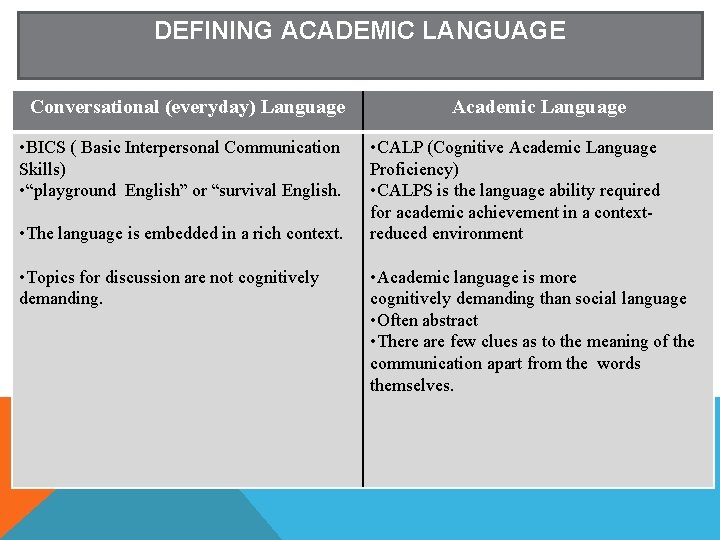
DEFINING ACADEMIC LANGUAGE Conversational (everyday) Language • BICS ( Basic Interpersonal Communication Skills) • “playground English” or “survival English. • The language is embedded in a rich context. • Topics for discussion are not cognitively demanding. Academic Language • CALP (Cognitive Academic Language Proficiency) • CALPS is the language ability required for academic achievement in a contextreduced environment • Academic language is more cognitively demanding than social language • Often abstract • There are few clues as to the meaning of the communication apart from the words themselves.
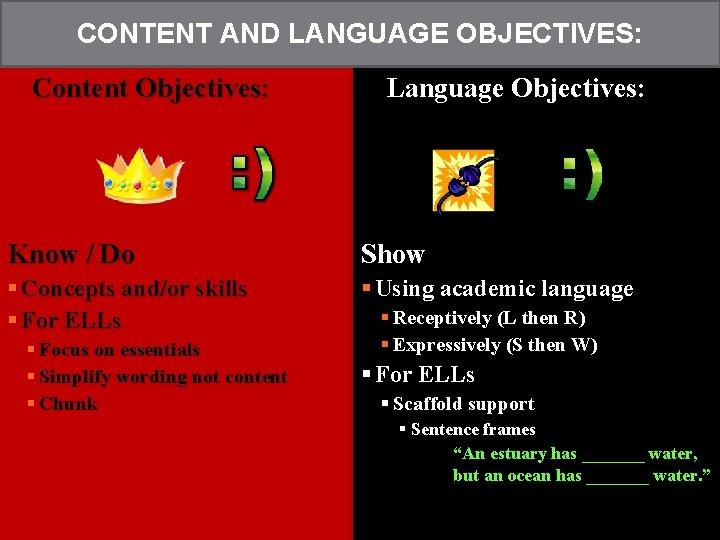
CONTENT AND LANGUAGE OBJECTIVES: Content Objectives: Language Objectives: Know / Do Show § Concepts and/or skills § For ELLs § Using academic language § Focus on essentials § Simplify wording not content § Chunk § Receptively (L then R) § Expressively (S then W) § For ELLs § Scaffold support § Sentence frames “An estuary has _______ water, but an ocean has _______ water. ”
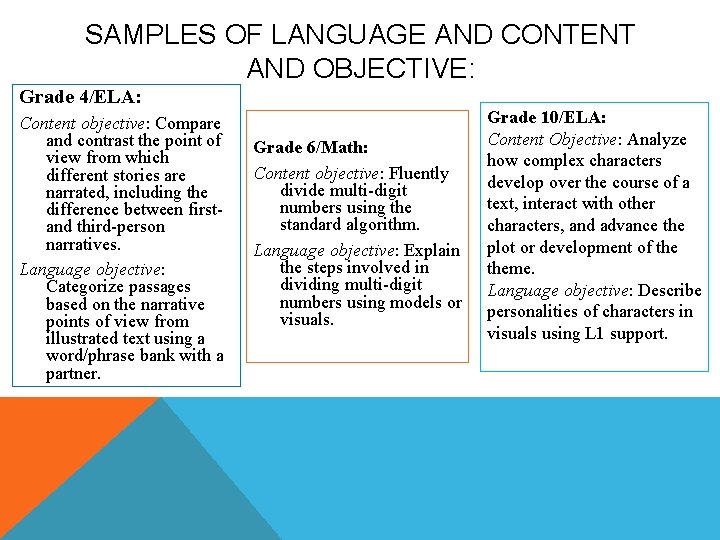
SAMPLES OF LANGUAGE AND CONTENT AND OBJECTIVE: Grade 4/ELA: Content objective: Compare and contrast the point of view from which different stories are narrated, including the difference between firstand third-person narratives. Language objective: Categorize passages based on the narrative points of view from illustrated text using a word/phrase bank with a partner. Grade 6/Math: Content objective: Fluently divide multi-digit numbers using the standard algorithm. Language objective: Explain the steps involved in dividing multi-digit numbers using models or visuals. Grade 10/ELA: Content Objective: Analyze how complex characters develop over the course of a text, interact with other characters, and advance the plot or development of theme. Language objective: Describe personalities of characters in visuals using L 1 support.
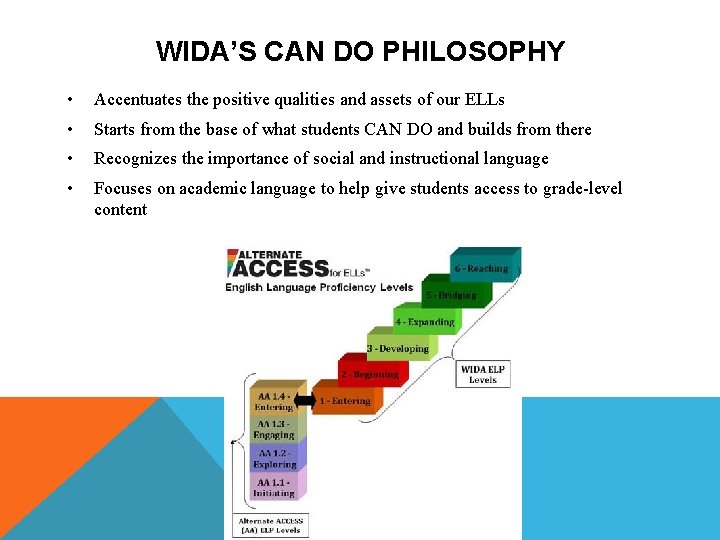
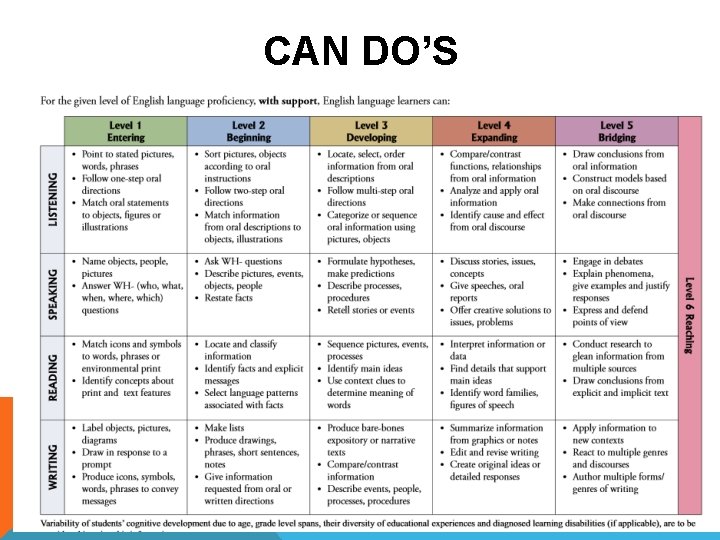
WIDA’S CAN DO PHILOSOPHY • Accentuates the positive qualities and assets of our ELLs • Starts from the base of what students CAN DO and builds from there • Recognizes the importance of social and instructional language • Focuses on academic language to help give students access to grade-level content
CAN DO’S
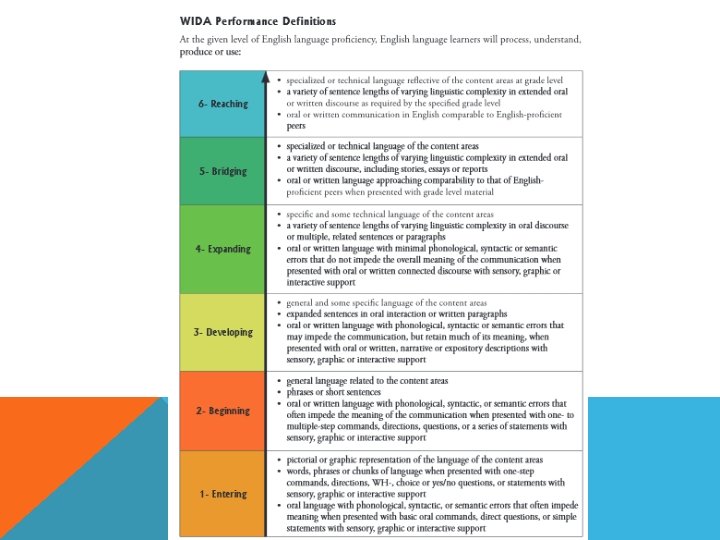
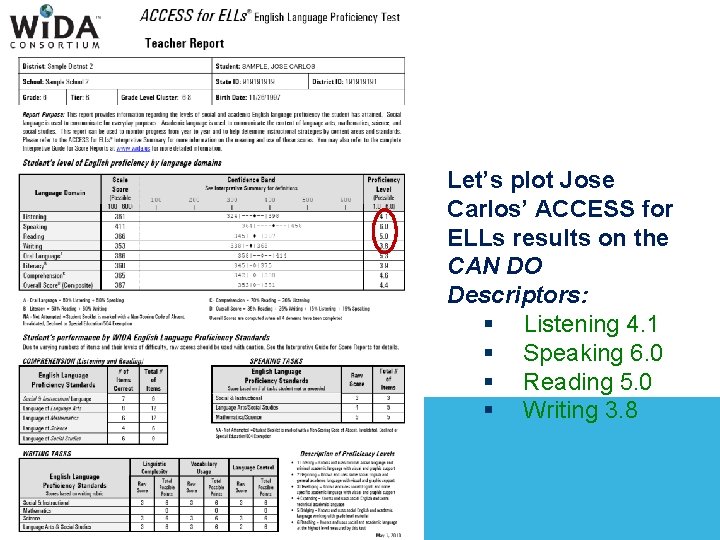
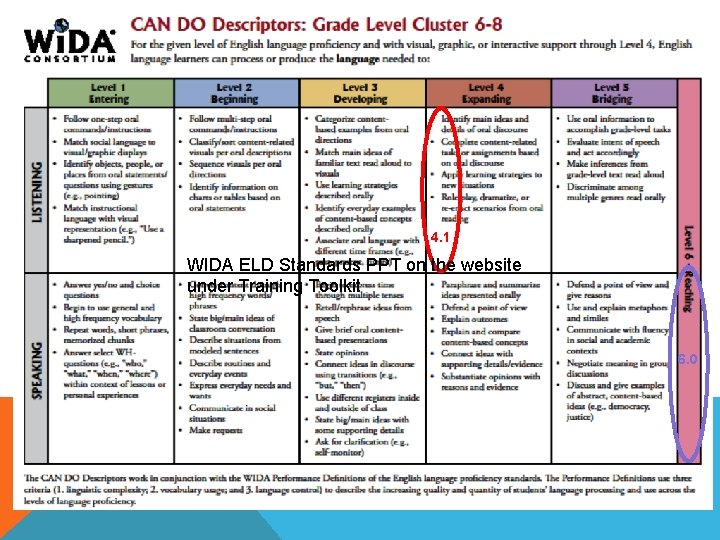
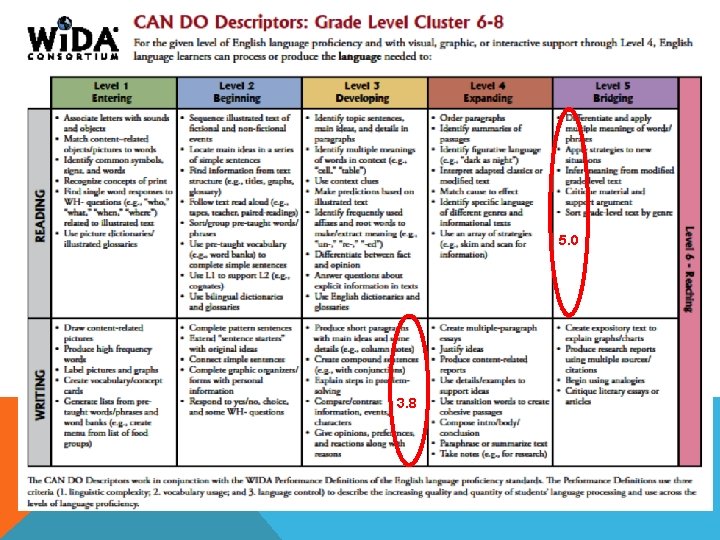
Let’s plot Jose Carlos’ ACCESS for ELLs results on the CAN DO Descriptors: § Listening 4. 1 § Speaking 6. 0 § Reading 5. 0 § Writing 3. 8
4. 1 WIDA ELD Standards PPT on the website under Training Toolkit 6. 0
5. 0 3. 8
WHAT IS WHAT DOES IT LOOK LIKE IN YOUR CLASSROOM?
WHEN AND WHERE IN THE REAL WORLD HAVE YOU BEEN DIFFERENTIATED FOR? • It is real world and relevant. • Doctor's Office • It is a part of real life, and not negative. • Mechanic • Stores and Restaurants • Lessons – music, sports, dance, exercise… • Think, Pair, Share Activity • Buffet • Airplanes • College Career • Travels in other countries
HOW DO I DIFFERENTIATE FOR ELLS? Language Differentiation: Ensuring the grade-level content is comprehensible and challenging while meeting the diverse language and learning needs of ELLs. Support Instructional strategies or tools to aid with making content comprehensible Scaffold Building upon students’ knowledge and acquired skills
HOW TO DIFFERENTIATE EFFECTIVELY? • Determine the current ability. • Define what the student CAN DO… • Determine specifically what the student is expected to accomplish. • Identify the gaps between what they are expected to accomplish in the activity or lesson and their current ability. • Implement strategies that allow the student to meet the expectations with what they can already do linguistically.
Model Performance Indicators
WHAT ARE MODEL PERFORMANCE INDICATORS? • WIDA’s standards framework shows examples of how language is processed or produced within a particular context through MODEL PERFORMANCE INDICATORS (MPIs). • MPIs are meant to be examples and not fixed guidelines of the language with which students may engage during instruction and assessment.
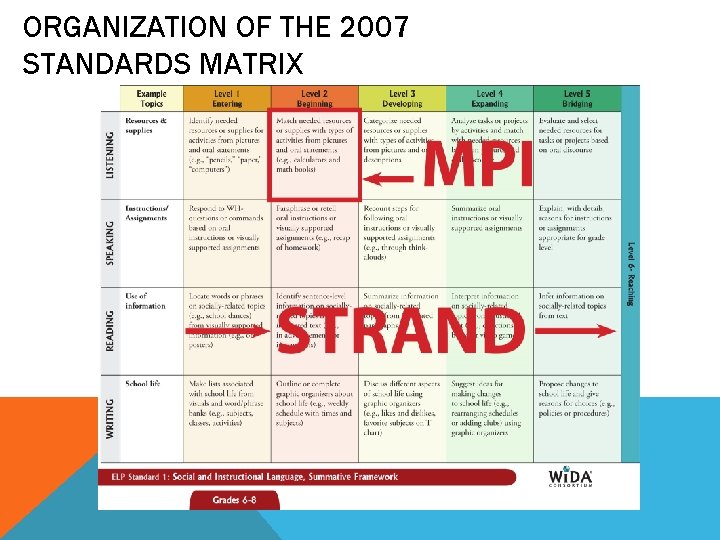
ORGANIZATION OF THE 2007 STANDARDS MATRIX
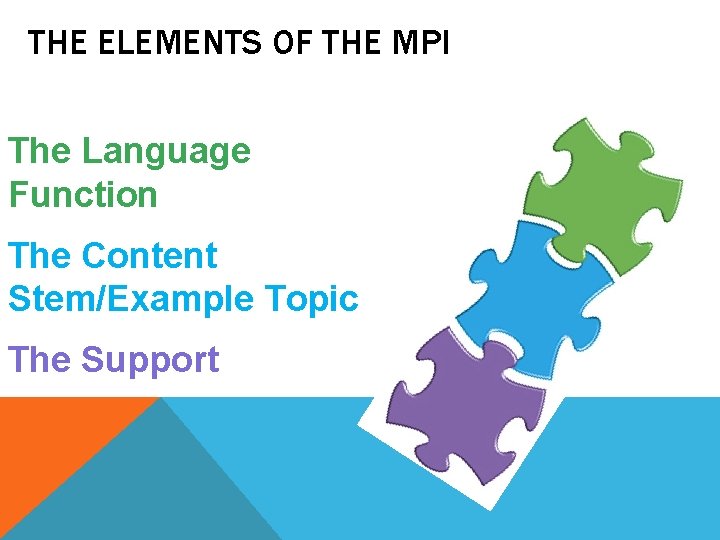
THE ELEMENTS OF THE MPI The Language Function The Content Stem/Example Topic The Support
ELEMENTS OF MODEL PERFORMANCE INDICATORS The Model Performance Indicator (MPI) consists of three elements: • Language function: describes how students use language to demonstrate their proficiency • Content stem/example topic: specifies context for language instruction; derived from state content standards • Support: sensory, graphic, or interactive resources embedded in instruction and assessment that help students construct meaning from language and content
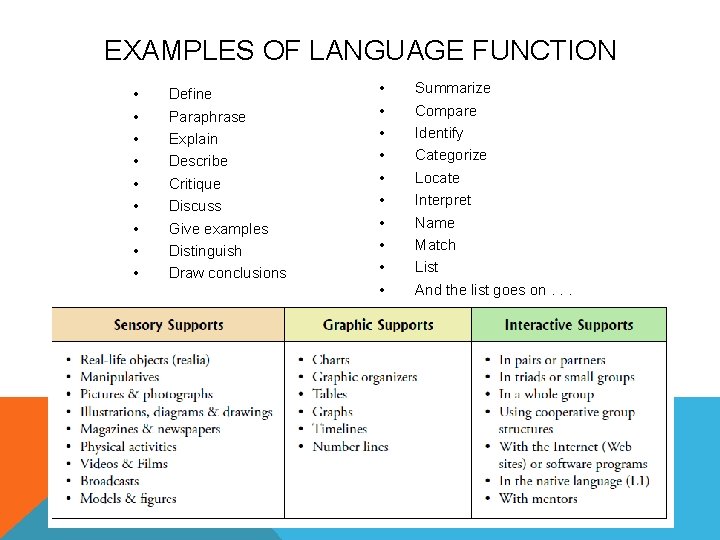
EXAMPLES OF LANGUAGE FUNCTION • • • Define Paraphrase Explain Describe Critique Discuss Give examples Distinguish Draw conclusions • • • Summarize Compare Identify Categorize Locate Interpret Name Match List And the list goes on. . .
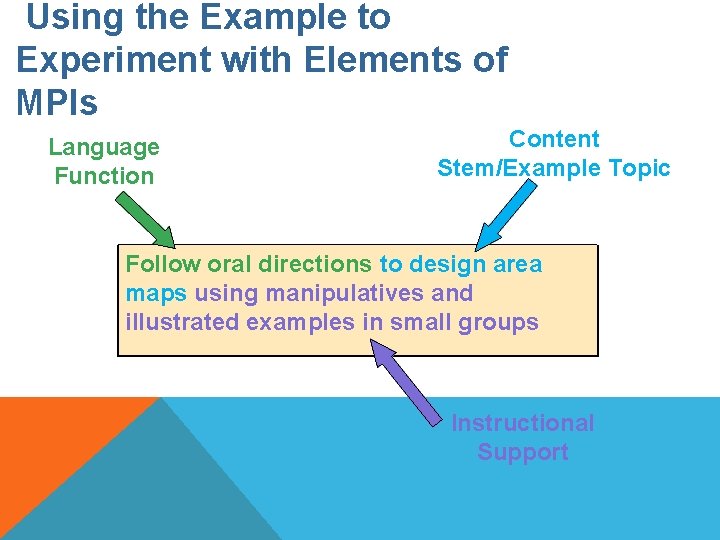
Using the Example to Experiment with Elements of MPIs Language Function Content Stem/Example Topic Follow oral directions to design area maps using manipulatives and illustrated examples in small groups Instructional Support
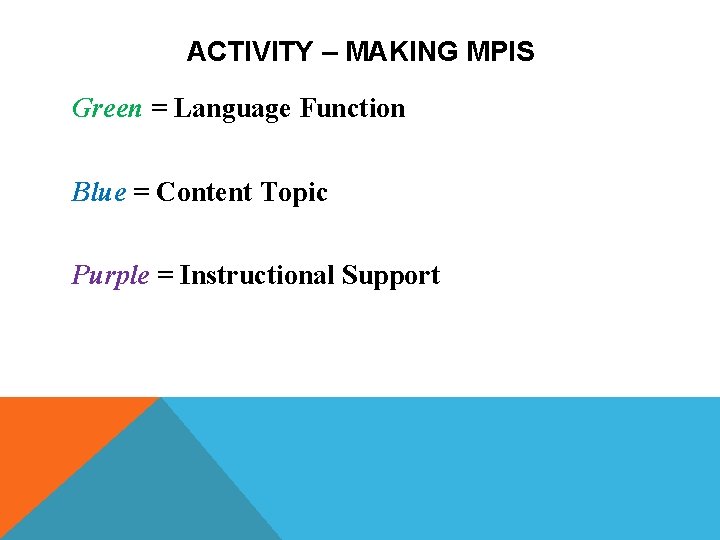
ACTIVITY – MAKING MPIS Green = Language Function Blue = Content Topic Purple = Instructional Support
ACTIVITY DIRECTIONS Write 2 or 3 examples for your element of an MPI on a Post -It note that corresponds to your color. We will then work on putting the colors together to show easy it is to put together an MPI.
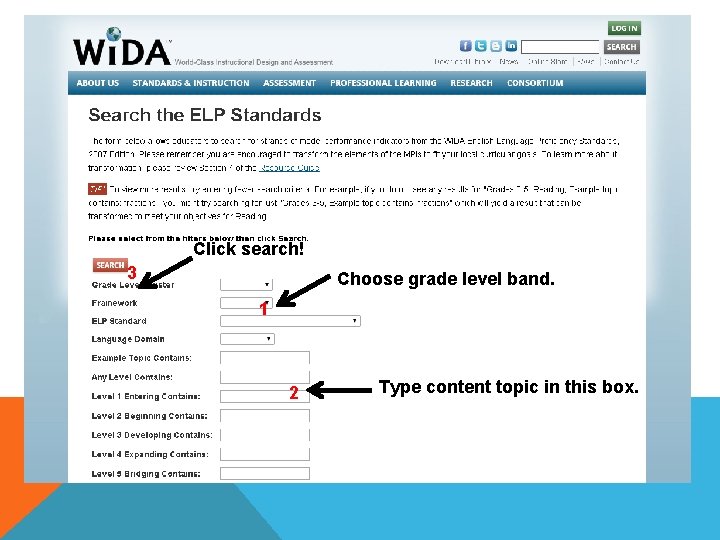
Click search! 3 Choose grade level band. 1 2 Type content topic in this box.
RESOURCES For more information about WIDA and the WIDA standards, you may go to: www. wida. us • Look under the Standards and Instruction tab to find the standards, 2007 and 2012 amplification of the standards and the Can Do Descriptors. o You will find Standards under http: //wida. us/standards/eld. aspx o The Can Do Descriptors are under http: //wida. us/standards/CAN_DOs/ o You can also find RTI information, lesson plans, and videos under http: //wida. us/professional. Dev/educator. Resources/