
I Timothy Chapter 2 11 15 Role of





- Slides: 44
I Timothy Chapter 2: 11 -15
Role of Women in the Church Why consider this?
Protestants • 900, 000 worldwide • 2, 000 Church of Christ (0. 2%)
Principle of Accommodation • 1 Cor 9: 19 -23: “Though I am free and belong to no man, I make myself a slave to everyone, to win as many as possible. To the Jews I became like a Jew, to win the Jews. To those under the law I became like one under the law (though I myself am not under the law), so as to win those under the law. To those not having the law I became like one not having the law (though I am not free from God's law but am under Christ's law), so as to win those not having the law. To the weak I became weak, to win the weak. I have become all things to all men so that by all possible means I might save some. I do all this for the sake of the gospel, that I may share in its blessings. ”
We Believe that God is an unchanging God • Deborah? • Judges 4: 4 -5 “Deborah, a prophetess, the wife of Lappidoth, was leading Israel at that time. 5 She held court under the Palm of Deborah between Ramah and Bethel in the hill country of Ephraim, and the Israelites came to her to have their disputes decided. ”
I Tim 2: 11 -15 • A woman should learn in quietness and full submission. I do not permit a woman to teach or to have authority over a man; she must be silent. For Adam was formed first, then Eve. And Adam was not the one deceived; it was the woman who was deceived and became a sinner. But women will be saved through childbearing--if they continue in faith, love and holiness with propriety.
A similar passage to the church in Corinth Chuck will cover next week
The “Traditional” View • These commands are “vitamins” to be taken by all churches, at all times. • “culturally transcendent”
The “Non-Traditional” View • These commands are “antibiotics” prescribed for a specific problem that existed in Ephesus and Corinth. • Required because of “culturally specific” problems of that day and apply only if similar problems exist now.
Look at pros & cons of each view “A woman should learn in quietness and full submission. I do not permit a woman to teach or to have authority over a man; she must be silent. . ” 1 Tim 2: 11 -12
The “Traditional” View: Pros • “I believe it says what it says” – Women should learn in quietness & full submission – Women should not be in authority over adult men – Women should not be allowed to teach--teaching by its very nature being authoritative
The “Traditional” View: Pros • Why? – 1 Tim 2: 13 -14 “For Adam was formed first, then Eve. ” – Priority of man in creation precedent for true order of sexes---especially in marriage and public worship – In matters of salvation & who is loved by God---there is neither slave nor free, male nor female, Jew nor Greek – “And Adam was not the one deceived; it was the woman who was deceived and became a sinner” • Some traditionalists (certainly not all) ---women have greater likelihood of being led astray, so certainly should not be allowed to teach!
SBRCC is functioning under “Traditionalist” view • Women are not allowed to teach men • They do not wait on Lord’s Supper • Do not lead prayers in assembly (or Sunday School) • Do not read scriptures in public assembly • I don’t think a woman heads up a major committee that contain men
“Traditionalist View”: Cons • 1 Tim 2: 12 “I do not permit a woman to teach or to have authority over a man; she must be silent. ” – Why have we chosen to let women sing? – Why have we chosen to let women make comments in this class? • “Silent” does not = absolute silence. – Greek word = hesuchia (hay-soo-khee’-ah) =“stillness” “a desistence from bustle”. Garmon: “quiet spirit”
“Traditionalist View”: Cons • But, 1 Cor 14: 33 -34 “As in all the congregations of the saints, women should remain silent in the churches. ” (Orderly assembly section) – Greek word: sigao (see-gah’-o)= silent • What do we do here? “It says what it says? ? ? ”
“Traditionalist View”: Cons How do we harmonize other passages on the very active role of women in 1 st century church?
“Traditionalist View”: Cons • Paul writes to Corinth about “propriety in worship” • 1 Cor 11: 2 -5 “I praise you for remembering me in everything and for holding to the teachings, just as I passed them on to you. Now I want you to realize that the head of every man is Christ, and the head of the woman is man, and the head of Christ is God. Every man who prays or prophesies with his head covered dishonors his head. And every woman who prays or prophesies with her head uncovered dishonors her head--it is just as though her head were shaved. ” – Garmon: “Exercising gifts outside the assembly” – But note topic heading; note next item discussed – Paul concerned women do so with proper submissive attitude for that culture
“Traditionalist View”: Cons • How do we harmonize other passages on the very active role of women in 1 st century church? – Acts 21: 7 -9 “We continued our voyage from Tyre and landed at Ptolemais, where we greeted the brothers and stayed with them for a day. Leaving the next day, we reached Caesarea and stayed at the house of Philip the evangelist, one of the Seven. He had four unmarried daughters who prophesied. ”
“Traditionalist View”: Cons • How do we harmonize other passages on the very active role of women in 1 st century church? – Luke 2: 36 -38 “There was also a prophetess, Anna, the daughter of Phanuel, of the tribe of Asher. She was very old; she had lived with her husband seven years after her marriage, and then was a widow until she was eighty-four. She never left the temple but worshiped night and day, fasting and praying. Coming up to them at that very moment, she gave thanks to God and spoke about the child to all who were looking forward to the redemption of Jerusalem. ”
“Traditionalist View”: Cons • How do we harmonize other passages on the very active role of women in 1 st century church? – Joel 2: 28 'And afterward, I will pour out my Spirit on all people. Your sons and daughters will prophesy, your old men will dreams, your young men will see visions. – Judges 4: 4 -5 “Deborah, a prophetess, the wife of Lappidoth, was leading Israel at that time. 5 She held court under the Palm of Deborah between Ramah and Bethel in the hill country of Ephraim, and the Israelites came to her to have their disputes decided. ”
Any references in NT to women teachers?
References in NT to women teachers • Acts 18: 24 -26 “Meanwhile a Jew named Apollos, a native of Alexandria, came to Ephesus. He was a learned man, with a thorough knowledge of the Scriptures. He had been instructed in the way of the Lord, and he spoke with great fervor and taught about Jesus accurately, though he knew only the baptism of John. He began to speak boldly in the synagogue. When Priscilla and Aquila heard him, they invited him to their home and explained to him the way of God more adequately. ” • Note order of names • Note Apollos was not her husband • Note where the teaching took place
References in NT to women teachers • Romans 16: 3 -5 “Greet Priscilla and Aquila, my fellow workers in Christ Jesus. They risked their lives for me. Not only I but all the churches of the Gentiles are grateful to them. Greet also the church that meets at their house. ” • Non-traditionalists would say this is evidence of a woman teaching in the assembly
References in NT to women teachers • Euodia & Syntyche • Phil 4: 2 -3 “I plead with Euodia and I plead with Syntyche to agree with each other in the Lord. Yes, and I ask you, loyal yokefellow, help these women who have contended at my side in the cause of the gospel, along with Clement and the rest of my fellow workers, whose names are in the book of life. ” • What do the phrases in red mean?
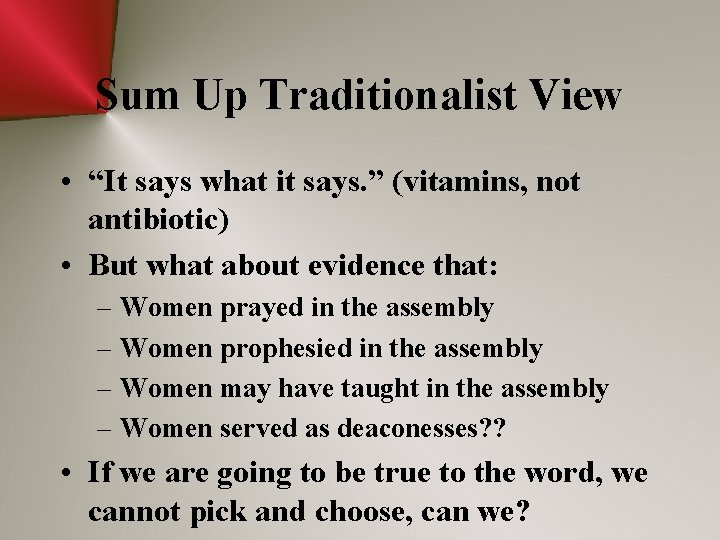
Sum Up Traditionalist View • “It says what it says. ” (vitamins, not antibiotic) • But what about evidence that: – Women prayed in the assembly – Women prophesied in the assembly – Women may have taught in the assembly – Women served as deaconesses? ? • If we are going to be true to the word, we cannot pick and choose, can we?
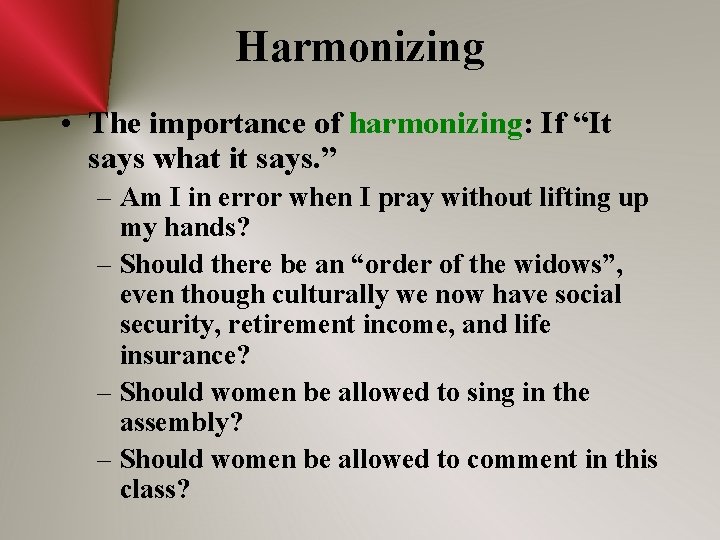
Harmonizing • The importance of harmonizing: If “It says what it says. ” – Am I in error when I pray without lifting up my hands? – Should there be an “order of the widows”, even though culturally we now have social security, retirement income, and life insurance? – Should women be allowed to sing in the assembly? – Should women be allowed to comment in this class?
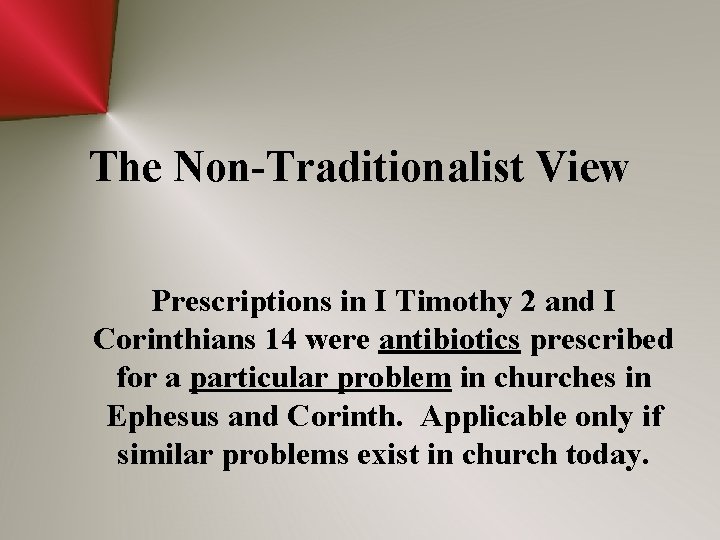
The Non-Traditionalist View Prescriptions in I Timothy 2 and I Corinthians 14 were antibiotics prescribed for a particular problem in churches in Ephesus and Corinth. Applicable only if similar problems exist in church today.
Two principles behind nontraditional view
Principle 1: Principle of Accommodation • 1 Cor 9: 19 -23: “Though I am free and belong to no man, I make myself a slave to everyone, to win as many as possible. To the Jews I became like a Jew, to win the Jews. To those under the law I became like one under the law (though I myself am not under the law), so as to win those under the law. To those not having the law I became like one not having the law (though I am not free from God's law but am under Christ's law), so as to win those not having the law. To the weak I became weak, to win the weak. I have become all things to all men so that by all possible means I might save some. I do all this for the sake of the gospel, that I may share in its blessings. ”
Principle 1: Principle of Accommodation • Paul was more concerned with missionary strategy than social progress or social issues. – Government was hostile to groups where women played a prominent role? – Trying to spread word in world where patriarchal dominance was the norm. • He believed & taught equality in Christ: Gal 3: 28 “There is neither Jew nor Greek, slave nor free, male nor female, for you are all one in Christ Jesus. ” • BUT, in this environment, women’s roles were subordinated to higher goal of reaching the lost
Principle #2: Subordination • God wants there to be order in a society, church, home---someone has to make final decision. – Also a principle: It was not uncompromising subordination • Note verses before and after
Authority? • 1 Tim 2: 12: “I do not permit a woman to teach or to have authority over a man; she must be silent. ” – Rare phrase in Greek: authentein – Only time used in NT – Usual Greek word is exousia (has no negative definitions or implications) – Scholars do not have great # of cases and contexts in which to establish precise meaning. – Significant that Paul chose this word over the customary one
Authentein • 1 Tim 2: 12: “I do not permit a woman to teach or to have authority over a man; she must be silent. ” – Apparently: Strong phrase meaning to dominate or “run over” • Strong’s Greek Dictionary: “dominance” • Vine’s Expository Dictionary: “to dominate” • Thayer’s Greek-English Lexicon: “”an absolute master; to exercise dominion over” • Complete Word Study Dictionary: “to exercise authority or power over as an autocrat; to domineer”
Authentein • 1 Tim 2: 12: “I do not permit a woman to teach or to have authority over a man; she must be silent. ” – Overtones of violence and power – Not saying that women cannot have ordinary & appropriate uses of authority (exousia) – Women should not exercise authority in a negative, domineering, autocratic, harmful way – Paul: Women not allowed to behave that way towards men. (Feminnazi? ? ) – Traditionally: v 12 prohibits women from teaching and having authority over men – Non-traditionalist: No. Prohibits women from teaching & being in authority in a domineering
Why say this to Church in Ephesus? (Ronnie’s “why? ”) • Main religion in Ephesus? – The biggest temple, the most famous shrine = a female-only cult – Temple of Artemis (or Diana if you are Roman) – All the priest were women – They ruled the show & kept men in their place
With this background, what is Paul saying about worship in Ephesus? • Old ways of organizing male/female roles needs to be rethought from top to bottom • Did not want the church to think this is a new system where again women would be leading and keeping men in line. • Women should have right to study like men, but not in order to have bossy leadership roles like under Artemis
Ephesus • Problem of deliberately sexually provocative dress (hold over from pagan religious rituals? ). • Need to accommodate government at the time and patriarchical attitudes of that day • Problem of abuse of new freedom in Christ by women
What about I Timothy 2: 13 -15?
Traditionalists • “For Adam was formed first, then Eve. And Adam was not the one deceived; it was the woman who was deceived and became a sinner. But women will be saved through childbearing--if they continue in faith, love and holiness with propriety. ” • Traditionalists: This is why woman should never have authority over man---order of creation
Non-Traditionalist: What about I Timothy 2: 13 -15? • “For Adam was formed first, then Eve. • Is this timeless? Whoever born first has authority over who was second? • Many times God chose younger over older: – Isaac over Ishmael – Jacob over Esau – Moses over Aaron – Judah over Rueben – Joseph over his brothers
What about I Timothy 2: 13 -15? • “For Adam was formed first, then Eve. And Adam was not the one deceived; it was the woman who was deceived and became a sinner. But women will be saved through childbearing--if they continue in faith, love and holiness with propriety. ” • For (gar) does not necessarily equal “Because” • Just following the train of thought?
What about I Timothy 2: 13 -15? • “For Adam was formed first, then Eve. And Adam was not the one deceived; it was the woman who was deceived and became a sinner. ” • Non-traditionalist: Has nothing to do with order of creation, but with purpose of her creation---to be a helper to man—to complement him. This purpose is destroyed when woman uses a domineering attitude. • Not appeal to return to male dominance but to return to complementary role
What about I Timothy 2: 13 -15? • “For Adam was formed first, then Eve. And Adam was not the one deceived; it was the woman who was deceived and became a sinner. But women will be saved through childbearing--if they continue in faith, love and holiness with propriety. ” • What to do about v 15? It says what it says? • Cannot accept verses 13 -14 as timeless without v 15 being timeless as well. – Heresy? Aren’t we saved by blood of Christ? – Childless women not saved? – Unwed woman had better have a child?
What about I Timothy 2: 15? • “But women will be saved through (the) childbearing--if they continue in faith, love and holiness with propriety. ” • “the” is in the text but left out of many translations (NIV) • “the” childbearing = Mary’s birth of Jesus? • If Paul had one, particular, history-making birth in mind the “the” makes sense