
I Theories of InformationSeeking Behavior II InformationGathering Process
I. Theories of Information-Seeking Behavior II. Information-Gathering Process by Selected Groups
I. Theories of Information-Seeking Behavior

Theories of Information-Seeking Behavior Information behavior • activities a person may engage in when identifying his or her own needs for information • searching for such information in any way • and using or transferring that information (T. D. Wilson 1999)
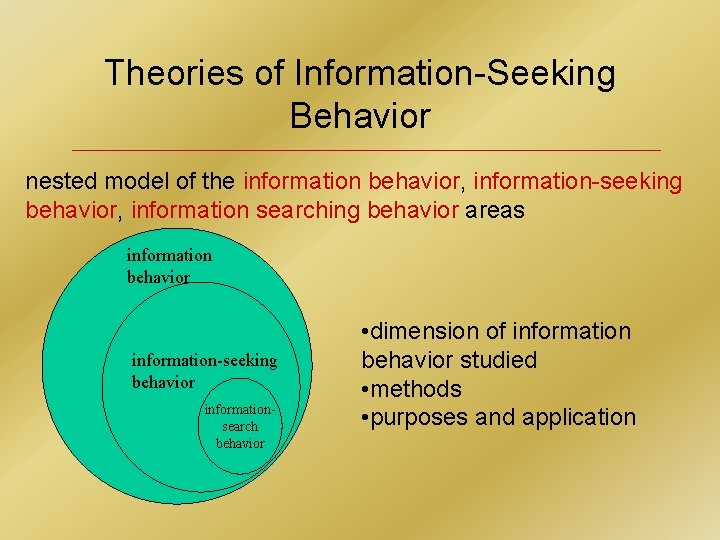
Theories of Information-Seeking Behavior nested model of the information behavior, information-seeking behavior, information searching behavior areas information behavior information-seeking behavior informationsearch behavior • dimension of information behavior studied • methods • purposes and application
Theories of Information-Seeking Behavior Information-searching behavior • interactions between information-searcher and information-provider • limited to the design of information retrieval (IR) systems • models of users in interaction with IR systems (Saracevic, Belkin, Ingwersen)
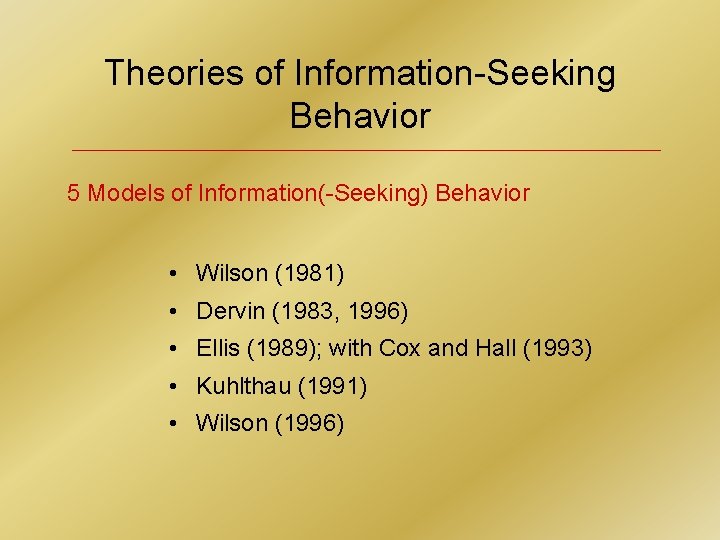
Theories of Information-Seeking Behavior 5 Models of Information(-Seeking) Behavior • Wilson (1981) • Dervin (1983, 1996) • Ellis (1989); with Cox and Hall (1993) • Kuhlthau (1991) • Wilson (1996)
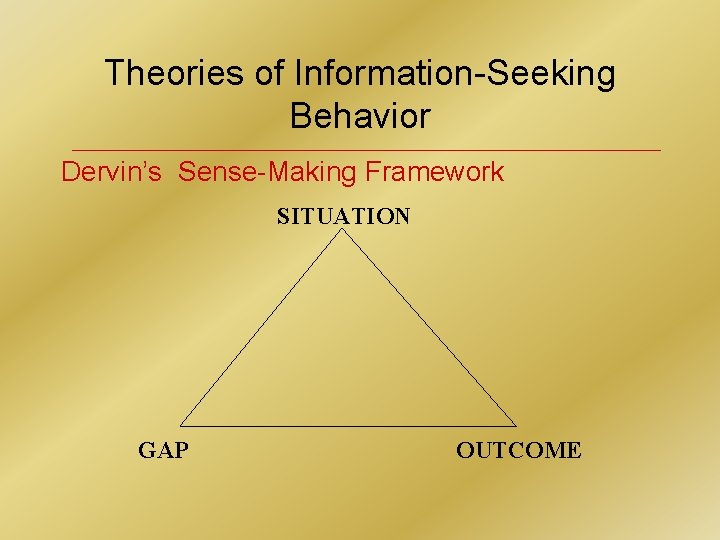
Theories of Information-Seeking Behavior Dervin’s Sense-Making Framework SITUATION GAP OUTCOME
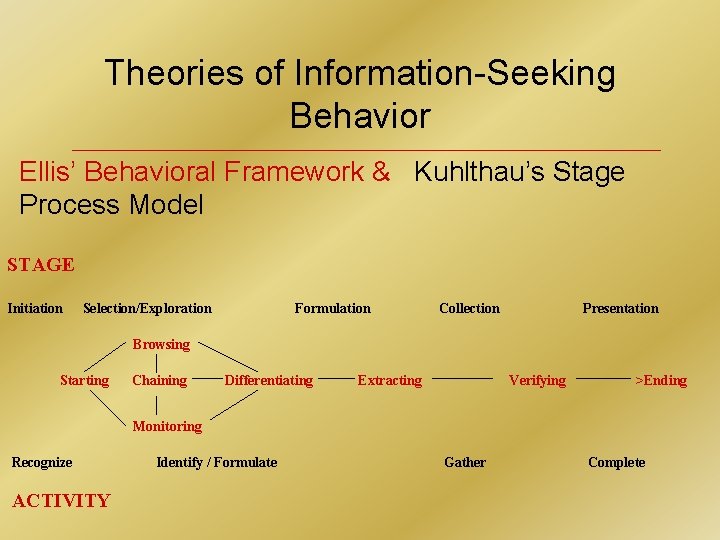
Theories of Information-Seeking Behavior Ellis’ Behavioral Framework & Kuhlthau’s Stage Process Model STAGE Initiation Selection/Exploration Formulation Collection Presentation Browsing Starting Chaining Differentiating Extracting Verifying >Ending Monitoring Recognize ACTIVITY Identify / Formulate Gather Complete
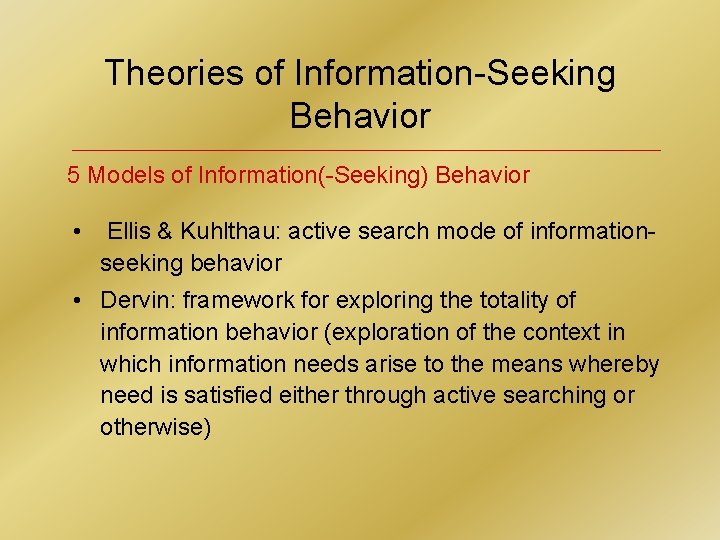
Theories of Information-Seeking Behavior 5 Models of Information(-Seeking) Behavior • Ellis & Kuhlthau: active search mode of informationseeking behavior • Dervin: framework for exploring the totality of information behavior (exploration of the context in which information needs arise to the means whereby need is satisfied either through active searching or otherwise)
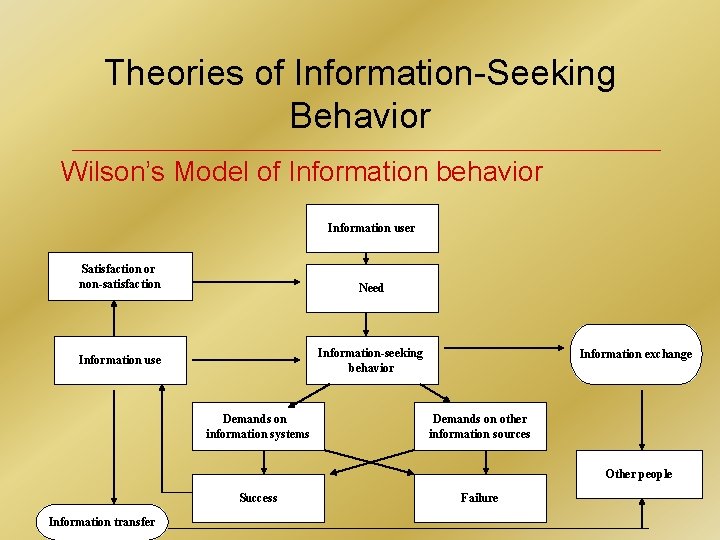
Theories of Information-Seeking Behavior Wilson’s Model of Information behavior Information user Satisfaction or non-satisfaction Need Information-seeking behavior Information use Demands on information systems Information exchange Demands on other information sources Other people Success Information transfer Failure
Theories of Information-Seeking Behavior • theories are models of methodologies, rather than a model of a set of activities or a situation • case studies of information-seeking behavior (empirical component) are driven by theories and models of methodologies
Theories of Information-Seeking Behavior positivist tradition (1940 s to 1970 s) • Quantitative methods not appropriate for the study of human behavior (counting of number of visits to libraries, number of personal subscriptions to journals, citation practices)
Theories of Information-Seeking Behavior post-positivist tradition (from the early 1970 s) • Qualitative methods appropriate for the study of human behavior (from allied work in related areas that have built robust theoretical frameworks and methodological approaches) • emergence of general models of information behavior in the last 10 -15 years)
An Integrated Model of Information. Seeking Behaviors • iterative model of information-seeking behavior (series of interactions, learning process by the user, implications for design of IR systems) • two-step flow of communication model and the notion of the “gatekeeper” • informal transfer of information between individuals (information exchanges)
An Integrated Model of Information. Seeking Behaviors • uncertainty vs. relevance as focus
II. Information-Gathering Process by Selected Groups
Information-Gathering by Selected Groups (information needs of four professional groups) Decision-makers Problem-solvers People-centered Self-expression
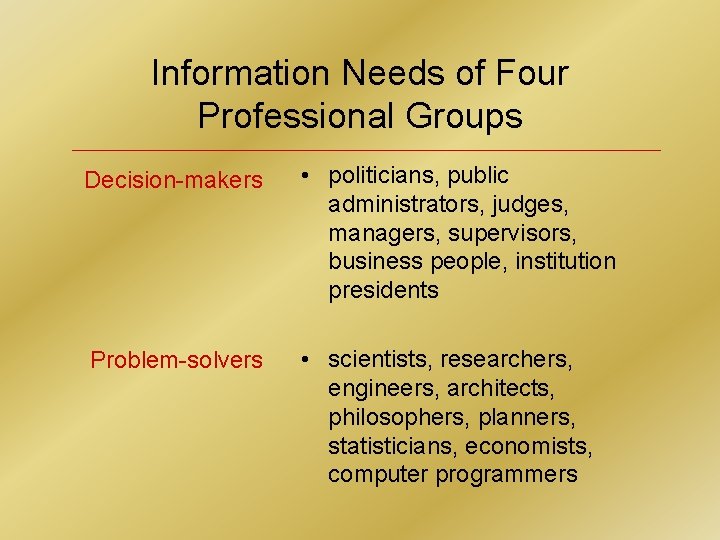
Information Needs of Four Professional Groups Decision-makers • politicians, public administrators, judges, managers, supervisors, business people, institution presidents Problem-solvers • scientists, researchers, engineers, architects, philosophers, planners, statisticians, economists, computer programmers
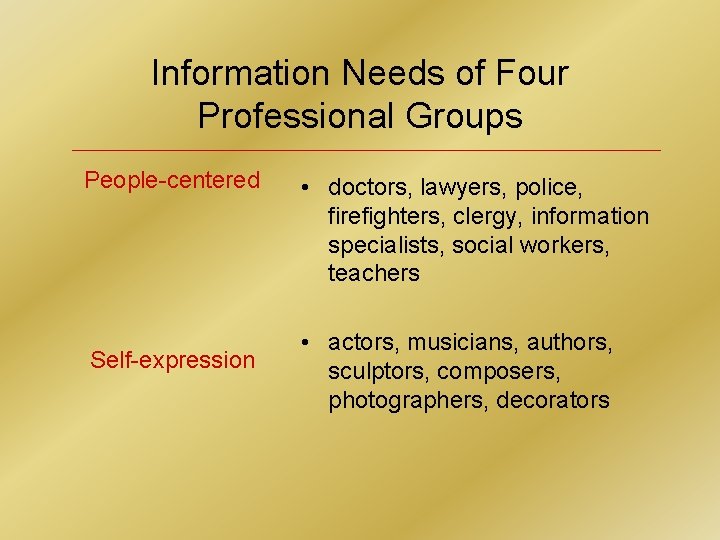
Information Needs of Four Professional Groups People-centered Self-expression • doctors, lawyers, police, firefighters, clergy, information specialists, social workers, teachers • actors, musicians, authors, sculptors, composers, photographers, decorators
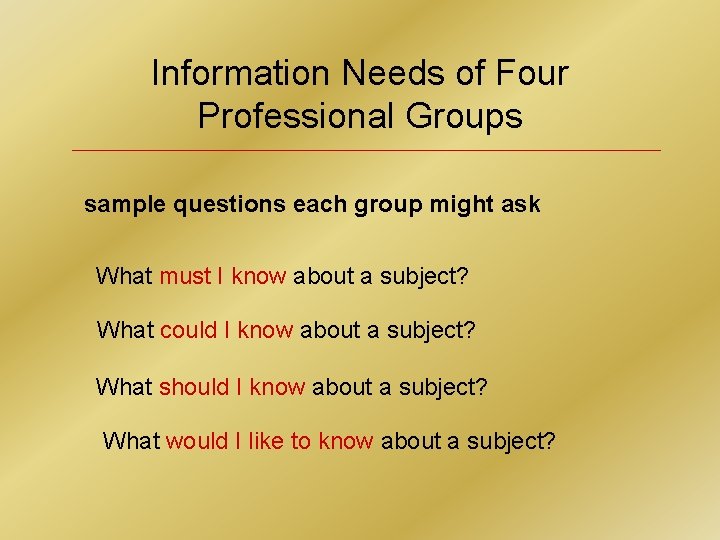
Information Needs of Four Professional Groups sample questions each group might ask What must I know about a subject? What could I know about a subject? What should I know about a subject? What would I like to know about a subject?
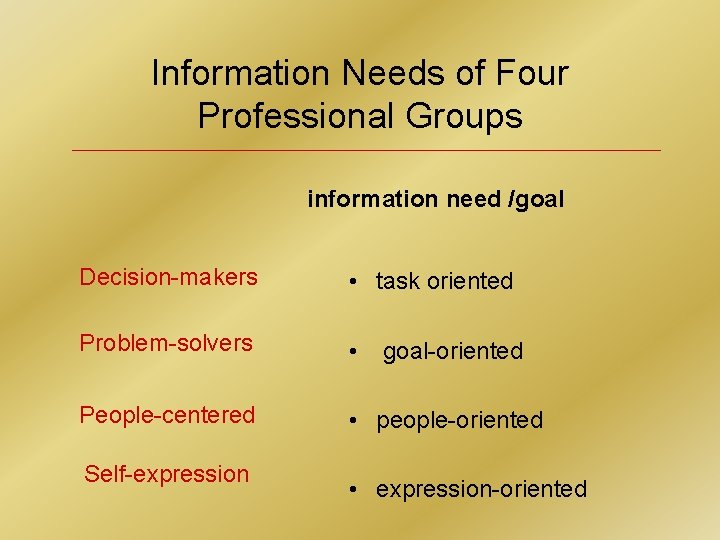
Information Needs of Four Professional Groups information need /goal Decision-makers • task oriented Problem-solvers • People-centered • people-oriented Self-expression goal-oriented • expression-oriented
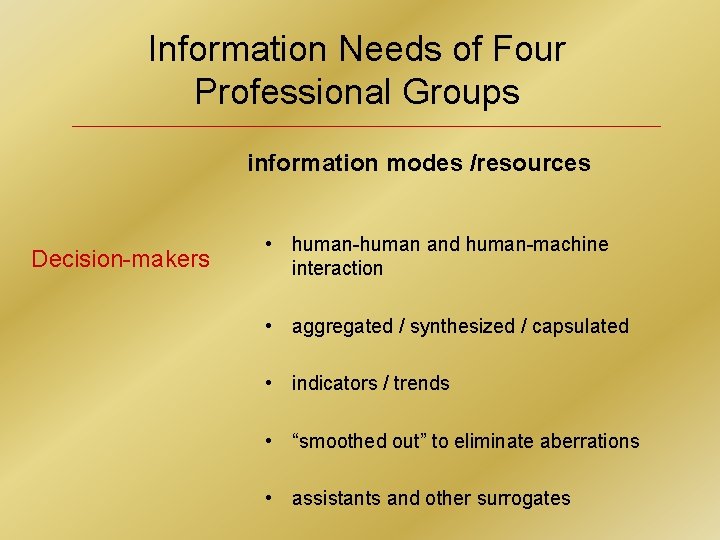
Information Needs of Four Professional Groups information modes /resources Decision-makers • human-human and human-machine interaction • aggregated / synthesized / capsulated • indicators / trends • “smoothed out” to eliminate aberrations • assistants and other surrogates
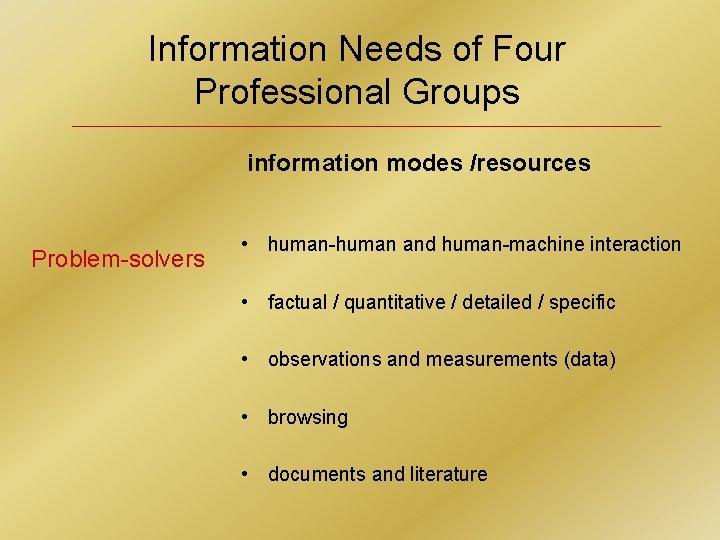
Information Needs of Four Professional Groups information modes /resources Problem-solvers • human-human and human-machine interaction • factual / quantitative / detailed / specific • observations and measurements (data) • browsing • documents and literature
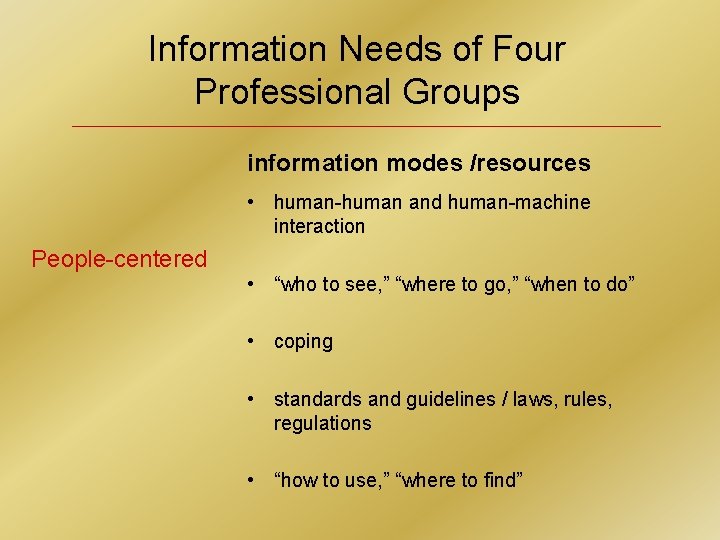
Information Needs of Four Professional Groups information modes /resources • human-human and human-machine interaction People-centered • “who to see, ” “where to go, ” “when to do” • coping • standards and guidelines / laws, rules, regulations • “how to use, ” “where to find”
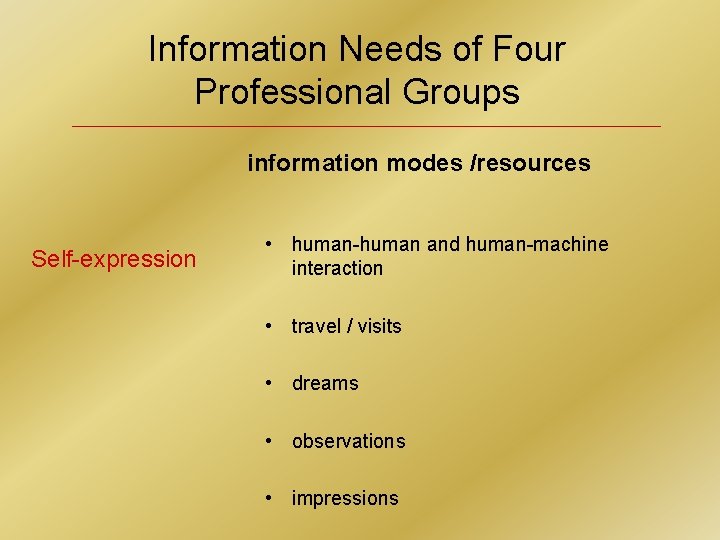
Information Needs of Four Professional Groups information modes /resources Self-expression • human-human and human-machine interaction • travel / visits • dreams • observations • impressions
Implications for Information Service, IR System Development • forms of delivery • resources • role of information professionals (intermediaries) and end-users R. T. Morris: Toward a User-Centered Information Service. JASIS 45 (1) 1994
Information-Gathering Process by Selected Groups conceptual models about information held in a subject domain, by a group of users user studies focus on information-seeking behaviors of distinct professional groups because these differences among various user populations determine how they organize information for retrieval •
Information-Gathering Process by Selected Groups personal information systems (individual’s information handling) public schemes (depend on convention) •
Information-Gathering Process by Selected Groups user’s motivation in storage and retrieval of text is important in how personal information space is organized •
Information-Gathering Process by Selected Groups INFORMATION WORKERS / MANAGERS • longitudinal study of a securities’ analyst • process of information seeking and decision making are intertwined and in recursive interaction Carol Kuhlthau: The Role of Experience in the Information Search Process of an Early Career Information Worker: Perceptions of Uncertainty, Complexity, Construction, and Sources. JASIS 50(5) 1999
Information-Gathering Process by Selected Groups INFORMATION WORKERS / MANAGERS • study of sources of information used, and of the process of seeking information • sources: information about events and relationships in a company’s outside environment the knowledge of which would assist top management in its task of charting the company’s future action
Information-Gathering Process by Selected Groups INFORMATION WORKERS / MANAGERS categories of sources • • External Personal External Impersonal Internal Personal Internal Impersonal
Information-Gathering Process by Selected Groups INFORMATION WORKERS / MANAGERS • EP (customers, competitors, government officers, business associates) • EI (newspapers, periodicals, broadcast media, conferences, industry and trade association publications and communication) • IP (superiors, board members, subordinate managers, staff) • II (internal memos, reports and studies, corporate library, and electronic sources)
Information-Gathering Process by Selected Groups INFORMATION WORKERS / MANAGERS classification of sources (Baldwin and Rice 1997) • Internal Channels • External Channels • Institutional Resources
Information-Gathering Process by Selected Groups INFORMATION WORKERS / MANAGERS • Internal Channels (newspapers read, magazines read, personal files maintained, and other securities analysts consulted) • External Channels (company contacts, visits to companies, annual meetings/trade shows, research report recipients) • Institutional Resources (use of external and internal libraries)
Information-Gathering Process by Selected Groups INFORMATION WORKERS / MANAGERS environmental scanning • viewing • searching • nonspecific information seeking • problem-driven information seeking • undirected or conditional • informal or formal
Information-Gathering Process by Selected Groups INFORMATION WORKERS / MANAGERS environmental scanning • viewing • searching • undirected (casual exposure • informal (unstructured, to information) cursory check of current facts or data) • conditional (purposeful but nonspecific such as browsing • formal (structured and indepth, directed to a specific a newspaper) problem)
Information-Gathering Process by Selected Groups INFORMATION WORKERS / MANAGERS • complex tasks require more varied sources than routine tasks, diversified approaches to information seeking, interpretation and construction of information, and result in increased uncertainty and anxiety
Information-Gathering Process by Selected Groups HISTORIANS • Case designs a study of information systems of historians (teachers and researchers and observes the patterns of behavior with regard to: spatial organization, organization by form, organization by topic) Donald Case: Conceptual Organization and Retrieval of Text by Historians: The Role of Memory and Metaphor. JASIS 42(9) 1991
Information-Gathering Process by Selected Groups HISTORIANS • method of research: participant-observation, interviews • personal ISAR systems of historians (spatial logic of PIS focuses on offices, how they organize piles of documents, what media they use, how they process information from the information sources and recall / retrieve documents at a later time)
Information-Gathering Process by Selected Groups HISTORIANS spatial organization keep like things together and close at hand (reminding function) organization by form aesthetics as sorting criterion, form over content (oversized, paperbound, old/new)
Information-Gathering Process by Selected Groups HISTORIANS organization by topic keep like things together and close at hand (reminding function) organization by treatment, purpose, quality purpose as sorting criterion (good and bad books, textbooks and research books, etc. )
Information-Gathering Process by Selected Groups HISTORIANS spatial organization • number of filing cabinet drawers and other storage devices, linear footage of books, journals and notebooks in offices and how arranged • number of stacks of material lying around the office (19 -49) -- physical scheme of organization, not categorical! • sometimes used spatial orientation and other times space in combination with specific labels
Information-Gathering Process by Selected Groups HISTORIANS • subjects’ decisions on how to organize documents is individual not based on document characteristics (Kwasnik: order of importance determined by context, form, use, topic, location, circumstance) • levels of information storage determine organization of documents: action, personal work files, archive • examples of movement in these 3 levels: once a semester we clean up our working spaces to be able to reuse information not needed now)
Information-Gathering Process by Selected Groups HISTORIANS • metaphorical use of space: proximity to the chair denotes urgency • spatial clues -- interaction needed to remember and recall (appropriate only for immediate action, reminder of what to do) • weakens as interaction with documents decreases
Information-Gathering Process by Selected Groups HISTORIANS • problems with retrieval in systems organized around space (losing files, misplacing information, need to rely on memory for recall) • memorizing possible through visualization of details (facts in physical structures) • spatial logic of elements is less vital while knowledge of category structures becomes more important as information is moved from action, personal working files, to archived files
Information-Gathering Process by Selected Groups HISTORIANS • crowding does not hinder but improve cognitive recall (although historians apologized for their offices being untidy); arrangement otherwise would destroy links and patterns and associations that are mnemonic • card is a powerful metaphor for historians who are trained to collect information in card-like chunks (conceptual nature of the card as unit of information, a single, multiple instance of ideas, evidence, question, quotation, document)
Information-Gathering Process by Selected Groups HISTORIANS organization by topic sporadic efforts to build and maintain indexing / elaborate filing systems which are abandoned labeling is difficult because tied to physical object (objects fall into more categories) -- need to produce a card system that would be access to the location of items which are in different formats or make duplicates (impractical to index that way)
Information-Gathering Process by Selected Groups HISTORIANS organization by topic reasons for abandoning filing systems is that indexing in paper-and-pencil environment entails high costs for the benefits received in later retrieval indexing card system used by historians: systems to aid writing (detailed chronologies in case of historians), keeping track of literature
Information-Gathering Process by Selected Groups HISTORIANS implications of findings How to implement spatial dimensions in computer interface and to enrich temporal and physical retrieval cues for electronic files? Evidence of inadequacy of existing display and manipulation devices for historians.
Information-Gathering Process by Selected Groups HISTORIANS implications of findings for system development 1. Thoughts / ideas are knowledge spaces in search of a physical location for storage 2. Historians use chronological and geographical facets for information rather than standard vocabulary for topics (display devices needed: maps, chronological) 3. Tactile associations with the material (sensory gloves for document manipulation)
Information-Gathering Process by Selected Groups ARTISTS • method of research: in-depth interviews with 4 artists (sculptor, painter, fiber artists, metalsmith) • neglected group of information professionals Susie Cobbledick: The Information-Seeking Behavior of Artists: Exploratory Interviews. Library Quarterly 66(4) 1994
Information-Gathering Process by Selected Groups ARTISTS sources • inspirational information (sources of ideas, moods, emotions, general or suggestive visual information) • technical information • information about current developments in the visual arts • shows, commissions, and sales • technology, books
Information-Gathering Process by Selected Groups ARTISTS sources • artists make substantial use of libraries and print materials • much of this material is not art related • they typically find this material by browsing within specific subject areas • they make substantial use of interpersonal sources to obtain technical information and information about developments in the local art scene
Information-Gathering Process by Selected Groups ARTISTS information needs profile • survey instrument designed to aid data collection from this group • age, educational background, medium of creative expression, geographic location • sources of visual and inspirational information • sources of technical information • sources of information about current developments in the visual arts • shows, commissions, and sales • library use, technology use, book use • reliance on gatekeepers and invisible colleges
Information-Gathering Process by Selected Groups ARTISTS Implications for building libraries for artists • libraries for artists need to be heavy on print materials whose verbal and visual content covers a wide array of topics without an undue emphasis on art • portability of materials is important (need to take visual information to the studio) • high-quality photocopying should be available on the premises, and material should be circulating; access to hardware and software for multiplication
Information-Gathering Process by Selected Groups ARTISTS Implications for building libraries for artists • size of the collection: small but concentrated • sources: technical manuals, visual arts journals, art monographs • MARC records should be enhanced to include information about illustrations • development of visual databanks
Information-Gathering Process by Selected Groups SCIENTISTS • foraging theory P. Sandstrom: An Optimal Foraging Approach to Information Seeking and Use. Library Quarterly 64(4) 1994
Information-Gathering Process by Selected Groups SOCIAL GROUP: AFR 0 -AMERICANS • disadvantaged groups and communities John Agada: Inner-City Gatekeepers: An Exploratory Survey of Their Information Use Environments. JASIS 1999
Information-Gathering Process by Selected Groups SOCIAL GROUPS community information need profile • cf. Metoyer-Duran: developed set of profiles based on study of ethno-linguistic gatekeepers in the American. Indian, Chinese, Japanese, Korean and Latino communities in California; Agada: African-American community gatekeepers
Information-Gathering Process by Selected Groups DISCOURSE COMMUNITIES • domain analysis -social aspects of information-seeking process B. Hjoerland H. Albrechtsen: Toward a New Horizon in Information Science: Domain-Analysis. JASIS 46(6) 1995
- Slides: 61