
I Science and Problem Solving A Scientific Method
I. Science and Problem Solving
A. Scientific Method- a logical, organized method to acquire knowledge 1. 2. 3. Collect background information by conducting a literature search Define the problem Form a hypothesisa logical assumption which can be tested.
4. Testing the Hypothesis A) B) C) Every experiment must use a control group and an experimental group A control group is identical to the experimental group except for one condition called an independent variable Therefore, any difference between the groups (the dependent variable) is a result of the independent variable

5. Making and Recording Observations A) B) Quantitative Data: Numerical data. Something that can be measured and expressed mathematically. Qualitative Data: Observations. Always avoid inferences
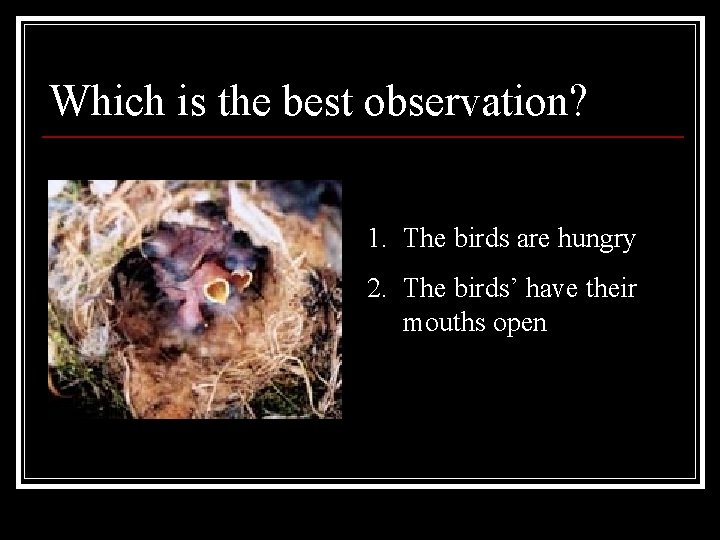
Which is the best observation? 1. The birds are hungry 2. The birds’ have their mouths open
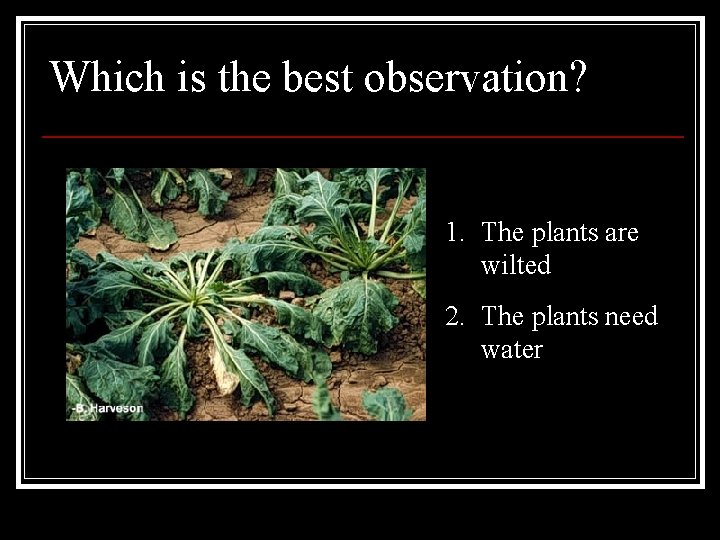
Which is the best observation? 1. The plants are wilted 2. The plants need water
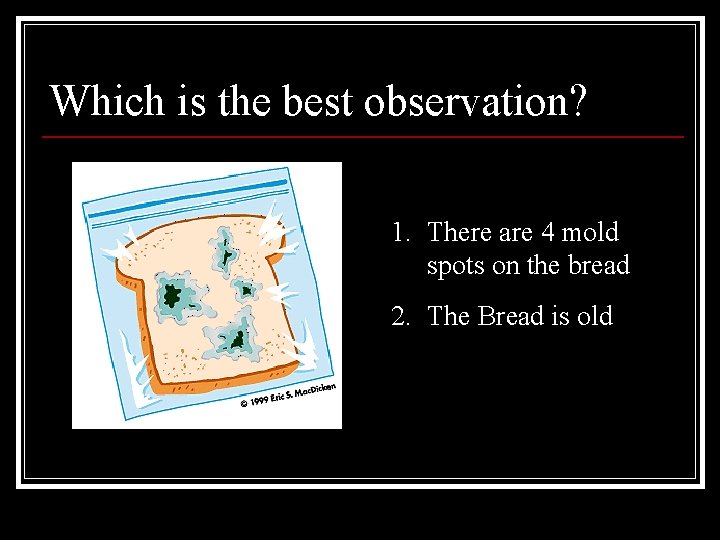
Which is the best observation? 1. There are 4 mold spots on the bread 2. The Bread is old
The last steps in scientific method 6. 7. 8. Verify Your Results- Repeat the experiment or incorporate replicates Do a statistical analysis. Mathematical manipulation of the data to increase the reliability of the results. Ie. Average the results of your trials Relate the results to your hypothesis. Do the results support or refute your hypothesis. Keep in mind that an experiment can prove a hypothesis wrong, but can only provide further evidence that a hypothesis is correct
So What is Science? Science is not the affirmation of a set of beliefs, but a process of inquiry aimed at building a testable body of knowledge open to rejection or support. In science, knowledge is fluid and certainty is fleeting.
- Slides: 9