
i SCADA Data Acquisition for the Scientific community
- Slides: 9
i. SCADA Data Acquisition for the Scientific community By Devices World
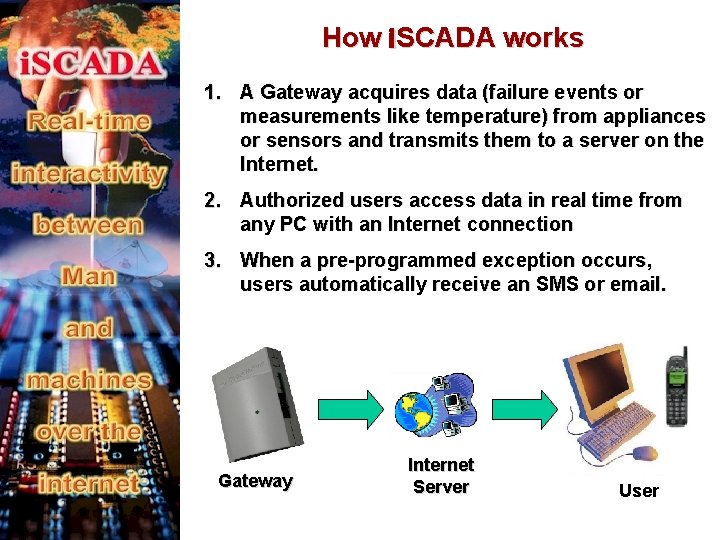
How i. SCADA works 1. A Gateway acquires data (failure events or measurements like temperature) from appliances or sensors and transmits them to a server on the Internet. 2. Authorized users access data in real time from any PC with an Internet connection 3. When a pre-programmed exception occurs, users automatically receive an SMS or email. Gateway Internet Server User
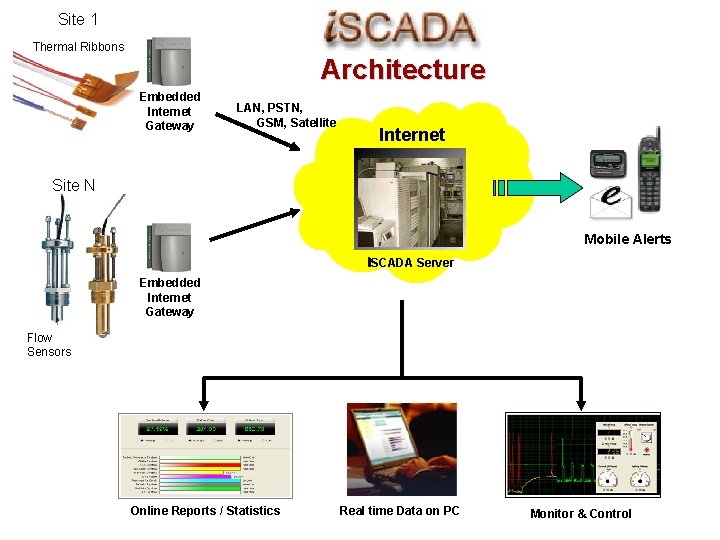
Site 1 Thermal Ribbons Architecture Embedded Internet Gateway LAN, PSTN, GSM, Satellite Internet Site N Mobile Alerts i. SCADA Server Embedded Internet Gateway Flow Sensors Online Reports / Statistics Real time Data on PC Monitor & Control
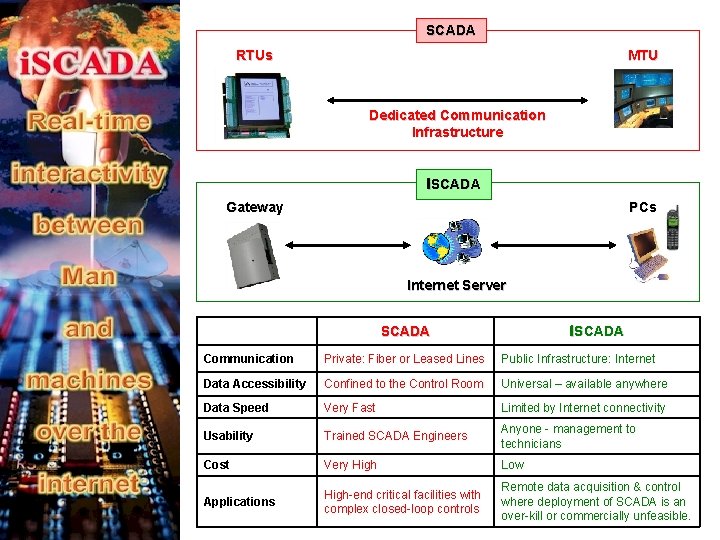
SCADA RTUs MTU Dedicated Communication Infrastructure i. SCADA Gateway PCs Internet Server i. SCADA Communication Private: Fiber or Leased Lines Public Infrastructure: Internet Data Accessibility Confined to the Control Room Universal – available anywhere Data Speed Very Fast Limited by Internet connectivity Usability Trained SCADA Engineers Anyone - management to technicians Cost Very High Low Applications High-end critical facilities with complex closed-loop controls Remote data acquisition & control where deployment of SCADA is an over-kill or commercially unfeasible.
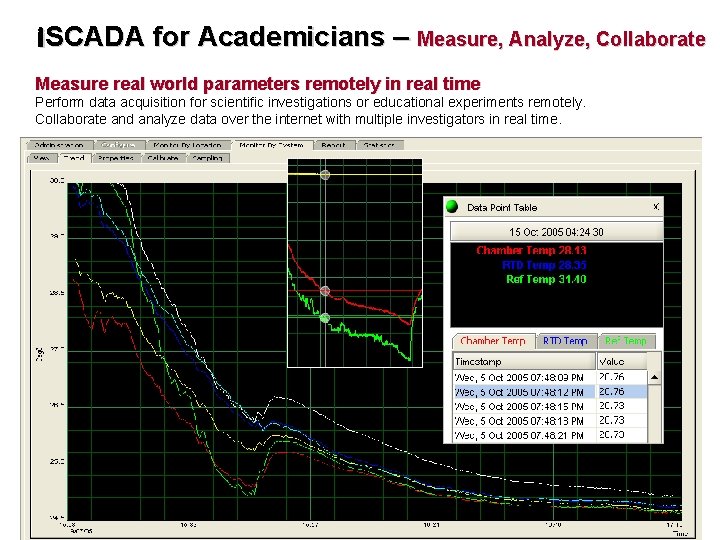
i. SCADA for Academicians – Measure, Analyze, Collaborate Measure real world parameters remotely in real time Perform data acquisition for scientific investigations or educational experiments remotely. Collaborate and analyze data over the internet with multiple investigators in real time.
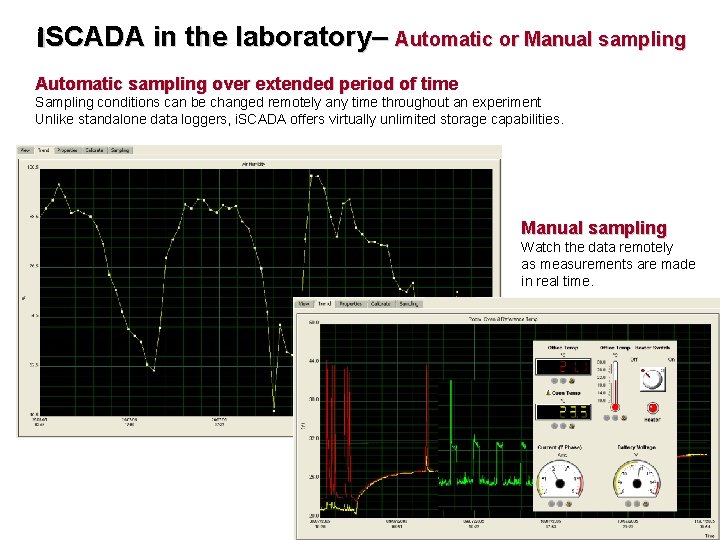
i. SCADA in the laboratory– Automatic or Manual sampling Automatic sampling over extended period of time Sampling conditions can be changed remotely any time throughout an experiment Unlike standalone data loggers, i. SCADA offers virtually unlimited storage capabilities. Manual sampling Watch the data remotely as measurements are made in real time.
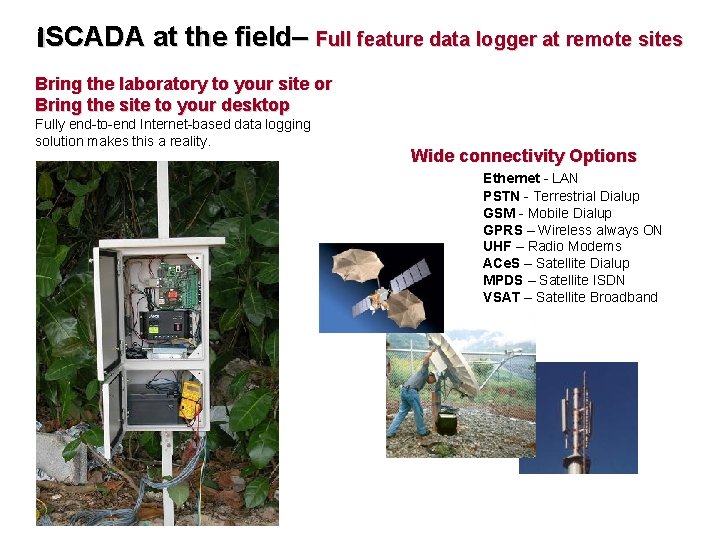
i. SCADA at the field– Full feature data logger at remote sites Bring the laboratory to your site or Bring the site to your desktop Fully end-to-end Internet-based data logging solution makes this a reality. Wide connectivity Options Ethernet - LAN PSTN - Terrestrial Dialup GSM - Mobile Dialup GPRS – Wireless always ON UHF – Radio Modems ACe. S – Satellite Dialup MPDS – Satellite ISDN VSAT – Satellite Broadband
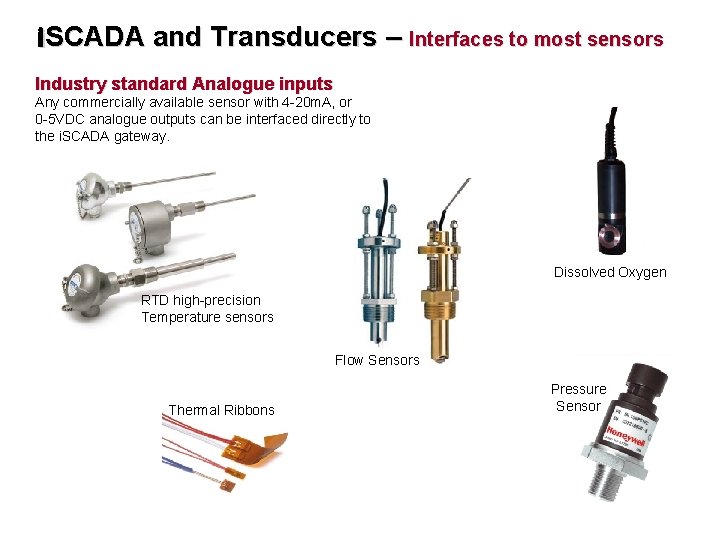
i. SCADA and Transducers – Interfaces to most sensors Industry standard Analogue inputs Any commercially available sensor with 4 -20 m. A, or 0 -5 VDC analogue outputs can be interfaced directly to the i. SCADA gateway. Dissolved Oxygen RTD high-precision Temperature sensors Flow Sensors Thermal Ribbons Pressure Sensor
i. SCADA Benefits Cost of data transmission Since all communications between devices, server and users are Internet based, this translates into the lowest compared to all other systems. Devices can be placed anywhere in the world, and users can seamlessly communicate with their devices from any Internet connection. Consolidated information Since all data is stored in a central database in the Internet, users have global access to consolidated data from many systems or locations. In pointto-point systems, data resides in a particular physical location (typically a control room), and access is restricted. Fast & Easy Deployment User friendly hardware interfaces with a wide range of legacy appliances and transducers. Managed services eliminate cost and complexities of owning and maintaining server and software. Universally accepted User Interface Web-based solutions like i. SCADA have a universally accepted, familiar and user-friendly Graphical User Interface (GUI). This takes the complexities out of sophisticated engineering solutions, and places information in the hands of managers and other decision makers. It also flattens the learning curve for engineers.