
i Ry P A Purely Edgebased Privacy Respecting
i. Ry. P: A Purely Edge-based Privacy. Respecting System for Mobile Cameras Yuanyi Sun 1 Shiqing Chen 1 Sencun Zhu 1 Yu Chen 2 1 Penn 2 State University of New York
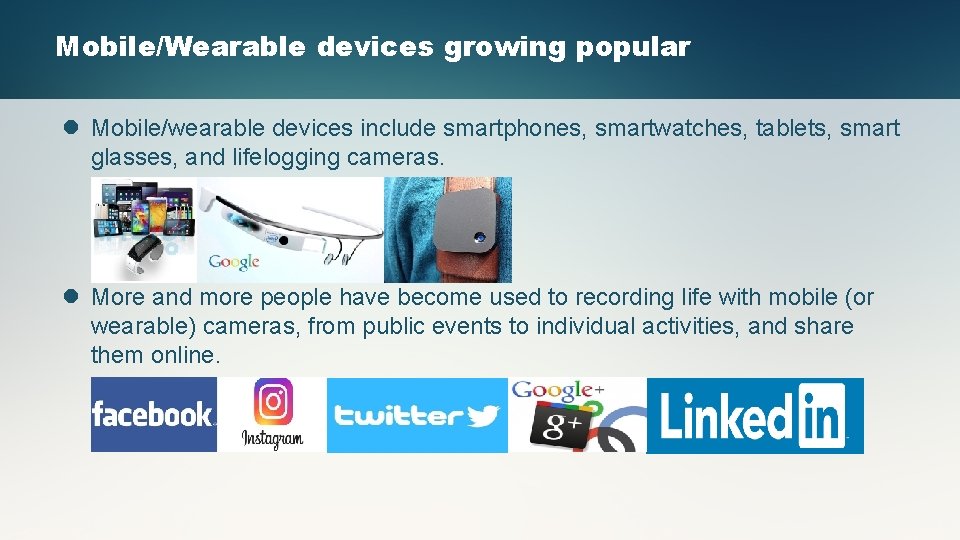
Mobile/Wearable devices growing popular l Mobile/wearable devices include smartphones, smartwatches, tablets, smart glasses, and lifelogging cameras. l More and more people have become used to recording life with mobile (or wearable) cameras, from public events to individual activities, and share them online.
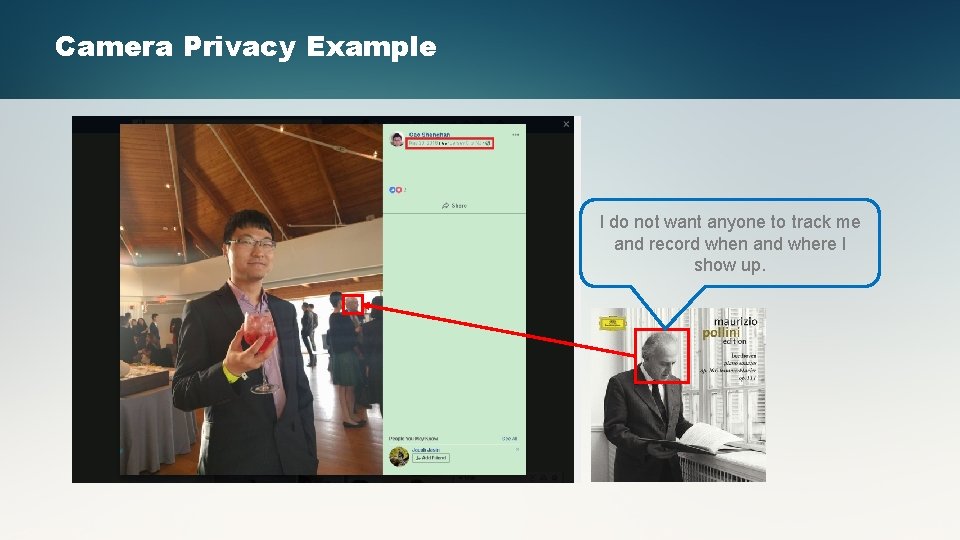
Camera Privacy Example I do not want anyone to track me and record when and where I show up.
User studies have shown l Many people do care about this privacy issue [1][2][3]. [1] “Privacy behaviors of lifeloggers using wearable cameras, ” in ACM Ubi. Comp 2014 [2] “In situ with bystanders of augmented reality glasses: Perspectives on recording and privacymediating technologies, ” in ACM conference on Human factors in computing systems 2014 [3] “I-pic: A platform for privacy-compliant image capture, ” in ACM Mobisys 2016. l People want to customize their own context-dependable policies [3]. l Camera users would choose to comply with the privacy preferences of friends and strangers, as long as doing so would not interfere with the spontaneity of media recording [3].
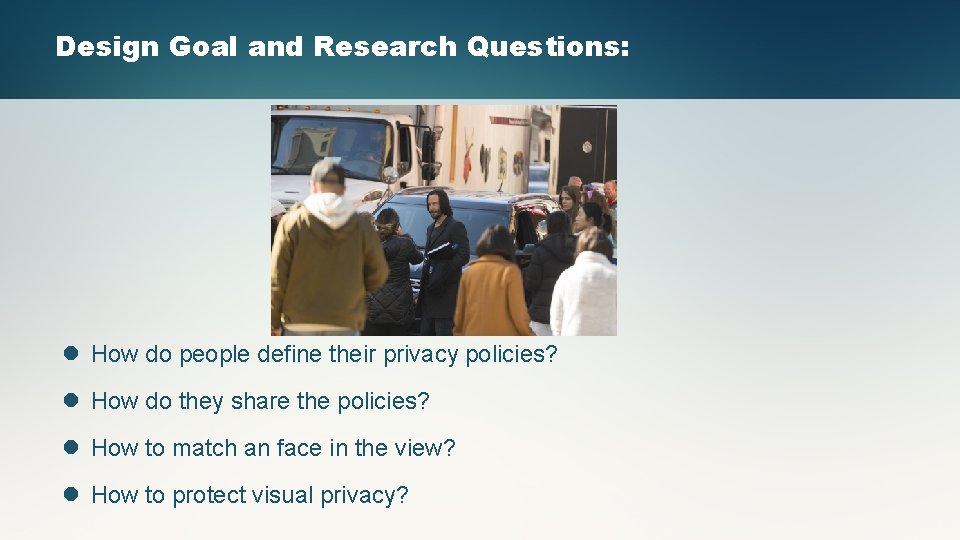
Design Goal and Research Questions: l How do people define their privacy policies? l How do they share the policies? l How to match an face in the view? l How to protect visual privacy?

How to define privacy policies? l Policy encoding: I am Bob. My privacy policy is “photographing allowed but no sharing”. In i. Ry. P system, this policy can be coded in two bytes for a limited number of scenarios. 0 = no photography, no share 1 = allow photography, allow share on Facebook 2 = allow photography, allow share on Instagram … 65535 = allow photography, allow share anywhere
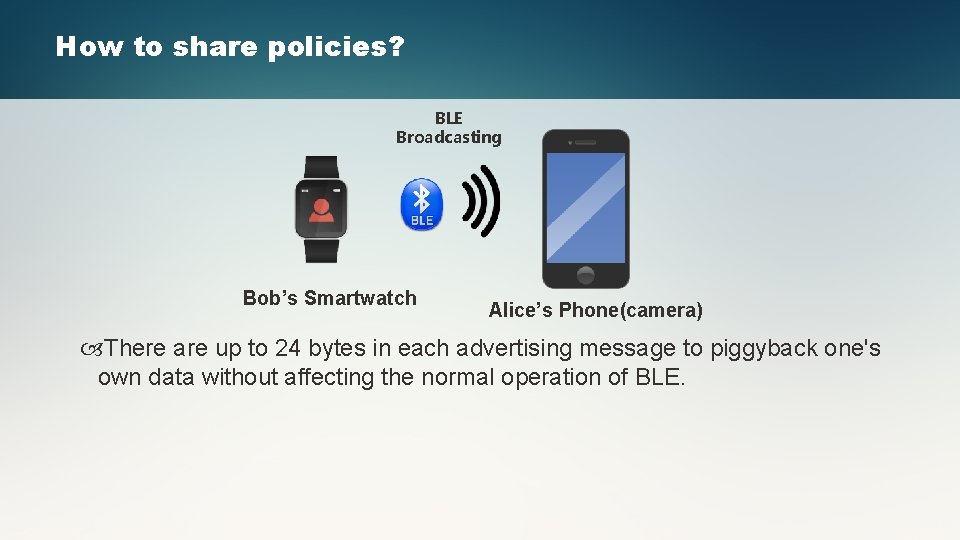
How to share policies? BLE Broadcasting Bob’s Smartwatch Alice’s Phone(camera) There are up to 24 bytes in each advertising message to piggyback one's own data without affecting the normal operation of BLE.
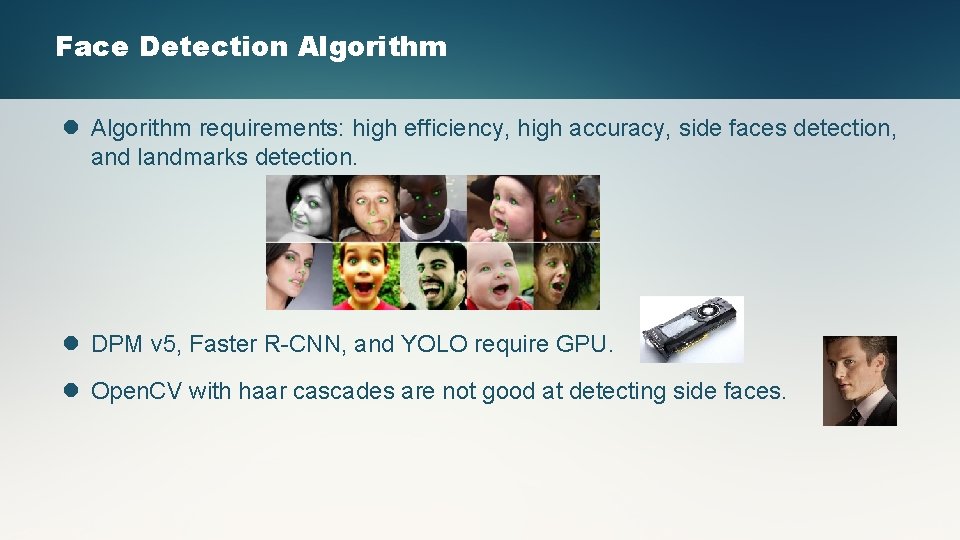
Face Detection Algorithm l Algorithm requirements: high efficiency, high accuracy, side faces detection, and landmarks detection. l DPM v 5, Faster R-CNN, and YOLO require GPU. l Open. CV with haar cascades are not good at detecting side faces.
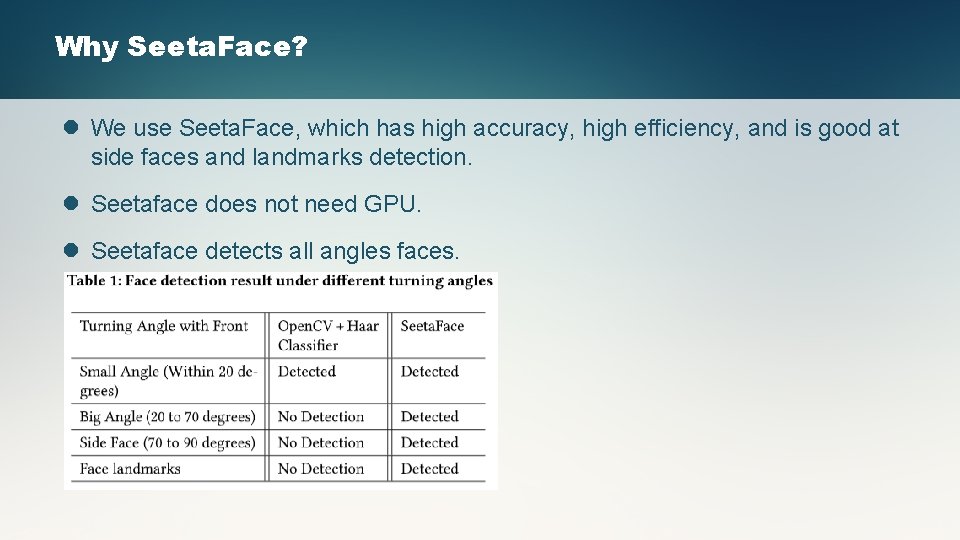
Why Seeta. Face? l We use Seeta. Face, which has high accuracy, high efficiency, and is good at side faces and landmarks detection. l Seetaface does not need GPU. l Seetaface detects all angles faces.
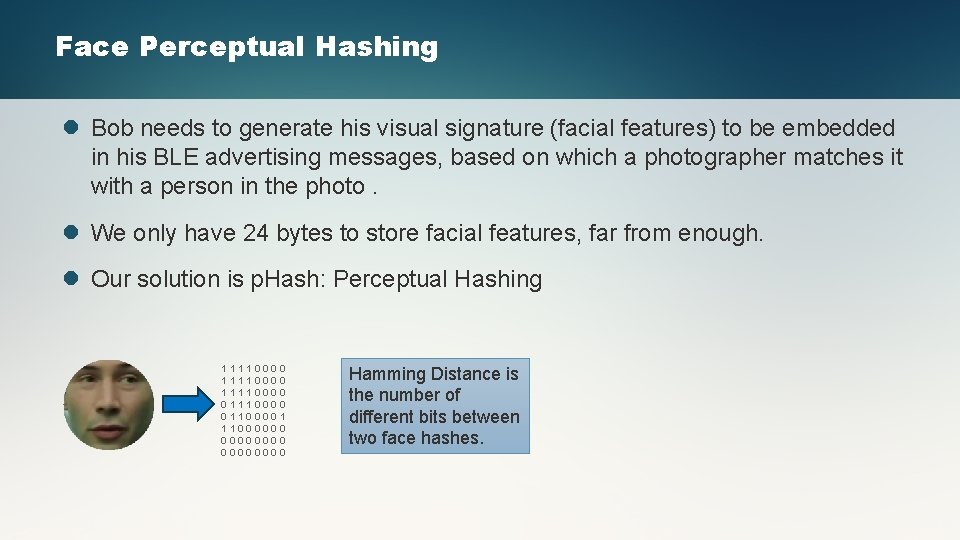
Face Perceptual Hashing l Bob needs to generate his visual signature (facial features) to be embedded in his BLE advertising messages, based on which a photographer matches it with a person in the photo. l We only have 24 bytes to store facial features, far from enough. l Our solution is p. Hash: Perceptual Hashing 11110000 01100001 1100000000 Hamming Distance is the number of different bits between two face hashes.
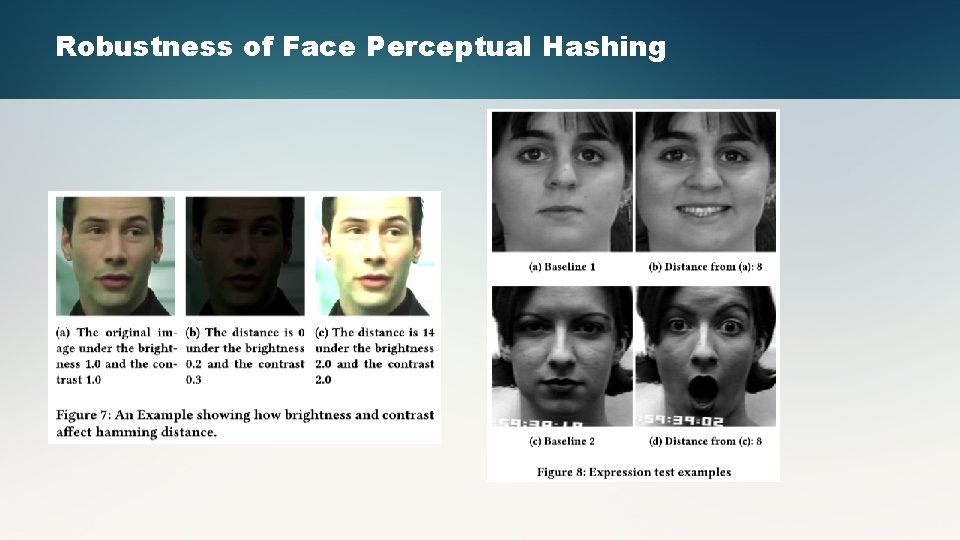
Robustness of Face Perceptual Hashing
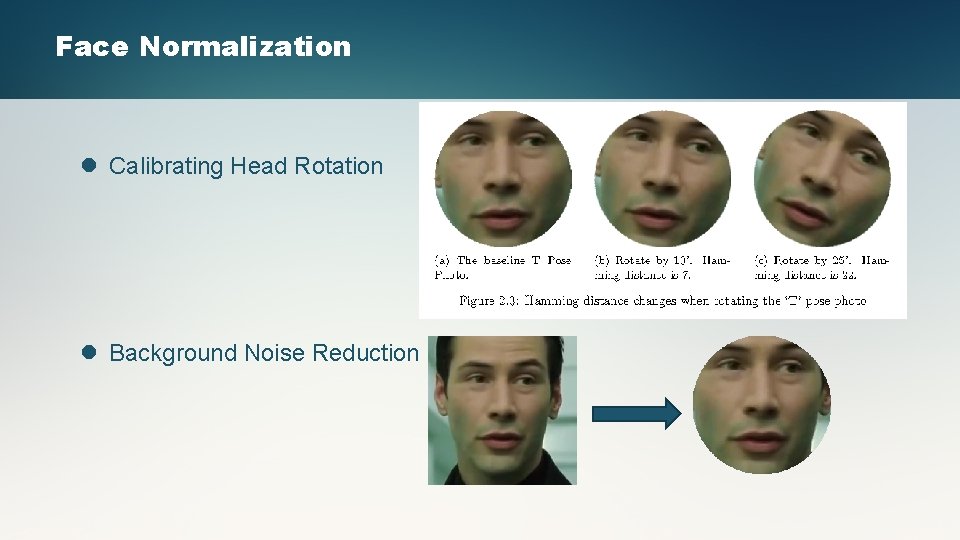
Face Normalization l Calibrating Head Rotation l Background Noise Reduction
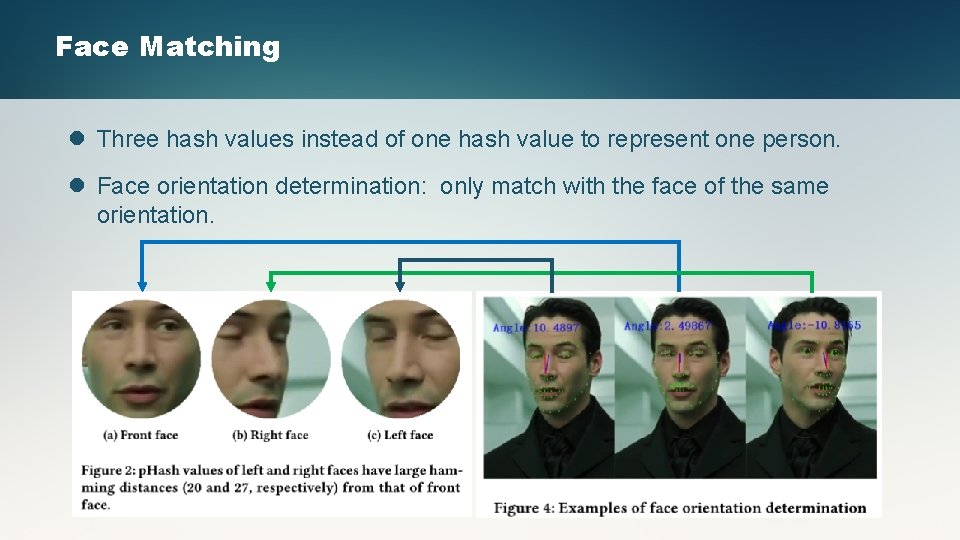
Face Matching l Three hash values instead of one hash value to represent one person. l Face orientation determination: only match with the face of the same orientation.
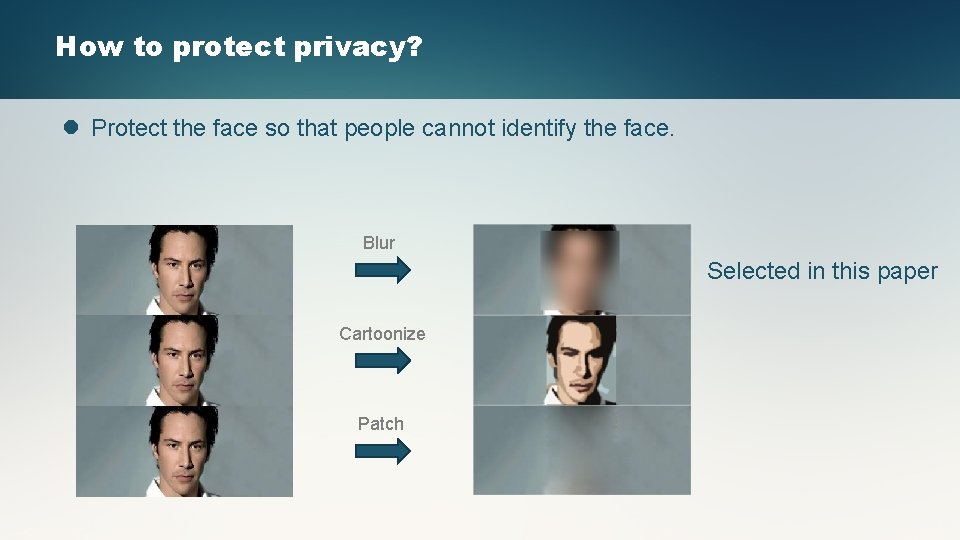
How to protect privacy? l Protect the face so that people cannot identify the face. Blur Selected in this paper Cartoonize Patch
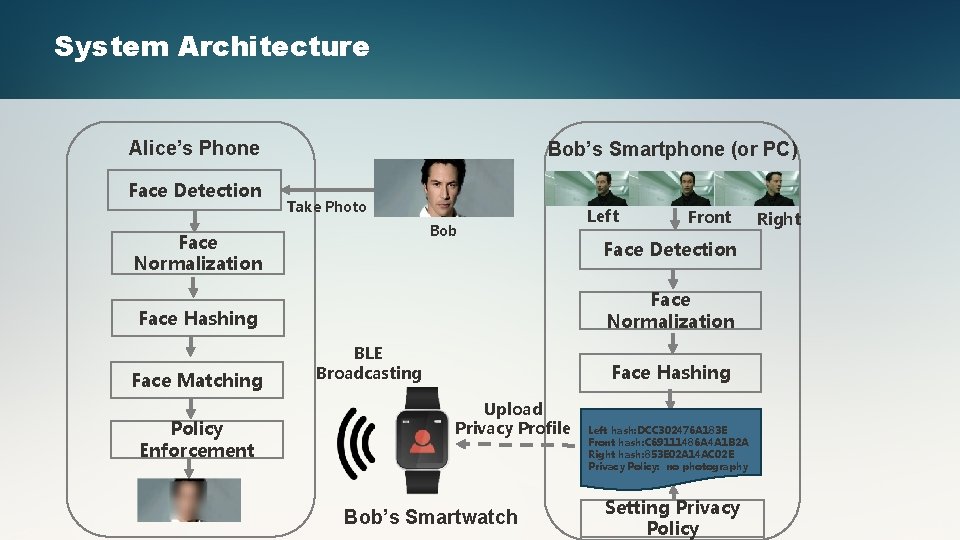
System Architecture Alice’s Phone Face Detection Bob’s Smartphone (or PC) Take Photo Bob Face Normalization Policy Enforcement Front Face Detection Face Normalization Face Hashing Face Matching Left BLE Broadcasting Face Hashing Upload Privacy Profile Bob’s Smartwatch Left hash: DCC 302476 A 183 E Front hash: C 69111486 A 4 A 1 B 2 A Right hash: 853 E 02 A 14 AC 02 E Privacy Policy: no photography Setting Privacy Policy Right
Implementation l The entire system has around 8 thousand lines of code (Including C/C++ and Java). l We import into our project the Android version of Seeta. Face and Open. CV 2. 4. 9. l For BLE operations, we use the classes and APIs provided by the Android framework, such as “m. Bluetooth. Manager” and “m. Bluetooth. Le. Advertiser. start. Advertising()”.
Thresholds of Three Faces l Thresholds of three faces. We did an offline analysis with thousands of faces and figured that the threshold value of 10 or 11 is good for front faces, 8 is good for side faces. More detail can be found at the paper. l Take the front face as an example, with the above threshold, both accuracy and recall are higher than 90%.
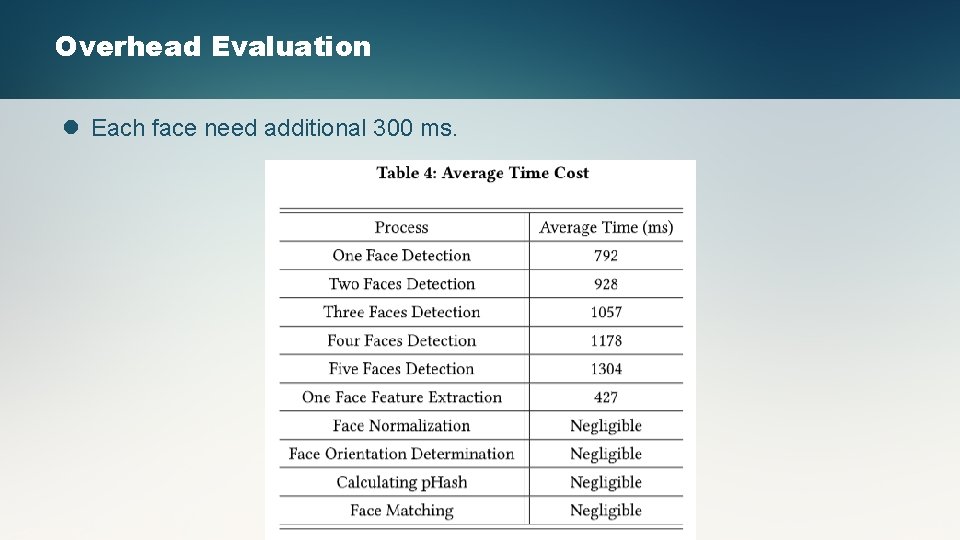
Overhead Evaluation l Each face need additional 300 ms.
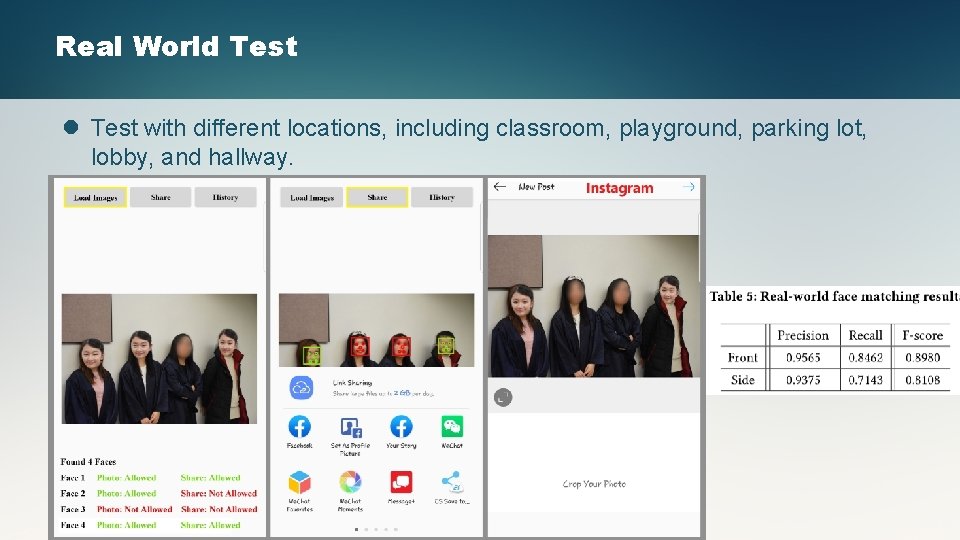
Real World Test l Test with different locations, including classroom, playground, parking lot, lobby, and hallway.
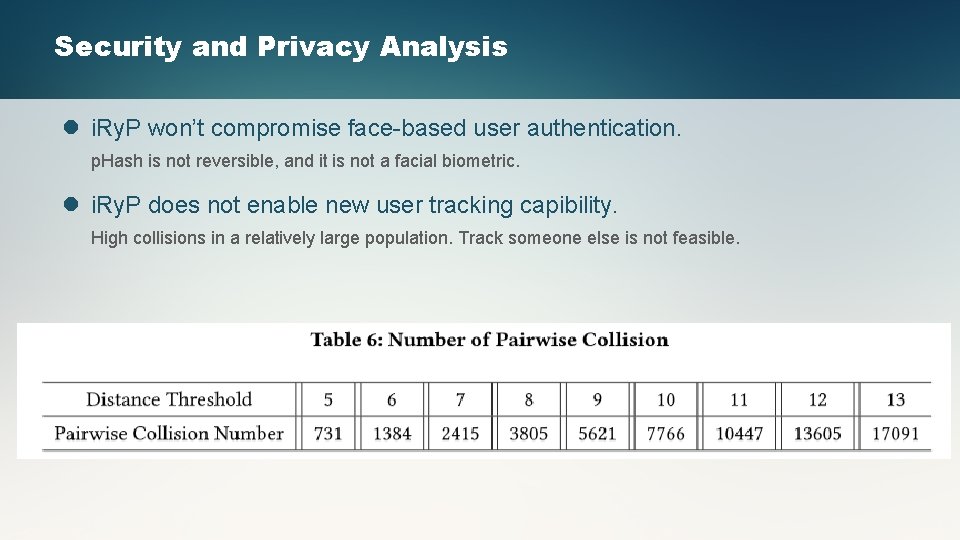
Security and Privacy Analysis l i. Ry. P won’t compromise face-based user authentication. p. Hash is not reversible, and it is not a facial biometric. l i. Ry. P does not enable new user tracking capibility. High collisions in a relatively large population. Track someone else is not feasible.
Existing work l I-pic: A platform for privacy-compliant image capture Unlike our system, the I-pic platform relies on the cloud computing platform to help match faces, and the camera needs a GPU to process images. l Hide. Me: Privacy-Preserving Photo Sharing on Social Networks Hideme is a plugin to existing photo sharing OSNs for preserving users’ privacy. Different from our work, which is a comprehensive system for mobile camera and covers both the photo-taking phase and sharing phase l Privacy. tag: Privacy concern expressed and respected In their system, people use QR code printed in their T-shirts to express their privacy policies. Photographer's Camera scans the QR code to learn people's privacy policies.
Conclusion l We presented i. Ry. P, a purely edge-based efficient privacy-respecting system for mobile devices. l We designed several efficient and effective mechanisms to boost up the accuracy of face matching based on perceptual hashing algorithm. l We presented an Android-platform based prototype, and performed various experiments. We showed that our system has high usability and good accuracy.

- Slides: 23