
I Platyhelminthes Flatworms Dorsoventrally flattened Simplest bilaterally symmetrical
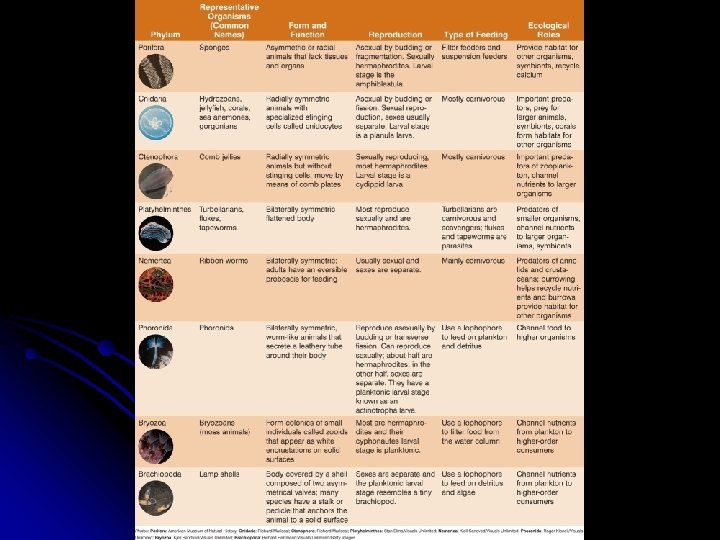
I. Platyhelminthes • • Flatworms - Dorsoventrally flattened Simplest bilaterally symmetrical organisms • • First organs and organ systems** Central nervous system • • Simple “brain” coordinates muscle movements Incomplete digestive system • • • Mouth but no anus Similar to Cnidaria and Ctenophora Mesoderm** • • Cell layer between endoderm and ectoderm Gives rise to muscles, reproductive system
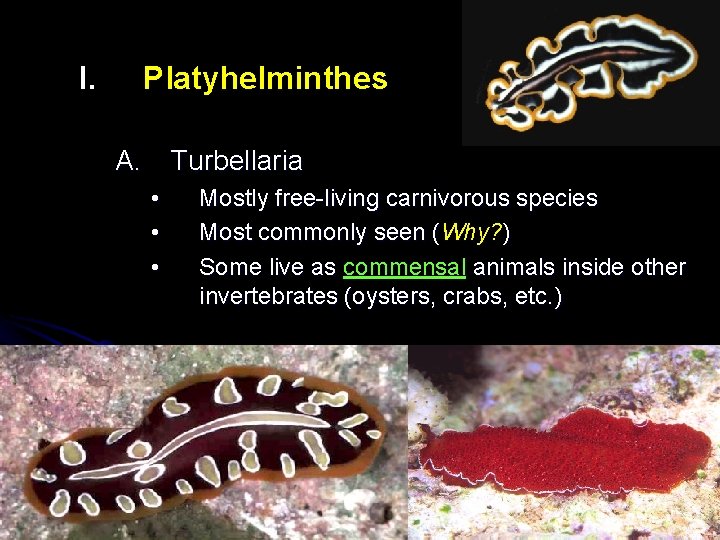
I. Platyhelminthes A. Turbellaria • • • Mostly free-living carnivorous species Most commonly seen (Why? ) ( Some live as commensal animals inside other invertebrates (oysters, crabs, etc. )

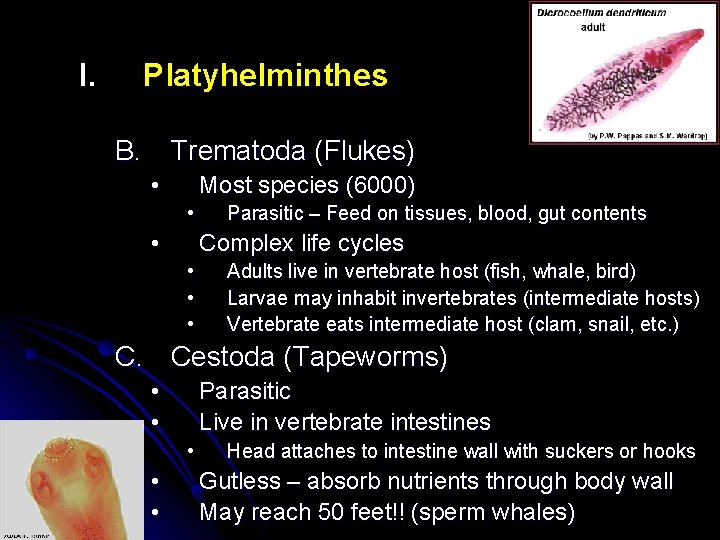
I. Platyhelminthes B. Trematoda (Flukes) • Most species (6000) • • Parasitic – Feed on tissues, blood, gut contents Complex life cycles • • • Adults live in vertebrate host (fish, whale, bird) Larvae may inhabit invertebrates (intermediate hosts) Vertebrate eats intermediate host (clam, snail, etc. ) C. Cestoda (Tapeworms) • • Parasitic Live in vertebrate intestines • • • Head attaches to intestine wall with suckers or hooks Gutless – absorb nutrients through body wall May reach 50 feet!! (sperm whales)
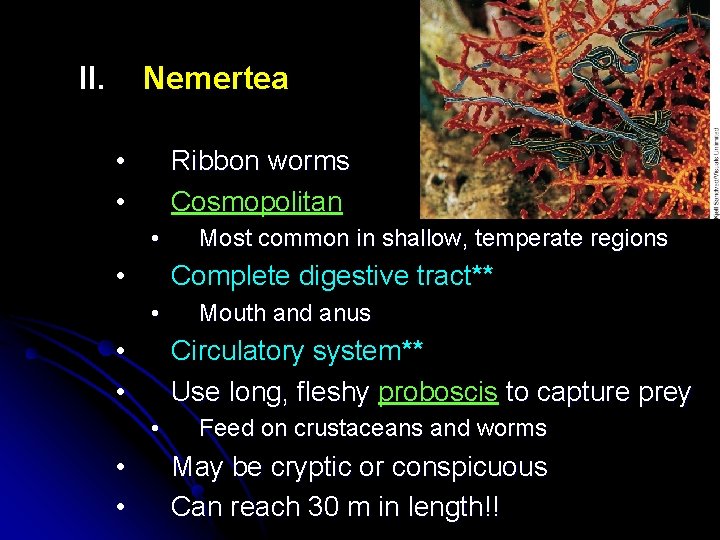
II. Nemertea • • Ribbon worms Cosmopolitan • • Complete digestive tract** • • • Mouth and anus Circulatory system** Use long, fleshy proboscis to capture prey • • • Most common in shallow, temperate regions Feed on crustaceans and worms May be cryptic or conspicuous Can reach 30 m in length!!
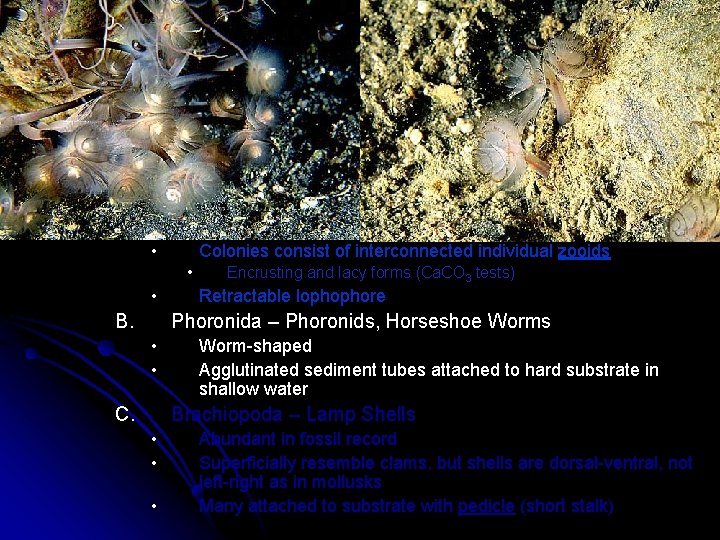
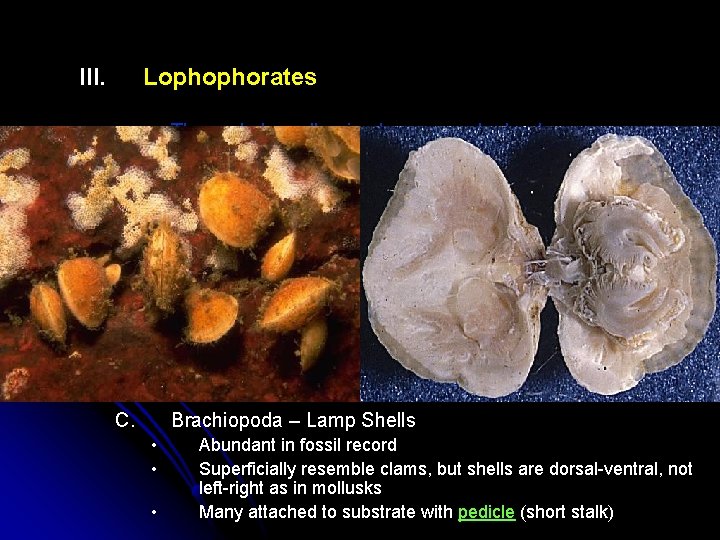
III. Lophophorates • Three phyla – all animals possess lophophore • • Ciliated hollow tentacles arranged in a horseshoe Suspension feeders • A. Bilateral symmetry, coelom (body cavity), U-shaped gut Ectoprocta – Bryozoans • Colonies consist of interconnected individual zooids • • B. Encrusting and lacy forms (Ca. CO 3 tests) Retractable lophophore Phoronida – Phoronids, Horseshoe Worms • • C. Worm-shaped Agglutinated sediment tubes attached to hard substrate in shallow water Brachiopoda – Lamp Shells • • • Abundant in fossil record Superficially resemble clams, but shells are dorsal-ventral, not left-right as in mollusks Many attached to substrate with pedicle (short stalk)
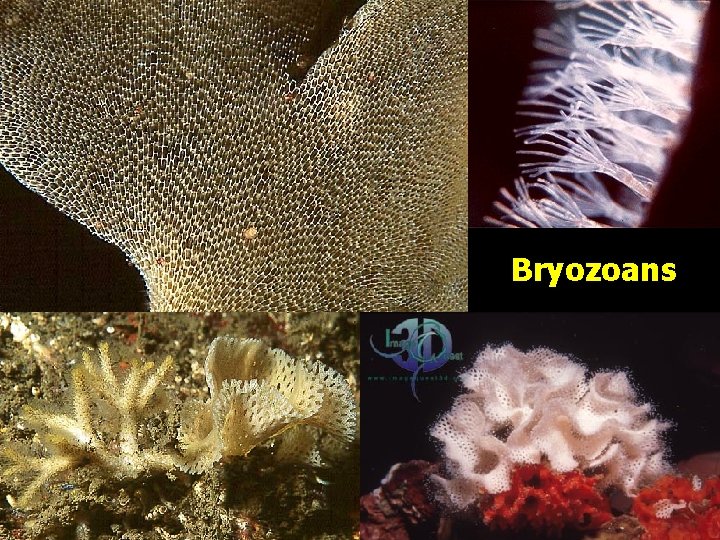
Bryozoans
III. Lophophorates • Three phyla – all animals possess lophophore • • Ciliated hollow tentacles arranged in a horseshoe Suspension feeders • A. Bilateral symmetry, coelom (body cavity), U-shaped gut Ectoprocta – Bryozoans • Colonies consist of interconnected individual zooids • • B. Encrusting and lacy forms (Ca. CO 3 tests) Retractable lophophore Phoronida – Phoronids, Horseshoe Worms • • C. Worm-shaped Agglutinated sediment tubes attached to hard substrate in shallow water Brachiopoda – Lamp Shells • • • Abundant in fossil record Superficially resemble clams, but shells are dorsal-ventral, not left-right as in mollusks Many attached to substrate with pedicle (short stalk)
III. Lophophorates • Three phyla – all animals possess lophophore • • Ciliated hollow tentacles arranged in a horseshoe Suspension feeders • A. Bilateral symmetry, coelom (body cavity), U-shaped gut Ectoprocta – Bryozoans • Colonies consist of interconnected individual zooids • • B. Encrusting and lacy forms (Ca. CO 3 tests) Retractable lophophore Phoronida – Phoronids, Horseshoe Worms • • C. Worm-shaped Agglutinated sediment tubes attached to hard substrate in shallow water Brachiopoda – Lamp Shells • • • Abundant in fossil record Superficially resemble clams, but shells are dorsal-ventral, not left-right as in mollusks Many attached to substrate with pedicle (short stalk)
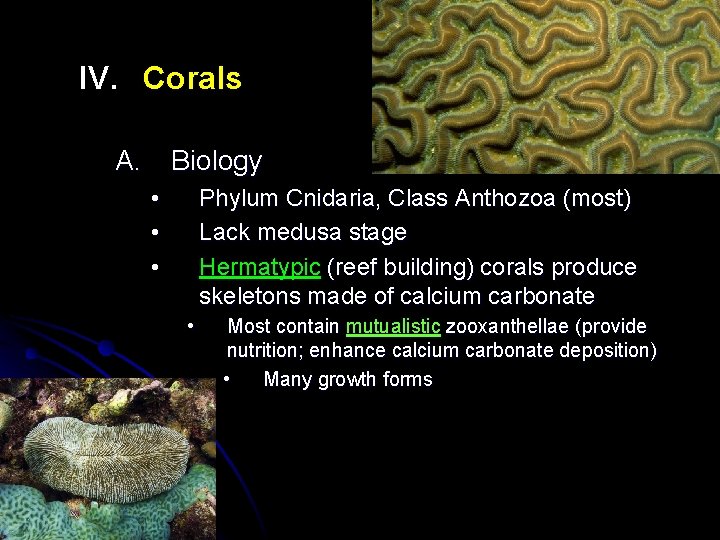
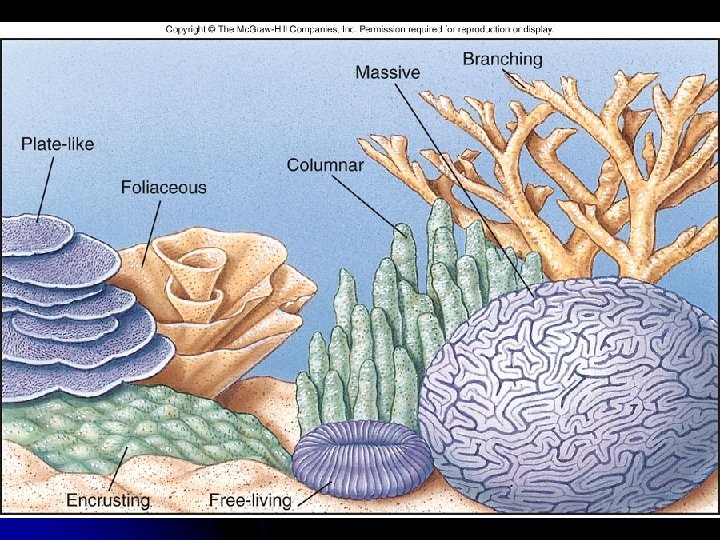
IV. Corals A. Biology • • • Phylum Cnidaria, Class Anthozoa (most) Lack medusa stage Hermatypic (reef building) corals produce skeletons made of calcium carbonate • Most contain mutualistic zooxanthellae (provide nutrition; enhance calcium carbonate deposition) • Many growth forms
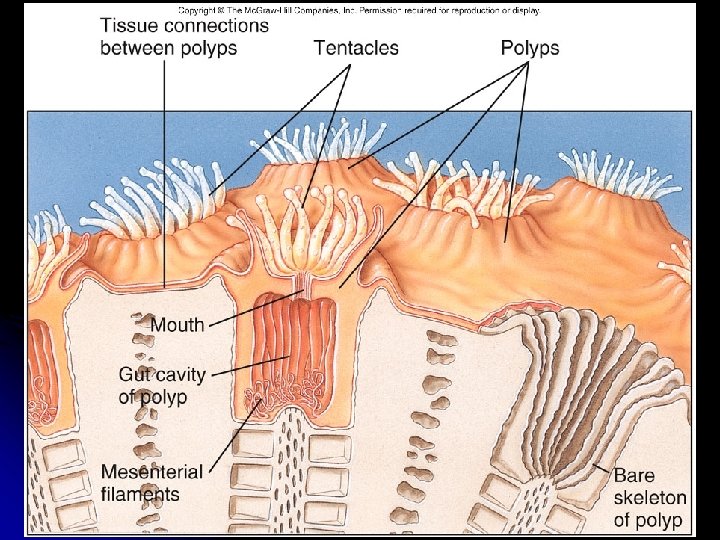
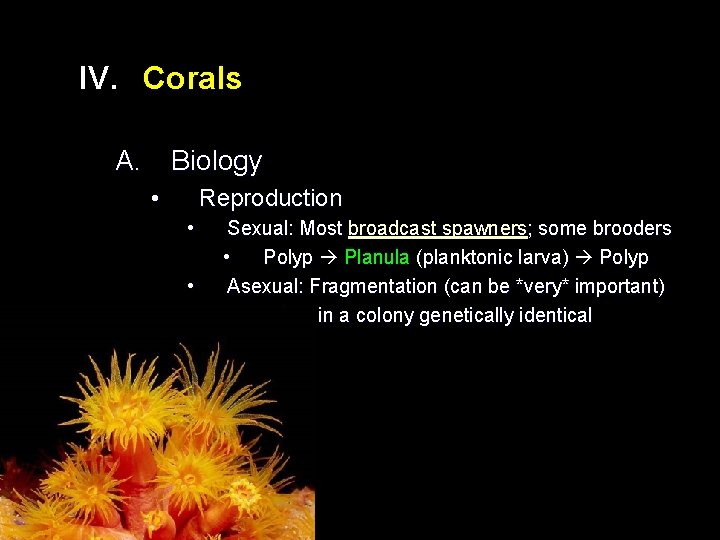
IV. Corals A. Biology • Reproduction • • • Sexual: Most broadcast spawners; some brooders • Polyp Planula (planktonic larva) Polyp Asexual: Fragmentation (can be *very* important) All polyps in a colony genetically identical
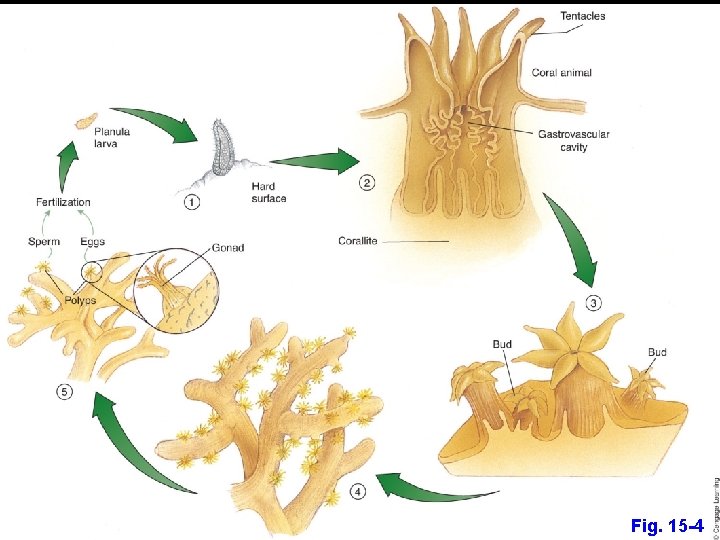
Fig. 15 -4
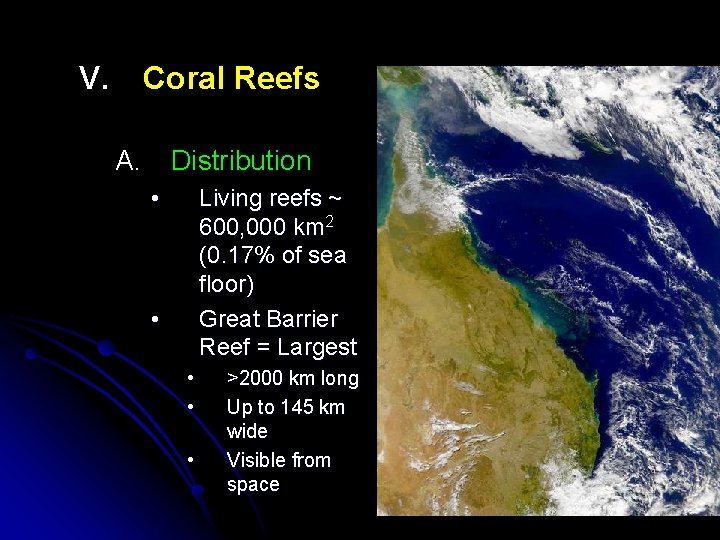
V. Coral Reefs A. Distribution • Living reefs ~ 600, 000 km 2 (0. 17% of sea floor) Great Barrier Reef = Largest • • >2000 km long Up to 145 km wide Visible from space
V. Coral Reefs B. Conditions 1. Substrate • 2. Primarily in areas with hard substrate Light - Bright (Why? ) ( • • 3. Rarely develop in water > 50 m deep Continental shelves, around islands, tops of seamounts Temperature • • Mean annual water temperature > 20 o. C Best development at 23 -25 o. C
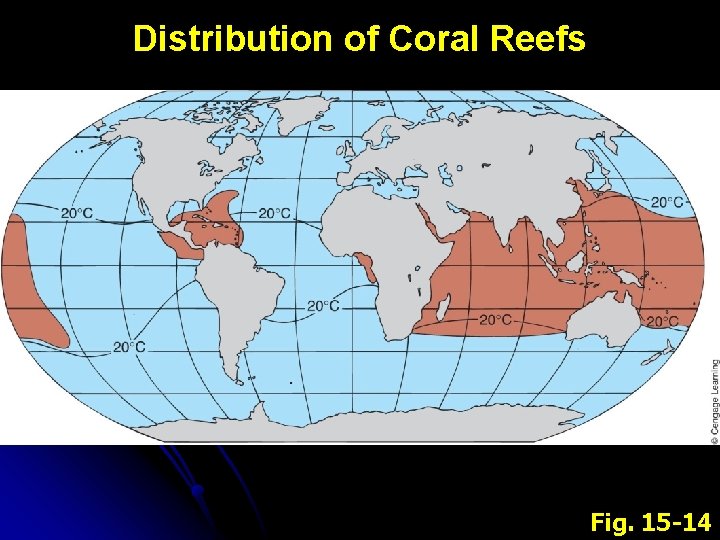
Distribution of Coral Reefs Fig. 15 -14
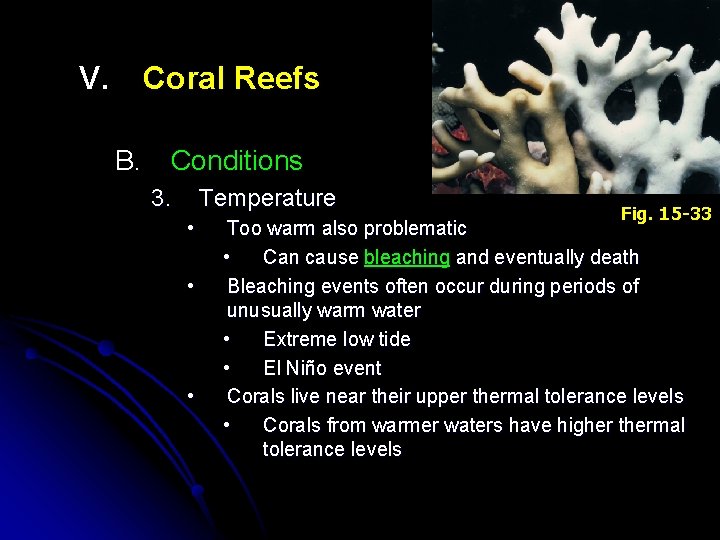
V. Coral Reefs B. Conditions 3. Temperature • • • Fig. 15 -33 Too warm also problematic • Can cause bleaching and eventually death Bleaching events often occur during periods of unusually warm water • Extreme low tide • El Niño event Corals live near their upper thermal tolerance levels • Corals from warmer waters have higher thermal tolerance levels
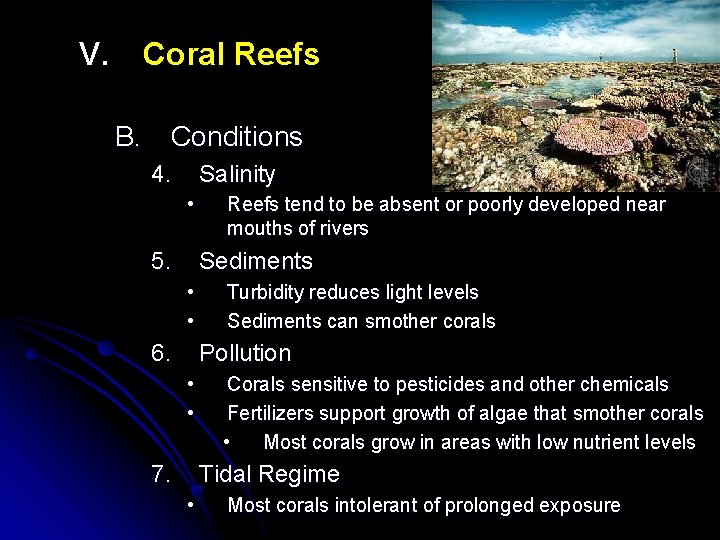
V. Coral Reefs B. Conditions 4. Salinity • 5. Reefs tend to be absent or poorly developed near mouths of rivers Sediments • • 6. Turbidity reduces light levels Sediments can smother corals Pollution • • 7. Corals sensitive to pesticides and other chemicals Fertilizers support growth of algae that smother corals • Most corals grow in areas with low nutrient levels Tidal Regime • Most corals intolerant of prolonged exposure
- Slides: 20