
I P S I A L Zanussi Pordenone











- Slides: 51
I. P. S. I. A. “L. Zanussi” - Pordenone CLIL PROJECT The cell Subject: Science Author: Allida De Candido English teacher: Bruna Pavan School year: 2004/2005 1
Sommario Lesson plan pqg. 3 Animal and plant cell 27 Procedure 5 Similarities and differences 28 Secret cell 7 Comparing plant and animal cell 29 Questions 8 Cell like a busy factory 30 Cells sizes 9 Departements and functions The words meaning 10 in the factory 31 Differences between cells 11 Question loop 32 How big are cells? 13 What are the correct definitions? 14 Final test 37 Relative sizes of cells A 15 Glossary 38 Relative sizes of cells B 16 Answers 41 What else about cells? 17 Bibliography 51 What is there inside the cell? 18 Cellcrossword 24 Parts of the cell A 25 Parts of the cell B 26 Home 2
Lesson plan Objectives § § § § Students will be able to: describe the cell use appropriate scientific terms for organelles and their functions remember the names of the organelles explain the resemblances and the differences between animal and plant cells recognize animal and plant cells know the importance of the cell Home Sommario 3
Contents The cell structure and function. A comparison between animal and plant cell. Grade level It may be adapted for use in a Vocational Training School for students beginning to study Biology. Time Approximately 3 hours. Resources Internet site; school books. Home Sommario 4
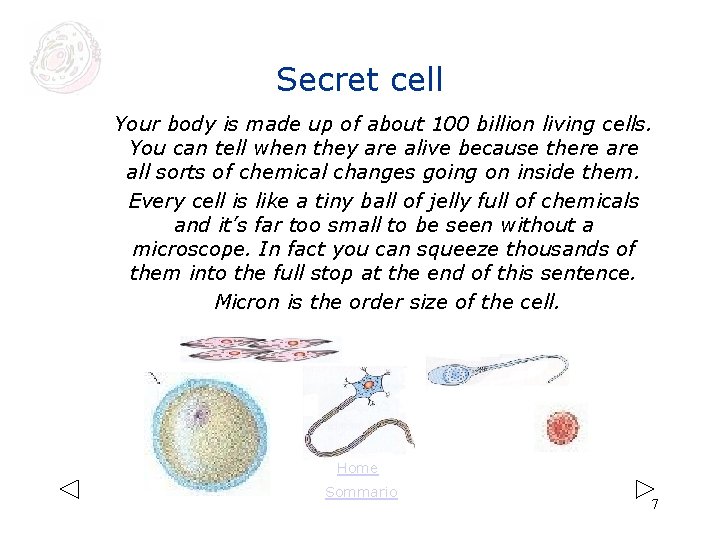
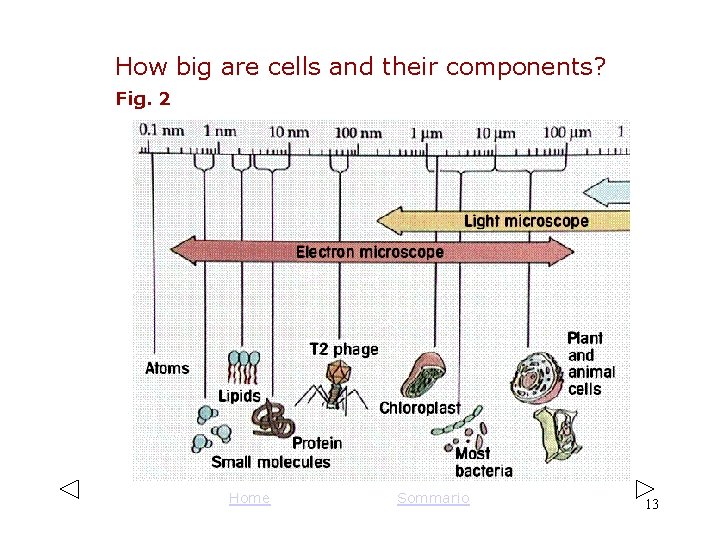
Procedure The lesson will start with simple information about the cell: a) all living organisms are made of one or more cells; b) cell size. Open questions will get some information from the text. With looking up in the dictionary for specific words students will understand better their meaning. In picture 1 the students can recognize the shape of different cells and in picture 2 they can see the various sizes of cells and their components. Finally to establish the students’ knowledge there is a chart to fill in with the given definitions. The next step is about what there is inside the cell, the names and the functions of the organelles. The students will be given a paper with all this information and matching halves phrases on the functions to get immediate feedback. With the filling of a crossword the students will be able to remember the names of organelles and their functions. A work in pairs is useful to fix the concepts. Home Sommario 5
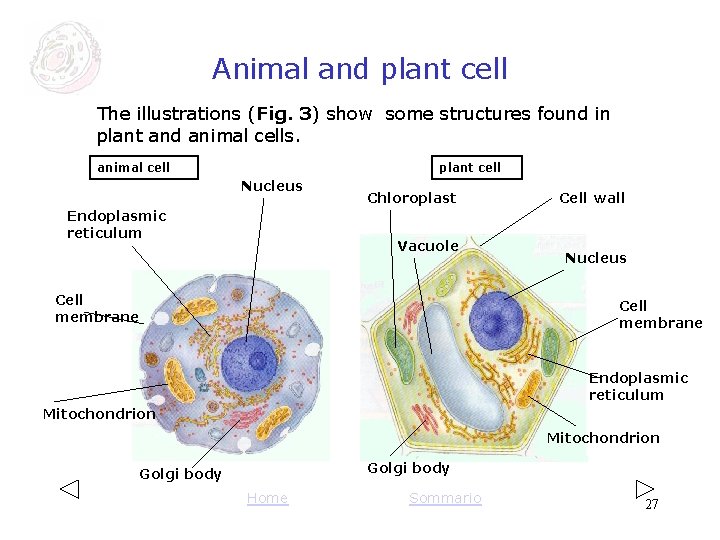
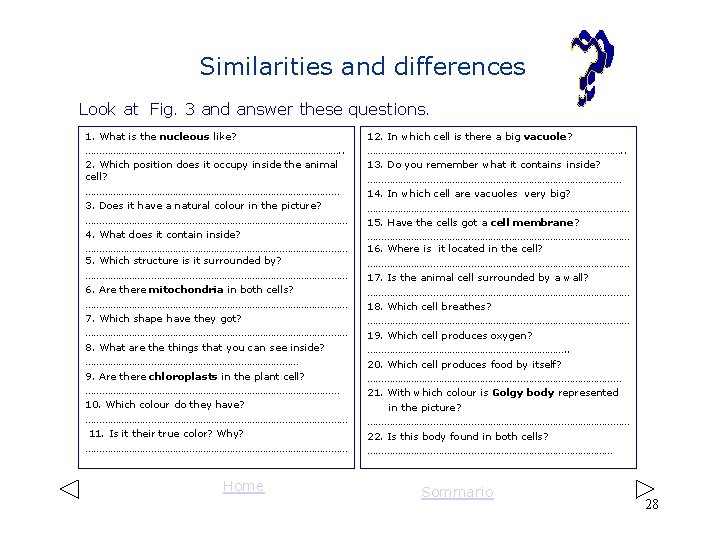
The third step is made to observe the difference between plant and animal cells. Looking at Fig. 3 the students will also see what animal and plant cells have in common and will be able to fill in the Venn diagram. Some questions about fig. 3 are useful to observe and point out the similarities and the differences. In the fourth step the student will consolidate and memorise the names of organelles, observing the picture and filling in the empty column. A game and a final test get students to revise all the lesson. Home Sommario 6
Secret cell Your body is made up of about 100 billion living cells. You can tell when they are alive because there all sorts of chemical changes going on inside them. Every cell is like a tiny ball of jelly full of chemicals and it’s far too small to be seen without a microscope. In fact you can squeeze thousands of them into the full stop at the end of this sentence. Micron is the order size of the cell. Home Sommario 7
Questions Answer these questions: 1. What other definition of cell do you know? ---------------------------2. What instrument do you use for looking at cells? ----------------------------3. How many cells are there in your body? ----------------------------4. What happens inside the cell? ----------------------------Home Sommario 8
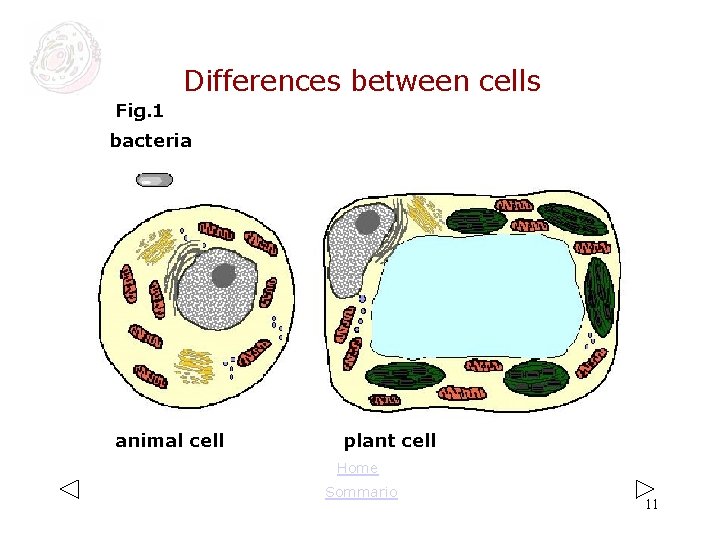
Cells sizes Cells vary greatly in size. Most cannot be seen without a microscope, although a few varieties are visible to the naked eye. The diameter of an average animal cell is about 10 micrometers (or 0. 01 millimetre) and of an average plant cell is about 100 micrometers (0, 1 millimetre). Some cells are quite large. Eggs of animals are single cells before their development begins, and they are usually visible to the eye. Bacterial cells are very small, with diameters of only 0. 35 to 0. 40 micrometer, near the limit of resolution of an ordinary light microscope. Home Sommario 9
Differences between cells Fig. 1 bacteria animal cell plant cell Home Sommario 11
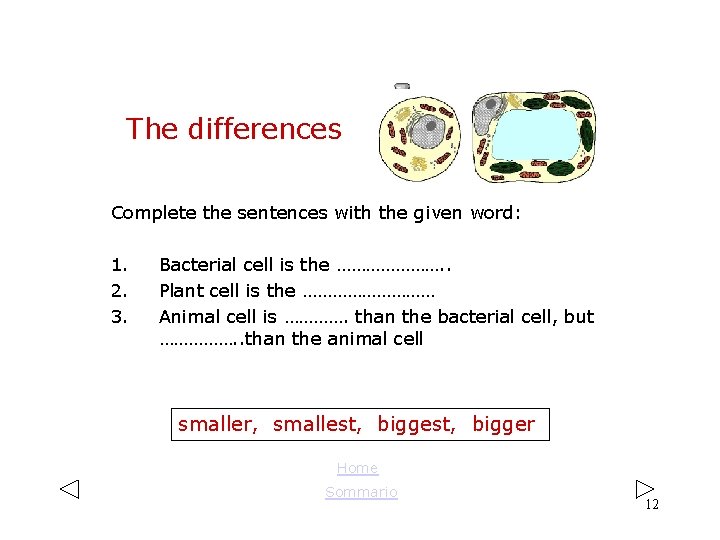
The differences Complete the sentences with the given word: 1. 2. 3. Bacterial cell is the …………………. . Plant cell is the …………… Animal cell is …………. than the bacterial cell, but ……………. . than the animal cell smaller, smallest, bigger Home Sommario 12
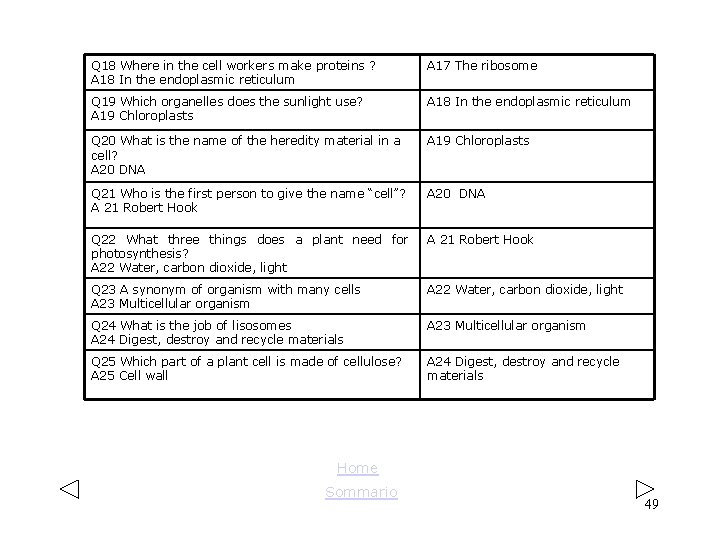
How big are cells and their components? Fig. 2 Home Sommario 13
What are the correct definitions? Complete the chart using the given definitions: What is the range in micron to see an animal and a plant cell? ………………… What is the size order of the molecules? ………………… Which instrument do you use to see the plant cell? ………………… What is the range in nm to see the proteins? ………………… Which type of instrument can you use to see the organelles better? ………………… nanometre; electron microscope; between 10 and 100 ; light microscope; between 0. 3 and 10 ; Home Sommario 14
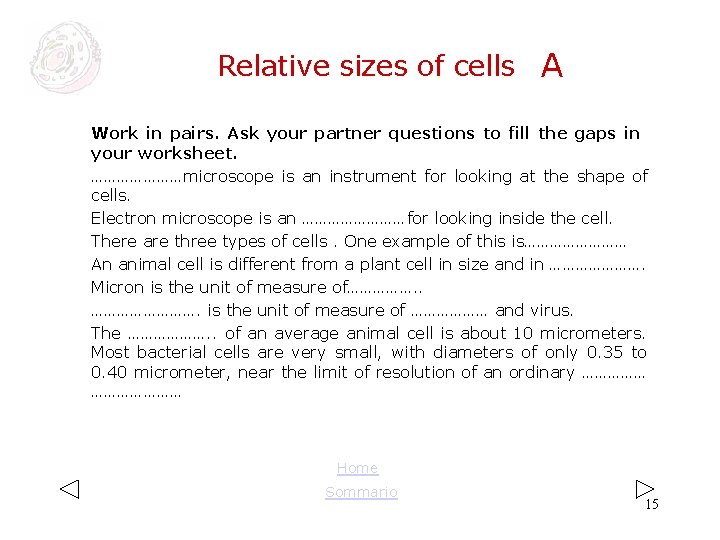
Relative sizes of cells A Work in pairs. Ask your partner questions to fill the gaps in your worksheet. …………………microscope is an instrument for looking at the shape of cells. Electron microscope is an …………for looking inside the cell. There are three types of cells. One example of this is………… An animal cell is different from a plant cell in size and in …………………. Micron is the unit of measure of……………. is the unit of measure of ……………… and virus. The ………………. . of an average animal cell is about 10 micrometers. Most bacterial cells are very small, with diameters of only 0. 35 to 0. 40 micrometer, near the limit of resolution of an ordinary ………………… Home Sommario 15
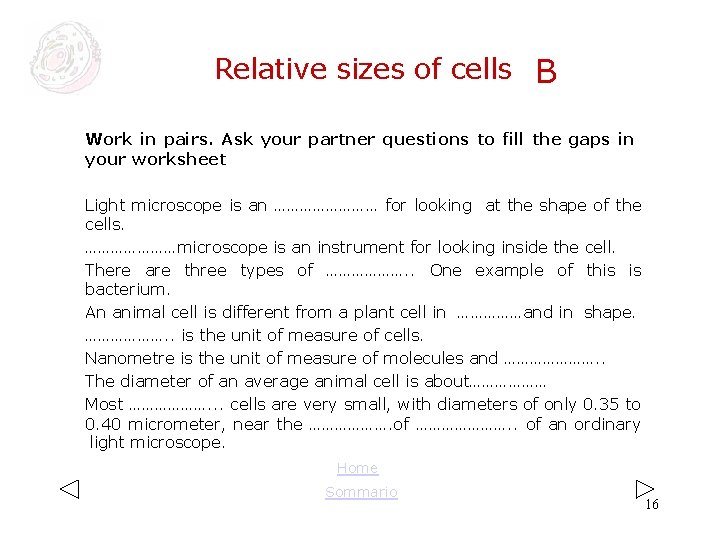
Relative sizes of cells B Work in pairs. Ask your partner questions to fill the gaps in your worksheet Light microscope is an ………… for looking at the shape of the cells. …………………microscope is an instrument for looking inside the cell. There are three types of ………………. . One example of this is bacterium. An animal cell is different from a plant cell in ……………and in shape. ………………. . is the unit of measure of cells. Nanometre is the unit of measure of molecules and …………………. . The diameter of an average animal cell is about……………… Most ………………. . . cells are very small, with diameters of only 0. 35 to 0. 40 micrometer, near the ………………. of …………………. . of an ordinary light microscope. Home Sommario 16
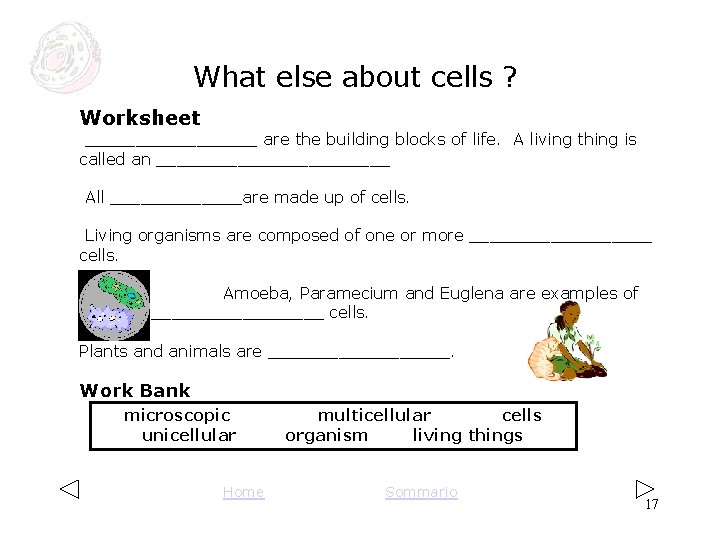
What else about cells ? _________ are the building blocks of life. A living thing is Worksheet called an ____________ All _______are made up of cells. Living organisms are composed of one or more _________ cells. Amoeba, Paramecium and Euglena are examples of _________ cells. Plants and animals are _________. Work Bank microscopic multicellular cells unicellular organism living things Home Sommario 17
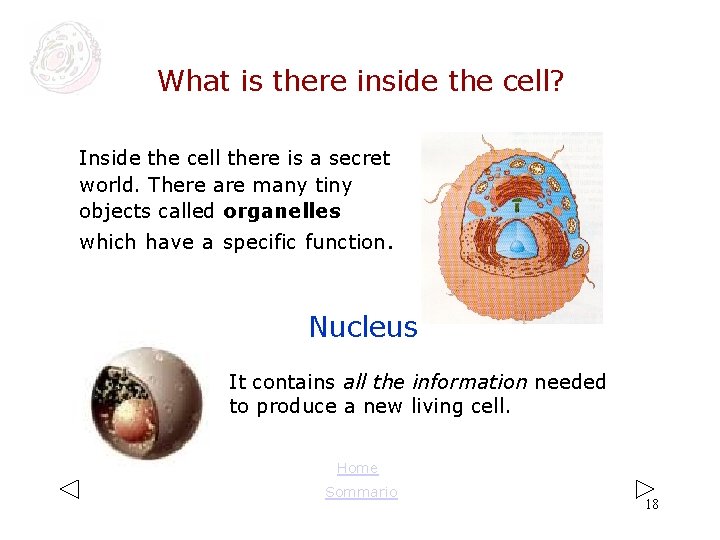
What is there inside the cell? Inside the cell there is a secret world. There are many tiny objects called organelles which have a specific function. Nucleus It contains all the information needed to produce a new living cell. Home Sommario 18
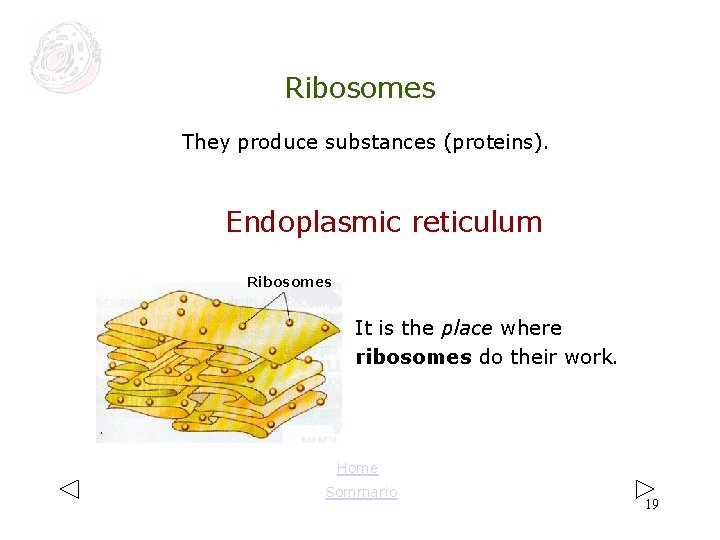
Ribosomes They produce substances (proteins). Endoplasmic reticulum Ribosomes It is the place where ribosomes do their work. Home Sommario 19
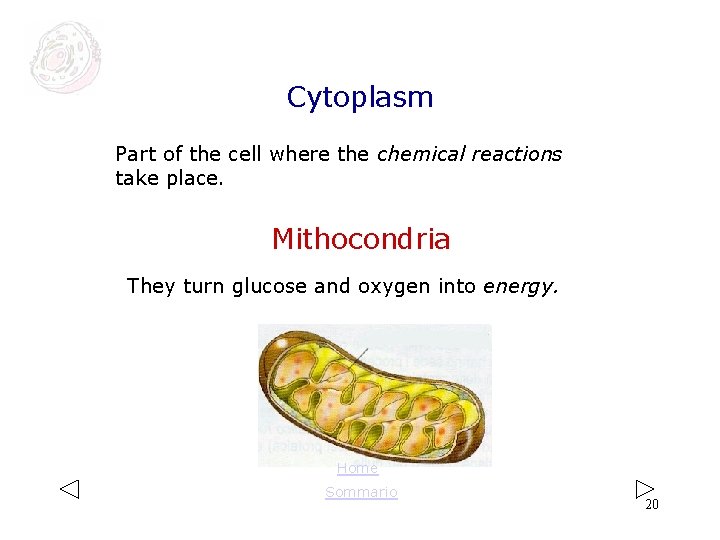
Cytoplasm Part of the cell where the chemical reactions take place. Mithocondria They turn glucose and oxygen into energy. Home Sommario 20
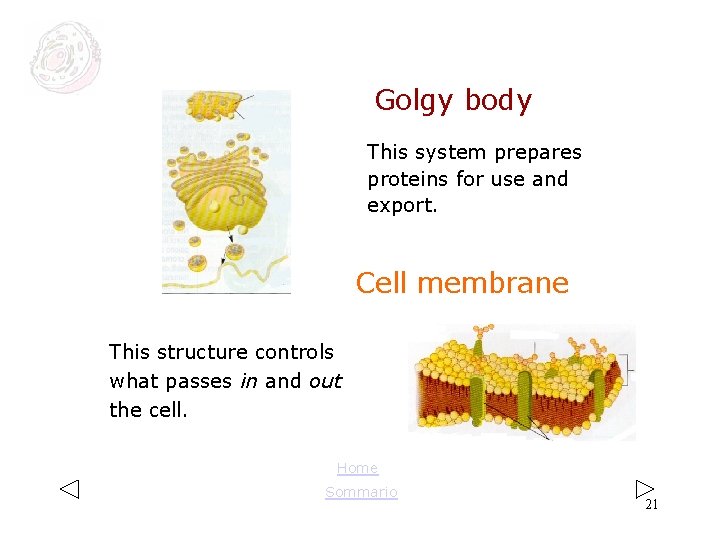
Golgy body This system prepares proteins for use and export. Cell membrane This structure controls what passes in and out the cell. Home Sommario 21
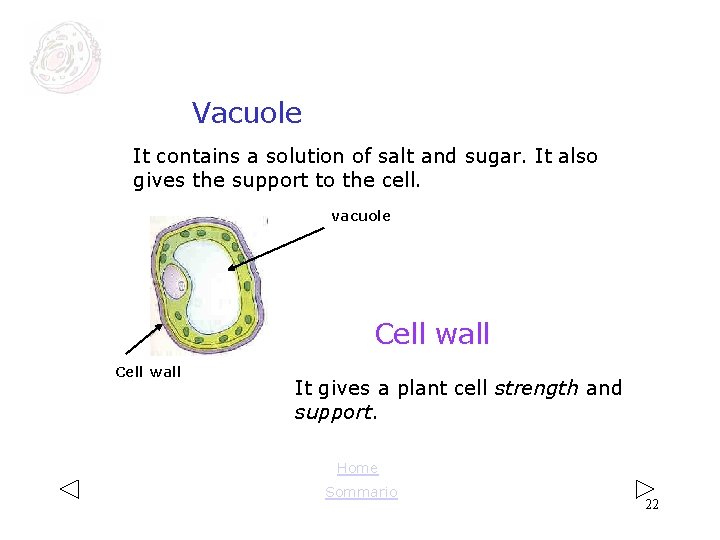
Vacuole It contains a solution of salt and sugar. It also gives the support to the cell. vacuole Cell wall It gives a plant cell strength and support. Home Sommario 22
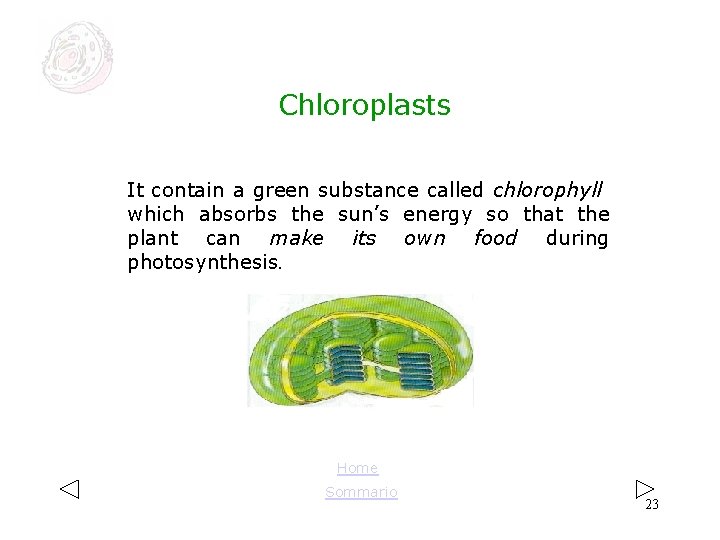
Chloroplasts It contain a green substance called chlorophyll which absorbs the sun’s energy so that the plant can make its own food during photosynthesis. Home Sommario 23
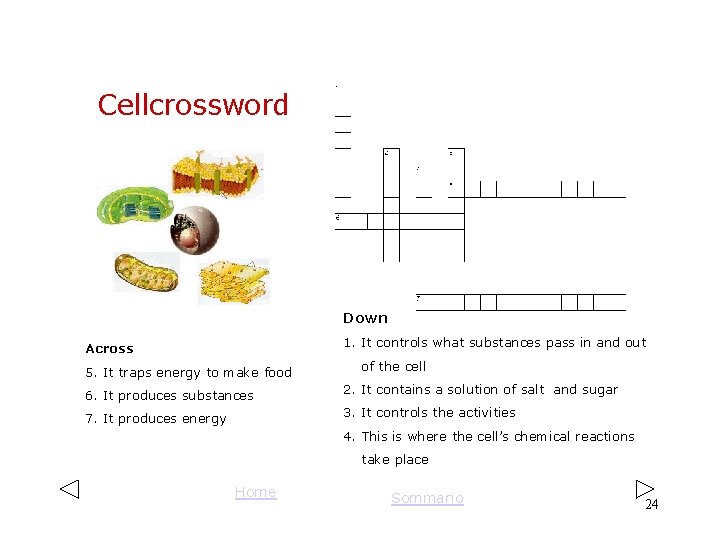
Cellcrossword Down Across 1. It controls what substances pass in and out 5. It traps energy to make food of the cell 6. It produces substances 2. It contains a solution of salt and sugar 7. It produces energy 3. It controls the activities 4. This is where the cell’s chemical reactions take place Home Sommario 24
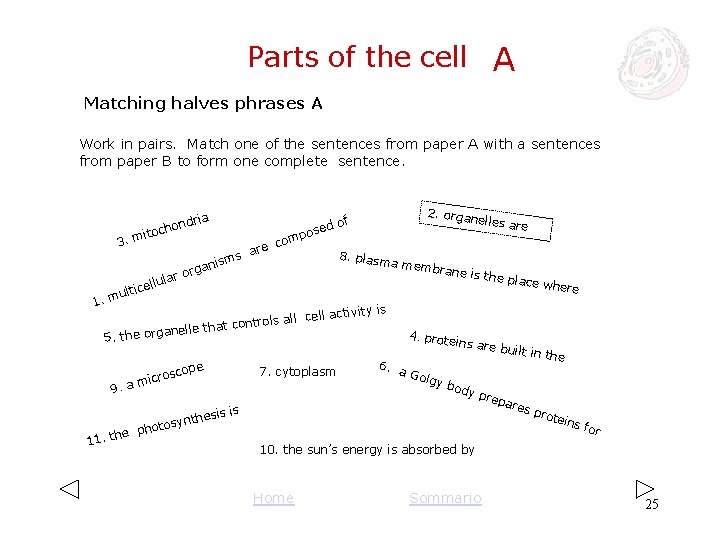
Parts of the cell A Matching halves phrases A Work in pairs. Match one of the sentences from paper A with a sentences from paper B to form one complete sentence. ria d chon o t i m 3. 2. orga nelles a of sed po com re a ms anis org ular re 8. plasm a memb r cell ti ul 1. m ane is t he plac e where vity is 5. the o acti ols all cell tr n o c t a h rganelle t cope ros mic 9. a 7. cytoplasm s esis i h t n y s photo 4. protein s are bu 6. a Go lgy ilt in the bod y pr e 11. th epa res prot eins for 10. the sun’s energy is absorbed by Home Sommario 25
B Parts of the cell Matching halves phrases B Work in pairs. Match one of the sentences from paper B with a sentences from paper A to form one complete sentence. p y erg en ce u rod contains the organelles nucleus minu te str use and export cells ma a n ke cont act with e e imag h t s e enlarg e of a c Home um ber of uctur es ins ide a cell s ribos the ext e omes rnal env ironmen t ll n actio chlorophyll e cal r emi a ch Sommario 26
Animal and plant cell The illustrations (Fig. 3) show some structures found in plant and animal cells. animal cell plant cell Nucleus Endoplasmic reticulum Chloroplast Vacuole Cell membrane Cell wall Nucleus Cell membrane Endoplasmic reticulum Mitochondrion Golgi body Home Sommario 27
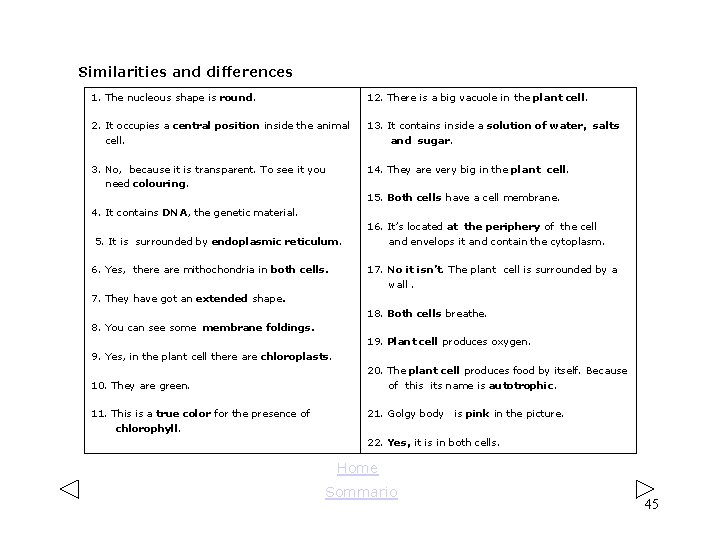
Similarities and differences Look at Fig. 3 and answer these questions. 1. What is the nucleous like? …………………………………………. . 2. Which position does it occupy inside the animal cell? ………………………………………… 3. Does it have a natural colour in the picture? ………………………………………… 4. What does it contain inside? ………………………………………… 5. Which structure is it surrounded by? ………………………………………… 6. Are there mitochondria in both cells? ………………………………………… 7. Which shape have they got? ………………………………………… 8. What are things that you can see inside? ………………………………… 9. Are there chloroplasts in the plant cell? ………………………………………… 10. Which colour do they have? ………………………………………… 11. Is it their true color? Why? ………………………………………… Home 12. In which cell is there a big vacuole? …………………………………………. . 13. Do you remember what it contains inside? ………………………………………… 14. In which cell are vacuoles very big? ………………………………………… 15. Have the cells got a cell membrane? ………………………………………… 16. Where is it located in the cell? ………………………………………… 17. Is the animal cell surrounded by a wall? ………………………………………… 18. Which cell breathes? ………………………………………… 19. Which cell produces oxygen? ………………………………. . 20. Which cell produces food by itself? ………………………………………… 21. With which colour is Golgy body represented in the picture? ………………………………………… 22. Is this body found in both cells? ……………………………………… Sommario 28
Comparing plant and animal cells Animal and plant cells are the same in some ways. We say that they have some of the same features. Animal and plant cells are also different. Look at Fig 3 and try to spot the differences. Fill in the Venn diagram to compare a plant cell to an animal cell. Use the words in the word box. cell membrane cell wall chloroplast cytoplasm mitochondria nucleus ribosome vacuole in common animal cell plant cell What's the most complicated cell? ___________ It is because it produces oxygen and food (glucose) for all living things using the sunlight directly. The animal cell depends on the plant cell. Home Sommario 29
Cell like a busy factory A cell can be thought as a factory with different departments where many activities take place. Fig. 4 Look at Fig. 4. Work in pairs and try to understand what happens in each department. Discuss with each other. Home Sommario 30
Departments and functions in the factory In the second column of the chart, write the name of the organelle connected with the factory activities described in the first column. Departments and functions in the factory Organelle Executive department: decides what products are made Power plant: provides energy for all process Workers: produce materials Packaging departments: assemble the products Factory floor: where most products are assembled, finished and shipped Assembly line (where workers do their work) Shipping/ Receiving department Have you filled in the gaps!? If not, try again! This is another clue for you. Golgi body, Cell membrane, Nucleus, Cytoplasm, Endoplasmic reticulum, Mitochondrion, Ribosomes Home Sommario 31
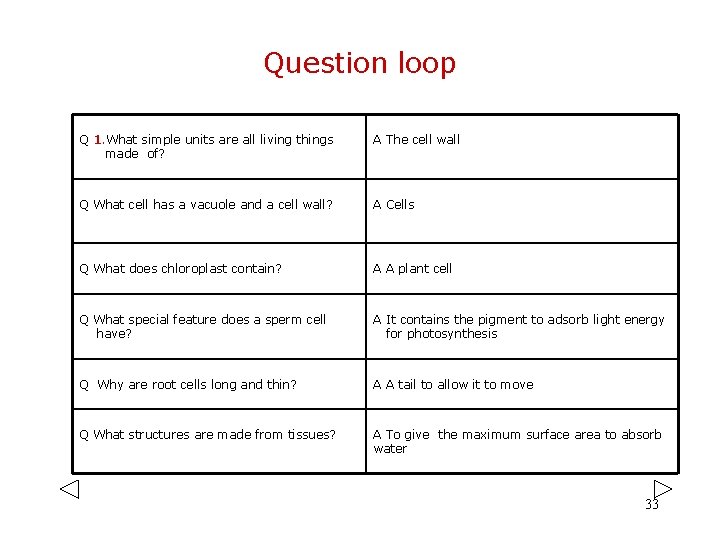
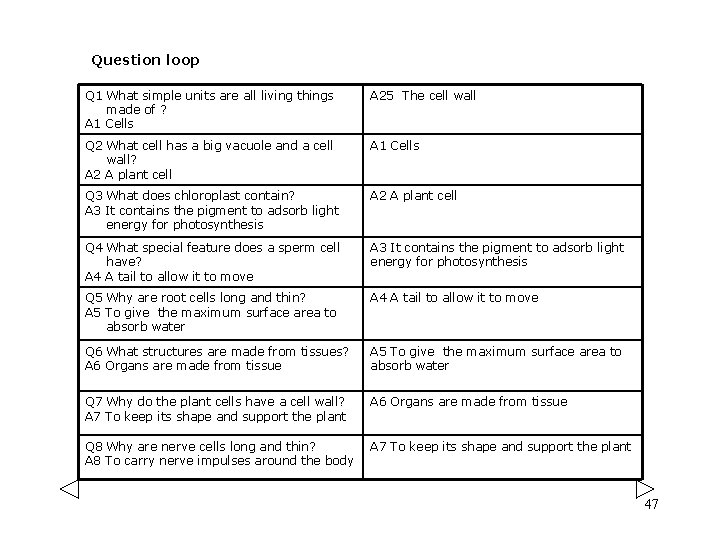
Question loop There are 25 strips of paper all different, each with a question and an answer. Print the pages and cut the strips. Hand out a strip to each student. Start the loop by getting one pupil to ask their question. Someone should recognize the correct answer and read it. Then they should read out their question and so on. Eventually the loop should return to the first person. Home Sommario 32
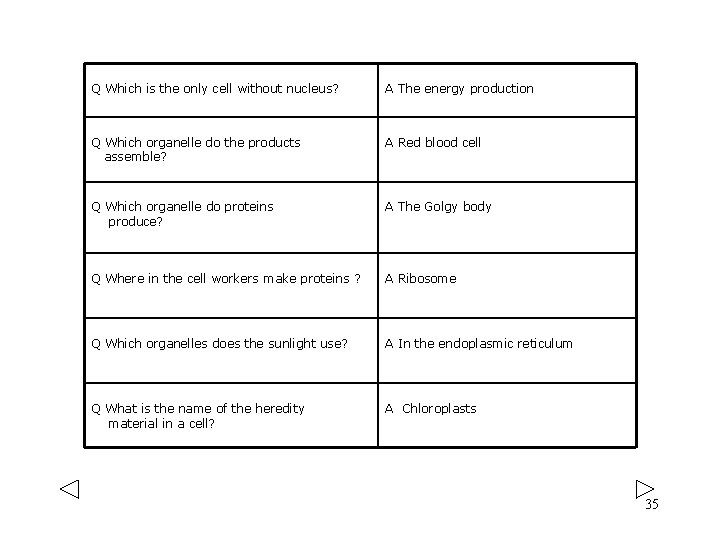
Question loop Q 1. What simple units are all living things made of? A The cell wall Q What cell has a vacuole and a cell wall? A Cells Q What does chloroplast contain? A A plant cell Q What special feature does a sperm cell have? A It contains the pigment to adsorb light energy for photosynthesis Q Why are root cells long and thin? A A tail to allow it to move Q What structures are made from tissues? A To give the maximum surface area to absorb water 33
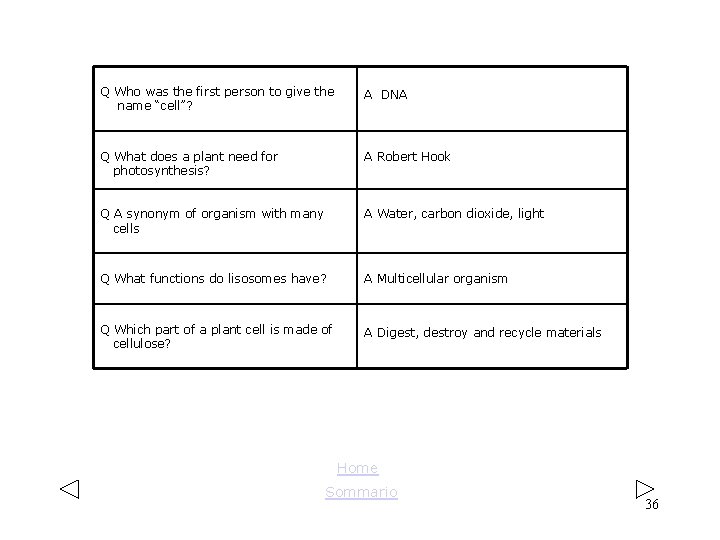
Q Why does the plant cell have a cell wall? A Organs are made from tissue Q Why are nerve cells long and thin? A To keep its shape and support the plant Q What useful product is made in photosynthesis? A To carry nerve impulses around the body Q What is the function of the nucleus? A Oxygen Q Which are the typical three parts of the plant cell? A It controls the activities of the cell Q Where in the cell do most of the chemical reactions take place? A Cell wall, chloroplasts and large permanent vacuole Q What does the cell membrane do? A In the cytoplasm Q What occurs in the mitochondria? A It controls what passes in and out of the cell 34
Q Which is the only cell without nucleus? A The energy production Q Which organelle do the products assemble? A Red blood cell Q Which organelle do proteins produce? A The Golgy body Q Where in the cell workers make proteins ? A Ribosome Q Which organelles does the sunlight use? A In the endoplasmic reticulum Q What is the name of the heredity material in a cell? A Chloroplasts 35
Q Who was the first person to give the name “cell”? A DNA Q What does a plant need for photosynthesis? A Robert Hook Q A synonym of organism with many cells A Water, carbon dioxide, light Q What functions do lisosomes have? A Multicellular organism Q Which part of a plant cell is made of cellulose? A Digest, destroy and recycle materials Home Sommario 36
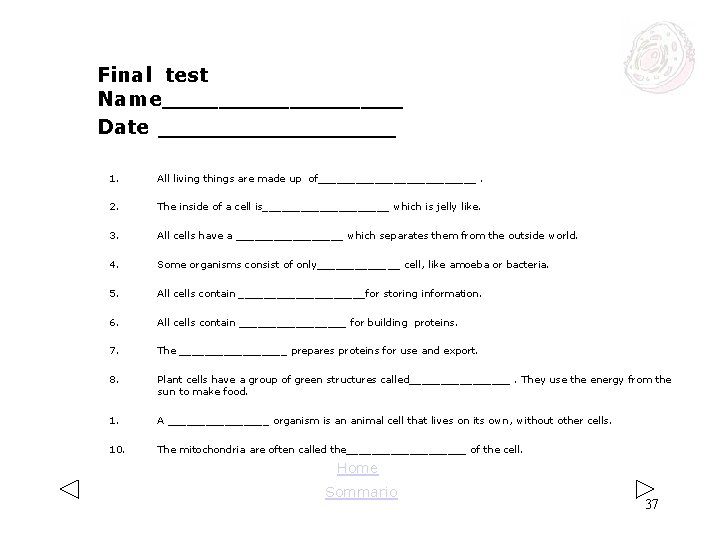
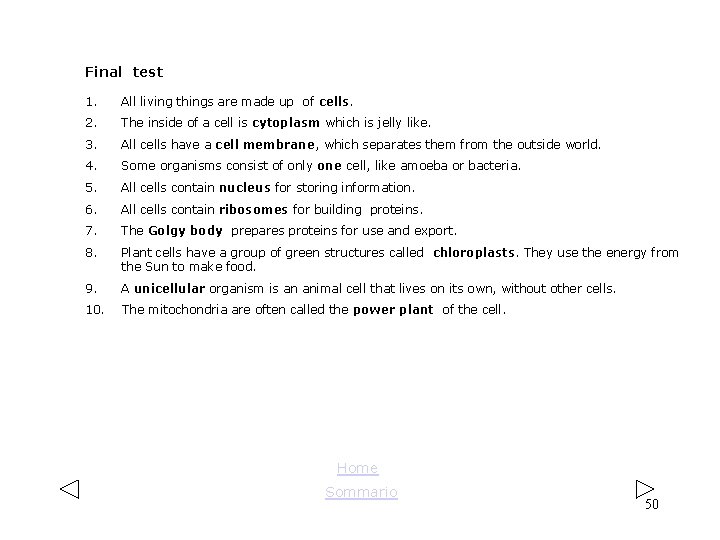
Final test Name_________ Date _______ 1. All living things are made up of_____________. 2. 3. 4. The inside of a cell is__________ which is jelly like. 5. 6. 7. 8. All cells contain __________for storing information. All cells have a _________ which separates them from the outside world. Some organisms consist of only______ __ cell, like amoeba or bacteria. All cells contain _________ for building proteins. The _________ prepares proteins for use and export. Plant cells have a group of green structures called________. They use the energy from the sun to make food. 1. A ________ organism is an animal cell that lives on its own, without other cells. 10. The mitochondria are often called the__________ of the cell. Home Sommario 37
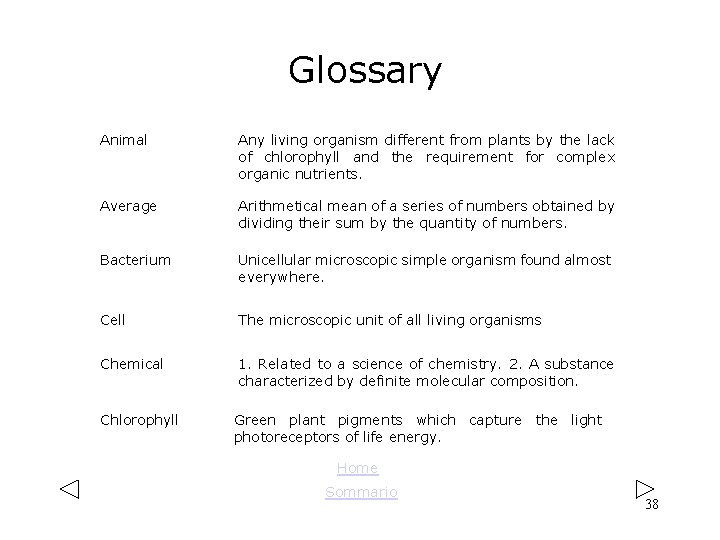
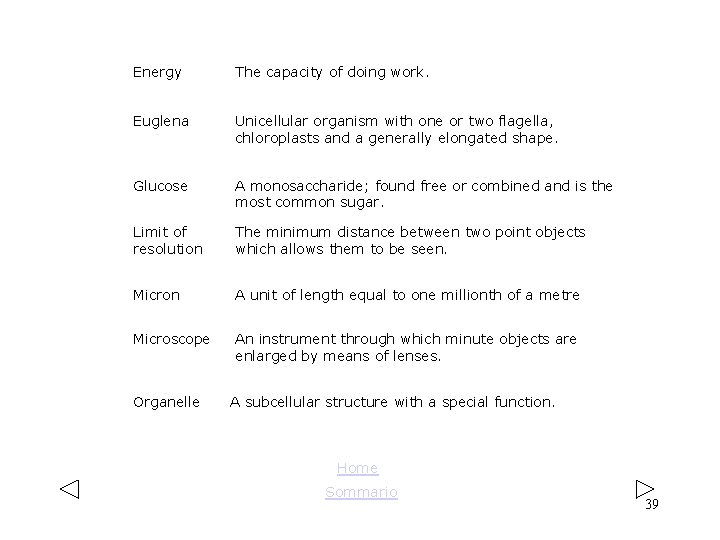
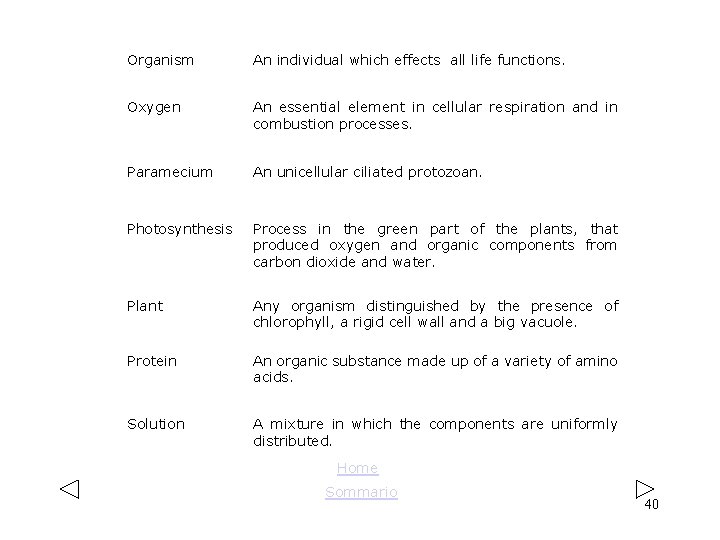
Glossary Animal Any living organism different from plants by the lack of chlorophyll and the requirement for complex organic nutrients. Average Arithmetical mean of a series of numbers obtained by dividing their sum by the quantity of numbers. Bacterium Unicellular microscopic simple organism found almost everywhere. Cell The microscopic unit of all living organisms Chemical 1. Related to a science of chemistry. 2. A substance characterized by definite molecular composition. Chlorophyll Green plant pigments which capture the light photoreceptors of life energy. Home Sommario 38
Energy The capacity of doing work. Euglena Unicellular organism with one or two flagella, chloroplasts and a generally elongated shape. Glucose A monosaccharide; found free or combined and is the most common sugar. Limit of resolution The minimum distance between two point objects which allows them to be seen. Micron A unit of length equal to one millionth of a metre Microscope An instrument through which minute objects are enlarged by means of lenses. Organelle A subcellular structure with a special function. Home Sommario 39
Organism An individual which effects all life functions. Oxygen An essential element in cellular respiration and in combustion processes. Paramecium An unicellular ciliated protozoan. Photosynthesis Process in the green part of the plants, that produced oxygen and organic components from carbon dioxide and water. Plant Any organism distinguished by the presence of chlorophyll, a rigid cell wall and a big vacuole. Protein An organic substance made up of a variety of amino acids. Solution A mixture in which the components are uniformly distributed. Home Sommario 40
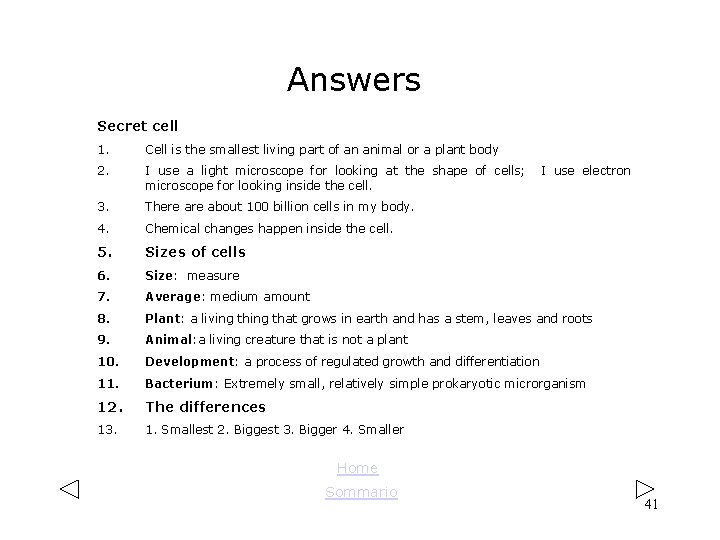
Answers Secret cell 1. Cell is the smallest living part of an animal or a plant body 2. I use a light microscope for looking at the shape of cells; I use electron microscope for looking inside the cell. 3. There about 100 billion cells in my body. 4. Chemical changes happen inside the cell. 5. Sizes of cells 6. Size: measure 7. Average: medium amount 8. Plant: a living that grows in earth and has a stem, leaves and roots 9. Animal: a living creature that is not a plant 10. Development: a process of regulated growth and differentiation 11. Bacterium: Extremely small, relatively simple prokaryotic microrganism 12. The differences 13. 1. Smallest 2. Biggest 3. Bigger 4. Smaller Home Sommario 41
What are the correct definitions? What is the range in micron to see an animal and a plant cell? between 10 and 100 What is the size order of the molecules? nanometre Which instrument do you use to see the plant cell? light microscope What is the range in nm to see the proteins? between 0, 3 and 10 Which type of instrument can you use to see the organelles better? electron microscope Relative sizes of cells A = underlined B= in bold Light microscope is an instrument for looking at the shape of cells. Electron microscope is an instrument for looking inside the cell. There are three types of cells. One example of this is bacterium. An animal cell is different from a plant cell in size and in shape. Micron is the unit of measure of cells. Home Sommario 42
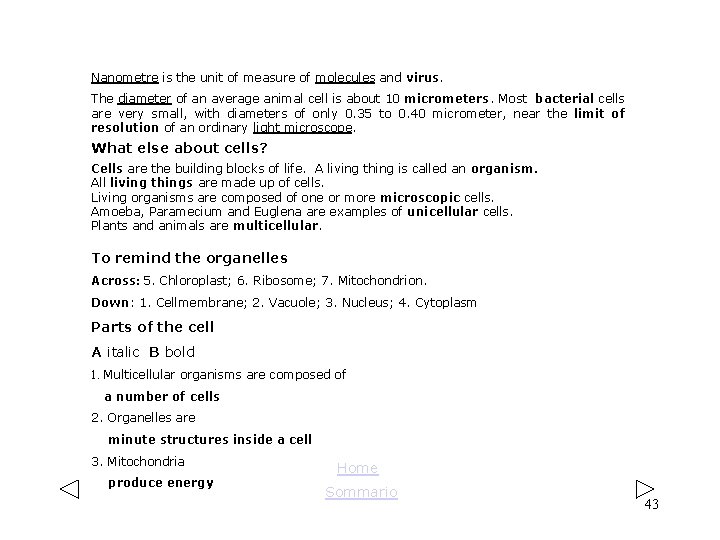
Nanometre is the unit of measure of molecules and virus. The diameter of an average animal cell is about 10 micrometers. Most bacterial cells are very small, with diameters of only 0. 35 to 0. 40 micrometer, near the limit of resolution of an ordinary light microscope. What else about cells? Cells are the building blocks of life. A living thing is called an organism. All living things are made up of cells. Living organisms are composed of one or more microscopic cells. Amoeba, Paramecium and Euglena are examples of unicellular cells. Plants and animals are multicellular. To remind the organelles Across: 5. Chloroplast; 6. Ribosome; 7. Mitochondrion. Down: 1. Cellmembrane; 2. Vacuole; 3. Nucleus; 4. Cytoplasm Parts of the cell A italic B bold 1. Multicellular organisms are composed of a number of cells 2. Organelles are minute structures inside a cell 3. Mitochondria produce energy Home Sommario 43
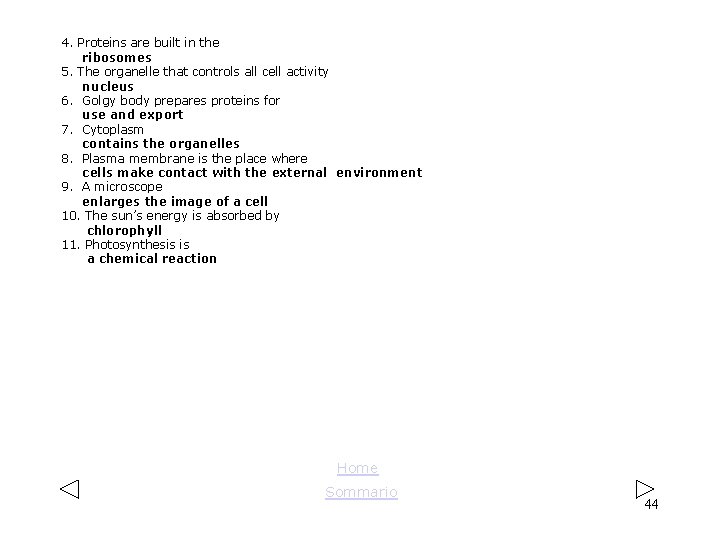
4. Proteins are built in the ribosomes 5. The organelle that controls all cell activity nucleus 6. Golgy body prepares proteins for use and export 7. Cytoplasm contains the organelles 8. Plasma membrane is the place where cells make contact with the external environment 9. A microscope enlarges the image of a cell 10. The sun’s energy is absorbed by chlorophyll 11. Photosynthesis is a chemical reaction Home Sommario 44
Similarities and differences 1. The nucleous shape is round. 12. There is a big vacuole in the plant cell. 2. It occupies a central position inside the animal cell. 3. No, because it is transparent. To see it you need colouring. 13. It contains inside a solution of water, salts and sugar. 14. They are very big in the plant cell. 15. Both cells have a cell membrane. 4. It contains DNA, the genetic material. 5. It is surrounded by endoplasmic reticulum. 6. Yes, there are mithochondria in both cells. 16. It’s located at the periphery of the cell and envelops it and contain the cytoplasm. 17. No it isn’t. The plant cell is surrounded by a wall. 7. They have got an extended shape. 18. Both cells breathe. 8. You can see some membrane foldings. 19. Plant cell produces oxygen. 9. Yes, in the plant cell there are chloroplasts. 10. They are green. 11. This is a true color for the presence of chlorophyll. 20. The plant cell produces food by itself. Because of this its name is autotrophic. 21. Golgy body is pink in the picture. 22. Yes, it is in both cells. Home Sommario 45
Comparing the plant and animal cell in common plant cell animal cell Cell Membrane Mitochondria Nucleus Cytoplasm Ribosoma Cell wall Chloroplast Vacuole What's the most complicated cell? Plant cell Departments and functions in the factory Organelle Executive department: decides what products are made Nucleus Power plant: provides energy for all process Workers: produce materials Packaging department: assembles the products Mitochondrion Factory floor: where most products are assembled, finished and shipped Cytoplasma Assembly line (where workers do their work) Endoplasmic reticulum Shipping/ Receiving department Plasma membrane Ribosomes Golgy body 46
Question loop Q 1 What simple units are all living things made of ? A 1 Cells A 25 The cell wall Q 2 What cell has a big vacuole and a cell wall? A 2 A plant cell A 1 Cells Q 3 What does chloroplast contain? A 3 It contains the pigment to adsorb light energy for photosynthesis A 2 A plant cell Q 4 What special feature does a sperm cell have? A 4 A tail to allow it to move A 3 It contains the pigment to adsorb light energy for photosynthesis Q 5 Why are root cells long and thin? A 5 To give the maximum surface area to absorb water A 4 A tail to allow it to move Q 6 What structures are made from tissues? A 6 Organs are made from tissue A 5 To give the maximum surface area to absorb water Q 7 Why do the plant cells have a cell wall? A 7 To keep its shape and support the plant A 6 Organs are made from tissue Q 8 Why are nerve cells long and thin? A 8 To carry nerve impulses around the body A 7 To keep its shape and support the plant 47
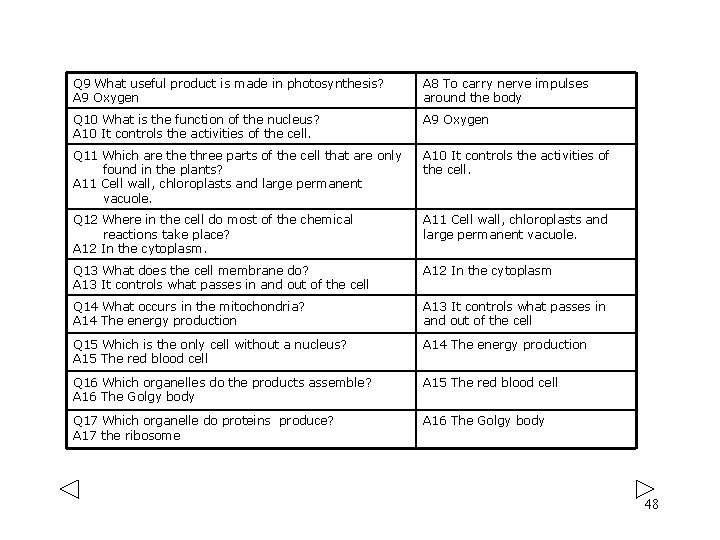
Q 9 What useful product is made in photosynthesis? A 9 Oxygen A 8 To carry nerve impulses around the body Q 10 What is the function of the nucleus? A 10 It controls the activities of the cell. A 9 Oxygen Q 11 Which are three parts of the cell that are only found in the plants? A 11 Cell wall, chloroplasts and large permanent vacuole. A 10 It controls the activities of the cell. Q 12 Where in the cell do most of the chemical reactions take place? A 12 In the cytoplasm. A 11 Cell wall, chloroplasts and large permanent vacuole. Q 13 What does the cell membrane do? A 13 It controls what passes in and out of the cell A 12 In the cytoplasm Q 14 What occurs in the mitochondria? A 14 The energy production A 13 It controls what passes in and out of the cell Q 15 Which is the only cell without a nucleus? A 15 The red blood cell A 14 The energy production Q 16 Which organelles do the products assemble? A 16 The Golgy body A 15 The red blood cell Q 17 Which organelle do proteins produce? A 17 the ribosome A 16 The Golgy body 48
Q 18 Where in the cell workers make proteins ? A 18 In the endoplasmic reticulum A 17 The ribosome Q 19 Which organelles does the sunlight use? A 19 Chloroplasts A 18 In the endoplasmic reticulum Q 20 What is the name of the heredity material in a cell? A 20 DNA A 19 Chloroplasts Q 21 Who is the first person to give the name “cell”? A 21 Robert Hook A 20 DNA Q 22 What three things does a plant need for photosynthesis? A 22 Water, carbon dioxide, light A 21 Robert Hook Q 23 A synonym of organism with many cells A 23 Multicellular organism A 22 Water, carbon dioxide, light Q 24 What is the job of lisosomes A 24 Digest, destroy and recycle materials A 23 Multicellular organism Q 25 Which part of a plant cell is made of cellulose? A 25 Cell wall A 24 Digest, destroy and recycle materials Home Sommario 49
Final test 1. All living things are made up of cells. 2. The inside of a cell is cytoplasm which is jelly like. 3. All cells have a cell membrane, which separates them from the outside world. 4. Some organisms consist of only one cell, like amoeba or bacteria. 5. All cells contain nucleus for storing information. 6. All cells contain ribosomes for building proteins. 7. The Golgy body prepares proteins for use and export. 8. Plant cells have a group of green structures called chloroplasts. They use the energy from the Sun to make food. 9. A unicellular organism is an animal cell that lives on its own, without other cells. 10. The mitochondria are often called the power plant of the cell. Home Sommario 50
Bibliography H. Kingston ( 2002) – GCSE Biology – Letts J. Martin (2003) - Biology – Cambridge Internet sites: www. emc. maricopa. edu/. . . / BIOBK/Bio. Book. CELL 2. html www. coe. uga. edu/. . . / glynn/models/cell. html www. sirinet. net/~jgjohnso/ comparingcells. html www. teach-nology. com/. . . / science/rain/venn 4/ Home Sommario 51