
I Overview II Anatomy III Physiology Autonomic Nervous
- Slides: 16
I. Overview II. Anatomy III. Physiology Autonomic Nervous System 1
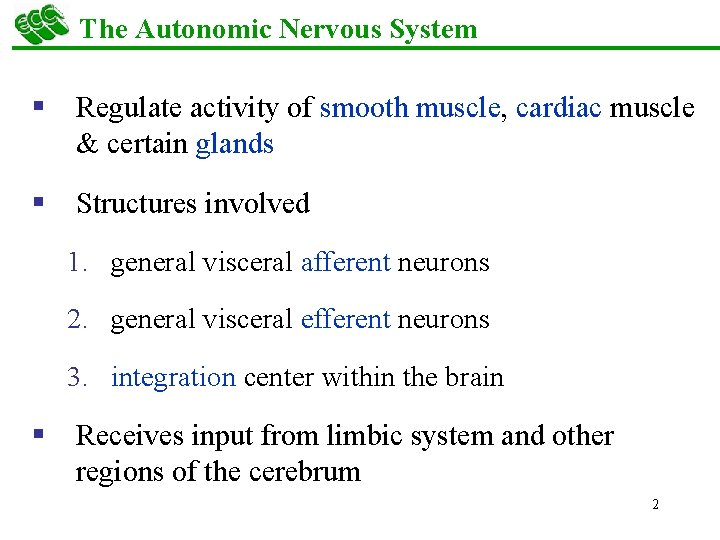
The Autonomic Nervous System § Regulate activity of smooth muscle, cardiac muscle & certain glands § Structures involved 1. general visceral afferent neurons 2. general visceral efferent neurons 3. integration center within the brain § Receives input from limbic system and other regions of the cerebrum 2
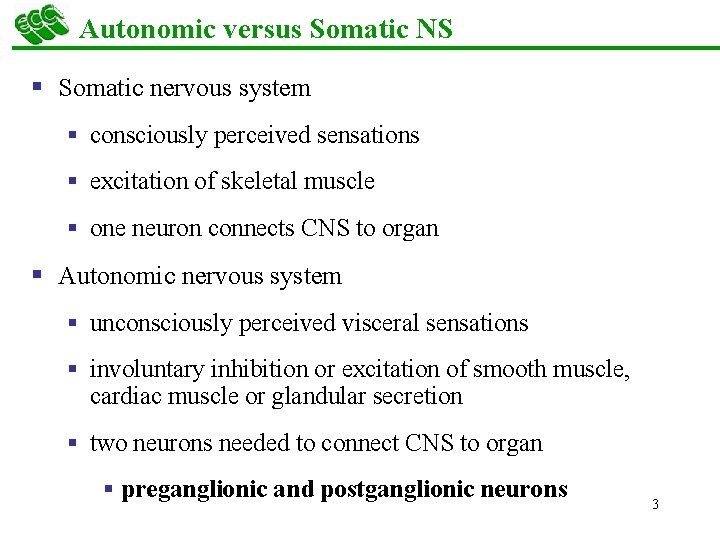
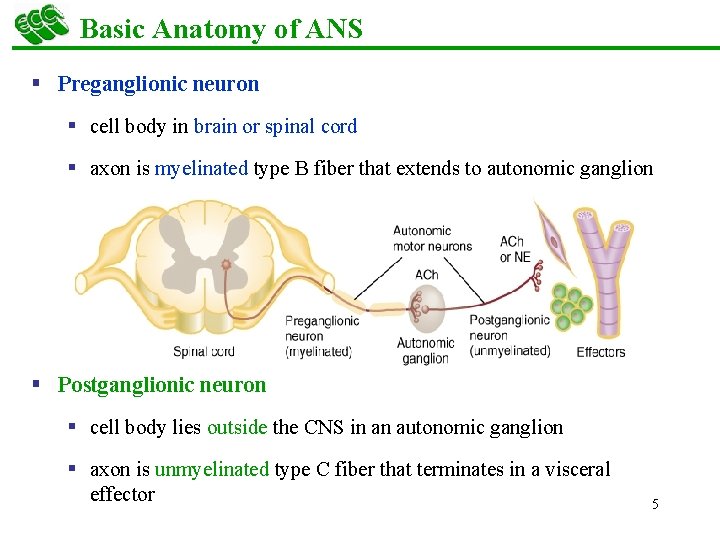
Autonomic versus Somatic NS § Somatic nervous system § consciously perceived sensations § excitation of skeletal muscle § one neuron connects CNS to organ § Autonomic nervous system § unconsciously perceived visceral sensations § involuntary inhibition or excitation of smooth muscle, cardiac muscle or glandular secretion § two neurons needed to connect CNS to organ § preganglionic and postganglionic neurons 3
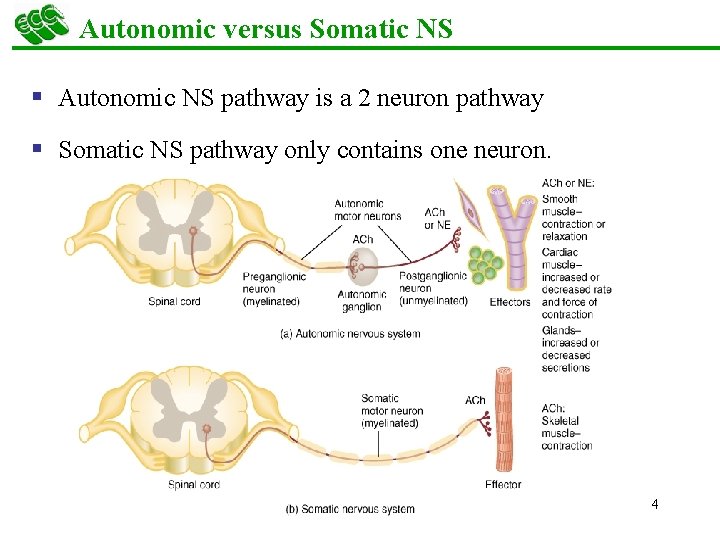
Autonomic versus Somatic NS § Autonomic NS pathway is a 2 neuron pathway § Somatic NS pathway only contains one neuron. 4
Basic Anatomy of ANS § Preganglionic neuron § cell body in brain or spinal cord § axon is myelinated type B fiber that extends to autonomic ganglion § Postganglionic neuron § cell body lies outside the CNS in an autonomic ganglion § axon is unmyelinated type C fiber that terminates in a visceral effector 5
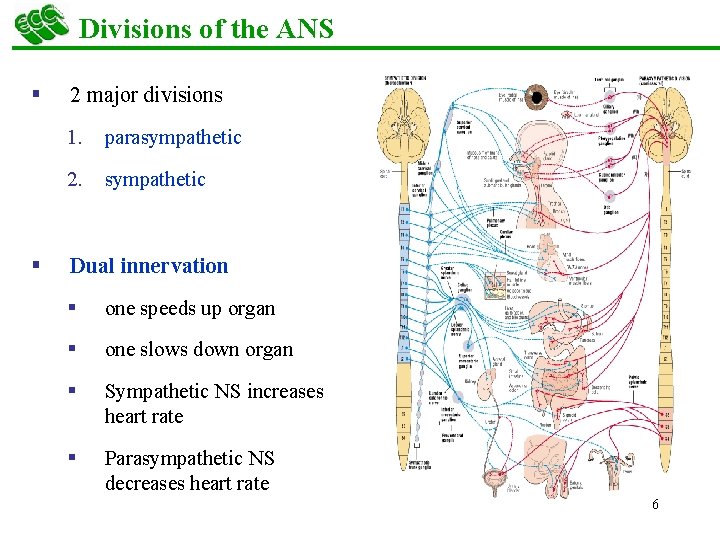
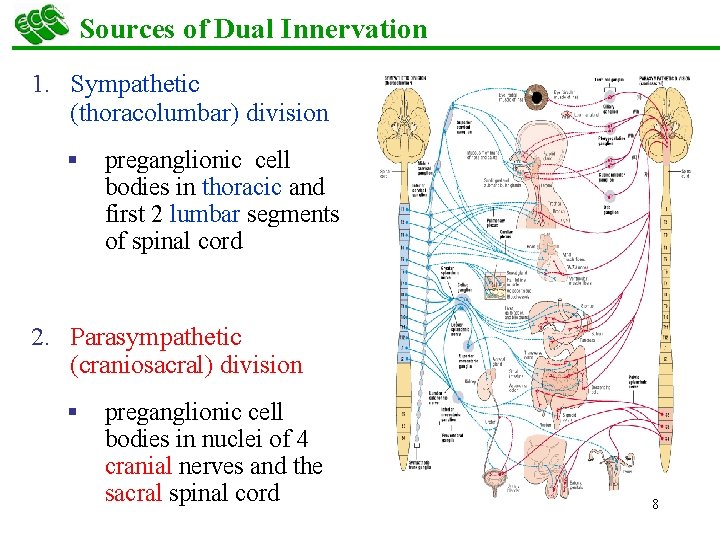
Divisions of the ANS § 2 major divisions 1. parasympathetic 2. sympathetic § Dual innervation § one speeds up organ § one slows down organ § Sympathetic NS increases heart rate § Parasympathetic NS decreases heart rate 6
I. Overview II. Anatomy A. Neurotransmitter III. Physiology Autonomic Nervous System 7
Sources of Dual Innervation 1. Sympathetic (thoracolumbar) division § preganglionic cell bodies in thoracic and first 2 lumbar segments of spinal cord 2. Parasympathetic (craniosacral) division § preganglionic cell bodies in nuclei of 4 cranial nerves and the sacral spinal cord 8
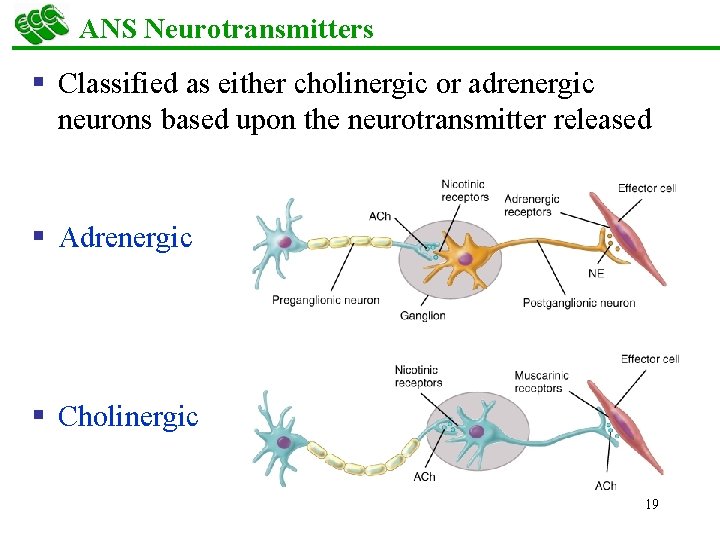
ANS Neurotransmitters § Classified as either cholinergic or adrenergic neurons based upon the neurotransmitter released § Adrenergic § Cholinergic 19
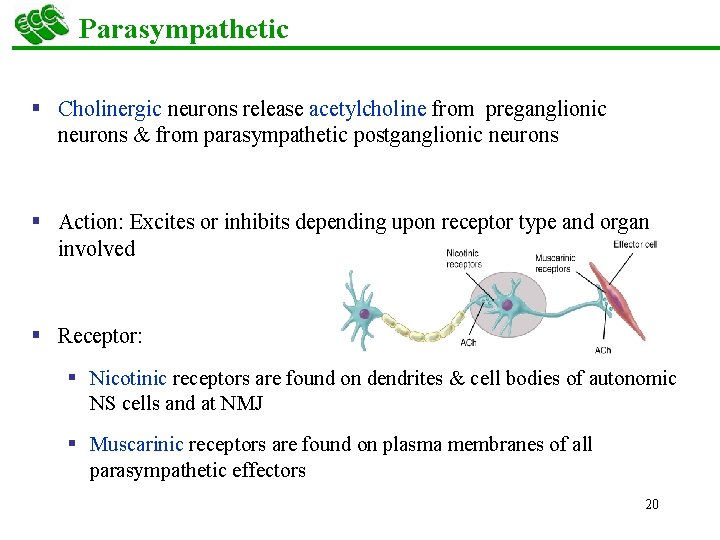
Parasympathetic § Cholinergic neurons release acetylcholine from preganglionic neurons & from parasympathetic postganglionic neurons § Action: Excites or inhibits depending upon receptor type and organ involved § Receptor: § Nicotinic receptors are found on dendrites & cell bodies of autonomic NS cells and at NMJ § Muscarinic receptors are found on plasma membranes of all parasympathetic effectors 20
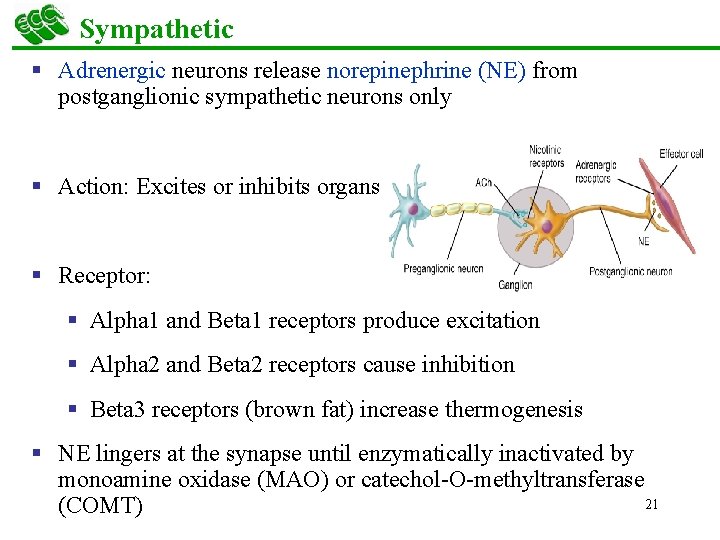
Sympathetic § Adrenergic neurons release norepinephrine (NE) from postganglionic sympathetic neurons only § Action: Excites or inhibits organs depending on receptors § Receptor: § Alpha 1 and Beta 1 receptors produce excitation § Alpha 2 and Beta 2 receptors cause inhibition § Beta 3 receptors (brown fat) increase thermogenesis § NE lingers at the synapse until enzymatically inactivated by monoamine oxidase (MAO) or catechol-O-methyltransferase 21 (COMT)
I. Overview II. Anatomy III. Physiology A. Hypothalamus B. Sympathetic C. Parasympathetic Autonomic Nervous System 22
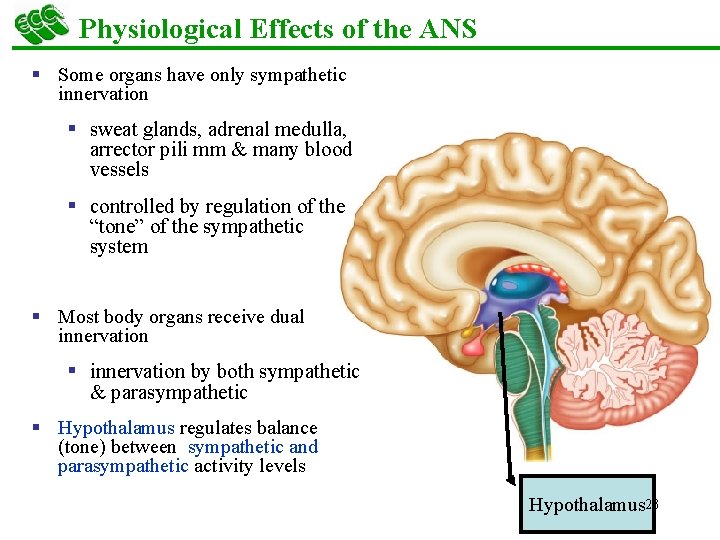
Physiological Effects of the ANS § Some organs have only sympathetic innervation § sweat glands, adrenal medulla, arrector pili mm & many blood vessels § controlled by regulation of the “tone” of the sympathetic system § Most body organs receive dual innervation § innervation by both sympathetic & parasympathetic § Hypothalamus regulates balance (tone) between sympathetic and parasympathetic activity levels Hypothalamus 23
Sympathetic Responses § Dominance by the sympathetic system is caused by physical or emotional stress -- “E situations” § emergency, embarrassment, excitement, exercise § Alarm reaction = flight or fight response § dilation of pupils § increase of heart rate, force of contraction & BP § decrease in blood flow to nonessential organs § increase in blood flow to skeletal & cardiac muscle § airways dilate & respiratory rate increases § blood glucose level increase § Long lasting due to lingering of NE in synaptic gap and release of norepinephrine by the adrenal gland 24
Parasympathetic Responses § Enhance “rest-and-digest” activities § Mechanisms that help conserve and restore body energy during times of rest § Normally dominate over sympathetic impulses § SLUDD type responses = salivation, lacrimation, urination, digestion & defecation § 3 “decreases”--- decreased HR, diameter of airways and diameter of pupil § Paradoxical fear when there is no escape route or no way to win § causes massive activation of parasympathetic division § loss of control over urination and defecation 25
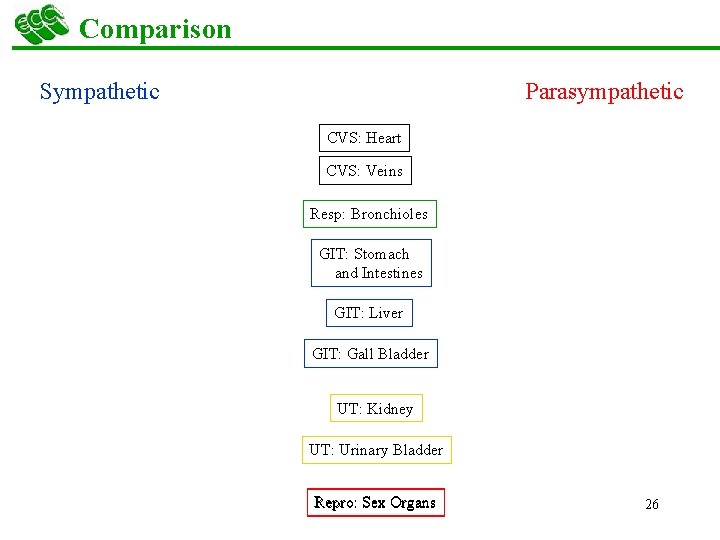
Comparison Sympathetic Increase HR Constriction Dilation Parasympathetic CVS: Heart CVS: Veins Resp: Bronchioles GIT: Stomach and Intestines GIT: Liver GIT: Gall Bladder UT: Kidney UT: Urinary Bladder Ejaculation Repro: Sex Organs Increase motility Glycogenesis Contraction Diuresis Contraction/ urination Erection 26