
I Octahedral Complexes A History 1 Crystal Field

- Slides: 14
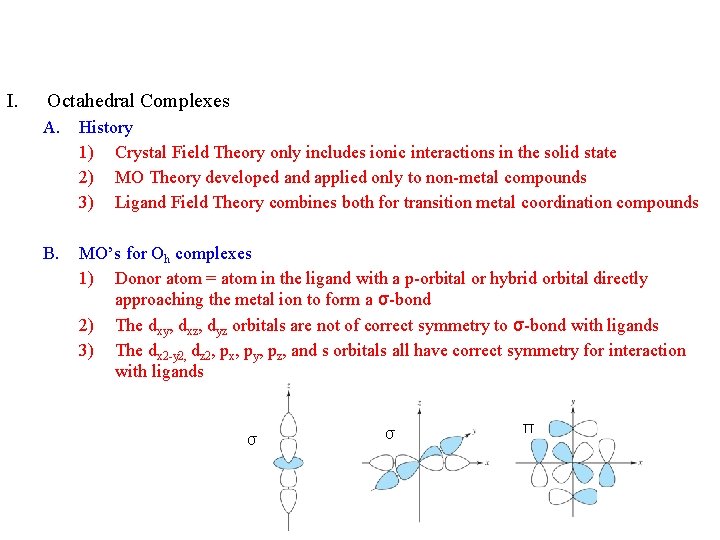
I. Octahedral Complexes A. History 1) Crystal Field Theory only includes ionic interactions in the solid state 2) MO Theory developed and applied only to non-metal compounds 3) Ligand Field Theory combines both for transition metal coordination compounds B. MO’s for Oh complexes 1) Donor atom = atom in the ligand with a p-orbital or hybrid orbital directly approaching the metal ion to form a σ-bond 2) The dxy, dxz, dyz orbitals are not of correct symmetry to σ-bond with ligands 3) The dx 2 -y 2, dz 2, px, py, pz, and s orbitals all have correct symmetry for interaction with ligands σ σ π
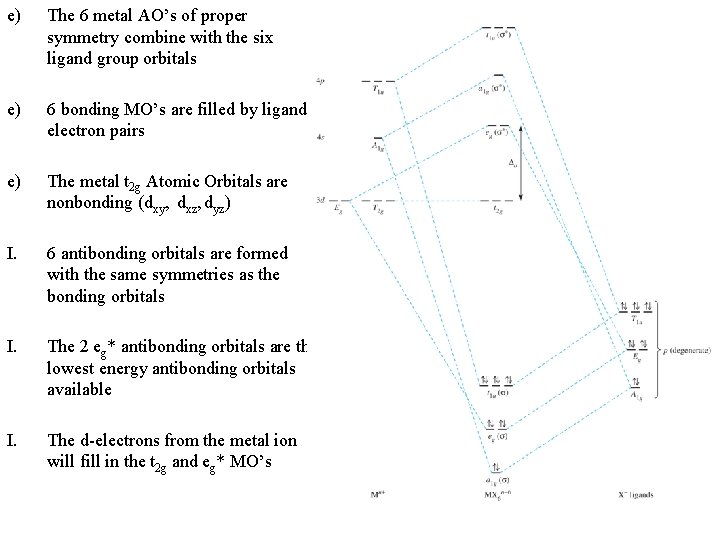
e) The 6 metal AO’s of proper symmetry combine with the six ligand group orbitals e) 6 bonding MO’s are filled by ligand electron pairs e) The metal t 2 g Atomic Orbitals are nonbonding (dxy, dxz, dyz) I. 6 antibonding orbitals are formed with the same symmetries as the bonding orbitals I. The 2 eg* antibonding orbitals are the lowest energy antibonding orbitals available I. The d-electrons from the metal ion will fill in the t 2 g and eg* MO’s
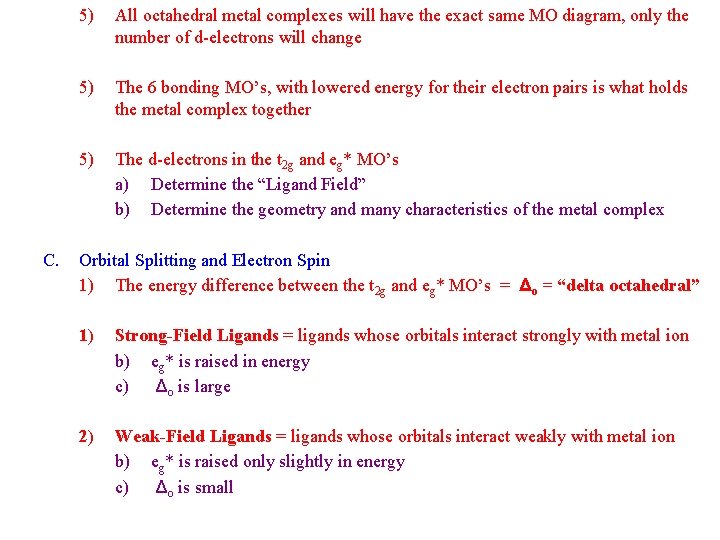
C. 5) All octahedral metal complexes will have the exact same MO diagram, only the number of d-electrons will change 5) The 6 bonding MO’s, with lowered energy for their electron pairs is what holds the metal complex together 5) The d-electrons in the t 2 g and eg* MO’s a) Determine the “Ligand Field” b) Determine the geometry and many characteristics of the metal complex Orbital Splitting and Electron Spin 1) The energy difference between the t 2 g and eg* MO’s = Δo = “delta octahedral” 1) Strong-Field Ligands = ligands whose orbitals interact strongly with metal ion b) eg* is raised in energy c) Δo is large 2) Weak-Field Ligands = ligands whose orbitals interact weakly with metal ion b) eg* is raised only slightly in energy c) Δo is small
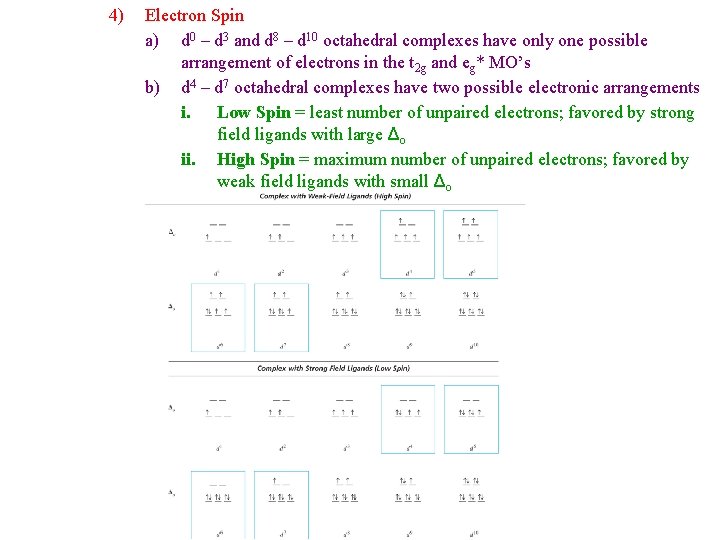
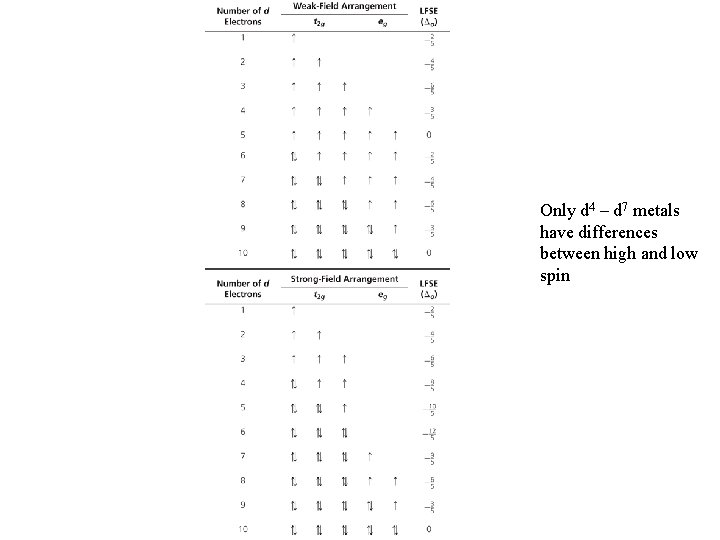
4) Electron Spin a) d 0 – d 3 and d 8 – d 10 octahedral complexes have only one possible arrangement of electrons in the t 2 g and eg* MO’s b) d 4 – d 7 octahedral complexes have two possible electronic arrangements i. Low Spin = least number of unpaired electrons; favored by strong field ligands with large Δo ii. High Spin = maximum number of unpaired electrons; favored by weak field ligands with small Δo
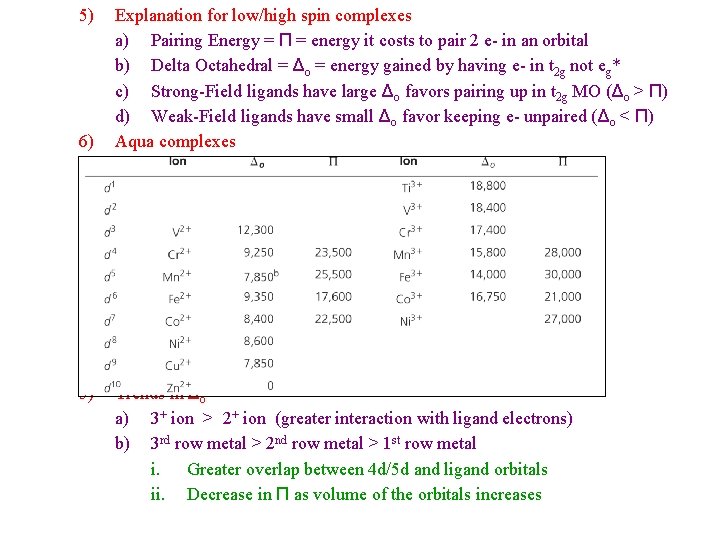
5) 6) 5) Explanation for low/high spin complexes a) Pairing Energy = Π = energy it costs to pair 2 e- in an orbital b) Delta Octahedral = Δo = energy gained by having e- in t 2 g not eg* c) Strong-Field ligands have large Δo favors pairing up in t 2 g MO (Δo > Π) d) Weak-Field ligands have small Δo favor keeping e- unpaired (Δo < Π) Aqua complexes Trends in Δo a) 3+ ion > 2+ ion (greater interaction with ligand electrons) b) 3 rd row metal > 2 nd row metal > 1 st row metal i. Greater overlap between 4 d/5 d and ligand orbitals ii. Decrease in Π as volume of the orbitals increases
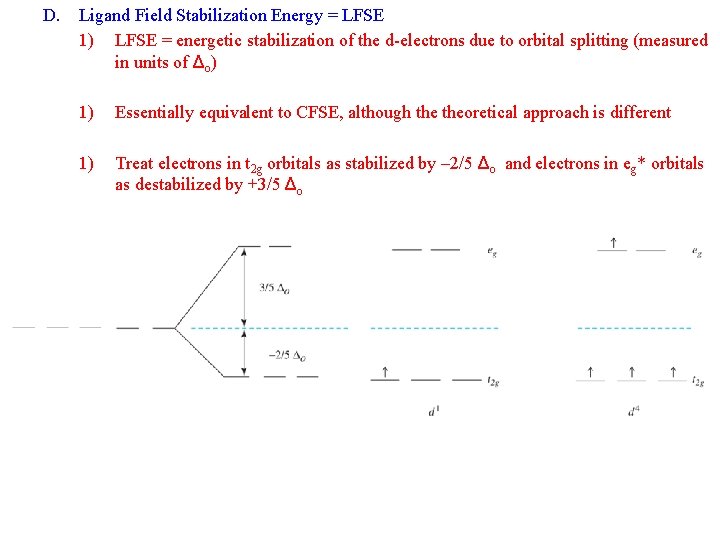
D. Ligand Field Stabilization Energy = LFSE 1) LFSE = energetic stabilization of the d-electrons due to orbital splitting (measured in units of Δo) 1) Essentially equivalent to CFSE, although theoretical approach is different 1) Treat electrons in t 2 g orbitals as stabilized by – 2/5 Δo and electrons in eg* orbitals as destabilized by +3/5 Δo
Only d 4 – d 7 metals have differences between high and low spin
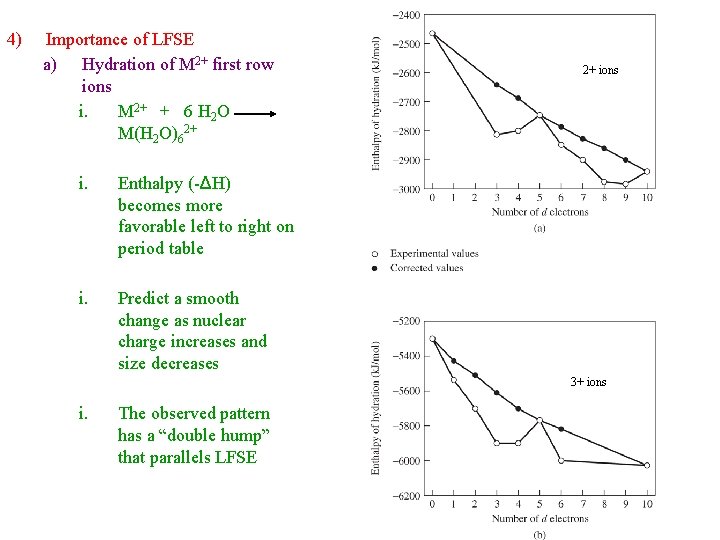
4) Importance of LFSE a) Hydration of M 2+ first row ions i. M 2+ + 6 H 2 O M(H 2 O)62+ i. Enthalpy (-ΔH) becomes more favorable left to right on period table i. Predict a smooth change as nuclear charge increases and size decreases 2+ ions 3+ ions i. The observed pattern has a “double hump” that parallels LFSE
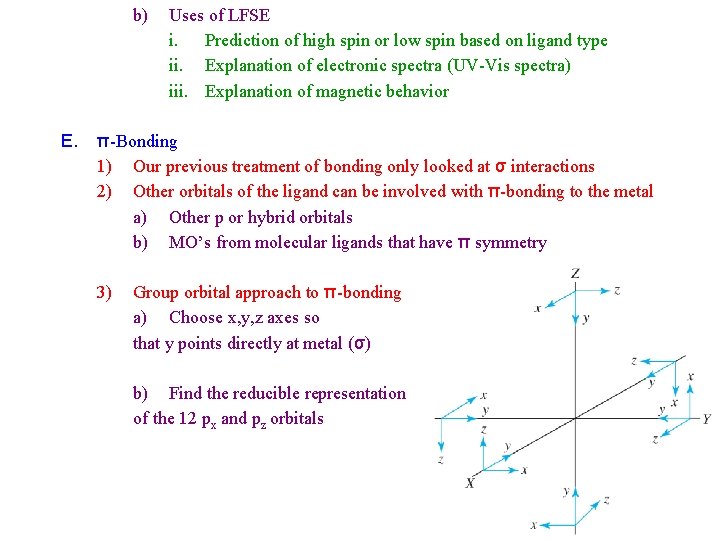
b) E. Uses of LFSE i. Prediction of high spin or low spin based on ligand type ii. Explanation of electronic spectra (UV-Vis spectra) iii. Explanation of magnetic behavior π-Bonding 1) Our previous treatment of bonding only looked at σ interactions 2) Other orbitals of the ligand can be involved with π-bonding to the metal a) Other p or hybrid orbitals b) MO’s from molecular ligands that have π symmetry 3) Group orbital approach to π-bonding a) Choose x, y, z axes so that y points directly at metal (σ) b) Find the reducible representation of the 12 px and pz orbitals
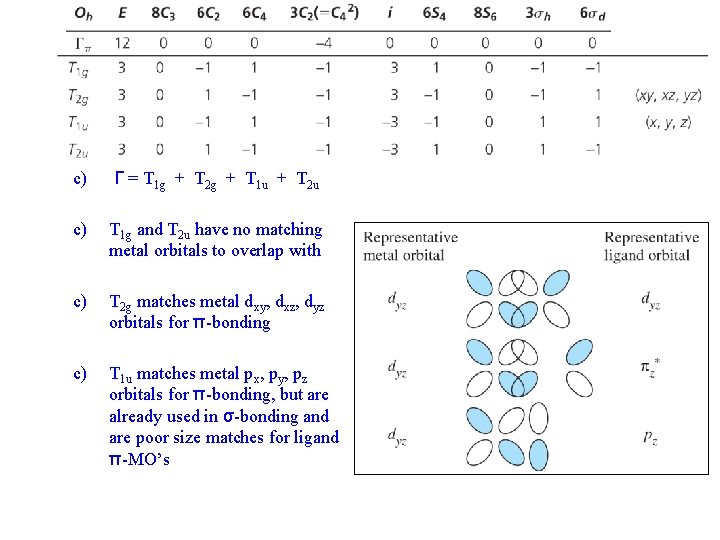
c) Γ = T 1 g + T 2 g + T 1 u + T 2 u c) T 1 g and T 2 u have no matching metal orbitals to overlap with c) T 2 g matches metal dxy, dxz, dyz orbitals for π-bonding c) T 1 u matches metal px, py, pz orbitals for π-bonding, but are already used in σ-bonding and are poor size matches for ligand π-MO’s
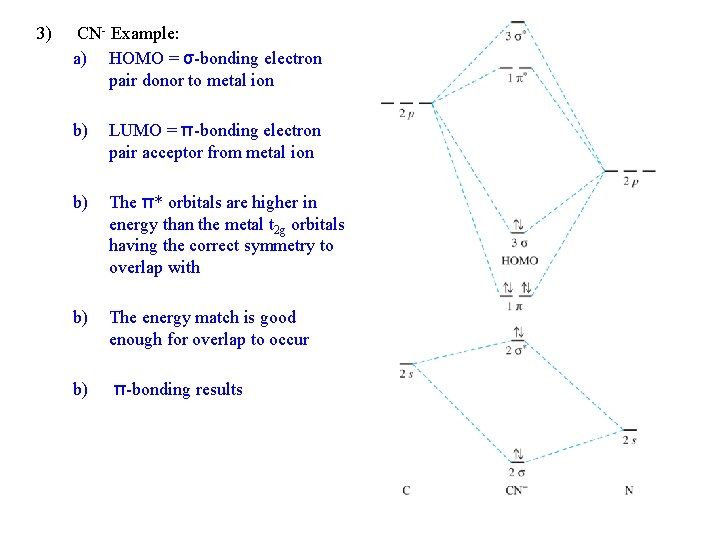
3) CN- Example: a) HOMO = σ-bonding electron pair donor to metal ion b) LUMO = π-bonding electron pair acceptor from metal ion b) The π* orbitals are higher in energy than the metal t 2 g orbitals having the correct symmetry to overlap with b) The energy match is good enough for overlap to occur b) π-bonding results
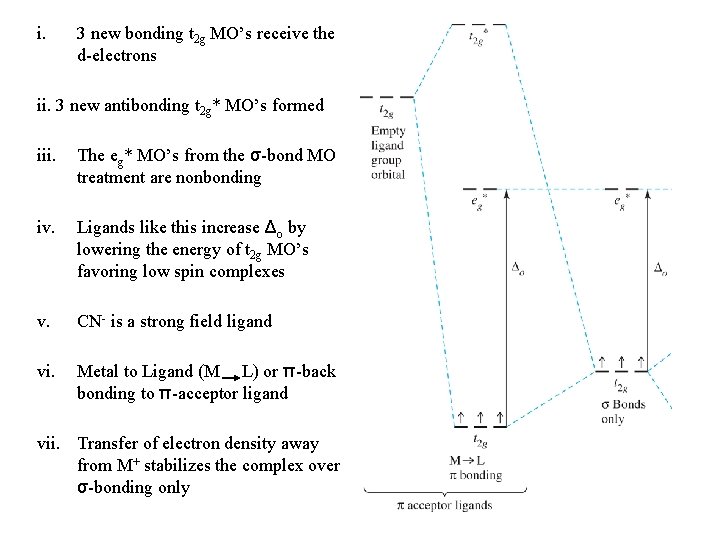
i. 3 new bonding t 2 g MO’s receive the d-electrons ii. 3 new antibonding t 2 g* MO’s formed iii. The eg* MO’s from the σ-bond MO treatment are nonbonding iv. Ligands like this increase Δo by lowering the energy of t 2 g MO’s favoring low spin complexes v. CN- is a strong field ligand vi. Metal to Ligand (M L) or π-back bonding to π-acceptor ligand vii. Transfer of electron density away from M+ stabilizes the complex over σ-bonding only
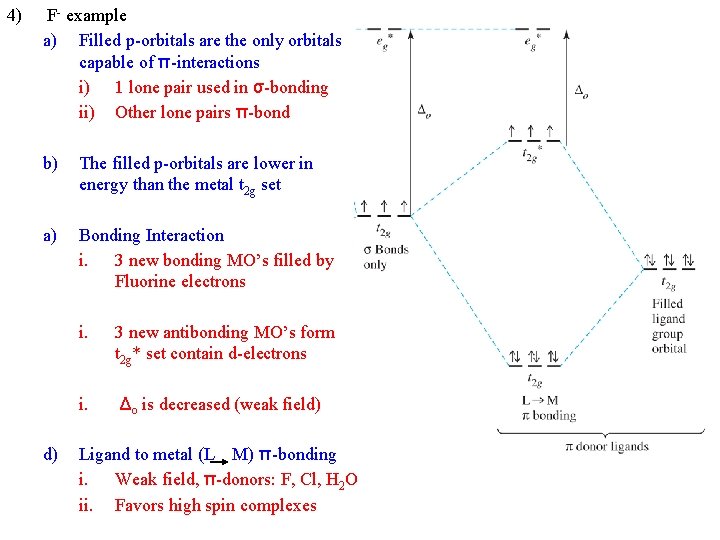
4) F- example a) Filled p-orbitals are the only orbitals capable of π-interactions i) 1 lone pair used in σ-bonding ii) Other lone pairs π-bond b) The filled p-orbitals are lower in energy than the metal t 2 g set a) Bonding Interaction i. 3 new bonding MO’s filled by Fluorine electrons d) i. 3 new antibonding MO’s form t 2 g* set contain d-electrons i. Δo is decreased (weak field) Ligand to metal (L M) π-bonding i. Weak field, π-donors: F, Cl, H 2 O ii. Favors high spin complexes